

Key Takeaways
- Yavapai County ranks fourth-highest in Arizona for opioid misuse, and nearly a third of Arizona substance use clients carry a co-occurring serious mental illness 1, 6.
- Truly integrated care means one team, one intake, one record, and one treatment plan — not a substance program and a psychiatrist working in separate buildings 5.
- Rural distance, small-town stigma, and polysubstance patterns like fentanyl combined with methamphetamine are clinical variables Prescott programs must address directly, not treat as background 7, 8.
- Before committing, compare staffing depth, whether psychiatrist and therapist share one record, medication continuity policies, ADHS licensing, and how aftercare is scheduled prior to discharge 4, 11.
What You’re Actually Up Against in Yavapai County
If you’re reading this, you probably already know the terrain. Not just the pine ridges and the switchback down Highway 69, but the harder terrain: the run of appointments, discharges, relapses, and the quiet stretch of days when you wonder whether anyone in the system is actually looking at the whole picture.
Here’s the honest local frame. In the Quad Cities area — Prescott, Prescott Valley, Chino Valley, and Dewey-Humboldt — community members themselves named drug addiction as the number one perceived health issue, and Yavapai County ranked fourth-highest in Arizona for opioid misuse 6. The Community Health Improvement Plan set a public target of reducing the drug-induced death rate from 26.7 per 100,000 down to 20 per 100,000 6. That number is not an abstraction. It is neighbors, coworkers, kids from the same high schools.
What that means for you, practically, is this: dual diagnosis care in Prescott sits inside a community that already recognizes addiction and mental illness as intertwined and urgent. That is a strange kind of good news. You are not fighting to be believed about the scale of the problem. Local public health has already said it out loud.
What it does not mean is that integrated care is automatic here. Being ranked high for opioid misuse and having a stated overdose-reduction target tells you the demand exists. It does not tell you whether the program down the road treats your depression, your PTSD, and your opioid use as one clinical picture — or as three separate problems that get handed off between people who never quite talk to each other.
The rest of this guide is about telling the difference.
How Co-Occurring Illness Actually Shows Up Here
The Scale of Co-Occurrence in Arizona’s Treatment System
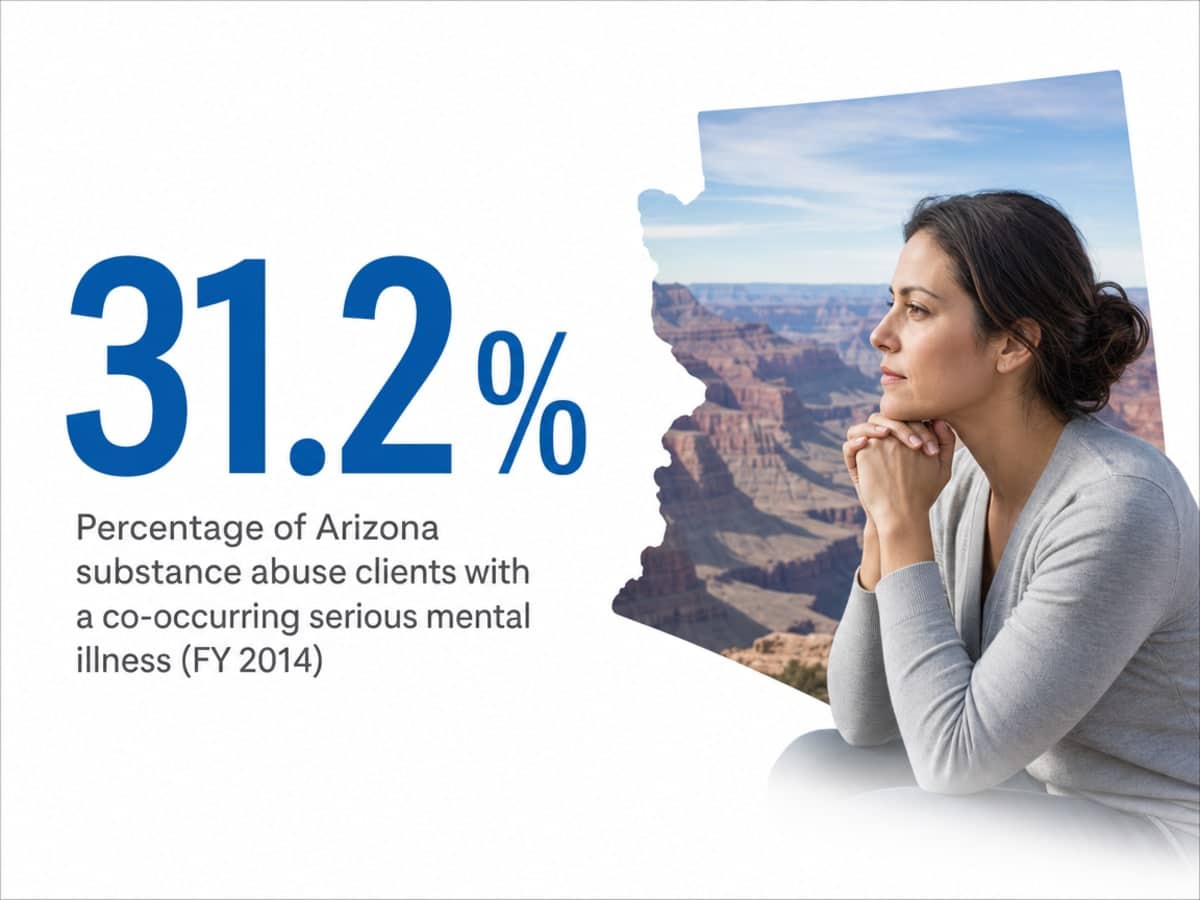
You’ve probably suspected this already, but the state’s own numbers back it up. In FY 2014, 22.1% of Arizona’s substance abuse clients carried a co-occurring general mental health diagnosis, and 31.2% had a serious mental illness on top of a substance use disorder 1. Read that again: nearly a third of the people walking into Arizona substance abuse treatment weren’t dealing with addiction alone. They were carrying schizophrenia, bipolar disorder, severe PTSD, or major depression at the same time.
That proportion matters for how you interpret your own experience. If you’ve felt like standard rehab kept missing something — like the depression got worse three weeks in, or the paranoia flared once the substances cleared — you weren’t a rare edge case. You were part of the majority pattern for anyone showing up with both conditions.
And yet the historical response has been to treat those two columns as if they belonged to different departments. One team handles the substance side. Another team, sometimes months later, handles the psychiatric side. The two rarely sit at the same table.
Fentanyl, Meth, and the End of Single-Substance Thinking
The addiction of ten years ago is not the addiction most people in Yavapai County are dealing with today. National overdose data from the CDC shows a sharp rise in deaths involving both fentanyl and stimulants like methamphetamine — a polysubstance pattern that has become one of the defining features of the current crisis 8. People aren’t just using one thing. They’re using fentanyl and meth, sometimes knowingly, sometimes because the supply is contaminated.
That shift changes what dual diagnosis care has to do. A program built around a single-substance model — alcohol only, opioids only — will keep missing the actual clinical picture in front of it. Withdrawal looks different. Cravings look different. The psychiatric overlay looks different too: meth-related psychosis and opioid-related depression can coexist in the same person, in the same week.
If you’re a family member trying to make sense of a loved one’s crashes, this is often the piece that hasn’t been named out loud. It isn’t a lack of willpower that made the last program not stick. It’s that treating the opioid use without treating the stimulant use — and without treating the mood or thought disorder underneath both — leaves too many exposed edges.
What you should hear from a program worth your trust: a straightforward acknowledgement that polysubstance use is the working assumption, and that psychiatric symptoms will be assessed both during and after stabilization, not just when the strongest substance clears.
Why Rural Distance Is a Clinical Variable, Not a Backdrop
The drive from Prescott to a Phoenix specialty program is not just an inconvenience. It’s a clinical fact that shapes whether care sticks. Rural residents with co-occurring disorders face longer travel distances, fewer specialty providers, and higher stigma in small communities, and those pressures push people out of care earlier than they should leave 7. If your therapist is ninety minutes away, you’ll miss appointments. If your prescriber is two hours away and books six weeks out, medication changes stall.
Rurality also shows up in penetration rates. The Arizona Center for Rural Health’s review estimated that around 20 percent of rural residents struggle with significant substance dependence, mental illness, or medical-psychiatric comorbid conditions, and it flagged that rural service capacity does not keep up with that estimated need 3. Translation: the demand is here. The seats, hours, and specialists have not always been.
There’s a small-town layer too. In Prescott and the surrounding Quad Cities, you may run into your counselor at the grocery store or share a pew with someone from group. That can be uncomfortable. It can also make people avoid care they need because they don’t want to be seen walking into a building. A good local program will name this openly and offer scheduling, telehealth, or discretion options so the fear of being recognized doesn’t become another reason to stop showing up.
Distance is not a backdrop. Ask how the program handles it.
What Integrated Care Actually Means (and What It Doesn’t)
The SAMHSA Definition in Plain Terms
Here’s the sentence worth memorizing before you evaluate any program. SAMHSA’s evidence-based guide defines integrated treatment as care in which“the same clinicians or teams provide both mental health and substance use interventions,”and it flags this model as producing better outcomes than non-integrated approaches for people with co-occurring disorders 5. Same clinicians. Same team. Not two buildings, two intakes, and two treatment plans that never quite meet.
Strip the acronyms away and it looks like this in daily life. When you walk in, one intake screens for both conditions at once, not just the one you led with. Your psychiatrist and your therapist know each other’s names and read each other’s notes. Medication decisions account for your substance history. Substance use groups account for your psychiatric symptoms. When something shifts — a new craving pattern, a rough week with intrusive memories, a med side effect — one team hears about it and adjusts one plan.
SAMHSA also treats routine screening for co-occurring disorders in every behavioral health setting as a baseline expectation, not a specialty add-on 5. That’s a small detail with big consequences. It means a program running integrated care should be screening you for depression, trauma, and psychosis even if you came in for opioids, and screening you for substance use even if you came in for bipolar disorder.
If that sounds obvious, it should. And yet most systems still don’t work this way. Which is why the definition matters — it gives you something specific to ask about.
Parallel Care, Sequential Care, and Why They Keep Failing You
Parallel care is when both conditions get treated, but by different people, in different buildings, on different schedules. Your rehab handles the substance use. Your outpatient psychiatrist handles the meds. A therapist somewhere handles the trauma. Nobody has the full chart. Sequential care is worse: get sober first, then we’ll deal with the psychiatric piece. Or get psychiatrically stable first, then we’ll address the drinking. Either way, one condition sits untreated while the other gets attention — and the untreated one usually drags the treated one back down.
The evidence on why this keeps failing is not subtle. An integrative review of treatment access for co-occurring disorders found that most systems still deliver parallel or sequential care despite evidence favoring integrated treatment, and that people with co-occurring conditions face both personal barriers like stigma and structural barriers like fragmented systems and provider shortages 2. The review also noted that co-occurring patients tend to use more services and have worse outcomes when their care stays split 2.
If you’ve done treatment before and it didn’t hold, this is often the reason nobody named for you. It wasn’t that you didn’t try hard enough. It was that the depression got worse in week three and the rehab didn’t have a psychiatrist on staff to adjust anything. Or the psych hospital stabilized the mania and discharged you back to the same drinking pattern with a referral list. Or the two providers had you sign releases and then never actually called each other.
That gap between systems is where relapses live. Naming it is the first step to picking a program that closes it.
How to Tell an Integrated Program from a Rebranded One
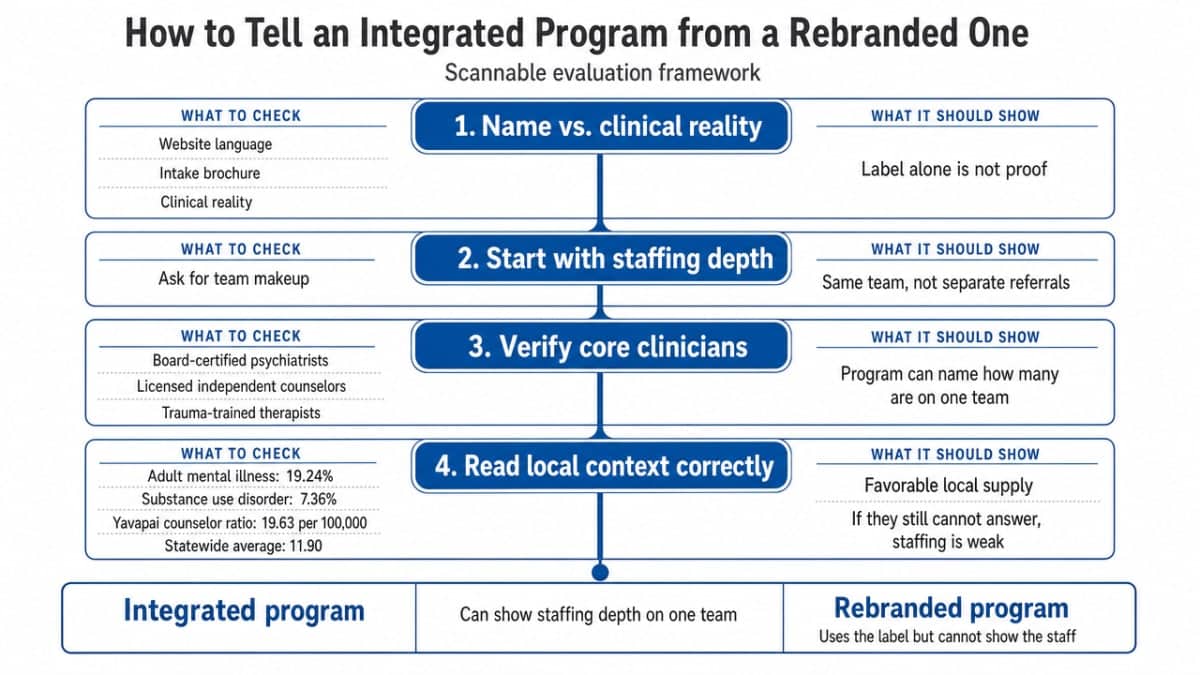
A lot of programs call themselves “dual diagnosis” now. The word is on the website. The word is in the intake brochure. That doesn’t mean the clinical reality behind it has changed. Here’s how you check.
Start with staffing depth, because that’s where the fraud tends to show. Arizona’s behavioral health workforce report puts adult prevalence at 19.24% for any mental illness and 7.36% for substance use disorder in the prior year, and it clocks Yavapai County’s substance abuse counselor ratio at 19.63 per 100,000 residents — the high end of the state, well above the statewide average of 11.90 4. That’s actually a favorable local number. It also means that if a program can’t tell you how many board-certified psychiatrists, licensed independent counselors, and trauma-trained therapists sit on the same team, they don’t have the staff to run integrated care regardless of what the brochure says. Ask for the roster. Ask who is full-time. Ask who is a subcontractor who drives in once a week.
Then look for four specific things in how the program actually operates.
- One intake that screens for both conditions at once — not a substance intake followed weeks later by a psych consult.
- One treatment plan with both diagnoses on it, updated together.
- One record your psychiatrist and your therapist both write in and both read.
- One team meeting where your case gets discussed with both sides in the room.
If a program can’t describe those four things in concrete detail — who meets, how often, what happens when your meds shift mid-treatment — you’re looking at parallel care with a new label. That’s not a small distinction. It’s the difference between the model SAMHSA’s evidence supports and the model that has quietly failed people for decades.
One more test. Ask what happens on a Tuesday afternoon when your cravings spike and your intrusive memories are loud on the same day. In an integrated program, one person you already know picks up. In a rebranded one, you get two phone numbers.
What the First 30 to 90 Days Should Look Like
Intake, Screening, and Psychiatric Stabilization
The first week should feel different from anything you’ve done before. Not because it’s dramatic, but because nobody is asking you to tell your story in halves.
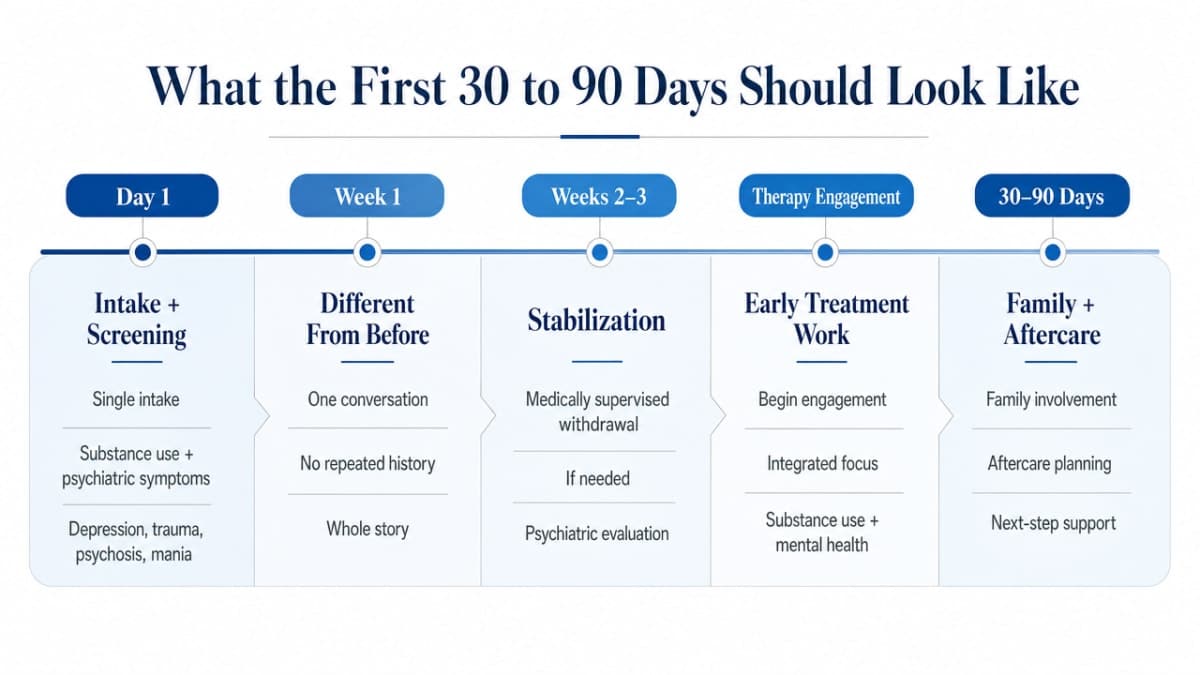
Day one, expect a single intake that screens for both substance use and psychiatric symptoms in the same conversation — depression, trauma, psychosis, mania, and whatever brought you in on the substance side. SAMHSA treats that kind of routine co-occurring screening as the baseline, not an optional add-on 5. If you find yourself telling the substance history to one person and repeating the psychiatric history to someone else three days later, that’s a warning sign, not a normal onboarding step.
The first two to three weeks are usually about stabilization. Medically supervised withdrawal if you need it. A psychiatric evaluation that actually accounts for what substances were on board and what symptoms remain once they clear. Medications get started or adjusted, sometimes more than once, because it takes time to tell what’s withdrawal, what’s baseline illness, and what’s a side effect.
Expect ambiguity in this window. Sleep may be rough. Mood may swing. That doesn’t mean the plan is failing. It means the team has enough information to start making real decisions. If you make it to week two still in the building, still talking, that counts. Say so out loud.
Therapy Engagement, Family Involvement, and Aftercare
Once the psychiatric picture steadies, therapy stops being an intake formality and starts doing actual work. Individual sessions begin looking at the pieces that substances were covering — trauma memories, grief, the reasons a particular pattern kept coming back. Group work runs alongside it. In an integrated program, the group facilitator knows your psychiatric diagnosis and adjusts, so you’re not asked to white-knuckle a confrontational format that will spike your PTSD symptoms.
Family involvement usually enters around weeks three to six, once you have some footing. Good programs invite family in on your terms, with clear releases, and use the sessions to teach everyone the same language about what co-occurring illness actually is. This matters more in Prescott than in a bigger city, because the people around you may share the same schools, churches, and grocery aisles. Small-community stigma is a documented barrier to sustained care in rural settings 7. Naming it early makes it smaller.
Aftercare planning should start weeks before discharge, not the day of. Expect a written plan with named providers, medication continuity, a relapse response, and a first outpatient appointment already on the calendar. If you told your full trauma history once without falling apart, if a medication finally fits — those are the wins to hold onto going out the door.
Questions to Ask Any Prescott Program Before You Commit
Bring a short list to the phone call or the tour. You don’t need to be clinical about it. You just need answers specific enough that a rebranded program can’t slide past them.
Start with team structure. Who exactly will be on my treatment team, and are the psychiatrist and therapist employed by the same program? Ask how often they meet about your case and whether they share one record. If the answer involves outside referrals or subcontractors who “coordinate,” you’re likely looking at parallel care 2.
Move to screening. On day one, will one intake screen for both substance use and psychiatric symptoms, including trauma and psychosis? That single-intake baseline is what SAMHSA identifies as the entry point for real integrated treatment 5.
Ask about polysubstance and medication reality. How does the program handle fentanyl combined with methamphetamine, and can I stay on my psychiatric medications during treatment? A program that hesitates on either question is not built for the current clinical picture 8.
Ask about length of stay. Is the treatment duration set by my clinical progress or by what insurance authorizes? Both are real constraints. You want a program willing to name that tension directly rather than pretend it doesn’t exist.
Ask about credentialing. Is the facility Arizona ADHS licensed, and are the independent clinicians licensed through the Arizona Board of Behavioral Health Examiners 11? You’re not auditing paperwork. You’re checking that the people making decisions about your care meet the state’s actual standard.
Ask about the small-town piece. If I run into my counselor at Safeway, what’s the plan? A good clinician has already thought about it and will say so plainly 10.
Finally, ask what aftercare looks like the week you’re discharged — named provider, first appointment on the calendar, medication continuity, a written relapse response. If the answer is a printed list of phone numbers, keep looking. You’ve earned better than that.
For Referring Clinicians and Case Managers
A quick audience shift here — this section is for the case managers, primary care providers, probation officers, and outpatient therapists routing patients toward dual diagnosis care in Yavapai County. Everything upstream still applies. The referral criteria just look different from the receiving side.
When you’re deciding where to send a co-occurring patient, the fragmentation problem is what tends to undo your work. The integrative review on co-occurring access barriers found that most systems still deliver parallel or sequential care despite evidence favoring integrated models, and that patients with both conditions accumulate more service touches while landing worse outcomes when their care stays split 2. Your referral is often the pivot point where that pattern either continues or breaks.
Three things worth confirming before you send a warm handoff.
- Does the receiving program run one intake that screens for psychiatric and substance use symptoms together, consistent with SAMHSA’s baseline expectation 5?
- Is the psychiatrist on staff, not a contracted consult who reads notes after the fact?
- Will they accept your existing psychiatric medication plan and titrate collaboratively rather than washing everything out on admission?
One more practical note. Ask what discharge communication looks like back to you. A written summary, a medication list, and a named contact for the first two weeks post-discharge is the minimum. If a program can’t commit to that, your patient is likely to land back in your office without context — and that’s where continuity breaks.
Find Out If Integrated Dual Diagnosis Care Fits
Get expert input on your unique treatment needs and next steps—right here in Prescott.
Frequently Asked Questions
How do I know if I actually need dual diagnosis treatment instead of regular rehab or a psychiatrist?
If a psychiatric symptom keeps returning when you use, or the substance use flares whenever a mood or trauma symptom spikes, the two are already linked clinically. Standard rehab often lacks a psychiatrist on staff, and outpatient psychiatry rarely manages active substance use. Integrated care treats them as one picture from day one 5.
Does insurance or AHCCCS cover dual diagnosis treatment in Prescott?
Most commercial plans and AHCCCS do cover integrated care, though coverage details and authorized length of stay vary. Ask the program directly: which plans are in-network, what level of care is authorized, and what happens clinically if insurance stops authorizing days before you’re ready. A program willing to name that tension straight is a better sign than one that avoids it.
Do I have to travel to Phoenix, or can I get integrated care locally in Yavapai County?
You can often get it locally. Yavapai County’s substance abuse counselor supply is actually strong for a rural county, and integrated programs do operate here. What matters is not the zip code but whether the psychiatrist and therapist sit on the same team. If a Prescott program can meet that bar, staying local usually protects continuity better than a ninety-minute commute to Phoenix.
What if I’ve been through treatment before and it didn’t hold?
That isn’t a character flaw. Research on co-occurring disorders shows most systems still deliver parallel or sequential care, and patients cycle through more services with worse outcomes when treatment stays split 2. If your last program treated the substance side without adjusting your psychiatric care, or vice versa, the gap was structural. A truly integrated program is a different clinical experience, not the same one repeated.
Can I stay on my psychiatric medications while in substance use treatment?
In an integrated program, yes — that’s the whole point. A board-certified psychiatrist reviews your current regimen, coordinates with the substance use side, and titrates as needed rather than washing everything out on admission. If a program tells you to stop all psychiatric medications at intake without a clinical reason, treat that as a signal the model isn’t actually integrated.
How can family members be involved without violating privacy or crossing lines in a small community?
Signed releases set the boundaries, and good clinicians already think carefully about dual-relationship risks in small towns 10. Family sessions happen on your terms, with clear agreements about what is shared. Ask the program how they handle Prescott’s overlap — shared schools, churches, workplaces — and whether family education runs separately from your individual therapy. Both matter.
References
- Underserved Arizonans: Mental Health and Developmental Disabilities. https://addpc.az.gov/sites/default/files/media/Underserved%20Arizonans_Mental%20Health%20and%20Developmental%20Disabilities_2.pdf
- Treatment Access Barriers and Disparities Among Individuals with Co-occurring Mental Health and Substance Use Disorders: An Integrative Literature Review. https://pmc.ncbi.nlm.nih.gov/articles/PMC4695242/
- On the Edge: Building an Inclusive System of Care in Rural Arizona (Rural Behavioral Health Review). https://crh.arizona.edu/sites/default/files/2022-04/2011_RuralBehavioralHealthReview.pdf
- The Arizona Behavioral Health Workforce (Center for Rural Health, University of Arizona). https://crh.arizona.edu/sites/default/files/2022-03/20210702_AZ_BH_WorkforceReport_FINAL_0.pdf
- Substance Use Disorder Treatment for People with Co-Occurring Disorders (SAMHSA Evidence-Based Resource Guide). https://library.samhsa.gov/sites/default/files/pep20-06-04-001.pdf
- Quad Cities Community Health Improvement Plan (CHIP) – Yavapai County. https://www.yavapaiaz.gov/files/sharedassets/public/v/1/resident-services/community-health/documents/quad-cities-chip.pdf
- Co-Occurring Mental Health and Substance Use Disorders in Rural Communities. https://www.ncbi.nlm.nih.gov/pmc/articles/PMC7821926/
- Drug Overdose Deaths Involving Fentanyl, Methamphetamine, and Cocaine — United States, 2016–2021. https://www.cdc.gov/mmwr/volumes/72/wr/pdfs/mm7249a2-H.pdf
- Arizona Revised Statutes § 32-3274 – Licensure by endorsement. https://www.azleg.gov/ars/32/03274.htm
- Arizona Revised Statutes § 32-3251. https://www.azleg.gov/ars/32/03251.htm
- Applying for Licensure. https://bbhe.az.gov/applying-licensure