

Key Takeaways
- Partial hospitalization fills the clinical gap after an inpatient discharge, when medications are still being adjusted and weekly outpatient visits move too slowly to catch daily shifts in symptoms.
- PHP sits at ASAM Level 2.5 with roughly 20-plus hours weekly and direct psychiatric, medical, and lab access — the density that separates it from IOP at Level 2.1 19.
- Day hospital care matches inpatient outcomes on symptoms, functioning, and quality of life for the right population, with higher patient satisfaction and lower direct costs 12.
- PHP is not appropriate for imminent danger to self or others, unsafe home environments, florid psychosis or mania, or active withdrawal requiring medical detox 1, 10.
The Week After Discharge Is Its Own Kind of Emergency
The discharge folder is on the kitchen table. The pill organizer is half-filled. The follow-up appointment is Tuesday, nine days out.
And it’s Sunday night.
If you’ve just left an inpatient psychiatric unit — or you’re sitting with someone who has — you already know the quiet math of this week. The acute crisis passed enough for the hospital to send you home. But the medication is new, or newly adjusted. The symptoms haven’t packed up and left. And weekly outpatient therapy, whenever it starts, suddenly feels like being handed a garden hose to manage what was, seventy-two hours ago, a house fire.
That gap is real. It isn’t a personal failure, and it isn’t your imagination. The first weeks after an inpatient stay are a distinct clinical window: past acute danger, still symptomatic, freshly medicated, and often unable to safely wait between appointments. Partial hospitalization programs (PHPs) were designed for exactly this stretch — a structured, community-based level of care that sits between the hospital you just left and the weekly appointment that hasn’t started yet 10.
This piece is meant to help you figure out one thing: whether that middle level of care is what your next few weeks actually need. Not in the abstract. In the specific shape of the week in front of you.
What a PHP Actually Is (and Isn’t)
The Federal Definition, Read as a Self-Assessment
Most explanations of partial hospitalization start with the provider’s checklist. Read it the other way. The federal criteria for PHP under 42 CFR § 410.43 are a surprisingly accurate portrait of where a lot of people actually are the week they leave an inpatient unit 1.
To qualify for PHP under Medicare’s rules, you need to meet five conditions:
- You need at least 20 hours a week of therapeutic services — meaning your clinical picture calls for near-daily structured treatment, not a weekly check-in.
- You do not require 24-hour care — the acute danger has passed enough that a locked unit is no longer the answer.
- You have an adequate support system at home — someone, or a stable enough environment, to hold the hours you’re not in the program.
- You have an active mental health or substance use disorder diagnosis being treated.
- You are not judged to be an imminent danger to yourself or others 1.
Read those five back slowly. If you just left a hospital, three or four of them probably describe you already. That isn’t a coincidence. It’s the clinical window the level of care was built for — past the crisis, not past the illness, and needing more than a Tuesday appointment can carry.
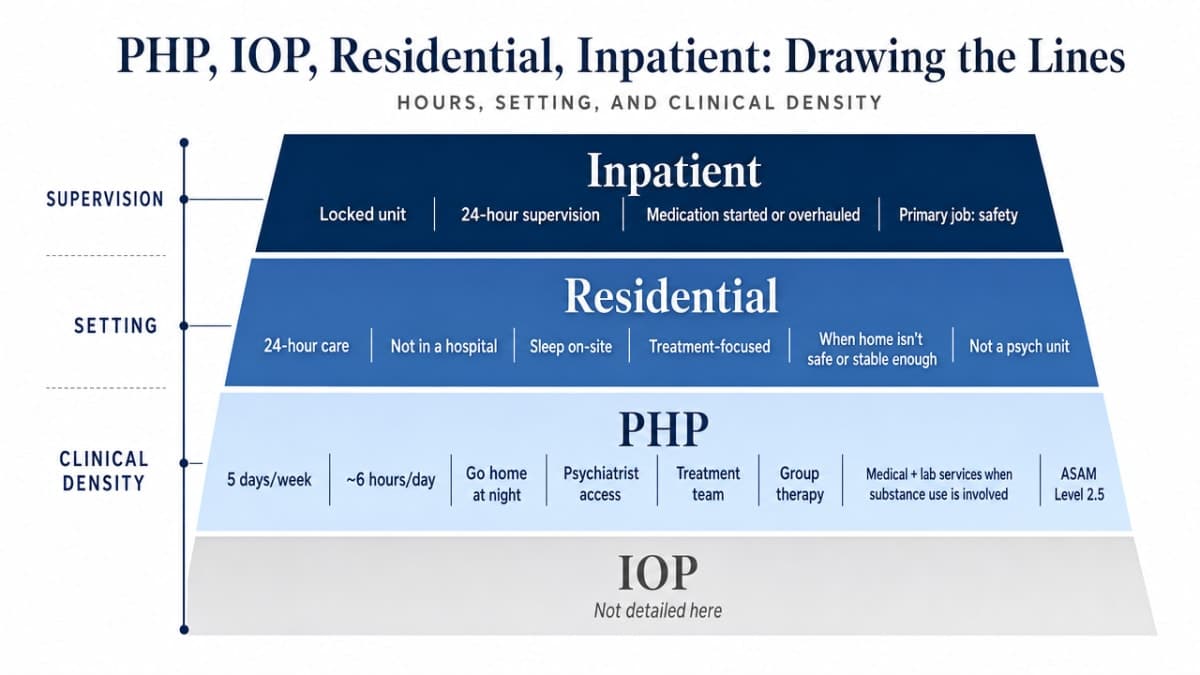
PHP, IOP, Residential, Inpatient: Drawing the Lines
Four terms get thrown around in discharge conversations, and they blur together fast when you’re tired. Here’s how a clinician would sort them at a kitchen table.
- Inpatient
- The locked unit you may have just left. 24-hour supervision, medication started or overhauled, safety the primary job.
- Residential
- 24-hour care too, but not in a hospital. You sleep on-site, but the setting is treatment-focused rather than acute-medical. It’s the answer when home isn’t safe or stable enough to sleep in, but a psych unit is no longer the right container.
- PHP
- Where you show up five days a week, roughly six hours a day, and go home at night. You get direct access to a psychiatrist, a treatment team, group therapy, and — when substance use is in the picture — medical and lab services in the same program. Under the ASAM framework, that’s Level 2.5, and the direct access to psychiatric, medical, and laboratory care is what separates it from anything below 19. The APA’s schizophrenia guideline names this same gap directly: some people need more than routine outpatient can offer and less than a hospital, and intermediate settings like PHP exist for exactly that stretch 17.
- IOP
- Intensive outpatient — roughly three sessions a week, three hours each. It’s real treatment. It’s just less of it, with less direct psychiatric and medical support attached. SAMHSA’s continuum places IOP at ASAM Level 2.1 and PHP at 2.5, and the difference is not marketing — it’s the number of hours, the density of the clinical team, and whether your psychiatrist is available the same week your medication needs a change 18.
If your medications are still being titrated and your symptoms shift day to day, the difference between 9 hours a week and 25 is not academic. It’s whether your next dose adjustment happens in seven days or seventy-two.
The Post-Hospital Window Where PHP Fits Best
Why Weekly Therapy Often Isn’t Enough After Discharge
Here’s the part nobody tells you in the discharge meeting: the medication that started working on day four of your hospital stay may not be the medication that works on day fourteen. Doses get adjusted. Side effects show up late. A mood shifts, and the plan has to shift with it.
A weekly outpatient appointment is not built for that pace. Fifty minutes on a Tuesday is enough to make small course corrections in a stable life. It is not enough to catch a bad reaction to a new antipsychotic on a Thursday, or to notice that the depression has crept back in by Sunday.
Research on planned shorter inpatient stays makes the trade-off visible. When people leave the hospital earlier, they don’t do worse on mental state or rehospitalization — but only when meaningful post-discharge day care picks up where the inpatient stay left off. In fact, patients discharged from shorter stays paired with day programs were more likely to be employed at the two-year mark 11.
The takeaway isn’t that hospitals should push people out faster. It’s that leaving a hospital and going straight to weekly therapy skips a level of care your clinical week was built to need.
Day Programs as a Real Alternative to Longer Hospital Stays
There’s a finding from a randomized trial that reshapes the whole conversation about post-discharge care, and it’s worth stating plainly — once — with the caveats attached.
But sit with the number for a moment.
Nearly half of the people arriving at an inpatient door — sick enough that hospitalization was on the table — could have had their crisis treated in a program where they went home at night, if the program was intensive enough. That is not a footnote. That is the entire clinical case for why PHP exists as a distinct level of care.
For you, freshly discharged, the implication runs the other direction. If a well-resourced day program could have substituted for a hospital stay in your situation, it can almost certainly substitute for the empty week between discharge and your first outpatient appointment.
Inside a PHP Day: Structure, Hours, and What Treatment Looks Like
A PHP day starts closer to a workday than a hospital shift. You arrive in the morning, usually around 9 a.m. You leave in the mid-afternoon. In between, you’re doing clinical work — not sitting in a dayroom waiting for meds.
The 20-hours-a-week floor set in federal rules is the minimum, not the shape 1. Most programs run five days, roughly five to six hours a day, and pack those hours with a specific mix: a check-in group, one or two therapy groups (skills-based work like DBT, CBT, or relapse prevention), a psychiatrist visit that week — often more than once when medications are being adjusted — and time with an individual therapist. If substance use is part of your picture, addiction-focused groups and lab work belong in the same building, on the same day, run by the same team.
That density is the point. Research on acute day treatment found that higher intensity — particularly more hours of group psychotherapy — is what predicts symptom improvement, not just showing up 8. A program running true PHP dose looks different from one running IOP hours with a PHP label.
What the treatment produces goes past symptom checklists. A 2025 day hospital study across multiple diagnoses found that after the intervention, patients reduced anxiety and impulsivity, increased self-esteem, and shifted toward an internal locus of control — the sense that you have some say in what happens next 14.
You go home at night. You sleep in your own bed. The pill organizer on the counter gets refilled by someone who saw you six hours ago and will see you again tomorrow.
How PHP Compares to Inpatient Care on Outcomes
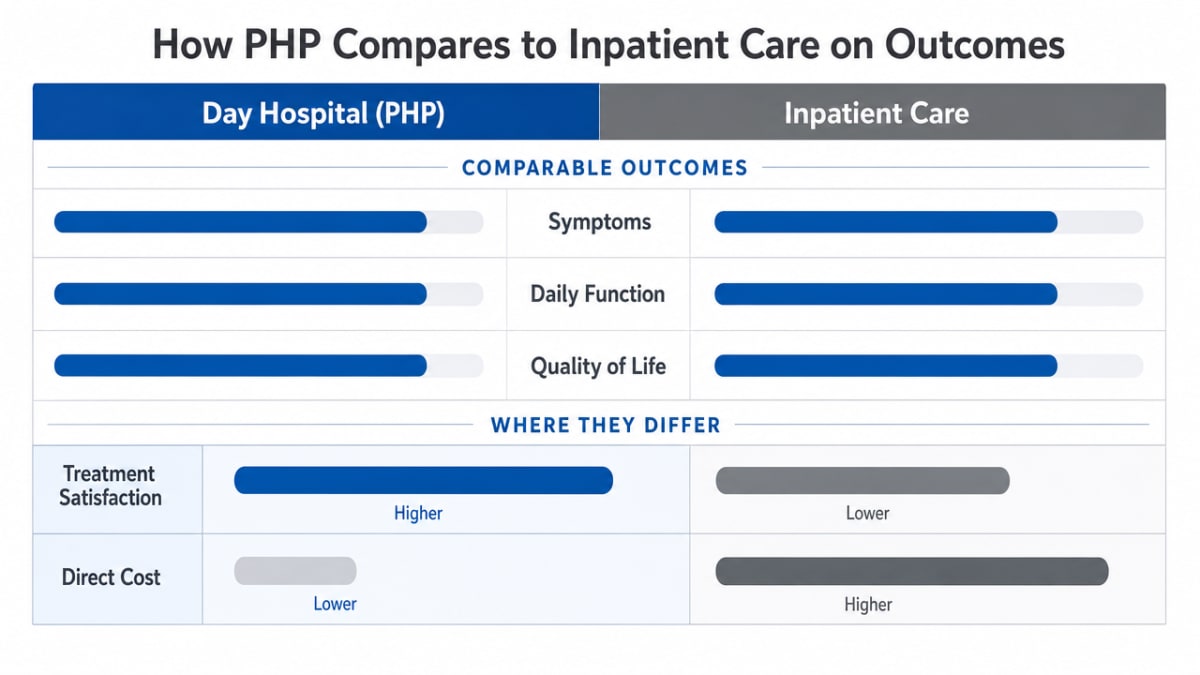
A fair question at this point: if a PHP is less intensive than the hospital you just left, does that mean it’s less effective? The research says no — not for the population it’s built for.
A 2020 study directly compared acute day hospital treatment with inpatient care for acutely ill psychiatric patients across the measures that actually matter to a person in your situation: how much symptoms improved, how well people functioned day to day, and how their quality of life shifted. On all three, there were no significant differences between settings. Same clinical gains. Same functional recovery. Same trajectory 12.
Where the two settings parted ways was on the human measures. Patients in the day hospital reported higher treatment satisfaction. And in the Swiss health system where the study ran, day hospital treatment carried clear direct cost advantages over inpatient care 12.
That last point is worth pausing on. The cost finding isn’t a pitch for the cheaper option — it’s evidence that PHP is a legitimate substitute, not a diluted version of hospitalization. If it were producing weaker outcomes, no health system would consider the cost difference an advantage. It would be a warning sign.
What this means for the week in front of you: choosing PHP over a longer inpatient stay, when your clinical picture allows it, is not a compromise. It’s the same recovery, on outcomes that count, in a setting you can go home from.
When PHP Fits Complex or Treatment-Resistant Presentations
Treatment-Resistant Depression and Severe Mood Episodes
If your depression has stopped responding to the last two or three medications, or if the episode that landed you in the hospital was the fourth one this decade, weekly therapy isn’t neutral. It’s a delay.
Treatment-resistant depression usually means the plan is changing. A new augmenting agent. A cross-titration off one antidepressant onto another. Maybe a referral for ketamine or ECT running alongside oral medications. Each of those moves needs someone watching your mood, your sleep, and your side effects on a scale of days, not weeks.
PHP is where that watching happens. Research on partial hospitalization for major depression shows clinically meaningful improvements in symptom scores and functioning over the course of treatment, with relatively low rehospitalization rates during follow-up — particularly for people with severe episodes and those transitioning from an inpatient stay 22. That’s the exact profile of a treatment-resistant post-discharge week.
You don’t have to have responded to the last thing you tried for the next thing to work. You just need enough clinical hours around you for someone to notice what’s shifting.
Schizophrenia Spectrum and Rapid-Cycling Bipolar Disorder
Psychotic-spectrum illness and rapid-cycling bipolar disorder don’t behave on a Tuesday-appointment schedule. A voice comes back on Thursday. A mixed state shifts overnight. A clozapine level needs checking, or a lithium dose needs tuning around a new mood shift.
The APA’s schizophrenia practice guideline draws the line clearly. Full inpatient care is indicated when someone poses a serious threat to self or others or can’t care for themselves without constant supervision. But many people with schizophrenia-spectrum illness need more monitoring than routine outpatient can offer and less than 24-hour supervision — and intermediate settings like PHP exist for exactly that stretch 17.
Rapid-cycling bipolar disorder lives in the same zone. When mood shifts happen inside a week, the clinical team needs to see you inside a week — repeatedly. A PHP can adjust a mood stabilizer on Monday, watch the response Tuesday through Thursday, and refine the plan on Friday. That’s not possible in a weekly outpatient rhythm.
For complex psychiatric illness, this level of care isn’t a downgrade from the hospital. It’s the setting that catches what the hospital didn’t finish.
Borderline Personality Disorder and Chronic Self-Harm Risk
Borderline personality disorder has an awkward relationship with the hospital. The crises are real. The admissions rarely help long-term. What actually shifts the pattern is structured, skills-based treatment delivered at enough intensity for the skills to take hold before the next crisis arrives.
A randomized controlled trial of intensive day hospital mentalization-based treatment for BPD showed significant reductions in self-harm and suicidal behavior, along with reduced inpatient bed use, compared with usual care 21. That finding matters for a specific reason: it separates “still having urges” from “needs the hospital.” Chronic self-harm risk, without imminent intent, is often the population PHP was designed to hold.
The daily structure is doing work you can’t do alone at home. Skills groups Monday through Friday. An individual therapist you see multiple times a week. A team that knows what your Wednesday looked like when they see you Thursday.
If your risk has been chronic rather than acute, that continuity is often the missing ingredient.
Co-Occurring Substance Use: One Team, One Chart, Same Week
If your discharge summary lists a psychiatric diagnosis and a substance use diagnosis side by side, the question isn’t which one to treat first. It’s whether the program you’re going to next treats both in the same building, by the same team, on the same day.
Most outpatient arrangements split the two. Psychiatry on Tuesday. Addiction group on Thursday. Two charts. Two treatment plans. Nobody with a full picture of what happened over the weekend.
PHP at ASAM Level 2.5 is structured to close that split. Level 2.5 programs have direct access to psychiatric, medical, and laboratory services in the same setting — which is what separates them from Level 2.1 intensive outpatient, where those services are usually referred out 19. SAMHSA’s continuum places this integration inside Level 2.5 for exactly this reason: co-occurring conditions need coordinated care, not parallel care 18.
What that looks like in practice: one team. One chart. Your psychiatric medications adjusted the same week your relapse trigger is worked through in group. A urine screen and a mood check in the same visit. The person leading your DBT group knows what your addiction counselor saw yesterday.
For dual diagnosis, that operational shape is the treatment. Anything less is two half-treatments running in different rooms.
When PHP Is Not the Right Fit
Here’s the honest part. PHP is not the right level of care for everyone leaving a hospital, and pretending otherwise would fail the reader this piece is written for.
PHP also doesn’t fit when the container at home isn’t safe enough to hold you between sessions. The federal rule assumes an adequate support system — a stable enough environment, or people who can be present, when you’re not in the program 1. If home is where the drinking happens, or where the abuse is, or where nobody notices whether you took your medication, the honest answer is often residential care first, PHP later.
Two other situations warrant naming. If you’re grossly psychotic or in a florid manic state that makes group participation impossible, the milieu can’t do its work yet — inpatient stabilization comes first 10. And if your ASAM assessment shows active withdrawal that needs medical management, detox precedes PHP, not the other way around.
None of this is a verdict on you. It’s a match problem. The right level of care meets you where your week actually is.
How to Tell If This Is Your Window
Here is a gut check you can run at the kitchen table tonight.
Read these five questions slowly:
- Is your medication still being adjusted, or was it changed in the last two weeks?
- Are your symptoms present enough that waiting seven days between appointments feels risky?
- Can you sleep at home safely, with someone or something to hold the hours you’re not in treatment?
- Are you past active intent to hurt yourself or someone else, even if the thoughts still visit?
- Do you have a mental health diagnosis, a substance use diagnosis, or both, that’s actively being treated?
If you answered yes to most of them, you are describing the federal criteria for PHP almost word for word 1. That is not a coincidence. That is the level of care built for exactly the week you’re in.
You do not have to be certain. You do not have to have your energy back. You just have to be willing to show up for the hours while the treatment team does the watching your Tuesday appointment can’t.
If dual diagnosis is part of your picture, look for a program where psychiatry and addiction treatment run under one team, one chart, in the same week. That operational shape — the kind ViewPoint Dual Recovery is built around — is where an integrated PHP earns its name.
The right level of care meets you where your week actually is. Not where you wish it were. Where it is.

Find Out If a PHP Suits Your Needs
Receive tailored guidance on whether a PHP is the right step after hospitalization.
Frequently Asked Questions
How long does a PHP for mental health usually last?
Most PHPs run somewhere between two and six weeks, though the honest answer is that duration should track your clinical picture, not a calendar. Federal rules require at least 20 hours of therapeutic services weekly and expect care to continue only as long as it improves or maintains functioning 1. Treatment-resistant or dual diagnosis presentations often need the longer end of that range.
Can I go to a PHP without being hospitalized first?
Yes. PHPs work as both a step-down from inpatient care and a direct point of entry when symptoms are serious enough to need daily structure but not 24-hour supervision — a role clinicians call hospital diversion 10. If your outpatient team is watching a decompensation and weekly appointments aren’t holding, a PHP can catch that slide before an inpatient admission becomes necessary.
What’s the difference between a PHP and an IOP?
Hours and clinical density. PHP sits at ASAM Level 2.5 with 20-plus hours weekly and direct access to psychiatric, medical, and laboratory services in the same setting. IOP sits at Level 2.1 with roughly 9 hours weekly and usually refers those services out 19. If your medications are still being adjusted or your symptoms shift day to day, that difference is not academic.
Will I still see a psychiatrist during a PHP?
Yes, and usually more often than in outpatient care. Direct access to psychiatric services is part of what defines Level 2.5 as a distinct level of care 19. When medications are being titrated, expect to see the psychiatrist multiple times a week — not once a month. That access is precisely what a Tuesday outpatient appointment cannot offer during an active adjustment.
Does a PHP work if I have both a mental health and substance use diagnosis?
It’s often the setting built for exactly that combination. ASAM Level 2.5 programs provide psychiatric, medical, and laboratory services in the same building 19, and SAMHSA’s continuum places integrated co-occurring care at this level rather than splitting it across parallel referrals 18. One team, one chart, same week — that operational shape is what makes dual diagnosis treatment work.
What happens if I’m still having thoughts of self-harm during a PHP?
Thoughts are not the same as imminent intent, and PHPs are built to hold chronic risk. Structured day hospital treatment has shown significant reductions in self-harm behaviors for high-risk populations 21. But if intent, plan, or means become active, PHP is not the right level — federal criteria require you not be imminently dangerous to yourself or others, because you go home at night 1.
References
- 42 CFR § 410.43 – Partial hospitalization services: Conditions and limitations. https://www.law.cornell.edu/cfr/text/42/410.43
- ASAM 2.5 – Partial Hospitalization Service Requirements (Montana DPHHS). https://dphhs.mt.gov/assets/BHDD/SubstanceAbuse/530_SUD_ASAM_2.5_eff.1.1.25.pdf
- 12VAC35-105-1412. Substance abuse partial hospitalization service (Virginia Admin Code). https://law.lis.virginia.gov/admincodefull/title12/agency35/chapter105/partVII/article6/
- Acute day hospital as an alternative to inpatient treatment for patients with severe mental illness. https://www.ncbi.nlm.nih.gov/pmc/articles/PMC4635696/
- Effectiveness of intensive day treatment vs. inpatient care in adult psychiatry: A randomized trial. https://www.ncbi.nlm.nih.gov/pmc/articles/PMC5851298/
- Intensive group-based day treatment for severe affective and anxiety disorders: A prospective cohort study. https://www.ncbi.nlm.nih.gov/pmc/articles/PMC8894600/
- Day hospital treatment for borderline personality disorder: Long-term follow-up. https://www.ncbi.nlm.nih.gov/pmc/articles/PMC6408391/
- Acute psychiatric day treatment: Intensity, outcomes, and predictors of improvement. https://www.ncbi.nlm.nih.gov/pmc/articles/PMC6361044/
- Chapter 4. Partial Hospitalization and Day Treatment for Substance Use Disorders (TIP 47). https://www.ncbi.nlm.nih.gov/books/NBK64049/
- Providing Crisis-oriented and Recovery-based Treatment in Partial Hospitalization Programs. https://pmc.ncbi.nlm.nih.gov/articles/PMC2848466/
- Length of hospitalisation for people with severe mental illness. https://pmc.ncbi.nlm.nih.gov/articles/PMC4040414/
- Psychiatric Acute Day Hospital as an Alternative to Inpatient Treatment. https://pmc.ncbi.nlm.nih.gov/articles/PMC7261862/
- Randomised controlled trial of day patient versus inpatient psychiatric treatment. https://pmc.ncbi.nlm.nih.gov/articles/PMC1662770/
- Effectiveness of the Intervention from a Mental Health Day Hospital on Clinical Symptoms, Psychological Variables, and Quality of Life. https://pmc.ncbi.nlm.nih.gov/articles/PMC12470248/
- Patient Outcomes in Transdiagnostic Adolescent Partial Hospitalization Programs: A Systematic Review. https://pubmed.ncbi.nlm.nih.gov/37271333/
- Overview of Substance Use Disorder Care Clinical Guidelines and Policy Recommendations for State Medicaid Agencies. https://www.medicaid.gov/state-resource-center/innovation-accelerator-program/iap-downloads/reducing-substance-use-disorders/asam-resource-guide.pdf
- The American Psychiatric Association Practice Guideline for the Treatment of Patients With Schizophrenia (2020). https://www.med.unc.edu/psych/epi-nc/wp-content/uploads/sites/720/2024/01/APA-2020-guidelines-1.pdf
- Chapter 3. Intensive Outpatient Treatment and the Continuum of Care for Substance Use Disorders (TIP 47). https://www.ncbi.nlm.nih.gov/books/NBK64088/
- Level 2.5 by Service Characteristics (Pennsylvania Department of Drug and Alcohol Programs). https://www.pa.gov/content/dam/copapwp-pagov/en/ddap/documents/documents/asam/level%202.5%20by%20service%20characteristics.pdf
- Intensity and Outcomes of Treatment in an Acute Psychiatric Day Hospital. https://www.ncbi.nlm.nih.gov/pmc/articles/PMC2899922/
- Day Hospital Mentalization-Based Treatment for Patients With Borderline Personality Disorder. https://www.ncbi.nlm.nih.gov/pmc/articles/PMC3867682/
- Effectiveness of Partial Hospitalization in the Treatment of Major Depression. https://www.ncbi.nlm.nih.gov/pmc/articles/PMC6135104/