Key Takeaways
- Loving someone with treatment-resistant psychiatric illness or dual diagnosis in Yavapai County reshapes the whole household, and family systems therapy treats that household as central to how recovery holds.
- Arizona backs family-inclusive care through AHCCCS-funded Parent/Family Support Services, Family Involvement Center access in Prescott, and the Child and Family Team planning model 3, 6.
- Research shows modest but durable effects — a 5.7% reduction in substance use frequency lasting 12 to 18 months — which matters most for complex cases that wobble past the one-year mark 9.
- Before choosing a Prescott program, compare how family education is delivered, whether families sit at the treatment planning table, what family weekends include, and how safety screening is handled 1.
When Loving Someone Through Treatment-Resistant Illness Becomes a Family Job
You already know what the brochures don’t say: loving someone with a treatment-resistant psychiatric condition or a dual diagnosis reshapes your whole household. The phone calls at 2 a.m. The medication changes that don’t hold. The hospitalizations that felt like they’d finally fix things, until they didn’t. If you’re reading this from somewhere in Yavapai County, you’ve probably been doing this for a while.
Here’s what family systems therapy starts with: your loved one’s illness doesn’t live inside them alone. It moves through the whole family — how you sleep, how you argue, how you plan a Sunday. That isn’t blame. It’s the reason federal treatment guidance now frames family involvement as central to recovery rather than optional 1, and why SAMHSA describes family therapy as work with two goals — helping the family support recovery, and strengthening the family’s own emotional health so everyone can actually live 2.
This guide walks you through what that model looks like in practice, what the research actually shows, how Arizona backs family-inclusive care, and what ViewPoint Dual Recovery in Prescott does specifically. You don’t have to keep guessing at your role. There is one.
What Family Systems Therapy Actually Means (And What It Doesn’t)
The Two Goals: Support Recovery, Strengthen the Family
Family systems therapy isn’t a lecture about what your loved one needs from you. It’s a working relationship with a licensed clinician who treats the family as the unit that shapes recovery — day to day, meal to meal, argument to argument.
SAMHSA frames the work around two goals that sit side by side. The first is helping everyone in the family give the right kind of support, so recovery holds and relapse becomes less likely. The second is strengthening the family’s own emotional health, so that everyone — not just the person diagnosed — can actually thrive 2.
That second goal matters more than most families expect. You’ve probably been in survival mode for a long time. Your sleep is off. Your other relationships have thinned. Family systems therapy makes room for that, too. It isn’t about turning you into a co-therapist. It’s about giving the whole household a way to breathe.
Why This Model Matters More for Complex Cases
When someone has a first-episode diagnosis and responds to a standard protocol, families often step back after a few weeks. Complex cases don’t work that way. Treatment-resistant schizophrenia, rapid-cycling bipolar, clozapine management, trauma-driven addiction — these conditions play out over years, with medication adjustments, hospital stays, and stretches where things get worse before they get better.
SAMHSA’s advisory is direct about this: positive family and social support is tied to long-term recovery, and family-based approaches are associated with lower delivery costs in some studies because they reduce the churn of relapse and readmission 1. When care has to last, the family has to be part of how it lasts.
The same guidance is careful, though. Family involvement isn’t automatic. Clinicians screen for withdrawal status, co-occurring conditions, legal issues, and any history of family violence before opening the door to family sessions 1. That caution isn’t a barrier — it’s what makes the model safe enough to actually work when your loved one’s case is complicated.
The Family Involvement Spectrum at a Specialty Psychiatric Program
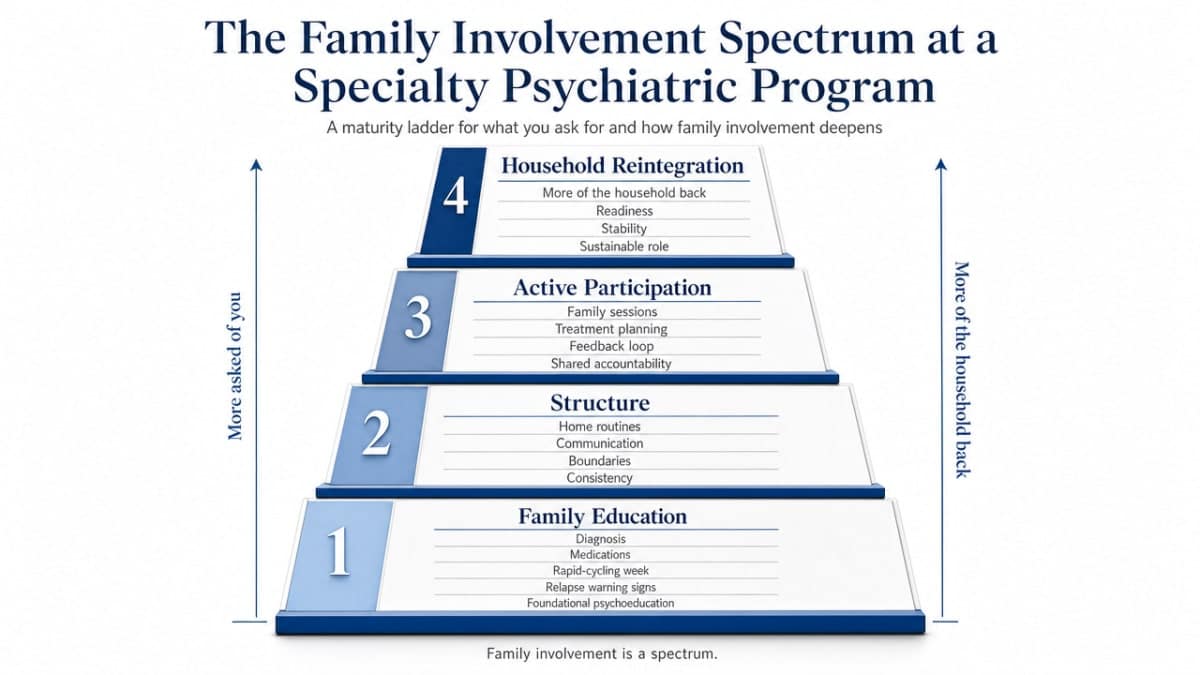
Family involvement isn’t one thing. It’s a spectrum, and knowing where you fit on it changes what you ask for. At a specialty psychiatric program handling treatment-resistant and dual diagnosis cases, that spectrum tends to move through four levels — each one asking a little more of you, and giving your loved one a little more of the household back.
Level 1: Family Education. This is where most families start, and where many stay for the first few weeks. You learn what the diagnosis actually is, how the medications work, what a rapid-cycling week looks like from the inside, and what the warning signs of relapse really are. SAMHSA’s guidance treats this psychoeducation as foundational — not a preamble to “real” treatment, but a piece of it 1. You can’t respond well to something you don’t understand.
Level 2: Structured Family Therapy Sessions. Now a licensed clinician sits in the room with you and your loved one, working on the specific patterns that keep tripping the household — the argument that always ends the same way, the silence after a hospital discharge, the way one sibling has quietly stopped calling. These are working sessions, not group venting.
Level 3: Treatment Planning Participation. Arizona’s Child and Family Team model describes this as engaging the family and others to plan and implement strategies, resources, and services 6. Translated: you’re at the table when discharge criteria, medication changes, and step-down plans get decided. You know what “stable enough to come home” actually means for this case.
Level 4: Family Weekends and Immersive Involvement. Multi-day, on-site programming where the family does the harder work together — practicing conversations, rebuilding trust after a relapse, planning the first ninety days at home. This is where the earlier levels compound.
You don’t have to climb all four rungs. But knowing they exist means you can ask, out loud, which one your loved one’s program supports and how to move up when you’re ready.
How Arizona Policy Backs Family-Inclusive Care
AHCCCS Parent/Family Support and Prescott Access
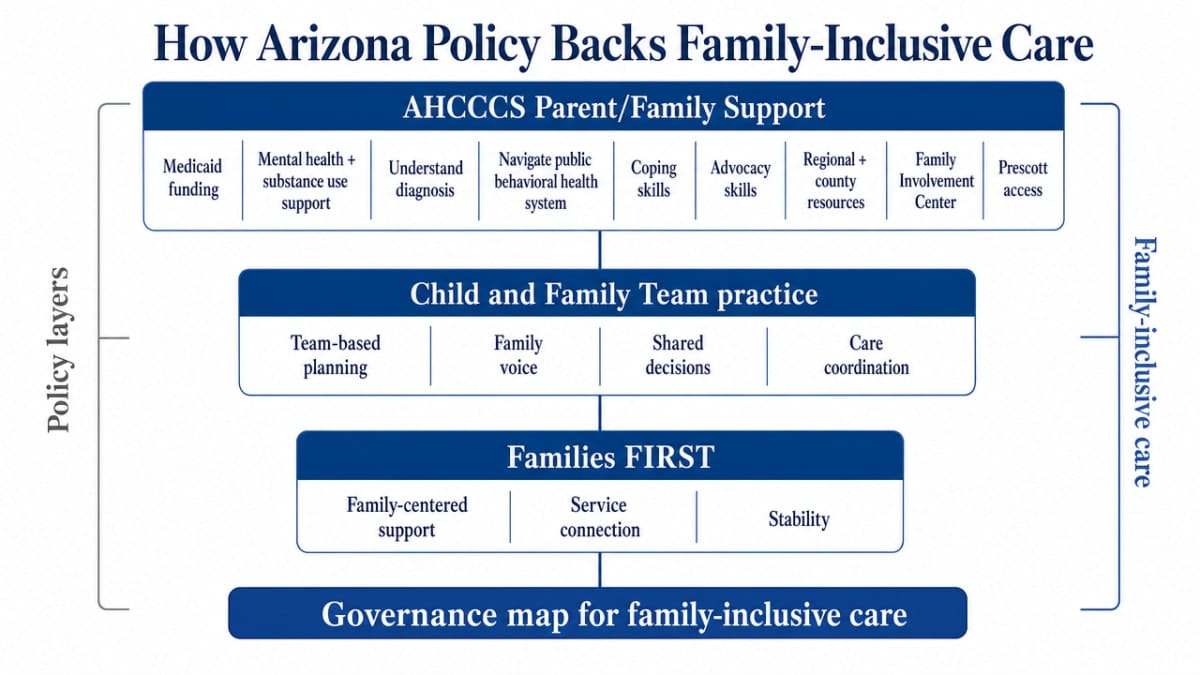
Here’s something a lot of families in Yavapai County don’t realize: Arizona actually pays for the kind of support you’ve been trying to piece together on your own. AHCCCS — the state’s Medicaid program — funds Parent/Family Support Services specifically to help families understand what a mental health or substance use diagnosis really means, learn how to navigate the public behavioral health system, and build coping and advocacy skills for the long haul 3.
That last part matters. Advocacy skills aren’t a soft concept. They’re what let you push back when a discharge feels premature, ask the right questions about a medication change, and know which agency to call when the answer you got doesn’t sit right.
AHCCCS lists regional and county resources for this work, including Family Involvement Center support in Prescott 3. Family therapy and counseling are separately covered as behavioral health services under the AHCCCS fee-for-service provider manual, so the clinical side of family systems work has payer backing too 14.
Child and Family Team Practice as a Statewide Template
Arizona didn’t invent family systems thinking, but the state built one of the more concrete templates for putting it into practice. Child and Family Team practice — CFT for short — is described in the state’s behavioral health protocol as engaging the child, family, and others to plan and implement strategies, resources, and services together 6. It moves through defined phases: engagement, service planning, and transition.
The DBHS Practice Protocol goes further. It says every child receiving out-of-home behavioral health services must be treated within the context of their family system, and treats family involvement as a treatment priority rather than a preference 4. The protocol still allows exceptions when contact isn’t safe or feasible — which is honest, not evasive.
CFT was written for pediatric and youth services, but the template is portable. The engagement-plan-transition rhythm shows up in adult specialty psychiatric care too, which is why asking a Prescott program about its family planning process isn’t an unusual request. It’s how Arizona expects care to run.
Families FIRST: A Family-Focused, Trauma-Informed Vision
The Arizona Families FIRST program manual, run through the Department of Child Safety, spells out what family-centered substance use care is supposed to look like at the state level. Its stated vision: family-focused, evidence-based, trauma-informed SUD treatment and recovery services that promote family stability and reunification 5.
Read that phrase again — family-focused, evidence-based, trauma-informed. Those aren’t decorative words. They describe a specific stance: the family is part of the treatment unit, the interventions have research behind them, and the clinicians understand that trauma often lives on both sides of the diagnosis.
The manual is also clear about limits. Family-centered care still requires careful screening for confidentiality, legal constraints, and safety issues before a family sits in the room together 5. That’s the model a good Prescott program should mirror.
What the Research Says When Families Show Up
You don’t need to take anyone’s word for whether family involvement matters. The research is there, and it’s honest about both what it shows and what it doesn’t.
A 2021 overview of family involvement in substance use treatment pulled together meta-analytic findings on what happens when families stay in the picture. The headline number: family involvement produced a small effect size that endured 12 to 18 months after treatment ended, translating to a 5.7% reduction in substance use frequency — the equivalent of roughly three fewer weeks per year of use 9. That’s not a dramatic number on paper. But durability is the point. A lot of interventions look strong at discharge and fade by month six. This one keeps working past the year mark, which is exactly the window when treatment-resistant cases tend to wobble.
A more recent open-access systematic review of randomized controlled trials came to a similar place from a different angle. Across the studies examined, family engagement in substance use treatment was linked to favorable outcomes — substance use reduction and improvements in family functioning — with 11 studies showing significant positive effects 8. The authors are careful to name the caveat: the studies vary in design and in which family components they tested, so it’s hard to pin down exactly which ingredient is doing the most work. That’s a fair limit to sit with.
The evidence also lines up with what SAMHSA has been telling providers for years — that positive family and social support is tied to long-term recovery, and that family-based approaches can lower some delivery costs by reducing the churn of relapse and readmission 1. You’re not being asked to believe in a novel theory. You’re being asked to be part of a model that has quietly been earning its place in the guidelines.
Why Families Keep People in Treatment Longer
One of the quieter findings in the family involvement research is also the most practical: when families are in the room, people stay in treatment. A synthesis of controlled trials of family-based treatment for adolescent substance abuse reported retention rates that were uniformly high — typically 70 to 90 percent — with significant effects on substance use across all fourteen studies examined, and positive impacts holding at follow-ups as far out as four years 10.
Read that number carefully. It comes from adolescent studies, not adult dual diagnosis trials, so it isn’t a promise about what happens with a 47-year-old in clozapine management or a mother with rapid-cycling bipolar and alcohol use. The mechanism, though, is worth borrowing. When a family is oriented, informed, and part of the plan, the person in treatment has fewer reasons to walk out — and more people who notice when the wobble starts.
For treatment-resistant and dual diagnosis cases, retention is often the whole ballgame. The medication trials that actually work take weeks to titrate. The therapy relationships that finally stick take months to build. A discharge that happens two weeks early — because a family panicked, or because no one at home understood the plan — can undo an entire admission. Families who’ve been brought into the education and planning work tend to hold the line on the harder days. They know why the third medication trial matters. They know what a stable week is supposed to look like. They know who to call before things break.
That’s the quiet leverage of showing up. Not dramatic recoveries. Just one more week in treatment, and then another.
ViewPoint Dual Recovery’s Family-Centered Approach in Prescott
Family Education Before You Ever Enter a Session
Before you sit down for your first family therapy session at ViewPoint Dual Recovery, the clinical team starts with what most families needed months ago: a real explanation of what’s actually happening. A rapid-cycling bipolar week has a shape. A clozapine titration has a timeline. Trauma-related addiction has patterns you can learn to see coming. Family education at ViewPoint means walking through those specifics with a licensed clinician — not a handout, not a generic slideshow — so you stop guessing.
This mirrors what SAMHSA describes as foundational to family therapy: helping everyone in the household give the right kind of support so recovery holds, and strengthening the family’s own emotional health at the same time 2. You learn the diagnosis. You learn the warning signs. You also get permission to name what the last two years have cost you. Both matter.
Getting a Seat at the Treatment Planning Table
ViewPoint’s integrated care team — board-certified psychiatry and therapy working the same case together — makes room for you at the planning conversations that actually shape your loved one’s admission. Medication decisions. Trauma-focused therapy pacing. Discharge criteria. Step-down plans. These get discussed with your input, not just reported back to you afterward.
That structure lines up with how Arizona expects family-inclusive care to run. The state’s Child and Family Team model describes planning as a process of engaging the family and others to design strategies, resources, and services together 6, and the DBHS Practice Protocol treats family involvement as a treatment priority rather than a courtesy 4. At ViewPoint, that shows up in practice: when you know why the third medication trial matters, or what “stable enough to come home” really means for this specific case, you can hold the plan on the days it gets hard. You’re not guessing anymore. You’re deciding, alongside the team.
What Family Weekends Look Like in Practice
Family weekends at ViewPoint are the level where the earlier work compounds. Multi-day, on-site programming brings you into the same rooms your loved one has been working in — with the same clinicians, on the same case — to do the harder conversations you can’t get through in a fifty-minute session.
Expect a mix:
- Psychoeducation sessions that go deeper than the intake overview.
- Structured family therapy work on the specific patterns tripping the household — the argument after every hospital discharge, the sibling who stopped calling, the spouse carrying too much.
- Practice conversations for the first ninety days at home, when relapse risk is highest and the plan has to hold without staff in the room.
- Time to ask the psychiatrist the questions you’ve been sitting on for weeks.
Family weekends aren’t a graduation ceremony. They’re a working intensive, and they matter most for treatment-resistant and dual diagnosis cases, where recovery unfolds over years and the household is the environment your loved one returns to between every step of care 1.
Honest Limits: When Family Involvement Isn’t the Right Move
You’ve probably felt it already — the pull to be in every session, on every call, in every planning meeting. Slow down for a minute. Family involvement is powerful, but it isn’t always the right first move, and any program worth trusting will tell you that out loud.
Arizona’s own family-centered policy carries the same caution. The Families FIRST manual, for all its emphasis on family stability and reunification, still requires careful screening for confidentiality, legal constraints, and safety issues before family sessions move forward 5. The DBHS Practice Protocol allows explicit exceptions when family contact isn’t safe or feasible, even inside a system that treats family involvement as a priority 4.
There’s also the honest research limit. Adult effect sizes for family involvement are modest, and the evidence base for severe mental illness and complex dual diagnoses is thinner than for adolescent studies 9. Family systems therapy isn’t magic. It’s one meaningful piece of a longer plan.
If any of this sounds like your situation, say so on the first admissions call. The right answer might be starting with individual family education, working with a clinician on your own for a while, or waiting until your loved one is medically stable before sitting in a room together. None of that means you’ve failed as family. It means the plan is being built to actually hold.
What to Ask ViewPoint’s Admissions Team
When you call, you don’t have to have the perfect script. But a few direct questions will tell you fast whether a program treats families as part of the plan or as visitors. Write these down before you dial.
Ask about family education. “What does family education look like in the first two weeks — who runs it, and what do we actually learn?” You want a licensed clinician walking you through the diagnosis, the medications, and the warning signs, not a packet of handouts 2.
Ask about treatment planning. “When medication changes or discharge criteria get decided, how am I included?” Arizona’s own care model expects families at the planning table 6. A real answer names when and how.
Ask about family weekends. “What happens during a family weekend, and when in the admission does it usually land?” Listen for structured sessions with the same clinicians working the case.
Ask about safety screening. If there’s conflict, legal involvement, or a violence history, say so 1. The right answer isn’t “we’ll figure it out” — it’s a specific plan.
If you’re stuck, SAMHSA’s national helpline can help you sort next steps too 13.
Start your family systems assessment today
Gain clarity on how family involvement can support sustained psychiatric recovery.
Frequently Asked Questions
What is family systems therapy, and how is it different from regular family counseling?
Regular family counseling often focuses on resolving a specific conflict in the room. Family systems therapy zooms out. It treats the whole family as the unit that shapes how an illness or addiction plays out day to day — sleep, arguments, roles, routines — and works on those patterns with a licensed clinician. SAMHSA frames the work around two goals side by side: helping the family support recovery, and strengthening the family’s own emotional health 2.
Does family therapy actually work for treatment-resistant or dual diagnosis cases?
The honest answer is yes, with modest but durable effects. A 2026 systematic review of randomized controlled trials found family engagement in substance use treatment was linked to favorable outcomes across 11 studies with significant positive effects 8. SAMHSA’s own guidance ties positive family support to long-term recovery 1. The adult dual-diagnosis evidence base is thinner than the adolescent literature, so treat family involvement as one meaningful piece of a longer plan — not a cure.
Does Arizona Medicaid (AHCCCS) cover family therapy in Yavapai County?
Yes. The AHCCCS Fee-For-Service Provider Manual lists group and family therapy and counseling as covered behavioral health services for eligible members 14. Arizona also funds Parent/Family Support Services separately through AHCCCS to help families understand diagnoses, navigate the system, and build coping and advocacy skills, with Family Involvement Center support listed in Prescott 3. Ask any Yavapai County program whether they bill AHCCCS and which family services are included.
What if our family relationship is strained or there’s a history of conflict — can we still participate?
Sometimes, and with the right sequencing. SAMHSA is clear that before family sessions begin, clinicians should evaluate withdrawal status, co-occurring conditions, legal involvement, and any history of family violence 1. Arizona’s Families FIRST manual requires similar screening for confidentiality, legal constraints, and safety before family work moves forward 5. That might mean starting with individual family education, meeting separately with a clinician for a while, or waiting until your loved one is medically stable. Say so on the first call.
How involved can I actually be in my loved one’s treatment planning at ViewPoint?
More than most families expect. ViewPoint’s integrated care team — board-certified psychiatry and therapy working the same case — brings families into planning conversations about medication decisions, trauma-focused therapy pacing, discharge criteria, and step-down plans. That structure mirrors Arizona’s Child and Family Team model, which describes planning as engaging the family and others to design strategies, resources, and services together 6. Your loved one’s consent shapes the scope, and safety screening comes first, but the seat at the table is real.
What should I ask ViewPoint’s admissions team about family involvement?
Keep it direct. Ask what family education looks like in the first two weeks and who runs it — you want a licensed clinician, not a handout packet 2. Ask how you’re included when medication changes and discharge criteria get decided. Ask what happens during a family weekend and when it lands in the admission. Ask how safety concerns get handled if there’s conflict or legal involvement 1. If you’re stuck, SAMHSA’s national helpline can help too 13.
References
- The Importance of Family Therapy in Substance Use Disorder Treatment (Advisory based on TIP 39). https://library.samhsa.gov/sites/default/files/pep20-02-02-016.pdf
- Family Therapy Can Help: For People in Recovery From Mental Illness or Addiction. https://library.samhsa.gov/sites/default/files/sma13-4784.pdf
- Family Support. https://www.azahcccs.gov/AHCCCS/HealthcareAdvocacy/OIFA/familysupport.html
- DBHS Practice Protocol. https://www.azahcccs.gov/plansproviders/downloads/gm/clinicalguidancetools/oohcs.pdf
- THE ARIZONA FAMILIES F.I.R.S.T. PROGRAM MANUAL. https://extranet.azdcs.gov/DCSPolicy/Content/Program%20Policy/03%20Case%20Planning%20and%20Services/Links/Arizona%20Families%20FIRST%20Program%20Manual%202020_12_22.pdf
- Child and Family Team – Arizona Department of Child Safety. https://extranet.azdcs.gov/DCSPolicy/Content/Practice%20Guides%20%26%20Additional%20Info/Links/Guides/Field%20Guide%20-%20Child%20and%20Family%20Team.pdf
- Arizona State Health Assessment. https://www.azdhs.gov/documents/operations/strategic-initiatives/az-state-health-assessment.pdf
- A Systematic Review on Randomized Controlled Trials of Family-Based Interventions for Substance Use. https://pmc.ncbi.nlm.nih.gov/articles/PMC13068785/
- Family Involvement in Treatment and Recovery for Substance Use Disorders: An Overview of Research. https://pmc.ncbi.nlm.nih.gov/articles/PMC8380649/
- Family-based treatment for adolescent substance abuse. https://pmc.ncbi.nlm.nih.gov/articles/PMC2989619/
- Multidimensional Family Therapy for Adolescent Substance Use: A Systematic Review and Meta-analysis. https://pubmed.ncbi.nlm.nih.gov/29870101/
- The Efficacy of Internal Family Systems Therapy in the Treatment of Depressive Symptoms. https://pubmed.ncbi.nlm.nih.gov/27500908/
- National Helpline for Mental Health, Drug, Alcohol Issues. https://www.samhsa.gov/find-help/helplines/national-helpline
- Behavioral Health Services – AHCCCS Fee-For-Service Provider Manual, Chapter 19. https://www.azahcccs.gov/PlansProviders/Downloads/FFSProviderManual/FFS_Chap19BehavioralHealth.pdf