Key Takeaways
- Rapid cycling — four or more mood episodes in a year — signals a need for a contributory-factor workup rather than another added medication 9.
- Treatment resistance in bipolar disorder means an unsatisfactory response after at least two dissimilar trials at adequate dose and duration, which should change the care approach 8.
- Yavapai County covers stable outpatient medication management and insurance-independent crisis response well, but complex rapid-cycling and dual-diagnosis presentations often need specialty care in between 1, 2.
- When substance use is part of the picture, integrated care with one team addressing both conditions concurrently outperforms separate psychiatric and substance use referrals 3, 7.
When your third mood episode this year isn’t a medication problem
You already know the drill. The prescription changes, the dose creeps up, and somewhere between the second and third episode of the year, you start wondering whether the problem is you. It isn’t. Rapid cycling — four or more mood episodes in twelve months — often signals that something underneath the medication picture hasn’t been fully worked up yet.
If you’ve landed here, you’ve probably already tried lithium or divalproex, layered on a second-generation antipsychotic, and maybe cycled through an antidepressant that seemed to help for six weeks and then didn’t. You can name your own diagnosis. You’ve read your discharge summaries. What you’re looking for isn’t another explainer on what bipolar disorder is. You want to know why the sequencing keeps stalling and what a specialty workup should actually catch that a standard outpatient visit misses.
Here’s the anchor point: current clinical practice guidelines specifically flag that for rapid cycling, no single medication has shown consistent superiority, and treatment selection needs to begin with a careful review of contributory factors — antidepressant exposure, stimulants, hypothyroidism, substance use, trauma history, sleep disruption, and epilepsy 9. That is a very different starting position than “let’s try one more agent.”
This piece walks through what that reset looks like in a Prescott context: how to map your current regimen against the guideline hierarchy, when “treatment-resistant” actually applies to you clinically 8, what a real contributory-factor workup should include, and how integrated care changes the math when substance use is part of the picture 3. It also covers what Yavapai County’s outpatient and crisis systems handle well 1, 2, and where complex-case psychiatric care picks up when those aren’t enough.
You’ve done the basics. This is the next layer.
Why rapid cycling demands a reset, not another prescription
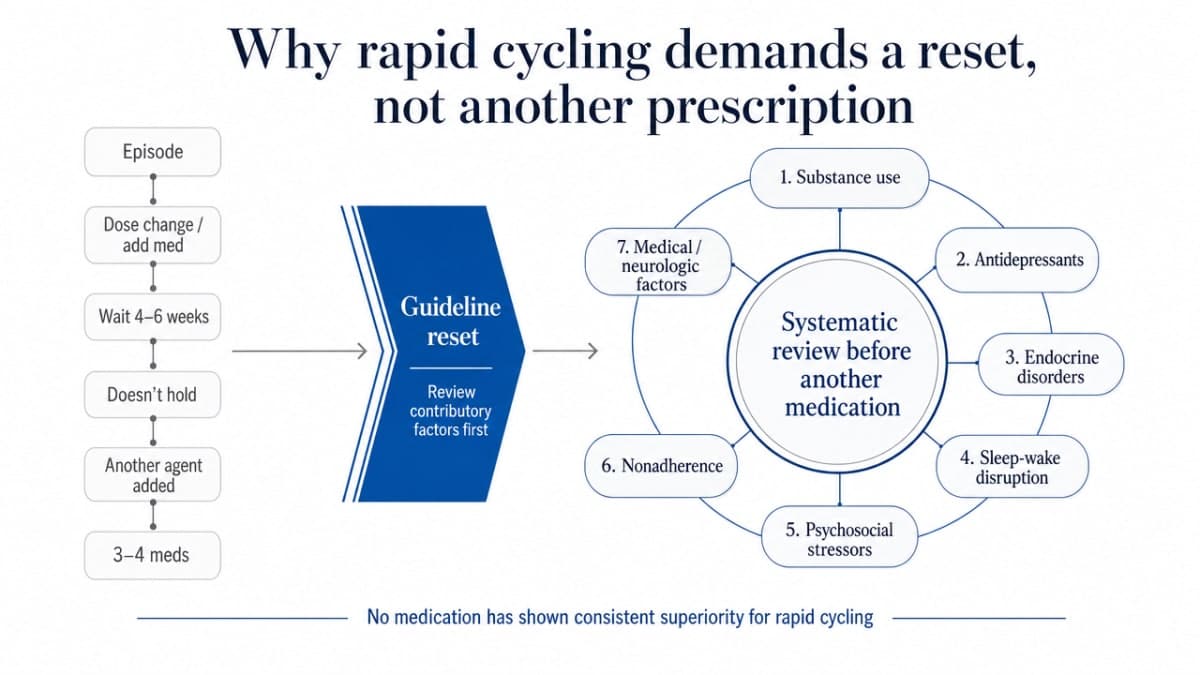
Here’s the part that rarely gets said out loud in a fifteen-minute med check: when someone is cycling through four or more episodes a year, adding a fourth agent to the regimen is often the least useful move on the table. The 2026 clinical practice guideline is direct about this. For rapid cycling, no medication has demonstrated consistent superiority, and the recommended starting point is a systematic review of contributory factors — the things pushing the cycling forward that a new prescription cannot outrun 9.
That’s a different mental model than most standard outpatient visits use. The default flow is: episode happens, provider adjusts dose or adds a med, patient waits four to six weeks to see if it holds. When it doesn’t hold, another agent gets layered in. Six months later you’re on three or four medications, half of which you can’t tell whether they’re helping, and the cycling continues. If any of that sounds familiar, it isn’t because you’re a difficult patient. It’s because the sequencing skipped a step.
The reset the guideline points to is a structured contributory-factor workup. The categories to walk through with your prescriber, in plain terms:
- Antidepressant exposure. SSRIs and SNRIs — even ones prescribed for what looked like a depressive episode — can accelerate cycling or trigger switching in bipolar patients. Timing matters: when did the cycling pattern intensify relative to when the antidepressant was started or increased?
- Stimulants. Prescribed ADHD medications, but also caffeine loads, over-the-counter decongestants, and unreported use.
- Hypothyroidism. A TSH in the “normal but high” range can still drive cycling, particularly in patients on lithium. This is one of the most commonly missed contributors.
- Substance use. Alcohol, cannabis, and stimulants all destabilize mood cycles. This includes patterns your chart may not fully reflect — more on that shortly.
- Sleep disruption. Shift work, chronic insomnia, and irregular sleep windows aren’t lifestyle noise. They’re direct inputs into cycling frequency.
- Trauma history. Untreated PTSD or complex trauma can present as, and amplify, mood instability.
- Epilepsy or subclinical seizure activity. Less common, but worth ruling in or out when the pattern doesn’t fit anywhere else 9.
None of this means your current medications are wrong. It means the question worth asking at your next appointment isn’t “what should we add?” It’s “what should we evaluate before we add anything?” A prescriber who takes rapid cycling seriously will welcome that question, not deflect it. You’ve earned the right to a workup, not another trial. And if the last three appointments have moved straight to the prescription pad without touching any of the categories above, that gap is worth naming — not because you’re being difficult, but because the guideline itself says that’s where the work belongs.
What standard sequencing looks like — and where it stalls
Before we get into the workup detail, it’s worth pausing on the pharmacology map itself. Most people cycling through Prescott outpatient psychiatry are on some version of a guideline-endorsed regimen — the sequencing isn’t wrong so much as incomplete. Knowing exactly where your current combination sits in the hierarchy makes the next conversation with your prescriber sharper, and it makes the phrase “treatment-resistant” mean something specific instead of something demoralizing.
Mapping your current regimen against the guideline hierarchy
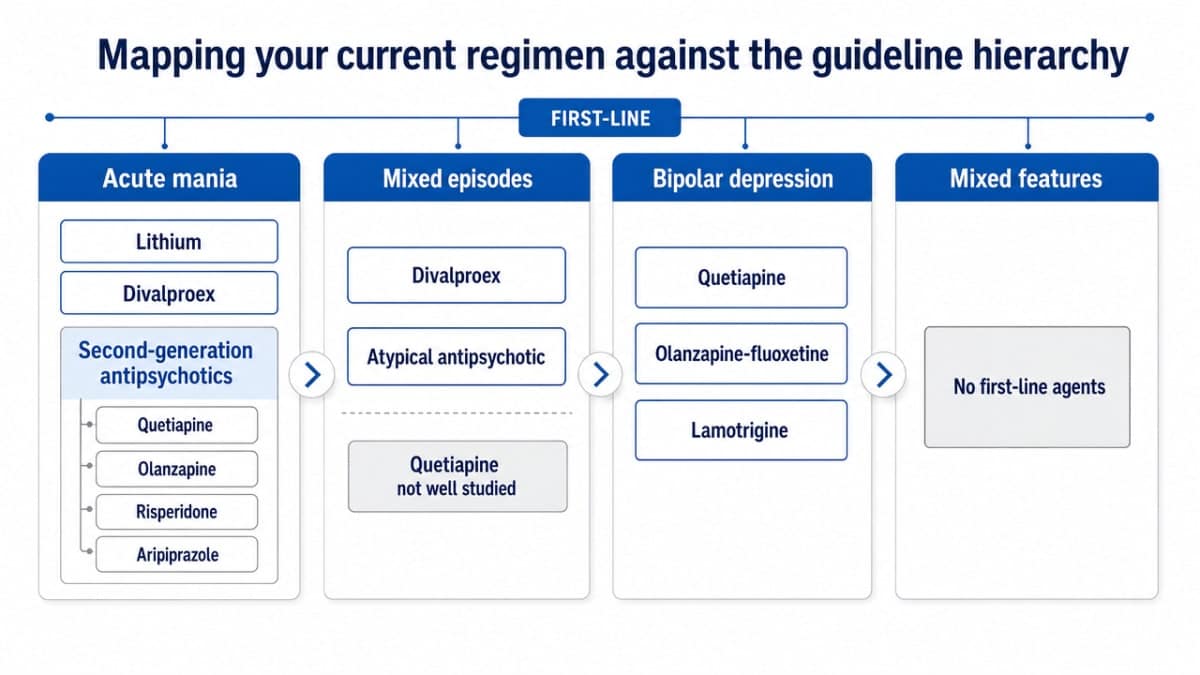
The standard pharmacologic hierarchy is more compact than the number of medications you may have tried suggests. For acute mania, lithium, divalproex, and second-generation antipsychotics (quetiapine, olanzapine, risperidone, aripiprazole) sit at the front. For mixed episodes, the first-line recommendation shifts toward divalproex or an atypical antipsychotic — quetiapine, notably, has not been well studied for mixed presentations even though it gets used there routinely 12. For bipolar depression, the first-line options narrow to quetiapine, the olanzapine-fluoxetine combination, or lamotrigine 12.
Then there’s the harder truth about mixed features. The CANMAT/ISBD 2021 guideline reviewed the evidence for DSM-5 manic or depressive episodes with mixed features and concluded that no agents met the threshold for first-line treatment. Several second-line and maintenance options are identified, but the top of the ladder is empty 10. If your presentation includes mixed features — irritable mania with depressive rumination, agitated depression with racing thoughts — and you’ve been treated as if there were a clean first-line answer, that gap is not your prescriber’s fault. It’s the evidence base.
Take a minute and locate your current regimen on this map. If you’re on lithium plus quetiapine for a depressive episode, you’re within the first-line frame for bipolar depression. If you’re on an SSRI plus a mood stabilizer for what was called “bipolar depression” and the cycling has intensified since, you’re outside the standard hierarchy in a way worth flagging. If you’re on three agents for mixed features and still symptomatic, you’ve hit the point where the guidelines themselves stop offering a clear first move — and that’s the point where a specialty workup earns its keep.
When ‘treatment-resistant’ actually applies to you
The label gets used loosely, and that’s part of what makes it hard to push back on. There is, however, a working clinical definition worth holding onto: treatment resistance in bipolar disorder is best described as a clinically unsatisfactory response after at least two trials of dissimilar treatments at adequate doses and durations 8.
Read that carefully. Two trials. Dissimilar — meaning a second SSRI after a first SSRI doesn’t count as two. Adequate dose. Adequate duration, which for most mood stabilizers means several weeks at therapeutic levels, not two weeks before switching because the side effects were rough. If you cross that threshold and you’re still cycling, the language fits.
The contributory-factor workup a specialty visit should include
A real workup takes longer than a med check and produces more than a prescription. The point is to answer a specific question: what is actively pushing your cycling forward that a new pill cannot outrun? The 2026 guideline frames this as the starting move for rapid cycling, not a nice-to-have once medications have been exhausted 9. What follows is what that visit should actually cover — not the ceremonial version, the working version.
Thyroid, sleep architecture, and iatrogenic drivers
Start with labs, and specifically with thyroid. TSH alone isn’t always enough — a level in the upper half of the reference range can still contribute to cycling, particularly if you’ve been on lithium for a while. A thorough workup adds free T4 and, when the picture is ambiguous, free T3 and thyroid antibodies. If nobody has rechecked your thyroid in the last six to twelve months while your cycling has intensified, that’s a real gap.
Sleep is the next layer, and it deserves more than “how are you sleeping?” A specialty visit should map your actual sleep architecture — bedtime, wake time, variability across the week, awakenings, and whether your cycling episodes track with shifts in that pattern. Circadian disruption is not incidental to bipolar disorder. It’s mechanistic.
Then the iatrogenic review: every medication and supplement you take, cross-checked for known mood-cycling contributors. Antidepressant monotherapy or under-protected antidepressant exposure is the most common one the guideline flags, but stimulants for ADHD, corticosteroids, thyroid supplementation, and some decongestants belong on that list too 9. The question isn’t whether any of these are “bad.” It’s whether the timing of your cycling maps onto when they were started, increased, or changed.
Substances your chart may not fully capture
Charts are almost always incomplete here, and not because patients are hiding things. Standard intake forms ask about substances the way a customs form asks about fruit — checkbox, next question. What actually matters for rapid cycling is pattern and timing: how much cannabis, how often, and at what point in the cycle; whether alcohol use has climbed during depressive stretches; whether stimulants (prescribed, borrowed, or otherwise) have entered the picture in the last year.
A specialty workup should give you room to answer those questions honestly, without a moral frame. Federal guidance is clear that substance use and mood disorders need to be assessed and treated together, not sequentially, and that screening should be built into the psychiatric evaluation itself rather than punted to a separate referral 7. If your last three intakes covered substances in under two minutes, the workup was structurally incapable of catching what a rapid-cycling presentation needs it to catch. That’s worth naming, and worth bringing to the next visit as something specific to ask for.
Integrated care when substance use is part of the picture
If cannabis, alcohol, or stimulants are in the mix — even inconsistently — treating your bipolar disorder in one office and your substance use in another almost always leaves the cycling untreated. That isn’t a moral point. It’s a clinical one. The two feed each other in ways that sequential care cannot untangle: a depressive stretch drives alcohol use, alcohol use disrupts sleep, disrupted sleep accelerates cycling, and the next mood episode arrives before the substance use referral has even generated an intake appointment.
Federal guidance has been unambiguous on this for years. Integrated treatment — one team, one plan, both conditions addressed concurrently — reduces substance use, improves psychiatric symptoms, lowers hospitalization, and improves quality of life compared to treating each condition in isolation 3. The practice standard is that screening for co-occurring disorders should be built into the psychiatric evaluation itself, with level-of-care and functional-impairment assessment happening in the same visit, not offloaded to a referral you may or may not follow through on 7.
What that looks like in practice: your prescriber and your therapist are talking to each other on your case, not just copying notes into a shared chart. Medication decisions account for what you’re actually using, including patterns you may have been reluctant to disclose to a provider who felt more like a case manager than a clinician. Relapse planning covers both mood episodes and substance use — because for you, they aren’t separate events.
If your current setup has you seeing a psychiatrist every four to six weeks for a med check and a separate substance use counselor who has never spoken to that psychiatrist, the integration is on paper only. That gap is worth naming, and it’s a reasonable thing to ask a specialty program directly: how does your team coordinate on dual-diagnosis cases, and what happens in the first two weeks that a standard outpatient handoff wouldn’t do? The answer should be specific. If it isn’t, the integration probably isn’t either.
Bipolar disorder in Arizona: the local access picture
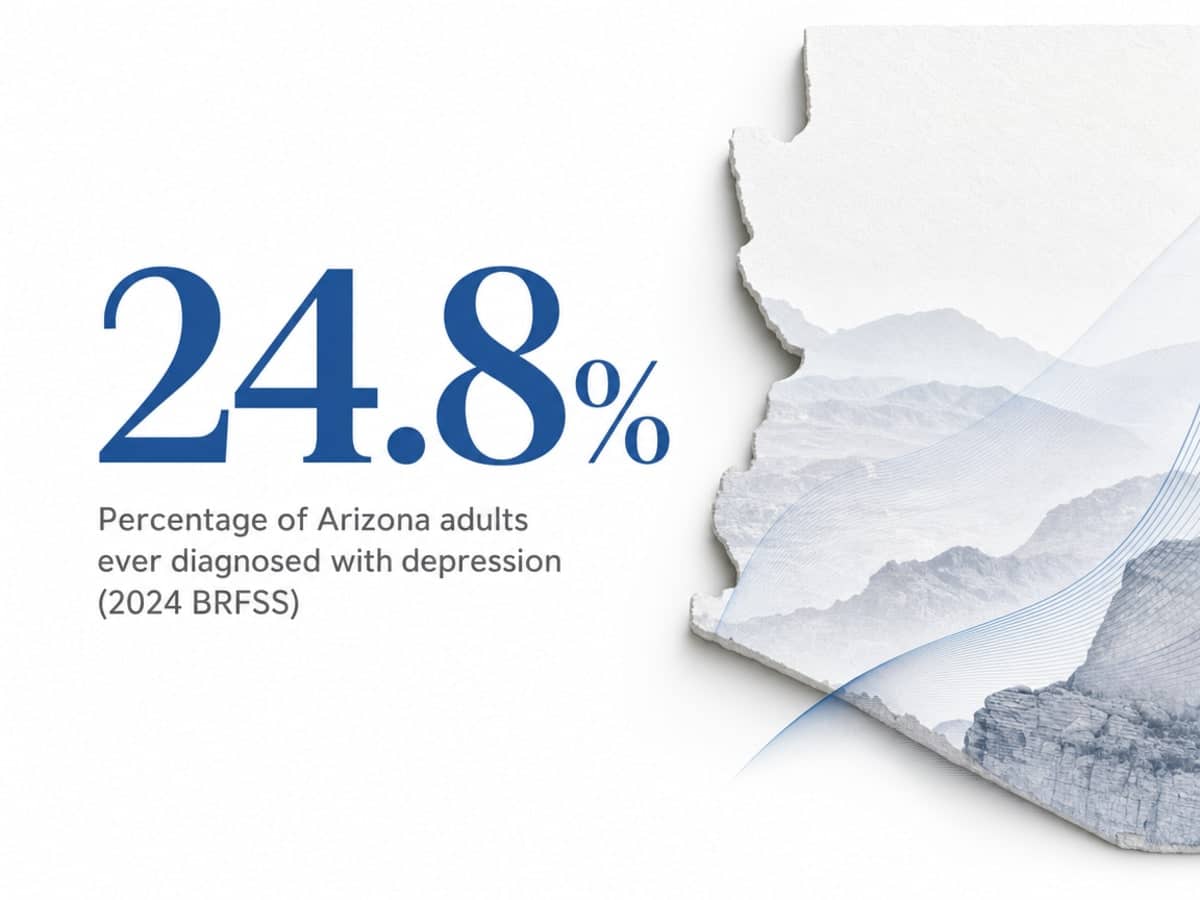
Arizona carries a heavier mood-disorder burden than the national average, and that shows up in what Prescott’s local system is built to handle. CDC’s 2024 BRFSS data puts the share of Arizona adults ever diagnosed with depression at 24.8%, and the state comparison table on the same CDC page shows Arizona at 19.2% in a separate current dataset — either way, near the top of the state distribution 4. Bipolar disorder isn’t broken out in those figures, but the underlying mood-disorder pressure on the outpatient and crisis system is real, and it shapes how quickly you can get seen and at what level of intensity.
For a rapid-cycling reader, the practical question isn’t whether Prescott has bipolar disorder treatment. It does. The question is which parts of the local infrastructure are built for stable outpatient medication management and crisis stabilization, and which parts pick up when your presentation is more complex than either of those categories.
What Yavapai County outpatient and crisis systems cover well
The county-level pieces are stronger than they get credit for. Community Health Center of Yavapai runs behavioral health services across Prescott, Prescott Valley, and Cottonwood, with medication management specifically listed for bipolar disorder alongside anxiety, depression, and PTSD. Same-day and telehealth appointments are part of the model, and most insurances are accepted, including AHCCCS and Medicare 2. For stable maintenance — a working regimen, quarterly check-ins, lab monitoring — that infrastructure is genuinely accessible.
Crisis is the other layer that works. Arizona’s crisis system is insurance-independent by design: any resident can access 988, the statewide 1-844-534-HOPE line, mobile crisis response teams that come to you, and facility-based stabilization — regardless of coverage 1. If you or someone supporting you is watching a manic escalation or a suicidal depressive stretch develop, that access is there. Use it.
Where specialty complex-case psychiatry picks up
Outpatient med management and crisis stabilization are two ends of a spectrum, and rapid cycling with mixed features or a dual-diagnosis pattern often lives in the gap between them. A twenty-minute quarterly visit isn’t structured to run a contributory-factor workup, coordinate substance use care in the same room, or manage a multi-agent regimen for a treatment-resistant presentation 8. A crisis bed isn’t designed for the four to eight weeks of steady, integrated work it takes to actually reset a cycling pattern.
Specialty complex-case psychiatric care is what sits in that middle space — longer visits, integrated dual-diagnosis screening built into the psychiatric evaluation itself 7, and clinical decisions driven by presentation rather than by the length of a standard outpatient slot. If your last year has been episodes-then-ER-then-back-to-outpatient without a durable stretch in between, that middle layer is probably what’s been missing.
When to consider ECT and other higher-intensity options
ECT gets talked about in whispers when it should just be talked about. For a rapid-cycling reader who has crossed the treatment-resistance threshold — two dissimilar trials at adequate dose and duration without a clinically satisfactory response 8— it belongs on the table as one option among several, not as a last resort dressed up in fear.
The guideline language is matter-of-fact: ECT may be considered when someone is very disruptive, not responding to a combination of medications, in a mixed episode, or during pregnancy when medication exposure is a concern 11. Read that plainly. It’s the same clinical logic as any other escalation — the presentation isn’t responding, and there is an evidence-based option that often does. Response rates in treatment-resistant mood episodes are meaningfully better than another sequential medication trial, and modern ECT is not the procedure the cultural imagination keeps rehearsing.
Other higher-intensity options sit alongside it. Structured combination pharmacotherapy — pairing a mood stabilizer with an atypical antipsychotic and, in select cases, a second stabilizer — is the more common next move when contributory factors have been addressed and the regimen still isn’t holding 8. Clozapine is used in some treatment-resistant presentations. Intensive outpatient or residential-level psychiatric care, with daily contact rather than monthly, is often what actually breaks a cycling pattern that briefer visits cannot.
If ECT has been mentioned to you and dismissed in the same breath, or never mentioned at all despite meeting the criteria above, that’s worth reopening. You don’t have to decide anything at the first conversation. You just deserve one that treats the option like clinical care, not a threat.
What durable stabilization actually looks like
Stabilization isn’t the absence of feeling. It’s the return of a floor under your feet — the ordinary certainty that next Thursday will probably resemble this Thursday. For a rapid-cycling reader, that floor is the outcome worth measuring against, not “euthymia” as an abstract ideal.
The concrete markers are more modest than the language around bipolar recovery sometimes suggests:
- A sleep window that holds within an hour of the same bedtime and wake time across the week.
- A stretch of eight to twelve weeks without a new episode meeting duration criteria.
- One planned medication decision made from data rather than from crisis.
- An ER visit that didn’t happen because a mobile crisis call or a same-day appointment caught the escalation earlier 1, 2.
- A substance use pattern that has actually shifted, not just been re-promised.
If you’ve had any of those in the last quarter, that is progress, even if the internal weather still feels rough.
Durable stabilization also means the plan holds when something breaks — a bad week, a missed dose, a family stressor — because integrated care built in relapse planning for both mood and substance use, together, at the start 3. That’s the layer worth asking any specialty program to describe in specifics. If your current picture matches what this piece has walked through and the standard sequencing hasn’t held, teams like ViewPoint Dual Recovery in Prescott are built for exactly this middle ground.
Start Your In-Depth Bipolar Assessment Today
Get expert clarity on your current needs and next steps for effective mood stabilization in Prescott.
Frequently Asked Questions
How is rapid-cycling bipolar disorder treated differently from standard bipolar disorder?
Rapid cycling — four or more mood episodes in twelve months — is treated as a signal to evaluate contributory factors before adjusting medications. Current guidelines note that no single agent has shown consistent superiority for rapid cycling, so the starting move is a structured review of antidepressant exposure, stimulants, thyroid function, substance use, sleep disruption, trauma, and epilepsy rather than another sequential prescription 9.
When does bipolar disorder qualify as treatment-resistant?
The working clinical definition is a clinically unsatisfactory response after at least two trials of dissimilar treatments given at adequate doses and adequate durations 8. Two SSRIs in a row would not count as dissimilar; a mood stabilizer followed by an atypical antipsychotic at therapeutic levels would. Meeting that threshold is a trigger to add combination pharmacotherapy, integrated substance use care, or higher-intensity options — not a verdict on you.
Can I get bipolar disorder treatment in Prescott if I also have a substance use disorder?
Yes, and the evidence favors treating both conditions concurrently in one integrated plan rather than sequentially in two offices. Federal guidance shows integrated care reduces substance use, improves psychiatric symptoms, lowers hospitalization, and improves quality of life 3. Screening for co-occurring disorders should be built into the psychiatric evaluation itself, with level-of-care and functional-impairment assessment handled in the same visit rather than referred out 7.
What contributory factors should a specialty bipolar workup evaluate?
A guideline-driven workup for rapid cycling covers antidepressant exposure, prescribed and unprescribed stimulants, hypothyroidism (including TSH in the upper reference range), substance use patterns and timing, sleep architecture, trauma history, and epilepsy or subclinical seizure activity 9. The point isn’t to catalog problems — it’s to identify what’s actively pushing the cycling forward that a new prescription cannot outrun. Ask for this review before agreeing to a fourth medication.
When is ECT considered for bipolar disorder?
ECT may be considered when someone is very disruptive, not responding to a combination of medications, in a mixed episode, or during pregnancy when medication exposure raises concerns 11. It belongs on the table once treatment-resistance criteria are met — two dissimilar trials at adequate dose and duration without a satisfactory response 8. Modern ECT is presented in guidelines as one clinical option among several, not a last resort.
What crisis resources are available in Yavapai County for a bipolar emergency?
Arizona’s crisis system is insurance-independent: any resident can access 988, the statewide 1-844-534-HOPE line, mobile crisis response teams that come to your location, and facility-based crisis stabilization — regardless of coverage 1. For non-emergency same-day psychiatric access, Community Health Center of Yavapai offers behavioral health services with same-day or telehealth appointments across Prescott, Prescott Valley, and Cottonwood, accepting most insurances including AHCCCS and Medicare 2.
References
- Crisis Hotlines. https://www.azahcccs.gov/BehavioralHealth/crisis.html
- Behavioral Health Services – Yavapai, AZ. https://www.yavapaiaz.gov/Resident-Services/Health-Services/Community-Health-Center-of-Yavapai/Behavioral-Health-Services
- Managing Life with Co-Occurring Disorders. https://www.samhsa.gov/mental-health/serious-mental-illness/co-occurring-disorders
- Mental Health Conditions & Care. https://www.cdc.gov/mental-health/about-data/conditions-care.html
- NSDUH Behavioral Health Barometer: Arizona, Volume 8. https://www.samhsa.gov/data/report/nsduh-behavioral-health-barometer-arizona-volume-8
- Arizona 2021 Uniform Reporting System Mental Health Data Results. https://www.samhsa.gov/data/sites/default/files/reports/rpt39382/Arizona.pdf
- Substance Use Disorder Treatment for People with Co-Occurring Disorders. https://library.samhsa.gov/sites/default/files/pep20-06-04-006.pdf
- Pharmacological Approaches for Treatment-resistant Bipolar Disorder. https://pmc.ncbi.nlm.nih.gov/articles/PMC4761631/
- Clinical practice guidelines for the management of bipolar disorder. https://pmc.ncbi.nlm.nih.gov/articles/PMC12900052/
- Canadian Network for Mood and Anxiety Treatments and International Society for Bipolar Disorders 2021 guidelines for the management of patients with bipolar disorder. https://pubmed.ncbi.nlm.nih.gov/34599629/
- Clinical Practice Guidelines for Management of Bipolar Disorder. https://pmc.ncbi.nlm.nih.gov/articles/PMC5310104/
- The Clinical Management of Bipolar Disorder. https://pmc.ncbi.nlm.nih.gov/articles/PMC3219517/