Key Takeaways
- Gambling disorder shares neurobiology, genetics, and clinical course with substance use disorders, which is why the DSM-5 reclassified it alongside addictions in 2013 3.
- Co-occurrence is common enough to demand bidirectional screening at intake, since 25 to 63 percent of people with pathological gambling also have a substance use disorder 6.
- Integrated treatment, not sequential or parallel handoffs, fits when both conditions are of comparable severity or reinforce each other, delivering CBT, motivational work, and pharmacology inside one plan 6.
- For treatment-resistant cases, the next step is a facility that screens both directions, treats gambling and substance use as separate but interacting problems, and sets duration by clinical response 11.
When Two Addictions Feed Each Other
If you have watched someone you love get sober from alcohol only to lose their savings on a sportsbook six months later, you already know something the treatment system has been slow to admit: compulsive gambling and substance use do not stay in separate lanes. They share circuitry, they share triggers, and they often share a person.
The clinical field caught up in 2013, when the DSM-5 moved pathological gambling out of the impulse-control chapter and placed it alongside substance use disorders under “Substance-Related and Addictive Disorders.” That change followed years of neurobiological and genetic evidence showing that gambling disorder behaves like an addiction, not a bad habit 3. The same reward pathway dysfunction, the same craving states, the same erosion of impaired control 1.
What that means for you, or for the patient sitting across from you, is straightforward. When both conditions are present, treating one and referring out for the other tends to fail both. This piece walks through why the two cluster, where screening usually breaks down, which treatment model the evidence actually supports, and what integrated dual-diagnosis care looks like when someone arrives having already tried the standard programs.
Gambling Disorder Is an Addiction, Not a Character Flaw
The DSM-5 Reclassification and What It Changed
For decades, pathological gambling sat in the DSM under “Impulse-Control Disorders Not Elsewhere Classified,” grouped with kleptomania and pyromania. That placement carried a quiet implication: the person had a problem controlling urges, but it was not quite an addiction. In 2013, the DSM-5 moved it. Pathological gambling was renamed gambling disorder and placed inside “Substance-Related and Addictive Disorders,” the same chapter as alcohol use disorder and opioid use disorder.
That was not a bureaucratic edit. The reclassification followed converging evidence that gambling disorder resembles drug addiction in genetic predisposition, clinical course, treatment response, and cognitive deficits 3. The clinical criteria themselves were rewritten to mirror substance use disorder criteria:
- preoccupation
- tolerance-like escalation of stakes
- withdrawal-like irritability when trying to cut back
- repeated unsuccessful attempts to stop
- continued behavior despite mounting consequences 4
For you as a clinician, or as someone advocating for a family member, this matters practically. It means the language of addiction medicine applies. It means you can stop asking whether gambling “counts” and start asking what integrated treatment looks like. And it means insurers, licensing boards, and referring physicians increasingly recognize gambling disorder as a diagnosable, treatable addiction rather than a moral failing dressed up as a symptom.
Shared Neurobiology: Frontostriatal Circuits, Craving, and Impaired Control
The reclassification rested on brain-level evidence, not just checklist overlap. Imaging and neuropsychological studies show that people with gambling disorder and people with substance use disorders share dysfunction in the same circuits: the ventromedial prefrontal cortex, which handles value-based decision making, and the striatum, which processes reward and reinforcement 1. The result is a familiar pattern to anyone who treats addiction: impulsive choice, poor response inhibition, and a gradual slide from impulsivity into compulsivity as the behavior becomes automatic and consequence-blind.
Craving states look similar too. When someone with gambling disorder is shown gambling cues, the same reward-related regions activate that light up when a person with a substance use disorder sees drug paraphernalia 3. Genetic evidence points the same direction, with heritability estimates and dopamine-related gene variants overlapping across behavioral and substance addictions 2.
The picture is not identical, and the differences matter. PET imaging studies have not consistently shown the same reduction in D2-like dopamine receptor availability in gambling disorder that appears reliably in substance use disorders 2. There is no ingested compound producing tolerance in a strictly pharmacological sense, and withdrawal-like symptoms in gambling disorder remain a topic of active debate 3. So the story is not that gambling is chemically identical to cocaine. It is that the downstream circuitry of reward, control, and craving behaves in overlapping ways, which is why treatments developed for substance addiction, particularly cognitive-behavioral therapy and motivational interviewing, transfer to gambling disorder with real effect 1.
What this gives you is a clinical rationale for treating the two together. If both conditions are driven, at least in part, by the same impaired reward and control circuits, then addressing only one leaves the underlying vulnerability intact.
Why Gambling and Substance Use Cluster Together
Co-Occurrence Rates in Treatment-Seeking Populations
If you have ever watched a substance use treatment program discharge a patient who is stable on naltrexone but quietly maxing out a third credit card at online blackjack, the overlap is not abstract. It is the caseload.
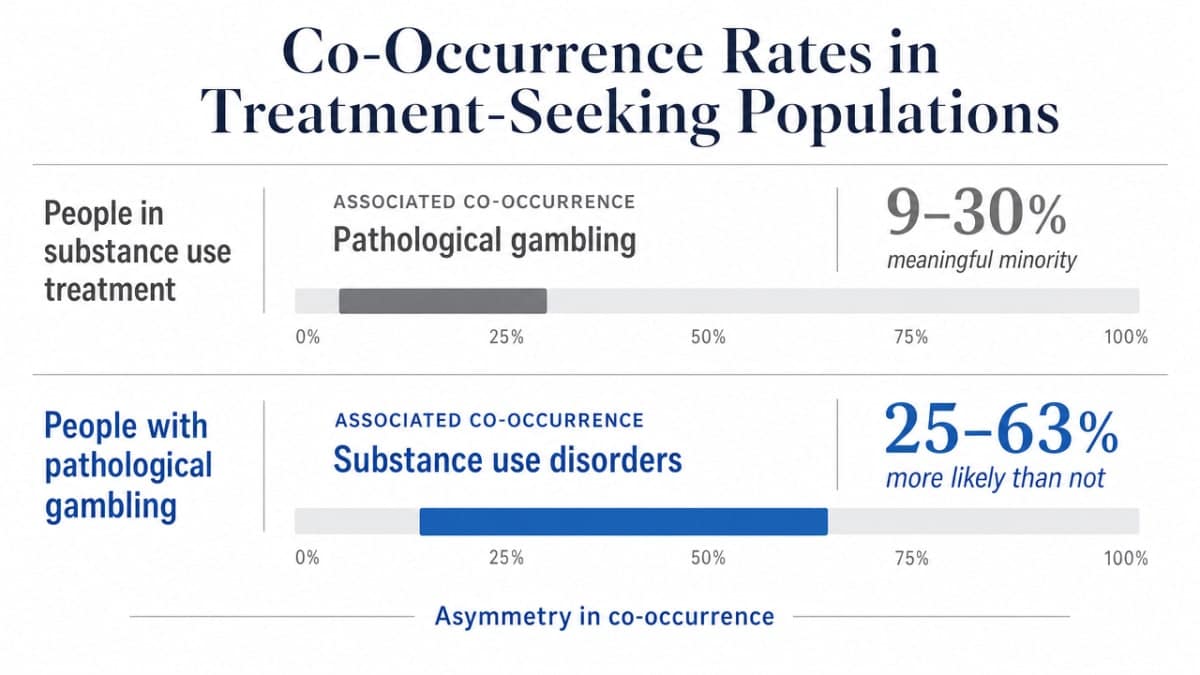
SAMHSA’s TIP 42 quick guide for clinicians pulls the ranges together in one place. Pathological gambling among people receiving substance use treatment falls between 9 and 30 percent, depending on the study population and screening method. Substance use disorders among people already identified with pathological gambling run higher, between 25 and 63 percent 6. The asymmetry is worth pausing on. When gambling is the presenting problem, a substance use disorder is more likely than not to be present too. When a substance use disorder is the presenting problem, gambling is present in a meaningful minority large enough that skipping the screen means missing cases at scale.
Narrower data from AUD and DUD treatment seekers sharpen the picture. Roughly 15 percent meet lifetime criteria for gambling disorder, and about 11 percent meet current criteria at the point they enter care 11. That is not a rare comorbidity to look for after the acute phase settles. It is a diagnosis that walks in the door alongside the primary complaint and deserves a place on the intake checklist, not the discharge summary.
The Reinforcement Loop: How One Behavior Drives the Other
Prevalence tells you the two conditions travel together. The clinical question is why. In practice, gambling and substance use tend to reinforce each other through a loop that neither the patient nor the family sees clearly until it has been running for years.
A win at the sportsbook or the slot machine triggers the same reward circuitry that lights up with a drink or a line, and many people learn to extend that high by pairing the two 1. A loss produces the opposite pull. Shame, anxiety, and financial dread become powerful cues to numb, and alcohol or opioids do that work efficiently. Then the substance disinhibits judgment enough to justify one more bet to get even. The cycle tightens. Because both conditions involve overlapping frontostriatal dysfunction and craving states, the neural substrate that would normally interrupt the sequence is exactly the substrate that is impaired 3.
The Bidirectional Screening Gap
Gambling Screens in Substance Use Settings
The good news is that if you run a substance use program, you have real tools to work with. A 2023 scoping review identified eleven gambling screening instruments that have been validated in SUD populations, and several are short enough to fit inside a standard intake without slowing the workflow 5.
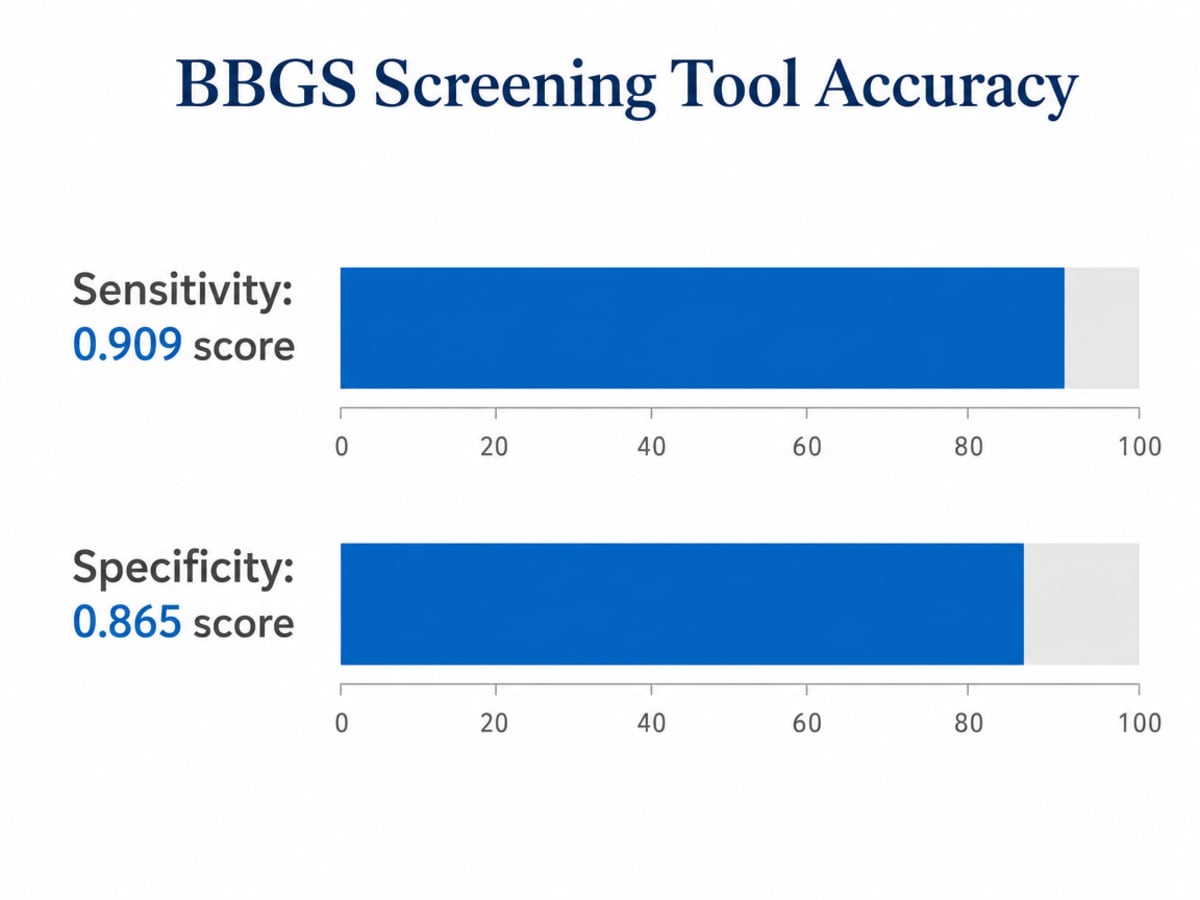
The Brief Biosocial Gambling Screen is the one most often cited. In a methadone clinic sample, the BBGS produced a sensitivity of 0.909 and a specificity of 0.865 5. Translated into clinic language, that means it catches roughly nine out of ten people who actually have a gambling problem and correctly clears about 87 percent of those who do not. Three yes-or-no questions. No specialist training required to administer.
SAMHSA’s TIP 42 quick guide backs this up at the policy level, recommending universal screening for co-occurring conditions at intake rather than reactive screening after a crisis 6. State-level guidance goes further. The Iowa Problem Gambling Toolkit recommends that every client presenting with substance abuse or mental health concerns be screened for gambling problems as a matter of course 12. If your program does not currently screen, the barrier is not the science or the instrument. It is the intake form.
Substance Screens in Gambling Settings: The Missing Direction
Flip the direction and the picture gets thinner. The same 2023 scoping review that catalogued eleven validated gambling screens for SUD settings noted the reverse asymmetry: there is a scarcity of tools designed specifically to screen for substance use inside gambling treatment programs 5.
That gap has clinical consequences. When someone walks into a problem gambling program, the clinician may lean on general substance use questionnaires borrowed from other settings, or on informal clinical judgment. Neither carries the same validation evidence as a purpose-built instrument. Given that substance use disorders are present in a large share of people with pathological gambling, missing the second diagnosis at the front door means building a treatment plan around half the problem 11.
For a dual-diagnosis facility, the operational fix is not complicated but it has to be deliberate. Screen in both directions at intake, use validated SUD instruments even if they were built for general clinical populations, and treat a positive screen in either direction as a trigger for full assessment rather than a note in the chart.
Three Treatment Models: Parallel, Sequential, and Integrated
What Each Model Actually Looks Like in Practice
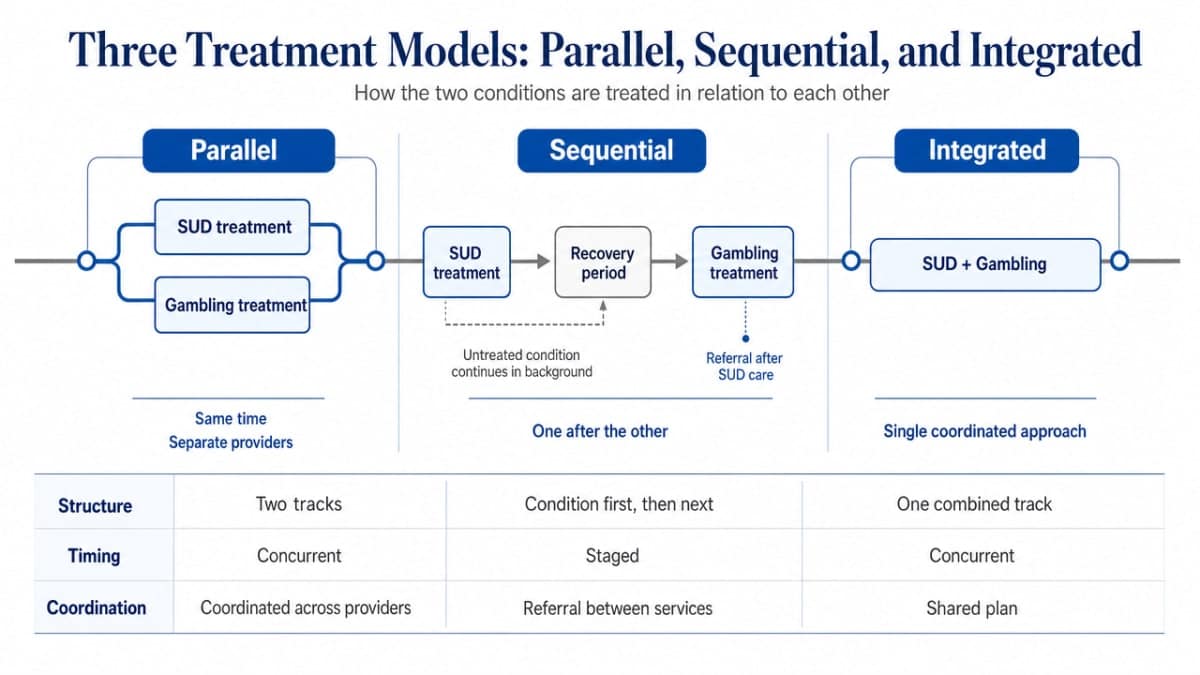
Once both diagnoses are on the table, the next decision is structural: how the two conditions get treated in relation to each other. The field has settled on three broad models, and the differences matter more than the labels suggest.
- Sequential treatment
- Handles one condition first and the other after. In practice, that usually means stabilizing the substance use disorder in a standard program, then referring to problem gambling treatment once the person is a few months into recovery. The Oregon SUD toolkit describes this pathway explicitly: if the substance use disorder is the more severe or acute problem, referral to gambling treatment can follow completion of SUD care 9. The risk is obvious. The untreated condition keeps working in the background, and the person may relapse in the first addiction before the second one is ever addressed.
- Parallel treatment
- Runs both tracks at once but in separate settings, with two clinical teams coordinating by phone or shared notes. A patient might attend an intensive outpatient SUD program on weekdays and a problem gambling group on evenings. Coordination is the weak point. When the teams do not share a treatment plan, the patient becomes the messenger.
- Integrated treatment
- Puts both conditions inside a single plan, delivered by a team that treats them as separate but interacting problems in the same room 6. TIP 42 frames this as the screen, assess, diagnose, and manage model, with a coordinated plan rather than two plans stapled together 7. It is the model the evidence increasingly favors for co-occurring cases.
Choosing the Right Model Based on Severity and Causal Role
The choice between models is not aesthetic. State-level guidance ties it to two clinical questions: which condition is more severe, and which one appears to be driving the other.
The Oregon Problem Gambling Services toolkit sets a specific rule for its integrated track. To qualify for integrated services inside a problem gambling program, the severity of gambling disorder must be greater than or equal to the severity of any co-occurring disorder, and co-occurring disorders are treated as the norm rather than the exception 8. Flip the setting and the logic flips with it. The Oregon SUD toolkit advises that when gambling behavior appears more severe than the substance use, or when gambling seems to be driving the substance use, immediate referral to problem gambling treatment is warranted rather than waiting for SUD treatment to finish 9.
The practical takeaway is this:
- Sequential treatment fits only when one condition is clearly dominant, clearly acute, and the other is mild enough to hold safely.
- Parallel treatment fits when two capable programs already coordinate closely and the patient can absorb the logistical load.
- Integrated treatment is the default for co-occurring gambling and substance use disorders of comparable severity, especially when the two behaviors reinforce each other or when previous single-focus treatment has already failed.
That last group is where dual-diagnosis facilities like ViewPoint most often see the referral.
What Integrated Care Delivers Clinically
CBT, Motivational Work, and Concurrent Behavioral Targets
Cognitive-behavioral therapy is the treatment with the deepest evidence base for gambling disorder, and it remains the standard of care whether gambling appears alone or alongside a substance use disorder 10. The reason it transfers so well is that the underlying targets overlap. CBT works on the automatic thoughts that precede a bet or a drink, the cognitive distortions that rationalize the next one, and the behavioral chains that carry a person from a trigger to a relapse before they consciously notice the sequence starting.
In an integrated plan, that work happens on both targets in the same session structure rather than in two separate curricula. A single functional analysis can map how a losing streak drives drinking and how drinking loosens the brakes on the next bet, because both behaviors are being treated as separate but interacting problems within one plan 6. Motivational interviewing sits alongside CBT to handle the ambivalence that shows up unevenly across the two conditions. Someone may arrive committed to alcohol abstinence and quietly unconvinced that sports betting is a real problem, and the motivational work meets that gap directly 13.
Pharmacology: What Helps, What Is Off-Label, What Is Not Approved
Here is the part that surprises families and referring physicians: no medication has FDA approval for gambling disorder 10. That is not a footnote. It shapes every honest conversation about what pharmacology can and cannot do when both conditions are present.
The medications that have shown the most promise are used off-label. Naltrexone, already approved for alcohol use disorder and opioid use disorder, has the strongest signal for reducing gambling urges and behavior in clinical trials, and it can address both targets when alcohol or opioids are the co-occurring substance 10. N-acetylcysteine, a glutamatergic agent, has shown effect in smaller studies and is sometimes layered in when naltrexone is not tolerated or not enough 10.
For the substance side, standard evidence-based pharmacotherapy applies without asterisk, including medications for opioid use disorder, alcohol use disorder, and any co-occurring psychiatric conditions driving the picture. What integrated care adds is a psychiatrist who is choosing those medications with the gambling behavior in mind, not treating them as a separate problem to be handled after discharge 13.
Mutual-Help Groups: Why GA and AA Are Not Interchangeable
Mutual-help involvement supports recovery in both conditions, but the two fellowships are not substitutes for each other. The Iowa Problem Gambling Toolkit is direct about this, cautioning clinicians against treating Gamblers Anonymous and Alcoholics Anonymous as interchangeable and reminding them to respect the distinct cultures, language, and step interpretations each fellowship carries 12.
The practical version of that guidance is straightforward. If someone has both diagnoses, the clinical recommendation is participation in both fellowships, not one as a stand-in for the other. GA meetings speak to financial wreckage, action cravings, and the specific shame patterns of gambling. AA and NA meetings address substance-specific triggers, physical recovery, and the social scaffolding of abstinence. The integrated plan holds both, and the treatment team helps the person find meetings that fit rather than choosing on their behalf.
When Someone Arrives Treatment-Resistant
By the time someone lands in a specialized dual-diagnosis facility with active gambling and active substance use, the chart usually tells a specific story. Detox once or twice. A residential SUD program that never asked about gambling. Outpatient therapy that treated the drinking as the problem and the sports betting as a symptom. A relapse that started at a casino, or a relapse that started with a drink after a bad loss. The pattern is not unusual, and it is not failure on the patient’s part.
What tends to have been missed is the second diagnosis, the interaction between the two, or both.
- If gambling was never formally screened during earlier SUD care, the treatment plan was built around half the picture 11.
- If gambling was noticed but referred out for a program the person never entered, the reinforcement loop kept running through recovery 13.
- If psychiatric comorbidity was present but managed by a separate prescriber who was not thinking about gambling behavior when choosing medications, the pharmacology may have worked against the behavioral plan 10.
What changes on arrival is the assumption. Bidirectional screening happens at intake, not after a crisis. Both conditions get written into one treatment plan as separate but interacting problems 6. Duration is set by clinical response rather than by whichever diagnosis the insurance authorization named first.
How ViewPoint Structures Dual-Diagnosis Care in Prescott
ViewPoint Dual Recovery sits in Prescott, Arizona, and takes the referrals other programs describe as too complex. That framing matters here because active gambling layered over active substance use, often with a treatment-resistant psychiatric diagnosis underneath, is exactly the presentation that breaks a single-focus program.
Three operational choices shape how the work gets done. The first is bidirectional screening at intake, applied to every admission rather than triggered by a disclosure. Gambling is screened in people arriving for substance use treatment, and substance use is screened in people arriving with gambling as the presenting problem, closing the asymmetry that most programs leave open 5. A positive screen in either direction moves into full assessment, not a chart note.
The second is an integrated care team. Board-certified psychiatry and therapy work from one plan that treats gambling and substance use as separate but interacting problems, with medication decisions made in view of the behavioral targets rather than after discharge 6. CBT and motivational work run concurrently on both behaviors, and any co-occurring psychiatric condition is managed inside the same plan rather than parked at a separate prescriber 10.
The third is duration set by clinical response, not by whichever diagnosis the authorization named first. If you or someone you love has already completed a program that missed one of these two problems, that is the case ViewPoint is built for. Reach out to talk through whether an integrated plan fits.
Get Answers for Complex Addictive Behaviors Now
Clarify your next steps for co-occurring gambling and substance use with a tailored clinical assessment.
Frequently Asked Questions
Can compulsive gambling and substance use disorder be treated at the same time?
Yes, and the evidence points strongly in that direction. SAMHSA’s TIP 42 framework treats co-occurring conditions as separate but interacting problems inside a single coordinated plan rather than handing the patient between siloed programs 6. Cognitive-behavioral therapy and motivational interviewing address both targets in the same session structure, which is why integrated care has become the working default for these presentations 13.
Is gambling disorder really considered an addiction like drugs or alcohol?
Clinically, yes. The DSM-5 moved pathological gambling out of the impulse-control chapter in 2013 and placed it inside “Substance-Related and Addictive Disorders” based on shared neurobiology, genetics, treatment response, and clinical course 3. Imaging studies show overlapping dysfunction in the ventromedial prefrontal cortex and striatum, the same reward and control circuits involved in substance addiction 1.
Is there a medication approved to treat gambling disorder?
No medication currently has FDA approval specifically for gambling disorder 10. Naltrexone, already approved for alcohol and opioid use disorders, has shown the strongest off-label signal for reducing gambling urges, and N-acetylcysteine has some smaller-study support 10. When both conditions are present, a psychiatrist choosing medications with the gambling behavior in mind can address more than one target at once.
Can Gamblers Anonymous replace AA if someone has both problems?
No. The Iowa Problem Gambling Toolkit is direct that GA and AA are not interchangeable and should not be swapped for each other 12. GA addresses financial wreckage, action cravings, and gambling-specific shame patterns. AA or NA addresses substance-specific triggers and physical recovery. If both diagnoses are present, the recommendation is participation in both fellowships, not one as a stand-in.
What should someone do if previous treatment addressed only substance use and gambling returned?
That pattern usually means gambling was never formally screened or was noticed and referred out to a program the person never entered 11. The next step is a full bidirectional assessment at a dual-diagnosis facility that treats both conditions inside one plan, with medication decisions made in view of the behavioral targets rather than parked at a separate prescriber 6.
How long should dual-diagnosis treatment for gambling and substance use last?
Length should track clinical response, not the diagnosis an insurance authorization named first. TIP 42 recommends stage-wise interventions inside a coordinated plan that adjusts as each condition changes 7. For treatment-resistant cases where earlier programs missed one diagnosis or treated them sequentially, duration set by clinical need rather than a fixed timeline is what tends to hold both recoveries together 10.
References
- Similarities and differences between pathological gambling and substance use disorders: a focus on impulsivity and compulsivity. https://pubmed.ncbi.nlm.nih.gov/22057662/
- A targeted review of the neurobiology and genetics of behavioral addictions. https://pmc.ncbi.nlm.nih.gov/articles/PMC3762982/
- Pathological gambling: a review of the neurobiological evidence relevant for its classification as an addictive disorder. https://pmc.ncbi.nlm.nih.gov/articles/PMC5808418/
- Gambling disorder and other behavioral addictions. https://pubmed.ncbi.nlm.nih.gov/25747926/
- Screening and Treatment for Co-occurring Gambling and Substance Use: A Scoping Review. https://pmc.ncbi.nlm.nih.gov/articles/PMC10628029/
- Quick Guide for Clinicians Based on TIP 42—Substance Abuse Treatment for Persons With Co‑Occurring Disorders. https://radarcart.boisestate.edu/library/files/2017/07/TIP-42_QuickG_co-occurring_clinician_SMA07-4034.pdf
- TIP 42: Substance Use Treatment for Persons With Co-Occurring Disorders. https://library.samhsa.gov/product/tip-42-substance-use-treatment-persons-co-occurring-disorders/pep20-02-01-004
- Oregon Health Authority Problem Gambling Services Co-Occurring Disorders Toolkit. https://www.oregon.gov/oha/HSD/Problem-Gambling/Documents/Co-Occurring%20Disorders%20Toolkit.pdf
- Oregon Health Authority Substance Use Disorder Toolkit (Problem Gambling Integration Sections). https://www.oregon.gov/oha/HSD/Problem-Gambling/Documents/SUD%20Toolkit%20Ver%201%20FINAL.pdf
- Gambling disorder comorbidity: a narrative review. https://pmc.ncbi.nlm.nih.gov/articles/PMC11980244/
- A review of gambling disorder and substance use disorders. https://pmc.ncbi.nlm.nih.gov/articles/PMC4803266/
- Problem Gambling Toolkit. https://hhs.iowa.gov/media/11228/download?inline
- Gambling and substance use: Comorbidity and treatment. https://pubmed.ncbi.nlm.nih.gov/31881248/