
Key Takeaways
- Arizona sees roughly 19% of adults with mental illness and 7% with substance use disorders, yet dual-trained clinicians remain scarce outside Phoenix and Tucson 7.
- Standard DBT reduces borderline symptoms but not substance use — only the SUD-adapted protocol, which folds relapse targets into the treatment hierarchy, moves both problems together 1, 4.
- When evaluating an Arizona program, verify it runs DBT-SUD with shared case formulation, diary-card-informed prescribing, and length of stay tied to clinical progress rather than benefit days.
- One Arizona Opioid Settlement funds now explicitly cover integrated co-occurring treatment, so ask programs how they coordinate settlement-supported slots and county behavioral health resources 13.
When Standard Treatment Hasn’t Held: Why DBT Enters the Conversation
If you’re reading this, you probably know the drill. Detox. A 30-day residential stay. An intensive outpatient program. Maybe a psychiatric hospitalization when things got sharp. And somewhere in the middle of all that, the quiet realization that the substance use and the psychiatric symptoms aren’t two problems taking turns — they’re one system, feeding itself.
That’s not a failure of effort. It’s a mismatch of model. Standard SUD care often treats substance use as the primary target and hopes mood, self-harm urges, and emotional flooding settle down once you’re sober. Standard psychiatric care often treats the diagnosis and hopes the drinking or using quiets when the medication lands. When someone carries both — a serious mental health condition and a substance use disorder — those parallel tracks tend to leak.
Dialectical Behavior Therapy earns a serious look here because it was built for exactly this kind of complexity. The original protocol was designed for chronically suicidal, multi-problem clients, and it was later adapted into DBT for Substance Abusers to fold relapse-prevention targets and substance-focused hierarchies directly into the DBT framework rather than bolting them on the side 1. That distinction — one integrated formulation, not two competing ones — is the whole reason DBT keeps showing up in dual diagnosis conversations. The rest of this piece walks through what the evidence actually supports, what it doesn’t, and what integrated care looks like on the ground in Arizona.
What the Evidence Actually Says About DBT for Dual Diagnosis
Standard DBT vs. DBT-SUD: The Distinction That Matters
Here’s the honest read on the research, because you deserve it before you invest another six months of your life in a program.
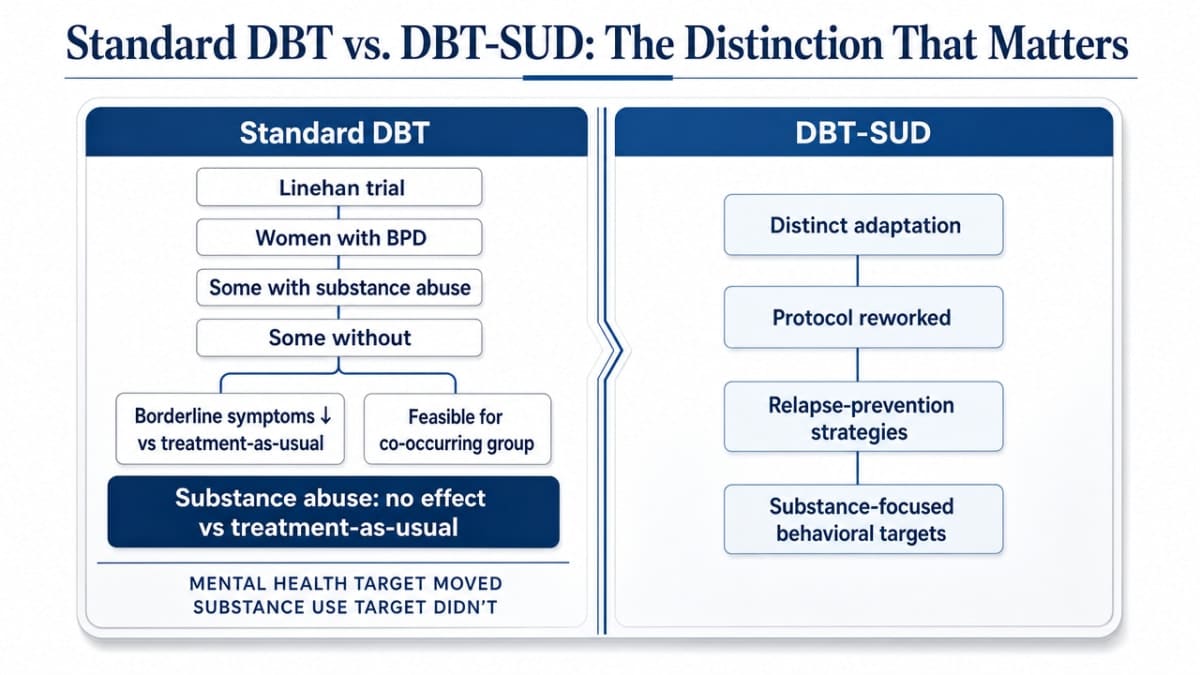
When Linehan’s team ran a randomized trial of standard DBT with women who had borderline personality disorder — some with comorbid substance abuse, some without — the result was a split verdict. Standard DBT produced greater reductions in severe borderline symptoms than treatment-as-usual, and it was feasible for the co-occurring group. But on substance abuse problems specifically, unmodified DBT had no effect compared to treatment-as-usual 4. Read that twice. The mental health target moved. The substance use target didn’t.
That finding is exactly why DBT-SUD exists as a distinct adaptation. When the protocol was reworked to fold in relapse-prevention strategies, substance-focused behavioral targets, and a treatment hierarchy that names substance use as a quality-of-life-interfering behavior worth targeting directly, the picture changed 1. A systematic review of DBT for co-occurring BPD and SUD concluded the adapted approach shows promise across both psychiatric and substance use outcomes, and a meta-analysis of the same population found significant improvements in BPD symptom severity alongside reductions in substance use compared to control conditions 9, 10.
So the label “DBT” on a brochure doesn’t tell you much. What matters is whether the program is running an SUD-adapted version — with substance-specific targets in the treatment hierarchy, diary cards that track urges and use, and a therapist team that treats a relapse as clinical information rather than a discharge trigger. If you’ve been in a program that offered a DBT skills group on Wednesdays while the SUD track ran on Tuesdays and Thursdays, that’s not what the trials tested. That’s parallel play. The evidence that moves both problems together comes from protocols where the two are formulated as one case from day one 1, 10.
How DBT Skills Map to Co-Occurring Risk
You already know the four modules. What’s more useful is watching how each one lands on a specific dual diagnosis pressure point — the moments where symptoms and substances actually collide.
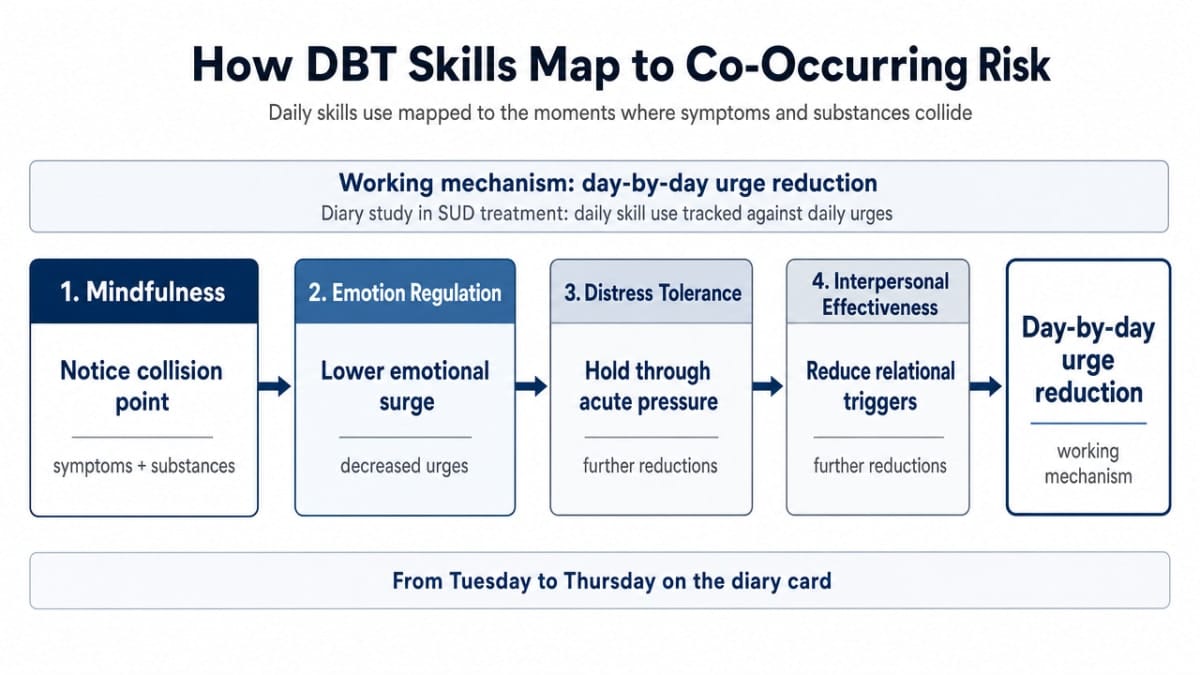
A 2023 diary study of adults in SUD treatment tracked daily skill use against daily urges. Mindfulness and emotion regulation skills were associated with decreased urges in people with high baseline use. Distress tolerance and interpersonal effectiveness skills predicted further reductions on top of that. The authors’ takeaway: DBT skills appear to be a working mechanism for lowering urges, day by day, in people with alcohol and other substance use 12. That’s not an outcome measured a year later in a journal. That’s what happened between Tuesday and Thursday on someone’s diary card.
Translate that into what the modules actually target:
Mindfulness addresses the automaticity of use — the seven-second gap between a trigger and a hand reaching for a bottle. For someone with dissociative symptoms or trauma reactivity layered on top of a substance use disorder, that gap is often where the whole day is lost.
Distress tolerance is the module built for the exact moment the urge peaks and skills-based abstinence feels impossible. TIPP, radical acceptance, and urge-surfing are engineered for the crisis point, which is why they map so cleanly onto relapse prevention. In DBT for Substance Abusers, this module gets extra weight because the protocol treats substance urges as high-risk behaviors that warrant crisis-level skill deployment 1.
Emotion regulation is where mood-driven use gets addressed at the source. If you’ve watched a depressive episode or a hypomanic surge pull someone back to use within 72 hours of discharge, you’ve seen why this module has to be doing real work — not just being reviewed in a Wednesday group.
Interpersonal effectiveness catches the conflict-triggered relapses. The fight with a partner, the boundary violation from a family member, the pull to use after a work confrontation. DBT for Substance Abusers preserves DBT’s five treatment functions — motivation, capability, generalization, environment, and therapist support — so these skills get rehearsed and coached across settings, not just named in a handout 1.
Skills alone are not the whole treatment. But the mechanism the research keeps pointing to is that the skills themselves are doing work on the substance use side, not just the psychiatric side 12.
Breadth of Adaptation: Beyond BPD-Only Populations
Most of the DBT dual diagnosis literature grew out of BPD-plus-SUD research, which is worth naming clearly. But the family of adapted protocols has been widening, and that matters if your presentation doesn’t fit the classic BPD picture.
A randomized trial of DBT adapted for women with concurrent eating disorders and substance use disorders found a significant positive effect on disordered eating features, substance use severity, negative mood regulation, and depressive symptoms compared to treatment-as-usual 2. That’s a different co-occurring pairing entirely, and the skills carried the load across all of it.
A pilot randomized trial extended DBT into methamphetamine use disorder, a population where psychiatric comorbidity is common and where, as the authors noted, no DBT randomized trials had previously examined cessation outcomes. The protocol was a 16-session DBT-based intervention targeting craving and cessation 6. It’s early evidence, not a settled case, but it signals that DBT skills are being tested against stimulant use — a gap that matters if your dual diagnosis story involves meth rather than opioids or alcohol.
Broader still, a meta-analysis of DBT for substance-related issues found DBT groups were superior to alternative treatment and waitlist groups in symptom remission and abstinence increases, with the honest caveat that follow-up abstinence differences were not always significant 11. And an adapted DBT skills training program for adults with mixed co-occurring presentations produced significant reductions in emotional dysregulation and self-reported substance misuse over six months, though follow-up substance use data was more limited 14.
The through-line: DBT for dual diagnosis is not one protocol. It’s a family of adapted approaches, tested across BPD, eating disorders, stimulants, and mixed co-occurring populations. When you’re evaluating a program, ask which adaptation they’re using and why it fits your specific mix.
The Arizona Context: Prevalence, Workforce, and Access
How Common Co-Occurring Disorders Are in Arizona
You are not an outlier here. That’s worth saying plainly, because treatment resistance can feel like a lonely diagnosis.
In Arizona, 19.24% of adults experienced mental illness in the prior year, and 7.36% of adults experienced a substance use disorder in the same window 7. Nationally, roughly 3.4% of Americans meet criteria for co-occurring mental illness and SUD, and the patterns hold across metro and non-metro Arizona with relatively similar rates 7. The Center for Rural Health frames behavioral health explicitly as “mental health, substance use disorders, and co-occurring disorders” — one umbrella, three overlapping populations, one shared workforce trying to reach them 8.
Do the arithmetic on those numbers against Arizona’s adult population and you’re looking at hundreds of thousands of people managing at least one behavioral health condition, and a smaller but still substantial group carrying both at once. The co-occurring group is the one that most often bounces between systems — showing up in emergency departments during a psychiatric crisis, then in detox after a relapse, then back in an outpatient clinic that treats one problem at a time.
The scale of the burden isn’t the story on its own. What matters is what it means for you: dual diagnosis is common enough in Arizona that specialized programs exist, and rare enough within any single generalist setting that most clinicians don’t get to build deep expertise in treating both together.
Workforce Shortages and What They Mean for Getting Real DBT
Here’s where Arizona’s map gets uncomfortable. The state’s behavioral health workforce is stretched thin, and non-metro regions — including much of the terrain around Prescott, Flagstaff, and the rural counties — carry provider shortages that outstrip the metro Phoenix and Tucson corridors 7. Co-occurring rates are only slightly lower outside the metros, but the clinicians trained to treat both problems together are considerably scarcer 7.
That shortage shows up in your search in specific ways. A therapist who advertises “DBT-informed” services isn’t necessarily on a DBT team with weekly consultation, phone coaching, and adherence to the full protocol. A residential program that runs a DBT skills group isn’t necessarily running DBT-SUD with substance-specific targets in the treatment hierarchy 1. When the workforce is thin, the label gets used loosely. That’s not anyone’s bad faith — it’s what happens when demand outruns supply.
Digital DBT is one response to the geography problem. A 2024 randomized trial of a self-guided internet DBT program for adults with SUD and co-occurring mental health concerns found medium-to-large improvements in substance dependence, depression, anxiety, suicidality, emotional dysregulation, and functional disability by 12 weeks 3. That’s meaningful for people in rural counties who can’t drive two hours to a specialty clinic. It is not a substitute for integrated residential care when your symptoms include serious suicidality, treatment-resistant psychiatric illness, or a use pattern that has already survived outpatient work.
Funding Pathways for Integrated Care
Cost is the wall that stops a lot of people from reaching integrated care, and it’s worth naming one funding development that’s changed the picture in Arizona.
The One Arizona Opioid Settlement Agreement lists approved uses that explicitly include funds to “support treatment of OUD and any co-occurring Substance Use Disorder or Mental Health (SUD/MH) conditions, co-usage, and/or co-addiction” 13. That language matters. It means state and local dollars flowing from opioid settlements can be directed at exactly the kind of integrated dual diagnosis treatment where DBT-informed care lives — not just at medication-assisted treatment or overdose reversal alone.
What that means for you practically: if opioids are anywhere in your co-occurring picture, ask any Arizona program you’re considering how they interact with settlement-funded services, what sliding-scale or grant-supported slots exist, and how they coordinate with county behavioral health authorities. The funding is authorized. The question is whether a program is set up to use it on your behalf.
What Integrated Looks Like Inside a Dual Diagnosis Program
Shared Case Formulation, Not Parallel Tracks
The word “integrated” gets used loosely. Here’s what it actually means at the case-formulation level, and why it matters for you.
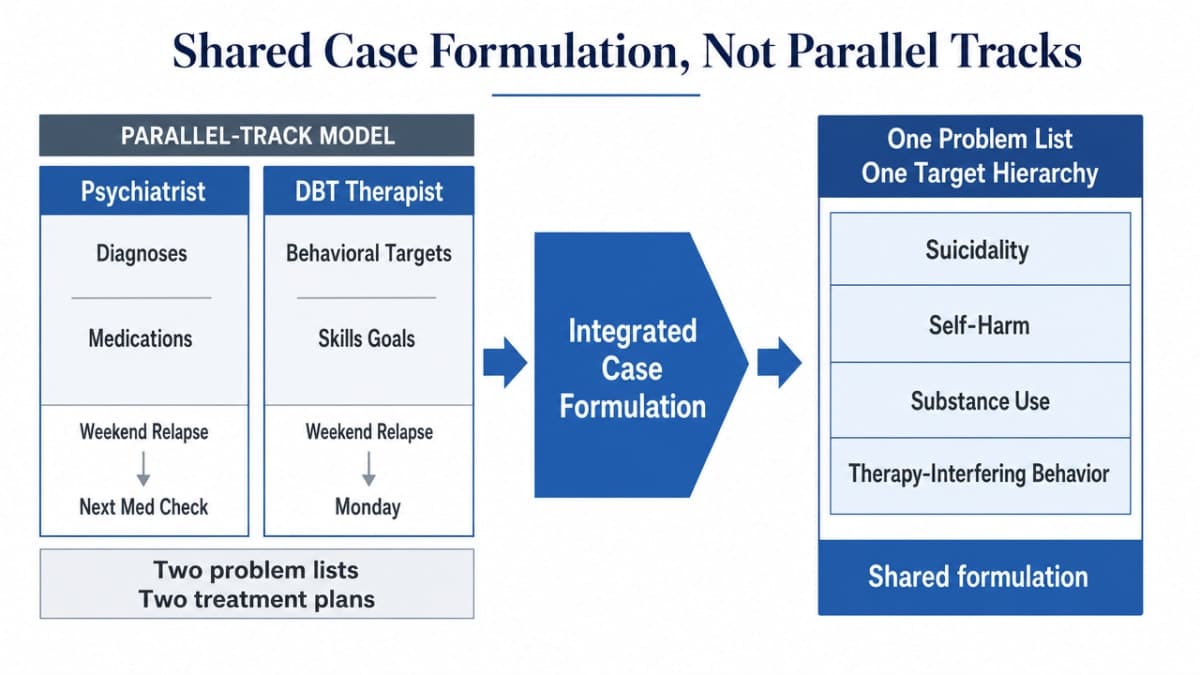
In a parallel-track program, your psychiatrist writes one problem list and your DBT therapist writes another. The psychiatrist’s list has diagnoses and medications. The therapist’s list has behavioral targets and skills goals. When you relapse over a weekend, the therapist hears about it Monday and the psychiatrist maybe hears about it at the next med check two weeks later. Two clinicians, two stories about you, two treatment plans quietly disagreeing.
Integrated case formulation collapses that. One problem list. One target hierarchy. The DBT for Substance Abusers framework was specifically designed so substance use sits inside the same treatment hierarchy as suicidality, self-harm, and therapy-interfering behavior — not on a separate ledger — and so the five treatment functions (motivation, capability, generalization, environment, therapist support) apply across both the psychiatric and substance use targets 1. That means when your therapist and psychiatrist meet, they are working from the same diary card and the same behavioral chain analysis of what happened Saturday night.
Practically: your team knows that Tuesday’s emotion regulation failure and Wednesday’s use are the same event, not two. That’s the difference between a program that treats you as one person and one that treats you as two case files stapled together.
Medication Decisions That Respond to Skills-Use Data
This is where integration stops being philosophy and starts being clinical practice.
If DBT skills are doing measurable work on urges day by day — and the diary evidence suggests they are, with mindfulness and emotion regulation associated with decreased urges in high-baseline users, and distress tolerance and interpersonal effectiveness predicting further reductions 12— then your psychiatrist should know when the skills are landing and when they aren’t. That information changes prescribing.
A mood stabilizer decision looks different when your team can see three weeks of diary cards showing that emotion regulation skills lose traction during the luteal phase, or after specific interpersonal triggers, or when sleep collapses. An anti-craving medication decision looks different when the team can see that urges are peaking despite consistent distress tolerance skill use — a signal the pharmacology needs to carry more of the load. A benzodiazepine taper looks different when distress tolerance skills are reliably deployed versus when they’re not being touched.
In a parallel program, the psychiatrist prescribes on symptom report at 20-minute intervals. In an integrated program, the psychiatrist prescribes on a fuller picture that includes what your skills are and aren’t doing. That’s a real clinical difference, and it’s one of the specific reasons DBT belongs inside a dual diagnosis program rather than beside it.
Clinical Progress as the Length-of-Stay Driver
You have almost certainly been discharged from a program before you were ready. Most people with treatment-resistant presentations have. Benefit days ran out, or the 30-day mark hit, or the utilization reviewer decided the acute crisis had resolved even though the underlying dysregulation had not.
Integrated dual diagnosis care built around DBT works on a different clock. The evidence base for DBT skills in co-occurring populations tracks change over months, not days — the adapted skills training study measured emotional dysregulation and substance misuse over six months, with skills use sustained during treatment 14, and the co-occurring BPD-SUD trials typically run a year of active treatment before follow-up 2, 10. Skill acquisition and generalization are the mechanism, and neither runs on a two-week schedule.
In practice, that means your length of stay should be tied to clinical markers you can name: are the diary cards showing skills use across the week, are urges declining in frequency or intensity, is the crisis behavior chain shortening, is the psychiatric symptom picture stabilizing? Those are the questions that should be driving your discharge date. Not the calendar.
For the Treatment-Resistant Reader: What Changes With DBT
You have tried things. That is worth naming before anything else. If you have already been through CBT that felt too tidy for what you’re actually carrying, or medication-assisted treatment that steadied the substance but left the mood untouched, or a residential SUD stay that held for a month and then didn’t — that history is data. It tells you something specific about what the next attempt needs to include.
What tends to change with an SUD-adapted DBT approach inside a dual diagnosis program is the unit of measurement. Instead of counting sober days or symptom scores in isolation, the work tracks whether skills are being used, whether urges are shrinking when they’re deployed, and whether the crisis chain is getting shorter. The diary evidence suggests those daily skill-to-urge relationships are real: mindfulness and emotion regulation lower urges in people with high baseline use, and distress tolerance and interpersonal effectiveness add more reduction on top 12. That’s a different kind of progress marker than a 30-day chip. It’s smaller, more frequent, and it belongs to you.
Something else shifts. Relapse stops being a discharge event and becomes clinical information. In DBT’s framework, substance use sits inside the treatment hierarchy alongside suicidality and therapy-interfering behavior, which means a slip triggers a behavioral chain analysis, not a phone call telling you to pack 1. If you have been kicked out of a program for using — and many treatment-resistant readers have — that structural change matters. It is the difference between a system that punishes the symptom it claims to treat and one that expects the symptom and has a protocol for it.
Celebrate the small markers when they come. One urge ridden out on a Tuesday afternoon. A week of diary cards actually filled in. A fight with a family member that didn’t end in a bottle. Those are not consolation prizes for people who couldn’t get the big win. In the co-occurring evidence, those are the win — the mechanism that eventually moves the larger outcome 12, 14. If nothing else has held, this is a different kind of holding.
ViewPoint Dual Recovery in Prescott: A Next Step Worth Considering
If the honest version of your history includes multiple attempts that didn’t hold, the next program you enter should be built for exactly that. ViewPoint Dual Recovery in Prescott is a Joint Commission-accredited psychiatric facility that treats co-occurring mental health and substance use disorders as one clinical picture, with board-certified psychiatry available around the clock and DBT-trained therapists sharing case formulation with the prescribing team.
What that means in practice is the structure this article has been describing: substance use targets and psychiatric targets on the same treatment hierarchy 1, medication decisions informed by what your skills are actually doing between sessions 12, and length of stay set by clinical progress rather than a benefit-day countdown. For readers in Arizona’s non-metro corridors where dual-trained clinicians are scarce 7, having psychiatry and DBT-informed therapy under one roof matters.
When you’re ready to look at what integrated care could look like for your specific mix, ViewPoint’s Dual Diagnosis and Co-Occurring Disorder Treatment page is the place to start. Not a sales pitch. A next step.
Find out if integrated DBT fits your needs
Discover your best pathway for dual diagnosis and DBT support with a personalized assessment.
Frequently Asked Questions
Is DBT actually evidence-based for substance use, or only for borderline personality disorder?
Both, but with important nuance. Standard DBT is strongly evidence-based for BPD symptoms, and a meta-analysis of DBT for substance-related issues found DBT superior to alternative treatments and waitlist controls for remission and abstinence 11. Standard DBT alone did not move substance use outcomes in the original BPD trial — that took the SUD-adapted protocol 4.
What is the difference between standard DBT and DBT-SUD?
DBT-SUD folds relapse-prevention strategies and substance-focused behavioral targets directly into DBT’s treatment hierarchy, so substance use sits alongside suicidality and therapy-interfering behavior rather than on a separate track 1. It preserves DBT’s five treatment functions but adds substance-specific diary tracking, urge-focused skills coaching, and a stance that treats relapse as clinical information rather than a discharge event.
If I’ve already completed IOP or residential SUD treatment, why would DBT be different this time?
Most IOP and residential SUD programs treat substance use as the primary target. If your psychiatric symptoms are driving the use, that model leaves the mechanism untouched. DBT skills work day-to-day on the actual pressure points — mindfulness and emotion regulation lower urges in people with high baseline use, with distress tolerance and interpersonal effectiveness adding further reductions 12. Different mechanism, different result.
How is DBT integrated with psychiatric medication management in a dual diagnosis program?
In an integrated program, your psychiatrist and DBT-trained therapist share one case formulation and one diary card. Medication decisions respond to skills-use data — if distress tolerance skills are deployed consistently but urges still peak, the pharmacology carries more weight; if emotion regulation loses traction around specific triggers, the mood stabilizer plan changes 1, 12. Prescribing gets grounded in what your skills are actually doing.
Can DBT help with substance use disorders other than opioid or alcohol use, like methamphetamine?
Emerging evidence says yes. A pilot randomized trial tested a 16-session DBT-based intervention for methamphetamine use disorder, targeting craving and cessation in a group where no DBT trials had previously examined stimulant outcomes 6. DBT has also been adapted for concurrent eating disorders and SUD with positive results on both 2. The evidence is broader than opioid and alcohol use, though still developing.
What should I look for to know a program delivers integrated DBT rather than a bolt-on group?
Ask three questions. Does the program run DBT-SUD with substance use in the treatment hierarchy, or a generic skills group 1? Do psychiatry and DBT therapists share case formulation and diary-card data, or work in parallel 12? Is length of stay driven by clinical progress markers — skills use, urge reduction, chain shortening — or by a fixed benefit-day countdown 14?
References
- Dialectical Behavior Therapy for Substance Abusers. https://pmc.ncbi.nlm.nih.gov/articles/PMC2797106/
- Outcome of dialectical behaviour therapy for concurrent eating and substance use disorders. https://pubmed.ncbi.nlm.nih.gov/21416557/
- Feasibility, Acceptability, and Potential Efficacy of a Self-Guided Internet-Delivered Dialectical Behavior Therapy Intervention for Substance Use Disorders: Randomized Controlled Trial. https://pmc.ncbi.nlm.nih.gov/articles/PMC10828941/
- Dialectical Behavior Therapy of borderline patients with and without comorbid substance abuse: efficacy and long-term outcome. https://pubmed.ncbi.nlm.nih.gov/12369475/
- Treating Youth Substance Use & Co-Occurring Disorders. https://adai.uw.edu/pubs/pdf/2016youthtxsudmh_brief.pdf
- A pilot randomized controlled trial of dialectical behavior therapy to treat methamphetamine use disorder. https://pmc.ncbi.nlm.nih.gov/articles/PMC8835386/
- The Arizona Behavioral Health Workforce. https://crh.arizona.edu/sites/default/files/2022-03/20210702_AZ_BH_WorkforceReport_FINAL_0.pdf
- Behavioral Health. https://crh.arizona.edu/sites/default/files/2022-03/20201116_BehavioralHealthReport_Brief.pdf
- Dialectical behaviour therapy for co-occurring borderline personality disorder and substance use disorder: A systematic review. https://pubmed.ncbi.nlm.nih.gov/34358844/
- Dialectical behavior therapy as treatment for co-occurring borderline personality disorder and substance use disorder: A meta-analysis. https://pubmed.ncbi.nlm.nih.gov/30371327/
- Meta‑Analysis of Dialectical Behavior Therapy (DBT) for Treating Substance Use Disorders. https://epublications.marquette.edu/cgi/viewcontent.cgi?article=1601&context=edu_fac
- Dialectical Behavior Therapy Skills and Urges to Use Alcohol and Other Substances. https://pmc.ncbi.nlm.nih.gov/articles/PMC11172370/
- Approved Purposes – One Arizona Opioid Settlement Agreement. https://www.azag.gov/sites/default/files/2025-03/Approved%20Purposes%20One%20Arizona%20Agreement.pdf
- Does an adapted Dialectical Behaviour Therapy skills training programme result in positive outcomes for participants with co-occurring disorders?. https://pmc.ncbi.nlm.nih.gov/articles/PMC6694661/