Key Takeaways
- Proximity matters less than integration; the deciding factor is whether one clinical team owns both the mental health and substance use diagnoses under a single coordinated plan.
- Integrated care differs sharply from parallel or co-located care, and learning to hear the difference on an intake call protects you from programs that market integration without delivering it.
- Real IDDT programs share five components: one coordinated team, combined psychopharmacology, stage-wise treatment, assertive outreach, and integrated screening, so use them as a checklist when calling providers.
- Evidence shows integrated care clearly improves psychiatric symptoms, but substance use and retention gains depend on how structured and coordinated the care actually is week to week 11, 12.
- Screen programs with pointed questions about who owns the plan, how often clinicians communicate, and whether abstinence is required before treating PTSD, depression, or bipolar disorder 17.
- Use SAMHSA’s findtreatment.gov locator and the National Helpline at 1-800-662-HELP, then cross-check with your state behavioral health authority and Medicaid directory to build a real shortlist 2.
- Complex cases like serious mental illness, trauma-driven addiction, or depression with medication interactions need more than a standard IOP, often requiring ACT, trauma-focused therapy, or a prescriber fluent in both fields 9, 18, 19.
Why ‘near me’ is the wrong first question
If you’ve typed “dual diagnosis near me” into a search bar tonight, you’re probably tired. Maybe you’ve already been through a 30-day rehab that treated the drinking but shrugged at the panic attacks. Maybe your psychiatrist keeps adjusting the medication while quietly ignoring the fact that you’re still using. That exhaustion is real, and it makes sense.
Here’s the honest reframe: proximity matters, but it’s not the deciding factor. What actually determines whether treatment works is whether one clinical team owns both diagnoses at the same time. Federal guidance is blunt about this. NIDA states that treating co-occurring substance use and mental health conditions simultaneously usually produces better outcomes than treating them separately 3. SAMHSA calls this integrated treatment and describes a “no wrong door” principle, meaning any entry point, whether a mental health clinic, an addiction program, primary care, or an ER, should screen for both conditions and connect you to coordinated care 2.
The problem is that plenty of programs within driving distance will use the words “dual diagnosis” on their homepage without actually delivering integrated care. Some run parallel tracks that never talk to each other. Some sequence treatment and ask you to “get sober first.” Some coordinate loosely across two buildings and call it integration.
So the better first question isn’t where is the closest program. It’s which programs within a reasonable distance actually integrate, and how do you tell before you commit. The rest of this guide gives you a way to screen for that, starting with what integrated care really means.
What integrated dual diagnosis treatment actually means
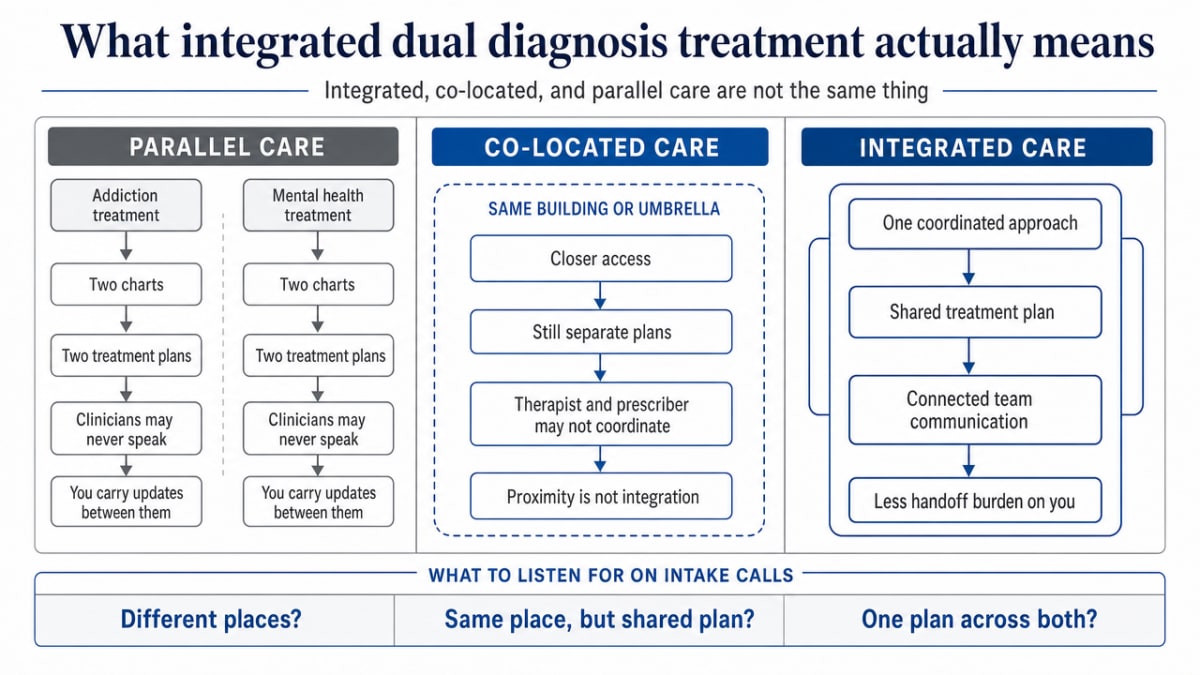
Integrated, co-located, and parallel care are not the same thing
Three programs can all put “dual diagnosis” on the sign out front and mean three very different things. Learning to hear the difference on a discovery call is one of the most useful skills you can build this week.
- Parallel care
- Means you get treated for the addiction at one place and the mental health condition somewhere else. Two charts. Two treatment plans. Two sets of clinicians who may never speak. You become the messenger between them, which is exhausting when you’re already unwell.
- Co-located care
- Means both services sit in the same building or under the same corporate umbrella. That’s a step up from parallel, but proximity is not integration. If the therapist treating your trauma has never spoken to the prescriber managing your mood stabilizer, and neither has read the other’s notes, you still have two treatments happening next to each other rather than one plan.
- Integrated care
- Is when the same clinical team owns both diagnoses in one coordinated plan. SAMHSA describes this as combining mental health and substance use interventions at the level of the clinical interaction, with the caregivers taking responsibility for combining them 6. NIMH puts it more plainly: coordinated care in one place 1. That’s the standard you’re screening for.
The five components of a real IDDT program
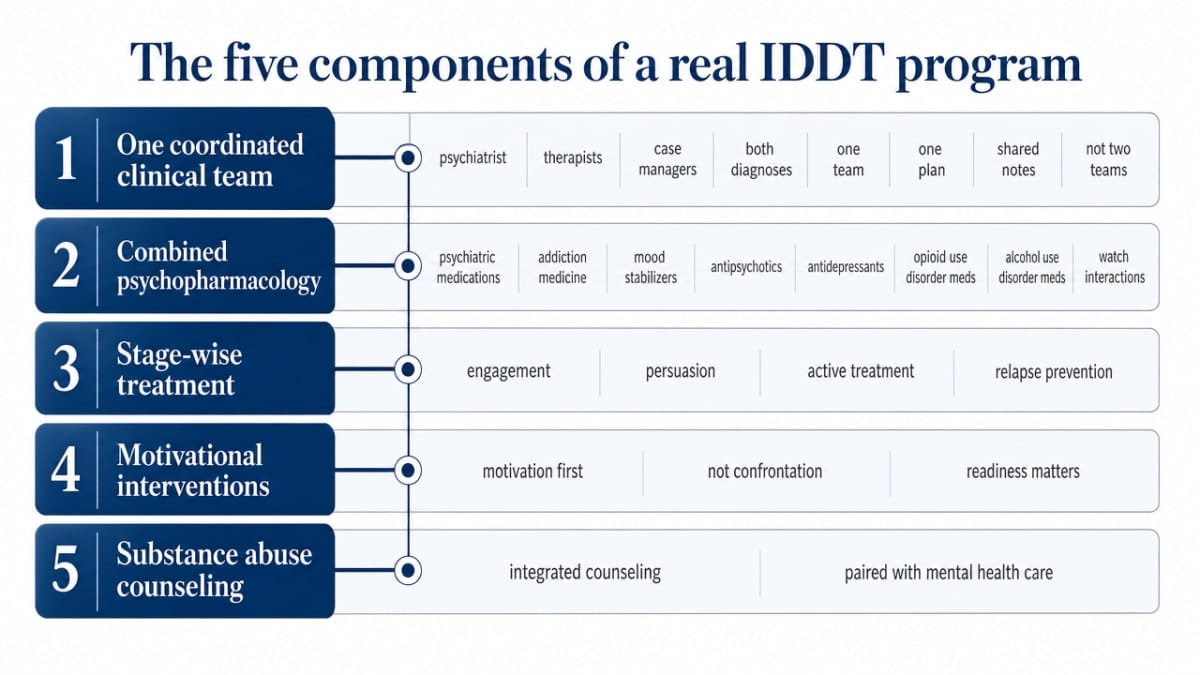
SAMHSA formalized what integration should look like in a model called Integrated Dual Disorder Treatment (IDDT), published as an Evidence-Based Practices Kit for organizations building these programs 5, 13. You don’t need to memorize the manual. You do need to recognize the five components when you hear them, or notice when they’re missing.
- One coordinated clinical team. A single team, usually including a psychiatrist, therapists, and case managers, holds responsibility for both diagnoses. Not two teams that meet occasionally. One team, one plan, shared notes.
- Combined psychopharmacology. The prescriber managing your psychiatric medications also understands addiction medicine, including how mood stabilizers, antipsychotics, antidepressants, and medications for opioid or alcohol use disorder interact. Someone is watching the whole picture, not just their piece of it.
- Stage-wise treatment matched to your readiness. Good integrated programs meet you where you are. Early on, that might mean engagement and harm reduction rather than abstinence demands. Later, active treatment and relapse prevention. Pushing everyone through the same protocol on day one is a red flag.
- Assertive outreach. If you disengage, an integrated team follows up rather than discharging you for missing a session. For people with serious mental illness, this often takes the form of Assertive Community Treatment or intensive case management 9.
- Integrated screening and assessment. On intake, one comprehensive assessment covers both conditions, symptoms, medication history, trauma, and psychosocial context, so nothing gets missed or siloed 14.
Print those five. Read them back on your next call. If a program can’t describe how it does each one, you’re probably looking at co-located or parallel care with a nicer brochure.
What the evidence actually promises (and doesn’t)
Before you start dialing programs, it helps to know what integrated care can and can’t do. The marketing pages will tell you it fixes everything. The research tells a more useful story, and understanding it now will save you from either giving up too soon or expecting a miracle by week six.
Read that carefully, because scope matters. The review pooled studies with different populations, different integrated models, and different definitions of “non-integrated.” It does not mean integrated care is a wash for addiction. Other work, including a NIDA publication reviewing common comorbidities, still concludes that integrated treatment is consistently superior to treating each diagnosis separately 7. And a review of serious mental illness plus substance use disorder found integrated programs reduced psychiatric hospitalizations and improved engagement, even when substance use outcomes varied by model 20.
So what does this mean for you, tonight, choosing between three programs within an hour’s drive?
Expect real gains in psychiatric symptoms. If you’re stabilizing bipolar swings, quieting PTSD flashbacks, or lifting a heavy depression, a genuinely integrated program is more likely to move the needle than parallel care shuttled between two clinics.
Set realistic expectations for the substance use side. Recovery from addiction is often nonlinear regardless of how well-integrated the mental health treatment is. A program that promises a straight line to sobriety is either overselling or misunderstanding its own field. Ask instead how the program handles slips, how it defines progress in early stages, and whether it uses stage-wise treatment matched to your readiness.
Judge retention on structure, not slogans. The 2023 review didn’t find integration alone kept people in treatment. What does help retention, based on newer 2024 data covered in the next section, is how organized and coordinated the care actually is on a day-to-day basis 12. That’s something you can screen for on a phone call.
You’re not looking for a program that promises everything. You’re looking for one that tells you the truth about what treatment can do, then does the harder work of coordinating it.
A screening checklist for any program within driving distance
Questions that expose parallel care pretending to be integrated
You will feel some resistance the first time you push back on a friendly intake coordinator. Do it anyway. The people who answer these calls are usually kind and well-meaning, and they are also trained to reassure. Your job is to get past the reassurance and find out what actually happens after you sign the paperwork.
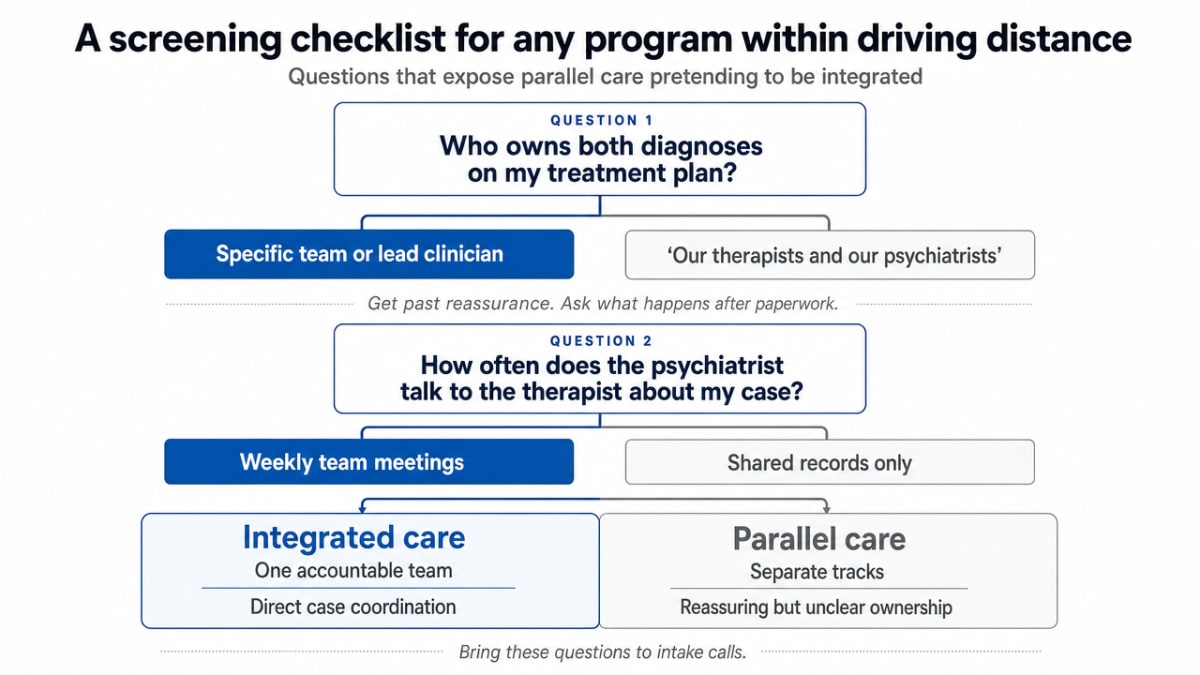
Here are the questions that separate real integrated care from parallel care wearing a nicer outfit.
- “Who owns both diagnoses on my treatment plan?” The right answer names a specific team or a specific lead clinician. A vague answer about “our therapists and our psychiatrists” that never converges on one accountable team usually signals parallel tracks.
- “How often does the psychiatrist talk to the therapist about my case?” Weekly team meetings and shared documentation are what you want to hear. “They can message each other if needed” is not the same thing.
- “If I have a slip or a bad mental health week, does the same team adjust the plan, or do I get referred out?” Being referred out mid-treatment is a hallmark of parallel care.
- “Do you require abstinence before you’ll treat my PTSD, depression, or bipolar disorder?” Concurrent treatment of both disorders is preferred over sequential approaches when feasible 17. A program that insists on sequencing is telling you it’s not equipped for the harder work of integration.
- “What does your intake assessment cover?” The answer to this one deserves its own section.
What the intake assessment should look like
A good intake is not a form you fill out in the parking lot. It’s the first place a program shows you whether it takes integration seriously, and it’s one of the clearest signals you’ll get before committing to weeks of care.
SAMHSA’s Treatment Improvement Protocol 42 is explicit about this: systematic, routine screening in both mental health and substance use programs, followed by comprehensive assessment, is foundational to identifying co-occurring disorders and avoiding missed diagnoses 14. In plain terms, one clinician or one team should ask you about both sides of your history in the same conversation, not on two separate forms handed off between two departments.
Expect the assessment to cover psychiatric history, including any hospitalizations, medication trials, and diagnoses you’ve been given (and un-given) over the years. Expect a detailed substance use history, including what you use, how much, how often, withdrawal patterns, and previous treatment attempts. Expect questions about trauma, family history, medical conditions, current medications, and how you’re functioning day to day.
If the intake feels rushed, or if it splits neatly into “the addiction questions” and “the mental health questions” with a pause in between, you’re seeing the seams of a system that hasn’t actually integrated. A program that can’t screen you thoroughly in one sitting is unlikely to treat you thoroughly across the next twelve weeks.
Why coordinated care can still beat a bad integrated program
Here’s the reassuring part, because you may not have a fully integrated single-site program within driving distance, and that’s a real constraint for a lot of people.
A 2024 study examining treatment outcomes across dual diagnosis modalities found that coordinated care produced higher attendance and lower dropout rates than less-structured approaches, even though overall retention was similar across modalities 12. Translated: how organized the care is on a week-to-week basis matters, sometimes more than whether every service lives under one roof.
What that means for your search: if the closest true IDDT program is four hours away and unrealistic, a well-coordinated pairing of a psychiatrist who understands addiction with an addiction program that communicates regularly with that psychiatrist can be a workable path. The keyword is coordinated. Not “you see two people who happen to share a zip code.” Coordinated means shared release-of-information forms are signed on day one, notes are exchanged, and someone, usually a case manager or your psychiatrist, is tracking both sides of the plan.
You are allowed to build this if the local market forces you to. Ask each provider directly: “Are you willing to coordinate weekly with my other provider, and will you document that?” A yes is worth more than a fancier building.
How to use federal and state locators without wasting a week
SAMHSA’s Behavioral Health Treatment Services Locator and National Helpline
Skip the ad-heavy “rehab directories” that dominate the first page of results. They are usually lead-generation sites that route your call to whoever pays for the placement, not to whoever is best equipped to treat you.
Start instead with SAMHSA’s Behavioral Health Treatment Services Locator at findtreatment.gov. Filter for facilities that list co-occurring mental and substance use disorders as a specialty, not just “mental health” or “substance use” alone. That single filter cuts your local list down fast, and the programs left standing are the ones federal data already flags as treating both.
SAMHSA also runs a free, confidential National Helpline at 1-800-662-HELP (4357), available 24/7 in English and Spanish. You can call for yourself or for someone you love, and the staff will refer you to local treatment facilities, support groups, and community-based organizations. They will not push you toward a specific brand 2.
One phone call to the helpline plus fifteen minutes on the locator will give you a shortlist that took most families weeks to build the old way. That’s real progress, even if you haven’t yet dialed a single program.
State behavioral health authorities and Medicaid provider directories
Federal tools are a starting line, not a finish line. Every state has a behavioral health authority (sometimes housed under the health department, sometimes standalone) that maintains its own list of licensed providers, and those lists often include details the federal locator misses, like which programs accept Medicaid, which have IDDT designations, and which serve specific populations such as veterans or adolescents.
If you have Medicaid or a Medicaid managed-care plan, call the member services number on your card and ask specifically for in-network dual diagnosis providers. Fragmentation between mental health and addiction funding streams is one reason integrated care can be hard to find in the first place 15, so asking your plan to name providers who bill for both is a legitimate and useful request.
Write down every name you get. You are building a shortlist, not making a commitment.
When your case is more complex than a standard IOP
Serious mental illness, schizophrenia, and rapid-cycling bipolar
If you’re living with schizophrenia, schizoaffective disorder, or rapid-cycling bipolar plus a substance use disorder, a standard three-day-a-week intensive outpatient program was probably not built for you. That isn’t a failure on your part. It’s a mismatch of intensity to need, and pretending otherwise costs you months.
The research on serious mental illness plus SUD points to more intensive integrated models. A systematic review of integrated care for co-occurring serious mental illness and substance use disorder found that integrated programs reduce psychiatric hospitalizations and improve engagement, though substance use outcomes vary by which model is used 20. SAMHSA’s TIP 42 specifically recommends Assertive Community Treatment (ACT) and intensive case management for this population, delivered as integrated treatment with substance use services built in rather than bolted on 9. ACT is a mobile, multidisciplinary team that comes to you, adjusts medication in real time, and doesn’t discharge you for missing a session.
For first-episode psychosis with co-occurring SUD, NIDA directs clinicians to SAMHSA guidance built specifically for that presentation, because the standard addiction curriculum does not account for antipsychotic titration or early psychosis recovery 8. When you call programs, ask directly: do you serve people on antipsychotics, including clozapine? Do you have a psychiatrist available more than once a week? A yes to both is a real filter.
PTSD, trauma-driven addiction, and the ‘get sober first’ myth
You may have been told, kindly and firmly, that you need to be sober for 30, 60, or 90 days before anyone will touch your trauma. The idea behind that rule was protective. Clinicians used to worry that opening trauma work would destabilize early recovery. It sounded cautious. It also turned out to be wrong for a lot of people.
Current evidence supports integrated trauma-focused treatment delivered alongside substance use care. A review of PTSD and co-occurring SUD reported that integrated trauma-focused therapies can reduce both PTSD symptoms and substance use, directly challenging the older concern that addressing trauma would worsen drinking or using 19. The broader clinical literature reaches the same conclusion: concurrent treatment of both disorders is preferred over sequential approaches when it’s feasible 17.
Practically, this changes what you should hear on an intake call. A program equipped for trauma-driven addiction will describe specific trauma-focused modalities, name a therapist who is trained in them, and explain how they’ll pace the work alongside your substance use treatment rather than gate one behind the other.
Depression, medication interactions, and combined pharmacotherapy
Co-occurring depression and substance use is one of the most common pairings, and it’s also one of the places where a genuinely integrated prescriber earns their keep. The clinical review on this combination emphasizes that combining antidepressant medication with addiction treatment can improve both mood and substance use outcomes compared to treating either condition alone, though trial results vary and the magnitude of benefit for antidepressants during active use remains debated 18.
Translated to your search: you want a psychiatrist who can hold both sides of the prescription pad at once. Someone who understands how SSRIs, mood stabilizers, and medications for alcohol or opioid use disorder interact. Someone who won’t refuse to prescribe an antidepressant because you’re still drinking, and won’t refuse naltrexone because you’re on an SSRI.
Ask the program: does the same prescriber manage both my psychiatric medications and my addiction medications? If the answer is two different prescribers who don’t talk regularly, you’ve found a coordination gap that will land on you to bridge.
What to do this week
You don’t have to solve this by Friday. You do need one or two concrete moves that get you closer.
- Tonight, open findtreatment.gov and filter for co-occurring disorders in your area. Save three to five names.
- Tomorrow, call SAMHSA’s National Helpline at 1-800-662-HELP for a second opinion on that shortlist 2.
- By midweek, pick two programs and run them through the five IDDT questions: one coordinated team, combined psychopharmacology, stage-wise treatment, assertive outreach, integrated screening 5. Write down what they actually say, not what you hoped to hear.
If nothing local passes, ask each provider whether they will formally coordinate weekly with your other clinician. Structured coordination is a legitimate second-best when full integration isn’t available 12.
Making the calls counts. Asking a hard question of an intake coordinator counts. You’ve spent enough years being handed off between systems that weren’t talking to each other. This week, you start building one that does.
See if integrated dual diagnosis care fits you
Get expert feedback on whether coordinated treatment matches your current needs and clinical complexity.
Frequently Asked Questions
What’s the difference between dual diagnosis and co-occurring disorders?
They mean the same thing. “Co-occurring disorders” is the term federal agencies like SAMHSA and NIMH tend to use in clinical writing, while “dual diagnosis” is more common in everyday conversation and program marketing 1. Both describe having a mental health condition and a substance use disorder at the same time.
How do I know if a nearby program offers true integrated treatment or just parallel care?
Ask who owns both diagnoses on your treatment plan. In an integrated program, one clinical team, sharing notes and meeting regularly, holds responsibility for both conditions and combines interventions at the level of the clinical interaction 6. In parallel care, you see separate providers who rarely communicate, and you end up carrying messages between them. If the program can’t name a single accountable team, keep looking.
Do I need to get sober before treating my PTSD, depression, or bipolar disorder?
No, and any program telling you otherwise is running on outdated thinking. Current clinical guidance favors concurrent treatment of both disorders over sequential approaches when feasible 17. Integrated trauma-focused therapy can reduce both PTSD symptoms and substance use at the same time, directly challenging the older “get sober first” rule 19. You deserve care that addresses both conditions now, not later.
What if there’s no fully integrated program within driving distance?
You have workable options. A 2024 study of dual diagnosis treatment modalities found that coordinated care produced higher attendance and lower dropout compared to less-structured approaches, even without single-site integration 12. Ask a psychiatrist and an addiction provider to formally coordinate weekly, sign releases so notes flow both ways, and designate one clinician to track both sides of your plan. Structure matters as much as the address.
Which federal resources should I use to find dual diagnosis treatment near me?
Start with SAMHSA’s Behavioral Health Treatment Services Locator at findtreatment.gov, filtered for co-occurring disorders. Then call the SAMHSA National Helpline at 1-800-662-HELP (4357), which is free, confidential, and available 24/7 in English and Spanish for referrals to local providers 2. Follow up with your state behavioral health authority for licensed programs and Medicaid-covered options.
Is a standard IOP enough for severe mental illness with substance use?
Often, no. If you’re managing schizophrenia, schizoaffective disorder, or rapid-cycling bipolar plus a substance use disorder, SAMHSA’s TIP 42 recommends more intensive integrated models like Assertive Community Treatment (ACT) or intensive case management, delivered with substance use services built in 9. A systematic review found integrated programs for serious mental illness plus SUD reduce psychiatric hospitalizations and improve engagement 20. Ask whether the program has psychiatry available more than once a week.
References
- Finding Help for Co-Occurring Substance Use and Mental Disorders. https://www.nimh.nih.gov/health/topics/substance-use-and-mental-health
- Managing Life with Co-Occurring Disorders. https://www.samhsa.gov/mental-health/serious-mental-illness/co-occurring-disorders
- Co-Occurring Disorders and Health Conditions. https://nida.nih.gov/research-topics/co-occurring-disorders-health-conditions
- Co-Occurring Disorders and Other Health Conditions. https://www.samhsa.gov/substance-use/treatment/co-occurring-disorders
- Integrated Treatment for Co-Occurring Disorders Evidence-Based Practices (EBP) Kit. https://www.samhsa.gov/resource/ebp/integrated-treatment-co-occurring-disorders-evidence-based-practices-ebp-kit
- Integrated Treatment for Co-Occurring Disorders: The Evidence. https://library.samhsa.gov/sites/default/files/ebp-kit-the-evidence-10242019.pdf
- Common Comorbidities with Substance Use Disorders. https://nida.nih.gov/sites/default/files/1155-common-comorbidities-with-substance-use-disorders.pdf
- Addiction Treatment | National Institute on Drug Abuse (NIDA). https://nida.nih.gov/nidamed-medical-health-professionals/treatment/addiction-treatment
- Treatment Settings (TIP 42: Substance Use Disorder Treatment for People With Co-Occurring Disorders). https://www.ncbi.nlm.nih.gov/books/NBK571024/
- Integrating Treatment for Co-Occurring Mental Health Conditions and Alcohol Use Disorder. https://pmc.ncbi.nlm.nih.gov/articles/PMC6799972/
- Integrated vs non-integrated treatment outcomes in dual diagnosis: A systematic review. https://pubmed.ncbi.nlm.nih.gov/37151615/
- Examining Profiles and Treatment Outcomes in Dual Diagnosis by Treatment Modality: Residential vs Coordinated Care. https://pubmed.ncbi.nlm.nih.gov/38478999/
- SAMHSA Evidence-Based Practices Kit for Integrated Dual Disorder Treatment (IDDT). https://case.edu/socialwork/centerforebp/resources/samhsa-evidence-based-practices-kit-iddt
- Screening and Assessment of Co-Occurring Disorders (TIP 42). https://www.ncbi.nlm.nih.gov/books/NBK424860/
- Co-Occurring Disorders: Introduction and Overview (TIP 42). https://www.ncbi.nlm.nih.gov/books/NBK424846/
- Integrated Treatment of Substance Use and Psychiatric Disorders. https://www.ncbi.nlm.nih.gov/pmc/articles/PMC4382069/
- Co-Occurring Addiction and Other Mental Health Disorders: Treatment Considerations. https://www.ncbi.nlm.nih.gov/pmc/articles/PMC5471768/
- Treatment of Patients With Co-Occurring Depression and Substance Use Disorders. https://www.ncbi.nlm.nih.gov/pmc/articles/PMC3281230/
- Co-Occurring PTSD and Substance Use Disorders: Treatment Approaches. https://www.ncbi.nlm.nih.gov/pmc/articles/PMC5736219/
- Integrated care for co-occurring serious mental illness and substance use disorder: Systematic review. https://pubmed.ncbi.nlm.nih.gov/28403449/