

Key Takeaways
- Treat off-island psychiatric admission as three coordinated handoffs: clinical intake, multi-leg travel from your home island, and a family communication plan that spans time zones for weeks.
- Clarify with admissions which tasks they own (bed hold, insurance verification, PHX ground pickup, intake scheduling) and which stay with you (inter-island flights, medications, lodging, guardianship paperwork).
- Confirm insurance coverage in writing before booking; Med-QUEST requires prior authorization for non-emergency mainland care 5, while many private plans exclude transportation benefits entirely 24.
- Plan the inter-island leg as its own project with early flights and hand-carried medications, since Molokaʻi and Lānaʻi residents routinely face delays that push medical travel by months 11.
- Route HNL to PHX with enough daylight for the two-hour drive to Prescott and a same-day psychiatric evaluation, avoiding red-eyes that land your loved one exhausted before intake staff arrive.
- Budget for the family-variable costs (lodging, meals, ground transport) that quietly squeeze families 23, 24, and reserve air ambulance at $42,000–$112,000 for true acuity decisions 1.
- Reserve medical escorts or air ambulance for cases where active psychosis, suicidal crisis, severe withdrawal, or aggression makes a commercial flight unsafe, and ask whether Oʻahu stabilization is a safer bridge first.
- Map the HST-to-MST gap once, pick a standing call window, and use family therapy actively, since consistent family contact predicts stronger discharge planning 17.
Why sending a loved one off-island is a coordination problem, not just a flight
You already know the hardest part isn’t buying the ticket. It’s the string of small decisions that come with it: who drives to the airport, who packs the medications, who calls the treatment team when your loved one lands, and how you’ll hear their voice again once they’re 2,700 miles away in Prescott.
When a family in Hawaiʻi decides that treatment-resistant psychiatric care or dual diagnosis treatment has to happen on the mainland, you’re not solving one problem. You’re stacking three: a clinical handoff, a multi-leg travel day that often starts on Kauaʻi, Maui, Molokaʻi, Lānaʻi, or Hawaiʻi Island, and a family communication plan that has to work across a time-zone gap for weeks at a time. Any one of those, on its own, is doable. Together, on a Tuesday, with someone in crisis, they can flatten you.
That’s not a failure on your part. Rural health researchers in Hawaiʻi have documented exactly this pattern: families end up carrying uncovered lodging, meals, and ground transportation costs on top of the flights themselves, and the logistical strain compounds the emotional one 23. The Trauma System Consultation Report for the state made the same observation about off-island transfers, noting that families typically bear their own travel costs to be present with a loved one and to bring them home 25.
So this guide treats your situation the way a good admissions coordinator would: as a coordinated handoff you can plan in stages, not one overwhelming leap.
Before the boarding pass: pre-admission decisions that shape the whole trip
What a specialty admissions team actually handles vs. what stays on you
One of the fastest ways to lower your stress this week is to stop guessing where the line is drawn. A specialty admissions team at a facility like ViewPoint Dual Recovery in Prescott takes on a specific slice of the work, and everything else still lives with you. Both lists are shorter than they feel at 2 a.m.
On the admissions side, expect the team to:
- run the clinical intake conversation,
- verify your loved one’s insurance benefits for psychiatric and dual diagnosis care,
- confirm a start date once a target arrival date is agreed on,
- coordinate the ground pickup from Phoenix Sky Harbor (PHX) up to Prescott, and
- schedule the first psychiatric evaluation and medication review for the day of arrival.
They also set expectations for how the treatment team will contact you after intake and who your point person is for questions during treatment.
What stays on you is more concrete than it sounds:
- booking the inter-island ticket from Līhuʻe, Kahului, Kona, or Molokaʻi to Honolulu, then the HNL–PHX segment;
- packing current medications in their original bottles;
- gathering guardianship or power-of-attorney paperwork if it applies; and
- planning lodging and meals for any in-person visits later on.
Rural health researchers in Hawaiʻi have documented that families routinely absorb these lodging, meal, and ground-transport costs even when a flight itself is partially covered 23. Knowing that up front lets you budget instead of being surprised.
Ask the admissions coordinator to walk you through both columns on the first call. If a task isn’t clearly claimed by one side, name it and assign it before you hang up.
Insurance and prior authorization for off-island psychiatric care
Before anyone books a flight to Phoenix, the insurance question needs a straight answer: will your plan pay for residential psychiatric care at a mainland facility, and under what conditions?
If your loved one is on Med-QUEST, the 2023 member handbook is direct about the rule:
“For non-emergency care on a neighbor island or the mainland, you’ll need to get approval first from your health plan” 5.
That prior authorization is not a formality. It’s the document that turns a treatment decision into a covered admission. The handbook also confirms that QUEST health plans cover behavioral health services including substance use treatment programs and psychiatric evaluation 5, and the Med-QUEST health plan appendix specifically lists air and ground transportation for medically necessary services alongside specialized behavioral health services as plan obligations 9. Ask your plan, in writing, whether ViewPoint’s level of care qualifies and what documentation they need from the referring provider.
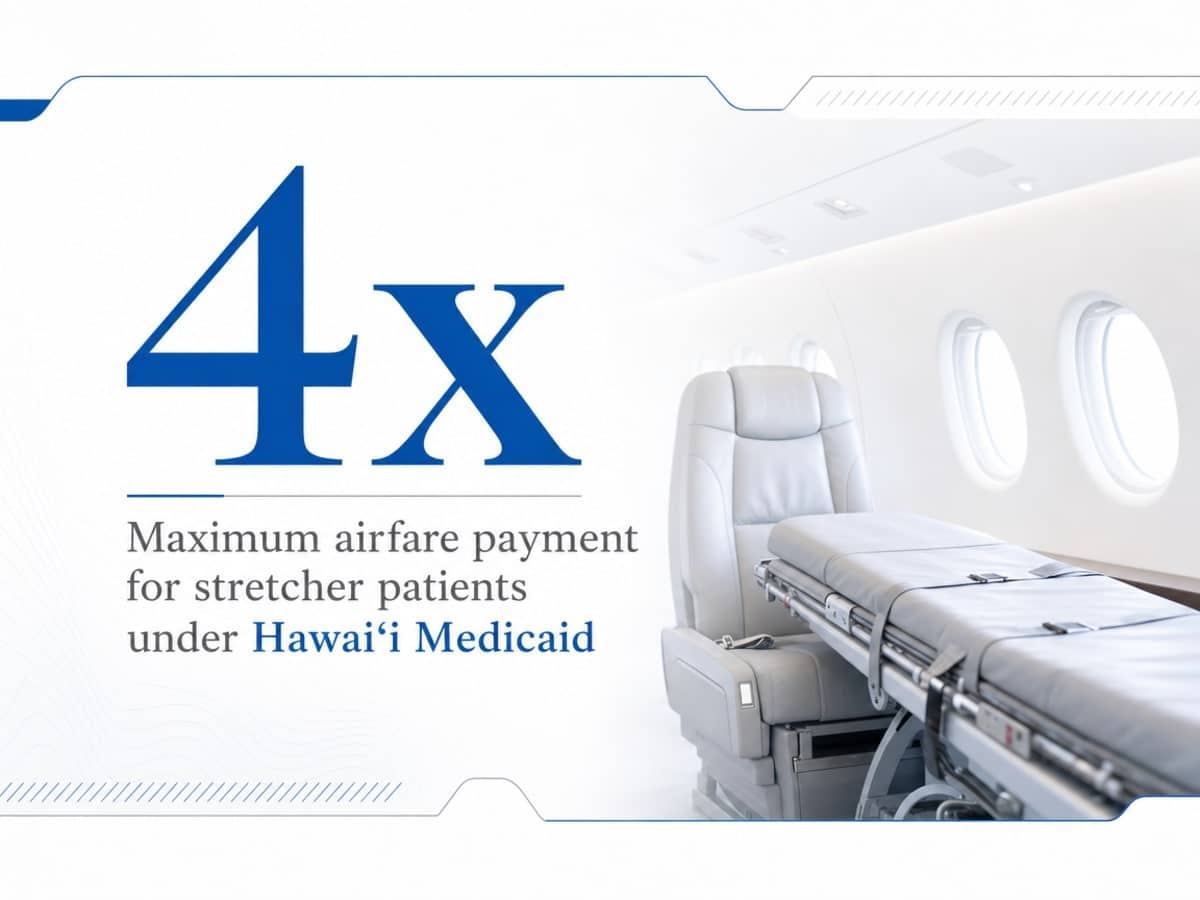
Two other rules matter for Hawaiʻi families. Under state Medicaid regulation, air transportation is allowable when the attending physician refers a recipient to services “not available or not accessible on the recipient’s island of residence,” and in non-emergency situations Medicaid may cover round-trip tickets for both the recipient and an attendant, plus related meals and lodging 13. Medicaid Chapter 16 confirms that inter-island medical transportation is authorized when necessary care isn’t available on the island of residence, and it can pay for an attendant’s transport, meals, and lodging as well 6.
If your loved one has private commercial insurance, the picture is different. Rural health stakeholders in Hawaiʻi report that many private plans exclude transportation benefits altogether, leaving families to pay full freight for flights, lodging, and ground transport 24. Ask your insurer three specific questions:
- Is residential psychiatric treatment at an out-of-state Joint Commission-accredited facility a covered benefit?
- What is the prior authorization process and expected timeline?
- Is any portion of travel reimbursable?
Get the answers by email or member portal message so you have them in writing when the admissions team asks.
Mapping the route: HNL, OGG, KOA, and LIH to Prescott
The inter-island leg and why it deserves its own plan
If you live on Kauaʻi, Maui, Hawaiʻi Island, Molokaʻi, or Lānaʻi, the trip to Prescott doesn’t start at HNL. It starts at Līhuʻe, Kahului, Kona, Hoʻolehua, or Lānaʻi City, and that first hop is where the whole travel day quietly succeeds or fails.
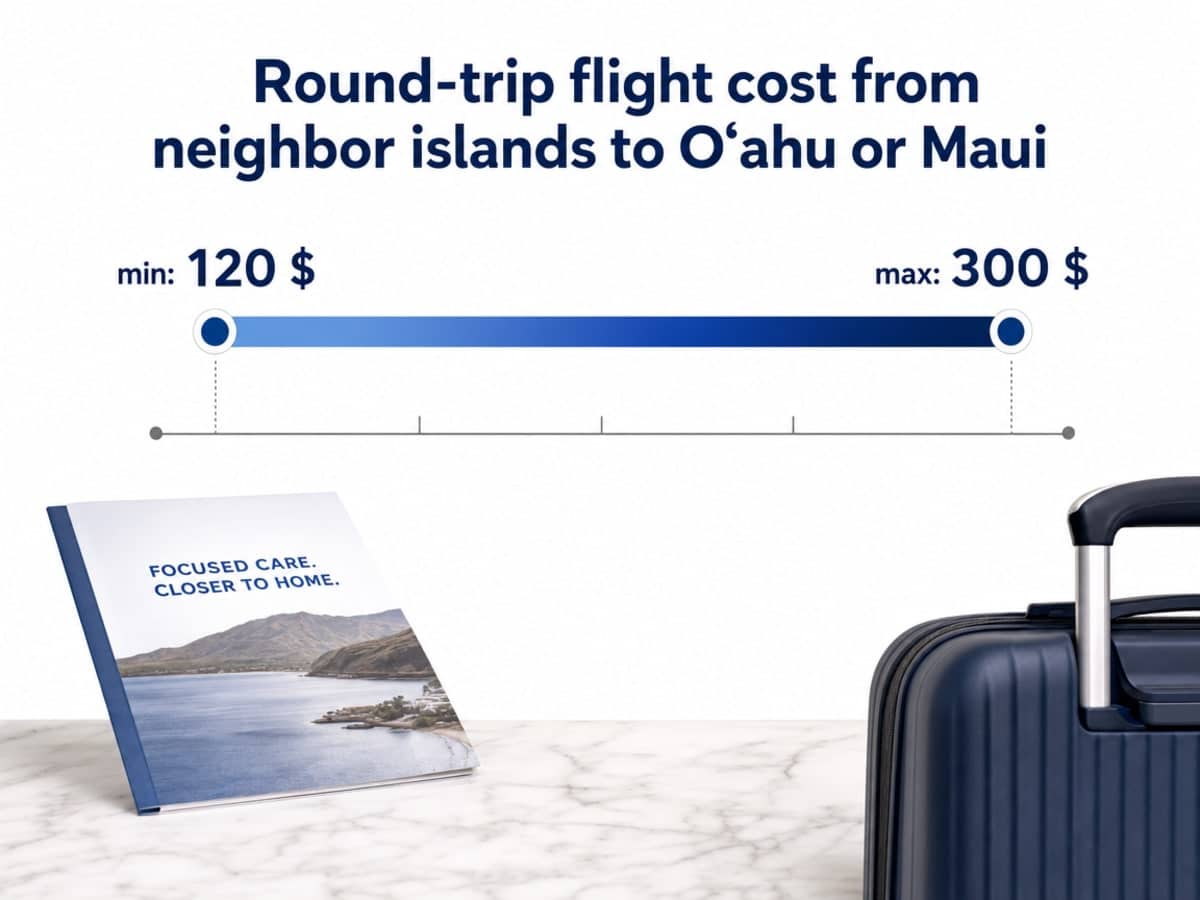
Treat the inter-island leg as its own project. Round-trip flights from the neighbor islands to Oʻahu or Maui run roughly $120 to $300 10, and DOH data on neighbor-island-to-Oʻahu airfare puts the range at about $130 to $200 or more 12. Those are real dollars, but the bigger risk is timing. Rural health researchers have documented that Molokaʻi and Lānaʻi residents routinely face flight delays or cancellations, missing urgent medical appointments and waiting months for rescheduling 11. You cannot afford that on the day your loved one is supposed to board a mainland flight.
Two habits protect you. First, book the inter-island segment on an earlier flight than you think you need, so a cancellation still leaves you a same-day option to HNL. Second, keep medications, ID, insurance cards, and any guardianship paperwork in a carry-on that never leaves your loved one’s hand between islands. Checked bags and psychiatric medications should not be on the same aircraft.
If your loved one is on Med-QUEST and the trip qualifies as medically necessary inter-island transport, ask your health plan whether the inter-island leg is covered before you pay out of pocket 9.
Honolulu to Phoenix to Prescott: the mainland handoff
Once you land at HNL, the mainland handoff has three moving parts: the HNL to PHX flight, the drive from Phoenix Sky Harbor up to Prescott, and the intake window on the ViewPoint side.
Most Hawaii families fly HNL to PHX nonstop when the schedule allows, then hand off ground transportation to Prescott to the admissions team. Ask ViewPoint’s admissions coordinator to confirm three specifics in writing before you buy tickets: the target arrival window at PHX, who is meeting your loved one at baggage claim, and what the driver will be wearing or carrying so recognition is easy after a long day of flying.
The drive from PHX to Prescott is about 100 miles north through desert and up into higher elevation, and it typically takes roughly two hours depending on traffic and weather. Your loved one will arrive tired, likely dehydrated, possibly medication-shifted, and staring at unfamiliar terrain. Building in a light meal and a bathroom stop is not indulgent; it makes the intake conversation on arrival more productive.
What a Hawaii-to-Prescott admission actually costs the family
Money questions get pushed to the end of these conversations, and they shouldn’t be. You need a rough picture of the travel budget before you commit to a date, so you’re not making a clinical decision and a financial one at the same 2 a.m. hour.
Here is what the research supports, and where you’ll have to fill in your own numbers:
| Cost line | Range | Source |
|---|---|---|
| Neighbor island round-trip flight (to Oʻahu or Maui) | $120 – $300 | Sourced 10 |
| Neighbor island to Oʻahu round-trip airfare | $130 – $200+ | Sourced 12 |
| HNL to PHX round-trip airfare (patient) | Family-supplied; varies by season and carrier | Family variable |
| HNL to PHX round-trip airfare (attendant, if flying with) | Family-supplied; possibly Medicaid-covered as attendant fare | Family variable / 2 |
| PHX to Prescott ground transfer | Coordinated by ViewPoint admissions on arrival day | Family variable for return trip |
| Lodging and meals for family visits | Commonly uncovered by insurance | Family variable 23, 24 |
| Acuity only: Hawaii-to-mainland air ambulance | $42,000 – $112,000 | Sourced 1 |
Two things stand out when you lay it out this way. The sourced line items alone don’t break most families, but the family-variable rows quietly do. Rural health stakeholders in Hawaiʻi describe exactly this pattern: public insurance may cover a flight but not lodging, meals, or ground transportation between airports and medical facilities, and private plans often exclude transportation benefits entirely 24. That gap is where families get squeezed.
The air ambulance row belongs on the table but not in your default plan. At $42,000 to $112,000 for Hawaiʻi-to-mainland service 1, medevac is an acuity decision, not a convenience one. The next section walks through when that call actually makes sense.
Before you finalize dates, ask ViewPoint’s admissions team to walk through this table with you and mark which rows their coordination reduces, which rows your insurance will touch, and which rows stay yours. That single conversation prevents the surprise you’d otherwise get from the first credit card statement after intake week.
When acuity forces a medical escort or air ambulance
Most Hawaii families sending a loved one to Prescott fly commercial with planning. A small number can’t, and it helps to know the difference before you’re staring at it.
A commercial flight assumes your loved one can tolerate a full travel day: TSA, boarding, five to six hours in a middle seat, a connection, and a two-hour drive on the other end. If active psychosis, suicidal crisis, severe withdrawal, or aggression makes that plan unsafe, you’re in a different category. Options then narrow to a medical escort flying commercial with your loved one, or, in the most acute cases, air ambulance transport.
Be honest about the cost of the latter. Hawaii-to-mainland air ambulance runs between $42,000 and $112,000, and the state auditor has documented that families without coverage carry a devastating financial exposure 1. That is why medevac is an acuity decision, not a convenience upgrade. If your loved one’s clinical team is raising it, ask two questions on the same call: is stabilization on Oʻahu first a safer bridge, and what will your insurer authorize in writing before wheels up?
Loop ViewPoint’s admissions team in early either way. The start date, intake window, and Prescott ground plan all shift when a medical escort is involved.
Travel day: a minute-by-minute view from the island side
The day itself will feel longer than you planned. It helps to know the beats in advance.
Night before. Charge two phones. Lay out ID, insurance card, prior authorization paperwork, and a printed itinerary in one folder. Pack current medications in original bottles in a carry-on that stays with your loved one from the front door to Prescott. Confirm the ViewPoint admissions coordinator has your cell number and the flight numbers for both legs.
Predawn, island side. Leave earlier than the flight strictly requires. If you’re departing from Molokaʻi or Lānaʻi, build in an entire extra layer of slack; residents there routinely face flight delays or cancellations that push urgent medical appointments by months 11. You cannot afford that today. Aim to clear the inter-island leg with hours to spare at HNL, not minutes.
At HNL, between legs. Eat something. Refill water bottles. Take scheduled medications on the island clock while you still know what time it is. This is the last quiet window before a five-plus-hour flight.
Boarding the mainland leg. Text the admissions coordinator the departure time. Some families send a short note to the treatment team describing how the morning went, especially if anxiety or agitation showed up at the gate.
Landing at PHX. Your loved one meets the ground driver at baggage claim. You’ll get a confirmation text from the admissions team when pickup happens, and again when the car reaches Prescott.
That evening. The intake call. Answer it, even if you’re exhausted. This is where the family involvement pattern that supports better discharge planning actually begins 17.
Staying in the loop across a three-hour gap
How the HST-to-MST window structures family contact
Once your loved one is in Prescott, the time difference stops being trivia and starts shaping your week. Hawaiʻi runs on HST year-round. Arizona runs on MST year-round and doesn’t observe daylight saving time. That means the gap between you and the treatment team is three hours for most of the year and two hours during the mainland’s daylight saving months.
Sketch out the overlap on paper once and you won’t have to re-solve it every day. When it’s 7 a.m. in Hilo, it’s 10 a.m. in Prescott. When it’s noon on Kauaʻi, the Prescott clinical team is heading into a 3 p.m. group. When it’s 5 p.m. in Kahului, the treatment team’s day is wrapping at 8 p.m. That gives you three practical windows:
- an early-morning Hawaiʻi call that catches the Prescott team mid-morning,
- a midday Hawaiʻi check-in that lands in Prescott’s afternoon programming block, and
- a late-afternoon Hawaiʻi window that reaches Prescott before staff shift change.
Pick one of those windows and make it your standing call time. This is not about scheduling convenience. A peer-reviewed study of family involvement in psychiatric hospitalizations found that family phone calls and visits, attending family therapy, and communicating with inpatient staff were all significantly associated with comprehensive discharge planning 17. In other words, the rhythm of your calls is part of the clinical work, not an interruption of it. Ask the admissions coordinator to note your preferred window in the chart so the care team knows when to expect your call.
Family therapy and treatment updates from six time zones away
Family therapy over Zoom from Hawaiʻi isn’t a downgrade from in-person work. Handled well, it becomes the connective tissue of the whole admission. Ask the admissions team three things up front: what day and time family therapy is typically scheduled in Prescott, whether that time can be set to land inside your Hawaiʻi window, and which platform they use so you can test audio and video the day before.
Ask for a named point person on the treatment team, and ask how you’ll get updates between sessions. Research on youth residential treatment emphasizes improved communication, greater family involvement as active team members, and extended support during and after discharge 18. That’s the standard to hold the program to, even from across the Pacific. In practice, that means knowing whether updates come by phone, secure message, or a scheduled weekly call, and knowing who calls you if something changes clinically.
Give the team something back. If your loved one had a rough night at home before admission, if a specific medication has failed before, if there’s a family member they only want to speak with on Sundays, tell them. Timely, transparent family input is one of the mechanisms strong programs build in for exactly this reason 19. You’re not intruding on the clinical work. You’re part of it.
Discharge routing back to the islands
Discharge planning starts earlier than most families expect. If the treatment team is doing its job, the conversation about how your loved one gets home to Kauaʻi, Maui, Molokaʻi, Lānaʻi, or Hawaiʻi Island opens in the first week or two, not the last. Ask ViewPoint’s admissions coordinator to loop you into that timeline directly. Family involvement in discharge conversations is one of the strongest predictors of comprehensive aftercare planning in psychiatric hospitalizations 17.
Three pieces need to line up before a return flight is booked:
- a written discharge summary and a medication list your loved one can hand to a Hawaiʻi outpatient prescriber on day one.
- a scheduled follow-up appointment on the island before the plane leaves the ground, not a phone number to call once they land. On neighbor islands, a Family Guidance Center may be part of that handoff for younger clients 14.
- a travel plan that mirrors the arrival plan in reverse: Prescott to PHX ground transfer, PHX to HNL, then the inter-island leg home.
Build the same slack you built on the way out. Fly midday when possible so the inter-island connection isn’t the last flight of the night. If your loved one is on Med-QUEST and the return trip qualifies as medically necessary transport, ask whether the inter-island leg is covered 9. Plan for someone to be at the home-island airport with a quiet car and a short drive. The first 72 hours back are part of treatment, not the end of it.
Questions worth asking ViewPoint’s admissions team
By the time you pick up the phone, you’ve done more research than you wanted to. Use that first admissions call to get specific answers rather than reassurance. A few questions carry more weight than the rest.
- What does a Hawaiʻi arrival day at PHX actually look like, from baggage claim to Prescott intake?
- Which of our travel line items does your coordination touch, and which stay ours?
- Can family therapy be scheduled inside our Hawaiʻi contact window, and who is our named point of contact between sessions?
- How do you handle prior authorization documentation with Med-QUEST or a private plan for out-of-state residential psychiatric care 5?
- When does discharge planning start, and how will you coordinate the return route back to our island?
If a Hawaiʻi family is weighing an off-island admission, calling ViewPoint’s admissions team with these questions in hand is a reasonable next step, not a commitment.
Find Out If Specialized Care Fits Your Needs
Get clear guidance on next steps for Hawaii-based treatment travel and clinical fit.
Frequently Asked Questions
Does Hawaii Medicaid cover flights to a mainland psychiatric facility like ViewPoint?
Med-QUEST can cover off-island care, but only with prior authorization from your health plan before travel 5. Coverage typically requires that the needed care is not available on your island of residence and that a physician has referred the recipient to the mainland provider 13. Ask your plan in writing which documentation ViewPoint’s admissions team should submit, and get the approval on paper before booking.
How do we handle the time difference between Hawaii and Arizona for family therapy calls?
Arizona stays on MST year-round, so you’re three hours behind Prescott most of the year and two hours behind during mainland daylight saving months. Pick one standing call window that lands inside Prescott’s programming day, and ask the admissions team to note it in the chart. Consistent family phone contact and therapy attendance are tied to stronger discharge planning 17, so this rhythm is clinical work.
Can a family member fly with our loved one, and will insurance help pay for the attendant?
Yes, an attendant can fly with your loved one, and for Med-QUEST members a round-trip fare for a medically necessary attendant may be covered when recommended by the attending physician 2. Chapter 16 of the provider manual also allows an escort’s transportation, meals, and lodging in some cases 6. Confirm in writing before you book; private insurance rarely reimburses attendant travel 24.
What if our loved one is too acute to fly commercial from HNL, OGG, KOA, or LIH?
If active psychosis, suicidal crisis, severe withdrawal, or aggression makes a commercial flight unsafe, options narrow to a medical escort flying commercial or air ambulance transport. Ask the treatment team whether stabilization on Oʻahu at a licensed psychiatric facility is a safer bridge first 7, since Medicaid may fund that inter-island psychiatric transport. Loop ViewPoint’s admissions team in early so the start date and intake plan shift accordingly.
What does ViewPoint’s admissions team coordinate between Phoenix and Prescott, and what do we still handle?
Admissions typically coordinates insurance verification, the start date, ground pickup from Phoenix Sky Harbor up to Prescott, and the same-day intake evaluation. You still handle the inter-island ticket, the HNL-to-PHX booking, medication packing in original bottles, guardianship paperwork if applicable, and lodging for any in-person visits. Families in Hawaiʻi routinely absorb lodging and meal costs even when flights are partially covered 23, so budget those separately.
How should we plan the return trip to the islands at discharge?
Ask the treatment team to open discharge planning in the first week or two, not the last. Before a return flight is booked, confirm three things: a written discharge summary with medication list, a scheduled outpatient follow-up on your home island, and a travel plan mirroring the arrival route in reverse. If Med-QUEST applies, ask whether the inter-island leg qualifies as medically necessary transport 9.
References
- Study of Proposed Mandatory Health Insurance Coverage for Air Ambulance Services. https://files.hawaii.gov/auditor/Reports/2019/19-07.pdf
- Haw. Code R. § 17-1739.1-9 – Payments for intra-state transportation and related services. https://www.law.cornell.edu/regulations/hawaii/Haw-Code-R-SS-17-1739-1-9
- §11-72-31 Fees | Emergency Medical Services System. https://health.hawaii.gov/ems/home/chapter-72-state-comprehensive-ems-systems-rules-and-regulations/subchapter-4-ambulance-services/%C2%A711-72-31-fees/
- The excess cost of inter-island transfer of intracerebral hemorrhage patients. https://dnhh.hawaii.edu/_docs/2015_excess_cost_of_inter-island_transfer_of_intracerebral_hemorrhage_patients.pdf
- Aloha! Med-QUEST Member Handbook 2023. https://medquest.hawaii.gov/content/dam/formsanddocuments/med-quest/member-handbook/Quest_Member.Handbook_2023.pdf
- Chapter 16: Transportation, Meals, Lodging and Foreign Language Translation/Sign Language Interpretation. https://medquest.hawaii.gov/content/dam/formsanddocuments/resources/Provider-Resources/provider-manuals/PMChp16.pdf
- Behavioral Health Services – Medicaid Provider Manual, Chapter 15. https://medquest.hawaii.gov/content/dam/formsanddocuments/resources/Provider-Resources/provider-manuals/PMChp15.pdf
- Hawaii State Plan Amendment (SPA) #13-004a. https://www.medicaid.gov/sites/default/files/State-resource-center/Medicaid-State-Plan-Amendments/Downloads/HI/HI-13-004a.pdf
- QI Health Plan Manual – Appendices 25.2. https://medquest.hawaii.gov/content/dam/formsanddocuments/plans-and-providers/health-plan-resources/hpm-25-1/health-plan-manual-25-2/Health%20Plan%20Manual%20-%20Appendices%2025.2.pdf
- The Impacts of Transportation and Travel Access on Rural Health in Hawaiʻi – Literature Review. https://research.hawaii.edu/rhrpc/wp-content/uploads/sites/23/2025/05/PART-1-LITERATURE-REVIEW_UH-RHRPC-Transportation-and-Rural-Health-Report.pdf
- Transportation barriers impacting Hawaiʻi rural health care, policy solutions proposed. https://www.hawaii.edu/news/2025/07/15/transportation-travel-rural-health/
- Title V Maternal and Child Health Services Block Grant – Hawaii Program Overview. https://health.hawaii.gov/fhsd/files/2021/09/2021-Title-V-Narrative-Report-includes-FY-2020-Report-FY-2022-Plans.pdf
- Haw. Code R. § 17-1737-82 – Intra-state transportation. https://www.law.cornell.edu/regulations/hawaii/Haw-Code-R-SS-17-1737-82
- Family Guidance Centers. https://health.hawaii.gov/camhd/family-guidance-centers/
- Behavioral Health Barometer: Hawaii, Volume 8 (2021–2023 NSDUH). https://www.samhsa.gov/data/sites/default/files/reports/rpt56790/2023-nsduh-barometer-hawaii.pdf
- State Council on Mental Health 2026 Report to the Governor and Legislature. https://scmh.hawaii.gov/wp-content/uploads/2026/01/SCMH-2026-Report-to-the-Governor-and-Legislature-Final-123125.pdf
- Family Involvement in Psychiatric Hospitalizations: Associations with Discharge Planning and Aftercare. https://pmc.ncbi.nlm.nih.gov/articles/PMC6773477/
- Identifying Family Engagement Priorities in Youth Residential Treatment. https://pmc.ncbi.nlm.nih.gov/articles/PMC11927959/
- Re-Imagining Family Involvement in Residential Long-Term Care. https://pmc.ncbi.nlm.nih.gov/articles/PMC8821144/
- Evaluating the Connection Between Rural Travel Time and Healthcare Utilization. https://pmc.ncbi.nlm.nih.gov/articles/PMC11273699/
- The Impacts of Transportation and Travel Access on Rural Health in Hawaiʻi (Full Report). https://research.hawaii.edu/rhrpc/wp-content/uploads/sites/23/2025/06/UH-RHRPC-FULL-REPORT-Transportation-Project-June-25-2025-Final.pdf
- The Impacts of Transportation and Travel Access on Rural Health in Hawaiʻi (Alternate PDF Version). https://research.hawaii.edu/rhrpc/wp-content/uploads/sites/23/2025/06/FULL-REPORT_UH-RHRPC-Transportation-Project-1.pdf
- Stakeholder Insights – Transportation and Rural Health in Hawaiʻi. https://research.hawaii.edu/rhrpc/wp-content/uploads/sites/23/2025/05/PART-2-STAKEHOLDER-INSIGHTS_UH-RHRPC-Transportation-and-Rural-Health-Report.pdf
- The Impacts of Transportation and Travel Access on Rural Health in Hawaiʻi – Stakeholder Insights (alternate PDF). https://research.hawaii.edu/rhrpc/wp-content/uploads/sites/23/2025/08/PART-2-STAKEHOLDER-INSIGHTS_RHRPC-Transportation-and-Rural-Health-Report.pdf
- Trauma System Consultation Report – State of Hawaiʻi. https://health.hawaii.gov/emsipsb/files/bsk-pdf-manager/2025/03/2017-ACS-Report.pdf
- Summary of Neighbor Island Rural Cancer Survivors’ Needs and Challenges Report. https://manoa.hawaii.edu/healthyhawaiievaluation/wp-content/uploads/project_2_summary_ni_rural_cancer_survivors_needs_challenges_report.pdf