

Key Takeaways
- Arizona law requires treatment plans to be built from your assessment, developed with your participation, and documented within 48 hours in residential facilities 1, 10.
- Plans must be updated within 14 days of any significant change in condition, and goals must be measurable and reflect your own definition of achievement 11, 3.
- Cookie-cutter curricula, insurance-driven discharge dates, and parallel providers without a shared plan fall below Arizona’s regulatory floor for individualized and integrated care 2, 17.
- Before signing, review any plan against six checkpoints—assessment link, your-language goals, medication specifics, stage-matched co-occurring care, update triggers, and unified team input—and request revisions where it falls short.
When the last program didn’t hold
You’ve experienced programs that felt like a template rather than tailored care. A 30-day stay, a 60-day residential track, a partial hospitalization slot, a rotation of SSRIs, or group therapy with a generic curriculum—you did the work, but something didn’t stick.
This exhaustion is understandable. Conditions like treatment-resistant schizophrenia, rapid-cycling bipolar disorder, or trauma-linked substance use don’t respond to a fixed curriculum on a fixed timeline. When a program discharges you based on a calendar or provides the same worksheets to everyone, regardless of diagnosis, you’re not receiving individualized care. You’re getting a standardized approach.
Many people are unaware that in Arizona, this template model often falls below state regulatory requirements. Treatment plans in licensed behavioral health facilities must be built from ongoing assessment, developed with your participation, and updated as your condition changes 1. Individualization isn’t an extra feature; it’s a legal minimum.
This guide will detail what that minimum standard entails, how generic programs often fail to meet it, and what a plan designed for complex clinical needs should include. You deserve specific, tailored care.
What Arizona rules actually require of a treatment plan
The 48-hour rule and the assessment foundation (R9-10-308)
Arizona Administrative Code § R9-10-308 mandates that a treatment plan in a licensed health care institution must be based on your behavioral health assessment and updated as that assessment evolves 1. It’s not a static document created at admission; it’s meant to be dynamic.
The rule also requires that qualified staff develop and implement the plan, and that you (or your representative) participate in its creation 1. This participation is crucial. If you weren’t involved in discussing goals, medications, and your vision for recovery, the plan hasn’t met the state’s standard.
Specifically for residential behavioral health facilities, Article 7 stipulates a tighter deadline: the treatment plan must be documented in your medical record within 48 hours of your first physical or behavioral health service 10. This means a facility has two days to move from intake paperwork to a concrete, written plan linked to your assessment.
If a program presents its weekly group schedule as your “plan,” it doesn’t align with Arizona’s requirements. The assessment is the bedrock; without it, any subsequent plan is merely a template.
Collaborative development and least-restrictive services under Title 9, Chapter 21
For adults with a serious mental illness (SMI) designation, Arizona imposes additional regulations through Title 9, Chapter 21. The individual service plan (ISP) must be developed jointly by the clinical team and you, and it must include the most appropriate and least restrictive services consistent with your needs and preferences 2.
The phrase “least restrictive” is key. It means the plan cannot default to the most contained setting simply for program convenience. If outpatient supports, community-based services, or a step-down level of care can meet your clinical needs, the ISP should reflect that.
The rule further states that the plan must identify these services “without regard to the availability of services or resources” 2. This means the clinical team is obligated to outline what you genuinely need, not just what the program offers. If a service isn’t available in-house, the plan should still name it and facilitate access.
This collaborative standard distinguishes a plan you helped create from one merely given to you. Your preferences, long-range goals, and short-term objectives are not optional; they are required components 2.
AHCCCS 320-O: goals measured by your own definition of achievement
AHCCCS Medical Policy Manual 320-O further refines these requirements for Medicaid recipients. The service plan must be a comprehensive written description of all covered health services and informal supports. Crucially, goals and objectives must be individualized, measurable, and reflect the member’s definition of achievement 3.
This means your definition of success, not the program’s discharge criteria or a generic scoring rubric. If a program’s success metric is “completed 30 days without incident,” but yours is “stayed on clozapine, achieved seven hours of sleep, and improved family relationships,” the rule mandates that your version be documented and measured 3.
Research on person-centered planning supports this, showing that individualized plans respecting stated preferences can improve satisfaction and clinical outcomes in SMI populations 18. This approach is a documented driver of engagement, which is essential for sustained treatment and effective therapy.
The 14-day update rule and why static plans fail
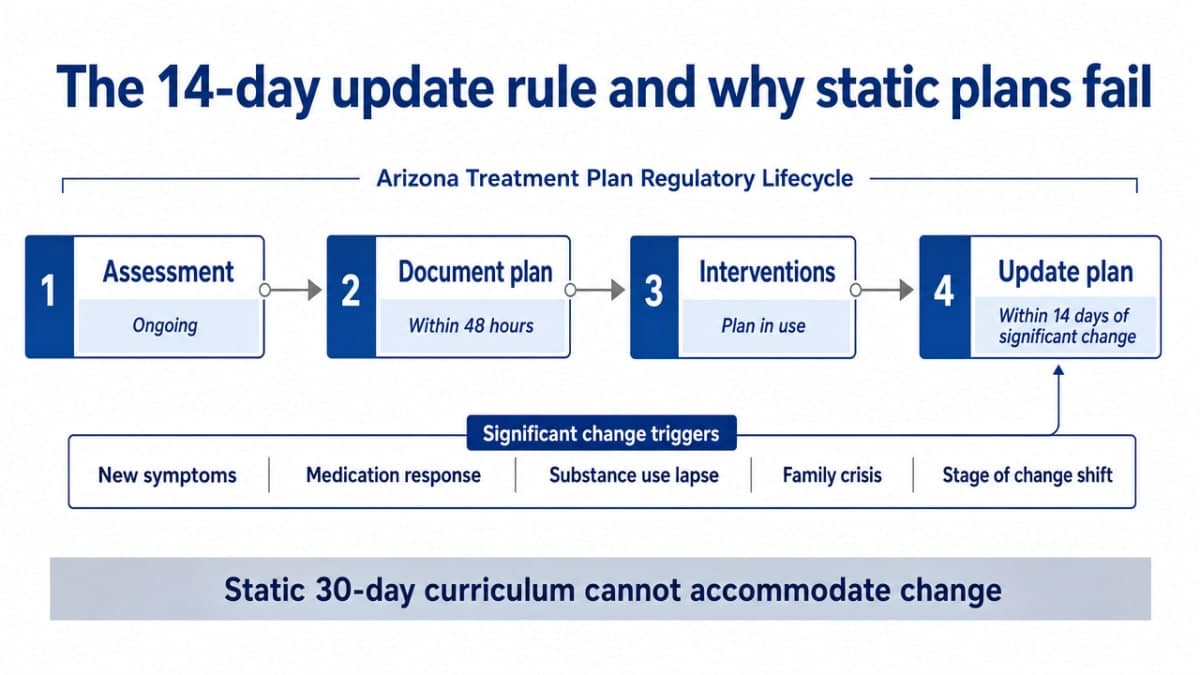
Programs often overlook a critical requirement: your plan must adapt as your condition changes. ADHS licensing training explicitly states that facilities must update the service plan within 14 days of a significant change in your condition 11. New symptoms, medication responses, substance use lapses, family crises, or shifts in your stage of change should all trigger a documented revision, not just a note in your chart.
Combined with R9-10-308’s requirement for ongoing assessment 1 and Article 7’s 48-hour initial documentation window 10, this creates a clear lifecycle: assessment informs the plan, the plan is documented within 48 hours, interventions occur, and if conditions shift, the plan is revised within two weeks.
Where cookie-cutter programs fall below Arizona’s floor
Fixed curriculum vs. assessment-driven interventions
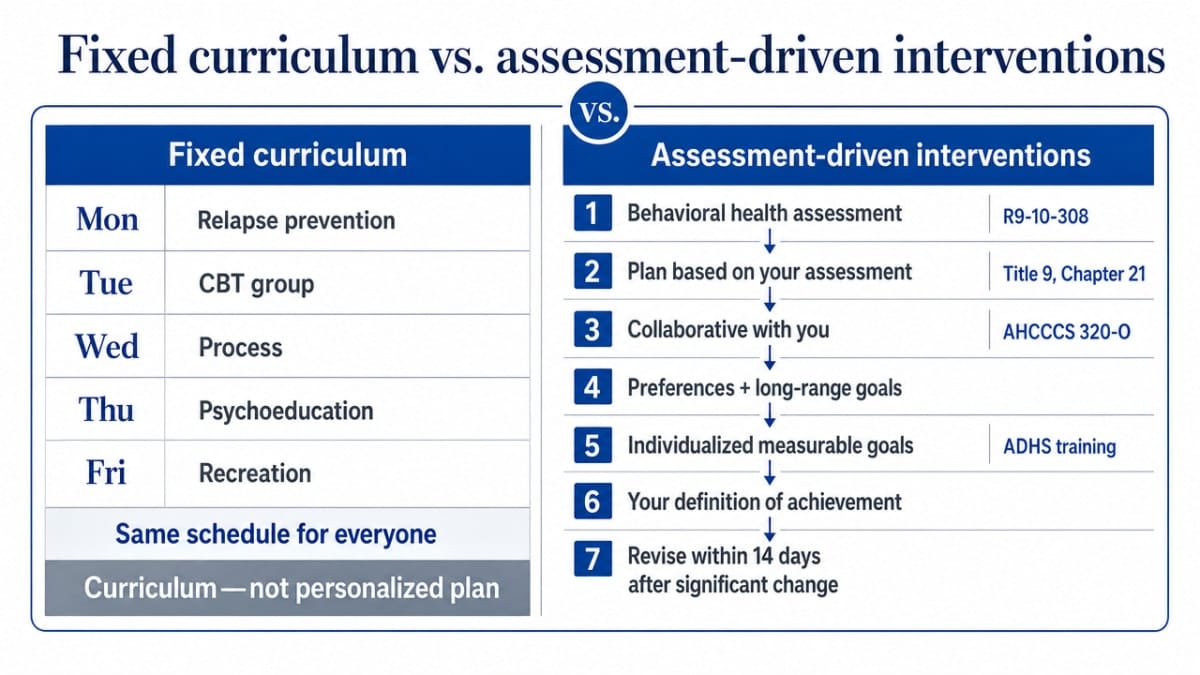
Many programs operate with a standardized weekly schedule: Monday relapse prevention, Tuesday CBT group, Wednesday process, Thursday psychoeducation, Friday recreation. Everyone follows this, regardless of their specific diagnosis or history. This is a curriculum, not a personalized treatment plan.
Arizona’s regulations clearly differentiate:
- R9-10-308 requires the plan to be based on your specific behavioral health assessment and updated as that assessment changes 1.
- Title 9, Chapter 21 mandates collaborative development with you, reflecting your preferences and long-range goals 2.
- AHCCCS 320-O specifies that goals must be individualized, measurable, and reflect your own definition of achievement 3.
- ADHS training clarifies that plans must be revised within 14 days of any significant change in condition 11.
| Arizona regulatory requirement | Cookie-cutter program practice |
|---|---|
| Plan documented within 48 hours, built from your assessment 1 | Intake paperwork plus the standing weekly schedule |
| Developed collaboratively with you, reflecting your preferences 2 | Signed at intake; content decided in advance by the program |
| Goals individualized, measurable, and defined by you 3 | Group-track goals: attend sessions, complete workbook, stay sober |
| Plan updated within 14 days of significant change 11 | Same plan from admission to discharge |
If your program meets fewer than three of these criteria, it is not exceeding personalization standards; it is operating below the state’s minimum requirements.
Insurance-timeline discharge vs. clinically indicated duration
Another area where standardized models often fail to meet regulations is at discharge. The common pattern is that the authorization lasts 28 days, so discharge occurs on day 28. In such cases, the billing cycle, not the treatment plan, dictates the timeline.
Arizona’s regulations do not permit this. R9-10-308 requires the plan to evolve with ongoing assessment 1, and Article 7 residential rules mandate that discharge needs be integrated into the plan itself, based on your clinical picture rather than a fixed calendar 10. Title 9, Chapter 21 further states that the ISP must identify the services you actually need, irrespective of resource availability 2. This means a program cannot shorten your care due to payer issues and claim it’s a clinical decision.
For treatment-resistant presentations, this aspect is paramount. A clozapine titration requires weeks of monitoring. Rapid-cycling bipolar needs sufficient time for mood stabilization. Trauma work initiated in week three cannot conclude in week four simply because a utilization reviewer dictates it. When duration is determined by clinical assessment rather than insurance authorization, the plan has the opportunity to be effective.
What belongs inside a plan built for treatment resistance
Treatment-resistant schizophrenia: clozapine protocols and psychosocial anchors
For patients with schizophrenia where initial antipsychotic trials have been ineffective, the APA practice guideline specifies that the treatment plan should include evidence-based pharmacological and nonpharmacological components. Treatment-resistant cases, in particular, warrant a clozapine trial alongside psychosocial supports 5.
In your written plan, the medication section should not merely state “antipsychotic.” It should explicitly name clozapine as an option if two prior adequate trials have failed, detail the ANC monitoring schedule, list side-effect symptoms that require immediate attention, and identify the prescriber responsible for titration. This constitutes a comprehensive plan, unlike a generic “continue current meds” instruction.
The psychosocial component is equally vital. Cognitive remediation, supported employment, family psychoeducation, and assertive community treatment are considered core, not supplementary, by the APA guideline 5. Your plan should specify which of these apply to you, who delivers them, and how they align with your stated goals, as required by AHCCCS 320-O for objectives to reflect your definition of achievement 3.
If the schizophrenia section of your plan is identical to a plan for situational depression, it has not met the guideline’s standard.
Rapid-cycling bipolar: mood stabilization, sleep architecture, and monitoring cadence
Rapid-cycling bipolar disorder does not conform to a 30-day treatment arc, and your plan should reflect this. With four or more mood episodes in a year, the plan must incorporate a monitoring cadence, not just a medication list.
This cadence needs to be documented. It should specify when lithium or valproate levels are drawn, who reviews them, your target sleep duration and how it’s tracked, and which prodromal signs (e.g., reduced sleep need, spending shifts, racing thoughts) trigger an immediate appointment rather than waiting for the next scheduled visit. R9-10-308 requires the plan to adapt with ongoing assessment 1, and ADHS training mandates plan updates within 14 days of a condition shift 11. For rapid cycling, this update rule is fundamental.
Your short-term objectives, as per AHCCCS 320-O, should be measurable and defined by you 3. “Stabilize mood” is not measurable. “Seven hours of sleep five nights a week, no episodes requiring ER contact for 60 days, lithium level between 0.8 and 1.0″ is. If your plan lacks specific, quantifiable targets, it cannot effectively track treatment progress.
Trauma-linked substance use and the stage-of-change match
When substance use is connected to trauma, sequencing of interventions is more important than intensity. SAMHSA’s integrated treatment principles explicitly state that interventions must align with your stage of readiness for change, and the plan should identify specific interventions for each disorder—treating both as primary, rather than one waiting on the other 12.
In the treatment document, this means the plan should name your current stage (precontemplation, contemplation, preparation, action, maintenance) for substance use and separately for trauma work. If you are in early contemplation about drinking but ready for trauma processing, forcing an abstinence-first curriculum before any trauma work is not stage-matched care; it’s a program’s default schedule.
Trauma-informed care is a requirement, not merely a philosophy. SAMHSA’s guidance for co-occurring conditions defines essential services as person-centered, trauma-informed, and culturally responsive. The assessment should directly inform a treatment plan that identifies strengths, cultural and linguistic needs, problem areas, and stage of change before interventions are selected 13.
If your plan omits the stage-of-change field or defers trauma work until “after you’re stable,” it’s a generic template. Effective care requires a plan that addresses both problems, matches interventions to your current readiness, and updates as you progress.
Integrated planning for co-occurring disorders in Arizona
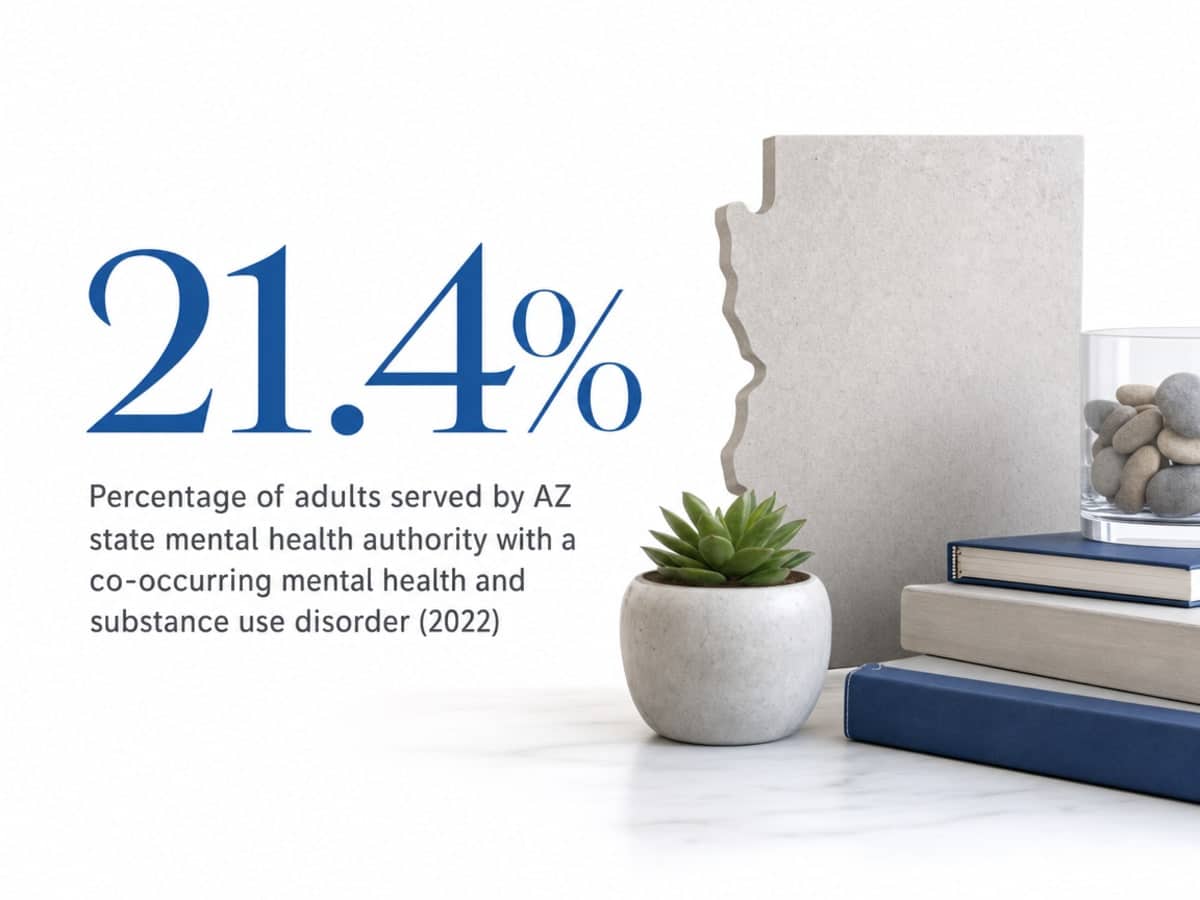
A significant portion of adults served by Arizona’s state mental health authority have co-occurring mental health and substance use disorders. In 2022, this figure was 21.4% 4. This means co-occurring disorders are a defining characteristic of the population within the public behavioral health system.
If your presentation includes both, how your plan addresses this pairing is critical. SAMHSA’s practice principles advocate for dual (or multiple) primary treatment, where a specific intervention is matched to each disorder at your current stage of readiness for change 12. Both problems are named, both receive targeted interventions, and neither is deferred.
Evidence strongly supports this structure; integrated treatment has been found superior to parallel and sequential treatment for individuals with co-occurring disorders 17. Parallel care involves uncoordinated providers, while sequential care addresses one disorder before the other. Integrated care, however, means one team, one plan, and simultaneous attention to both conditions.
SAMHSA’s guidance reinforces this, stating that integrated treatment coordinates mental and substance use interventions and connects you to individualized services addressing both the physical and emotional aspects of each disorder 7. If your Arizona plan directs you to a psychiatrist for mood issues and a separate outpatient program for substance use, without shared documentation, it is parallel care disguised as integrated.
Who builds the plan with you
The clinical team and unified service plan (PIP-8)
The effectiveness of a plan depends on the team involved in its creation. Arizona’s Adult Clinical Team model, outlined in Practice Improvement Protocol 8 (PIP-8), specifies that the team’s primary role is to develop“a comprehensive and unified service plan with the enrolled person that is responsive to his or her identified needs”9. This means one cohesive plan, collaboratively built, rather than disparate plans from uncommunicative providers.
This unified structure is particularly important for treatment-resistant cases. If your psychiatrist is titrating clozapine, your therapist is conducting trauma-focused work, and a case manager is coordinating housing, all three should be referencing the same document and updating shared goals. PIP-8 sets the standard: services must be individualized, strength-based, clinically sound, and developed collaboratively with you and your natural supports 9.
Always ask to review the plan and inquire about who signed it. If psychiatric notes mention goals unfamiliar to your therapist, it indicates a breakdown in coordination.
Family participation and the ISP for SMI designation
If you have an SMI designation in Arizona, the Individual Service Plan (ISP) is developed with your full participation, and family or chosen supports can be included. AHCCCS explicitly states that the ISP considers your unique needs, strengths, culture, diversity, and goals, and is created “with the individual’s full participation” 8. Title 9, Chapter 21 reinforces this by requiring the plan to reflect your preferences and long-range goals 2.
Family involvement is not merely a courtesy. For conditions like rapid-cycling bipolar or during a clozapine trial, those who see you daily often notice prodromal shifts before a monthly appointment. Documenting their role in the plan integrates them into the monitoring system, making them active participants rather than bystanders.
How to read a plan a program hands you
When a facility provides you with a treatment plan, do not sign it immediately. Take time to review it thoroughly, treating it as a document that must answer specific questions, as required by Arizona law.
Look for six key elements:
- Is the plan linked to your specific assessment, or does it appear generic? R9-10-308 mandates it be based on your behavioral health assessment and updated as that assessment changes 1.
- Are the goals articulated in your own words, with measurable targets like sleep hours, medication levels, or symptom-free days? AHCCCS 320-O requires objectives to be individualized, measurable, and reflect your definition of achievement 3.
- Does the medication section specify details—such as clozapine consideration for treatment-resistant cases, monitoring cadence, and contact information for side effects—in line with APA guidelines 5?
- If you have co-occurring substance use, is there a named intervention for each disorder, matched to your stage of change 12?
- Is there a written trigger for the 14-day update rule 11?
- Does one unified plan reflect the input and coordination of the entire clinical team 9?
If four or more of these questions yield a “no,” request a revision. This is not being difficult; it is holding the plan to Arizona’s existing requirements.
Clarify Next Steps With a Personalized Assessment
Receive clear, expert guidance tailored to your unique clinical profile and treatment history.
Frequently Asked Questions
What makes a treatment plan legally ‘individualized’ under Arizona rules?
Under Ariz. Admin. Code § R9-10-308, a plan must be built on your specific behavioral health assessment, updated as that assessment changes, and developed with your participation 1. AHCCCS 320-O further requires goals to be individualized, measurable, and reflect your own definition of achievement 3. A generic curriculum given to every admission does not meet this standard.
How quickly does an Arizona facility have to document my treatment plan?
For behavioral health residential facilities, the treatment plan must be documented in your medical record within 48 hours of your first physical or behavioral health service 10. This written plan must be linked to your assessment 1. If a program only provides a weekly group schedule after two days, it is not compliant with the rule.
How often does my plan have to be updated once treatment starts?
ADHS licensing training specifies that the service plan must be updated within 14 days of a significant change in your condition 11. R9-10-308 also requires the plan to adapt with ongoing assessment 1. New symptoms, a medication response, a substance use lapse, or a trauma disclosure should all prompt a written revision, not just a chart note.
What should a plan for treatment-resistant schizophrenia or rapid-cycling bipolar actually include?
The APA guideline recommends a documented, comprehensive, person-centered plan with evidence-based pharmacological and nonpharmacological components, including clozapine consideration and psychosocial supports for treatment-resistant schizophrenia 5. For rapid-cycling bipolar, the plan should detail a written monitoring cadence: medication levels, sleep targets, prodromal triggers, and measurable short-term objectives as per AHCCCS 320-O 3.
If I have a co-occurring substance use disorder, does Arizona require integrated planning?
Arizona rules require plans to address your identified needs 2. SAMHSA’s practice principles advocate for dual-primary treatment planning, where a specific intervention is matched to each disorder at your current stage of change 12. Integrated care has proven superior to parallel or sequential models 17. Separate providers without a shared plan do not constitute integrated care.
Can my family participate in building the plan, especially with an SMI designation?
Yes. AHCCCS explicitly states that the Individual Service Plan is created with your full participation and considers your unique needs, strengths, culture, and goals 8. Title 9, Chapter 21 requires the plan to reflect your preferences and long-range goals 2. Naming family or chosen supports in the plan integrates them into the monitoring team.
References
- Ariz. Admin. Code § R9-10-308 – Treatment Plan. https://www.law.cornell.edu/regulations/arizona/Ariz-Admin-Code-SS-R9-10-308
- Arizona Administrative Code Title 9, Chapter 21 – Behavioral Health Services for Persons with Serious Mental Illness. https://apps.azsos.gov/public_services/Title_09/9-21.pdf
- AHCCCS Medical Policy Manual 320-O – Behavioral Health Services. https://www.azahcccs.gov/shared/Downloads/MedicalPolicyManual/300/320-O.pdf
- Arizona 2022 Uniform Reporting System Mental Health Data Results. https://www.samhsa.gov/data/sites/default/files/reports/rpt42739/Arizona.pdf
- The American Psychiatric Association Practice Guideline for the Treatment of Patients With Schizophrenia. https://pmc.ncbi.nlm.nih.gov/articles/PMC7725162/
- Integrated Treatment for Co-Occurring Disorders Evidence-Based Practices (EBP) KIT. https://www.samhsa.gov/resource/ebp/integrated-treatment-co-occurring-disorders-evidence-based-practices-ebp-kit
- Managing Life with Co-Occurring Disorders – SAMHSA. https://www.samhsa.gov/mental-health/serious-mental-illness/co-occurring-disorders
- SMI Designation – AHCCCS Member Resources. https://www.azahcccs.gov/Members/AlreadyCovered/MemberResources/SMIDesignation.html
- Practice Improvement Protocol 8 – The Adult Clinical Team. https://www.azahcccs.gov/PlansProviders/Downloads/GM/ClinicalGuidanceTools/tact.pdf
- Article 7 – Behavioral Health Residential Facilities (Licensing Rules). https://www.azdhs.gov/documents/licensing/residential-facilities/article-7.pdf
- Behavioral Health 101 – Licensing Training. https://www.azdhs.gov/documents/licensing/trainings-exercises-collaboratives/rules/behavioral-health-101.pdf
- SAMHSA – Practice Principles of Integrated Treatment for Co-Occurring Disorders. https://library.samhsa.gov/sites/default/files/SAMHSA_Digital_Download/PEP20-02-01_004.pdf
- Substance Use Disorder Treatment for People with Co-Occurring Conditions. https://library.samhsa.gov/sites/default/files/pep20-06-04-006.pdf
- Early Recognition and Effective Treatment of Early Serious Mental Illness. https://library.samhsa.gov/product/early-recognition-effective-treatment-early-serious-mental-illness/pep24-01-006
- Behavioral Health & Substance Abuse Services for Children – DCS Policy. https://extranet.azdcs.gov/DCSPolicy/Content/Program%20Policy/03%20Case%20Planning%20and%20Services/07%20Medical%20and%20Behavioral%20Health%20Services/CH3_S07_02%20Behavioral%20Health.htm
- Annual HCBS Report Contract Year Ending 2024. https://www.azahcccs.gov/Shared/Downloads/HCBS/HCBSAnnualReportforCYE2024.pdf
- Integrated Treatment of Substance Use and Psychiatric Disorders. https://www.ncbi.nlm.nih.gov/pmc/articles/PMC3753025/
- Person-Centered Care for People with Serious Mental Illness: A Review of the Evidence. https://pubmed.ncbi.nlm.nih.gov/25238603/
