

Key Takeaways
- Yavapai County residents in Prescott, Prescott Valley, and Cottonwood can access outpatient services locally, while higher-acuity needs may qualify for residential or inpatient admission when outpatient care has failed.3
- Arizona defines clear criteria for escalating care: safety concerns, significant functional decline, and prior failure at lower levels of care support admission to residential or inpatient settings.11,13
- Coverage hinges on prior authorization and the IMD rule, which allows AHCCCS to fund inpatient stays for adults aged 21-64 up to 15 days per calendar month.7
- Before choosing a program, compare psychiatric availability, integrated dual diagnosis capability, treatment-resistant protocols like clozapine, licensing, and how insurance benefits apply to the specific level of care.21,24
When Outpatient Care Isn’t Enough
You’ve likely navigated a challenging journey: therapists, medications, and diagnoses that offered temporary relief but ultimately fell short. This exhaustion is a valid signal. In Arizona, inpatient behavioral health admission is medically appropriate when outpatient care has failed or when needs are so severe they require a specialized inpatient setting. This policy acknowledges that sometimes the treatment approach, not the individual, needs to change.3
If your loved one is in Prescott, Prescott Valley, Cottonwood, or elsewhere in Yavapai County, options extend beyond weekly therapy. Community behavioral health services address lower-acuity needs, and a 24/7 crisis line at (877) 756-4090 or 988 can help assess urgent situations. For more complex cases, including treatment-resistant conditions and co-occurring mental health and substance use disorders, higher levels of care like residential and inpatient programs are available.1,2
This guide will clarify what these higher levels of care entail, when they are appropriate, and how ViewPoint Dual Recovery in Prescott addresses complex cases often turned away by other programs.
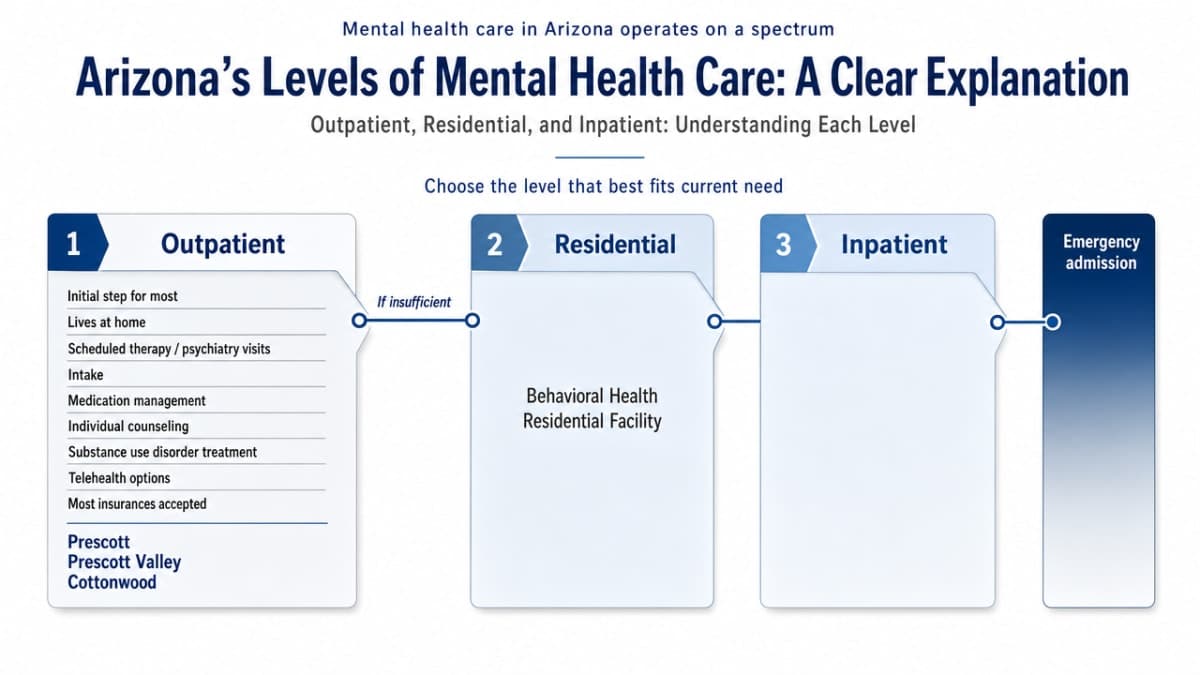
Arizona’s Levels of Mental Health Care: A Clear Explanation
Outpatient, Residential, and Inpatient: Understanding Each Level
Mental health care in Arizona operates on a spectrum, with each level serving a distinct purpose. Identifying the correct level for your loved one can streamline the path to effective treatment.
Outpatient care is the initial step for most individuals. Patients reside at home and attend scheduled appointments with therapists or psychiatrists. Yavapai County offers outpatient behavioral health services in Prescott, Prescott Valley, and Cottonwood, including intake, medication management, individual counseling, and substance use disorder treatment, with telehealth options and acceptance of most insurances. When this level of care proves insufficient, other options become necessary.1
Residential treatment, also known as a Behavioral Health Residential Facility (BHRF), is a live-in program providing 24-hour supervision. Under Arizona’s Medicaid rules, BHRF admission requires prior authorization, a diagnosed behavioral health condition, significant functional or psychosocial impairment, and evidence that stabilization cannot be achieved in a less restrictive setting. A 2024 AHCCCS training document further specifies that significant risk of harm, serious functional impairment, the need for 24/7 care, and prior failure at lower levels of care are qualifying factors. This level is for individuals experiencing significant struggles but who are not in an acute medical emergency.4,13
Inpatient hospitalization represents the highest level of structured care. Arizona defines a behavioral health inpatient facility as one that provides continuous treatment for individuals who may pose a danger to themselves or others, are gravely disabled, or are unable to meet basic physical needs. State licensing rules describe it as continuous treatment for severe behavioral health issues impacting judgment, safety, reality testing, or basic needs. AHCCCS considers inpatient admission medically appropriate when outpatient care has failed or when the individual’s needs are so severe they can only be met in a specialized inpatient setting 3,11,12
Emergency admission is a separate pathway, permitted under Arizona law when an individual is a danger to self or others, has persistent or acute disability or grave disability, and is likely to suffer serious harm without immediate hospitalization. This option is typically accessed through crisis intervention when consent for treatment may not be possible.14
Indicators for a Higher Level of Care
Recognizing when a shift in care is needed doesn’t require a clinical background. The key is to align observed changes with Arizona’s criteria for escalating care.
Consider these indicators:
- Outpatient care is no longer effective. If weekly therapy and medication adjustments are not sustaining stability, this is a recognized signal. AHCCCS specifically identifies outpatient treatment failure as a condition for appropriate inpatient admission.3
- Safety concerns are present. This includes suicidal ideation, self-harm, threats towards others, or more subtle signs like refusing food or medication, or prolonged sleep deprivation. Arizona’s inpatient and emergency admission standards prioritize danger to self or others, grave disability, and inability to meet basic needs.11,14
- Daily functioning has significantly declined. Inability to work, parent, or leave one’s room are examples. Residential criteria explicitly include serious functional impairment and the need for 24/7 support when lower levels of care have been insufficient.13
- Previous lower-level interventions have been attempted. A history of cycling through intensive outpatient programs, therapy changes, and medication trials strengthens the medical case for a higher level of care.4
If several of these points resonate, your concerns are likely aligned with clinical guidelines. The next step, whether contacting a crisis line or an admissions team, is a well-justified decision.
Inside an Inpatient Stay: What to Expect
A Typical Day: Structured Care and Support
An inpatient stay is designed around structure, safety, and continuous observation. Arizona regulations mandate that inpatient behavioral health facilities provide continuous treatment, meaning nursing staff are available around the clock. This constant presence forms the foundation of the entire treatment experience.11
A typical day often begins with a morning check-in with nursing staff, including vital signs and a brief assessment of mood and safety. Psychiatrist visits occur in the morning, daily during the initial phase of the stay. The psychiatrist evaluates current medications, their effectiveness, side effects, and adjusts the treatment plan as needed. This continuous oversight allows for real-time medication management, a significant advantage over less intensive settings.
Therapy sessions fill the time between medical appointments. Group therapy focuses on coping skills, relapse prevention, processing underlying issues, and improving family communication. Individual therapy is scheduled regularly, and family sessions are incorporated when clinically beneficial.
Meals, rest, and quiet periods are integral to the treatment plan. AHCCCS bills inpatient care on a per diem basis, meaning all daily services—psychiatry visits, group therapy, nursing checks, and medication administration—are included in a single daily rate, ensuring comprehensive care without hourly billing concerns.5
Patient Rights During Inpatient Treatment
A common concern for families considering inpatient care is the perceived loss of control. Arizona law provides specific protections to address this.
Patients in inpatient settings retain a set of rights clearly outlined by AHCCCS. These include the right to wear personal clothing, keep personal possessions, use a telephone, access mail, and receive visits from family and support persons. Patients also have the right to give informed consent before receiving medication, except in emergencies or when legally mandated, and the right to be free from unnecessary or excessive medication. A patient-rights brochure further emphasizes these protections and includes freedom from discrimination.6,9
These are fundamental rights, not privileges. As a family member, you can call, visit within program guidelines, and ask questions. Your loved one can communicate their needs and concerns, knowing they will be heard. Understanding these rights can make the initial call to admissions less daunting.
Addressing Treatment-Resistant Mental Health Conditions
The frustration of trying various treatments without success is a distinct challenge. This pattern has a clinical designation: treatment resistance. For instance, approximately 20 to 30 percent of schizophrenia patients meet criteria for treatment resistance despite adequate antipsychotic trials. This is not an uncommon scenario but a recognized clinical category with established guidelines and specific treatment approaches.29
The American Psychiatric Association’s practice guideline specifically recommends clozapine for treatment-resistant schizophrenia. Recent research focuses on safe initiation and management of clozapine due to its significant potential benefits for appropriate patients. This highlights that when standard treatments fail, it often points to a limitation of the treatment system, not a personal failing of the individual.23,24
Treatment resistance also redefines what constitutes “appropriate care.” When outpatient care has not achieved stability, AHCCCS considers inpatient admission medically appropriate. Clozapine protocols, in particular, require blood monitoring and close psychiatric oversight, which is more safely initiated in a setting with 24-hour nursing and daily access to a board-certified psychiatrist.3
Dual Diagnosis: Integrated Treatment for Co-Occurring Disorders
When mental health challenges and substance use intertwine, they often exacerbate each other. This is clinically termed co-occurring disorders: the simultaneous presence of a mental health disorder and a substance use disorder, encompassing various combinations like depression and alcohol, bipolar disorder and stimulants, or PTSD and opioids. Individuals with co-occurring disorders are more prone to hospitalization than those with a single diagnosis.16,17
Effective treatment requires addressing both conditions concurrently. SAMHSA emphasizes that both disorders must be treated, utilizing a combination of medications, rehabilitation, talk therapy, and support groups, rather than sequential treatment. Peer-reviewed literature supports integrated treatment—where one team addresses both disorders simultaneously—as the standard of care, regardless of which issue initially brings the patient to treatment. While integrated care is considered the strongest model, a separate review suggests the evidence is more nuanced than often portrayed in marketing.18,21,22
Practically, this means seeking a program where the psychiatrist managing medications and the therapist focusing on substance use are part of the same team, in the same facility, collaborating on the patient’s care. ViewPoint Dual Recovery in Prescott is structured around this integrated approach, ensuring that individuals do not have to prioritize one aspect of their condition over the other.
Navigating Care in Yavapai County: Geography, Demographics, and Access
Local context significantly influences healthcare access. Yavapai County presents unique considerations compared to larger metropolitan areas.
Key demographic factors include a median age of 54.5 years, with approximately 18.1% of residents reporting a disability and about 10.9% being uninsured. These statistics indicate an older population with a higher prevalence of chronic illness and a notable segment facing insurance barriers. For adult children assisting aging parents with medication adherence issues, these factors form a crucial backdrop.26
Geographically, Prescott, Prescott Valley, and Cottonwood serve as primary hubs for community behavioral health services, offering intake, medication management, counseling, and substance use services. While beneficial for outpatient needs, immediate 24-hour supervision often necessitates contacting the crisis line at (877) 756-4090 or 988.1,2,8
The practical implication is not to assume that higher-acuity care requires leaving the county, nor that the nearest outpatient clinic is always the appropriate solution. Utilizing the crisis line for triage or directly contacting an admissions team for level-of-care assessment is recommended.
Insurance, AHCCCS, and the IMD Rule
Understanding the financial aspects of mental health care is a practical necessity. Here’s a breakdown of common insurance considerations.
For individuals with AHCCCS (Arizona’s Medicaid), inpatient behavioral health admission requires prior authorization and is deemed appropriate when outpatient care has failed or when needs are severe enough to necessitate a specialized inpatient setting. Residential care in a Behavioral Health Residential Facility also requires prior authorization, and it’s important to note that room and board are not always bundled into the per diem rate for clinical services. This means treatment is covered when medically necessary, but some non-clinical costs may be separate.3,10
The Institution for Mental Diseases (IMD) rule is another key factor. Federally, Medicaid typically covers inpatient psychiatric services for individuals under 22 and over 64, with limited exceptions for adults aged 21 to 64. Arizona addresses this through an “in-lieu-of” authority, allowing AHCCCS to cover IMD stays for adult members up to 15 days per calendar month. This is a monthly allowance, not a lifetime cap, providing a window for necessary care.7,27
Inpatient per diem billing bundles all daily services into a single rate, preventing separate billing for individual items. This is why admissions teams require specific insurance plan details to provide accurate coverage information. Verifying coverage is an informational step, not a commitment, and is crucial for planning.5
The Admission Process: From First Call to First Night
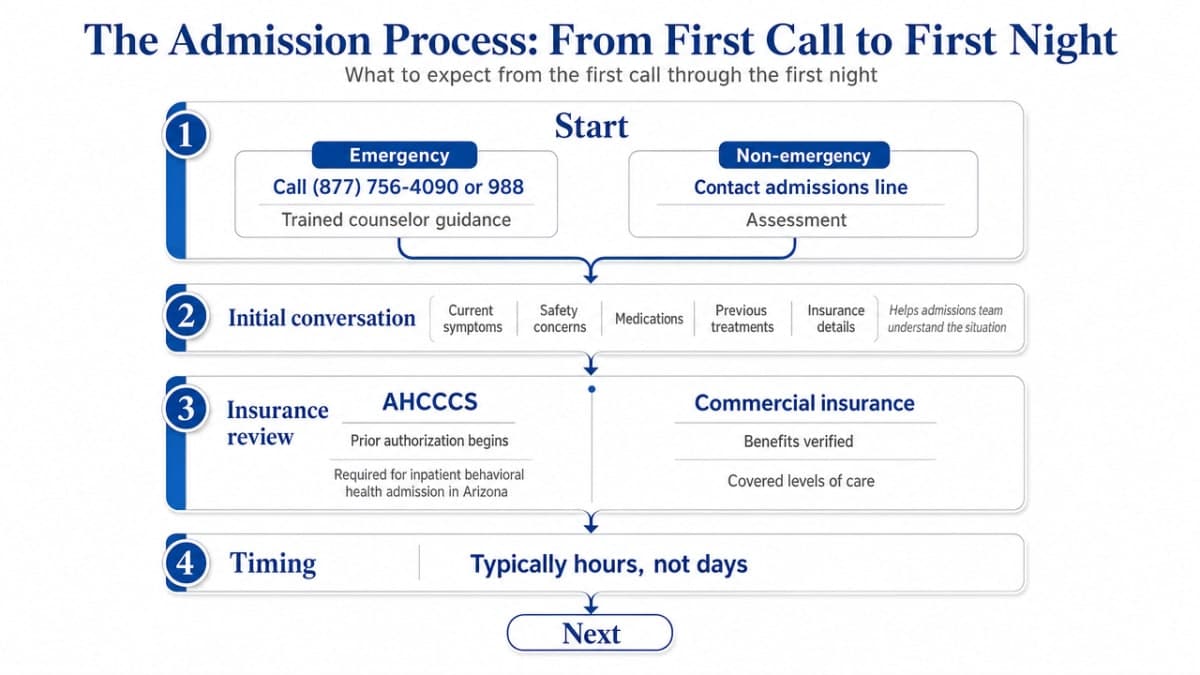
Initiating the admission process can feel overwhelming, but the first call is often more straightforward than anticipated. In an emergency, dial (877) 756-4090 or 988 to connect with a trained counselor who can guide you. For non-emergencies where concerns are escalating, directly contact an admissions line for an assessment.2,8
During this initial conversation, you’ll be asked about current symptoms, safety concerns, medications, previous treatments, and insurance details. This information helps the admissions team understand the situation. If AHCCCS is involved, the prior authorization process will begin, as inpatient behavioral health admission always requires it in Arizona. For commercial insurance, benefits will be verified to determine covered levels of care. This step typically takes hours, not days.3
Next, a clinical assessment is conducted, which may be in person, by phone, or video. The clinician will confirm the appropriateness of inpatient or residential care based on criteria such as safety, functional impairment, and treatment history. If appropriate, admission is scheduled; otherwise, alternative levels of care are discussed.3,13
The first night in a facility is generally calm, involving intake paperwork, a meeting with nursing staff, a brief psychiatric review, settling into a safe room, and preparing for the next day. Making that initial call is often the most challenging part of the process.
ViewPoint Dual Recovery in Prescott: Specialized Care for Complex Needs
Many programs may decline complex cases or have extensive waitlists. ViewPoint Dual Recovery in Prescott specializes in situations often overlooked by other facilities, focusing on treatment-resistant psychiatric conditions and co-occurring substance use disorders that require advanced psychiatric expertise.
ViewPoint offers daily access to board-certified psychiatry, 24-hour nursing, and advanced medication strategies, including clozapine protocols for treatment-resistant schizophrenia, a medication recommended by the American Psychiatric Association for this population. Individual, group, and family therapies, along with trauma-focused work, are integrated with the psychiatric treatment plan. For dual diagnosis, psychiatrists and addiction-focused therapists collaborate as a single team, adhering to the integrated care model recognized as the standard of care.21,24,23,28
The facility is licensed by Arizona ADHS under state behavioral health treatment regulations, and length of stay is determined by clinical need rather than a fixed schedule. To determine if this level of care is suitable for your loved one and to understand insurance coverage, contacting admissions for a benefits check is the recommended next step.25
Start a tailored plan for complex needs
Connect with a clinical expert to clarify next steps for advanced inpatient care in Yavapai County.
Frequently Asked Questions
How do I know if my loved one needs inpatient care instead of more outpatient therapy?
Look for a combination of signs: outpatient care is no longer effective, safety is a concern, or daily functioning has severely declined. Arizona’s Medicaid rules specify that outpatient failure and the severity of needs requiring a specialized inpatient setting make admission medically appropriate. If these signs are present, seeking an assessment is a prudent next step.3
What’s the difference between inpatient hospitalization and a residential (BHRF) program in Arizona?
Inpatient hospitalization is for individuals who may be a danger to themselves or others, gravely disabled, or unable to meet basic needs, requiring continuous medical treatment. A Behavioral Health Residential Facility (BHRF) provides 24-hour supervision for significant functional impairment when less restrictive settings have failed. Both require prior authorization. Inpatient care addresses higher acuity needs, while residential care is a live-in step below it.4,11,13
Will AHCCCS or my insurance cover an inpatient mental health stay in Yavapai County?
AHCCCS covers inpatient behavioral health admission when medical necessity is established and prior authorization is obtained. For adults aged 21 to 64, AHCCCS may cover stays in an Institution for Mental Diseases for up to 15 days per calendar month under specific authority. Commercial insurance plans vary widely. A benefits verification call is the most efficient way to confirm coverage for your specific plan.
What happens if outpatient therapy and several medications haven’t worked?
This pattern indicates a recognized clinical category, not a personal failure. For example, 20-30% of schizophrenia patients experience treatment resistance despite adequate medication trials. The APA guideline recommends clozapine for treatment-resistant schizophrenia, and its safe initiation often benefits from 24-hour nursing and daily psychiatric oversight. Escalating the level of care is often indicated by clinical guidelines in such situations.23,24,29
Can someone get treatment for both a mental illness and a substance use problem at the same time?
Yes, and this integrated approach is widely recommended by experts. SAMHSA emphasizes that both conditions must be treated concurrently, utilizing medications, therapy, and support systems. Peer-reviewed research identifies integrated treatment—where one team addresses both disorders simultaneously—as the standard of care. However, another review suggests the evidence is more complex than often marketed, so inquire about how programs coordinate care.18,21,22
What do I do right now if my loved one is in crisis in Prescott, Prescott Valley, or Cottonwood?
Immediately call the Yavapai County crisis line at (877) 756-4090 or dial 988 to connect with a trained counselor. They can assess the situation, provide support, and connect you with mobile crisis services or emergency evaluation if necessary. Arizona law permits emergency admission when an individual poses a danger to themselves or others or is gravely disabled. Do not hesitate to make the call.2,8,14
References
- Behavioral Health Services – Yavapai, AZ. https://www.yavapaiaz.gov/Resident-Services/Health-Services/Community-Health-Center-of-Yavapai/Behavioral-Health-Services
- 24/7 Crisis Line – Yavapai County Sheriff’s Office. https://www.ycsoaz.gov/I-Want-To/Find/Find-Mental-HealthSubstance-Abuse-Resources/247-Crisis-Line
- PA Criteria for Behavioral Health Inpatient Admission – AHCCCS. https://www.azahcccs.gov/PlansProviders/FeeForServiceHealthPlans/PriorAuthorization/criteria.html
- AMPM Policy 320-V – Behavioral Health Residential Facilities. https://www.azahcccs.gov/shared/Downloads/MedicalPolicyManual/300/320v.pdf
- COVERED BEHAVIORAL HEALTH SERVICES GUIDE (CBHSG). https://www.azahcccs.gov/PlansProviders/Downloads/MedicalCodingResources/AHCCCSCoveredBHServicesManual.pdf
- Your Rights While You Are Inpatient – AHCCCS. https://www.azahcccs.gov/Members/Downloads/RandRBrochures/OHR_SMI_Inpatient_Rights_Education_Eng.pdf
- IMDs in Arizona. https://www.azahcccs.gov/Members/BehavioralHealthServices/IMDs_in_Arizona.html
- Crisis Hotlines. https://www.azahcccs.gov/BehavioralHealth/crisis.html
- Inpat Rights & DC Brochure final 10-25-2017.pub – AHCCCS. https://www.azahcccs.gov/Members/Downloads/RandRBrochures/InpatRightsDCBrochurefinal10252017.pdf
- BEHAVIORAL HEALTH SERVICES – AHCCCS. https://www.azahcccs.gov/PlansProviders/Downloads/FFSProviderManual/FFS_Chap19BehavioralHealth.pdf
- Behavior Health Residential Facilities. https://www.azdhs.gov/documents/licensing/trainings-exercises-collaboratives/rules/residential-facilities-new-rules-training-presentation.pdf
- LICENSING ARTICLE – Arizona Department of Health Services. https://www.azdhs.gov/documents/director/administrative-counsel-rules/rules/rulemaking/hci/inpatient/hci-behavioral-health-inpatient-facilities-draft-rules-121012.pdf
- Behavioral Health Residential Facility (BHRF) …. https://www.azahcccs.gov/Resources/Downloads/DFSMTraining/2024/Behavioral_HealthResidentialFacilityBHP_ResponsibilitiesSeptember2024.pdf
- Chapter 0163 – 562R – S Ver of SB1311 – Arizona Legislature. https://www.azleg.gov/legtext/56leg/2R/laws/0163.htm
- AMPM Policy 586. https://www.azahcccs.gov/PlansProviders/Downloads/MedicalPolicyManual/500/586.pdf
- Managing Life with Co-Occurring Disorders. https://www.samhsa.gov/mental-health/serious-mental-illness/co-occurring-disorders
- Co-Occurring Disorders and Other Health Conditions | SAMHSA. https://www.samhsa.gov/substance-use/treatment/co-occurring-disorders
- Mental Health and Substance Use Co-Occurring Disorders – SAMHSA. https://www.samhsa.gov/mental-health/what-is-mental-health/conditions/co-occurring-disorders
- Substance Use Disorder Treatment for People with Co-Occurring …. https://library.samhsa.gov/sites/default/files/pep20-06-04-006.pdf
- Integrated Treatment for Co-Occurring Disorders: The Evidence. https://library.samhsa.gov/sites/default/files/ebp-kit-the-evidence-10242019.pdf
- Integrating Treatment for Co-Occurring Mental Health Conditions. https://pmc.ncbi.nlm.nih.gov/articles/PMC6799972/
- Integrated versus non-integrated management and care for clients with co-occurring mental health and substance use disorders: a qualitative systematic review of randomised controlled trials. https://pubmed.ncbi.nlm.nih.gov/15626531/
- A Guideline and Checklist for Initiating and Managing Clozapine in Treatment-Resistant Schizophrenia. https://www.pubmed.ncbi.nlm.nih.gov/35759211/
- The American Psychiatric Association practice guideline for the treatment of patients with schizophrenia. https://www.med.unc.edu/psych/epi-nc/wp-content/uploads/sites/720/2024/01/APA-2020-guidelines-1.pdf
- Arizona Administrative Code Title 9, Chapter 10 – Health Care Institutions: Licensing. https://apps.azsos.gov/public_services/Title_09/9-10.pdf
- Yavapai County Economic Conditions Report. https://oeo.az.gov/sites/default/files/data/idj/economic-profile-yavapaicounty.pdf
- Medicaid Handbook: Interface with Behavioral Health Services. https://library.samhsa.gov/sites/default/files/sma13-4773_mod3.pdf
- Integrated treatment of substance use and psychiatric disorders. https://pubmed.ncbi.nlm.nih.gov/23419281/
- Treatment-resistant schizophrenia: definition, prevalence, and therapeutic options. https://pubmed.ncbi.nlm.nih.gov/28429312/