

Key Takeaways
- Long-term psychiatric care should be defined by clinical response, not a fixed day count, with medication trials, trauma work, and dual-diagnosis stabilization dictating length of stay rather than a payer’s clock.
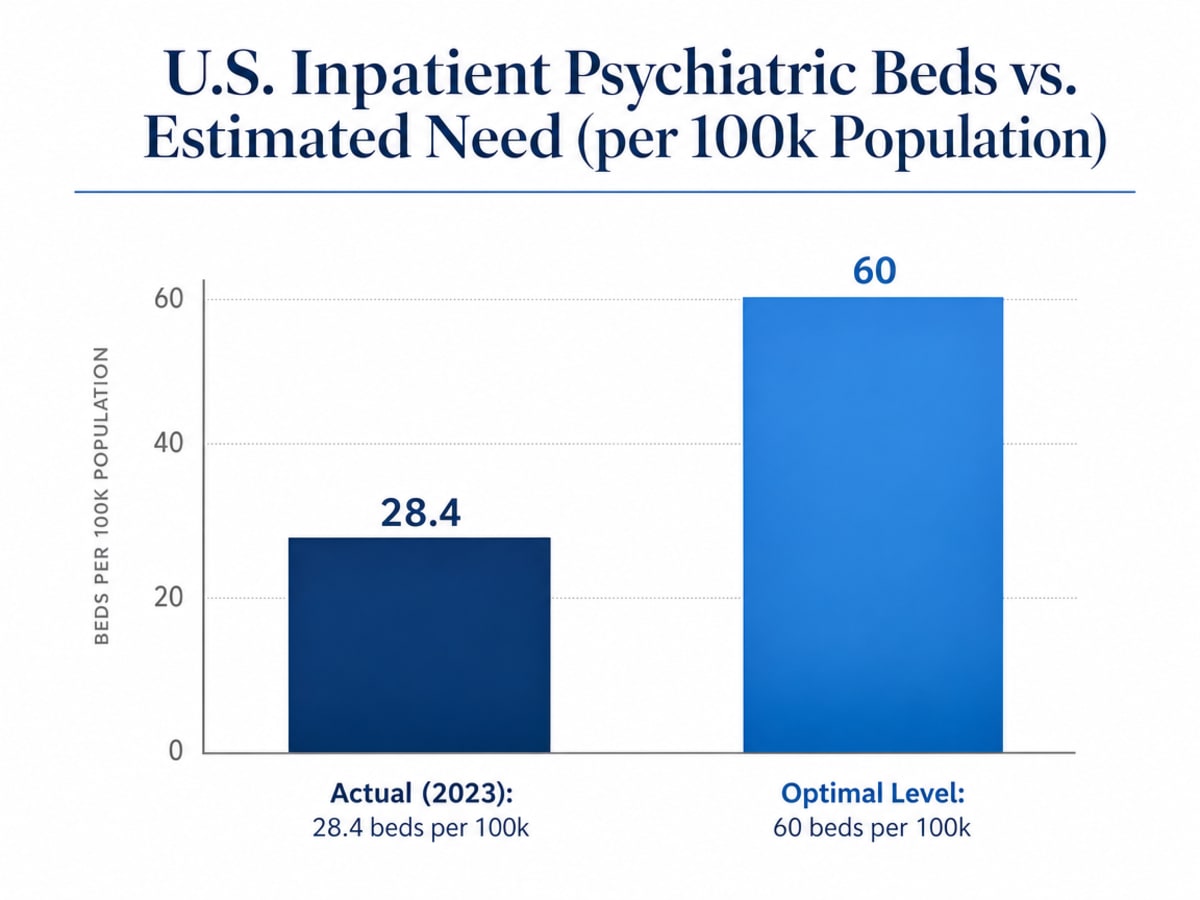
- The U.S. has roughly 28.4 inpatient psychiatric beds per 100,000 people, far below the 60 per 100,000 the literature calls adequate, making short admissions and revolving-door discharges structural rather than clinical outcomes 7.
- Extended stays matter most for treatment-resistant psychosis, dual diagnosis, and court-involved adults, where research shows 90-day retention improves six-month outcomes and dual-diagnosis cases often require stays beyond 180 days 1, 15.
- Families and referring clinicians whose local options have run out should consider out-of-state, private-pay programs built on clinically-indexed length of stay, since IMD exclusion rules and SMI/SED waiver limits cap extended care through public financing 17, 6.
Why the search for extended psychiatric care keeps hitting walls
You have probably already lived some version of this. A hospital stabilizes your family member in six or seven days, hands you a discharge folder, and sends everyone home before the medication has even reached a steady state. Two months later, you are back in the emergency department. The intake nurse asks the same questions. Someone uses the word “revolving door” like it explains something.
It doesn’t. What it describes is a supply problem, a financing problem, and a clinical mismatch that most families are never told about directly.
The U.S. has roughly 28.4 inpatient psychiatric beds per 100,000 people, well below the level of about 60 per 100,000 that the literature considers adequate 7. Even where beds exist, the stays attached to them are short by design. Managed care treats length of stay as the main cost-control lever in inpatient mental health, and that lever has been pulled steadily for decades 10. For adults with treatment-resistant schizophrenia, rapid-cycling bipolar disorder, or a serious mental illness layered on top of active substance use, the standard episode of care ends before the actual work of stabilization can begin.
None of that is your fault. You are searching for something the system has quietly stopped producing at scale.
This piece walks through why long-term adult psychiatric care is so hard to find nationwide, what “long-term” should actually mean when it is set by clinical response rather than a payer clock, and how a smaller number of programs — including ViewPoint Dual Recovery in Prescott, Arizona — build length of stay around the person in front of them instead of the calendar on the wall. If you are looking outside your home state because your options at home have run out, you are not overreacting. You are reading the map correctly.
What ‘long-term’ actually means in adult psychiatric care
Here is the first thing worth clearing up. “Long-term” is not a fixed number of days. It is a length of stay set by how the person in front of you is actually responding, not by what a utilization reviewer approved on day three.
That distinction matters because the industry uses the phrase loosely. A 28-day rehab calls itself long-term compared to a detox. A state hospital calls a two-year admission long-term compared to a general unit. Neither definition helps you if the person you love has cycled through five short admissions and is still not stable.
Clinically, the more useful frame is a stay long enough to complete the actual work: a full diagnostic reassessment, a medication trial that reaches therapeutic levels and shows response (clozapine titration alone can take six to twelve weeks), trauma stabilization that does not blow up the psychiatric picture, and dual-diagnosis work that treats the substance use and the mental illness in the same room, not in sequence.
Research anchors this in specific numbers. In a residential dual-diagnosis program, adults who stayed at least 90 days used less inpatient mental health care and engaged more with outpatient services at six months than those who left earlier 1. In a large 2024 study of nearly 8,900 adult psychiatric admissions, schizophrenia, treatment resistance, and mandatory care all independently increased the odds of a stay beyond 30 days — treatment resistance alone carried an odds ratio of about 1.4 12. Adults with dual diagnosis were significantly more likely to have prior hospitalizations exceeding 180 days, and the authors were direct: this group needs longer inpatient treatment because of noncompliance, suicide risk, and the coordination required to prepare them for addiction therapy 15.
So when you read “long-term” on a program’s website, the question to ask is not how many days. It is whose clock the program runs on. If the answer is the payer’s, you already know how the story ends. If the answer is the clinical team’s — with length of stay reviewed against symptoms, medication response, and functional gains — that is a different kind of program. ViewPoint’s model sits in that second category, sizing each adult’s stay to what the case actually requires rather than to a preset track.
The supply problem: a bed shortage most families never hear about
When a discharge planner tells you there is nothing available, that is not a soft no. It is often literally true.
The most recent CMS-based count puts U.S. inpatient psychiatric capacity at 28.4 beds per 100,000 people in 2023 — more than 30 beds short of the 60-per-100,000 level that the research literature treats as adequate 7. That figure includes both freestanding psychiatric hospitals and psychiatric units inside short-term acute care hospitals. It is a national number, and it hides real geography: hundreds of counties have lost every psychiatric bed they had, and the beds that remain are concentrated in metro areas and referral centers.
The shortage shows up first in the emergency department. Adults arriving in crisis with co-occurring mental health and substance use disorders wait the longest of any ED mental health group, particularly when they are awaiting transfer to an inpatient or residential bed 5. If you have sat in one of those hallways for eighteen hours, you already know what a bed shortage feels like at 3 a.m.
Recent policy attempts have not moved this needle much. A 2025 analysis of CMS Section 1115 waivers for serious mental illness and serious emotional disturbance found no measurable association between waiver adoption and any of four measures of psychiatric bed capacity 6. States that took the waivers did not, on average, end up with more beds than states that did not.
SAMHSA’s 2023 national survey counted roughly 88,893 designated beds in mental health facilities and another 30,094 in combined substance use and mental health facilities 8. That sounds like a lot until you set it against 61.5 million adults with any mental illness 16and remember that most of those beds are locked into short episodes, not extended treatment.
So when you cannot find a program that will keep an adult with treatment-resistant schizophrenia or dual diagnosis for as long as the case actually needs, you are running into a real ceiling. That ceiling is one of the reasons a national search — including options in Arizona like ViewPoint — often makes more sense than exhausting every bed within driving distance of home.
Short-stay models fail chronic illness
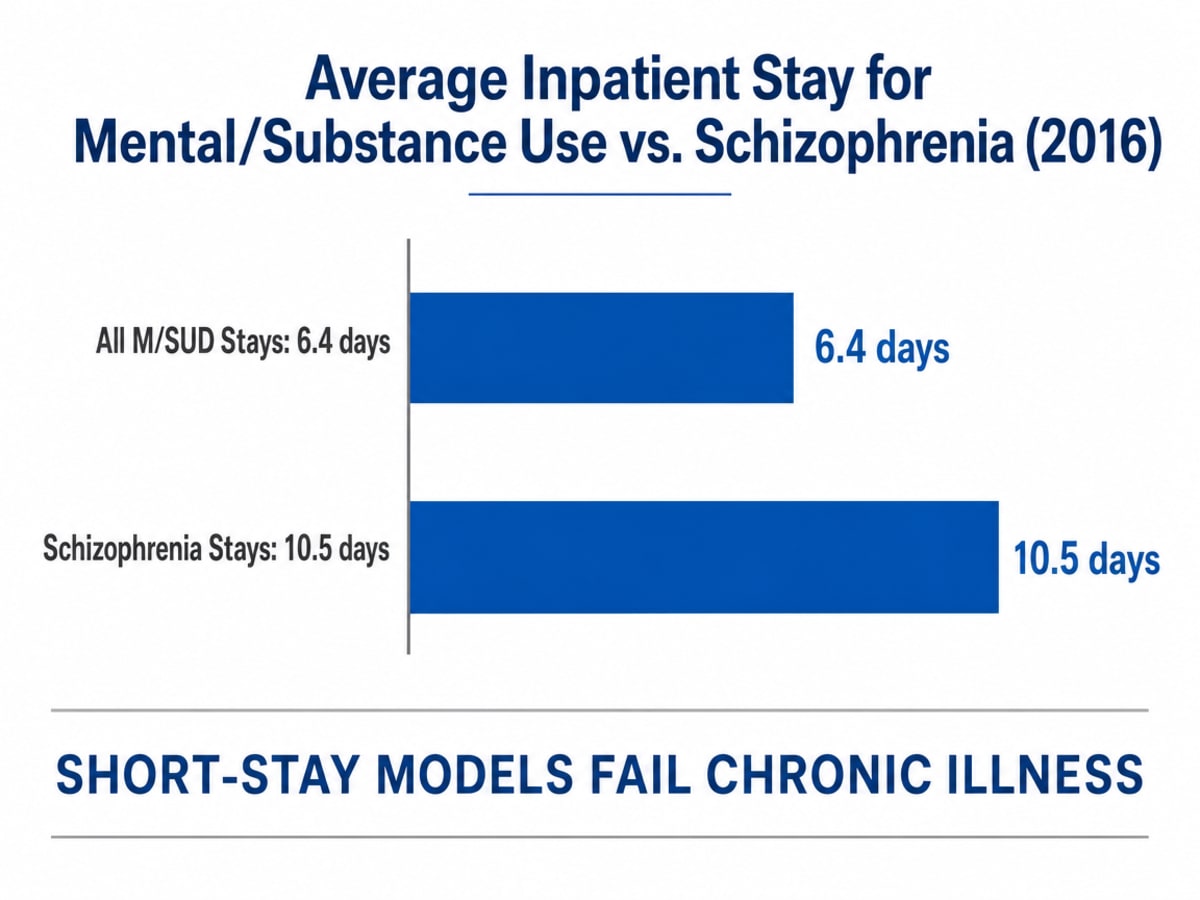
Look at what an inpatient stay actually delivers in the U.S. right now. In 2016, the mean length of stay for all mental and substance use disorder hospitalizations was 6.4 days. For schizophrenia and related disorders — arguably the most complex psychiatric admissions on that list — it was 10.5 days 3. That is the national baseline you are being measured against when a discharge planner says the patient is “stable enough to go home.”
Now put that next to what treatment-resistant illness actually requires. A clozapine trial for schizophrenia that hasn’t responded to two prior antipsychotics needs weeks of gradual titration, weekly blood monitoring, and time to see whether symptoms truly move. Rapid-cycling bipolar disorder needs enough observation to catch the swing, not just the current pole. Trauma work in someone with active substance cravings cannot start on day two and finish on day nine. And in dual diagnosis, the research is blunt: adults with severe mental illness plus substance use had significantly more lifetime hospitalizations exceeding 180 days, and the authors concluded that this group needs longer inpatient treatment because of noncompliance, suicide risk, and the coordination required to even prepare them for addiction therapy 15.
The clinical anchor for what “long enough” looks like sits around three months. In the residential dual-diagnosis literature, adults who stayed at least 90 days used less inpatient mental health care and engaged more with outpatient services six months out than those who left earlier 1. That is a nine-fold gap between the average schizophrenia admission and the retention threshold associated with better downstream trajectories.
You have probably watched this happen. The dose was changed on day four. Discharge came on day seven. By week three at home, the side effects hit, the pills stopped, and the crisis returned. That is not a treatment failure on your part or your family member’s part. It is the short-stay math doing exactly what it was designed to do. A program built around clinically-indexed length of stay — where the psychiatrist, not the utilization reviewer, decides when the work is done — is a different equation entirely. It is the equation ViewPoint runs.
How financing rules quietly shape length of stay
The number of days your family member gets is rarely a clinical decision alone. It is a financing decision wearing clinical clothes.
Start with the oldest constraint. The Institutions for Mental Diseases (IMD) exclusion, written into Medicaid in 1965, blocks federal Medicaid funds from covering care for adults aged 21 to 64 in psychiatric residential facilities with more than 16 beds 17. That single rule has shaped six decades of adult psychiatric capacity. It is the reason so many long-term programs are small, and why the ones that could operate at scale often cannot accept Medicaid at all for the extended portion of a stay.
The workaround, in theory, is a Section 1115 waiver. Since 2018, states can apply for SMI/SED waivers that let Medicaid pay for IMD care under specific conditions. Read the conditions carefully. To keep federal matching funds, participating facilities must maintain a statewide average length of stay of 30 days or less, with an individual ceiling of 60 days 6. In other words, the federal financing mechanism designed to expand access to psychiatric residential care has short-stay math baked into its charter.
Did the waivers actually add beds? A 2025 analysis looked at every state that adopted an SMI/SED waiver and compared bed capacity against non-waiver states. It found no measurable association between waiver adoption and any of four measures of psychiatric bed capacity 6. The policy did not fail because states ignored it. It failed because a 30-day average is not enough runway to build sustainable extended-care programs.
Layer commercial insurance on top and the pattern repeats. Managed care has treated length of stay as the primary cost-control lever in inpatient mental health for decades, and the direction of pressure has been steadily downward 10. Utilization reviewers rarely say the person is well. They say the criteria for continued stay are no longer met.
You are not imagining the ceiling. It is written into the rules. Programs that build around clinically-indexed length of stay — including private-pay and out-of-network options like ViewPoint — exist in part because the public financing rails were never designed to carry the cases you are trying to place.
Who actually ends up needing an extended stay
If you have been told your family member is “too complex” for a program, there is a shape to that complexity, and it is worth naming out loud. The adults who genuinely need an extended stay are not a random slice of the psychiatric population. They cluster.
Treatment-resistant psychosis sits at the center. Schizophrenia that has not responded to two or more antipsychotic trials often requires specialized intervention, including clozapine, which the NIMH describes as a distinct pathway for people who do not respond well to first-line treatments 9. The 2024 Paris Psychiatry Hospital Group study of 8,870 admissions confirmed the pattern quantitatively: a diagnosis of schizophrenia, documented treatment resistance, and mandatory care each independently raised the odds of a stay beyond 30 days, with treatment resistance carrying an odds ratio near 1.4 12. Older U.S. data show the same directional signal — psychosis has consistently predicted longer stays across decades of length-of-stay research 11.
Dual diagnosis is the second cluster, and the evidence here is unusually direct. Adults with severe mental illness plus active substance use had significantly more lifetime hospitalizations exceeding 180 days than either single-diagnosis group, and the authors concluded plainly that this population needs longer inpatient treatment to stabilize mental status, hold pharmacological treatment steady, and prepare for addiction therapy 15. When 42% of a long-stay dual-diagnosis cohort improved enough to step down to a less restrictive setting after extended, integrated care 14, you are seeing what happens when the clock gets long enough to matter.
The third cluster is quieter but real: adults whose care is shaped by legal status. In a U.S. inpatient sample, patients subject to court-ordered interventions had mean and median stays more than three times longer than those without 13. That is not a preference. It is what the case required once safety and adherence entered the picture.
The age band matters too. Adults 26 to 49 carry the highest past-year rate of any mental illness of any adult group, at 29.4% 16. That is the demographic ViewPoint is built around — the 25 to 40 range where treatment-resistant illness, dual diagnosis, and years of interrupted care most often converge in the same person. If you recognize your family member in more than one of these clusters, you are not looking for something exotic. You are looking for a program willing to hold the case long enough for the clinical work to finish.
What clinically-indexed length of stay looks like inside
If you have never seen a program run on clinical time instead of payer time, the difference shows up in the first week. Nobody is talking about the discharge date yet. The team is talking about what they are actually observing.
The opening stretch is diagnostic, not administrative. A board-certified psychiatrist reassesses the full picture — prior medication trials, what worked partially, what caused which side effect, whether the substance use is masking or driving the psychiatric symptoms, whether trauma has been treated or just documented. For treatment-resistant schizophrenia, that often means a serious conversation about clozapine, which NIMH describes as a specialized pathway for people who have not responded well to first-line antipsychotics 9. Clozapine is not a two-week decision. Titration, blood monitoring, and clinical response take weeks to read honestly.
The middle stretch is where the work compounds. Medication reaches steady state. Individual therapy stops being crisis triage and starts being actual therapy. Trauma processing can begin because the person is stable enough to do it without unraveling. In dual diagnosis, the substance use work and the psychiatric work happen in the same treatment plan, with the same team — not handed off between a mental health provider and a separate addiction program that do not talk to each other. The research on this is unambiguous: adults with severe mental illness plus substance use need longer inpatient treatment specifically because the mental status has to hold before addiction therapy can even begin 15.
The later stretch is step-down planning that matches the work already done. Aftercare gets built while the person is still in the building — outpatient psychiatrist, therapist, medication logistics, family communication plan, relapse triggers named out loud. That is what makes the 90-day retention finding matter in real life. Adults who stayed at least 90 days in integrated residential dual-diagnosis care used less inpatient mental health treatment and engaged more with outpatient services six months later 1. The stay does the work, and the aftercare holds it.
Length of stay, in this model, is a clinical variable the team watches — not a number set on admission. That is the frame ViewPoint operates from, and it is why the calendar looks different from the inside than it does from the outside.
Traveling out of state for the right program
If you have been searching within a two-hour drive and coming up empty, the next honest step is often a plane ticket. That is not a failure of your local system alone. It is the arithmetic of a national bed shortage colliding with a case that needs more than the local system was built to offer.
Traveling out of state sounds bigger than it usually is. The mechanics are ordinary. A phone assessment with the admissions team. A records review — prior discharge summaries, medication history, any legal or safety documentation. A financial conversation up front, because private-pay and out-of-network programs exist in part because the public financing rails were never designed to carry extended adult psychiatric stays 17. Then a travel plan, often with a family member or a professional transport service accompanying the adult to the facility.
What changes when you cross state lines is the pool of programs willing to take the case. A facility built for treatment-resistant illness and dual diagnosis in Prescott, Arizona — like ViewPoint — is not a substitute for a local outpatient team. It is an intensive episode that resets what outpatient can actually hold. Distance also does something quieter. It puts real space between the person and the environments where the last relapse happened.
You are not overreacting by looking nationally. You are matching the scope of the search to the scope of the problem.
For referring clinicians and case managers
A quick shift in audience: if you are the outpatient psychiatrist, therapist, case manager, or interventionist reading this on behalf of a patient, the calculus is a little different. You already know what a stabilization admission produces and what it does not. What you are usually trying to solve is the placement problem — where to send an adult whose acuity has outrun the local system, whose insurance has stopped authorizing days, or whose next ED visit is a matter of weeks.
A few things worth having on hand when you make the referral call. First, prior medication trials with doses, durations, and reason for discontinuation — this is what tells an admitting psychiatrist whether clozapine or another next-line strategy is on the table 9. Second, the substance use picture in the same document, not a separate one, because dual diagnosis is where lifetime hospitalizations over 180 days cluster and where sequential care tends to fail 15. Third, any legal status. Court-ordered patients had mean and median stays more than three times longer in one U.S. sample, and that matters for admission planning 13.
Programs like ViewPoint that run on clinically-indexed length of stay are built to accept the case you have been holding together on outpatient scaffolding. Send the full record, not the summary.
Find out if extended care is the answer
Receive expert guidance on whether long-term care matches your clinical needs and treatment history.
Frequently Asked Questions
How long is a ‘long-term’ psychiatric stay for adults, really?
There is no fixed number, and any program that quotes one before meeting the patient is running on a payer clock, not a clinical one. The most useful anchor from the research is around 90 days of integrated residential care, which is the retention threshold associated with less inpatient use and more outpatient engagement six months later for adults with co-occurring disorders 1. Treatment-resistant cases often need longer. Length of stay should track medication response and functional gains, not the calendar.
Why do so many programs discharge after 6 to 14 days when the illness clearly isn’t stable?
Because that is what the system is engineered to produce. Managed care has treated length of stay as the primary cost-control lever in inpatient mental health for decades, and the pressure has been steadily downward 10. Utilization reviewers rarely certify that someone is well. They certify that criteria for continued stay are no longer met. If your family member keeps getting discharged mid-titration, that is not a clinical judgment about wellness. It is a coverage decision wearing clinical clothes.
Will insurance cover an extended stay, and how does the IMD exclusion affect coverage?
Partial coverage is possible, but the structural rules matter. The IMD exclusion blocks federal Medicaid funds from covering adults 21 to 64 in psychiatric residential facilities with more than 16 beds 17. State SMI/SED waivers exist but require a 30-day average stay with a 60-day individual ceiling to keep federal matching funds 6. Commercial insurance authorizes in short increments. Many extended-stay programs, ViewPoint included, operate as private-pay or out-of-network specifically because the public rails were not built for this.
Can an adult travel out of state for long-term psychiatric care, and how does admission work?
Yes, and for treatment-resistant or dual-diagnosis cases it is often the more realistic path. National bed supply sits at roughly 28.4 per 100,000, well below what the literature considers adequate 7, so the local pool is thin by design. Admission usually starts with a phone assessment, a full records review including prior medication trials and any legal status, and a financial conversation. Then a travel plan, sometimes with a family escort or professional transport. Distance can also help separate the person from relapse environments.
What kinds of cases actually need an extended stay rather than another acute admission?
Three patterns cluster in the extended-stay population. Treatment-resistant psychosis, especially schizophrenia that has not responded to two or more antipsychotic trials and may need clozapine 9. Dual diagnosis, where severe mental illness plus active substance use produces significantly more lifetime hospitalizations over 180 days and requires longer inpatient treatment to stabilize before addiction work can begin 15. And adults whose care is shaped by legal status, where court-ordered interventions have been associated with mean and median stays more than three times longer 13.
What happens clinically during a longer stay that can’t happen in a short one?
Real medication trials reach steady state and get read honestly, not guessed at on day seven. Clozapine titration and weekly monitoring have room to actually show response. Trauma work can begin once the person is stable enough not to unravel. Dual-diagnosis treatment happens in the same plan with the same team, instead of being handed off between disconnected providers. Step-down planning gets built while the person is still in the building. That combination is what the 90-day retention research is measuring 1.
References
- Stability of Outcomes Following Residential Drug Treatment Among Patients With Co-Occurring Disorders. https://pmc.ncbi.nlm.nih.gov/articles/PMC3146302/
- Hospitalizations Involving Mental and Substance Use Disorders, 2012. https://hcup-us.ahrq.gov/reports/statbriefs/sb191-Hospitalization-Mental-Substance-Use-Disorders-2012.jsp
- Inpatient Stays Involving Mental and Substance Use Disorders, 2016. https://hcup-us.ahrq.gov/reports/statbriefs/sb249-Mental-Substance-Use-Disorder-Hospital-Stays-2016.jsp
- Length of Hospitalisation for People With Severe Mental Illness. https://pmc.ncbi.nlm.nih.gov/articles/PMC10105316/
- Waiting for Care: Length of Stay for ED Mental Health Patients by Disposition. https://pmc.ncbi.nlm.nih.gov/articles/PMC9250335/
- Addressing Psychiatric Bed Capacity: Evidence From Medicaid SMI/SED and SUD Waivers. https://pmc.ncbi.nlm.nih.gov/articles/PMC12834665/
- Inpatient psychiatric bed capacity within CMS-certified U.S. hospitals, 2011–2023. https://pmc.ncbi.nlm.nih.gov/articles/PMC12310024/
- National Substance Use and Mental Health Services Survey (N-SUMHSS): 2023 Annual Report. https://www.samhsa.gov/data/sites/default/files/reports/rpt53012/2023-nsumhss-annual-report.pdf
- Schizophrenia. https://www.nimh.nih.gov/health/publications/schizophrenia
- Length of Stay: Managed Care Agenda or a Measure of Clinical Efficiency?. https://pmc.ncbi.nlm.nih.gov/articles/PMC2990648/
- Length of Stay of General Psychiatric Inpatients in the United States: Systematic Review. https://pubmed.ncbi.nlm.nih.gov/20924662/
- Predictors of the length of stay in psychiatric inpatient units: a retrospective study for the Paris Psychiatry Hospital Group. https://pmc.ncbi.nlm.nih.gov/articles/PMC11445158/
- The impact of court-ordered psychiatric treatment on hospital length of stay: balancing legal and clinical concerns. https://pmc.ncbi.nlm.nih.gov/articles/PMC9311333/
- Clinical effects and treatment outcomes of long-term compulsory in-patient treatment of treatment-resistant patients with severe mental illness and substance-use disorder. https://pmc.ncbi.nlm.nih.gov/articles/PMC6724243/
- Impact of dual diagnosis in patients with schizophrenia and affective disorders during hospital treatment on the course of illness and outcomes of treatment – a preliminary report. https://pubmed.ncbi.nlm.nih.gov/32017814/
- Mental Illness. https://www.nimh.nih.gov/health/statistics/mental-illness
- Institutions For Mental Diseases Medicaid Waivers. https://pmc.ncbi.nlm.nih.gov/articles/PMC10161239/