

Key Takeaways
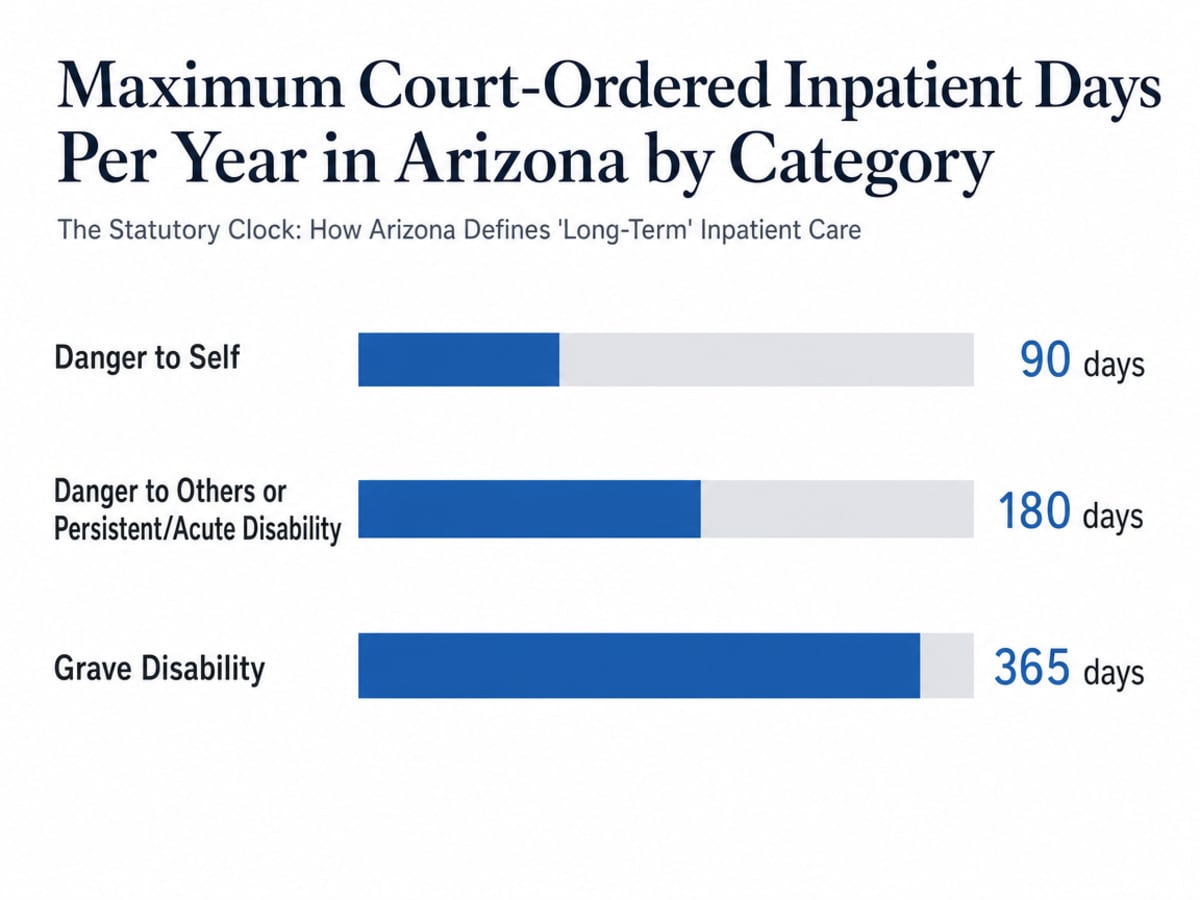
- Arizona’s civil commitment law caps court-ordered inpatient care at 90, 180, or 365 days per year depending on risk category 1, which sets a legal ceiling rather than a clinical endpoint for durable recovery.
- Four extended-care pathways operate in Arizona—Arizona State Hospital, Secure Behavioral Health Residential Facilities, private specialty residential, and Assertive Community Treatment—each with different eligibility rules, court involvement, and clinical scope.
- Treatment-resistant conditions like schizophrenia requiring clozapine titration 10or rapid-cycling bipolar disorder 9cannot complete their clinical arc inside a 28-day stay, making duration a prerequisite rather than a preference.
- Referring clinicians and families should evaluate programs by how discharge readiness is determined, whether clozapine and dual-diagnosis care happen on one integrated team 4, 6, and how the handoff to community continuity is built.
When 30 Days Wasn’t Enough: The Gap Arizona’s System Leaves Open
You already know how this story goes. A crisis, a hospitalization, a stabilization plan, a discharge summary that read cleanly on paper. Then, weeks or months later, the same voices, the same manic surge, the same relapse into use, the same call from the ER. If you are reading this, the 28-day residential model or the acute inpatient stay did not hold. That is not a failure of your loved one, or your patient, or you. It is a mismatch between how long chronic psychiatric illness actually takes to treat and how long Arizona’s system is built to treat it.
Arizona’s civil commitment law caps court-ordered inpatient care at 90, 180, or 365 days per year depending on the risk category a person meets 1. Private residential programs typically discharge much sooner, often on a schedule set by benefit design rather than clinical readiness. Treatment-resistant schizophrenia, rapid-cycling bipolar disorder, and co-occurring substance use disorders rarely resolve inside those windows. They stabilize, sometimes. Stabilization is not the same as durable recovery.
This guide is written for the people who already know that difference: clinicians planning a discharge that has to actually stick, case managers looking for the next placement, and families who have watched short-stay programs run their course. What follows maps the real long-term pathways in Arizona, what each one is built to do, and how to match clinical duration to clinical need instead of to a statutory or insurance clock.
The Statutory Clock: How Arizona Defines ‘Long-Term’ Inpatient Care
In Arizona, the phrase “long-term inpatient” has a legal ceiling before it has a clinical meaning. Under A.R.S. § 36-540, a court reviewing a petition for involuntary treatment can order inpatient care up to three annual maximums: 90 days when the person is found to be a danger to self, 180 days for danger to others or persistent or acute disability, and 365 days for grave disability 1. Those numbers are ceilings on court-ordered hospitalization, not prescriptions for how long recovery takes.
That distinction matters when you are looking at a patient whose illness does not respect a calendar. A person with treatment-resistant schizophrenia may cross the 180-day threshold still symptomatic, still poorly adherent, still without a stable discharge environment. A rapid-cycling bipolar patient may reach day 90 stabilized on paper and destabilize within weeks of discharge. The statute was designed to protect civil liberty by limiting the state’s authority to hold someone against their will. It was not designed to define what durable psychiatric recovery looks like.
Private and voluntary residential programs operate under a different clock entirely, one set by benefit design, medical-necessity reviews, and internal length-of-stay defaults that often land near 28 to 30 days. Neither timeline—the statutory ceiling or the insurance default—was built around the natural course of chronic, treatment-resistant illness. Both were built around other constraints.
The practical consequence is that “long-term” in Arizona splits into two overlapping meanings. Legally, it refers to the longest court-ordered inpatient windows available under civil commitment. Clinically, it refers to the extended, stage-wise care that treatment-resistant conditions actually require, which frequently begins after those windows close. Referring clinicians and families end up managing both definitions at once: what the court can order, what the insurer will authorize, and what the illness actually needs. The rest of this guide focuses on that third question, and on the Arizona pathways that exist to answer it once the statutory clock runs out.
Four Pathways to Extended Psychiatric Care in Arizona
Arizona State Hospital: Civil, Forensic, and SVP Beds
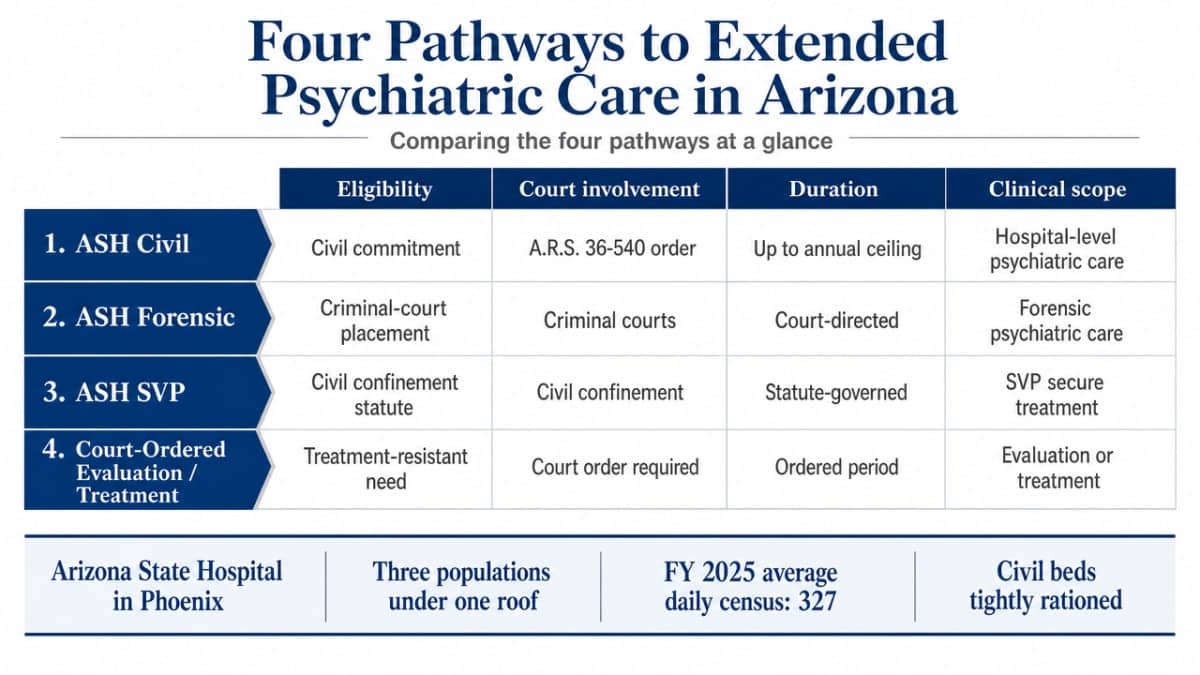
The Arizona State Hospital (ASH) in Phoenix is the state’s dedicated hospital-level psychiatric facility, and it operates three distinct populations under one roof: civil patients committed through A.R.S. § 36-540 proceedings, forensic patients placed through the criminal courts, and sexually violent persons held under civil confinement statutes. In FY 2025, ASH ran an average daily census of 327 patients across all three populations combined 5. That is a small number relative to statewide need, and it explains why access to an ASH civil bed is tightly rationed.
For a treatment-resistant patient, an ASH civil placement usually follows a court order under one of the three commitment categories, up to the statutory annual ceiling 1. The forensic side accepts defendants found incompetent to stand trial or not guilty by reason of insanity. The clinical scope is broad — psychiatry, nursing, milieu therapy, medication management — but ASH is a hospital, not a residential program. Discharge planning is oriented toward stepping down, not toward multi-year stays. When a civil patient’s court order expires, the hospital’s authority to hold them ends, whether or not community placement is ready.
Secure Behavioral Health Residential Facilities (SBHRFs)
SBHRFs are Arizona’s newer answer to a specific problem: people with serious mental illness who are chronically resistant to treatment, cannot be safely managed in open community settings, but no longer meet acute hospitalization criteria. The statute caps each facility at 16 beds and limits admission to individuals placed by court order 7. That is a deliberately small footprint. The model prioritizes intensive, longer-arc residential treatment over hospital-style acute care.
Two tracks feed SBHRFs. The civil track applies to SMI patients whose treatment resistance has cycled them through repeated hospitalizations without durable improvement. The forensic track, expanded through recent legislation and a $25 million appropriation supporting up to five SBHRFs, routes certain incompetent or dangerous defendants into secure treatment rather than incarceration 2. Both tracks share the statute’s defining language: seriously mentally ill, chronically resistant to treatment, and under court order 2.
For a referring clinician, SBHRFs are worth knowing about but hard to access on demand. The bed cap and court-order requirement mean these are not placements a discharge planner can arrange quickly. They function as a targeted long-term option for a narrow population, not a general extended-care resource.
Private Specialty Residential Programs
Private specialty residential is the pathway most families end up considering after a short-stay program has run its course and neither ASH nor an SBHRF is on the table. These are voluntary, licensed residential programs that set length of stay by clinical protocol rather than by statute. The quality range is wide. A program that discharges every patient at day 28 is running to a benefit-design default, not a treatment-resistant protocol.
What to look for is straightforward. Programs built for treatment-resistant psychiatric illness and dual diagnosis extend past the standard month, run clozapine and other advanced medication protocols when indicated 10, and coordinate psychiatry with therapy on the same case rather than referring out. ViewPoint Dual Recovery in Prescott is one Arizona example built around this profile — Joint Commission-accredited, focused on treatment-resistant and dual-diagnosis presentations, with duration set by clinical need rather than by a fixed calendar. It is one option among several. The category itself matters more than any single facility.
Assertive Community Treatment and Community-Based Continuity
Long-term does not always mean residential. Assertive Community Treatment (ACT) is a community-based model that brings a multidisciplinary team — psychiatry, nursing, case management, peer support — to the patient rather than the reverse. For patients with serious mental illness who have cycled through hospitalizations, ACT is often the piece that keeps gains from eroding after discharge 4. Arizona’s regional behavioral health authority network contracts for ACT services across the state, though availability and fidelity to the model vary.
The evidence base for ACT in co-occurring populations is real but not unlimited. Peer-reviewed reviews note that integrated community models are the standard of care while also acknowledging that superior-efficacy data over usual care remains limited 4. Treat ACT as a continuity layer, not a substitute for residential when acute or subacute risk is present. For many treatment-resistant patients, the right sequence is residential first, ACT second — with the ACT team engaged before discharge so the handoff is a bridge, not a gap.
Comparing the Four Pathways at a Glance
These four pathways are not interchangeable, and conflating them is one of the more common mistakes families and even referring clinicians make. Eligibility, court involvement, typical duration, and clinical scope differ in ways that determine which one fits a given patient.
- ASH is hospital-level care, accessed through civil or criminal court orders, with a combined average daily census of 327 across civil, forensic, and SVP populations in FY 2025 5. Duration is bounded by the annual statutory ceilings — 90, 180, or 365 days depending on category 1.
- SBHRFs are secure residential, capped at 16 beds per facility, restricted to court-ordered chronically treatment-resistant SMI patients 7, with expanding forensic capacity funded through recent appropriations 2.
- Private specialty residential is voluntary, admits on clinical criteria, and sets duration by protocol — the range is wide, and only some programs are built for treatment-resistant or dual-diagnosis cases.
- ACT is community-based continuity care, open-ended in duration, and best used to hold gains made in residential or hospital settings.
Read the pathways as a system, not a menu. Most treatment-resistant patients move through more than one over time.
Treatment-Resistant Schizophrenia: Why Duration Matters for Clozapine Protocols
Treatment-resistant schizophrenia is defined by what has already failed: two adequate trials of antipsychotics at therapeutic doses and durations, without meaningful response. When a patient meets that threshold, current guidelines are unambiguous — clozapine is the first-line choice 10. It is also the medication most under-used in the United States, and the reason is largely operational rather than clinical.
Clozapine works, when it works, because it targets symptoms other antipsychotics do not touch. It also carries a hematologic risk profile that requires weekly absolute neutrophil count monitoring for the first six months, then biweekly, then monthly for as long as the patient remains on the drug. Initiation involves slow titration over weeks, careful management of sedation and orthostasis, and monitoring for myocarditis in the early phase. None of that fits inside a 28-day residential stay. It barely fits inside 90.
A program built for treatment-resistant schizophrenia treats clozapine initiation as a multi-month arc: titration, therapeutic dosing, symptom response assessment, side-effect stabilization, and a warm handoff to an outpatient prescriber who can continue the monitoring cadence. Length of stay is set by where the patient is on that arc, not by the calendar. If a facility cannot describe how it handles clozapine initiations across an extended stay, it is not built for this population — regardless of what its marketing says.
Rapid-Cycling Bipolar Disorder: A Different Long-Term Problem
Rapid-cycling bipolar disorder—four or more mood episodes in a year—does not respond to duration the same way treatment-resistant schizophrenia does. There is no single first-line medication with the clarity that clozapine offers for schizophrenia. The current evidence points to aripiprazole, lamotrigine, and lithium as options with some support, while acknowledging that effective long-term prevention remains inadequately studied 9. That is an uncomfortable truth for families who want a clean answer, and it is the honest starting point.
What the evidence does say is that antidepressants can worsen cycling, that mood stabilizer combinations often outperform monotherapy in this population, and that the clinical work is longitudinal by nature 9. You cannot assess whether a regimen prevents cycling inside a 28-day stay. You can barely establish therapeutic lithium levels and watch for the first thyroid or renal signals in that window. The pattern only becomes visible over months.
This is why extended residential care for rapid cycling looks less like a titration protocol and more like a controlled observation period. The team needs enough time to see a full cycle or two, adjust the regimen, and correlate mood shifts with sleep, adherence, substance use, and life stressors. Programs built for this work treat length of stay as clinically variable rather than fixed. If cycling is still active at day 60, the answer is rarely to discharge on schedule and hope outpatient catches it.
Integrated Dual-Diagnosis Care as a Stage-Wise, Longitudinal Model
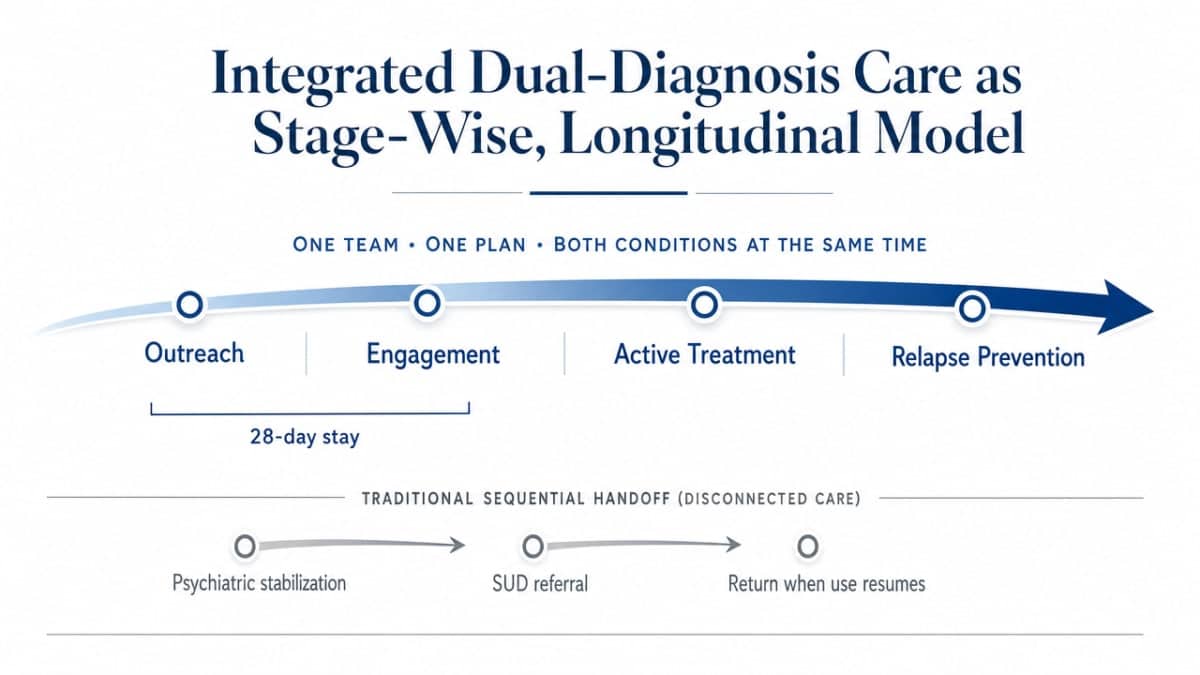
If your patient or family member has a serious mental illness and a substance use disorder, you have probably already lived through the sequential handoff. Psychiatric stabilization first, then a referral to an SUD program, then a return to a mental health provider when use resumes. The handoff is where people fall through. SAMHSA has been clear for years that integrated treatment — one team, one plan, both conditions addressed at the same time — is the standard of care regardless of which door the person walked through first 4, 8.
What is less often explained is that integrated care is not a single intervention. It is a stage-wise process that unfolds across an extended course of treatment. SAMHSA’s evidence-based practices toolkit describes four stages 3:
- Outreach is about establishing contact with someone who may not yet see themselves as needing care.
- Engagement builds a working alliance and shared goals.
- Active treatment addresses both conditions with coordinated pharmacology, therapy, and skills work.
- Relapse prevention shifts the frame from acute change to long-term maintenance.
TIP 42 layers in the operational detail: routine screening in both directions, joint treatment planning, and level-of-care decisions that account for both diagnoses at once 6.
The stages do not fit into a 28-day residential stay. They barely fit into 90. Engagement alone, in a patient who has cycled through multiple failed programs, can take weeks before active treatment gains traction. That is the point of the stage-wise model — it names the work that has to happen before medication changes and therapy protocols can hold.
An honest reading of the evidence base matters here. Integrated care is the standard of care, but some systematic reviews have not found clear superior efficacy over usual care in every population 4. That is not a reason to abandon the model. It is a reason to be specific about what integration actually means in a given program. A facility that runs psychiatry on one hallway and addiction counseling on another, with separate treatment plans and separate progress notes, is not delivering integrated care. It is delivering parallel care with a shared address.
What integration looks like in practice: one treatment plan that names both diagnoses, one team that meets on the case together, medication decisions that account for substance use history and interaction risk, and therapy that treats the interplay rather than sequencing it. When you are evaluating a long-term program, ask how the psychiatrist and the addiction clinician communicate on a Tuesday afternoon when a patient’s mood destabilizes and cravings spike at the same time. If the answer involves a referral or a handoff, the program is not built for this work.
Matching Clinical Duration to Clinical Need
Here is the shift that changes everything: stop asking how long the program is, and start asking how the program decides when someone is done. Those are different questions, and only one of them has anything to do with recovery.
A program that discharges every patient at day 28 or day 60 is running to a template. Templates are efficient. They are also indifferent to whether a clozapine titration has reached a therapeutic dose, whether a mood-stabilizer regimen has been observed across a full cycle, or whether a dual-diagnosis patient has moved past engagement into active treatment 3. The clinical arc for treatment-resistant illness is not a fixed shape. It bends around the patient in front of you.
Matching duration to need means a few concrete things in practice. It means the treatment team can articulate, at any point in the stay, what clinical milestone they are working toward next and roughly how long it takes. It means length of stay extends when the milestone has not been met, and it also means the team is honest when residential care has done what it can and the next step is ACT or outpatient continuity 4. It means the calendar serves the case, not the reverse.
If you are exhausted from watching short stays end at the wrong moment, that instinct is telling you something real. Ask the next program how it makes the call.
Placement Pathways: What Referring Clinicians and Families Should Ask
By the time you are researching a long-term program, you have already sat through more intake calls than you can count. The pitch is usually the same. The questions that actually predict fit are not.
- Start with duration logic. Ask how the program decides when a patient is ready for discharge, and listen for whether the answer names clinical milestones or a default length of stay. A program built for treatment-resistant illness should be able to describe the arc — titration to therapeutic dose, observation across a full mood cycle, movement from engagement into active treatment 3— and should be willing to extend when the milestone has not been met.
- Ask about clozapine specifically, if schizophrenia is in the picture. Does the facility initiate and titrate on-site, run the required hematologic monitoring, and coordinate the outpatient handoff with a prescriber who can continue the cadence 10? If clozapine is referred out, the program is not built for treatment resistance.
- For dual diagnosis, ask how the psychiatrist and the addiction clinician actually communicate on a hard day. One team, one plan, one set of progress notes — or a referral relationship with a shared address 4, 6. The answer tells you everything.
- Then ask what comes after. Warm handoff to ACT 4, outpatient prescriber continuity, family involvement in relapse prevention. If the discharge plan is a phone number and a follow-up appointment, the gap you have already lived through is about to reopen.
Find out if long-term care fits your needs
Receive expert feedback on whether extended care is the next right step for complex psychiatric recovery.
Frequently Asked Questions
What counts as ‘long-term’ psychiatric treatment in Arizona?
Long-term has two overlapping meanings here. Legally, it refers to the longest court-ordered inpatient windows available under civil commitment, which top out at 90, 180, or 365 days per year depending on risk category 1. Clinically, it refers to the extended, stage-wise care treatment-resistant illness actually requires, which often continues past those statutory windows in residential, secure, or community-based settings.
What happens when a court-ordered inpatient stay reaches its statutory day limit but the patient still isn’t stable?
The court’s authority to hold the patient ends when the ordered period ends 1. From there, the options are voluntary continuation in a private residential program, transition to an SBHRF if the patient meets the chronically resistant criteria and a bed is available 7, or step-down to community supports like ACT 4. Discharge planning has to start well before the day limit approaches.
How is a Secure Behavioral Health Residential Facility (SBHRF) different from the Arizona State Hospital?
ASH is hospital-level care with a combined average daily census of 327 across civil, forensic, and SVP populations in FY 2025 5. SBHRFs are secure residential programs capped at 16 beds per facility, restricted to court-ordered patients who are seriously mentally ill and chronically resistant to treatment 7. ASH stabilizes acute risk; SBHRFs are built for the longer-arc treatment-resistant population that no longer meets acute hospitalization criteria.
When is clozapine appropriate for treatment-resistant schizophrenia, and why does it require an extended stay?
Clozapine is the first-line choice after two adequate antipsychotic trials have failed 10. It requires slow titration over weeks, weekly absolute neutrophil count monitoring for the first six months, and careful management of sedation, orthostasis, and early myocarditis risk. A 28-day stay cannot complete that arc. Programs built for this population run the full titration, reach a therapeutic dose, stabilize side effects, and coordinate outpatient monitoring before discharge.
How should families evaluate whether a program delivers truly integrated dual-diagnosis care versus a sequential handoff?
Ask whether one team writes one treatment plan that names both diagnoses, or whether psychiatry and addiction counseling operate as separate services with separate notes 4, 6. Ask how the psychiatrist and addiction clinician communicate when mood destabilizes and cravings spike on the same afternoon. Integrated care is stage-wise across outreach, engagement, active treatment, and relapse prevention 3. If the answer names a referral, it is parallel care.
What should referring clinicians and families ask before placing someone in a long-term Arizona program?
Ask how the program decides discharge readiness — clinical milestones or a default calendar. Ask whether clozapine initiation, titration, and monitoring happen on-site 10. Ask how psychiatry and addiction clinicians coordinate day-to-day on dual-diagnosis cases 6. Ask what the discharge bridge looks like: warm handoff to ACT, outpatient prescriber continuity, family involvement in relapse prevention 4. Vague answers to any of these predict the same gap you have already lived through.
References
- 36-540 – Court options; immunity; rules. https://www.azleg.gov/ars/36/00540.htm
- SB1442 – Senate Fact Sheet – Arizona Legislature. https://www.azleg.gov/legtext/57leg/1R/summary/S.1442HHS-APPROP.DOCX.htm
- Integrated Treatment for Co-Occurring Disorders: Building Your Program. https://library.samhsa.gov/sites/default/files/ebp-kit-building-your-program-10112019.pdf
- Integrating Treatment for Co-Occurring Mental Health Conditions. https://pmc.ncbi.nlm.nih.gov/articles/PMC6799972/
- FY 2027 Baseline Book – Department of Health Services. https://www.azjlbc.gov/27baseline/dhs.pdf
- TIP 42: Substance Use Disorder Treatment for People With Co-Occurring Disorders. https://library.samhsa.gov/sites/default/files/SAMHSA_Digital_Download/PEP20-02-01_004.pdf
- 36-425.06 – Secure behavioral health residential facilities; license; annual report; definition. https://www.azleg.gov/ars/36/00425-06.htm
- Adoption of Integrated Care for People with Co-Occurring Disorders. https://aspe.hhs.gov/sites/default/files/documents/e2ccdd7991f1de5060983598cb66624f/adoption-integrated-care.pdf
- Current Status and Treatment of Rapid Cycling Bipolar Disorder. https://pubmed.ncbi.nlm.nih.gov/38230858/
- Guideline for Pharmacological Therapy of Schizophrenia. https://pmc.ncbi.nlm.nih.gov/articles/PMC8411321/