

Key Takeaways
- Narcissistic personality features alongside substance use disorder are a prognostic multiplier, reshaping alliance, group work, and medication adherence in ways standard 30-day abstinence programming was never built to hold 13, 5.
- Grandiose presentations break treatment loudly through devaluation and early AMA exits, while covert presentations perform compliance and carry higher relapse risk that behavioral cooperation alone will not detect 14, 4.
- Integrated care that treats personality pathology and substance use as simultaneous active targets is the right design, with psychiatry-led formulation and response-driven length of stay determining whether the arc actually holds 6, 11.
- Plan for the execution gap: integrated labels do not guarantee retention or SUD gains, so teams must actively coordinate around splitting, covert withdrawal, and stage-matched pacing rather than relying on structure alone 12.
The engagement failure that keeps ending treatment early
You have seen the pattern. A patient arrives for residential care with a clear substance use diagnosis, engages briefly, and then something shifts. The clinician becomes incompetent. The program becomes beneath them, or too demanding, or missing the one thing that would have helped. By week two or three, they have signed out AMA, or they have stayed physically but disengaged from any work that requires self-examination. When narcissistic personality features sit alongside a substance use disorder, this is often how treatment ends, and it ends before the therapeutic work has really begun.
That pattern is not a failure of your clinical judgment. Personality-disorder comorbidity in addiction populations is a documented predictor of poorer treatment response and worse prognosis than substance use alone 13, 5. The engagement problem is baked into the presentation. Grandiosity resists the vulnerability that group work requires. Devaluation of staff undermines the therapeutic alliance you need for retention. And in the covert presentation, shame drives the same exit through a quieter door.
You already know what standard 30-day abstinence-focused programming does with these patients. What follows is a clinical read on why the combination resists treatment, what the evidence actually supports, and how a psychiatry-led model built for treatment-resistant cases holds these patients long enough for the work to matter.
Why NPD-plus-SUD resists standard programming
Personality pathology as a prognostic multiplier
Think about the last three patients you referred back out for a higher level of care. If any of them had significant personality features, you already know the math. Personality disorder comorbidity in substance use populations tracks with poorer treatment response, greater chronicity, and worse outcomes than substance use alone 13, 5. The personality pathology is not a side finding in the chart. It is the variable that reshapes almost everything the program does, from group composition to medication adherence to the therapeutic alliance itself.
With narcissistic features specifically, the multiplier effect shows up in the parts of programming that standard SUD care depends on most. Standard SUD care rests on assumptions that narcissistic presentations strain:
- Motivational interviewing assumes some willingness to sit with ambivalence.
- Group therapy assumes some tolerance for peer feedback.
- Twelve-step integration assumes some acceptance of powerlessness.
Grandiosity strains each of these assumptions, and the covert presentation strains them differently but no less severely. You are not watching a patient fail treatment. You are watching treatment run into a set of defenses that were built long before the substance use started.
That is why the literature on PD-SUD care consistently frames the personality dimension as a prognostic variable that deserves its own treatment plan, not a subordinate feature to be addressed once sobriety is stable 5, 13. When you sequence them, the sequence usually collapses.
Narcissistic traits are common in addiction populations, not an edge case
One thing worth naming early: you are not seeing a rare phenotype. Self-reported narcissistic traits show up in addiction samples often enough that the research community treats narcissistic pathology as having empirical and clinical relevance in addicted patients, not as a niche presentation to be flagged for a specialist elsewhere 3. The dark-triad literature reinforces the point from a different angle, associating narcissism and psychopathy with substance-related addictive behavior across both clinical and nonclinical populations 4.
For program design, that has a specific implication. If narcissistic features are common in the population you already treat, then your intake, group structure, and staff training should assume the presentation will appear on your census in any given month. You do not need a separate NPD track to change what happens on the floor. You need clinicians who can recognize devaluation as a clinical signal rather than a personal attack, groups that are structured to interrupt splitting before it consolidates, and a treatment plan that does not depend on the patient arriving with intact self-reflection.
The cases that stall in standard programming are rarely the outliers. They are the ones the model was not built for, presenting at the rate the evidence would predict 3, 4.
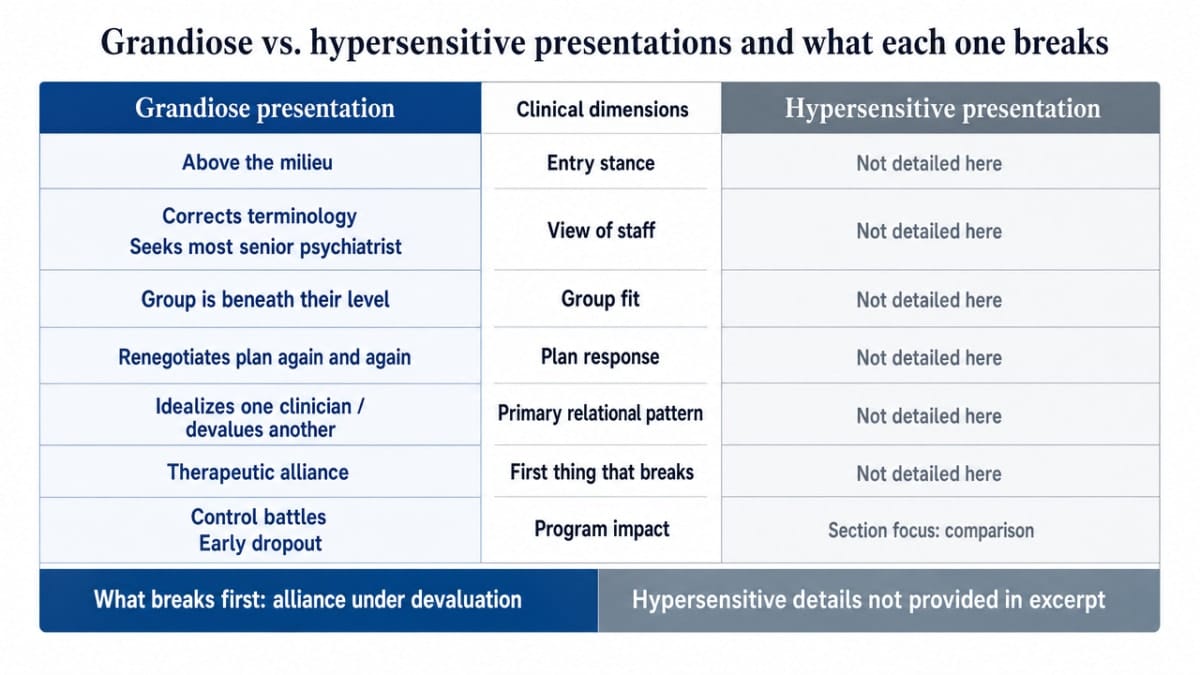
Grandiose vs. hypersensitive presentations and what each one breaks
Grandiose presentation: devaluation, control battles, and early dropout
The grandiose presentation is the one most clinicians can describe from memory. The patient arrives already positioning themselves above the milieu. They correct the intake nurse on terminology. They ask which psychiatrist has the most training, and when told, ask whether there is anyone more senior. By the second week, one clinician is ‘the only one who gets it’ and another has been quietly written off as unqualified. Group is described as beneath their level. The treatment plan is renegotiated, then renegotiated again.
What breaks first is the therapeutic alliance, and it breaks in a specific way. Devaluation is not a personality quirk to be tolerated until the patient warms up. It is the defense structure interacting with the humility that abstinence-focused work asks for, and it produces control battles that consume clinical time without moving the case forward. The externalizing profile associated with narcissistic and psychopathic features in addiction populations tracks with exactly this pattern of high-risk, low-collaboration engagement 4. You are not being difficult when you name it. You are describing what the literature already shows.
Dropout in this presentation tends to be loud and early. An AMA discharge in week two, a transfer request framed as the program’s failure, a family member pulled in to intervene against the treatment team. The retention problem is visible, which at least gives you something to work with clinically.
Hypersensitive (covert) presentation: shame, withdrawal, and quiet relapse
The covert presentation is harder to catch, and that is what makes it more dangerous. This patient does not devalue you to your face. They comply. They attend group, complete the workbook, nod through the psychoeducation, and thank the staff on their way out. What you may miss, until the urine screen or the phone call from a family member, is that the shame underneath the compliance never came into the room. They performed treatment. They did not receive it.
This is where the outpatient addiction data becomes clinically useful. In a drug addiction unit sample, hypersensitive (covert) narcissism and certain personality disorders functioned as risk factors for relapse into drug use, while the more grandiose presentation did not carry the same predictive weight in that analysis 14. The quieter patient, the one who did not generate incident reports or split the staff, was the one more likely to return to use. That should reshape how you weight risk at discharge. A patient who never caused friction is not necessarily a patient who engaged.
What breaks in the covert presentation is different from the grandiose one. Alliance is not openly attacked; it is silently withheld. Self-disclosure in group stays surface-level. Shame prevents the patient from bringing the material that would actually move the work, and the treatment team, seeing cooperation, may not press. Then discharge comes, the external structure falls away, and relapse follows without much clinical warning.
What the evidence actually supports for integrated care
The case for treating both foci at the same time
Sequential treatment has a specific failure mode with this population. You stabilize the substance use in one setting, then refer to a PD-focused clinician who inherits a patient already halfway back to use, because the personality features that drove the substance use never came into the room during the SUD stay. The literature has been pointing away from that model for years. Systematic review evidence on personality disorders and addiction concludes that methodologically integrative treatment is the therapy of choice for dual diagnoses, and that the two foci need to be worked on together rather than in sequence 6.
The clinical rationale is straightforward. Severe dual-diagnosis patients need treatment plans that include both the substance use and the personality pathology as active targets, and when both are addressed together, the review evidence describes potential for what one paper calls “enormous gains” 7. Psychotherapy for comorbid personality disorder and substance dependence “requires an integrative approach” rather than parallel tracks that hand the patient back and forth 8. The general dual-diagnosis literature reinforces the same principle: integrated treatment for comorbidity has been found to be consistently superior to separate treatment plans across a range of psychiatric-plus-SUD combinations 11.
For NPD-plus-SUD specifically, integration is what lets you touch the personality-level material while the patient is still in a structured setting with medical support, rather than losing the window the moment abstinence looks stable.
The honest limits: psychiatric gains outpace SUD and retention gains
Here is where the marketing copy usually stops and the clinical read has to keep going. A more recent systematic review comparing integrated to non-integrated dual-diagnosis care found that integrated treatment improved psychiatric symptomatology but showed no clear advantage for substance misuse outcomes or treatment retention 12. That is a real gap between what integrated care demonstrably does and what we sometimes claim it does. The psychiatric side of the equation moves. The substance use side and the retention numbers are less consistent across studies.
Put alongside the older synthesis showing integrated treatment consistently superior to separate plans 11, you get a more honest picture: integration is the right structural choice for these patients, but structural integration alone does not solve the SUD or dropout problem. Two programs can both call themselves integrated and produce very different retention curves depending on how the clinical work is actually organized inside that structure.
What this means for your referral decisions is practical. Do not evaluate a program on whether it labels itself integrated. Ask how the psychiatric and therapy teams share formulation, how length of stay is set, how the program handles devaluation and splitting in real time, and how covert non-engagement is detected before discharge. The evidence supports integration as a design principle, and it also tells you that the program-level execution is where NPD-plus-SUD cases are won or lost 11, 12. Peers who calibrate expectations this way tend to make cleaner referrals and get fewer surprise bouncebacks.
Borrowing from the BPD evidence base without overclaiming
The uncomfortable truth for anyone building an NPD-focused program is that the NPD-specific RCT evidence is thin. Reviews of psychotherapy for comorbid personality disorders and substance dependence have noted how few studies had evaluated psychotherapy in these comorbid patients at all, and non-BPD presentations remain underrepresented in the trial literature 8. What we have is the BPD-adjacent evidence base, and it is worth using carefully rather than pretending it maps cleanly onto narcissistic presentations.
Here is what that base actually says:
- DBT adapted for SUD improved overall functioning and increased abstinence days in randomized trials with BPD-plus-SUD patients 9.
- A systematic review of interventions for co-occurring substance use and borderline personality disorders identified DBT, dynamic deconstructive psychotherapy, and dual-focused schema therapy as the main studied approaches, with DBT and DDP both showing reductions in substance use and improved treatment retention 10.
- The same review found insufficient evidence to recommend one over another 10.
These modalities were built for a different personality pathology, and clinicians should say so. The structural principles they share, longer arcs, explicit attention to the therapeutic alliance, skills work paired with dynamic exploration, translate reasonably to NPD-plus-SUD care. The specific techniques do not always transfer, and any program telling you otherwise is claiming more than the evidence supports 8, 10.
Building a program that holds these patients long enough to work
Psychiatry-led case formulation before the therapy plan
Most programs that stall on these cases stall because the therapy plan was written before the psychiatric formulation was finished. A therapist starts a treatment arc built around relapse prevention curriculum, and the psychiatrist sees the patient twice for medication questions. The personality-level material never makes it into the shared case conception, so when devaluation or covert withdrawal shows up in week two, the team has no framework for it. It reads as behavior, not as the presenting problem.
A psychiatry-led formulation puts the personality pathology on the same page as the substance use before therapy scope is set. That means the psychiatrist owns the initial synthesis of Axis I comorbidity, personality functioning, medication response history, and the specific narcissistic presentation the patient shows, and the therapy plan is built downstream of that read. The PD-SUD literature is clear that both foci belong in the treatment plan as active targets rather than sequential ones 7, 6. When the psychiatric formulation leads, the therapist inherits a plan that already accounts for why standard motivational work will meet resistance, and adjusts accordingly.
Stage-matched engagement and screening at intake
Intake is where most NPD-plus-SUD cases are already lost, because the screening asked about substances and mood and did not ask about personality functioning at all. SAMHSA’s TIP 42 guidance is explicit that all SUD clients should be screened for co-occurring mental disorders, and that intervention should be matched to the patient’s readiness for treatment rather than a fixed program schedule 1. That readiness matching matters more with narcissistic presentations than with almost any other comorbidity.
A grandiose patient at intake is rarely at the same stage as their substance use severity would suggest. They may be behaviorally in action stage, in a facility, detoxing, and psychologically in precontemplation about anything touching the self-concept. A stage-matched plan meets that gap directly, offering structure and medical stabilization first, and delaying confrontational personality work until the alliance can hold it. For covert presentations, the reverse issue applies: apparent readiness masks unaddressed shame 14. Screening for personality functioning at intake, not two weeks in, lets the program set pace correctly from day one.
Length of stay driven by clinical response, not insurance calendar
Thirty days is not a clinical unit. It is a billing convention that has become a de facto treatment arc, and for NPD-plus-SUD it is almost always too short. The personality-level work that changes the retention curve, moving a patient from performing treatment to receiving it, does not happen on a fixed schedule. The BPD-adjacent evidence base uses longer, structured arcs precisely because personality change tracks a different clock than acute stabilization 9, 10.
A program built for these cases sets length of stay against clinical response markers:
- Depth of disclosure in individual work
- Reduction in splitting behavior across the team
- Medication adherence without renegotiation
- The patient’s capacity to tolerate feedback without exit
When those markers move, discharge planning starts. When they do not, the arc extends. Peers referring in should ask directly how a program handles the patient who needs eight weeks instead of four, and whether that decision sits with the psychiatric team or with a utilization reviewer.
Coordinating the team when the patient tries to split it
Splitting is not a character flaw you are watching. It is a predictable clinical phenomenon in personality-disorder-involved care, and if the team is not organized to catch it, the patient will run the program instead of the other way around. One clinician becomes the idealized figure, another becomes the persecutor, and the treatment plan quietly bifurcates along those lines. Group notes contradict individual notes. The psychiatrist hears a different story than the therapist. Within two weeks, the team is arguing about the patient instead of treating them.

Where ViewPoint fits when your program has already tried
Most of the patients ViewPoint takes on this pathway have already completed at least one course of standard residential care. Sometimes two or three. The referring clinician has done the work, and the case still bounced. That is the census this program was built for, and it is worth naming plainly so peers know when the referral fits.
The model has a few specific features that map to what NPD-plus-SUD needs. Board-certified psychiatry is on-site 24/7, which means the psychiatric formulation leads the case and stays live through the arc, not a consult twice a week. Length of stay is set by clinical response markers, depth of disclosure, reduction in splitting, medication adherence without renegotiation, rather than by a 30-day insurance calendar that these patients almost always outrun 9, 10. Psychiatrist and therapist share a single case conception and coordinate in real time when devaluation or covert withdrawal shows up, which is the execution layer where integrated care actually delivers or doesn’t 11, 12. And both foci, the personality pathology and the substance use, are treated as active targets from intake forward, consistent with what the PD-SUD literature has been recommending for years 6, 7.
ViewPoint is not the right call for every dual diagnosis. It is built for the cases your program has already tried and where the personality features are the reason the arc collapsed. If you are looking at a patient who has cycled through conventional care without response, that is the conversation to have.
Explore new options for NPD and addiction cases
Find out if a psychiatry-led, individualized approach fits your most complex dual diagnosis presentations.
Frequently Asked Questions
Why do standard 30-day addiction programs so often fail patients with narcissistic personality features?
Standard programs are built for a substance use focus with mood or anxiety comorbidity, not for personality pathology that reshapes the therapeutic alliance from day one. Personality disorder comorbidity in SUD populations predicts poorer treatment response and worse prognosis than substance use alone 13, 5, and the 30-day arc rarely holds long enough for the personality-level work that actually changes retention.
How should we distinguish grandiose from hypersensitive narcissism when planning treatment?
Grandiose patients show up in devaluation, control battles, and early AMA discharge, patterns consistent with the externalizing profile linked to narcissism in addiction populations 4. Hypersensitive (covert) patients comply on the surface while shame keeps the real material out of the room, and this presentation has been identified as a relapse risk factor in outpatient addiction care 14. Plan pace and confrontation accordingly.
Does integrated dual diagnosis treatment actually improve outcomes for NPD-plus-SUD patients?
The honest read is mixed. Older synthesis work describes integrated treatment as consistently superior to separate plans for comorbidity 11, and PD-SUD reviews recommend integrative care as the therapy of choice 6. A more recent systematic review found integrated care improved psychiatric symptoms but showed no clear advantage for substance misuse or retention 12. Integration is the right design principle, but execution inside the model determines whether NPD-plus-SUD cases actually hold.
Which therapy modalities have the strongest evidence for personality-disorder-involved addiction?
The strongest evidence sits in the BPD-adjacent literature, not NPD specifically. DBT adapted for SUD improved functioning and increased abstinence days in RCTs 9, and a systematic review identified DBT, dynamic deconstructive psychotherapy, and dual-focused schema therapy as the main studied approaches, with DBT and DDP both reducing substance use and improving retention 10. Non-BPD comorbid presentations remain underrepresented in trials 8, so borrow structural principles rather than claiming direct transfer.
When should I refer an NPD-plus-SUD patient out rather than continue in my current program?
Consider referral when the patient has already completed at least one course of standard care without response, when splitting is consuming clinical time your team cannot absorb, or when covert non-engagement keeps discharging apparently stable patients back into relapse 14. Also refer when your length-of-stay ceiling cannot flex to clinical response markers, since the personality-level work these patients need rarely fits inside a fixed 30-day arc 9, 10.
How does ViewPoint’s model differ from a standard residential dual diagnosis program?
Board-certified psychiatry is on-site 24/7 and leads case formulation, so the personality pathology is on the treatment plan alongside the substance use from intake forward rather than as a downstream consult 6, 7. Length of stay tracks clinical response markers, depth of disclosure, reduction in splitting, medication adherence, rather than a 30-day insurance calendar. Psychiatrist and therapist share a single case conception, which is where integrated care actually earns its outcomes 11, 12.
References
- Substance Use Disorder Treatment for People With Co-Occurring Disorders. https://www.ncbi.nlm.nih.gov/books/NBK571020/
- An Introduction to Co-Occurring Borderline Personality Disorder and Substance Use Disorders. https://library.samhsa.gov/product/introduction-co-occurring-borderline-personality-disorder-and-substance-use-disorders/sma14
- Self-reported narcissistic traits in patients with addiction. https://pmc.ncbi.nlm.nih.gov/articles/PMC9732545/
- Addiction and the Dark Triad of Personality. https://pmc.ncbi.nlm.nih.gov/articles/PMC6757332/
- The co-occurrence of personality disorders and substance use disorders. https://pmc.ncbi.nlm.nih.gov/articles/PMC10798162/
- A Systematic Review of Personality Disorders and Addiction: Epidemiology, Course and Treatment. https://pubmed.ncbi.nlm.nih.gov/26588717/
- Patients with addiction and personality disorder: Treatment outcomes and clinical implications. https://pubmed.ncbi.nlm.nih.gov/17143086/
- Psychotherapy of personality disorders and concomitant substance dependence. https://pubmed.ncbi.nlm.nih.gov/18852571/
- Borderline personality disorder and comorbid addiction. https://pubmed.ncbi.nlm.nih.gov/24791755/
- A systematic review of interventions for co-occurring substance use and borderline personality disorders. https://pubmed.ncbi.nlm.nih.gov/25919396/
- Integrated Treatment of Substance Use and Psychiatric Disorders. https://pmc.ncbi.nlm.nih.gov/articles/PMC3753025/
- Integrated vs non-integrated treatment outcomes in dual diagnosis. https://pmc.ncbi.nlm.nih.gov/articles/PMC10157410/
- Comorbidity of Personality Disorder among Substance Use Disorder Patients. https://pmc.ncbi.nlm.nih.gov/articles/PMC6241194/
- [Open narcissism, covered narcissism and personality disorders as predictive factors of treatment response in an out-patient Drug Addiction Unit]. https://pubmed.ncbi.nlm.nih.gov/20549145/