Key Takeaways
- Empire Plan behavioral health runs through a separate MHSU Program administered by Carelon, with its own nationwide network, clinical staff, and dedicated referral line 7.
- Calling the Clinical Referral Line at 1-877-7-NYSHIP before admission triggers precertification and the guaranteed-access rule that can secure network-level cost-sharing at out-of-network facilities 11.
- In-network inpatient mental health and substance use care costs nothing at the point of service, while out-of-network stays typically run 10% coinsurance when precertified 8.
- Before choosing a facility, verify precertification is on file, confirm which parity protections apply to your bargaining unit, and get authorization numbers in writing 3.
When You’ve Already Tried Treatment and Need Something More Serious
If you’re reading this, you’ve probably already done the hard part. You or someone you love has sat through intake calls, tried a partial hospitalization program, cycled through medications, maybe finished a 30-day stay that helped for a while and then didn’t. Now you’re looking at something more intensive, and you’re trying to figure out what your NYSHIP coverage will actually do for you.
That exhaustion is real. And so is the good news underneath it: the Empire Plan’s Mental Health & Substance Use Program is more generous than most enrollees realize, especially for complex psychiatric and dual diagnosis cases 9. New York’s Real Care, Real Access framework explicitly names NYSHIP enrollees among the members these behavioral health rules protect 6.
The catch is that the benefit only works the way it’s supposed to if you understand a few specific mechanics before you pick a facility: the Clinical Referral Line, precertification for higher-intensity care, and the guaranteed network-access rule that can protect your cost-sharing even at an out-of-state program 11.
This guide walks you through what’s covered, what you can expect to pay, and how to verify benefits before admission — in plain language, step by step.
How the Empire Plan’s Mental Health & Substance Use Program Actually Works
Who Administers Your Behavioral Health Benefits
Here’s something worth knowing up front: your medical benefits and your behavioral health benefits under the Empire Plan don’t run through the same door. Mental health and substance use care lives inside a dedicated Mental Health & Substance Use (MHSU) Program, administered by Carelon Behavioral Health, with its own network, its own clinical staff, and its own referral line 7.
That matters more than it sounds. When you call the general Empire Plan number or your primary care office to ask about residential treatment, you’re often talking to people who don’t touch the MHSU side of the plan day to day. The answers you get can be vague or, honestly, wrong. The MHSU Program is where the real authorizations, network lookups, and cost-sharing decisions happen for psychiatric and dual diagnosis care 9.
Carelon’s network for the Empire Plan is nationwide, not just New York-based, which is a quiet but important detail if you’re considering an out-of-state facility for treatment-resistant care 7. You’re not limited by geography the way you might assume.
The Clinical Referral Line and Why It’s the First Call You Make
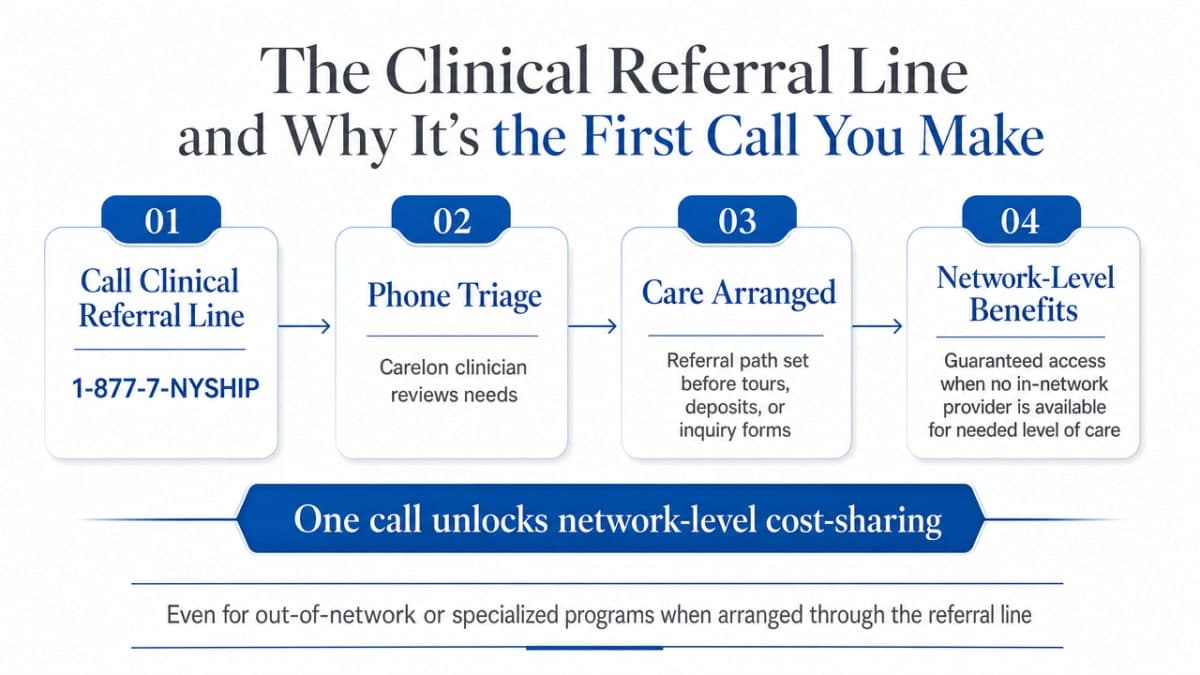
If you take one practical thing from this whole guide, take this: before you tour a facility, before you put down a deposit, before you even fill out an inquiry form, call the Empire Plan’s Clinical Referral Line at 1-877-7-NYSHIP 7. That single call unlocks the mechanism that most NYSHIP members never hear about.
The MHSU Program has a rule called guaranteed access to network benefits. Under it, if you contact the Clinical Referral Line and they help arrange your care, you get network-level cost-sharing — even when there is no in-network provider available in your area for the level of care you need 11. Read that again, because it changes the math on out-of-network and specialized programs.
Here’s how the path is supposed to run:
- You call the referral line.
- A Carelon clinician does a phone triage to figure out what level of care fits your situation — outpatient therapy, intensive outpatient, structured SUD program, residential, inpatient.
- If higher-intensity care is on the table, they open a precertification review 11.
- If they can’t produce an appropriate in-network match, the guaranteed-access rule kicks in and network-level benefits follow you to the provider they help arrange 11.
This is the piece most rehab-marketing pages leave out entirely. It’s also the piece that can meaningfully lower your out-of-pocket cost for a specialized program. So even if you’re exhausted from making phone calls, this is the one worth making first. Getting that call on the record is a real step forward.
What ‘Medically Necessary’ Means for Higher-Intensity Care
Every level of care under the MHSU Program has to clear one bar: medical necessity 9. That phrase gets thrown around casually, but it has a specific meaning here. Carelon’s clinical reviewers look at your diagnosis, your treatment history, your current symptoms, and the risk of continuing at a lower level of care, then decide whether residential, inpatient, or intensive outpatient treatment is clinically justified.
If you’ve already cycled through outpatient therapy, medication trials, or a 30-day program that didn’t hold, that history actually helps you. Treatment-resistant symptoms, active substance use alongside a psychiatric diagnosis, safety concerns, and functional decline are exactly the kinds of clinical facts that support authorization for a higher level of care. New York’s coverage rules require plans to cover diagnosis and medically necessary inpatient and outpatient treatment for both mental health and substance use conditions, including dual diagnosis presentations 2.
What this means for you in practice: have your records, your recent medication list, and a clear description of what has and hasn’t worked ready before that first referral call. Specifics move faster than summaries.
What Mental Health and Dual Diagnosis Services Are Covered
Inpatient, Residential, and Crisis Care
The higher-intensity end of your NYSHIP coverage is where the Empire Plan does some of its best work, and it’s also where members tend to have the most questions. Inpatient mental health and substance use care at an approved facility is covered when it’s medically necessary, and the plan’s structure treats these services as core benefits, not add-ons 9.
That includes hospital-based psychiatric care, medically supervised detox, and residential treatment at licensed substance use facilities. New York’s coverage rules require your plan to cover the diagnosis and medically necessary treatment of mental health and substance use conditions across a defined set of settings:
- Hospital
- Crisis residence
- Licensed SUD facilities
- Provider office visits
- OMH-licensed facilities
- Crisis stabilization centers 2
For a dual diagnosis presentation — say, treatment-resistant bipolar disorder alongside active alcohol use — that matters. You’re not choosing between mental health coverage and substance use coverage. Both are covered under the same MHSU umbrella.
Crisis care sits inside this same tier. If you or your family member is in acute psychiatric crisis, the plan covers hospital-based emergency psychiatric services and crisis residence stays as medically necessary care 2. Precertification is required for many of these higher-intensity services, which is another reason the Clinical Referral Line is your first phone call — Carelon opens the review while you’re still figuring out logistics 5. Getting that authorization on paper before admission is what protects the cost-sharing you expect to pay.
Outpatient, Intensive Outpatient, and Structured SUD Programs
Not every situation calls for a residential stay, and the MHSU Program is built around a full range of outpatient options. Individual therapy, psychiatric medication management, group therapy, and office-based visits with participating mental health and substance use providers are all covered outpatient benefits under the Empire Plan 9. New York’s coverage rules also require plans to cover care delivered at OMH-licensed facilities, licensed SUD outpatient clinics, and crisis stabilization centers 2.
Between standard weekly therapy and 24/7 residential care sits a middle tier that matters a lot for treatment-resistant and dual diagnosis situations: intensive outpatient programs (IOPs) and structured substance use programs. These are covered too, but with an important condition. Precertification is required for intensive outpatient and structured SUD programs under the MHSU Program, and skipping that step can put your benefits at risk 5.
If you’ve done outpatient therapy that didn’t hold and you’re not sure whether IOP, a partial hospitalization program, or residential is the right next step, that’s exactly the kind of question the Clinical Referral Line is set up to answer. A Carelon clinician will look at what you’ve already tried and route you toward the level of care that clinically fits, then start the precertification for whichever intensity is authorized 11. You don’t have to figure out the right acronym on your own before you call.
Crisis Visits: The Three-Visit Rule Most Members Miss
Here’s a benefit that quietly disappears from most conversations about NYSHIP: under the Empire Plan’s MHSU Program, up to three visits per crisis are paid in full for mental health care. After the third visit, the standard $25 copayment per visit applies 5.
Read that carefully, because it’s structured around the crisis, not the calendar year. If you or a family member has an acute mental health event — a suicidal episode, a psychotic break, an overdose scare that leads into psychiatric evaluation — the first three crisis visits related to that event are covered at zero cost to you 5. That’s the plan actively lowering the barrier to reaching out during the moments when cost is most likely to make someone hesitate.
What You’ll Actually Pay: In-Network vs. Out-of-Network Cost-Sharing
The Cost-Sharing Comparison at a Glance
The most useful thing you can do before comparing facilities is understand how the Empire Plan splits your cost-sharing across four buckets: inpatient in-network, inpatient out-of-network, outpatient in-network, and outpatient out-of-network. Once you can see them side by side, the rest of the conversation about residential care, IOP, and specialized programs gets a lot less abstract.
Here’s what the 2025 Summary of Benefits and Coverage lays out for mental health, behavioral health, and substance use services under the Empire Plan 8:
| Service | In-Network | Out-of-Network |
|---|---|---|
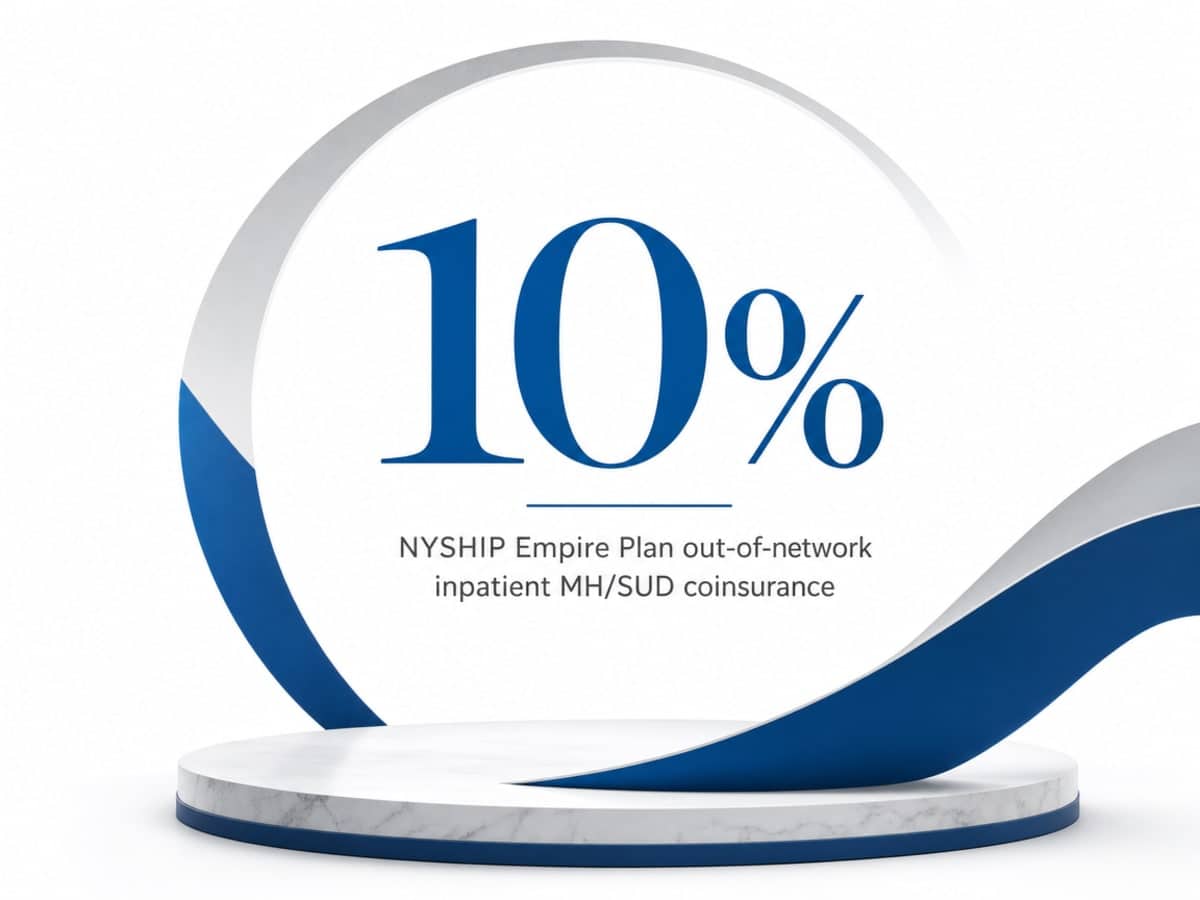
| Inpatient MH/SUD (approved facility) | No charge 8 | 10% coinsurance 8 |
| Outpatient MH/SUD visit | $25 copayment per visit 8 | 20% coinsurance (some tiers) 8 |
| Crisis visits (mental health) | First 3 visits per crisis paid in full; $25 copay thereafter 5 | First 3 visits per crisis paid in full; $25 copay thereafter 5 |
A few things worth sitting with here. Inpatient care at an approved facility inside the network genuinely costs you nothing at the point of service 1. That’s unusual, and it’s one of the strongest features of the plan. Out-of-network inpatient care is not free, but a 10% coinsurance on a residential or hospital stay is far more workable than the 30% or 40% coinsurance many commercial plans apply to the same services 8.
On the outpatient side, the $25 copay covers standard therapy and psychiatry visits with an in-network provider, and the 20% coinsurance kicks in for certain out-of-network tiers 8. Where things get interesting is the middle: intensive outpatient programs, partial hospitalization, and structured SUD programs sit between routine outpatient and inpatient, and their cost-sharing depends on how the program is coded and whether precertification is in place. That’s the next thing to understand.
Precertification: What Triggers It and What Happens If You Skip It
Precertification is the single administrative step that decides whether your cost-sharing looks like the chart above or something much worse. The Empire Plan Summary of Benefits and Coverage says it plainly: precertification is required for some mental health and substance use care 8. That includes inpatient admissions, residential SUD treatment, intensive outpatient programs, and structured substance use programs 5.
Here’s what triggers it in practice:
- Any admission to a facility for psychiatric or SUD care.
- Any step-up from standard weekly therapy into IOP or partial hospitalization.
- Any medically supervised detox.
If you’re not sure whether the level of care you’re considering needs precertification, assume it does and let the Clinical Referral Line confirm.
The fix is straightforward, and it’s the same fix that unlocks the guaranteed-network-access rule: call 1-877-7-NYSHIP before admission and let Carelon open the review 7. If you’re already in a crisis and can’t call ahead, the facility’s utilization review team can usually initiate precertification within the first 24 to 48 hours. Ask them to confirm it’s been done and get an authorization number in writing.
The Parity Rules Behind Your Benefits (and One Honest Caveat)
The reason your Empire Plan cost-sharing for mental health and substance use care looks comparable to your medical/surgical cost-sharing isn’t an accident. It’s the result of New York’s behavioral health parity rules, which require MH/SUD benefits to be offered on terms comparable to medical/surgical benefits 10. The Department of Financial Services enforces this through a formal parity compliance program, with insurers submitting written certifications and data on a regular reporting cycle 4.
What that means for you: if a therapy visit for a physical health condition would be covered a certain way, a therapy visit for a mental health or substance use condition has to be treated on comparable terms. The same logic applies to precertification standards, medical necessity criteria, and network adequacy. If something feels wrong, you can raise a parity question directly with the Office of Mental Health or file a complaint with DFS 10.
One honest caveat worth naming. DFS has clarified that some newer MH/SUD cost-sharing protections apply to NYSHIP, but not until the expiration of the collectively bargained agreement that was in effect on January 1, 2020 3. Depending on your bargaining unit and the year, that timing can affect which specific protections are already active for your plan. When you verify benefits, ask whether the protection you’re relying on is currently in force for your unit.
How an Out-of-State or Specialized Facility Fits the NYSHIP Rules
Using an Out-of-Network Program Without Losing Your Benefits
Here’s the part that trips up a lot of NYSHIP members: you assume that picking an out-of-state or specialized facility automatically dumps you into full out-of-network cost-sharing. It doesn’t have to. The Empire Plan’s MHSU Program is built with a specific escape hatch for exactly the situation you’re in — a complex clinical picture that the local in-network options can’t fully address.
That escape hatch is the guaranteed access to network benefits rule. If there are no network providers in your area who can deliver the level of care you medically need, and you call the Clinical Referral Line to arrange your care with an appropriate provider, you receive network-level benefits at that provider 11. The Empire Plan’s network is already nationwide across its Medical/Surgical, Hospital, Mental Health/Substance Use, and Prescription Drug programs, so many specialized facilities outside New York may already participate 7. When they don’t, the guaranteed-access mechanism is what protects your cost-sharing.
The sequence matters. Call 1-877-7-NYSHIP first. Let Carelon do the clinical triage, run the network search, and document that no appropriate in-network match exists for your level of care 7. Then let them help arrange the referral. Doing it in that order is what turns an out-of-network stay into one that’s billed at network-level benefits 11. Doing it in the opposite order — admitting first, calling later — is where members lose the protection they were entitled to.
How ViewPoint Works With NYSHIP Members
ViewPoint Dual Recovery is a Joint Commission-accredited psychiatric facility in Prescott, Arizona that specializes in treatment-resistant mental health conditions and dual diagnosis cases — the exact clinical territory where local in-network options often run out of tools. The team has experience working with NYSHIP and Empire Plan members and understands how the MHSU Program’s precertification and guaranteed-access mechanics need to line up for your benefits to work the way they should 11.
To be straightforward with you: this doesn’t mean ViewPoint is automatically in-network with your specific Empire Plan tier, and it doesn’t mean coverage is guaranteed for any individual case. What it does mean is that you don’t have to piece the process together alone. ViewPoint’s admissions team can help you verify your NYSHIP benefits, coordinate with the Clinical Referral Line, and document the medical necessity case for a higher level of care before you commit.
If you’re a NYSHIP member weighing a specialized program, the practical next step is to run your plan through ViewPoint’s Verify Insurance process. It’s a low-pressure way to see, in writing, what your Empire Plan is likely to cover for your situation.
A Practical Sequence for Verifying Benefits Before Admission
If you’ve made it this far, you already know more about the MHSU Program than most NYSHIP members ever will. Here’s how to turn that into a short, workable checklist you can actually run this week.
- Start with the Clinical Referral Line at 1-877-7-NYSHIP 7. Have your Empire Plan ID, your treatment history, your current medication list, and a plain description of what’s happening right now within reach. Ask Carelon to do a clinical triage and open a precertification review for the level of care you’re considering — inpatient, residential, IOP, or a structured SUD program 5. Get any authorization number in writing.
- While that review is in motion, ask two specific questions:
- Are there appropriate in-network providers in your area for the level of care being authorized? If the answer is no, ask them to document it and confirm that the guaranteed-access rule applies to the referral they help arrange 11.
- Which MH/SUD cost-sharing protections are currently in force for your bargaining unit, given the collectively bargained timing caveat DFS has flagged for NYSHIP 3?
- Run the facility side in parallel. Ask the admissions team to verify your NYSHIP benefits in writing, confirm precertification is on file, and coordinate directly with Carelon. ViewPoint’s Verify Insurance process is built to handle exactly this sequence for NYSHIP members considering specialized care.
That’s the whole path. One phone call, one written verification, one authorization number. It’s less than most people fear, and it’s the difference between a benefit that works and one that doesn’t.
Check your NYSHIP mental health coverage now
Find out if your NYSHIP plan covers advanced dual diagnosis or psychiatric treatment tailored to your needs.
Frequently Asked Questions
Does NYSHIP cover residential mental health and dual diagnosis treatment?
Yes. The Empire Plan’s Mental Health & Substance Use Program covers medically necessary inpatient and residential mental health and substance use treatment, including dual diagnosis presentations, through its participating provider network 9. New York’s coverage rules also require your plan to cover care at licensed SUD facilities, hospitals, and OMH-licensed settings 2. Precertification through the Clinical Referral Line is required for most residential admissions 5.
What will I pay out of pocket for inpatient care under the Empire Plan?
At an approved in-network facility, inpatient mental health and substance use care is covered at no charge to you at the point of service 8. If you go out-of-network, you’ll typically owe 10% coinsurance on the covered charges 8. Precertification has to be in place for either scenario, and the guaranteed-network-access rule can protect your cost-sharing at an out-of-network facility when the referral line arranges care 11.
Do I have to call the Clinical Referral Line before starting treatment?
For higher-intensity care, yes — and it’s worth doing even when it’s not strictly required. Calling 1-877-7-NYSHIP lets Carelon Behavioral Health triage your situation, open precertification, and document the network search 7. That single call is what unlocks the guaranteed access to network benefits rule, which can secure network-level cost-sharing even when no in-network provider is available for your level of care 11. Call before admission whenever possible.
Can I use an out-of-state or out-of-network facility and still get network-level benefits?
Often, yes. The Empire Plan’s MHSU network is nationwide, so many out-of-state facilities may already participate 7. When they don’t, the guaranteed-access rule applies: if no appropriate in-network provider is available in your area and Carelon helps arrange the referral through the Clinical Referral Line, you receive network-level benefits at that provider 11. The key is calling the referral line first, before you admit.
What happens if I skip precertification for intensive outpatient or SUD care?
The plan can reduce or deny benefits for that episode of care, even if the treatment itself was clearly medically necessary 5. Precertification is specifically required for intensive outpatient programs, structured SUD programs, and inpatient admissions under the Empire Plan 8. If you’re already admitted without one, ask the facility’s utilization review team to initiate precertification with Carelon within the first 24 to 48 hours and confirm an authorization number in writing.
How does the three-visit crisis rule work?
Under the Empire Plan’s MHSU Program, up to three visits per crisis are paid in full for mental health care 5. The count is tied to the crisis event, not the calendar year, so a suicidal episode, psychotic break, or acute psychiatric evaluation each opens a new set of three fully covered visits. After the third visit related to that crisis, the standard $25 copayment per visit applies 5. Ask the clinic to code accordingly.
References
- 2026 NYSHIP Plan Comparison – CS.NY.gov. https://www.cs.ny.gov/employee-benefits/nyship/shared/apps/plan-comparison/compare.cfm?plancode=001&group=6
- Mental Health and Substance Use Disorder Coverage. https://www.dfs.ny.gov/consumers/health_insurance/mhsud
- Mental Health and Substance Use Disorder (MH/SUD) FAQs – NY DFS. https://www.dfs.ny.gov/apps_and_licensing/health_insurers/mhsud_faqs
- Mental Health and Substance Use Disorder Parity Reporting and …. https://www.dfs.ny.gov/apps_and_licensing/health_insurers/mh_sud_parity_reporting
- NYSHIP at a Glance 2025 – dutchessny.gov. https://www.dutchessny.gov/Departments/Human-Resources/Docs/NYSHIP-2025-At-a-Glance.pdf
- Real Care, Real Access to Behavioral Health Services – NY.Gov. https://www.ny.gov/programs/real-care-real-access-behavioral-health-services
- Empire Plan Providers and Pharmacy – NYS Civil Service. https://www.cs.ny.gov/employee-benefits/nyship/shared/providers/index.cfm
- Summary of Benefits and Coverage: What this Plan Covers …. https://www.cs.ny.gov/employee-benefits/sbc/pdfs/2025/ny-unrep-sbc-2025.pdf
- Empire Plan Programs and Services – CS.NY.gov. https://www.cs.ny.gov/employee-benefits/pa-market/shared/providers/pa_market.cfm
- Behavioral Health Parity. https://omh.ny.gov/omhweb/bho/parity.html
- Reporting On: Mental Health & Substance Use Program – January 2024. https://www.cs.ny.gov/employee-benefits/pa-market/shared/publications/reporting-on/2024/reporting-on-mhsu-2024.pdf