

Key Takeaways
- Local systems often cannot handle treatment-resistant psychosis, rapid-cycling bipolar, or complex dual diagnosis cases, which is why families reasonably consider residential programs in other states 11.
- Filter every program through SAMHSA’s five quality signals — accreditation, evidence-based practices, appropriate medication use, a defined family role, and continuing care — before comparing locations 2.
- The first admissions call should run 30 to 60 minutes and build a medical necessity case in ASAM Criteria language, giving insurance the documentation it needs to authorize 5.
- Verify benefits in writing before booking travel, ask about out-of-network residential coverage and single-case agreements, and know that Medicaid rarely pays across state lines 6.
- Expect a defined arc: clinical intake, insurance authorization, travel day, stabilization, midpoint family work, and discharge planning, with concurrent insurance reviews every 5 to 14 days.
- Structured family involvement across distance — weekly video therapy, a midpoint psychiatrist call, and one onsite weekend — drives better adherence and lower relapse than ad hoc visits 12.
- Discharge planning should start in week one, with the treatment team contacting home-state prescribers directly and confirming refills, because handoff gaps drive relapse and rehospitalization 13.
- Out-of-state does not fit acute crises, Medicaid-only coverage, untried strong local options, or families whose primary support person cannot participate remotely.
When the local system stops working
You have been through the local options. The community mental health center. The outpatient psychiatrist with a three-month waitlist. Maybe an inpatient stabilization or two. The medications got tried, adjusted, stacked, and swapped. And the person you love is still not well.
That is the point where families start looking at maps.
If you are researching residential care in another state, you are not being dramatic. Researchers who study access to serious mental illness care describe a “geographic maldistribution of specialty services” that pushes some people with complex conditions to travel long distances or relocate to get adequate treatment 11. Treatment-resistant psychosis, rapid-cycling bipolar disorder, and dual diagnosis cases that need integrated psychiatric and substance use care simultaneously are exactly the presentations that most local systems are not built to handle.
Here is what the evidence actually says about the harder path you are considering: residential programs can produce meaningful improvement in symptom severity and functioning for adults with severe mental disorders when the care is intensive and family engagement is built into the plan 9. Distance does not cancel that out. It just means the logistics need to be handled with care.
This guide walks you through those logistics in the order they actually happen. The first admissions call. Insurance verification across state lines. The travel day. The first family touchpoint when you cannot drive to the building. The midpoint session. Discharge planning back to your home state.
You are not choosing between staying home and giving up on home. You are choosing whether the clinical fit is strong enough that traveling for it makes sense, and then building a plan around the distance. The next sections show you how.
The clinical fit test before the map
Five quality signals that decide the shortlist
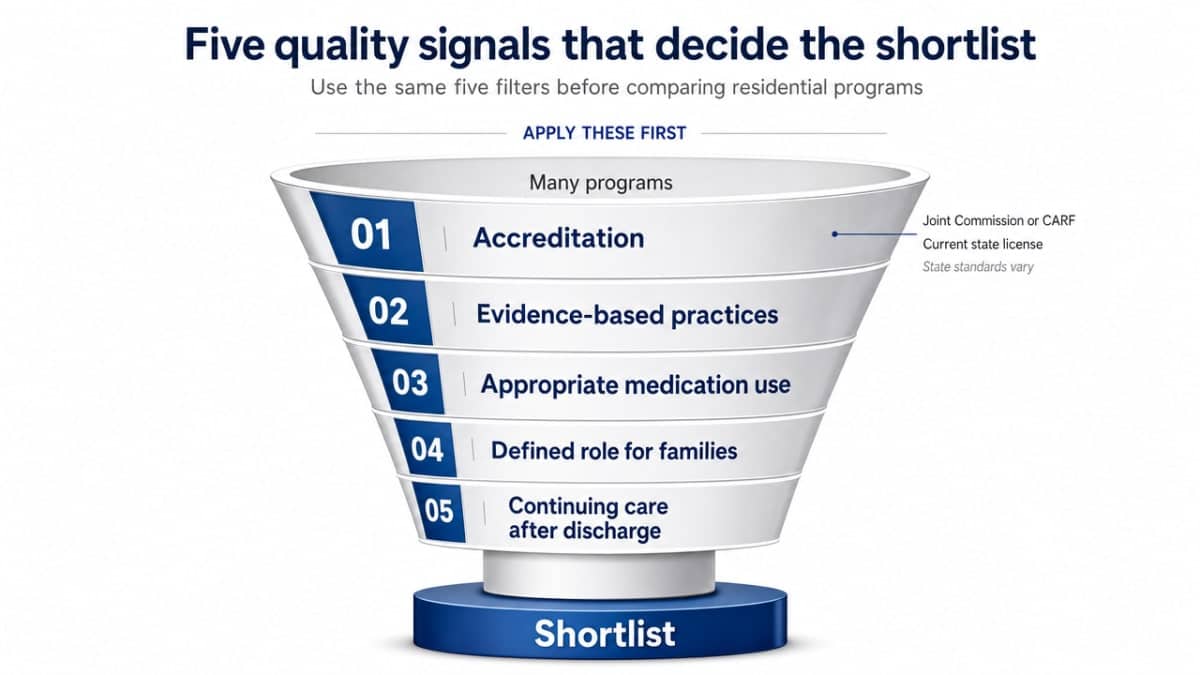
Before you compare flight prices or look at photos of grounds, run every program on your shortlist through the same five filters. SAMHSA identifies five signs of a quality treatment center: accreditation, evidence-based practices, appropriate medication use, a defined role for families, and continuing care after discharge 2. Those five signals do more work than any brochure. Apply them first, and half your list usually drops out.
- Accreditation.
- Ask whether the program is accredited by The Joint Commission or CARF, and confirm the state license is current in the state where the facility operates. State standards for staffing, safety, and clinical documentation vary — Massachusetts, for example, publishes detailed licensing rules under 104 CMR 27.00 that show how granular these expectations get 1. Two facilities in two states can both be legal and still be very different.
- Evidence-based practices.
- You want to hear specific names: CBT, DBT, trauma-focused therapies, motivational interviewing, family psychoeducation. Vague answers about “holistic healing” are a signal to keep moving.
- Appropriate medication.
- For treatment-resistant conditions, this is the whole ballgame. Ask directly whether the program uses clozapine protocols, long-acting injectables, and evidence-based mood stabilizer strategies, and whether a board-certified psychiatrist is available 24/7. If the answer is “our psychiatrist is on-site two half-days a week,” that is not a program built for complex cases.
- Family role.
- The program should describe, without prompting, how families participate — weekly video sessions, scheduled psychiatrist calls, onsite family days 2.
- Continuing care.
- Ask what discharge planning looks like when the patient lives out of state. If they cannot describe a handoff process, that is your answer.
When distance is a design constraint, not a red flag
Once you have run the five filters, look at what actually made it through. If the strongest fit is 40 minutes from your house, take it. Local is easier on everyone.
But that is often not what the shortlist looks like when the diagnosis is complex. Integrated residential programs that treat co-occurring psychiatric and substance use disorders in the same building, with the same team, are associated with better adherence and reduced substance use compared with non-integrated care 10— and they are not evenly distributed across the country. Neither are programs that run clozapine protocols with 24/7 psychiatric coverage, or facilities that keep length of stay tied to clinical progress instead of insurance timelines.
When the specialized program is in Arizona and you are in Ohio, distance is not a red flag. It is a design constraint. It means you will plan family involvement around video sessions and scheduled onsite visits instead of Tuesday-night drop-ins. It means the admissions team needs to handle travel and insurance verification for someone they have not met in person. It means discharge planning has to loop in a psychiatrist and therapist in your home state, not the ones down the hall.
Those are solvable problems. A program that treats treatment-resistant cases every day already has a process for each of them.
The wrong question is “can we handle the distance.” The right question is whether the clinical fit is strong enough that the distance is worth designing around. If it is, the next sections show you how the design actually works.
The admissions call: what actually happens on the phone
The first call is not a sales pitch. Or it should not be. A good admissions team spends most of the first conversation listening and gathering clinical detail — because without that, they cannot tell you whether their program is the right fit or whether you should be looking somewhere else.
Expect the call to take 30 to 60 minutes. Have the following in front of you before you dial: current diagnoses, a list of medications tried (including doses and how long each was tried), any recent hospitalizations, current prescriber names, insurance card, and a short honest description of what is happening at home right now. If a family member is making the call for the patient, that is normal and expected.
Here are the questions worth asking directly, drawn from SAMHSA’s checklist for evaluating treatment programs 7:
- Do you accept my insurance, and can you verify benefits today?
- What does a typical week look like clinically — how many hours of individual therapy, group, and psychiatry?
- How is length of stay determined? Is it driven by clinical progress or by what insurance authorizes?
- What is your process for including family when we live in another state?
- What happens if my loved one is in crisis at 2 a.m.?
You should also expect the admissions clinician to ask you about medical necessity in ASAM Criteria terms — severity of symptoms, prior treatment response, risk factors, and support at home 5. That documentation is what makes an out-of-state residential authorization possible. It is not bureaucratic. It is the language insurance requires.
By the end of the call, you should know three things: whether the program clinically fits, what the next step is on insurance, and who your specific point of contact will be from here forward. If you hang up unsure of any of those, call back and ask.
Insurance verification across state lines
This is the part that keeps families up at night. You have found a program that fits. Now you are staring at an insurance card, wondering whether crossing state lines means writing a check you cannot write.
Start with the number on the back of the card. Ask three specific questions:
- Is this facility in-network for residential mental health treatment?
- If it is out-of-network, what are the out-of-network benefits for residential care, and is there a single-case agreement process?
- What prior authorization do you require, and what documentation supports it?
Federal parity rules matter here. Plans that cover mental health and substance use treatment must pay for those services at a level comparable to medical and surgical care, and SAMHSA advises asking your insurer directly for a list of preferred facilities or providers so costs do not surprise you later 6. That parity protection does not erase network boundaries, but it does mean an out-of-network residential authorization is a legitimate ask, not a favor.
The documentation piece is where a good admissions team earns its keep. Insurance authorizes residential level of care based on medical necessity, and medical necessity is written in ASAM Criteria language — symptom severity, prior treatment response, risk of harm, and whether lower levels of care have failed 5. The admissions clinician who took your call in the last section is building that case in the background. If your loved one has tried multiple medications, been hospitalized recently, and has a diagnosis that requires specialized protocols not available locally, that is the argument for authorization.
A few realities worth knowing before the first call to your insurer:
- Medicaid rarely travels. Most state Medicaid plans do not pay for residential treatment across state lines. If Medicaid is the only coverage, out-of-state is usually not viable 6.
- Commercial plans, TRICARE, and some VA benefits can travel, especially when in-network options for the specific level of care do not exist in your region.
- Prior authorization is not one-and-done. Expect concurrent reviews every 5 to 14 days during the stay. The clinical team documents progress and continued medical necessity. This is normal.
- Denials mid-stay happen. Ask upfront how the facility handles appeals and whether they have utilization review staff who fight denials on your behalf.
The out-of-state admissions sequence, week by week
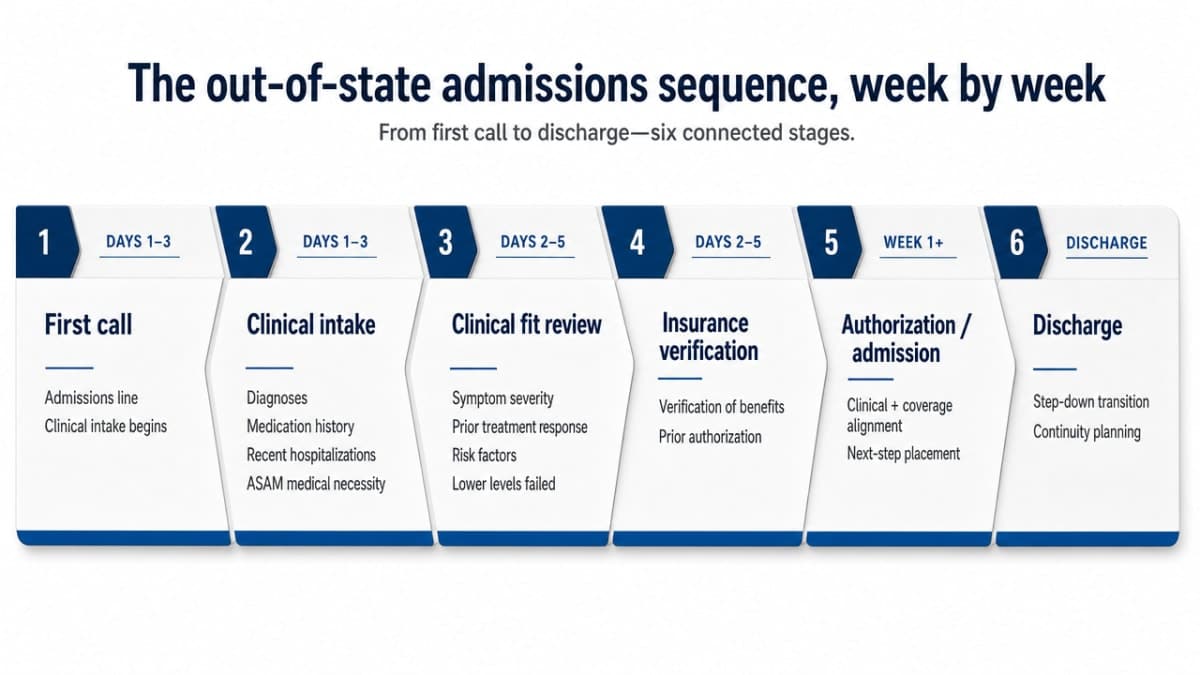
Here is what the whole arc actually looks like when you lay it flat on a table. Not a marketing timeline. The real one.
Days 1 to 3: First call and clinical intake. You call the admissions line. A clinician gathers diagnoses, medication history, and recent hospitalizations, and starts building the medical necessity case in ASAM Criteria language — symptom severity, prior treatment response, risk factors, and whether lower levels of care have failed 5. If the clinical fit looks right, they move to insurance the same day or the next.
Days 2 to 5: Insurance verification and authorization. The facility runs a verification of benefits and submits for prior authorization. Federal parity rules require plans that cover mental health to pay at a level comparable to medical and surgical care, and the admissions team uses that framework when they push for residential authorization 6. You should receive a written estimate before you book a flight.
Day of travel. The admissions coordinator confirms the arrival window, arranges airport pickup, and briefs the clinical team on what is coming through the door. A family member usually travels with the patient. Bring medications in original bottles, ID, insurance card, and a short written history if the patient cannot narrate their own.
Days 4 to 10: Stabilization and first family contact. The first week is heavy on assessment. Psychiatry adjusts medications. Therapy assignments get set. You will get a scheduled call with the treatment team, usually by day 5 to 7, once they have something real to tell you.
Weeks 2 to 4: Midpoint family session and concurrent reviews. Insurance runs concurrent reviews every 5 to 14 days. Family therapy shifts from update calls into structured video sessions.
Final two weeks: Discharge planning. The team coordinates with a psychiatrist and therapist in your home state so continuity of care does not break at the airport 13. That handoff is where the stay either holds or unravels.
Staying involved from 1,500 miles away
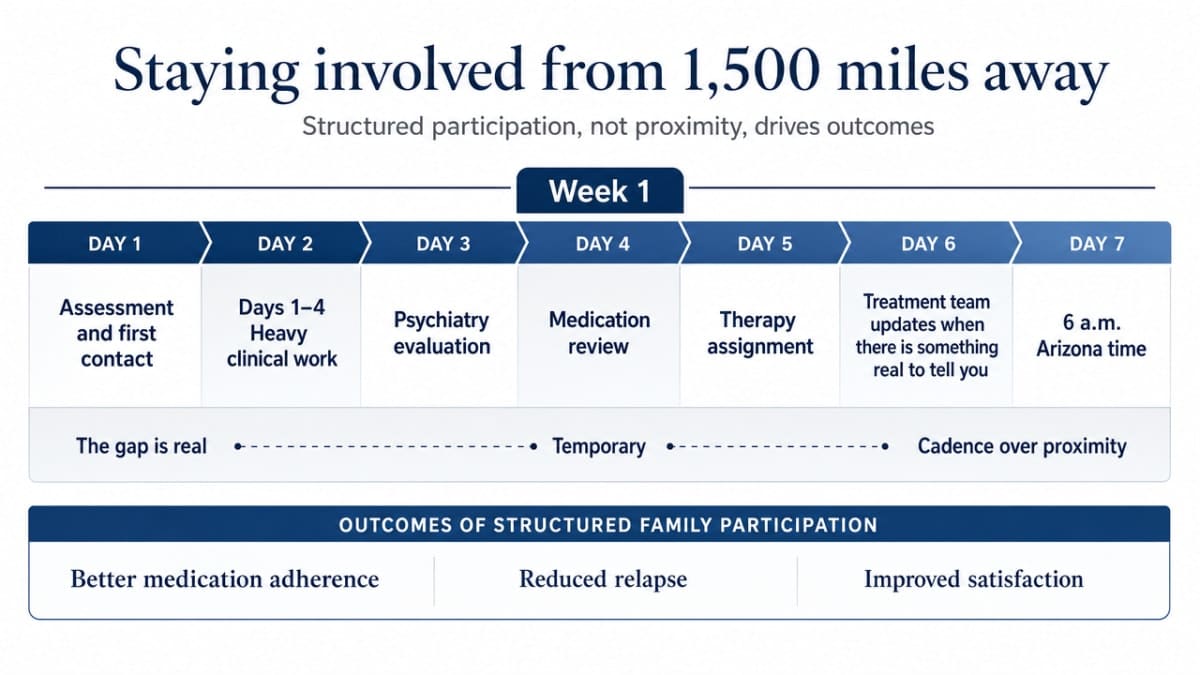
The hardest week is the first one. You are used to being in the room. Now you are checking your phone at 6 a.m. Arizona time, waiting for a call that will not come until the treatment team has something real to tell you.
That gap is real, and it is temporary. It is not the shape of the whole stay.
A systematic review of family involvement in adult psychiatric care found that structured family participation is associated with better medication adherence, reduced relapse, and improved satisfaction with treatment 12. The word doing the work in that sentence is structured. Showing up in the lobby on a Tuesday is not what moves outcomes. A cadence is.
Here is what a real cadence looks like across distance:
Week 1: Assessment and first contact. Days one through four are heavy clinical work — psychiatry evaluation, medication review, therapy assignments. You get an initial call from the treatment team once they have data worth sharing, usually by day 5 to 7. Not before. Expect a nurse or care coordinator to be your daily point of contact for logistics during this window.
Weeks 2 to 3: Video family therapy begins. A licensed clinician runs 50-minute sessions with the patient and family together over secure video. These are working sessions — communication patterns, boundaries, what happened before admission, what needs to change before homecoming. One session a week is standard. Two if the case calls for it.
Midpoint: Scheduled psychiatrist call. The psychiatrist gets on the phone with the family directly to walk through the medication plan, what has been tried, what is working, and what the plan is for the second half of the stay. This is the call to ask hard questions.
Onsite family weekend. Most out-of-state families come to Prescott once during the stay, usually around the midpoint or in the final third. The admissions team helps coordinate travel timing so the visit aligns with a family therapy block, a psychiatrist meeting, and time with the patient.
Final two weeks: Discharge planning meetings. Family joins the treatment team on video to build the aftercare plan — home-state psychiatrist, therapist, medication logistics, what the first month back looks like.
Between scheduled sessions, patients typically have supervised phone or video time with family several evenings a week, depending on clinical stability. Ask the admissions team what that looks like on their unit specifically. Programs vary.
You will miss things. Birthdays, a bad day at work you cannot debrief in person, the ordinary evenings. What you gain is a person who is in the right building with the right team, and a set of family sessions with more structure than anything you were doing at home.
Discharge planning starts in week one
Here is the part most families do not expect: the last two weeks of a residential stay matter as much as the first. Maybe more.
What that looks like in practice when you live in another state:
Week 1: The treatment team asks who your loved one will see when they get home. Psychiatrist. Therapist. Primary care. If those relationships do not exist yet, this is when the search starts. Waitlists for a psychiatrist who prescribes clozapine or manages rapid-cycling bipolar can run six to twelve weeks in many regions. You cannot start that search on discharge day.
Weeks 2 to 3: The Arizona team contacts your home-state prescriber directly, shares the medication history and current regimen, and confirms who will manage refills for the first 30 days. Records get sent, not promised.
Final two weeks: Family joins video meetings to walk through the aftercare plan step by step — first appointment on the calendar, medication logistics at the pharmacy, what warning signs mean a call to the home-state psychiatrist versus a trip to the ER, and what the first month at home actually looks like day to day.
Ask the admissions team, on your first call, how they handle out-of-state discharge coordination. If the answer is vague, that is worth knowing before the plane takes off.
When out-of-state does not make sense
An honest guide has to say this part out loud. Traveling for residential care is the right move for some people and the wrong move for others. Here are the situations where staying closer to home is the better call.
Acute suicidality or medical instability. If your loved one is in an active crisis right now — imminent risk of harm, medical complications from a substance, catatonia, or a psychotic break that needs an emergency response — the answer is the nearest emergency department or inpatient psychiatric hospital. Not a flight. Residential is a step-down from acute stabilization, not a substitute for it.
Medicaid-only coverage. Most state Medicaid plans do not pay for residential treatment across state lines 6. If Medicaid is the only insurance in play, focus your energy on the strongest in-state options and on programs that accept your specific Medicaid managed care organization.
Strong local supports that have not been fully used. If a nearby program meets the five quality signals — accreditation, evidence-based practices, appropriate medication protocols, structured family involvement, and continuing care 2— and you have not tried it yet, try it first. Local is easier on the family, easier on discharge, and easier on the wallet.
A caregiver who cannot participate remotely. Structured family involvement is one of the strongest predictors of good outcomes in adult psychiatric care. If the primary support person cannot commit to video sessions, scheduled psychiatrist calls, and at least one onsite visit, the distance model breaks down before it starts.
If none of these apply and the clinical fit is genuinely specialized, out-of-state is worth the design work. If one of them does apply, use that information. It is not a failure to stay home. It is a match.
Start your out-of-state treatment journey here
Clarify eligibility and next steps for specialized residential care, no travel required until you’re ready.
Frequently Asked Questions
Will my insurance cover residential treatment in another state?
Often, yes, if you have commercial insurance, TRICARE, or some VA benefits. Federal parity rules require plans that cover mental health to pay at a level comparable to medical care, and out-of-network residential authorizations are a legitimate ask, especially when local in-network options do not exist 6. Medicaid usually does not travel across state lines. Call the number on your card and ask about residential coverage, prior authorization, and single-case agreements before booking travel.
How does the admissions process work when I’m calling from across the country?
The first call runs 30 to 60 minutes. An admissions clinician gathers diagnoses, medication history, hospitalizations, and current risk, then builds the medical necessity case in ASAM Criteria language for insurance 5. If the clinical fit is right, verification of benefits usually happens the same day or the next. You should leave the call with a written estimate, a named point of contact, and clarity on travel logistics before you commit to a flight.
How can our family stay involved in treatment from 1,500 miles away?
Structured participation is what moves outcomes, not physical proximity 12. Expect an initial team call by day 5 to 7, weekly video family therapy sessions with a licensed clinician, a scheduled psychiatrist call at the midpoint to walk through the medication plan, and one onsite family weekend timed to align with a therapy block. Between formal sessions, supervised phone or video contact with the patient typically happens several evenings a week, depending on clinical stability.
How do I know an out-of-state program is actually higher quality than local options?
Run every program through the same five filters: accreditation, evidence-based practices, appropriate medication protocols, a defined family role, and continuing care 2. Ask specifically about clozapine protocols, 24/7 board-certified psychiatry, and whether length of stay is driven by clinical progress or insurance authorization. Cross-check your shortlist against SAMHSA’s FindTreatment.gov directory 4. If the local program meets all five signals, stay local. Travel is worth it when the specialization genuinely is not available closer to home.
What happens when my loved one comes home? How is discharge coordinated across state lines?
Discharge planning should start in week one, not week four. Disruptions in continuity of care after intensive treatment raise the risk of relapse and rehospitalization 13. The treatment team identifies your home-state psychiatrist and therapist early, contacts them directly with medication history and current regimen, and confirms who manages refills for the first 30 days. Family joins video meetings to walk through the aftercare plan, first appointments, and what warning signs mean before homecoming.
When does out-of-state residential treatment not make sense?
Skip travel when your loved one is in acute crisis right now — imminent risk of harm or medical instability needs the nearest emergency department, not a flight. Skip it if Medicaid is the only coverage, since most Medicaid plans do not pay across state lines 6. Skip it if a nearby program meets the five quality signals and has not been tried yet, or if the primary support person cannot commit to video sessions and one onsite visit.
References
- DEPARTMENT OF MENTAL HEALTH 104 CMR 27.00. https://www.mass.gov/doc/104-cmr-27-licensing-and-operational-standards-for-mental-health-facilities/download
- Finding Quality Treatment for Substance Use Disorders. https://library.samhsa.gov/product/finding-quality-treatment-substance-use-disorders/pep18-treatment-loc
- Treatment Locators: Mental Health, Drug, Alcohol Issues. https://www.samhsa.gov/find-help/locators
- FindTreatment.gov (English) – SAMHSA. https://www.samhsa.gov/resource/dbhis/findtreatmentgov-english
- ASAM Criteria for Patients with Addiction and Co-occurring Conditions. https://www.samhsa.gov/resource/ebp/asam-criteria-patients-addiction-co-occurring-conditions
- Mental Health Treatment: What Does Health Insurance Cover?. https://www.samhsa.gov/find-support/how-to-pay-for-treatment/know-what-your-insurance-covers
- A Quick Guide to Finding Effective Alcohol and Drug Addiction Treatment. https://www.michigan.gov/-/media/Project/Websites/mdhhs/Folder2/Folder62/Folder1/Folder162/SAMHSA_Quick_Guide_Find_Treatment.pdf
- Struggling with Addiction? Tips on Finding Quality Treatment. https://www.samhsa.gov/blog/struggling-addiction-tips-finding-quality-treatment
- Residential mental health treatment: a review of outcomes and predictors. https://pubmed.ncbi.nlm.nih.gov/24856362/
- Integrated treatment for co-occurring psychiatric and substance use disorders in residential settings. https://pubmed.ncbi.nlm.nih.gov/31238457/
- Barriers to accessing mental health services for adults with serious mental illness. https://www.ncbi.nlm.nih.gov/pmc/articles/PMC6353395/
- Family involvement in adult psychiatric care: a systematic review. https://www.ncbi.nlm.nih.gov/pmc/articles/PMC5576123/
- Continuity of care in mental health services: implications for long-term outcomes. https://www.ncbi.nlm.nih.gov/books/NBK207132/