Key Takeaways
- Treatment-resistant schizophrenia is defined by two adequate antipsychotic trials failing — meaning therapeutic dose, consistent adherence, and at least six weeks at a therapeutic level, not brief hospitalizations or partial courses 1, 4.
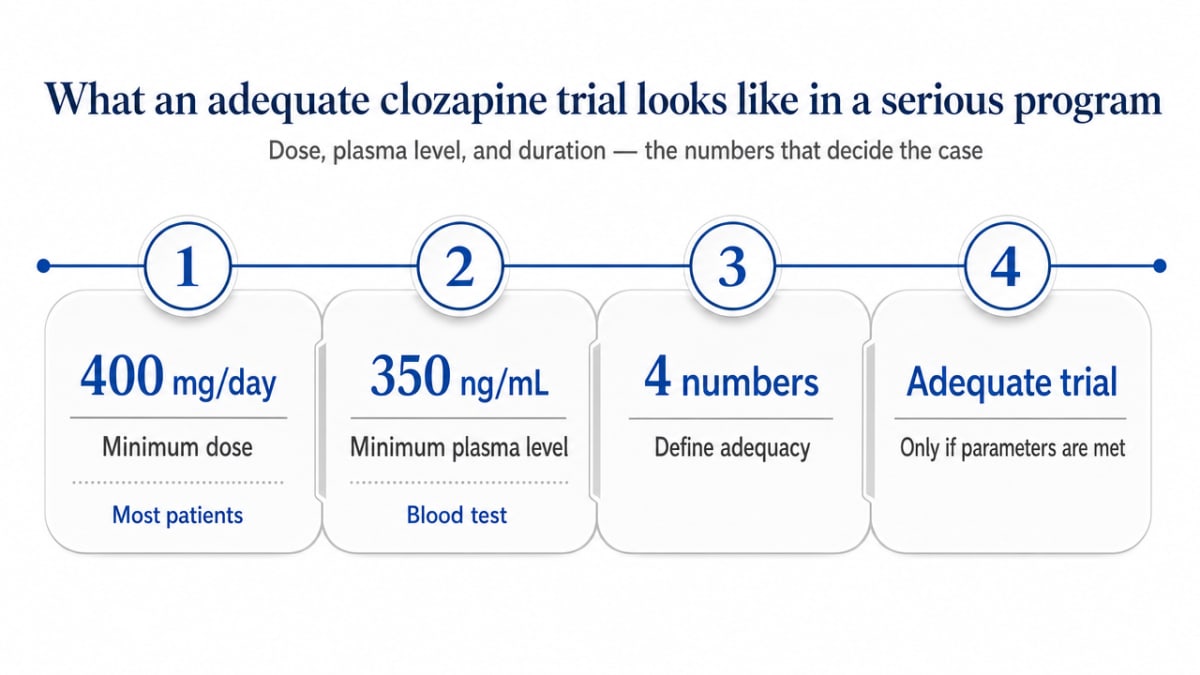
- An adequate clozapine trial requires specific numbers: 400 mg or more daily, plasma level at or above 350 ng/mL, 12 to 16 weeks from therapeutic level, and verified 80% adherence 1, 5, 6.
- When comparing Prescott programs, look for integrated dual-diagnosis care where one team treats psychosis and substance use concurrently, since parallel referrals correlate with two to three times more hospitalizations 7, 9.
- Ask any program for specifics on clozapine protocols, family psychoeducation curriculum, and how length of stay is decided — vague answers or insurance-driven discharge timelines signal the wrong fit.
When two antipsychotics have already failed
You already know the pattern. A hospitalization, a discharge, a new prescription, a few months of something that looks like stability, and then the phone call again. By the time you’re searching for a program in Prescott, you can probably name the antipsychotics your son or spouse has tried, the doses, and the reason each one was stopped — weight gain, sedation, a voice that never fully quieted, a refusal to keep taking it.
That history is not a personal failure. It’s a clinical threshold. When two adequately dosed antipsychotic trials haven’t produced a meaningful response, the diagnosis shifts to treatment-resistant schizophrenia, and the treatment plan is supposed to shift with it 1, 4. The next step is not another second-generation antipsychotic rotation. National guidelines are direct: clozapine becomes the treatment of choice, and the American Psychiatric Association gives that recommendation its strongest evidence rating 3.
Most programs never get there. Some don’t have the monitoring infrastructure. Some discharge at the 30-day insurance mark before a real trial can begin. Some treat the substance use in one building and the psychosis in another, so neither problem ever gets solved. And most treat you — the family — as a visitor rather than part of the clinical team.
The rest of this piece is about what a program built for this level of complexity actually does differently, and how you can tell before you enroll.
What actually defines treatment resistance
The two-adequate-trials threshold, and why most ‘failed trials’ don’t count
The clinical definition is narrower than most families are told. Treatment-resistant schizophrenia is established when two clearly identified, adequate antipsychotic trials have failed to produce meaningful improvement 1, 4. The word doing the work in that sentence is adequate. And when you go back through the chart, a lot of what looked like a failed medication was never really a trial at all.
An adequate antipsychotic trial means a therapeutic dose, taken consistently, for long enough for the drug to actually work — generally at least six weeks at a therapeutic level 1. A three-week inpatient stay that ended with a discharge script and no follow-up is not a trial. A prescription your daughter stopped after ten days because the sedation made her miss class is not a trial. A medication that was cross-titrated onto something else within a month because a hospitalist wanted a cleaner handoff is not a trial. Any of those episodes might get labeled a “failed antipsychotic” in a chart summary, but none of them meet the threshold that would move the case into TRS territory and, with it, onto clozapine 1, 3.
A serious program starts by rebuilding that history with you. Which drugs, at what dose, for how long, at what plasma level where available, and with what evidence of actual adherence. Only after that reconstruction can anyone say whether your loved one has genuinely failed two adequate trials — or whether the plan has simply never held together long enough to find out.
Adherence and substance use as hidden variables
Before a case gets labeled resistant, two variables have to be honestly examined: whether the medication was actually being taken, and whether substances were quietly rewriting the picture 4. Neither one is a moral question. Both are clinical ones.
Adherence in schizophrenia is rarely all-or-nothing. It looks like half doses on the days the voices are quieter, skipped mornings when the side effects felt worse than the symptoms, a bottle that lasts five weeks instead of four. You may already suspect this. A program that takes the case seriously will use plasma levels, pill counts, and long-acting injectables where appropriate to answer the adherence question with data instead of assumption 1.
Substance use sits alongside it. Cannabis, methamphetamine, and alcohol can all mimic, mask, or worsen psychotic symptoms, and their presence changes what an antipsychotic trial is actually measuring 4. If your son was smoking daily through his last two hospitalizations, no one can honestly say those antipsychotics failed on their merits. Screening, honest conversation, and integrated treatment — covered later in this piece — are what turn that variable from a confounder into part of the plan.
What an adequate clozapine trial looks like in a serious program
Dose, plasma level, and duration — the numbers that decide the case
When a program tells you it is “going to try clozapine,” the words you want to hear next are numbers. Clozapine is not a drug you can evaluate on impression. Whether it worked or didn’t work in your loved one’s case is a question with specific parameters, and if the parameters weren’t met, the trial didn’t happen — no matter what the discharge summary says.
Four numbers define an adequate clozapine trial:
- The dose has to reach at least 400 mg per day in most patients, which is the minimum threshold consensus guidelines treat as therapeutic 1, 6.
- The plasma level, drawn from a simple blood test, needs to sit at or above 350 ng/mL — this is the measurement that tells you the drug is actually in the bloodstream at a concentration capable of producing a response, independent of the milligrams on the prescription 1, 5.
- The duration has to be at least 12 weeks from the point the therapeutic level was reached, not from the day the first pill was swallowed, and closer to 16 weeks when the target symptoms are negative or cognitive rather than positive 6.
- And adherence has to be verifiable at 80% or better across that window 5.
Miss any one of those, and the case has not been decided yet. A patient who reached 300 mg but never went higher because of sedation, or hit 400 mg but was discharged at week eight, has not had a real clozapine trial. A serious program will name these numbers back to you, chart them week by week, and treat any deviation as a problem to solve rather than a reason to give up.
Why so few patients get a real clozapine trial
Clozapine has been the guideline-endorsed drug of choice for treatment-resistant schizophrenia for decades, and the APA gives it a 1B recommendation — one of the strongest evidence ratings the guideline confers 3. And yet, if you have been through several programs, there is a real chance no one has offered it. That gap between what the evidence says and what actually happens has a specific explanation, and it is not about your family member.
Clozapine carries a monitoring burden most outpatient settings are not built to carry. Starting it requires structured baseline assessment, a slow titration schedule, ongoing neutrophil counts, cardiac monitoring, and vigilance for a handful of serious side effects that need to be caught early 2. Weekly blood draws for the first six months. Metabolic labs. A REMS registry. A clinician who knows what to do when the numbers move.
A lot of programs quietly opt out of that work. They will rotate a patient through a third and fourth second-generation antipsychotic instead, or hand the case back to an outpatient prescriber with a suggestion to “consider clozapine later.” The result is the pattern you already know — years of medication changes that never touch the drug the guidelines have been pointing at the whole time 6. What you’re looking for is a program that treats clozapine as routine, not exceptional.
When clozapine itself isn’t enough: next-line strategies
Sometimes a patient completes a full, adequate clozapine trial and still hasn’t reached the response the family hoped for. That is a hard moment. It is also a real clinical category with its own name — clozapine-resistant schizophrenia — and there is a next set of moves, not a dead end 1, 5.
The first step is confirming the trial really was adequate on all four fronts before calling it a failure. Was the plasma level actually documented at or above 350 ng/mL, or was the dose alone the metric? Was adherence measured, or assumed? Were the target symptoms positive symptoms, where 12 weeks is a reasonable window, or negative and cognitive symptoms, which often need closer to 16 weeks to show movement 5, 6? Reviewing all of that with fresh eyes sometimes reveals that a longer trial or a modest dose adjustment is still on the table.
When the trial truly was adequate, augmentation strategies come into play — adding a second agent, targeting specific symptom clusters, or adjusting for comorbid conditions 5. There is legitimate disagreement in the field about which augmentation works best for whom, and a good clinician will be honest with you about that uncertainty rather than promising a specific outcome.
Treating substance use in the same building, with the same team
The 15-year cost of parallel, uncoordinated care
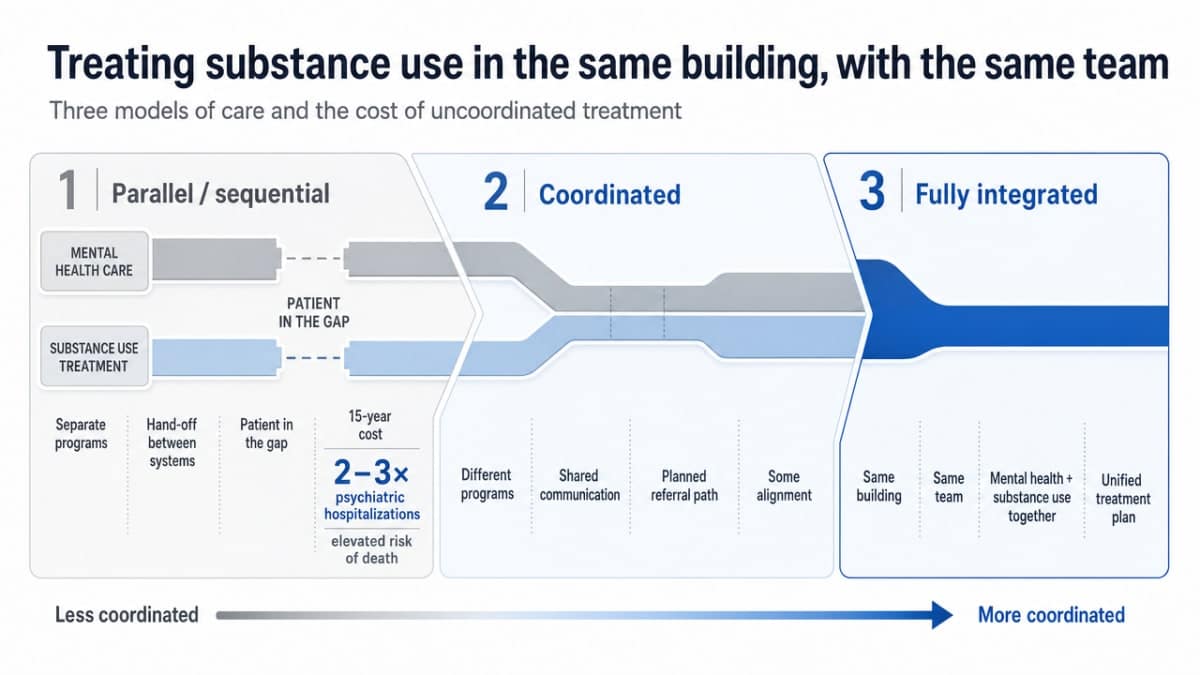
If you’ve watched your family member cycle between a psychiatric unit and a separate rehab, you already know how the story tends to go. The mental health program says the substance use has to be addressed first. The addiction program says the psychosis makes the patient a poor fit. Each side hands the case back to the other, and your loved one ends up managing both problems in the gap between them.
The clinical response to that data is direct. SAMHSA’s evidence-based guidance is that integrated care — both disorders treated concurrently, by the same team, in the same setting — is the preferred model for co-occurring conditions 9, 8. Not sequential. Not parallel referrals across town. Concurrent, in one place, with clinicians who share notes and share a plan.
What integrated dual-diagnosis care looks like on a Tuesday
Integration is a word that gets used loosely. A program can call itself dual diagnosis because it has an addiction counselor on staff and still deliver two mostly separate treatment tracks. The version that changes outcomes looks different in the day-to-day.
On a Tuesday in a truly integrated program, the psychiatrist adjusting your daughter’s clozapine dose already has that morning’s urine screen result in front of her. The therapist running her afternoon group is using motivational interviewing calibrated to where she actually is in her readiness to change, not a fixed curriculum aimed at someone who has already decided to quit 9, 10. The addiction clinician and the psychiatrist are not writing to each other; they are on the same team, meeting about the same case, adjusting the plan together 10.
Stage-matched is the technical term for what that looks like in practice. Early in treatment, when denial and ambivalence are high, the work is engagement and harm reduction, not abstinence contracts. Later, as the psychosis stabilizes and insight returns, the substance use work can deepen 9, 10. Family sessions, group work, and individual therapy all move in coordination rather than as separate services stapled together 9.
What you can ask a program directly: does the psychiatrist and the addiction clinician sit in the same treatment team meeting each week, and does one integrated plan get written for both problems? If the answer is vague, the integration probably is too.
Family involvement as a clinical intervention, not a visiting policy
The relapse math families are rarely shown
You have probably been handed a visitor pass more than once. Sit here, stay quiet, come back Sunday between two and four. If a program treated family the way the evidence says it should, you would be handed a schedule of sessions instead — because the involvement of the people who live with the patient is one of the most reliably effective interventions in the whole treatment package.
Meta-analyses of family interventions in schizophrenia consistently find relapse rate reductions of 50 to 60 percent compared with treatment as usual 12. That is a range built from multiple randomized trials of structured family psychoeducation programs — programs where relatives are taught the illness, the medications, the warning signs, and specific communication strategies over a defined series of sessions 12. It is not a soft finding pulled from one small study. It is what happens across the literature when families are pulled into the clinical work in a real way.
Sit with that number for a moment. If your son’s last hospitalization came fourteen months after the previous one, cutting the relapse rate by half is the difference between a call this year and a stretch of stability long enough for therapy, work, and relationships to actually take root. Any program that treats family involvement as optional is leaving that effect on the table.
Structured psychoeducation, adherence, and suicide risk
The relapse number is the headline, but it is not the only outcome family work moves. More than thirty randomized trials of family psychoeducation across schizophrenia and related conditions have found reductions in relapse, improvements in patient recovery, and measurable gains in family well-being — including lower caregiver burden and depression 13, 11. When you are the parent making the calls, sitting up at night, tracking the pill bottle, that last piece matters more than most programs acknowledge.
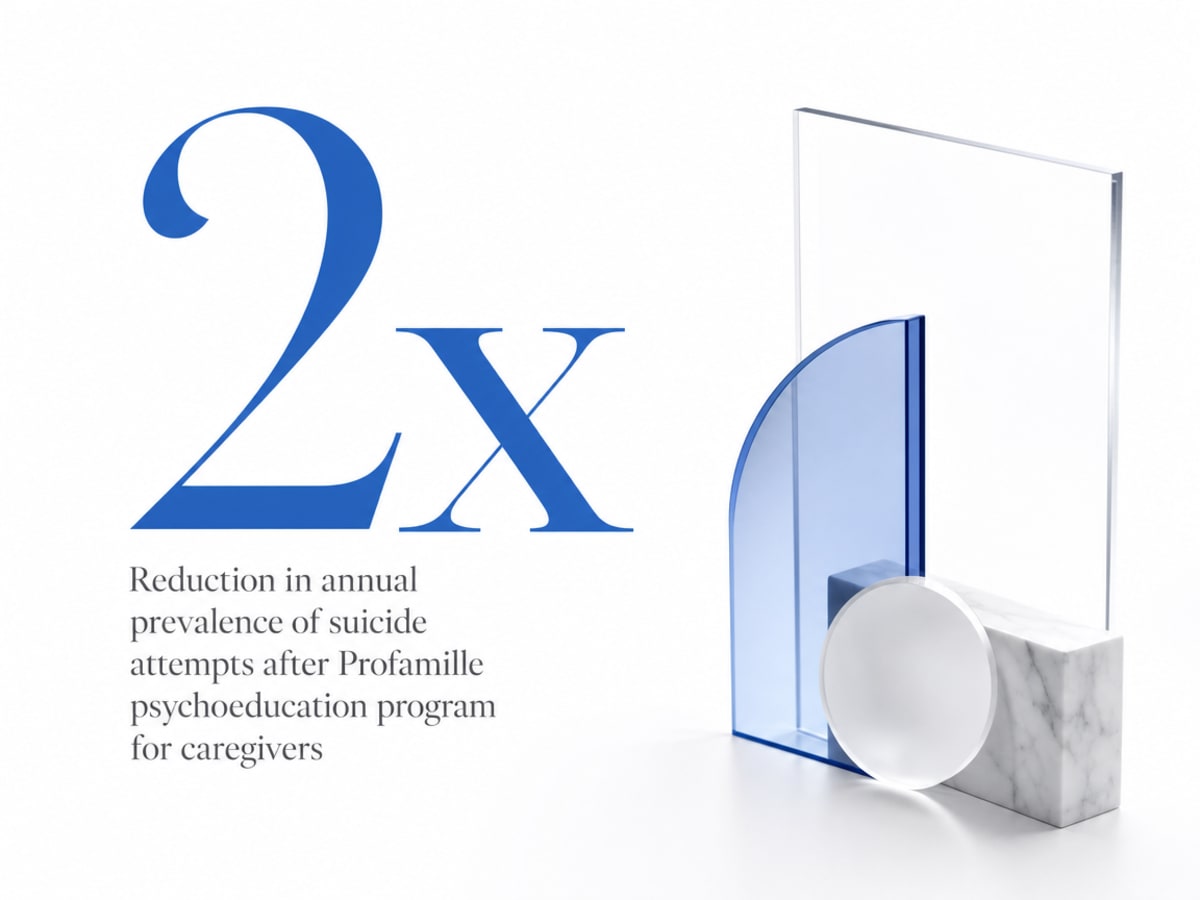
One recent finding is worth naming carefully. A 2024 study of the Profamille V3.2 multi-family psychoeducation program, delivered to caregivers of relatives with schizophrenia, reported that the annual prevalence of suicide attempts among the patients fell by a factor of two after their families completed the program 14. The study is retrospective and specific to that curriculum and caregiver cohort, so it is not a universal promise. It is a signal — a striking one — that what families learn and practice at home can shift the most serious outcomes.
One thing the evidence does not fully solve is medication adherence. At least one brief multifamily program improved caregiver burden and 12-month relapse risk without producing a significant change in adherence rates 11. Family work is powerful, and it is not a substitute for the medication protocols in the previous section. Both have to be in place.
What week-to-week family work should actually include
When you ask a program what family involvement looks like, listen for specifics. A monthly update call from a case manager is not psychoeducation. A single discharge meeting is not psychoeducation. The programs that produced the outcomes above ran structured, multi-session curricula with defined content and a predictable schedule 12, 13.
The week-to-week components tend to look like this:
- Sessions on what schizophrenia is doing neurologically, so warning signs become recognizable rather than mysterious.
- Sessions on the specific medications your family member is taking — including clozapine, if that is the plan — with the side effects and monitoring schedule laid out honestly.
- Communication practice, because expressed emotion at home is one of the variables that predicts relapse and can be modified.
- Problem-solving frameworks for the situations you already know are coming: a missed dose, a bad appointment, a return of a symptom you thought was gone 13.
Multi-family formats — several families in the room together — are common in the evidence and often more useful than single-family sessions, because you meet people further along the same road 11, 14. Ask any program you are considering how many family sessions are built into the plan, who runs them, and what the curriculum covers. A vague answer is an answer.
Questions to ask any Prescott program before you enroll
By the time you’re picking up the phone, you have earned the right to be specific. A tour and a warm brochure are not enough. Bring a short list of questions that the last three programs probably could not answer cleanly, and listen for how the clinical director responds — vague, or precise.
Ask what defines an adequate antipsychotic trial in their program. A serious answer names dose, duration, and how adherence is verified 1. Ask at what point clozapine is offered. If the answer is “we consider it eventually,” keep looking. The guideline standard is after two adequate failed trials, and that is the moment the drug is supposed to move to the front of the conversation 3, 6.
Ask what an adequate clozapine trial looks like in their hands — specifically, the target dose, the plasma level they draw and act on, the duration they hold before calling it a nonresponse, and how they handle the monitoring schedule 1, 2, 6. Ask how substance use is treated when it shows up. The right answer describes one team, one plan, and concurrent care, not a referral out 9, 10.
Start Your Expert Schizophrenia Assessment Today
Gain clear, expert recommendations for your family’s next steps in treatment-resistant schizophrenia care.
Frequently Asked Questions
How do you know if my loved one’s schizophrenia is truly treatment-resistant?
Treatment resistance is established when two clearly identified, adequately dosed antipsychotic trials have failed to produce meaningful improvement 1, 4. Adequate means a therapeutic dose, taken consistently, for long enough for the drug to work. A serious program will rebuild the medication history with you and rule out adherence gaps and substance use before applying the label 4.
At what point will clozapine actually be offered, and what makes a clozapine trial adequate?
Clozapine should move to the front of the conversation after two adequate antipsychotic trials have failed 3, 6. An adequate trial means at least 400 mg per day, a plasma level of 350 ng/mL or higher, 12 weeks from the point the therapeutic level is reached (closer to 16 weeks for negative or cognitive symptoms), and verified adherence at 80% or better 1, 5, 6.
Can substance use be treated at the same time as schizophrenia, or does my family member need to get sober first?
Concurrent treatment is the standard of care, not a compromise. SAMHSA’s evidence-based guidance is that both disorders should be treated at the same time, in the same setting, by the same team 9, 8. Sequential care — sober up first, then address the psychosis — is what produced the two-to-three-fold hospitalization gap in long-term outcomes 7.
What does family involvement actually look like week to week?
Structured psychoeducation runs as a defined series of sessions with set content: how the illness works, how the medications work, warning signs, communication practice, and problem-solving for situations you already know are coming 13. Multi-family formats put several families in the room together 11. A monthly case-manager call is not psychoeducation, and the outcomes data reflects the difference 12.
What happens if clozapine itself doesn’t produce a full response?
The first move is confirming the trial really was adequate on every front — dose, plasma level, duration matched to the target symptoms, and documented adherence 5, 6. If it was, the case becomes clozapine-resistant schizophrenia, which is a defined clinical category with augmentation strategies, not a dead end 1, 5. A good clinician will be honest about which augmentations have stronger evidence and which are more uncertain.
We’ve been discharged at the 30-day mark before. How is treatment duration decided here?
Treatment duration in a program built for treatment-resistant work is calibrated to the clinical case. Clozapine titration, therapeutic plasma levels, and response evaluation take time — the guideline standard is 12 weeks from therapeutic level, longer for negative or cognitive symptoms 6. If the insurance calendar is setting the discharge date instead of the treatment plan, the case is not being run on clinical judgment.
References
- Guidelines for the Pharmacotherapy of Schizophrenia in Adults. https://pmc.ncbi.nlm.nih.gov/articles/PMC5593252/
- A Guideline and Checklist for Initiating and Managing Clozapine. https://pubmed.ncbi.nlm.nih.gov/35759211/
- The American Psychiatric Association practice guideline for the treatment of patients with schizophrenia. https://www.med.unc.edu/psych/epi-nc/wp-content/uploads/sites/720/2024/01/APA-2020-guidelines-1.pdf
- Treatment-Resistant Schizophrenia. https://pmc.ncbi.nlm.nih.gov/articles/PMC7725152/
- Clozapine resistant schizophrenia: Newer avenues of management. https://pmc.ncbi.nlm.nih.gov/articles/PMC8394694/
- Clozapine is the approved option in treatment-resistant schizophrenia. https://pmc.ncbi.nlm.nih.gov/articles/PMC9936483/
- The impact of substance use disorders on the course of schizophrenia—a 15-year follow-up study: dual diagnosis over 15 years. https://pubmed.ncbi.nlm.nih.gov/21592731/
- Managing Life with Co-Occurring Disorders. https://www.samhsa.gov/mental-health/serious-mental-illness/co-occurring-disorders
- Substance Use Disorder Treatment for People with Co-Occurring Disorders. https://library.samhsa.gov/sites/default/files/pep20-06-04-006.pdf
- Integrating Treatment for Co-Occurring Mental Health Conditions and Substance Use Disorders. https://pmc.ncbi.nlm.nih.gov/articles/PMC6799972/
- Family psychoeducation to improve outcome in caregivers of patients with schizophrenia. https://pubmed.ncbi.nlm.nih.gov/10326382/
- Family Interventions for Schizophrenia and the Psychoses: A Review. https://pubmed.ncbi.nlm.nih.gov/27411376/
- Family psychoeducation and schizophrenia: a review of the literature. https://pubmed.ncbi.nlm.nih.gov/12728780/
- Discussion (Profamille psycho-educational program for schizophrenia caregivers). https://pmc.ncbi.nlm.nih.gov/articles/PMC11024790/
- Co-Occurring Disorders and Other Health Conditions. https://www.samhsa.gov/substance-use/treatment/co-occurring-disorders