

Key Takeaways
- Assign a risk tier before naming a level of care, since high, moderate, and lower-acuity presentations each point to different settings and require documented reasoning that holds up under utilization review 1.
- Document treatment resistance as a trajectory with specific medication trials, prior levels of care, and discharge circumstances, because Arizona BHRF criteria require evidence that lower levels have failed or are unavailable 5.
- Translate your clinical narrative into ASAM 4th Edition language and name the level explicitly, including the COE designation when integrated psychiatric care is required rather than bolted on 10, 9.
- Verify program-fit using the DDCAT and DDCMHT framework, since Dual Diagnosis Capable keeps clients safe but Dual Diagnosis Enhanced is what moves the trajectory for complex psychiatric cases 2, 9.
- Match the Arizona pathway to the presentation: BHRF for 24/7 stabilization needs 5, AzSH when DTO, DTS, GD, or PAD criteria are met after local treatment 6, and SMI level-of-care indicators under HB2980 for ongoing wraparound 7.
- Build the referral packet in five structured parts with dates attached to every claim, so it reads as a clinical decision to intake teams, reviewers, receiving psychiatrists, and potentially courts 5, 7, 9.
- Route acute presentations through the coordinated crisis system’s contact, response, and stabilization functions while continuing to build the clinical packet in parallel 4.
- Own continuity after handoff by offering a 72-hour call to the receiving psychiatrist and requesting discharge planning documentation before discharge, since step-down planning starts on day one 5, 7.
When Your Clinical Judgment Says the Room Isn’t Big Enough Anymore
You know the moment. Your client walks in, and the interventions that were working three weeks ago aren’t holding the line anymore. Sleep is fractured. The drinking is back. There’s a plan now, not just ideation. You’re the therapist holding the risk, and the weekly session is no longer the container this presentation needs.
Referring to a higher level of care isn’t giving up on the work. It’s a clinical judgment that has to stand up to utilization review, potentially to court, and to your own continuity-of-care obligations. Done well, it protects the client and protects you. Done sloppily, it lands your treatment-resistant patient in a program rated Dual Diagnosis Capable when they actually need Dual Diagnosis Enhanced, and you’ll see them again in six weeks with a fresh discharge summary and the same untreated psychosis.
This guide walks through the decision the way you’d actually make it: risk stratified against published thresholds, treatment resistance documented, ASAM level named, Arizona pathway selected, and program-fit verified before you hit send. Your judgment is the load-bearing wall here. The framework just helps you show your work.
Stratifying Risk Before You Pick Up the Phone
The Three Risk Tiers That Drive the Referral Decision
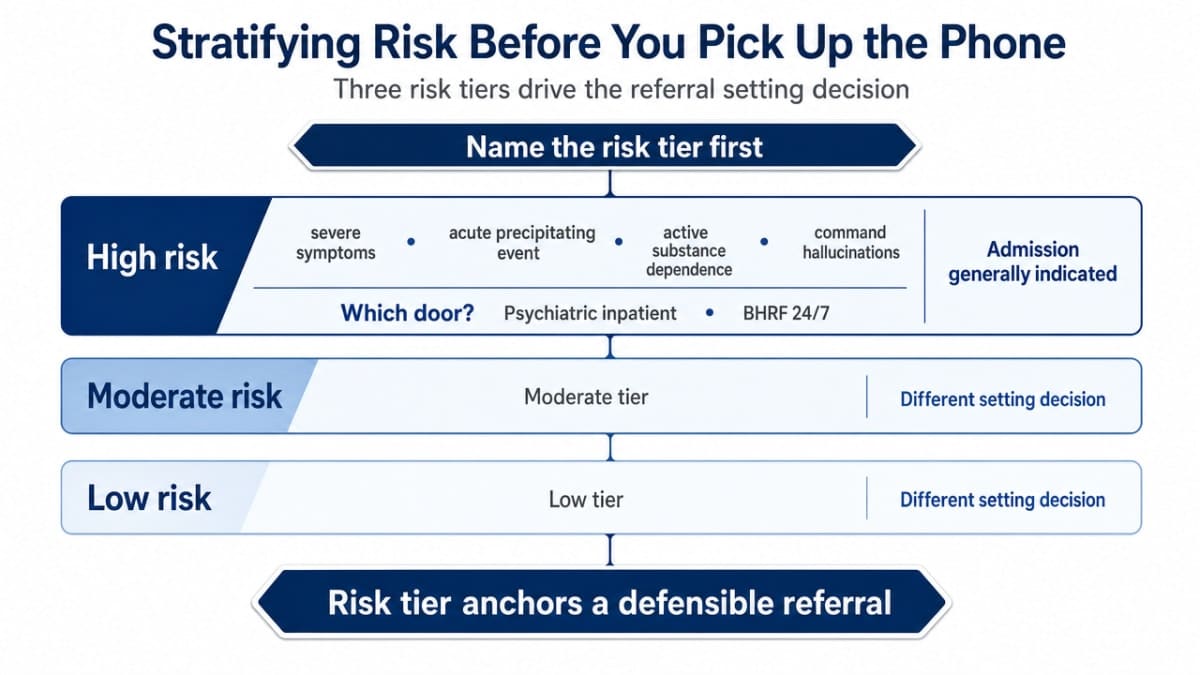
Before you name a level of care, you have to name the risk tier. Published guidance stratifies suicide risk into high, moderate, and low, and each tier points to a different setting decision 1. When you’re building the referral, this is the anchor that keeps the rest of the packet defensible.
High risk. Severe symptoms, an acute precipitating event, active substance dependence, or command hallucinations. In these presentations, admission is generally indicated unless something meaningful has already changed the risk picture 1. If your client just described a plan with intent, or you’re hearing command hallucinations from a treatment-resistant schizophrenia case, you’re not deciding whether to escalate. You’re deciding which door: psychiatric inpatient, BHRF with 24/7 coverage, or crisis stabilization on the way there.
Moderate risk. Suicidal ideation with some plan formation but limited intent, active substance use that’s destabilizing outpatient work, or a recent decompensation that outpatient sessions haven’t reversed. This is where the residential and high-intensity outpatient conversation lives. It’s also where you’ll do the most defending in utilization review, because moderate risk is where insurers push back hardest.
Lower acuity, high complexity. Ideation without plan or intent, stable enough for weekly work, but a treatment history that shows repeated near-misses. These clients don’t need admission today. They need a documented safety plan, a step-up pathway ready if the picture shifts, and, often, a medication consult you don’t have to broker from scratch.
Guidelines are explicit that clinical judgment and local resources still shape the final call 1. Tiers are the floor of your reasoning, not the ceiling. Write down which tier you assigned and why, in the same note where you document the referral.
Documenting Treatment Resistance and Prior Trials
Utilization reviewers and receiving programs are going to ask the same question in different words: what have you already tried, and why isn’t it working? For treatment-resistant clients, the answer is usually longer than the intake form has room for, which is exactly why you write it out separately.
Your documentation should name the trials specifically. Medications by class, dose, duration, and reason for discontinuation. Prior therapy modalities and their measurable outcomes, not just “client attended.” Prior levels of care and the discharge circumstances. If the client is a clozapine candidate who hasn’t been trialed because outpatient prescribers won’t manage the monitoring, that belongs in the packet. If two SSRIs and an atypical failed at adequate dose and duration, say so.
Write treatment resistance as a trajectory, not a snapshot. Three crisis contacts in six months. Two failed medication trials at therapeutic dose. One prior residential stay that discharged before stabilization because the program couldn’t handle the co-occurring picture. That’s the story the receiving psychiatrist needs to walk into on day one, and it’s the story that turns a referral into a defensible clinical decision.
Speaking ASAM: The Shared Vocabulary of Your Referral Packet
When you send a client up the ladder, the receiving program is going to translate your narrative into ASAM. If you translate it first, the intake conversation moves faster and the acuity match is cleaner.
The ASAM 4th Edition continuum runs from remission monitoring and outpatient therapy through high-intensity outpatient (HIOP), then into residential at 3.5 and 3.7 with co-occurring enhanced (COE) designations, and finally Level 4 psychiatric care for the most acute presentations 10. That’s the shared language. If your treatment-resistant client is decompensating on weekly outpatient work but doesn’t need medical detox or locked psych, you’re probably naming HIOP or 3.5 COE in the packet, not “residential” as a generic category.
The COE designation is where dual-diagnosis referrals live or die. Co-occurring Enhanced is indicated when higher-intensity mental health care is needed, meaning on-site cross-trained mental health professionals, active medication management, and psychiatric consultation embedded in the program rather than bolted on 9. For a client with treatment-resistant schizophrenia and active alcohol dependence, a 3.7 COE bed is not the same product as a 3.7 co-occurring capable bed, even though the ASAM number looks identical on paper.
Name the level explicitly. “Recommending 3.5 COE based on ASAM dimensional assessment, with escalation criteria to 3.7 COE if psychiatric stability isn’t achieved within the first two weeks.” That sentence tells the receiving admissions team you’ve done multidimensional thinking, and it tells utilization review that your recommendation is criteria-based, not preference-based.
One caution. The 4th Edition terminology is still rolling out unevenly across programs and payers in 2025 10. Some intake coordinators will still speak in 3rd Edition levels. Keep both in your working vocabulary, and when you call ahead, ask the receiving program which edition their utilization language currently references. That five-second question saves an hour of translation later.
Program-Fit: Dual Diagnosis Capable Is Not Dual Diagnosis Enhanced
Here is where a lot of well-built referral packets die on arrival. You’ve stratified the risk, documented treatment resistance, named the ASAM level. Then you call a program that describes itself as “dual diagnosis” on the website, ship your treatment-resistant client with active psychosis and alcohol dependence, and get a discharge summary three weeks later that reads like the mental health side barely got touched. The gap isn’t the ASAM number. It’s the co-occurring capability underneath it.
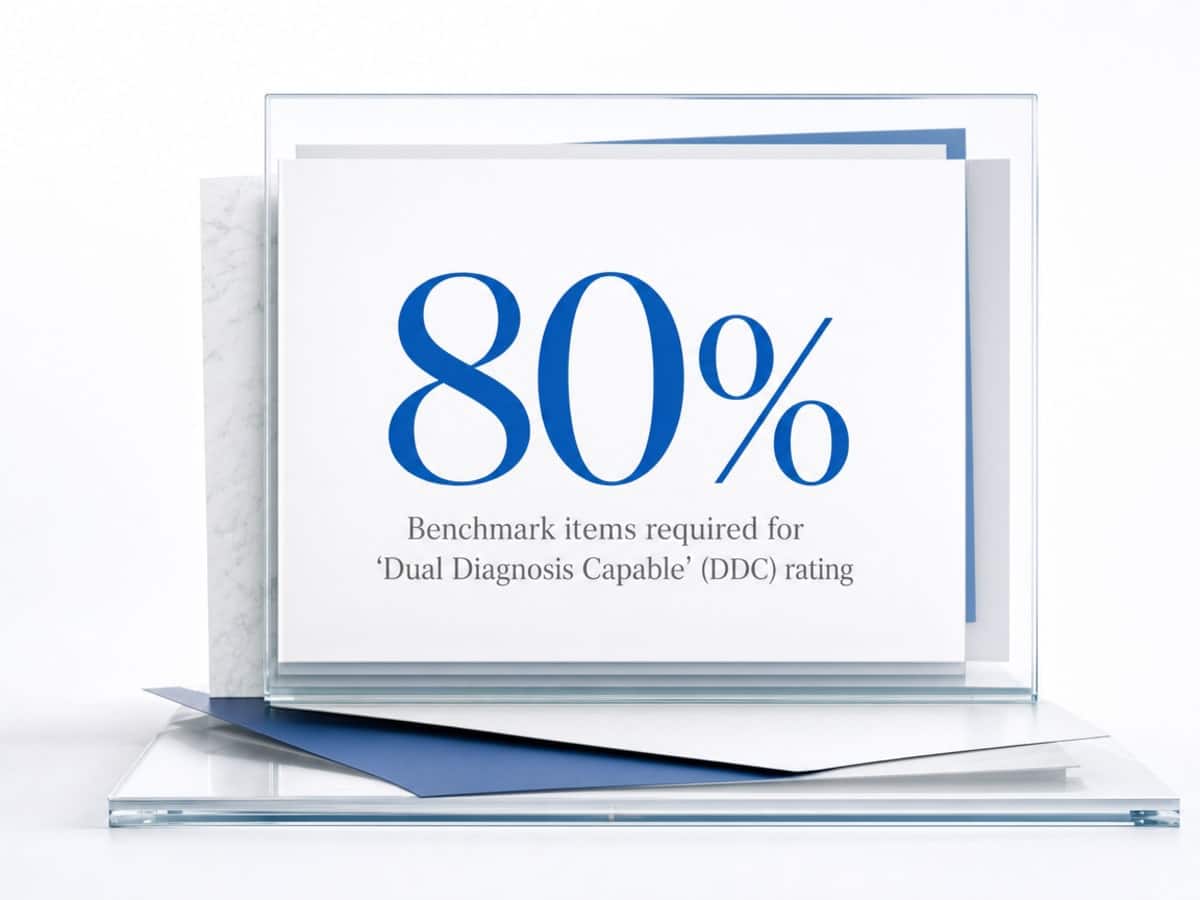
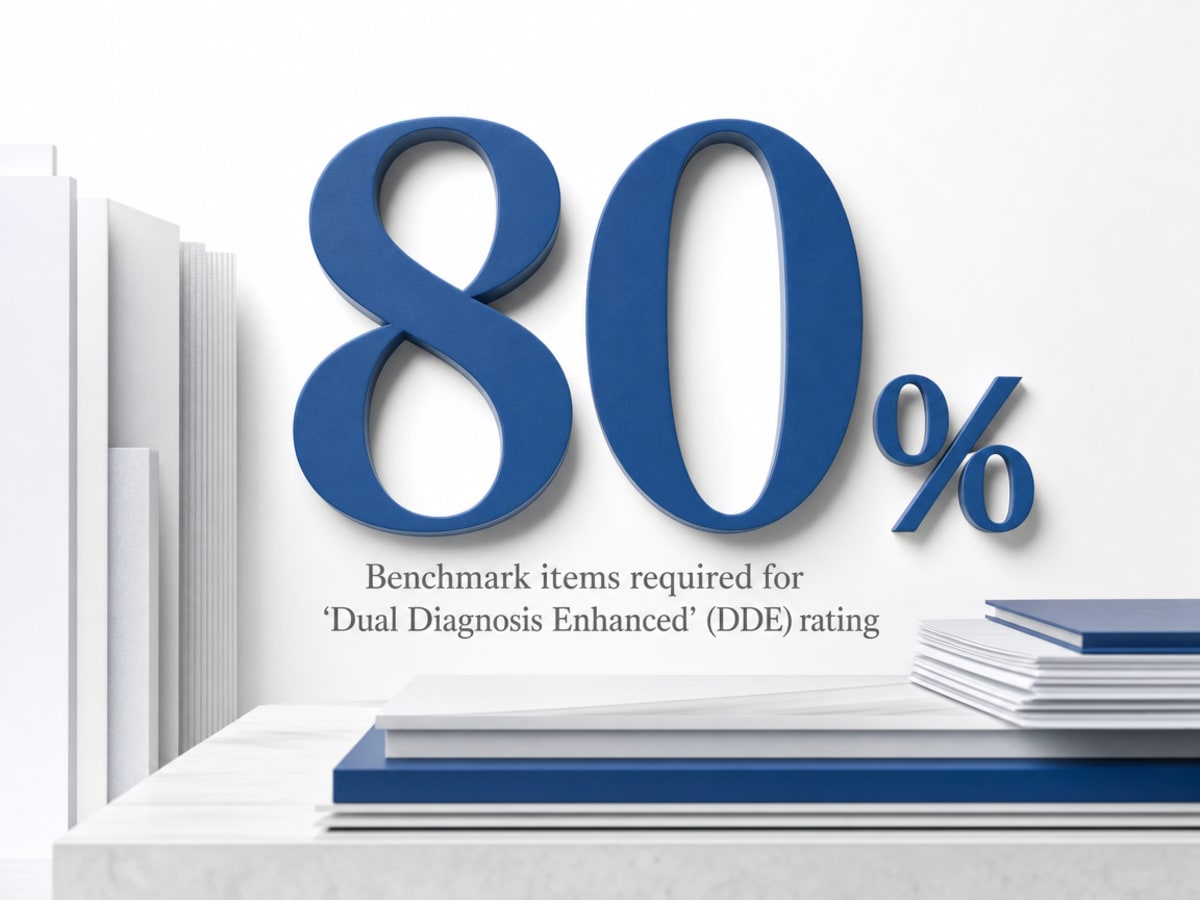
The DDCAT and DDCMHT rating tools give you a concrete filter. Both are structured, item-level assessments of a program’s actual capacity to treat co-occurring psychiatric and substance use disorders, scored across 35 benchmark items covering program structure, staffing, assessment, treatment, and continuity. To earn a Dual Diagnosis Capable (DDC) rating, a program has to score at least 3 out of 5 on 80% of those 35 items. To earn Dual Diagnosis Enhanced (DDE), it has to score at least 5 on 80% of them 2. These are facility-level program ratings, not patient outcome measures, and not every program has been formally rated. But the framework tells you what to ask about.
For a treatment-resistant, complex dual-diagnosis client, DDC is the floor, not the target. DDC means the program can handle co-occurring conditions competently. DDE means the mental health side is fully integrated: on-site psychiatric consultation, active medication management for both conditions, cross-trained clinicians who don’t treat the psychiatric picture as a discharge problem 9. If your client is a clozapine candidate or has repeated psychiatric hospitalizations behind them, DDC-level capability will keep them safe, but it probably won’t move the trajectory.
Ask the receiving program directly, before the intake call:
- Do you have board-certified psychiatry on-site or on-call, and how often?
- Who manages complex psychotropic regimens, and can that clinician start or continue clozapine?
- Are your therapists cross-trained in both SUD and serious mental illness, or is the psychiatric care contracted out?
- What percentage of your current census has a primary psychiatric diagnosis, not just a co-occurring one?
A DDE-capable program answers these in specifics. A DDC-only program answers in mission statements.
Write the answers in the referral note. If the receiving program couldn’t clarify who manages medication complexity, that’s clinical information the next referring clinician needs, and it’s information you’ll want if this client comes back to your caseload in six weeks.
The Arizona Pathways: BHRF, AzSH, and the SMI Level of Care
BHRF Admission Criteria and What Utilization Review Wants to See
Behavioral Health Residential Facility is often the right landing spot for the treatment-resistant, dual-diagnosis client who’s decompensating on outpatient work but isn’t acute enough for locked psych. To get them in, and to keep them in past the first continued-stay review, your documentation has to hit specific criteria that AHCCCS training materials spell out in plain language.
The BHRF standard requires:
- at least one area of significant risk of harm,
- at least one area of serious functional impairment,
- a need for 24/7 care to learn and generalize safety skills, and
- evidence that stabilization cannot be achieved in a less restrictive setting.
Lower levels of care must have not achieved symptom remission, or be genuinely unavailable, and the placement must be the least restrictive option that meets clinical need 5.
Read that list as a checklist, not a paragraph. For each criterion, your referral note needs a sentence with a specific behavior, date, or trial attached. “Significant risk of harm” isn’t a phrase you copy from the guidance. It’s the two ED visits in the last 60 days for intentional overdose, the escalating self-injury during weekly sessions, the command hallucinations that returned when the client stopped clozapine because outpatient couldn’t manage monitoring. “Serious functional impairment” is the job loss, the housing instability, the inability to complete ADLs during depressive episodes.
The “failure of lower LOC” criterion is where treatment-resistant cases have the strongest documentation, if you’ve been keeping notes. Name the outpatient modalities tried, the HIOP attempt that discharged early, the medication trials that hit therapeutic dose without remission. Continued-stay reviews will come back to this same list every seven to fourteen days, so write the initial packet knowing the reviewer will re-read it four times.
Escalating to AzSH: DTO, DTS, GD, and PAD
Arizona State Hospital is the top of the escalation ladder, and the criteria are narrower than most outpatient clinicians remember. Under ADHS Policy 114, AzSH admission requires the individual to be determined to meet DTO, DTS, GD, or PAD criteria due to a mental disorder, and AzSH must be the least restrictive alternative available for treatment after mandatory local treatment days have been completed 6. Translation: your client has to be a danger to others, a danger to self, gravely disabled, or persistently and acutely disabled, and community-based higher levels of care have to have been tried or clearly determined inadequate.
For the treatment-resistant client, the AzSH pathway usually opens after a pattern rather than a single event. Repeated involuntary commitments that discharge before stabilization. A grave disability picture that returns every time community placement steps down. Court-ordered treatment that community providers cannot deliver because of medication complexity or aggression the setting can’t hold safely. You typically aren’t the clinician who initiates AzSH placement directly, but you are the clinician whose documentation feeds the petition, and your notes on prior local treatment adequacy are what the least-restrictive analysis rests on.
When the picture is moving that direction, the SAMHSA-aligned crisis system runs parallel to your referral work: someone to contact, someone to respond, and a safe place for help, all coordinated so acute presentations don’t sit in an ED waiting for a bed 4. Use the mobile crisis team and stabilization side of that system when the client is deteriorating faster than your standard intake calls can keep up with.
SMI Level-of-Care Indicators Under HB2980
HB2980 codifies an SMI-specific level of care built around behavioral, functional, and safety criteria rather than a single diagnostic label. The indicators map closely to the treatment-resistant, complex psychiatric client you already carry: repeated psychiatric hospitalizations or crisis episodes, high-intensity or complex psychotropic medication regimens requiring enhanced monitoring, and structured supports needed to prevent relapse, decompensation, or hospitalization 7. Court-ordered treatment history and housing instability also weigh into the determination.
Practical use for you as the referring therapist: if your client meets SMI criteria and the pattern shows repeated hospitalizations plus a complex regimen like clozapine, a mood stabilizer, and adjunctive antipsychotics, name the SMI level-of-care indicators in the referral packet even when you’re referring to BHRF or HIOP. The determination shapes which wraparound supports the receiving program is expected to build in, and it shifts what “successful discharge” means. You’re not just documenting the current episode. You’re documenting the trajectory that qualifies your client for a level of ongoing support the standard SUD-primary program isn’t structured to deliver.
Cite the indicators specifically. The receiving program’s utilization team reads them as a signal that your referral is anchored in the population the statute contemplates, not just in this week’s acuity.
Building the Referral Packet That Survives Scrutiny
The packet is the artifact of your clinical thinking. If it reads like a form, it will be treated like one. If it reads like a decision, it holds up to the four separate audiences that will read it: the receiving program’s intake team, the utilization reviewer, the psychiatrist who inherits the case on admission day, and, potentially, a court or licensing board reading it six months from now.
Structure it in five parts, in this order:
- First, the presenting picture in two paragraphs: current risk tier with the specific behaviors that placed the client there, and the acute change that triggered this referral now rather than three weeks ago.
- Second, the treatment trajectory: medication trials by class, dose, duration, and reason for discontinuation, plus prior levels of care and how each ended.
- Third, the ASAM recommendation with the level named explicitly and the co-occurring designation attached, so the receiving admissions team isn’t guessing whether you meant 3.5 COC or 3.5 COE 9.
- Fourth, the Arizona-specific criteria you’re leaning on: BHRF admission language if that’s the target, SMI level-of-care indicators if the client qualifies, and any court-ordered treatment history that shapes the placement 5, 7.
- Fifth, the safety plan currently in place and the specific reasons it’s no longer sufficient.
One more thing worth doing before you send. Read the packet as if you were the psychiatrist admitting this client on a Sunday night with no other context. If a stranger can build a working formulation and safety plan from what you wrote, the packet is done. If they’d have to call you to fill in the gaps, keep writing.
The Acute Case: When Standard Intake Isn’t Fast Enough
Sometimes the client walks into your office already past the point where a Tuesday intake call at a residential program is going to matter. Command hallucinations returned overnight. The overdose was two days ago and they discharged themselves against medical advice. The plan is specific and the means are in the house. When you’re the therapist holding that picture, the standard packet-and-callback workflow isn’t the tool. The coordinated crisis system is.
Federal guidance frames the crisis response as three linked functions: someone to contact, someone to respond, and a safe place for help 4. Use all three. The mobile crisis team can respond in the community while you’re still on the phone, which matters when the client won’t tolerate an ED waiting room or when a locked unit isn’t yet clinically warranted. A crisis stabilization setting can hold the client for hours to days while you continue building the residential or inpatient referral in parallel.
Keep writing the clinical packet while the crisis system is engaged. Acute stabilization buys hours, not a treatment plan. Your documentation of risk, prior trials, and the ASAM level you’re recommending is what turns a crisis hold into a defensible admission to the right next setting.
Continuity After the Handoff Is Still Your Clinical Responsibility
The admission call ends, the bed is confirmed, and there’s a very human urge to feel the weight lift. It doesn’t quite lift, and it shouldn’t. Your client is now in a program you don’t run, but the trajectory is still yours to shape until they’re stable in a follow-up relationship.
Send the receiving psychiatrist a direct line, not just a fax number. Offer a fifteen-minute call in the first 72 hours to walk through the medication history and the interventions that have and haven’t held. For treatment-resistant presentations where clozapine, complex mood stabilization, or a history of court-ordered treatment is on the table, that call is often the difference between a program continuing your work and quietly restarting the clock.
Ask, in writing, to receive discharge planning documentation before discharge, not after. BHRF and residential programs are expected to plan step-down against least-restrictive criteria from day one 5. If the plan is a warm handoff back to you, name the first appointment on the calendar before the client leaves the building. If it’s a step-down to HIOP or an SMI wraparound under HB2980 indicators, confirm the receiving team has that referral in hand, not on a task list 7.
Your judgment got this client to the right door. Your continuity is what keeps them from walking back through yours in six weeks with the same untreated picture.
Get Clarity on Next Steps for Complex Care
Receive expert insight to guide your referral for higher-level psychiatric intervention.
Frequently Asked Questions
How do I know when to refer a dual-diagnosis client to a Dual Diagnosis Enhanced program rather than a Dual Diagnosis Capable one?
Match the program tier to the mental health acuity, not just the SUD picture. Co-occurring Enhanced is indicated when the psychiatric side needs on-site cross-trained clinicians, active medication management, and embedded psychiatric consultation 9. If your client has treatment-resistant symptoms, a complex regimen like clozapine, or repeated psychiatric hospitalizations, DDC-level capability keeps them safe but rarely moves the trajectory. DDE is the target.
What documentation of prior treatment failure does utilization review expect before approving a BHRF admission?
Show that lower levels of care did not achieve symptom remission or are genuinely unavailable, alongside significant risk of harm, serious functional impairment, and a documented need for 24/7 care to generalize safety skills 5. Name each medication trial by class, dose, and duration. List prior HIOP or outpatient episodes and how they ended. Attach dates to every claim. Reviewers re-read this narrative at every continued-stay checkpoint.
When does a client’s presentation cross from BHRF-appropriate to requiring AzSH-level care under DTO, DTS, GD, or PAD criteria?
The threshold shifts when community-based higher levels of care have been tried or clearly determined inadequate and the client meets DTO, DTS, GD, or PAD criteria due to a mental disorder 6. Watch for the pattern: repeated involuntary commitments discharging before stabilization, grave disability returning at every step-down, or court-ordered treatment the community can’t safely deliver. Your notes on prior local treatment adequacy anchor the least-restrictive analysis.
What ASAM 4th Edition level of care should I name in my referral packet for a treatment-resistant client with active substance use?
For a decompensating client who doesn’t need locked psych or medical detox, name 3.5 COE or 3.7 COE explicitly, with escalation criteria attached 10. The COE designation signals the receiving admissions team that mental health integration, not add-on, is required 9. If psychosis is acute or safety cannot be held in an unlocked setting, Level 4 Psych is the correct call. Ask which edition the receiving program’s utilization language currently uses.
If my client is in acute crisis, do I still route through standard intake or use the crisis system?
Use the crisis system. Federal guidance frames it as someone to contact, someone to respond, and a safe place for help, all coordinated so acute presentations don’t sit in an ED waiting for a bed 4. Mobile crisis can meet the client in the community while stabilization holds them for hours to days. Keep writing the clinical packet in parallel. Acute stabilization buys hours, not the admission you’re building toward.
What are my continuity-of-care obligations after the client is admitted to a higher level of care?
Send the receiving psychiatrist a direct line and offer a 72-hour call to walk through medication history and what has and hasn’t held. Request discharge planning documentation before discharge, since residential programs are expected to plan step-down against least-restrictive criteria from day one 5. If step-down includes SMI wraparound supports under HB2980 indicators, confirm the referral is in hand, not on a task list 7. Book the first follow-up before release.
References
- Clinical Practice Guidelines for Management of Suicidal Behaviour. https://pmc.ncbi.nlm.nih.gov/articles/PMC10096207/
- Dual Diagnosis Capability in Mental Health and Addiction Treatment. https://pmc.ncbi.nlm.nih.gov/articles/PMC3594447/
- Field Guide – Higher Levels of Behavioral Health Care. https://extranet.azdcs.gov/DCSPolicy/Content/Practice%20Guides%20%26%20Additional%20Info/Links/Guides/Field%20Guide%20-%20HLOC.pdf
- 2025 National Guidelines for a Behavioral Health Coordinated System of Crisis Care. https://library.samhsa.gov/sites/default/files/national-guidelines-crisis-care-pep24-01-037.pdf
- Behavioral Health Residential Facility (BHRF) – Behavioral Health Professional Responsibilities. https://www.azahcccs.gov/Resources/Downloads/DFSMTraining/2024/Behavioral_HealthResidentialFacilityBHP_ResponsibilitiesSeptember2024.pdf
- Arizona Department of Health Services Policy 114 – Admissions to Arizona State Hospital. https://archive.azahcccs.gov/archive/Resources/ADHS%20DBHS%20Guides%20Manuals/ADHS%20And%20DBHS%20Policy%20And%20Procedures%20Manual/Chapter%20100%20-%20Network%20ProviderService%20Delivery%20Requirements/bhs-policy-114.pdf
- HB2980 – Serious Mental Illness Level of Care (Arizona Legislature). https://www.azleg.gov/legtext/57leg/2r/bills/hb2980p.htm
- Arranging Treatment in a Behavioral Health Inpatient Facility (Arizona Department of Child Safety). https://extranet.azdcs.gov/DCSPolicy/Content/Program%20Policy/03%20Case%20Planning%20and%20Services/07%20Medical%20and%20Behavioral%20Health%20Services/CH3_S07_04%20Inpatient%20Treatment.htm
- The ASAM Criteria Assessment Guide – Adult (Co-Occurring Capable and Enhanced). https://www.ihs.gov/sites/nashville/themes/responsive2017/display_objects/documents/UHC-Consent/asam-paper-criteria-form.pdf
- Understanding the 4th Edition ASAM Criteria (UW PACC 2025 Presentation). https://ictp.uw.edu/wp-content/uploads/2025/11/UW-PACC-2025_11_20-Hauzinger-compressed.pdf
