

Key Takeaways
- Treatment-resistant depression has a specific definition: two antidepressants from mechanistically different classes, each at adequate dose and duration with confirmed adherence, that failed to produce remission.9,14
- Standard outpatient care often stalls because it lacks time to reappraise the diagnosis, screen for bipolarity, trauma, or substance use, and titrate medications past subtherapeutic doses.7,16
- A real TRD program pairs a full re-evaluation with psychiatry-led algorithmic sequencing, measurement-based care using tools like the PHQ-9, and integrated treatment for co-occurring conditions.2,4,13
- Use the five program questions on assessment depth, prescriber credentials, measurement, comorbidity handling, and somatic options to judge whether a program fits the complexity you are carrying.8
When ‘try another medication’ stops being the answer
You have done the work. You showed up for the appointments, filled the prescriptions, waited out the side effects, and answered the same intake questions more times than you can count. And still, the weight hasn’t lifted. If you are reading this, another medication swap probably feels less like hope and more like a coin flip you are tired of losing.
That exhaustion is not a character flaw. It is a signal. When two adequate antidepressant trials have not produced remission, you are no longer in the same clinical territory as someone starting their first SSRI. You are in a defined space with a name, a literature, and a different set of next steps.7,9
This guide is written for that moment. Not to sell you on optimism, and not to hand you another checklist of self-care tips you have already tried. The goal is more practical: to explain what treatment-resistant depression actually means in clinical terms, why standard outpatient care often runs out of runway with these cases, and how to tell whether a specialty program is built for the complexity you are carrying or just rebranded as one.
You will find concrete criteria, a decision framework for levels of care, and the specific questions worth asking before you commit to any program, ViewPoint Dual Recovery included. What has not worked so far is worth naming clearly, because that pattern changes what should happen next.
What treatment-resistant depression actually means
The two-trial standard, in plain language
Here is the clinical definition, stripped of jargon. The FDA and the European Medicines Agency both use the same threshold: your depression is considered treatment-resistant when at least two antidepressants, from mechanistically different classes, have failed to bring you into remission, provided each was taken at an adequate dose, for an adequate duration, and with adherence confirmed.9,14
Each of those pieces matters more than it sounds.
Mechanistically different means the two medications actually work through different pathways. Two SSRIs back to back do not count as two trials in the way the criteria intend. Switching from sertraline to escitalopram is closer to running the same experiment twice than testing a new hypothesis.
Adequate dose means you reached a therapeutic dose, not just the starter dose someone gave you to get past the first two weeks of side effects. A lot of trials stall out at subtherapeutic doses because the initial adjustment was hard.
Adequate duration is usually described as at least six weeks at that therapeutic dose. Six weeks is the floor, not the ceiling. If you stopped at four weeks because it felt like nothing was happening, that trial technically does not qualify as a failed one under the standard definition.12
Adherence just means you actually took the medication as prescribed. Missed doses, stopping early, or inconsistent timing can all quietly turn a real trial into an incomplete one.9
Run your own history against those four filters. Most people find that some of what they remember as “failed medications” would count under the criteria, and some would not. That is useful information, not a verdict.
How common this pattern really is
If your depression fits the two-trial picture, you are not an unusual case being handed to a specialist as a last resort. You are part of a large and well-documented group.
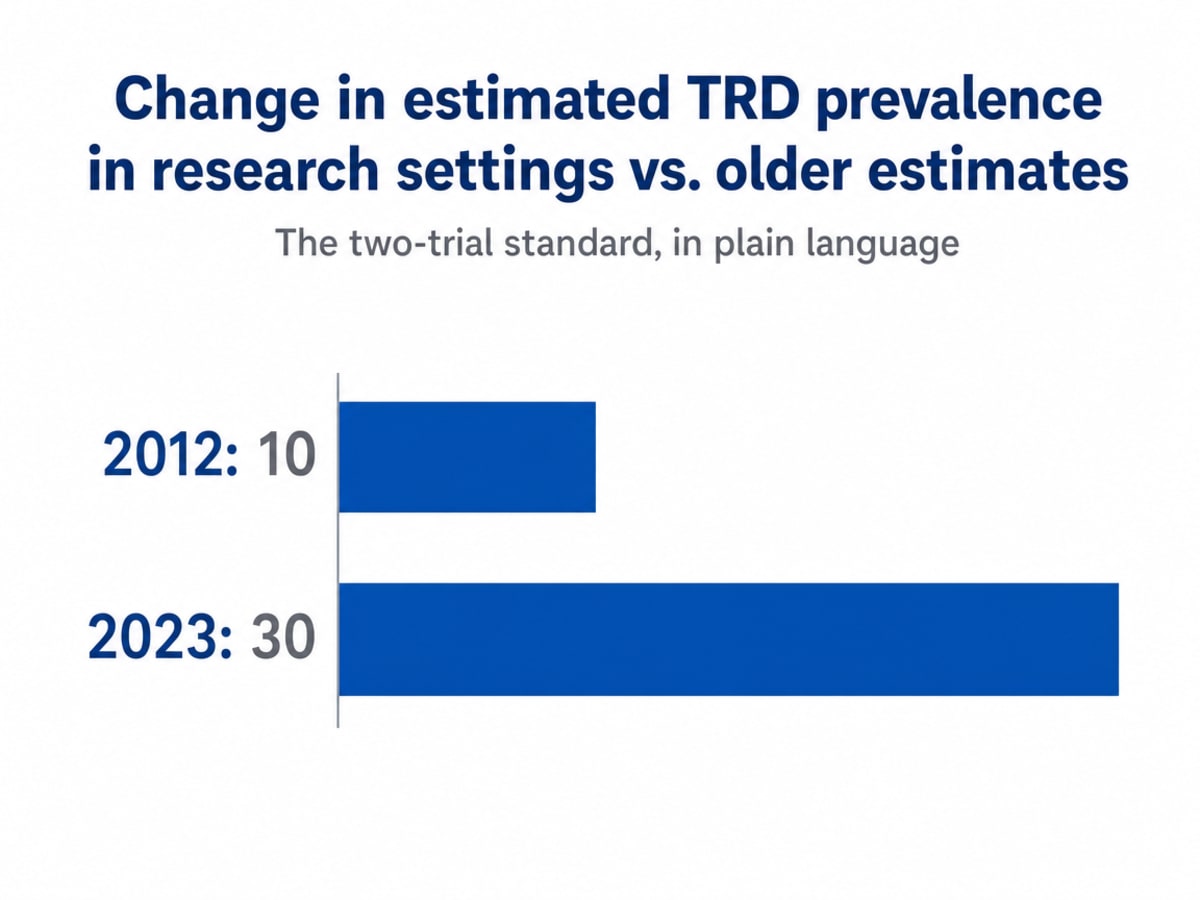
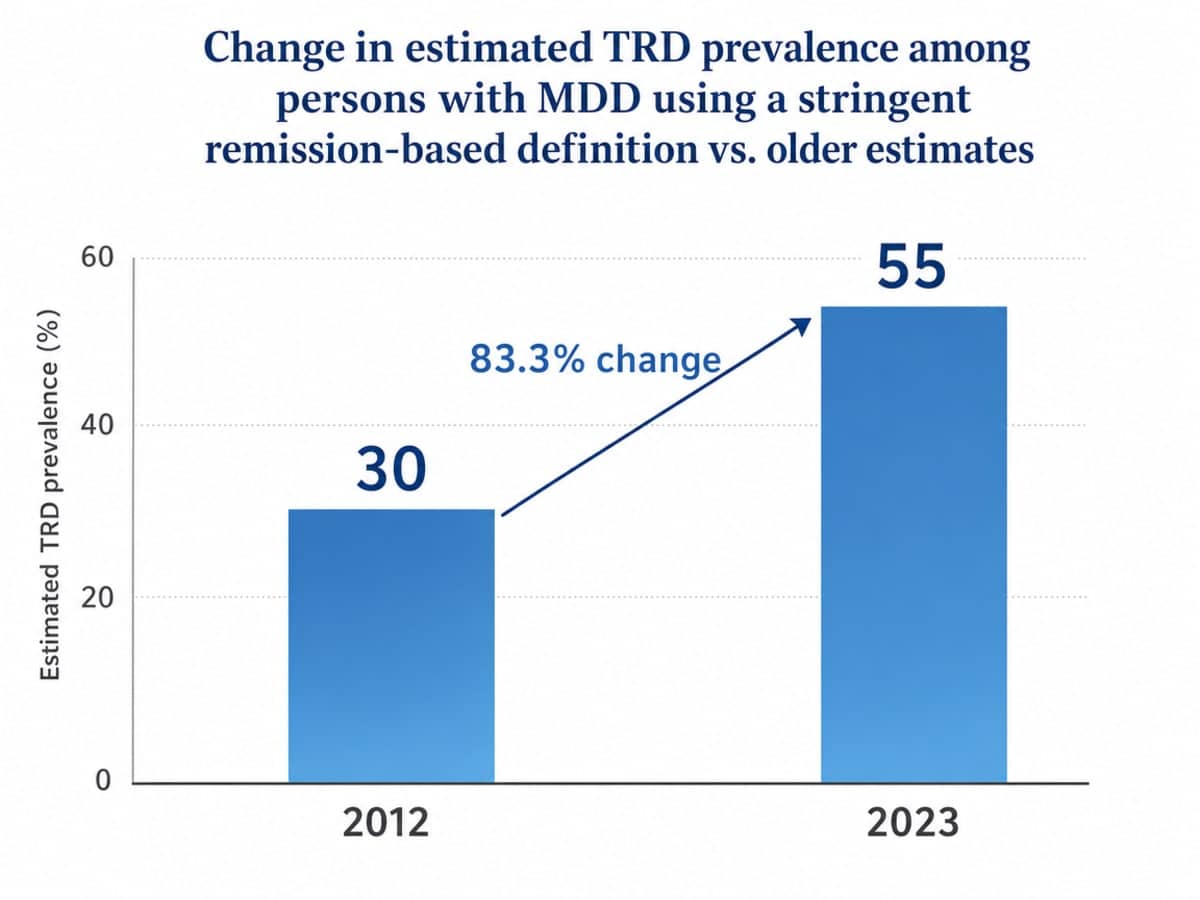
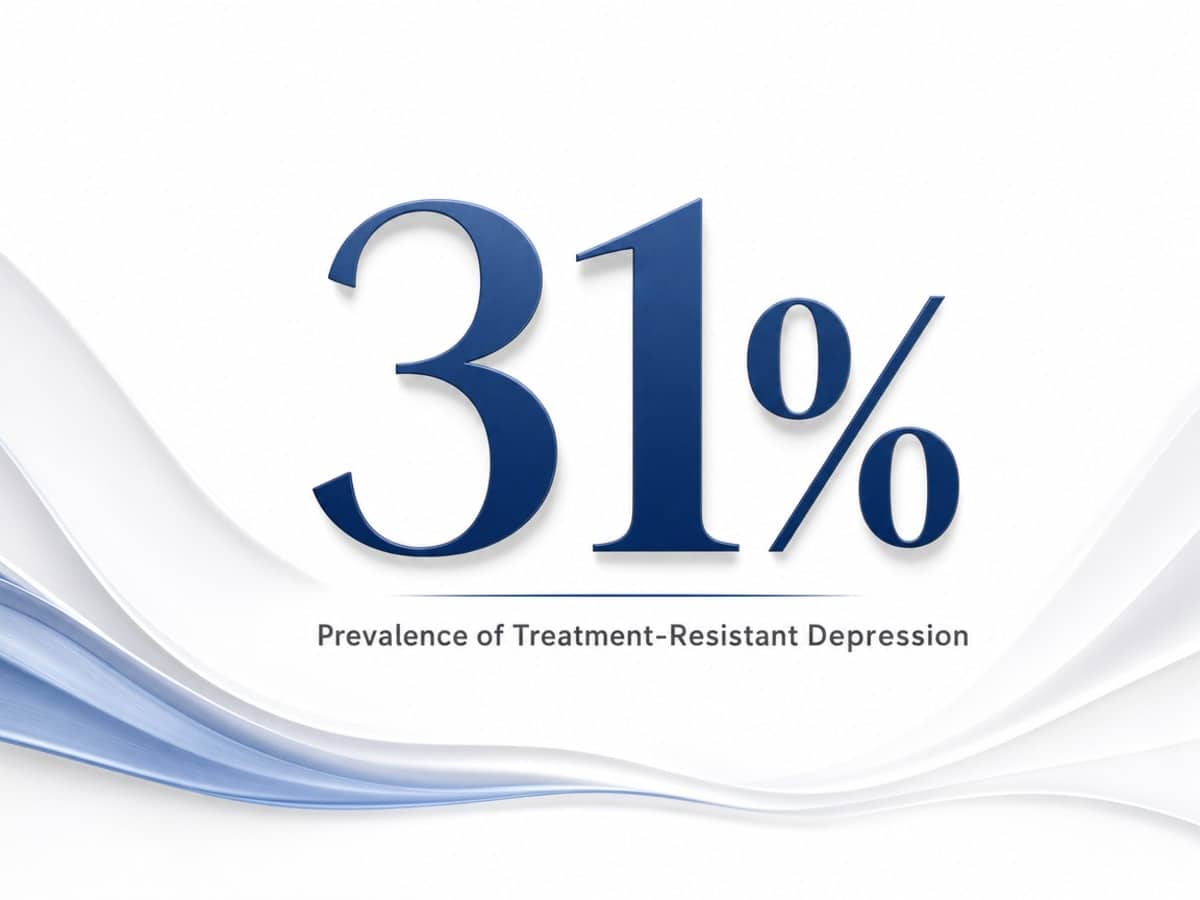
Under stringent, remission-based definitions used in recent reviews, roughly three in ten adults with major depressive disorder meet criteria for treatment-resistant depression. That estimate has shifted upward as the definitions have gotten sharper. Older figures from a decade ago put the number closer to ten percent, in part because looser definitions counted symptom improvement rather than full remission. When researchers demand actual remission, more people who thought they were “responding” turn out to still be sick.9,12,14
This matters for two reasons.
First, it changes the story you have probably been telling yourself. You are not the rare patient who mysteriously does not respond to anything. You are in a defined clinical category that psychiatry has been studying, arguing about, and building programs for.
Second, it changes what you should expect from care. When roughly a third of people with major depression will end up here, a mental health system that only knows how to prescribe first-line SSRIs and refer for weekly talk therapy is going to run out of runway for a lot of people. Reaching that point is not proof that something is wrong with you. It is the moment the standard playbook was designed to hand off.
Why standard care missed the mark
Missed comorbidities: substance use, trauma, bipolarity
Sometimes depression is not the whole story. It is the loudest symptom on top of something else that was never named.
Three patterns come up over and over in TRD evaluations. The first is substance use, including alcohol and cannabis at levels most people would not call a problem. The second is unprocessed trauma, which can look like depression on a screening form but responds to trauma-focused therapy in a way that no SSRI ever will. The third is bipolar spectrum illness, where the depressive episodes are real but the underlying pattern is closer to bipolar II than unipolar depression. Antidepressants alone, without a mood stabilizer, can quietly make that presentation worse.
Contemporary reviews of TRD stress this exact point: before labeling depression resistant, clinicians should reappraise the diagnosis and screen carefully for co-occurring conditions and adherence issues. A twenty-minute med-check appointment rarely leaves room for that kind of reappraisal. If nobody has ever taken a careful trauma history, asked in detail about your drinking, or explored whether you have had periods of unusual energy or irritability, one of those may be the reason the medications have not landed.7,16
Under-dosed and too-brief trials
Look back at your medication list with a critical eye. How many of those trials actually cleared the bar?
None of that is anyone’s fault. Fifteen-minute appointments and long gaps between them are not built for the patient guidance a real titration requires. But the downstream effect matters: what looks like five failed medications on your chart may be two truly adequate trials and three that never got a fair test. That distinction changes what a specialty team will do next. It also explains why simply adding a sixth medication in the same outpatient rhythm is unlikely to break the pattern.7
No measurement, no course correction
Here is a question worth sitting with: in the last two years of treatment, how often has anyone actually measured your depression?
Not asked “how are you feeling today” at the start of a visit. Measured. A PHQ-9 or comparable scale, scored, tracked over time, and used to decide whether to hold course or change something. If the answer is rarely or never, that is not a small oversight. It is the reason course correction did not happen.
Measurement-based care has a solid evidence base, and PHQ-9 tracking specifically is linked to better monitoring and better outcomes when it is actually used. When practices upgrade from ad hoc check-ins to structured, technology-enabled measurement, patients show larger short-term reductions in symptom scores than those tracked with less rigorous methods. Without measurement, treatment decisions drift on gut feel and the shape of the last conversation.2,3
For someone whose depression has not improved, this is often the invisible failure. Not a wrong medication, not a bad therapist, but a system that never generated the data needed to notice when a plan was quietly not working. A serious TRD program treats measurement as a floor, not a feature.
Where you are on the care ladder
Mental health care is not one thing. It is a ladder, and knowing which rung you are actually on changes what your next move should look like. Most people whose depression has not responded to standard care are still being treated at the same rung that stopped working, because nobody drew the ladder for them.
Guidelines describe this as a stepped care model, where treatment intensity scales up in response to prior response, severity, and urgency. Here is what the rungs actually look like in practice.1,17
- Standard outpatient care is what most people start with: a prescriber visit every few weeks, weekly or biweekly therapy, and a few hours of contact per month. This is where the first two medication trials happen, and where most depression is successfully treated. It is also where TRD tends to stall, because the structure is not built for the reappraisal and titration a resistant case needs.
- Intensive outpatient (IOP) under ASAM-style criteria means at least three days per week, adding up to 9 to 19 hours of programming weekly, while you still live at home. IOP adds group therapy, more frequent contact with clinicians, and closer monitoring without pulling you out of your life entirely.
- Partial hospitalization (PHP) steps up to 20 or more hours per week, at least three days per week, with medical and psychiatric services directly integrated into the program. Think of PHP as hospital-level structure during the day, home at night.
- Residential and specialty TRD programs sit at the top of the ladder. You live on-site, psychiatry is available around the clock, and the schedule is dense enough to run a full re-evaluation, careful medication changes, and integrated treatment of co-occurring conditions in a compressed window. This is the rung built for cases that have already exhausted the ones below it.
What a real TRD program does differently
A full re-evaluation before another prescription
The first thing a serious TRD program does is refuse to write the next prescription until someone has actually looked at you again.
That sounds obvious. It is not what usually happens. Most escalations in standard care go straight to the medication list: add bupropion, try an SNRI, augment with something new. A specialty program starts one step back. Before anything changes, the team reopens the diagnosis itself. Is this unipolar depression, or has a bipolar pattern been quietly missed? Is there a substance use pattern that has been shaping every trial so far? Is there trauma that no antidepressant is designed to touch? Are there medical contributors, sleep disorders, or thyroid issues that never got a full workup?7,16
This kind of reappraisal takes time. It means longer intake sessions, collateral history from family when you can consent to it, and a careful walk through your actual medication history to sort adequate trials from ones that never got a fair test. In a standard outpatient rhythm, there is no room for that work. In a program built for TRD, it is the first week, not an optional add-on. What comes out the other side is often a different clinical picture than the one you walked in with, and a plan that finally matches it.
Algorithm-based medication sequencing, led by a psychiatrist
Once the diagnosis has been re-examined, the medication conversation changes shape. It stops being “what should we try next” and starts being “where are we in a sequence, and what is the next evidence-based step given what has actually been tried.”
Structured algorithms exist for exactly this reason. Their whole point is prescriptive sequencing when patients have not responded to initial antidepressants, and their directness is what makes them useful in TRD. That means concrete moves rather than open-ended experimentation: optimizing the current medication to a full therapeutic dose and duration first, then switching to a mechanistically different class, then augmenting with agents that have real evidence behind them.4
The augmentation options are not exotic. Lithium and T3 have the deepest research base, and several atypical antipsychotics have solid evidence as add-ons to SSRIs in TR. Each one carries its own monitoring requirements — lithium levels, metabolic labs, thyroid checks — which is a big part of why board-certified psychiatry needs to run the plan, not a rotating cast of prescribers.5,6
A program with real psychiatric depth also knows the limits of algorithms. Rigid protocols can miss individual variability, so the sequence gets tailored to your history rather than run like a flowchart. The structure is there to make sure nothing effective gets skipped. The judgment is there to make sure the plan actually fits you.4
Integrated treatment for co-occurring conditions
Depression rarely shows up alone in cases that have not responded to standard care. Substance use, trauma histories, and other psychiatric conditions travel with it, and treating any one of them in isolation is a common reason cycles of care stall out.
In fragmented systems, this becomes a scheduling problem. You see one clinician for depression, someone else for substance use, and a third person for trauma, if trauma comes up at all. The plans do not talk to each other. The medications sometimes work against each other. When your drinking gets worse, the depression plan does not adjust; when the depression deepens, nobody flags the increased relapse risk on the substance use side.
An integrated program treats these threads as one clinical picture. The psychiatrist managing your medication is in the same case conference as the therapist doing trauma work and the clinician handling substance use. Decisions get made together, in the same week, with the same information. This is the model contemporary reviews of TRD point toward when they describe addressing medical and psychiatric comorbidities alongside the depression itself. For ViewPoint Dual Recovery, that integration is the core of what the program is designed to do.13
Somatic options: ketamine, esketamine, ECT, TMS
You have probably read about ketamine, esketamine, ECT, and TMS. A good TRD program should be able to talk about them with you clearly, whether or not those treatments happen under the same roof.
The evidence base is real. Intravenous ketamine and intranasal esketamine can produce rapid symptom reduction in TRD, sometimes within a day or two, and trials define nonresponse using specific stopping rules — typically after four to six infusions or about four weeks of treatment. ECT remains one of the most effective options for severe or treatment-resistant depression, and rTMS has established evidence in the TRD landscape as well. Each comes with its own risk profile, durability questions, and maintenance considerations.8,13
What matters at the program level is honest coordination. A psychiatrist should be able to tell you whether one of these is a reasonable next step for your specific presentation, what the criteria for trying it would be, and how it would be sequenced with the medication and therapy plan already in motion. Programs that quietly avoid the conversation, or promise every intervention as an in-house menu regardless of fit, are worth looking at more carefully.
Five questions to ask any program you’re considering
Program brochures blur together. The language is similar, the stock photography is similar, and everyone claims to specialize in complex cases. Here are five questions that separate a program actually built for treatment-resistant depression from one that has adopted the label.
- 1. How long is your initial assessment, and what does it include? A real re-evaluation is not a ninety-minute intake. Ask whether the team reopens the diagnosis, screens for bipolarity, trauma, and substance use, and reviews your prior medication history trial by trial to sort adequate ones from incomplete ones. If the answer sounds identical to what you got in outpatient, the program is unlikely to produce a different result.7
- 2. Who is running my medication plan, and how often will I see them? Ask for specifics. Is a board-certified psychiatrist directly managing changes, or is a nurse practitioner checking in with a supervising physician once a week? Algorithm-based sequencing for TRD, including augmentation with agents like lithium, T3, or atypical antipsychotics, needs psychiatric depth and close monitoring, not a rotating prescriber.4,6
- 3. How do you measure whether treatment is working? The right answer includes a structured tool like the PHQ-9, scored at regular intervals, with decisions tied to the trend. Programs that use measurement-based care see better monitoring and better outcomes than those relying on conversational check-ins. If nobody can describe how progress gets tracked, that is the answer.2,3
- 4. How do you handle co-occurring substance use, trauma, or other psychiatric conditions? Ask whether the psychiatrist, therapist, and any substance use clinician sit in the same case conference and adjust the plan together. Fragmented care is a common reason TRD cases stall.13
- 5. If ketamine, esketamine, ECT, or TMS becomes a reasonable next step, what happens? A credible program can tell you which options fit your presentation, what stopping rules apply, and how a referral or coordination would work if the treatment is not offered on-site.8
Where ViewPoint Dual Recovery fits
ViewPoint Dual Recovery, in Prescott, Arizona, is built for the case profile this article has been describing: adults whose depression has not remitted after adequate outpatient care, often with substance use, trauma, or complex psychiatric conditions layered underneath. The facility is Joint Commission-accredited, licensed by Arizona ADHS, and LegitScript certified, with board-certified psychiatry available around the clock.
What the program is designed to do maps directly to the failure modes covered earlier. Extended assessment reopens the diagnosis before anything is prescribed, so bipolarity, trauma, substance use, and adherence issues get named rather than assumed. Medication planning is psychiatry-led and algorithm-informed, which matters when augmentation with agents like lithium, T3, or atypical antipsychotics is on the table and needs close monitoring. Length of stay is set by clinical need, not an insurance clock. Psychiatrists and therapists work the same case together, so co-occurring conditions are treated in one plan rather than three parallel ones.4,6.7,13
If your depression has held through two or more adequate trials and standard outpatient has stopped moving the needle, that is the conversation ViewPoint’s admissions team is set up to have. A call is not a commitment. It is a clearer read on whether this level of care fits what you are actually carrying.
Find Out If Advanced Care Is Right For You
Connect with clinical experts to clarify if specialized treatment-resistant depression care matches your needs.
Frequently Asked Questions
What officially qualifies as treatment-resistant depression?
The FDA and European Medicines Agency use the same threshold: inadequate response to at least two antidepressants from mechanistically different classes, each taken at an adequate dose, for an adequate duration, with confirmed adherence. Two SSRIs in a row do not count as two mechanistically different trials, and a subtherapeutic dose or a four-week attempt does not clear the bar.9,14
How long should an antidepressant trial last before it’s considered a failure?
The general clinical standard is at least six weeks at a therapeutic dose, with adherence. Some sources argue for longer windows before declaring nonresponse, but six weeks is the floor most definitions rely on. If you stopped earlier because of side effects or discouragement, that trial technically does not qualify as a failed one under the standard criteria.9,12
When should I move from outpatient care to a residential or specialty TRD program?
Stepped care guidelines call for escalating intensity when prior response has been inadequate and severity or urgency warrants it. If two adequate antidepressant trials have not produced remission, and standard outpatient contact of a few hours a month is not generating the reassessment and monitoring your case needs, that is the clinical trigger to consider IOP, PHP, or a residential specialty program.1,7,17
What separates a real TRD program from a standard depression treatment center?
Three things done together. A full reappraisal of diagnosis, adherence, and comorbidities before any new prescription. Algorithm-based medication sequencing led by a psychiatrist, including evidence-based augmentation options like lithium, T3, or atypical antipsychotics. And measurement-based care, with a tool like the PHQ-9 scored at regular intervals to guide decisions. Programs missing any of the three tend to repeat the pattern that already stalled.2,4,6,7,16
Does a TRD program have to offer ketamine, ECT, or TMS on-site?
Not necessarily. What matters is that the psychiatrist can evaluate whether one of these is a reasonable next step for your presentation, explain the criteria and stopping rules (for example, nonresponse to ketamine or esketamine is often defined after four to six infusions or about four weeks), and coordinate a referral if the treatment is not offered in-house. Honest coordination beats an all-in-house menu that ignores fit.8
What if my depression is tangled up with substance use or trauma?
That combination is one of the most common reasons standard care stalls, and it is exactly what integrated programs are built for. Contemporary TRD reviews emphasize treating co-occurring psychiatric and substance use conditions as part of one clinical plan, not as parallel referrals. A program where the psychiatrist, therapist, and substance use clinician share the same case conference is the setting where that integration actually happens.13
References
- Care pathways for people with major depressive disorder. https://pmc.ncbi.nlm.nih.gov/articles/PMC9280921/
- Use of PHQ-9 for monitoring patients with depression in primary care. https://pubmed.ncbi.nlm.nih.gov/36693193/
- Comparison of the Efficacy Between Standard Measurement Based Care and Enhanced Measurement Based Care for Patients with Depression. https://pmc.ncbi.nlm.nih.gov/articles/PMC11296504/
- Using treatment algorithms for the effective management of treatment-resistant depression. https://pubmed.ncbi.nlm.nih.gov/11575732/
- Combating Treatment Resistant Depression (TRD) in Veterans. https://www.pbm.va.gov/PBM/AcademicDetailingService/Documents/508/IB10-1405TreatmentResistantDepression_508Ready.pdf
- Augmentation strategies for treatment-resistant depression. https://pubmed.ncbi.nlm.nih.gov/19122528/
- Evaluation, Treatment, and Referral of Treatment-Resistant Depression. https://pmc.ncbi.nlm.nih.gov/articles/PMC10557564/
- Synthesizing the Evidence for Ketamine and Esketamine in Treatment-Resistant Depression. https://pmc.ncbi.nlm.nih.gov/articles/PMC9635017/
- Treatment-resistant depression: definition, prevalence, detection and treatment. https://pmc.ncbi.nlm.nih.gov/articles/PMC10564558/
- The STAR*D Project results: a comprehensive review of findings. https://pubmed.ncbi.nlm.nih.gov/18221624/
- Questions and Answers about the NIMH Sequenced Treatment Alternatives to Relieve Depression (STAR*D) Study. https://www.nimh.nih.gov/funding/clinical-research/practical/stard/backgroundstudy
- Treatment-resistant depression: therapeutic trends, challenges, and future directions. https://pmc.ncbi.nlm.nih.gov/articles/PMC3363299/
- Management of Treatment-Resistant Depression: Challenges and Strategies. https://pmc.ncbi.nlm.nih.gov/articles/PMC6982454/
- Treatment‐resistant depression: definition, prevalence, detection and treatment. https://pmc.ncbi.nlm.nih.gov/articles/PMC10503923/
- Definitions Of Treatment-Resistant Depression And Treatment-Resistant Major Depressive Disorder (TRD, TR-MDD). https://ncbi.nlm.nih.gov/books/NBK526364/table/table6/
- Treatment of Resistant Depression. https://depts.washington.edu/nwaetc/presentations/uploads/230/treatment_of_resistant_depression.pdf
- 2.1: Intensive Outpatient Services & 2.5: Partial Hospitalization. https://www.pa.gov/content/dam/copapwp-pagov/en/ddap/documents/professionals/documents/asam-page/asam-archive/level%202.0%20iop%20php%20slides.pdf_august2021.pdf
- Table 2. Summary of clinical practice guidelines for depression. https://pmc.ncbi.nlm.nih.gov/articles/PMC8841913/table/table2-20451253211067656/
- Summary of the clinical practice guideline for the treatment of depression across three age cohorts. https://pubmed.ncbi.nlm.nih.gov/34843274/
