Key Takeaways
- Refusal is often a symptom, not defiance — conditions like anosognosia, mania, and psychosis impair the brain’s ability to recognize illness, so persuasion alone rarely works 5, 6.
- You cannot force an adult into treatment, but you can document behavior, learn your state’s criteria, and use tools like assisted outpatient treatment to break the discharge-relapse loop 1, 7.
- A psychiatric advance directive drafted during a calm stretch lets your loved one direct their own care during future crises, covering medications, settings, and coercion preferences 9, 10.
- AOT quality varies sharply by county and the evidence base remains limited, so ask your local behavioral health authority how it actually operates before building your plan around it 8.
The Loneliest Room in the House
You already know the exact look on their face. The one that says I’m fine, leave me alone, even as the dishes stack up, the pills go untaken, and the phone calls from work stop coming. You’ve tried the calm voice. You’ve tried the direct voice. You’ve tried leaving the pamphlet on the counter where they’d have to see it. Nothing.
Watching someone you love refuse the help that would give them their life back is one of the loneliest experiences there is. It is also one of the most misunderstood. Friends tell you to give them space. Family tells you to push harder. A neighbor mentions a cousin who got “tough love” and turned it around. None of it fits your situation, and all of it makes you feel like you’re failing.
You are not failing. You are running into the wall that every family in this position runs into: in the United States, you generally cannot force an adult into psychiatric treatment just because they need it. That single fact is where most families stop reading and start grieving.
Don’t stop reading. “You can’t force them” is not the same sentence as “you can’t do anything.” The rest of this guide is about the space between those two sentences, and how to work inside it.
Why ‘They Just Won’t Listen’ Is Often Something Else
Anosognosia: When the Brain Can’t See the Illness
There is a word for what you may be running into, and it is not stubbornness. It is anosognosia — a brain-based inability to recognize one’s own illness. Say it out loud once: an-oh-sog-NOH-zha. It is a symptom, not a personality trait, and it shows up often in schizophrenia and other serious mental illnesses. Many people with schizophrenia genuinely do not realize that what they are experiencing is part of an illness at all 5.
This changes what the refusal actually means. When your loved one says nothing is wrong with me, you’re the problem, they may not be lying to you or pushing you away on purpose. Their brain — the very organ that would need to notice the illness — is the organ that is sick. Asking them to see it clearly can be a little like asking someone with a broken leg to walk it off. The instruction assumes a working part they do not have right now.
You are allowed to let this reframe settle in. It does not fix anything tonight. But it can lift a specific weight off your chest: the weight of thinking you failed to explain it well enough, or that if you just found the right words, they would agree. The right words were never going to be enough on their own.
Mania, Psychosis, and the Judgment Problem
Refusal can also come from an episode, not a fixed belief. During a manic episode of bipolar disorder, a person may feel very “up,” elated, or energized, take on risky plans, and not recognize that anything is off — that’s part of the mania itself 6. In psychosis, the internal logic feels airtight from the inside. Voices are real voices. The pattern in the wallpaper means something.
Judgment is not a steady dial. It rises and falls with the episode. The person who calmly told you last month that they’d go back to their psychiatrist is not the same person standing in the kitchen tonight refusing to get in the car. Both are your loved one. Only one is currently able to weigh the choice the way a well brain weighs a choice.
Knowing this does not mean you excuse every behavior or stop setting limits. It means you stop taking the refusal as the final answer from the whole person. It is one answer, from one state, on one day. That distinction is what lets you keep planning instead of collapsing into well, they said no, so that’s that.
What You Cannot Do, and What You Actually Can
Here is the hard line, and then the door in the wall. In the United States, you cannot walk your adult loved one into a hospital and sign them in because you know they need to be there. You cannot cancel their apartment lease, seize their car keys as a legal matter, or authorize medication on their behalf. An adult’s right to refuse care is real, and it holds even when the refusal is clearly making them worse. Involuntary treatment exists, but it is narrow by design — generally reserved for people with severe mental illness who pose a significant risk of harm and for whom no less restrictive option will do 7.
Now the door. You can do each of the following:
- Learn your state’s exact criteria before you need them, so you are not googling them at 2 a.m.
- Write down what you see, dated and specific, so any hospital, judge, or admissions clinician has real information instead of a panicked summary.
- Look into assisted outpatient treatment in your county.
- Help draft a psychiatric advance directive during a calm stretch.
- Call a specialized admissions team and ask questions with no one being admitted that day.
Each of these is a small, unglamorous act. Together, they are what “doing something” actually looks like.
The Three Legal Realities Families Confuse
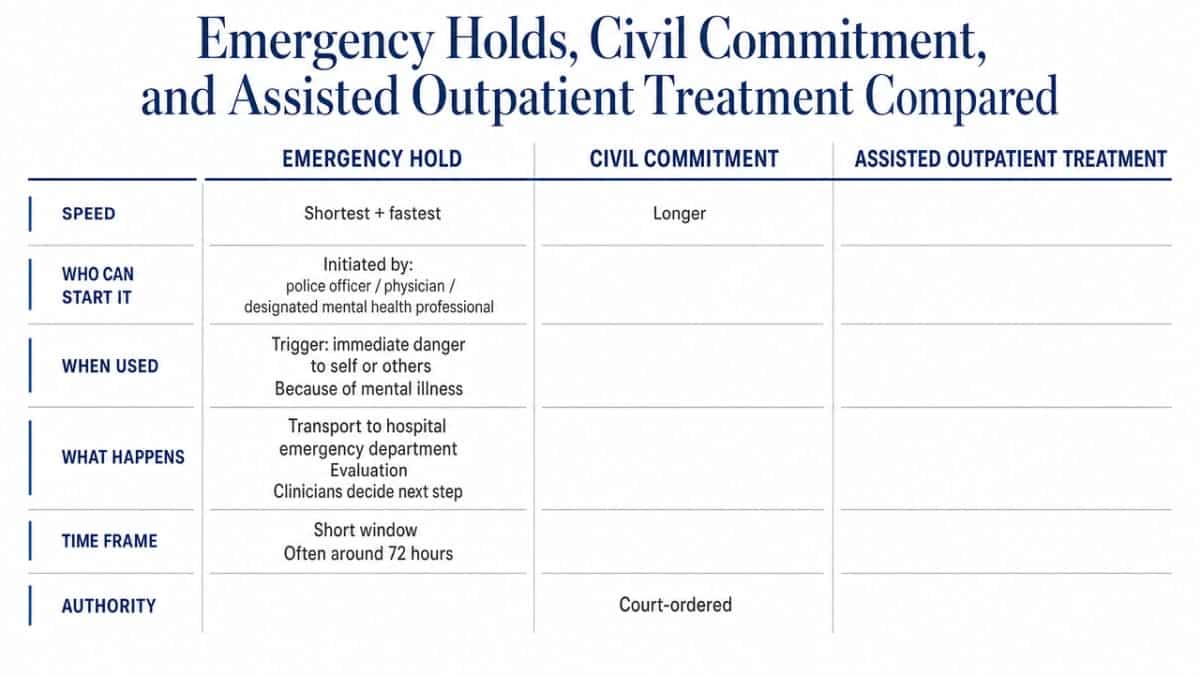
Emergency Holds, Civil Commitment, and Assisted Outpatient Treatment Compared
Most families use these three terms interchangeably at 2 a.m. and then discover, in the worst possible moment, that they mean very different things. Sorting them out now — while nothing is on fire — is one of the most useful hours you can spend.
An emergency hold (sometimes called a 72-hour hold, a psych hold, or by a state-specific name) is the shortest and fastest of the three. A police officer, a physician, or in some states a designated mental health professional can initiate it when someone appears to be in immediate danger to themselves or others because of a mental illness. The person is transported, usually to a hospital emergency department, and evaluated. It buys a short window — often around 72 hours — for clinicians to decide what happens next.
Civil commitment is the longer, court-ordered version. It requires a judge, a hearing, and a higher standard of proof. The criteria are narrow on purpose: the person must have a severe mental illness, be at significant risk of harming themselves or others, and have no less restrictive option that would work 7. Even when a judge orders commitment, the person keeps rights — to informed consent where practical, to the least restrictive setting, and to appeal 7. Length varies by state, from days to months.
Assisted outpatient treatment (AOT) is the one families most often haven’t heard of, and it may be the one that fits your situation best. AOT is a civil court order for mental health treatment — a tool, not a specific type of mental health treatment — that requires someone to participate in outpatient care while they continue living in the community 1. It is not hospitalization. It is a judge saying: you will show up to your appointments and take your medication, or we will revisit this.
The chart below lays out who initiates each pathway, how long it typically lasts, and what setting it happens in. Read it once now. You’ll be glad you did.
Assisted Outpatient Treatment in Practice
Here is what AOT actually looks like from the kitchen table. Your loved one has been hospitalized more than once. Each time, they stabilize, get discharged, stop the medication within a few weeks, and slide back into crisis. You can see the pattern. They cannot. The AOT process is designed for exactly this loop.
In states that authorize it, a family member — you — can file a petition with the probate or civil court asking a judge to order outpatient treatment. The family guide from Wayne State walks through the practical steps: obtaining the petition forms, gathering documentation of the pattern (stopped medication, behavioral changes, prior hospitalizations), and filing with the court 1. If a judge grants the order, your loved one is required to participate in a treatment plan while living at home or in a community setting.
AOT is not a magic wand. It is a lever. In the right county, with the right team, it can break the discharge-relapse loop that has been eating your family alive.
Guardianship: A Narrow, Serious Option
Guardianship comes up in conversations with exhausted families more often than it should. It is a legal arrangement in which a court transfers decision-making authority — over medical care, finances, or both — from your loved one to you or another named guardian. It is not a shortcut. It is a significant removal of adult rights, and courts treat it that way.
Judges generally reserve guardianship for cases of clear, ongoing incapacity — think advanced dementia, severe intellectual disability, or a persistent inability to make basic self-care decisions. Serious mental illness alone, especially when the person has periods of clarity, usually does not clear that bar. Pursuing guardianship also requires an attorney, medical evaluations, and a court process that can take months.
If someone has suggested guardianship as your next step, get a consultation with an elder law or mental health attorney before you commit to that road. For most families reading this, an AOT petition or a psychiatric advance directive will get you closer to the actual goal — safer, more consistent care — without dismantling your loved one’s legal personhood.
Psychiatric Advance Directives: The Tool Most Families Miss
What a PAD Actually Contains
A psychiatric advance directive (PAD) is a legal document your loved one writes while they are well, describing what they want to happen if a future crisis makes them unable to decide for themselves. Think of it as a set of instructions from the calm version of the person to the treatment team who will meet the unwell version. Most states recognize some form of PAD, though the exact legal weight varies.
Families often hear “advance directive” and picture end-of-life paperwork. A PAD is different. It is about psychiatric episodes — hospitalization, medication, who can be contacted, what has worked and what has caused harm.
A systematic review that screened 4,047 articles and included 42 found that PADs consistently cover six recurring themes 9:
- Early crisis signs the person and their team should watch for
- Preferred treatment approaches
- Preferred setting for care
- Feelings about coercive interventions like restraints or seclusion
- Social instructions such as who takes care of the pets or handles the rent
- Specific consents or refusals for particular medications and procedures
Reading that list, you may notice something quiet and important: this document lets your loved one keep authorship of their own care, even during the parts they will not remember well.
How Families Help Draft One (Before the Next Crisis)
The best time to write a PAD is a boring Tuesday. Not the week after a hospitalization, when everyone is raw. Not during a symptom-free stretch that feels so good no one wants to break the spell by talking about the next episode. Somewhere in between — a calm week when your loved one has capacity and is willing to sit with the topic for an hour.
Your role is not to write it for them. It is to make writing it possible. Service users say they are genuinely interested in PADs and prefer documents that are legally binding and revocable only when they are well — and the single biggest factor in whether a PAD gets completed is having support during the drafting process 10. That support is often you.
Bring the raw material to the table: the medications that helped, the ones that caused side effects your loved one hated, the hospital where they felt respected, the one they never want to return to, the name of a sibling who should be called first. Ask, don’t dictate.
Evidence on PAD outcomes is still early — one study found reduced involuntary hospitalization, but longer-term data is thin 11. Even so, writing one is progress. Every completed section is one less decision the emergency room has to make in the dark.
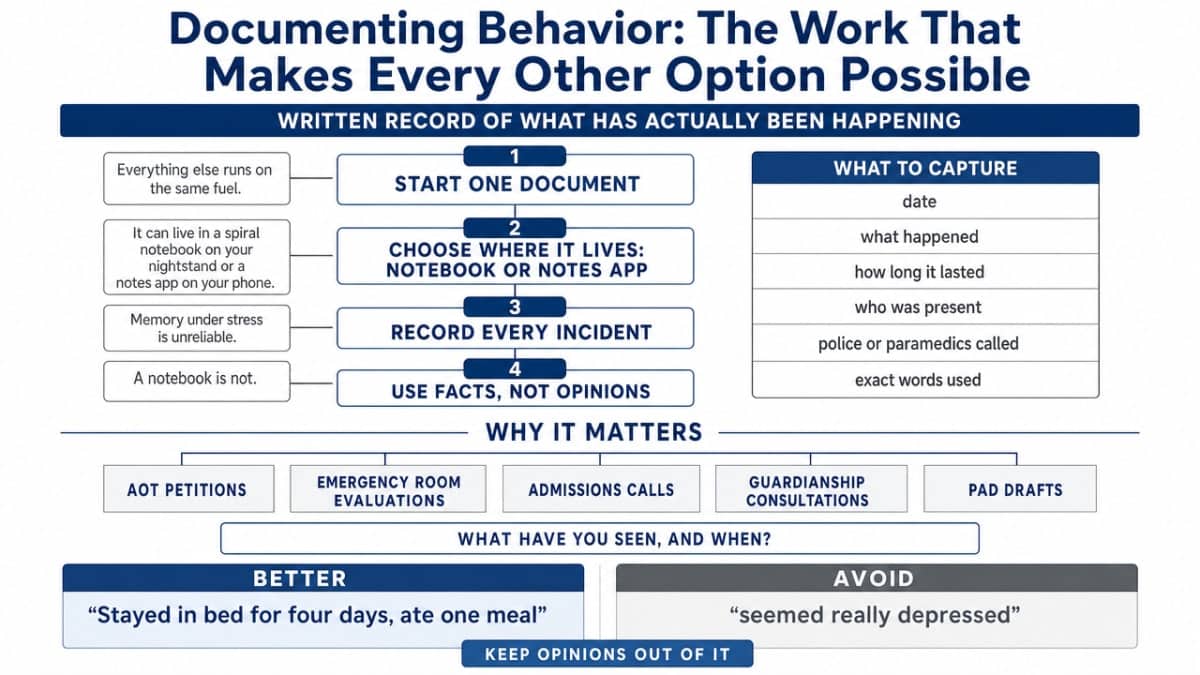
Documenting Behavior: The Work That Makes Every Other Option Possible
Everything else in this guide runs on the same fuel: a written record of what has actually been happening. AOT petitions, emergency room evaluations, admissions calls, guardianship consultations, and PAD drafts all ask you some version of the same question — what have you seen, and when? Memory under stress is unreliable. A notebook is not.
Start a single document. It can live in a spiral notebook on your nightstand or a notes app on your phone. Every incident gets a date, a short factual description of what happened, and any concrete detail that matters — how long it lasted, who else was present, whether police or paramedics were called, what your loved one said in their own words. Keep opinions out of it. “Stayed in bed for four days, ate one meal” is more useful to a clinician than “seemed really depressed.”
Alongside the incident log, pull together the practical file you will need the moment you call anyone. The Wayne State family guide to AOT walks through exactly this kind of preparation for petition filings — documenting stopped medications, behavioral changes, and prior hospitalizations so a judge has real information to work with 1. The same file works for a hospital intake nurse or a specialized admissions team.
The checklist below is what to have ready before you dial. Print it. Fill it in on a calm afternoon. You are not being dramatic by preparing this. You are being useful.
Who to Call Tonight, and Who to Call Next Week
Immediate Danger: 911, 988, and What to Say
If your loved one is threatening to hurt themselves or someone else right now, or is in a state where you honestly don’t know what they will do in the next hour, this is the moment for a phone call, not a plan.
Call 911 if there is immediate physical danger — a weapon, a suicide attempt in progress, violence in the room. When the dispatcher answers, say the words mental health crisis in the first sentence. Many areas can dispatch a crisis-trained responder or a co-response team when they know that’s what they’re walking into. Give the address, describe what your loved one is doing right now, mention any weapons in the home, and say whether they have a psychiatric diagnosis.
Call or text 988, the Suicide and Crisis Lifeline, when the danger is serious but not physically imminent — a person talking about suicide, spiraling, refusing to stay safe. A counselor will stay on the line with you. You do not have to be the person in crisis to call.
Making the call is progress. You are not overreacting.
Not an Emergency, But Not Okay: SAMHSA and Specialized Admissions Lines
Most nights are not the 911 night. Most nights are the ones where your loved one is clearly unwell — not eating, not sleeping, not answering the door — but nobody is bleeding and nobody is going to a hospital tonight. This is where families feel the loneliest, because the crisis is slow and there is no obvious number to dial.
There is one. SAMHSA’s National Helpline, 1-800-662-HELP (4357), is a free, confidential, 24/7, 365-day-a-year treatment referral and information service for individuals and families facing mental and substance use disorders 3. They do not provide counseling. They will connect you to local treatment options, state-funded resources, and support services in your area. You can call at midnight. You can call in Spanish. You do not have to give your name.
The other number worth having in your phone before you need it is the admissions line of a specialized program that handles complex cases. ViewPoint’s admissions team, for example, takes calls from families who are not ready to admit anyone — families who want to understand what treatment for a treatment-resistant loved one actually looks like, what questions to ask their current provider, and what to have prepared if the situation gets worse. A pre-crisis conversation is a real conversation, not an intake pitch. Ask what the admissions team can tell you about your specific scenario. Then hang up and go make dinner. You’ve done something useful.
When Standard Programs Have Already Failed
If you are reading this, there is a decent chance your loved one has already been somewhere. Maybe several somewheres. A 28-day program that discharged them the day the insurance ran out. A hospital that stabilized them in a week and sent them home with a prescription and a follow-up card that got lost in the car. A therapist who was kind and completely outmatched by the actual illness.
You are not starting from zero. You are starting from tired. Generic advice to “just get them into treatment” lands like an insult when treatment is exactly what has already not worked.
Treatment-resistant does not mean untreatable. It means the standard playbook — first-line medications, short stays, one-size programming — has not been enough. Cases that involve treatment-resistant schizophrenia, rapid-cycling bipolar disorder, or a serious mental illness tangled up with active substance use usually need something the last place did not offer: longer stays set by clinical need rather than a billing cycle, integrated psychiatric and substance use care under one roof, and medication strategies that go beyond the first two things anyone tries.
When you make your next call, ask specifically about that. What happens when the standard medication doesn’t work. How psychiatry and therapy actually coordinate. What determines discharge. The answers will tell you whether you’re looking at another 28-day loop or something built for the situation you’re actually in.
Taking Care of the Person Who Keeps Showing Up: You
You are the one who keeps the medication list current. Who answers the 3 a.m. phone call. Who reads articles like this at a kitchen table while everyone else in the house sleeps. You are also, quietly, a person with a body that needs sleep and a mind that needs a break from the weight of someone else’s illness.
Find one other person who knows the whole story. A friend, a sibling, a NAMI Family Support Group, a therapist of your own. Not a Facebook post. A real person who can hear the ugly parts without flinching. Isolation is what turns caregiving into collapse.
Set one small thing down this week. Skip the pharmacy run and ask a sibling to do it. Say no to a work project. Go to bed at nine. You will not save anyone by running yourself into the ground, and the long version of this — years, not weeks — needs you to still be standing.
You showed up today by reading this. That counts. Tomorrow, you get to show up again.
Get Guidance Before a Crisis Forces Action
Talk with experts to clarify your options when a loved one won’t accept help.
Frequently Asked Questions
Can I force my adult loved one into mental health treatment?
Generally, no. In the United States, involuntary treatment is narrow by design and typically requires a severe mental illness, significant risk of harm to self or others, and no less restrictive option that would work 7. What you can do is document behavior, learn your state’s criteria, look into assisted outpatient treatment, and call for guidance before the situation reaches a hospital.
What is the difference between an emergency hold, civil commitment, and assisted outpatient treatment?
An emergency hold is a short evaluation window (often around 72 hours) initiated when someone appears in immediate danger. Civil commitment is a longer, court-ordered inpatient stay requiring a judge, a hearing, and narrow criteria 7. Assisted outpatient treatment (AOT) is a civil court order for outpatient care — a tool, not a specific type of treatment — allowing the person to live in the community while required to participate 1.
Why does my loved one insist nothing is wrong when it clearly is?
It may be anosognosia, a brain-based inability to recognize one’s own illness. Many people with schizophrenia genuinely do not realize their experiences are part of a mental illness 5. In bipolar mania, judgment itself is impaired — people may feel elated or energized and not see the risk 6. The refusal is often a symptom, not stubbornness, and no amount of the right words will simply undo it.
What is a psychiatric advance directive, and how do we create one?
A psychiatric advance directive (PAD) is a legal document your loved one writes while well, describing what they want during a future crisis. A systematic review found PADs commonly cover six themes: crisis signs, treatment approach, setting, feelings about coercion, social instructions, and specific consents or refusals 9. Service users are highly interested in PADs, and having support during drafting is the single biggest factor in completion 10.
Who should I call if my loved one is refusing help right now?
If there is immediate physical danger, call 911 and say “mental health crisis” in your first sentence. If the danger is serious but not physically imminent, call or text 988, the Suicide and Crisis Lifeline. For non-emergency help finding local treatment, call SAMHSA’s National Helpline at 1-800-662-HELP — free, confidential, 24/7 treatment referral for individuals and families facing mental and substance use disorders 3.
What should I have ready before I call a hospital, hotline, or admissions team?
Have a current medication list, prior diagnoses, insurance information, emergency contacts, and a dated incident log describing what you have actually seen. If a psychiatric advance directive exists, keep a copy handy. The same file supports an AOT petition, a hospital intake, or a specialized admissions conversation — judges and clinicians need concrete documentation of behavioral changes and stopped medications to act 1.
References
- Assisted Outpatient Treatment: A Resource for Families. https://behaviorhealthjustice.wayne.edu/aot/aot-a-resource-for-families-7924.pdf
- Psychiatric Advance Directives: An Evidence Review. https://www.rand.org/pubs/research_reports/RR1339.html
- National Helpline for Mental Health, Drug, Alcohol Issues. https://www.samhsa.gov/find-help/helplines/national-helpline
- What Is Mental Health?. https://www.mentalhealth.gov/basics/what-is-mental-health
- Schizophrenia. https://www.nimh.nih.gov/health/topics/schizophrenia
- Bipolar Disorder. https://www.nimh.nih.gov/health/topics/bipolar-disorder
- Involuntary Commitment – StatPearls – NCBI Bookshelf. https://www.ncbi.nlm.nih.gov/books/NBK557377/
- Emerging Trends in Research on Assisted Outpatient Treatment in the U.S.: A Narrative Review. https://pubmed.ncbi.nlm.nih.gov/39789955/
- The Content of Psychiatric Advance Directives: A Systematic Review. https://pubmed.ncbi.nlm.nih.gov/36039553/
- Mental Health Service Users’ Perspectives on Psychiatric Advance Directives. https://pubmed.ncbi.nlm.nih.gov/36128696/
- Psychiatric Advance Directives: A Review of the Evidence. https://www.rand.org/content/dam/rand/pubs/research_reports/RRA3400/RRA3464-2/RAND_RRA3464-2.pdf