

Key Takeaways
- Joint Commission accreditation functions as an audit trail verifying medication safety, restraint review, staff credentialing, and continuous improvement cycles — the exact systems most likely to fail in treatment-resistant cases.2
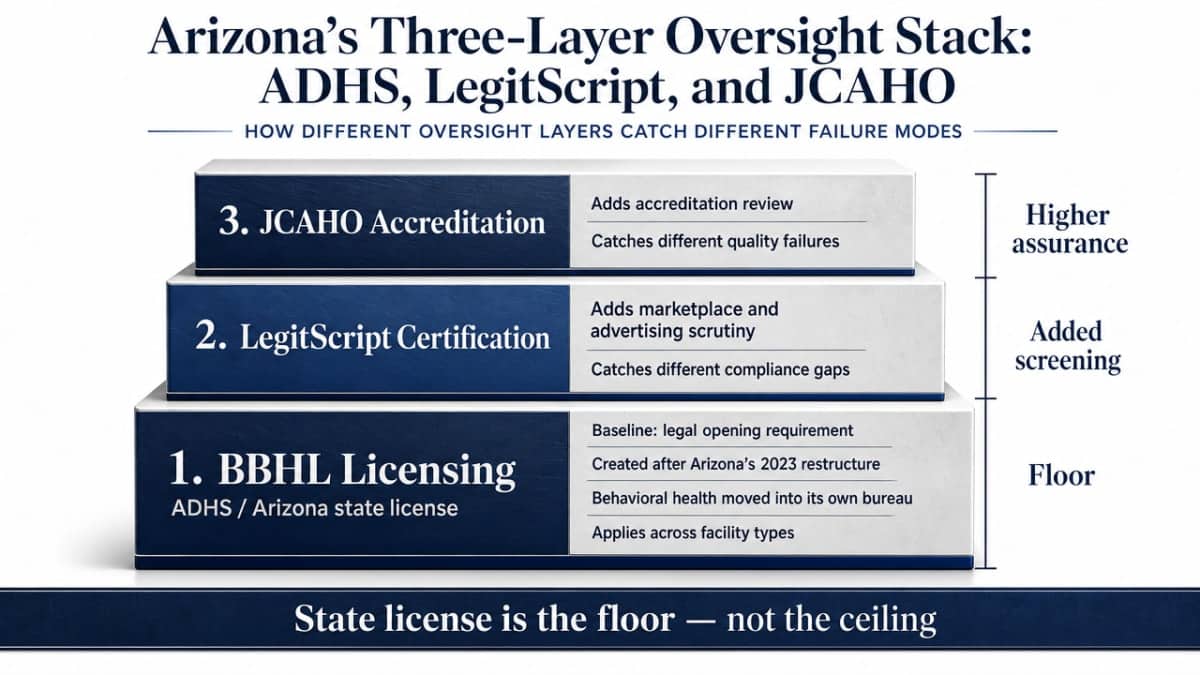
- Arizona layers three separate checks: BBHL licensing verifies legal operation post-2023 restructure, LegitScript screens marketing integrity, and JCAHO audits clinical process — each catches gaps the others miss.8
- For high-acuity conditions like clozapine management or rapid-cycling bipolar, integrated dual diagnosis care shows a measured advantage in psychiatric symptomatology, though substance use and retention outcomes match non-integrated models.1
- Verify accreditation through Joint Commission’s Quality Check and AZ Care Check, then ask facilities for specifics on restraint frequency, credentialing files, and last survey corrective actions before committing.9
What Accreditation Actually Verifies When Treatment Hasn’t Worked Before
If you’re reading this, you’ve probably already sat through an intake call, watched a loved one cycle through a program that didn’t hold, or refilled a prescription that stopped working. That’s exhausting, and the fact that you’re now looking at accreditation as a filter means you’re advocating carefully. That matters.
Here’s what to understand about the Joint Commission seal: it’s not a marketing badge. It’s an audit trail. When a psychiatric facility carries JCAHO accreditation, an outside body has reviewed how that facility actually runs — how it dispenses medications, how it responds when a patient is in crisis, how it verifies that the nurse handing your family member a pill is credentialed to do so, and how it investigates itself when something goes wrong. The standards are built to reduce medical errors, adverse events, and preventable harm — the exact failure points that get more dangerous when a case is complex.2
That distinction matters more when standard treatment hasn’t worked. Treatment-resistant schizophrenia, rapid-cycling bipolar, and co-occurring substance use disorders demand tighter medication oversight, better team coordination, and cleaner handoffs than a straightforward case does. Accreditation doesn’t guarantee a good outcome. It verifies that the systems meant to protect the patient are documented, tested, and reviewed on a schedule — not improvised.
Inside a Joint Commission Survey: The Audit Trail Behind the Gold Seal
Medication Management and National Patient Safety Goals
Medication is where accreditation earns its keep, and where a treatment-resistant case is most likely to break down. If your loved one is on a complex regimen — a mood stabilizer stacked with an atypical antipsychotic, or clozapine paired with something for co-occurring anxiety — the number of places an error can hide multiplies. Wrong dose. Missed level draw. A pharmacy that didn’t flag an interaction. A shift change where the note didn’t travel.
The Joint Commission’s National Patient Safety Goals are built around exactly these failure points. Surveyors look at how medications are ordered, stored, labeled, reconciled at admission and discharge, and double-checked at the point of administration. They inspect whether the facility’s process reduces medical errors and adverse events on a documented, ongoing basis — not once, but as a continuous review cycle. That’s the difference between a facility that says it’s careful and one that can show you the log.2
For treatment-resistant conditions, ask what happens when a psychiatrist wants to start clozapine. There should be a written protocol covering baseline labs, ANC monitoring, the REMS registry, and how the nursing team catches a missed weekly draw before it becomes a gap in therapy. Accreditation doesn’t write that protocol for the facility. It requires that the protocol exists, that staff are trained on it, and that the facility audits itself against it. When you ask about medication safety on an intake call and the person on the phone can describe the actual workflow — not just say “we’re very careful” — you’re hearing accreditation working in daily practice.
Restraint, Seclusion, and Incident Review Protocols
This is a hard part of the conversation, and it’s okay if you’ve been avoiding it. Anyone considering residential psychiatric care for a high-acuity case has to think about what happens on the worst day — the moment a patient is a danger to themselves or someone else, and the team has to intervene physically.
Accredited facilities are held to standards that treat restraint and seclusion as clinical last resorts, not routine tools. Surveyors examine whether a facility documents every episode, reviews it afterward, and uses that review to reduce future events. They look at whether staff are trained in de-escalation before hands go anywhere near a patient, whether a physician’s order is required and time-limited, and whether the patient is monitored continuously during and debriefed after.2
When you tour or interview a program, you can ask directly: How often are restraints used here in a typical month? Who reviews each incident, and what changes have come out of those reviews in the past year? A confident, accredited program will answer without defensiveness. That answer tells you more than any brochure.
Staff Credentialing and Competency Verification
The person in the room with your family member matters more than the building. Accreditation verifies that the facility knows who those people actually are.
Joint Commission standards require that a facility check credentials at hire and re-verify on a schedule — licenses current, board certifications valid, background checks documented, and clinical competencies tested for the specific work the staff member is doing. A psychiatric technician trained to run a group is not automatically qualified to monitor a patient on clozapine. Accreditation forces the facility to draw those lines and keep the paperwork proving it.2
For treatment-resistant care, ask who is actually credentialed to do what. Is there board-certified psychiatry on-site or on-call around the clock? Are the nurses trained specifically in psychiatric medication protocols, or are they generalist nurses picking it up as they go? Are therapists credentialed in the modalities the facility markets — trauma-focused work, for example — or is that a website claim without a corresponding certificate on file?
An accredited facility can pull the file. That’s the whole point. Accreditation formalizes the four surveyor categories worth remembering:2
- patient safety
- error reduction
- adverse event review
- continuous improvement
Credentialing sits inside all four.
Arizona’s Three-Layer Oversight Stack: ADHS, LegitScript, and JCAHO
The Baseline: BBHL Licensing After Arizona’s 2023 Restructure
Before any facility in Arizona can legally open its doors, it needs a license from the state. That’s the floor, not the ceiling — and it’s worth understanding what changed recently, because the landscape looks different than it did two years ago.
Arizona restructured its licensing bureaus and created the Bureau of Behavioral Health Facilities Licensing (BBHL), which now oversees residential behavioral health facilities, counseling facilities, outpatient treatment centers, sober living homes, and behavioral supported group homes. Before the restructure, this work was split across a bureau that handled residential facilities broadly. Pulling behavioral health into its own bureau was meant to bring more consistent oversight to a sector that had grown quickly and unevenly.8
What BBHL licensing actually verifies is the baseline: that the facility has a physical plant that meets code, staffing that fits the license type, defined assessment and treatment planning processes, and behavioral health services delivered under the direction of a licensed behavioral health professional. You can look up any Arizona facility through AZ Care Check and file complaints through the state system.7,9
Here’s the honest limit. A state license means a facility is legally allowed to operate and has cleared a defined set of rules. It doesn’t tell you how the medication room runs at 2 a.m., or whether the last restraint incident was reviewed and the protocol adjusted. That’s where the next two layers come in.
LegitScript: The Marketing-Integrity Layer Most Families Miss
LegitScript is the layer families most often skip past, and it catches something specific that neither state licensing nor JCAHO is built to catch: how a facility markets itself.
Addiction and mental health treatment marketing has a history of deceptive lead-generation practices — call centers that pose as neutral referral lines, patient brokering, misleading claims about outcomes, and search ads that route calls to whichever facility pays the most. LegitScript certification is what Google and Meta require before a treatment facility can run paid ads on their platforms, and the certification reviews business practices, staff licensure, and marketing claims against a documented standard.
If a facility carries LegitScript certification alongside ADHS licensing and JCAHO accreditation, you’re seeing three different failure modes covered: legal operation, honest marketing, and clinical process rigor. The absence of LegitScript isn’t automatically disqualifying, but its presence tells you the facility has been reviewed by someone whose job is to spot marketing you can’t trust.
Where JCAHO Sits on Top — and What It Catches That Licensing Doesn’t
Think of accreditation as the layer that looks inside the daily work. State licensing asks whether the facility is allowed to operate. LegitScript asks whether it’s telling the truth about itself. Joint Commission accreditation asks whether the clinical process — the actual sequence of what happens to a patient from admission through discharge — meets a national standard.
JCAHO surveyors evaluate medication reconciliation, National Patient Safety Goals adherence, incident review, staff competency verification, and continuous improvement cycles. They come back on a regular schedule. They talk to staff without leadership in the room. They pull charts and trace what happened. The accreditation attests that the facility meets or exceeds rigorous standards for patient care and safety and that those standards are designed to reduce medical errors, infections, and adverse events.2
Here’s what that catches that licensing misses. A state inspection might confirm the med room is locked. Accreditation asks whether every high-alert medication has a documented double-check protocol, whether the last three near-misses were logged, and whether staff can describe the process in their own words. Licensing verifies structure. Accreditation verifies practice.
For a treatment-resistant or dual diagnosis case, that difference is the difference between a facility that meets the rules and one whose rules are alive. You want all three layers. Any single layer alone leaves a gap the next one is built to close.
Why Accreditation Carries More Weight in Treatment-Resistant and Dual Diagnosis Care
The Stakes: Clozapine, Rapid-Cycling Bipolar, and High-Acuity Coordination
The higher the acuity, the smaller the margin for a coordination failure. That’s the plain math of treatment-resistant psychiatric care, and it’s why accreditation stops being a nice-to-have and starts functioning as a safety net.
Consider clozapine. It’s often the medication of last resort for treatment-resistant schizophrenia, and it works when other antipsychotics haven’t. It also requires weekly or biweekly ANC monitoring, REMS registry compliance, and a nursing team that catches a missed lab draw before the patient hits a therapy gap. A single dropped handoff — the Friday afternoon draw that didn’t happen, the note that didn’t make it to the covering physician — can force a full re-titration or worse. Accredited facilities are held to documented medication reconciliation and continuous review processes built to catch exactly these breakdowns.2
Rapid-cycling bipolar carries a different kind of risk. Mood states shift faster than a weekly appointment cadence can track, so the team has to communicate daily and adjust in real time. If the psychiatrist, the therapist, and the nursing staff aren’t operating from the same chart with the same protocol, the patient pays for that fragmentation.
When you’re looking at a program for a high-acuity case, you’re not asking whether they mean well. You’re asking whether the systems hold under stress. Accreditation is the outside verification that they do.
What the Evidence Says About Integrated Dual Diagnosis Programs
If you’re weighing a dual diagnosis program, you deserve an honest read of the evidence — not a marketing claim dressed up as research. Here’s where the data actually lands.
A 2023 systematic review and meta-analysis compared integrated treatment (mental health and substance use addressed together, by the same team, at the same time) against non-integrated models (parallel or sequential care). The finding worth carrying with you: integrated treatment produced a significant advantage in improving psychiatric symptomatology. On substance misuse outcomes and treatment retention, the same analysis found no significant difference between models. That’s a real win on one outcome and a flat line on two others.1
What that means in plain language: if the psychiatric side of a dual diagnosis case is the harder engine to move — the depression that won’t lift, the psychosis that keeps returning, the trauma symptoms driving relapse — integrated care has evidence behind it. It’s not a promise that substance use itself will resolve faster than in a program that treats the two conditions separately. That distinction matters, because a lot of dual diagnosis marketing implies integrated care is superior across every outcome. The current best evidence doesn’t support that broader claim.
Older and adjacent research points in a compatible direction. A classic review found that comprehensive integrated outpatient programs showed encouraging engagement and substance-use outcomes, though results across other domains were less consistent. A synthesis in a major medical journal reported that integrated treatment is associated with improved engagement and, in some studies, better psychiatric and substance use outcomes compared with parallel or sequential care.3,12
Here’s why this reinforces the accreditation argument. Integrated care only delivers on its promise when the underlying infrastructure is real — cross-trained staff, shared documentation, coordinated treatment planning, and quality-improvement cycles that catch when the model is slipping. Accreditation is the mechanism that verifies those bones exist. A facility can market integrated dual diagnosis care on its website in an afternoon. Building the systems that make it work takes years, and the survey process is what checks whether the work got done.6
Sizing the Arizona Need: Prevalence, Service Gaps, and Why Vetting Matters Here
You aren’t imagining that finding the right facility in Arizona is hard. The demand for serious behavioral health care here is substantial, and the supply of programs equipped for genuinely complex cases is thinner than the marketing volume suggests.
The CDC identifies mental health conditions and suicide as significant public health concerns in Arizona, with rates that match or exceed national averages in some populations. SAMHSA’s most recent behavioral health barometer for the state tracks substance use disorders, mental health indicators, and suicidal thoughts across adolescent and adult populations, and the pattern it documents is one of persistent, sizable need. Historical SAMHSA data reinforces the service-engagement gap: from 2011 to 2015, roughly 351,000 Arizona adults with any mental illness — about 37.7% of all adults with AMI in the state — received mental health services in a given year. The majority did not.4,10,11
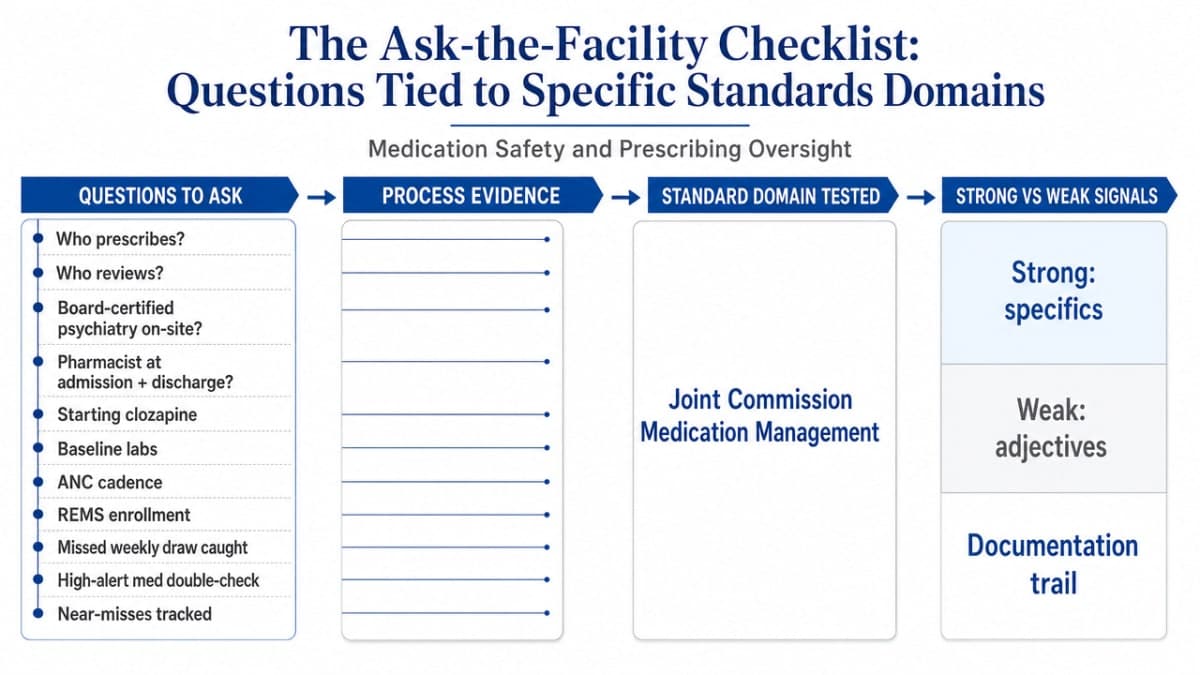
The Ask-the-Facility Checklist: Questions Tied to Specific Standards Domains
Medication Safety and Prescribing Oversight
This is where you press hardest. Ask who prescribes and who reviews — is there board-certified psychiatry on-site, and is there a pharmacist involved in reconciling medications at admission and discharge? Ask what the facility does when starting clozapine: baseline labs, ANC monitoring cadence, REMS registry enrollment, and the workflow that catches a missed weekly draw before it becomes a therapy gap. Ask how high-alert medications get a documented double-check at administration, and how the facility tracks near-misses. The Joint Commission’s medication management standards are built around exactly this documentation trail. A program running the process well will describe it in specifics. A program running it on faith will give you adjectives.2
Restraint, De-escalation, and Crisis Protocols
You have permission to ask the hard question directly. How often are physical restraints or seclusion used here in a typical month? Who signs the order, how long is it valid, and who monitors the patient during the episode? What de-escalation training does every direct-care staff member complete, and how often is it refreshed? After an incident, who reviews it, and what specific protocol changes have come out of those reviews in the last year? Accredited facilities are expected to document each event and use the review to reduce future ones. A defensive answer here is data. A specific, calm one is different data.2
Staff Credentialing, Cross-Training, and Ratios
Ask for the org chart, and then ask who’s actually on the unit at 2 a.m. What is the nurse-to-patient ratio overnight? Is a psychiatrist available on-call around the clock, and how quickly do they respond? For dual diagnosis, are clinicians cross-trained in both mental health and substance use treatment, or does the team hand a case back and forth? Effective integrated programs depend on cross-training and shared documentation, not parallel silos. Ask whether the facility can produce credentialing files on request — license verification, board certification dates, competency check-offs for the specific work each person does. If the answer is vague, the file may be too.2,6
Complaint Pathways and Continuous Review
A facility that welcomes complaints is a facility whose systems can absorb them. Ask how a patient or family member files a grievance internally, who reviews it, and what the response timeline is. Ask what the facility learned from its last accreditation survey and what corrective actions it took. You should also know your external options: Arizona’s AZ Care Check lets you look up any licensed behavioral health facility, and ADHS accepts complaints directly through its system. The Joint Commission runs its own complaint channel for accredited organizations. Three doors, not one. A program that names all three without flinching is a program that expects to be watched.2,9
What Accreditation Looks Like in Practice at an Arizona Facility
You can see the difference on the ground. In Prescott, ViewPoint Dual Recovery operates as a Joint Commission-accredited psychiatric facility built specifically for the cases other programs return — treatment-resistant schizophrenia, rapid-cycling bipolar, and dual diagnosis where the psychiatric and substance use sides have to be treated by the same team, in the same room, at the same time. Accreditation shows up in the details: board-certified psychiatry available around the clock, documented clozapine protocols with ANC monitoring built into the nursing workflow, and treatment duration set by clinical need rather than by an insurance clock.
What the evidence supports is worth naming plainly. Integrated dual diagnosis care carries a measured advantage for psychiatric symptomatology, even when substance use and retention outcomes look similar to non-integrated models. A facility layered with ADHS BBHL licensing, LegitScript certification, and Joint Commission accreditation is one where the systems behind that integration have been checked by three different sets of eyes. If you’re vetting a program for someone whose case is genuinely complex, that stack is what you’re looking for — and asking to see it is the right next step.1,2,9
Find Out If Advanced Care Is Right for You
Get clarity on your eligibility for specialized, accredited psychiatric support tailored to complex, treatment-resistant needs.
Frequently Asked Questions
Is JCAHO accreditation the same as Arizona state licensing for a mental health facility?
No, and treating them as interchangeable is one of the most common mistakes. Arizona’s Bureau of Behavioral Health Facilities Licensing (BBHL) grants the legal permission to operate and verifies baseline structural requirements. Joint Commission accreditation is a separate, voluntary review of clinical process — medication safety, incident response, staff competency, and continuous improvement. You want both, because each catches what the other misses.2,9
How can I verify that an Arizona facility is currently JCAHO accredited?
Use The Joint Commission’s Quality Check tool on their website — search by facility name or location and confirm the accreditation is current, not expired. Cross-check the facility’s state license through Arizona’s AZ Care Check system, which BBHL maintains for public lookup. A legitimate program will hand you both confirmations without hesitation. Vague answers or expired seals are useful data on their own.9
Does JCAHO accreditation mean a facility can safely handle treatment-resistant conditions like clozapine management or rapid-cycling bipolar?
Accreditation verifies the systems are in place — documented medication protocols, credentialed staff, incident review. It doesn’t confirm specialization in your specific case. Ask directly whether the facility runs clozapine with REMS registry enrollment and weekly ANC monitoring, whether board-certified psychiatry is available around the clock, and how the team coordinates on rapid-cycling presentations. Accreditation plus specific clinical capacity is what you’re looking for.2
What’s the difference between JCAHO accreditation and LegitScript certification?
They review different things. LegitScript certifies marketing integrity and business practices — it’s what Google and Meta require before a treatment facility can run paid ads, and it screens for deceptive lead-generation and patient brokering. JCAHO accreditation reviews clinical process inside the facility: medication safety, restraint protocols, staff credentialing, incident review. One checks how a facility talks about itself. The other checks how it treats patients.2
What specific questions should I ask a facility to test whether their accreditation is meaningful in daily practice?
Ask how often restraints are used in a typical month and what changed after the last incident review. Ask who is credentialed to administer high-alert medications and how competencies are re-verified. Ask what the last Joint Commission survey found and what corrective actions followed. A program running its systems well answers in specifics — names, timelines, protocol details. Adjectives without examples signal something else.
If a facility isn’t JCAHO accredited, does that automatically mean the care is unsafe?
Not automatically. Accreditation is voluntary, and some smaller or newer programs run rigorous operations without pursuing it yet. That said, for a treatment-resistant or dual diagnosis case where medication complexity and coordination stakes are high, the absence of external clinical process verification is a meaningful gap. Ask the facility how it audits itself, and weigh their answer against what accredited peers demonstrate through survey.2
References
- Integrated vs non-integrated treatment outcomes in dual diagnosis: A systematic review and meta-analysis. https://pubmed.ncbi.nlm.nih.gov/37151615/
- What is The Joint Commission and what does it mean to you?. https://www.utmb.edu/heartbeat/blog/detail/heartbeat/2024/03/29/what-is-the-joint-commission-and-what-does-it-mean-to-you
- Review of integrated mental health and substance abuse treatment for patients with dual diagnoses. https://pubmed.ncbi.nlm.nih.gov/9853791/
- Mental Health in Arizona. https://www.cdc.gov/mentalhealth/state_factsheets/arizona.htm
- Integrated care: Assessing the evidence. https://www.ncbi.nlm.nih.gov/pmc/articles/PMC3685807/
- Implementing integrated services for adults with co-occurring substance use and mental health disorders. https://www.ncbi.nlm.nih.gov/pmc/articles/PMC3052997/
- Behavioral Health 101: Supporting Physical and Behavioral Health Through Licensing Rules. https://www.azdhs.gov/documents/licensing/trainings-exercises-collaboratives/rules/behavioral-health-101.pdf
- Restructuring our licensing bureaus to better address the needs of the state. https://directorsblog.health.azdhs.gov/restructuring-our-licensing-bureaus-to-better-address-the-needs-of-the-state/
- Behavioral Health Provider Training & Licensing Resources – ADHS BBHL. https://www.azdhs.gov/licensing/bbhl-facilities/index.php
- NSDUH Behavioral Health Barometer: Arizona, Volume 8. https://www.samhsa.gov/data/report/nsduh-behavioral-health-barometer-arizona-volume-8
- Behavioral Health Barometer: Arizona, Volume 4. https://www.samhsa.gov/data/sites/default/files/Arizona_BHBarometer_Volume_4.pdf
- Integrated Treatment for Co-Occurring Disorders: Evidence and Practice. https://www.ncbi.nlm.nih.gov/pmc/articles/PMC3777345/