
Key Takeaways
- Co-occurring disorders — a mental health condition alongside substance use — affect an estimated 3 to 3.8% of Arizona adults, and Arizona defines them formally through its Board of Behavioral Health Examiners.11,12
- Yavapai County recorded 66 overdose deaths in 2024, and the local Overdose Fatality Review Board found most decedents had histories of both mental illness and substance use, making integrated treatment a county-level priority.17,18
- Programs that treat mental health and substance use sequentially or in separate buildings often fail because each untreated condition destabilizes the other; SAMHSA’s integrated ‘no wrong door’ model is the federal standard.3,4,5
- Families in Prescott, Prescott Valley, Cottonwood, or Sedona should verify ADHS licensure, ask whether one team treats both conditions, and confirm the program can handle complex medications and relapse without discharge.8,24
When One Program Treats the Depression and Another Treats the Drinking
You already know how this goes. The rehab in the Valley wouldn’t take him because he was still on his antipsychotic. The psychiatrist in Prescott said the drinking had to stop before they could really work on the depression. The ER stabilized her, handed you a folder, and sent you home by 2 a.m. You’ve driven 89A more times than you can count. And somehow, after three or four rounds of this, the person you love is still sitting at the kitchen table, worse than before.
If you’ve been through that loop and you’re still here reading, that isn’t failure. It’s information. It’s telling you something important: when a mental health condition and a substance use problem show up together — what clinicians call a co-occurring disorder or dual diagnosis — treating them one at a time, in separate buildings, with separate teams, usually doesn’t hold. The two feed each other. Pull on one thread, the other tightens.2,3
This guide is written for Yavapai County families. Not for clinicians, not for insurance adjusters — for the parent in Prescott Valley, the spouse in Cottonwood, the sister in Sedona who is trying to figure out what to do next. You’ll get a plain-language explanation of what co-occurring disorder actually means, an honest look at why previous programs may have missed, what integrated care looks like in practice, and specific questions to ask any local provider before you enroll someone you love.
What ‘Co-Occurring Disorder’ Actually Means
The Plain-Language Definition (and Why the Term Matters)
A co-occurring disorder is what clinicians call it when a person has a mental health condition and a substance use problem at the same time. That’s it. Depression plus drinking. PTSD plus opioid painkillers after a rough injury. Bipolar disorder plus meth. Anxiety plus a nightly bottle of wine that stopped being just a nightly bottle of wine a long time ago. SAMHSA, the federal agency that sets the terms most treatment programs follow, describes it as any combination of two or more substance use disorders and mental disorders as they’re defined in the DSM-5, the clinical manual doctors use to diagnose. You might also hear it called dual diagnosis. Same thing.2
Arizona has its own official version. The state’s Board of Behavioral Health Examiners defines a co-occurring disorder as a combination of a substance use disorder or addiction and a mental or personality disorder. Why does the label matter? Because once your loved one has that label attached to their chart, they qualify for a different kind of program — one that treats both problems in the same room, with the same team, at the same time. Without the term, they can get bounced between systems that each only see half the picture.11
How Common This Is in Arizona
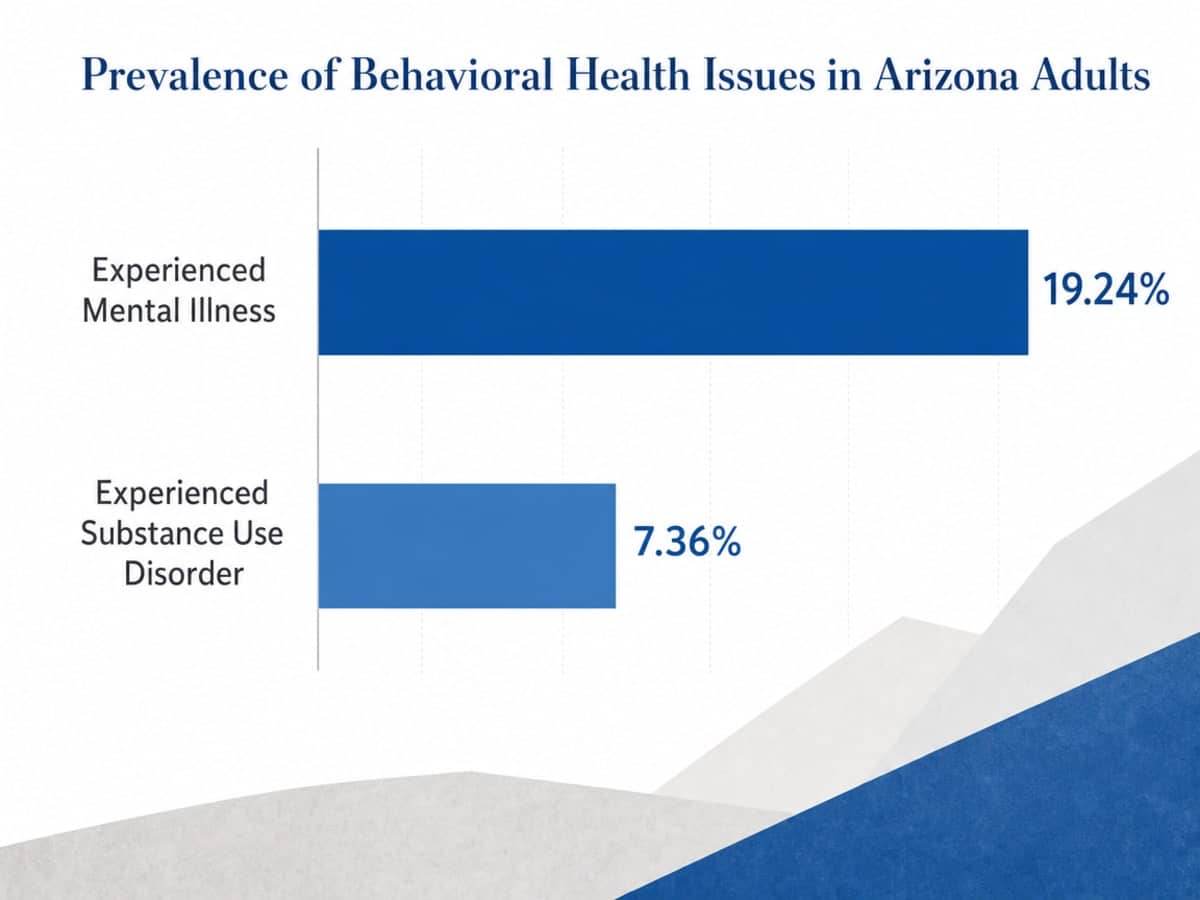
If this is the first time you’ve heard the words co-occurring disorder, it can feel like your family stumbled into something rare. It isn’t. A statewide behavioral health report from the University of Arizona’s Center for Rural Health found that roughly 19.24% of Arizona adults experienced mental illness in the prior year, 7.36% experienced a substance use disorder, and 3.0 to 3.8% experienced both at the same time, with the exact figure varying by whether people lived in a metro area or a more rural one. That last group — the both-at-once group — works out to tens of thousands of Arizonans, spread across the state, walking around with the same layered problem your family is trying to solve.12
Three to four percent might sound small until you translate it. In a town the size of Prescott, that’s thousands of neighbors. In a county the size of Yavapai, it’s a crowd. The CDC notes that people with a mental health condition are more likely to use substances or develop a substance use disorder, and the reverse is also true. The two conditions pull each other along. So if you’ve been feeling like your family’s situation is uniquely broken, take a breath. It isn’t unique. It’s under-recognized, which is different — and it’s part of why finding the right kind of help has felt so hard.21
The Yavapai County Picture
What the Local Numbers Show
Zoom in from the state to the county, and the picture gets sharper. In 2024, overdose deaths surpassed every other cause of accidental death in Yavapai County. The Medical Examiner’s Office recorded 66 overdose deaths — the same number as 2023 — with fentanyl and methamphetamine leading the list of substances involved. Sixty-six neighbors. In one year. In one county.18,23
Behind those numbers is a pattern that matters for anyone reading this: the Yavapai County Overdose Fatality Review Board, formed to look closely at these deaths one by one, found that the vast majority of the people they reviewed had histories of both mental illness and substance use. Not one or the other. Both. That is the co-occurring picture, drawn on a county map.17
A longer look at Yavapai adds context, with a careful caveat. A peer-reviewed study of non-Hispanic white adults aged 25–64 in the county — not the whole population — found that combined drug, alcohol, and suicide mortality climbed from 53.7 per 100,000 in 1999 to 126.8 per 100,000 by 2017. That’s a specific slice of the county, but the direction is what matters. The problem hasn’t been rare here for a long time, and the two threads — mental health and substance use — have been braided together the whole way. If your family feels the weight of that history, you are not imagining it.17
Why Prescott, Prescott Valley, Cottonwood, and Sedona Feel the Gap
The county already knows. In the Quad Cities area — Prescott, Prescott Valley, Chino Valley, Dewey-Humboldt — the Community Health Improvement Plan names mental health, substance use, and access to care as top priorities, and sets a specific goal: bring the age-adjusted suicide death rate down from 32.8 per 100,000 to 25 per 100,000. Over in the Verde Valley — Cottonwood, Sedona, Camp Verde — the 2023–2027 CHIP puts access to mental health resources in the top four issues the region needs to focus on. Two separate planning bodies, looking at two different parts of the same county, arriving at the same conclusion.15,16
The gap they’re describing has a practical shape. Yavapai is a large county with towns spread out along 89A and I-17, a workforce that is stretched thin, and a population that skews older and more rural than the Phoenix metro. Statewide research from the University of Arizona has flagged behavioral health provider shortages that hit non-metro counties hardest. When you combine that with the co-occurring reality — someone who needs a psychiatrist and an addiction team, in the same building, on the same week — the shortfall isn’t just about how many providers exist. It’s about how few of them are set up to treat both problems at once. That is the gap. And it is exactly the gap this guide is trying to help you close.12
Why Previous Treatment May Not Have Worked
Sequential Care vs. Integrated Care
Here’s the mechanism nobody explained the first three times around. In the older model — the one most of Arizona’s system was built on — mental health and substance use are treated one after the other, in separate places. Get sober first, then we’ll look at the depression. Or: get the mood stabilized, then go handle the drinking. Clinicians call this sequential care. It sounds logical on paper. It falls apart in real life, because the untreated condition keeps knocking down the one you’re trying to fix. The drinking flares the depression. The unmanaged bipolar drives the meth use. Round and round.
Integrated care flips that. One team, one treatment plan, both conditions addressed at the same time. SAMHSA has spent two decades pointing at the research and saying, plainly, that integrated treatment is the preferred model for people with co-occurring disorders. TIP 42 — the federal treatment protocol most quality programs follow — says outcomes are better when each problem is treated specifically and concurrently, not stacked in a queue.4,5
The scale of the mismatch shows up in Arizona’s own numbers. In FY 2015, 19.5% of clients in Arizona’s publicly funded substance abuse treatment programs also had a co-occurring general mental health disorder, and another 29.3% had a co-occurring serious mental illness. That data is a decade old, and prevalence has almost certainly risen since — but even then, nearly half the room in a typical SUD program had a diagnosable mental health condition sitting right next to the substance use. If the program was only staffed to treat one lane, most of the room was getting half a treatment plan.14

The ‘Too Complex’ Problem
Then there’s the other reason previous programs may not have held: your loved one got labeled too complex. Maybe the rehab wouldn’t admit him because he was on clozapine, and their nursing setup couldn’t handle the required blood monitoring. Maybe the outpatient program discharged her after a relapse, treating a symptom of the disease as a rule violation. Maybe the psychiatric unit stabilized him in three days and sent him home because the substance use “wasn’t their scope.” You have probably heard some version of we’re not equipped for that here more than once.
That answer isn’t a verdict on the person. It’s a description of a program’s staffing and licensing limits. Arizona’s residential treatment framework licenses facilities separately for mental health and substance use services through ADHS, and not every program is built or staffed to hold both at once. When SAMHSA lays out what an actual co-occurring program should include — onsite psychiatric consultation, case management, willingness to work with clients across the severity spectrum — the list quietly explains why so many programs turn complex cases away. They weren’t designed for the room they’re actually seeing.8,24
What Integrated Care Looks Like in Practice
The ‘No Wrong Door’ Standard
There’s a phrase you can borrow from SAMHSA and use as a yardstick: no wrong door. It means that whichever entry point your loved one walks through — a therapist’s office, a detox unit, an ER, a primary care clinic — that door screens for both mental health and substance use, and connects them to care for whichever they need. Nobody gets told, “That’s not our department.”3
In practice, this looks small and quiet. A counselor at an addiction program asks about depression, panic attacks, past trauma, and sleep — not just about drinking. A psychiatrist managing bipolar medication asks about alcohol, cannabis, and pills — not just about mood. Federal guidance is direct about this: providers on both sides should screen every new client for the other condition.8
You can use this as a filter. If a program’s intake form only asks about one lane, or if the staff seems surprised when you mention the other diagnosis, that’s a sign. The right door doesn’t flinch when you describe the whole picture.
What a Real Assessment Includes
A real co-occurring assessment takes longer than a paperwork intake. It should look at both conditions side by side, because the symptoms overlap in ways that trip up quick evaluations. NIMH is blunt about this — accurate diagnosis matters because withdrawal can look like anxiety, intoxication can look like mania, and untreated depression can look like the aftermath of a relapse. Comprehensive assessment reduces missed diagnoses.20
What that means for your family: expect questions about when the mood symptoms started versus when the substance use started, what happened during any clean stretches, family psychiatric history, trauma, current medications, and medical conditions. TIP 42, the federal treatment protocol, walks clinicians through severity assessment and placement so the treatment plan actually matches what your loved one is dealing with, not a generic template.5,9
If the assessment happens in twenty minutes and lands on a single diagnosis, that’s a red flag. If it takes a couple of sessions, involves both a therapist and a prescribing clinician, and ends with a plan that names both problems out loud — that’s the shape you’re looking for.
Questions to Ask Any Yavapai County Program
You do not have to be a clinician to vet a program. You just have to ask specific questions and listen to how the person on the phone answers. Here’s a short list, drawn from what federal guidance says an integrated program should actually do:4,8,24
- Do you treat mental health and substance use at the same time, with one team? If they describe two separate tracks in two separate places, that’s sequential care, not integrated.
- Is a psychiatrist on staff, and can they manage complex medications like clozapine, lithium, or long-acting injectables? This matters if your loved one has been told they’re “too complex” elsewhere.
- What happens if my loved one uses during treatment? An integrated program treats relapse as clinical information, not as grounds for discharge.
- Do you screen every client for both conditions at intake? The answer should be yes, automatically.
- Are you licensed by Arizona ADHS for both mental health and substance use services? State licensure sets the baseline for what a program is legally set up to handle.
Write the answers down. If a program stumbles on more than one of these, keep calling. You are allowed to be picky here — this is your family.
Local Options and What to Expect
Baseline Services Across the County
You are not starting from zero. The Community Health Center of Yavapai runs counseling and psychiatric services out of Prescott, Prescott Valley, and Cottonwood, and offers substance use disorder treatment that includes medications for opioid use disorder — what you may hear called MOUD, things like buprenorphine or naltrexone that help steady someone off opioids. They accept AHCCCS and Medicare, and same-day or telehealth appointments are on the table. For a lot of families, that’s the right first call: outpatient counseling, medication management, and a psychiatrist your loved one can actually see.22
If the situation is milder — anxiety plus heavier drinking than you’d like, mood swings plus cannabis — outpatient care may hold it. If it isn’t holding, that’s real information, not a failure. It means the next level up is what’s actually needed.
When You Need a Higher Level of Care
Some situations don’t fit an hour-a-week appointment. A recent overdose. Active psychosis. A mood disorder that swings hard while someone is still using. A person who has been through three outpatient rounds and lost weight, lost work, lost the plot. When the two conditions are feeding each other in real time, the person often needs a residential or higher-intensity program that can hold both problems inside one building — with a psychiatrist on-site, nursing that can handle complex medication regimens like clozapine or long-acting injectables, and a team that treats a relapse as clinical information instead of grounds for discharge.4,8
This is the niche ViewPoint Dual Recovery fills in Prescott — a Joint Commission-accredited, ADHS-licensed psychiatric facility built for the cases other programs call “too complex”: treatment-resistant depression paired with alcohol use, bipolar disorder paired with meth, schizophrenia paired with opioids, PTSD paired with anything. If your loved one has already been turned away or discharged elsewhere, that isn’t the end of the road.
Insurance, AHCCCS, and Length of Stay
The money question is fair, and you should ask it out loud. Most reputable Yavapai County programs work with AHCCCS, Medicare, or commercial insurance — CHCY does at the outpatient level, and Arizona ADHS licenses residential facilities separately for mental health and substance use services, so ask any program which licenses they hold and which plans they take. Don’t accept vague answers.22,24
On length of stay: the right question isn’t “how many days does insurance cover” but “how long does the clinical team think this will take, and what happens if we need more time?” A program built for complex cases will answer that honestly rather than mapping treatment to a benefit cap.

A Practical Next Step
If you’ve read this far, you already know more than most families do when they start making calls. You know the term. You know the mechanism. You know what to ask. That’s not nothing — that’s the difference between a productive phone call and another folder of pamphlets on the kitchen counter.
Here’s what to do this week. Write down what you’re actually seeing: the mood pattern, the substances, what previous programs said, what medications are on the shelf. Then call one program that treats both conditions in the same building. If outpatient care through the Community Health Center of Yavapai in Prescott, Prescott Valley, or Cottonwood is the right level, start there. If your loved one has been discharged for relapse, told they were too complex, or is on a medication regimen most rehabs won’t touch, that’s a signal to look at a psychiatric facility built for exactly those cases — like ViewPoint Dual Recovery in Prescott.22
One honest conversation with a team that sees the whole picture is progress. You don’t have to have it all figured out tonight.
Find Out If Integrated Care Is Right For You
Get expert input on the next steps for complex mental health or substance use challenges.
Frequently Asked Questions
What is a co-occurring disorder in plain language?
A co-occurring disorder means someone has a mental health condition and a substance use problem at the same time — depression and drinking, PTSD and opioids, bipolar disorder and meth. SAMHSA describes it as any combination of a mental disorder and a substance use disorder defined in the DSM-5. You may also hear it called dual diagnosis. Same thing, different label.2
Why do previous treatment programs keep failing for someone with both mental illness and substance use?
Most older programs treat one problem at a time, in separate places — get sober first, then handle the depression. Clinicians call that sequential care, and the untreated condition keeps knocking down the one being worked on. Federal guidance is clear that integrated treatment, where one team addresses both conditions at once, produces better outcomes for people with co-occurring disorders.4,5
Can a Yavapai County program still help if my loved one is considered ‘too complex’ or has been discharged before?
Yes. Being called “too complex” usually reflects a program’s staffing and licensing limits, not your loved one’s prognosis. Arizona licenses residential facilities separately for mental health and substance use services through ADHS, and not every program is built for both. Look for a psychiatric facility with onsite psychiatry, complex medication capability, and a policy that treats relapse as clinical information.8,24
What questions should I ask a Prescott or Verde Valley program before enrolling?
Ask if mental health and substance use are treated together by one team, whether a psychiatrist is on staff who can manage medications like clozapine or long-acting injectables, what happens if your loved one uses during treatment, and whether every client is screened for both conditions at intake. Confirm ADHS licensure for the services you need. Write the answers down.8,24
Does AHCCCS or insurance cover co-occurring disorder treatment in Yavapai County?
Often, yes. The Community Health Center of Yavapai accepts AHCCCS and Medicare for outpatient counseling, psychiatric services, and medications for opioid use disorder across Prescott, Prescott Valley, and Cottonwood. For residential care, ask each program which ADHS licenses they hold and which plans they contract with. Don’t accept vague answers — get the specifics in writing.22,24
What is the difference between integrated care and ‘no wrong door’ treatment?
Integrated care means one team treats both the mental health condition and the substance use problem together, with a single plan. “No wrong door” is the policy that supports it: whichever entry point someone walks through — therapist, detox, ER, primary care — that door screens for both conditions and connects them to care, instead of sending them away.3,4
References
- Arizona 2025 Uniform Reporting System Mental Health Data Results. https://www.samhsa.gov/data/sites/default/files/reports/rpt57191/Arizona.pdf
- Co-Occurring Disorders and Other Health Conditions. https://www.samhsa.gov/substance-use/treatment/co-occurring-disorders
- Managing Life with Co-Occurring Disorders. https://www.samhsa.gov/mental-health/serious-mental-illness/co-occurring-disorders
- Substance Use Disorder Treatment for People with Co-Occurring Disorders (Advisory). https://library.samhsa.gov/sites/default/files/pep20-06-04-006.pdf
- Substance Use Disorder Treatment for People With Co-Occurring Disorders (NCBI Bookshelf, TIP 42). https://www.ncbi.nlm.nih.gov/books/NBK571020/
- Integrated Treatment for Co-Occurring Disorders: Evidence-Based Practices (EBP Kit). https://library.samhsa.gov/product/integrated-treatment-co-occurring-disorders-evidence-based-practices-ebp-kit/sma08-4366
- Integrated Treatment for Co-Occurring Disorders: Building Your Program. https://library.samhsa.gov/sites/default/files/ebp-kit-building-your-program-10112019.pdf
- Providing Substance Use Disorder Treatment for Clients With Co-Occurring Disorders (Guidance Excerpt). https://library.samhsa.gov/sites/default/files/SAMHSA_Digital_Download/PEP20-02-01_004.pdf
- Substance Use Disorder Treatment for People With Co-Occurring Disorders (Full TIP 42 PDF). https://www.psychiatry.wisc.edu/wp-content/uploads/2023/05/SAMHSA-TIP-42.pdf
- Quick Guide for Clinicians Based on TIP 42—Substance Abuse Treatment for Persons With Co-Occurring Disorders. https://radarcart.boisestate.edu/library/files/2017/07/TIP-42_QuickG_co-occurring_clinician_SMA07-4034.pdf
- Arizona Board of Behavioral Health Examiners Rules (Effective January 12, 2019). https://bbhe.az.gov/sites/default/files/2025-01/FINAL%20BOARD%20RULES%20011219.pdf
- The Arizona Behavioral Health Workforce. https://crh.arizona.edu/sites/default/files/2022-03/20210702_AZ_BH_WorkforceReport_FINAL_0.pdf
- Behavioral Health (Arizona Brief). https://crh.arizona.edu/sites/default/files/2022-03/20201116_BehavioralHealthReport_Brief.pdf
- Annual Report on Substance Abuse Treatment Programs (Arizona, FY 2015). https://archive.azahcccs.gov/archive/Resources/Reports/Behavioral%20Health/fy15-sa-rep.pdf
- Quad Cities Community Health Improvement Plan (Yavapai County Community Health Services). https://www.yavapaiaz.gov/files/sharedassets/public/v/1/resident-services/community-health/documents/quad-cities-chip.pdf
- Verde Valley Community Health Improvement Plan (Yavapai County Community Health Services, 2023–2027). https://www.yavapaiaz.gov/files/sharedassets/public/v/1/resident-services/community-health/documents/yavapaicounty_verdevalleychip_1-23_print-singlepages-withbleed.pdf
- The US Mortality Crisis: An Examination of Non-Hispanic White Mortality and Morbidity in Yavapai County, Arizona. https://par.nsf.gov/servlets/purl/10093398
- Yavapai County Medical Examiner’s Office – Annual Report 2024. https://www.yavapaiaz.gov/files/sharedassets/public/v/1/resident-services/community-health/documents/2024-medical-examiners-annual-report.pdf
- Co-occurring disorders among arrestees: Results from the AARIN project. https://cvpcs.asu.edu/sites/g/files/litvpz1111/files/content/products/AARIN_Public_Defender_final.pdf
- Finding Help for Co-Occurring Substance Use and Mental Disorders. https://www.nimh.nih.gov/health/topics/substance-use-and-mental-health
- Substance Use & Mental Health. https://www.cdc.gov/mental-health/about-data/substance-use-mental-health.html
- Behavioral Health Services – Yavapai, AZ. https://www.yavapaiaz.gov/Resident-Services/Health-Services/Community-Health-Center-of-Yavapai/Behavioral-Health-Services
- Yavapai county sees rising meth numbers in overdose fatalities. https://www.ycsoaz.gov/News-Articles/MATFORCE-OD-REPORT-2024
- Arizona Summary — State Residential Treatment. https://aspe.hhs.gov/sites/default/files/2021-08/StateBHCond-Arizona.pdf