

Key Takeaways
- A local program’s refusal usually signals a level-of-care mismatch, not a verdict on prognosis — SAMHSA guidance places clients based on combined severity across both disorders.2
- Complexity is defined by concurrent severity, functional impairment, prior treatment history, and safety risk; SAMHSA’s Four Quadrant Model and tools like LOCUS and ASAM translate that into the right setting.2
- Three presentations most often get declined locally — treatment-resistant psychosis with active use, rapid-cycling bipolar with SUD, and severe PTSD with active SUD, where ‘get sober first’ contradicts current VA/DoD guidance.7,8,10
- Genuinely integrated programs run one team and one treatment plan covering both diagnoses, updated on a defined schedule, not parallel tracks with separate prescribers.3,4,13
- When evaluating a specialty facility, confirm accreditation, 24/7 on-site board-certified psychiatry, clozapine and mood stabilizer capability, concurrent trauma-focused therapy, and clinically driven length of stay.7,8,10
- Traveling out of state becomes a level-of-care decision when two or more local programs have declined citing acuity and the presentation matches Quadrant IV needs.2
When ‘We Can’t Take This Case’ Is a Level-of-Care Signal, Not a Verdict
You have made the calls. Maybe a dozen of them. You have heard versions of the same sentence — we’re not the right fit, the acuity is too high, we can’t safely admit her here — and each one has landed like a door closing. If you are reading this after being told locally that your loved one’s case is too complex, you already know more than most families ever have to learn about co-occurring disorders. That knowledge is worth something here.
Here is what those calls usually mean, in plain terms: the program is telling you their setting cannot match the severity in front of them. That is a level-of-care problem, not a statement about whether your person can be helped. SAMHSA’s guidance for co-occurring disorders is explicit that clients should be placed in a level of care aligned with the functional challenges, symptom severity, and recovery environment tied to both the mental health disorder and the substance use disorder. When those two severities stack, most community outpatient clinics and general rehabs are structurally not built for it — and integrated care remains the preferred model when they are.2,3
This article gives you the language to name what you are dealing with, a way to read program capability honestly, and a direct answer about when traveling for specialty psychiatric care is the right clinical call.
What Actually Makes a Dual Diagnosis Case ‘Complex’
The Clinical Markers Programs Are Reading
When an admissions coordinator says the case is too complex, they are usually reading a specific cluster of markers on the intake form. It helps to know what they are.
- The first is severity across both diagnoses at once — not just active psychosis or heavy daily use, but both at the same time, feeding each other.
- The second is functional impairment: whether your person can manage medications, attend appointments, keep themselves safe, or maintain any structure without direct support.
- The third is prior treatment history — the number of failed admissions, medications tried without response, and psychiatric hospitalizations in the last twelve months.
- The fourth is active safety risk: recent suicide attempts, overdose history, or the kind of medical instability that requires 24/7 clinical eyes.
SAMHSA’s Advisory based on TIP 42 frames these exact factors — functional challenges, symptom severity, and recovery environment across both the mental disorder and the SUD — as the inputs that should drive level-of-care decisions. When a local program says no, they are usually saying their staffing, medical coverage, or milieu cannot hold that combined load safely. That is real information. It tells you what to look for next.2
SAMHSA’s Four Quadrant Model and Why Quadrant IV Gets Turned Away
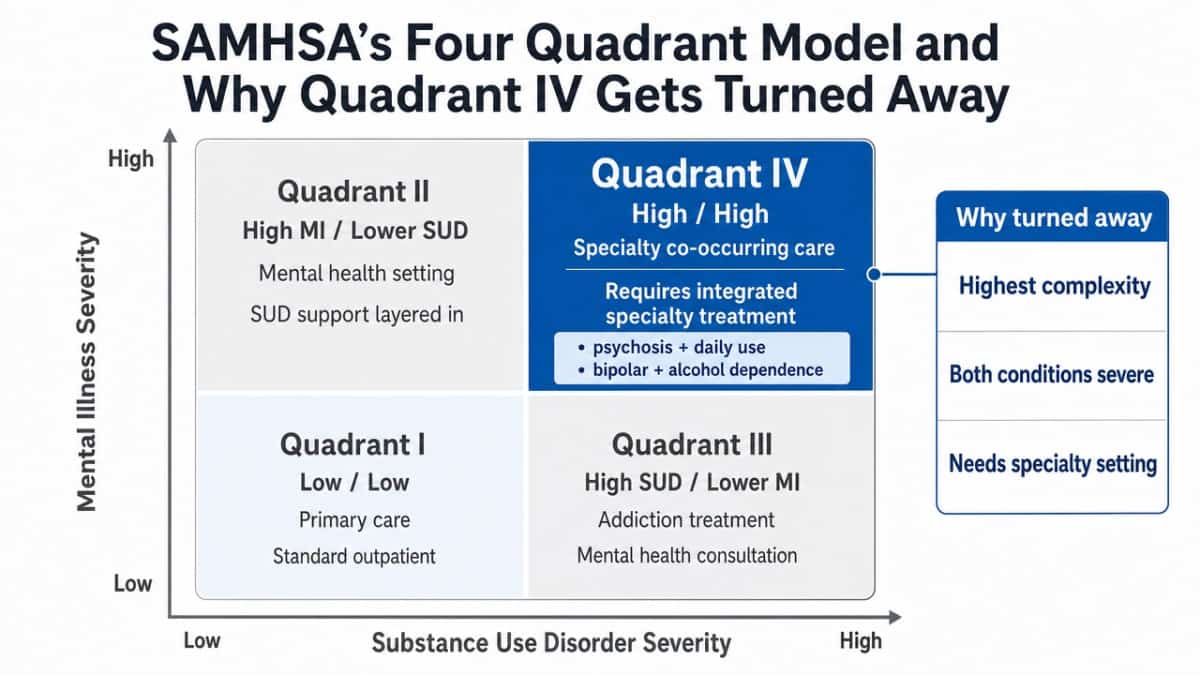
The clearest way to see where your loved one falls is SAMHSA’s Four Quadrant Model, referenced in the TIP 42 Advisory as a tool for matching severity to setting. It plots two axes: severity of mental illness on one, severity of substance use disorder on the other. Four quadrants come out of that.2
- Quadrant I is low severity on both — often manageable in primary care or standard outpatient.
- Quadrant II is high mental illness severity with lower SUD severity, typically served in mental health settings with SUD support layered in.
- Quadrant III is high SUD severity with lower mental illness severity, usually addressed in addiction treatment programs with mental health consultation.
- Quadrant IV is high severity on both — treatment-resistant psychosis with active daily use, rapid-cycling bipolar with alcohol dependence, severe PTSD with opioid use disorder.
Quadrant IV is the population most community programs are not built to hold. The Advisory is direct that clients should be placed in a level of care aligned with both disorders’ severity, and that integrated care is the preferred model when acuity is this high. If you have been told locally that the case is too much, there is a strong chance you are looking at Quadrant IV — which points to specialty psychiatric residential care, not another try at outpatient.2
How ASAM and LOCUS Translate Severity Into a Level of Care
The Four Quadrants tell you what you are dealing with. ASAM Criteria and LOCUS translate that into where care should happen.
LOCUS — the Level of Care Utilization System — scores functional impairment, risk, comorbidity, recovery environment, treatment history, and engagement, and produces a recommended intensity of service. TIP 42’s Advisory identifies LOCUS and the Four Quadrant Model together as the standard tools for matching co-occurring disorder severity to setting. ASAM Criteria do parallel work on the addiction side, using dimensions that include biomedical status, emotional and behavioral conditions, and recovery environment to place someone along a continuum from outpatient through medically managed inpatient care.2
What matters for you: when a program declines the case, ask what LOCUS or ASAM level they believe is indicated. If they say Level IV medically managed or high-intensity residential and they are neither, they have just told you exactly what to search for. That is the language to use with the next facility, and the language a specialty psychiatric center will already be speaking on the intake call.
The Three Presentations That Most Often Get Declined
Treatment-Resistant Psychosis With Active Substance Use
If your loved one carries a diagnosis of schizophrenia or schizoaffective disorder, has failed two or more antipsychotic trials, and is using substances on top of that — cannabis, methamphetamine, alcohol, or a combination — you have almost certainly heard the word no more than once. The reasons are consistent across programs. General rehabs are not staffed to manage acute psychotic symptoms or the medication regimens that go with them. Community mental health clinics can prescribe antipsychotics but rarely have the milieu, medical coverage, or urine monitoring to hold someone who is actively using.
What this presentation actually needs is different from either. It needs a setting where the psychiatric prescriber and the SUD clinician are working from the same treatment plan, in the same building, on the same day — the definition of integrated care that SAMHSA and NIMH both name as the standard for co-occurring disorders. It needs pharmacology depth, including the capacity to run a clozapine trial when two prior antipsychotics have not worked. And it needs 24/7 psychiatric coverage, because the moments that determine whether treatment holds — a paranoid episode at 2 a.m., a decision about whether to hold a dose — do not happen on business hours.3,13
If a program can only offer one side of that, they are right to decline. Your job is to find the program that offers both.
Rapid-Cycling Bipolar Disorder Complicated by SUD
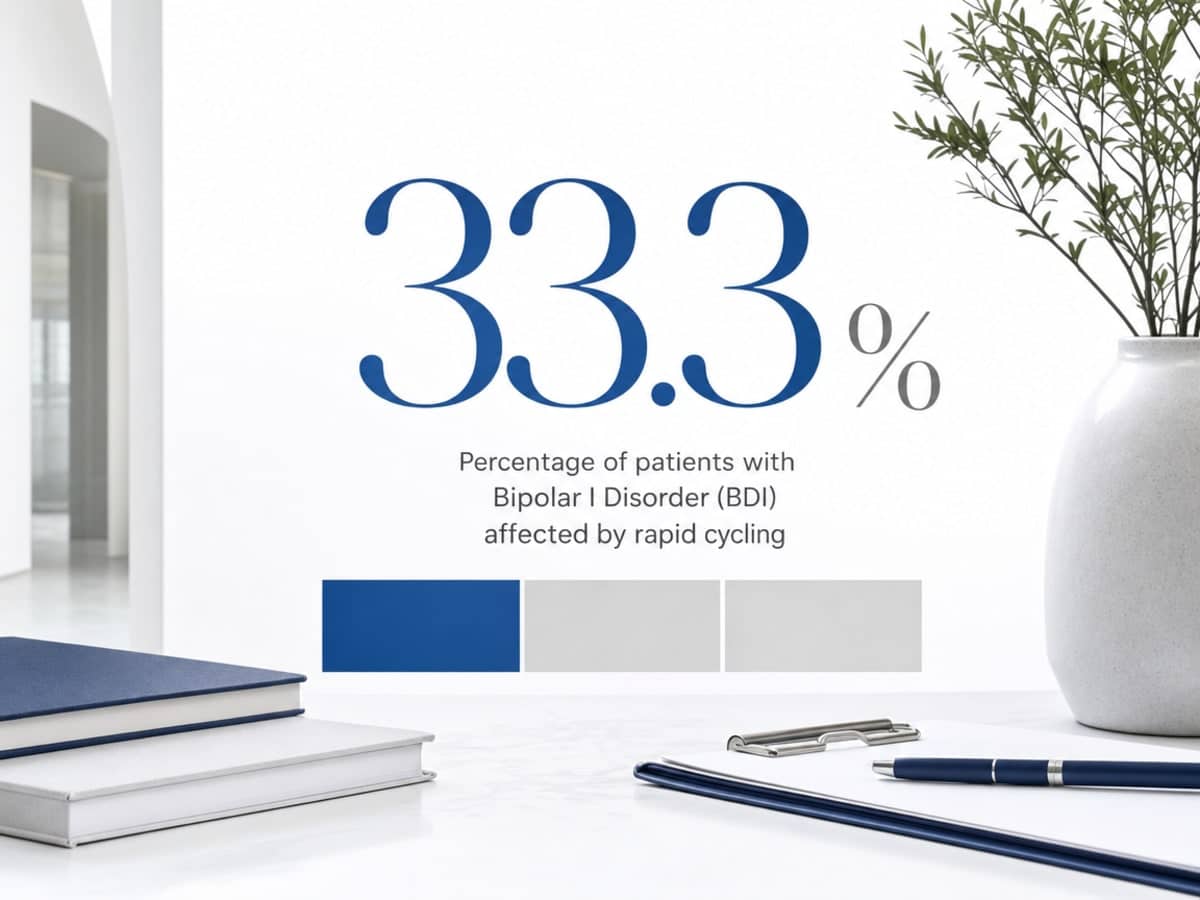
Rapid cycling has a specific clinical definition: four or more mood episodes in a twelve-month period, meeting full criteria for mania, hypomania, or depression. It is not “moody” or “unstable.” It is a defined pattern, and it is common. The 2018 CANMAT/ISBD guideline reports that rapid cycling affects up to one-third of patients with Bipolar I Disorder, and specifically identifies substance abuse and antidepressant exposure as frequent destabilizers.7
That last point matters when a local program calls the case “too unstable to admit.” The instability is often being driven by two things the treatment system itself can address: an antidepressant that should probably be tapered, and active substance use that is fueling the cycling. CANMAT/ISBD is direct that discontinuation of antidepressants, stimulants, and other psychotropic agents contributing to cycling is imperative, alongside assessment of thyroid function. The 2023 update adds that ECT is a second-line option for treatment-refractory bipolar depression, particularly when there is imminent suicide risk, catatonia, psychotic features, or a need for rapid medical stabilization.6,7
None of that happens in a standard 28-day rehab or a weekly outpatient psychiatry appointment. It requires a facility that can taper destabilizing agents while managing withdrawal, run a mood stabilizer trial with real monitoring, and escalate to ECT if the depressive pole becomes life-threatening. When a program tells you they can’t safely admit rapid-cycling bipolar with SUD, they are describing their own capability gap. It is not a description of your person’s prognosis.
Severe PTSD With Active SUD — and Why ‘Get Sober First’ Is Outdated Guidance
You have probably heard some version of this: we can start working on the trauma once she’s had 90 days clean. Or: we don’t do trauma therapy with active users — it’s not safe. That framing is out of step with current national guidance, and it has been for several years.
What this means practically: if a local program is refusing PTSD work until your loved one strings together sobriety on their own, they are applying a standard that current guidelines have moved past. The right setting delivers PE, CPT, or EMDR alongside SUD treatment — not after it. Notably, the VA/DoD guideline also recommends against Seeking Safety as a primary PTSD treatment in this population, which is a useful screening question when a facility describes its trauma approach.8
What a Truly Integrated Program Looks Like on the Inside
Integrated Team, Not Parallel Tracks
A lot of programs use the word integrated. Fewer actually operate that way. The tell is structural: in a truly integrated program, the psychiatrist treating the mood disorder and the clinician treating the substance use are on the same team, sharing one chart, meeting about your loved one in the same room. Not two departments with a fax machine between them.
SAMHSA defines integrated treatment as care that coordinates mental and substance use interventions rather than referring across silos, and NIMH describes it the same way — combined mental health and SUD treatment delivered in one place, by a coordinated team. When you call, ask directly: who writes the treatment plan, and does one plan address both diagnoses? If the answer involves two separate plans or a referral to an outside prescriber, that is parallel care wearing an integrated label. The distinction matters most in the moments that decide whether treatment holds — a medication change, a relapse on the unit, a decision about a pass.3,13
The Six-Step Integrated Treatment Plan You Should Expect to See
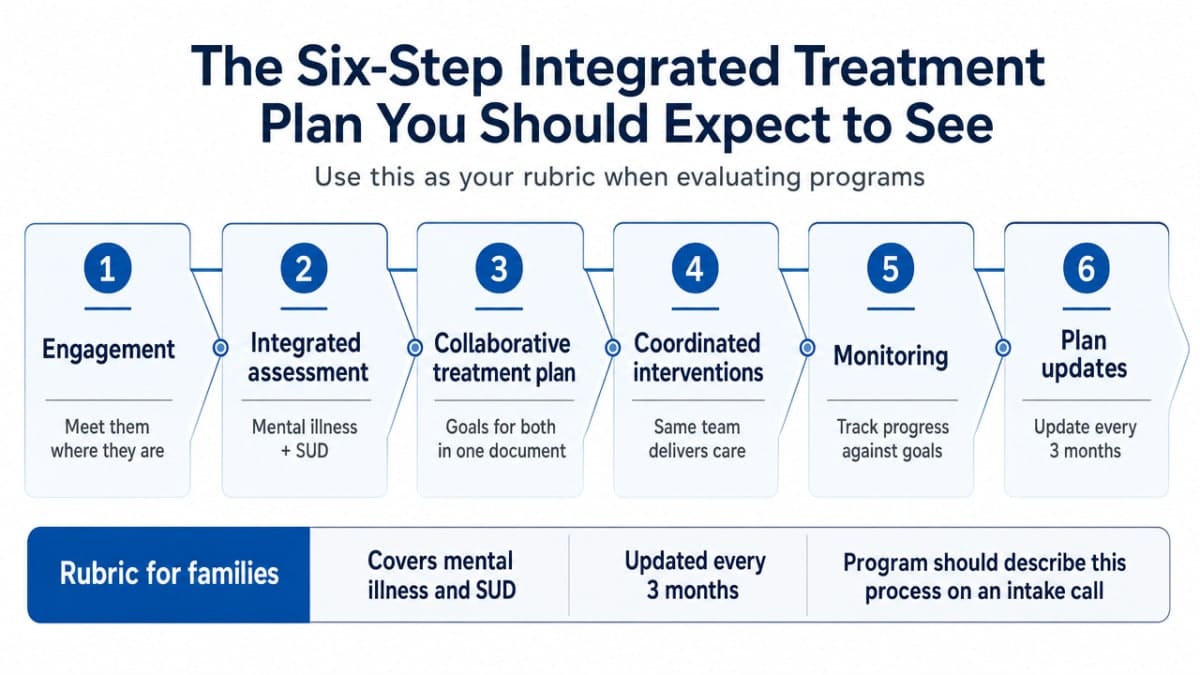
SAMHSA’s EBP kit for integrated treatment lays out a six-step planning process that a real program should be able to describe on an intake call. You do not need to memorize the steps. You need to hear the shape of them.4
- The plan starts with engagement — meeting your loved one where they are in the stages of change, rather than requiring motivation they do not yet have.
- It moves to integrated assessment across mental illness and SUD,
- then to a collaborative treatment plan that names goals for both diagnoses in one document.
- From there: coordinated interventions delivered by the same team,
- monitoring against those goals,
- and plan updates. SAMHSA specifies that integrated plans should cover both mental illness and SUD and be updated every three months.
Use that as your rubric. Ask the admissions coordinator to walk you through how they build the plan, who signs it, and when it gets revised. A program that stumbles on “who owns the plan” is telling you something. A program that answers cleanly — one team, one plan, updated on a defined interval — is describing what SAMHSA’s evidence base actually looks like in practice.
Pharmacology Depth: Clozapine, Mood Stabilizers, and 24/7 Psychiatry
Integrated care is not just a team structure. It is also a pharmacology capability. For the presentations that get declined locally, the medication work is where programs either hold their ground or run out of tools.
Treatment-resistant psychosis often means a clozapine trial — a medication that requires baseline labs, weekly blood monitoring in the early months, and a prescriber willing to titrate carefully alongside active SUD management. Rapid-cycling bipolar frequently requires tapering off destabilizing agents like antidepressants while trialing lithium or another mood stabilizer with real serum monitoring, which the CANMAT/ISBD guidelines identify as imperative when substance use and prior antidepressant exposure are driving the cycling. Refractory bipolar depression may escalate to ECT. None of that is safe on a 9-to-5 schedule.6,7
What you are looking for is a facility with board-certified psychiatry available around the clock — not on call from home, but present — and a pharmacy protocol that includes clozapine and complex mood stabilizer regimens as standard, not exceptions. Ask both questions plainly. The answers separate specialty psychiatric care from general behavioral health.
Evaluating a Specialty Facility: A Direct Checklist for Families
By the time you are calling a specialty psychiatric facility, you have earned the right to ask hard questions. Here is what to work through on that call — not as a list of hopes, but as things a program either does or does not offer.
- Accreditation and licensure. Ask whether the facility is Joint Commission accredited and licensed by the state health department for psychiatric residential care. Anything less does not clear the bar for the acuity you are describing.
- Integrated team, one plan. Confirm that psychiatrists and therapists work from a single treatment plan that names goals for both the mental health diagnosis and the substance use disorder, updated on a defined schedule — SAMHSA’s EBP kit specifies every three months. Two plans in two departments is not integrated care.3,4,13
- 24/7 board-certified psychiatry on site. Not on call from home. Present. Ask how many psychiatrists are credentialed on the unit and what overnight coverage actually looks like.
- Advanced medication capability. Ask directly whether they run clozapine protocols, manage lithium and complex mood stabilizer regimens with serum monitoring, and taper destabilizing agents while managing withdrawal — the pharmacology work CANMAT/ISBD identifies as imperative in rapid-cycling bipolar with SUD.7
- Trauma-focused therapy alongside SUD treatment. Confirm the program delivers Prolonged Exposure, Cognitive Processing Therapy, or EMDR concurrent with substance use care, in line with current VA/DoD guidance. If they still require sobriety first, keep calling.8,10
- Individualized length of stay. Ask who decides when your loved one is ready to step down — the clinical team based on progress, or the utilization review clock. The answer tells you what kind of program you are talking to.
The Travel Question: When Leaving Your State Is the Right Clinical Decision
Traveling for care feels like a bigger decision than it usually is. You worry about being far from home if something goes wrong. You worry about the cost of a flight on top of everything else. You worry, quietly, that going that far means admitting how serious this has become.
A few practical markers make the travel decision clearer:
- If your loved one has been declined by two or more local programs citing acuity.
- If the presentation involves treatment-resistant psychosis needing clozapine, rapid-cycling bipolar requiring destabilizer taper and mood stabilizer trial, or PTSD with active SUD where local providers are still requiring sobriety first.7,8,10
- If prior local admissions have not held.
Those are signals that specialty psychiatric residential care — wherever it sits on the map — is the match.
Where ViewPoint Dual Recovery Fits
ViewPoint Dual Recovery Centers in Prescott, Arizona was built for the presentations described throughout this article — the ones community programs cite when they say no. Treatment-resistant psychosis needing a clozapine trial. Rapid-cycling bipolar requiring destabilizer taper and mood stabilizer work with real serum monitoring. PTSD with active SUD, where trauma-focused therapy proceeds alongside substance use treatment rather than after it. The facility is Joint Commission accredited, licensed by Arizona ADHS, and staffed with board-certified psychiatry available around the clock, with psychiatrists and therapists working from one integrated treatment plan per client — the structure SAMHSA and NIMH describe as integrated care rather than parallel tracks 3,7,8,10,13
Two features matter when you weigh the distance. Length of stay is set by clinical progress, not utilization review. And the intake team is used to hearing what you have already heard — declined, discharged, told the acuity was too high. If that describes where you are, a call to Prescott is a reasonable next step.
See if complex dual diagnosis care fits now
Receive expert insight into whether advanced integrated treatment is the next right step for your situation.
Frequently Asked Questions
Why do local programs keep telling us the case is ‘too complex’ or ‘not appropriate’?
In most cases, they are describing a mismatch between their staffing and the severity in front of them, not a judgment about your loved one. SAMHSA’s TIP 42 Advisory states that clients should be placed in a level of care aligned with the functional challenges and symptom severity of both the mental illness and the substance use disorder. When both are high, community outpatient and general rehab settings often cannot meet that bar safely.2
Does my loved one really have to be sober before starting trauma-focused therapy for PTSD?
No. The 2023 VA/DoD PTSD Clinical Practice Guideline recommends guideline-based trauma-focused therapies for PTSD even when SUD is present, and states that co-occurring disorders should not prevent access to those treatments. The VA’s practice resource confirms Prolonged Exposure, CPT, and EMDR can be delivered safely alongside SUD care.8,10
What should I ask a facility to confirm it can actually handle treatment-resistant psychosis or rapid-cycling bipolar with SUD?
Ask whether psychiatrists and therapists work from one integrated treatment plan covering both diagnoses, updated on a defined schedule. Confirm 24/7 board-certified psychiatry on site, clozapine protocol capability, and lithium or complex mood stabilizer management with serum monitoring — the pharmacology work CANMAT/ISBD identifies as imperative when substance use is driving cycling.4,7
Is it worth traveling out of state to a specialty psychiatric facility instead of trying another local program?
If two or more local programs have declined citing acuity, and the presentation involves treatment-resistant psychosis, rapid-cycling bipolar with SUD, or PTSD with active SUD, distance becomes a level-of-care question. SAMHSA’s guidance is to match placement to the severity of both disorders in a setting equipped for integrated care. The right unit farther away is often closer, clinically, than the wrong unit nearby.2
What does ‘integrated treatment’ actually mean, and how is it different from a rehab that has a psychiatrist on staff?
Integrated care means mental health and substance use interventions are coordinated by one team working from a single treatment plan, delivered in one place. A rehab with a consulting psychiatrist typically runs parallel tracks — two clinicians, two plans, limited coordination. SAMHSA’s EBP kit specifies one plan addressing both diagnoses, updated every three months.3,4,13
How long should a complex dual diagnosis stay last, and who decides?
There is no fixed number. For high-acuity co-occurring presentations, length of stay should be set by clinical progress against the integrated treatment plan — engagement, medication stabilization, movement through stages of change — not by a utilization review clock. Ask any facility directly who makes the step-down decision and what criteria they use.4
References
- Co-Occurring Disorders and Other Health Conditions. https://www.samhsa.gov/substance-use/treatment/co-occurring-disorders
- Substance Use Disorder Treatment for People with Co-Occurring Disorders (Advisory based on TIP 42). https://library.samhsa.gov/sites/default/files/pep20-06-04-006.pdf
- Managing Life with Co-Occurring Disorders. https://www.samhsa.gov/mental-health/serious-mental-illness/co-occurring-disorders
- Integrated Treatment for Co-Occurring Disorders: Building Your Program. https://library.samhsa.gov/sites/default/files/ebp-kit-building-your-program-10112019.pdf
- Integrated Treatment for Co-Occurring Disorders Evidence-Based Practices (EBP Kit). https://library.samhsa.gov/product/integrated-treatment-co-occurring-disorders-evidence-based-practices-ebp-kit/sma08-4366
- The CANMAT and ISBD Guidelines for the Treatment of Bipolar Disorder: Summary and a 2023 Update of Evidence. https://pmc.ncbi.nlm.nih.gov/articles/PMC11058959/
- Canadian Network for Mood and Anxiety Treatments (CANMAT) and International Society for Bipolar Disorders (ISBD) 2018 guidelines for the management of patients with bipolar disorder. https://pmc.ncbi.nlm.nih.gov/articles/PMC5947163/
- VA/DoD Clinical Practice Guideline for Management of Posttraumatic Stress Disorder and Acute Stress Disorder (2023). https://www.healthquality.va.gov/HEALTHQUALITY/guidelines/MH/ptsd/VA-DoD-CPG-PTSD-Full-CPG-Edited-111624-V5-81825.pdf
- State of the Science: Treatment of comorbid posttraumatic stress disorder and substance use disorder. https://www.ptsd.va.gov/professional/articles/article-pdf/id1635224.pdf
- Treatment of Co-Occurring PTSD and Substance Use Disorder in VA. https://www.ptsd.va.gov/professional/treat/cooccurring/tx_sud_va.asp
- Practice Recommendations for Treatment of Veterans with Comorbid Substance Use Disorder and Posttraumatic Stress Disorder. https://www.mentalhealth.va.gov/providers/sud/docs/SUD_PTSD_Practice_Recommendations.pdf
- Management of Substance Use Disorder (SUD) (2021) – Guideline summary page. https://www.healthquality.va.gov/guidelines/mh/sud/
- Finding Help for Co-Occurring Substance Use and Mental Health Problems. https://www.nimh.nih.gov/health/topics/substance-use-and-mental-health