

Key Takeaways
- Persistent symptoms, failed medication trials, and rapid relapses after weekly outpatient care usually signal a level-of-care mismatch, not a personal failure or lack of effort.3,5
- ASAM Level 3.5 offers clinically managed residential care centered on psychotherapy, while Level 3.7 adds 24-hour nursing and physician oversight for higher medical or psychiatric acuity.6 8
- Integrated dual-diagnosis programs address psychiatric and substance use conditions on one treatment plan, closing the gap that leaves nearly half of co-occurring cases untreated.10
- Plan for an honest assessment that may recommend 3.5, 3.7, an outpatient enhancement, or a referral elsewhere, rather than assuming residential admission is automatic.12
When Weekly Sessions Stop Holding the Line
You already know something isn’t working. The Tuesday appointment goes fine. By Thursday night, you’re back in the same place, or somewhere worse. The medication that was supposed to take the edge off has been adjusted three times, and the edge is still there. Maybe you’ve had a short hospital stay that steadied things for a week, then didn’t.
This is not a piece that will tell you to try harder, journal more, or trust the process. You’ve done the process. If you’re reading this, weekly outpatient therapy and standard medication trials have not stabilized your symptoms, your substance use, or your safety, and you’re trying to figure out whether that means something clinical, or something about you.
It usually means something clinical. National treatment guidance from SAMHSA and the American Society of Addiction Medicine is explicit that when symptoms and substance use remain uncontrolled at a lower level of care, or when a person hasn’t responded to less intensive treatment episodes, a higher level of care is indicated. That language matters, because it reframes what you’re experiencing. This isn’t a willpower gap. It’s a level-of-care mismatch, and it has a name in the same manuals your outpatient team already uses.1,3,5
The rest of this article walks through what those signals look like in real life, what residential care actually means at ASAM 3.5 and 3.7, and how an honest assessment at ViewPoint Dual Recovery in Prescott, Arizona sorts out where you actually belong.
Level-of-Care Mismatch Is Not a Personal Failure
If you’ve spent months, or years, cycling through outpatient care without traction, someone has probably suggested — directly or through implication — that the problem is you. That you aren’t engaging enough. That you need to be more honest with your therapist. That you need to stick with the medication longer, even though the last three didn’t help either.
Set that framing down for a minute. Weekly 45-minute sessions and monthly medication checks are a specific dose of care, designed for a specific range of severity. When your symptoms sit outside that range, the dose can’t reach them. That is a matching problem, not a character problem.
What that means in practical terms: if you have a serious mental illness plus a substance use disorder, or a treatment-resistant psychiatric condition, the two problems tend to worsen each other, and the intensity of care has to match the intensity of what you’re carrying. Co-occurring disorders also raise overdose risk and suicidality, and they generally require more intensive interventions than a single-disorder case. None of that is a comment on how hard you’ve worked. It’s a comment on what the outpatient level of care can and can’t do.1,11
Your outpatient therapist and prescriber may be excellent. The issue isn’t their skill. It’s that an hour a week, plus a prescription refill, doesn’t add up to the containment some presentations need. Recognizing that early — before another relapse, another ED visit, another close call — is how people actually move forward.
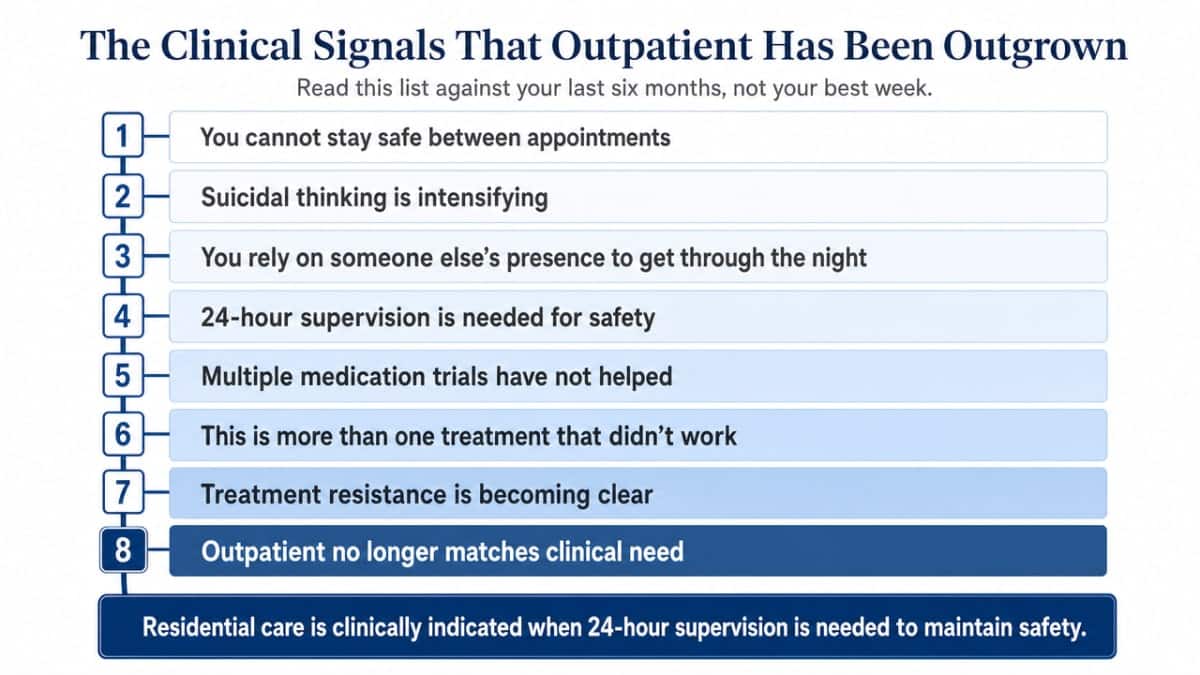
The Clinical Signals That Outpatient Has Been Outgrown
Here is the honest part. Most people don’t escalate care until something scares them, and by then a lot of ground has been lost. It’s worth naming the signals early, while you still have room to make a considered decision instead of an emergency one.
Read this list against your last six months, not your best week.
- You cannot keep yourself safe between appointments. Suicidal thinking is intensifying, or you’re relying on someone else’s presence to get through the night. SAMHSA’s TIP 42 is direct that when a person needs 24-hour supervision to maintain safety, residential care is what’s clinically indicated.3
- You’ve had multiple medication trials without meaningful response. Not one that didn’t work — several. Treatment-resistant presentations require more intensive interventions than a single-disorder or first-line case, and that includes settings with the psychiatric staffing to try more complex strategies.11
- Relapses are happening within days or weeks of discharge or a med change. Short stabilization followed by fast decompensation is one of the clearest signs that outpatient reinforcement isn’t enough to hold the gains.
- Substance use and psychiatric symptoms are actively worsening each other. Drinking to sleep, using stimulants to fight depression, going off meds when using — SAMHSA describes co-occurring disorders as conditions that “worsen each other,” and the interaction raises overdose and suicide risk.1,11
- You cannot function in your home environment. Not showering, not eating, missing work for weeks, unable to parent, unable to stay in your apartment alone. Level 3.5 exists partly to stabilize people whose home setting is contributing to acute instability.6
- Your outpatient team has raised the question. When a therapist or prescriber suggests a higher level of care, they’ve usually been watching the pattern longer than you have. That’s a signal, not an insult.
- You’ve been through outpatient before and it didn’t hold. Non-response to less intensive treatment episodes is a named criterion for stepping up, not evidence that you’re a difficult case.3
- Someone in your life is telling you they’re scared. Family members often see the trajectory before the person inside it does. Their alarm is data.
One of these on its own may not mean much. Two or three together, over months, usually does. If you’re recognizing yourself in this list, that recognition is the work. The next step is a real conversation with a program that can tell you honestly whether residential is the right match — not a promise that it is.
What ASAM 3.5 and 3.7 Actually Mean
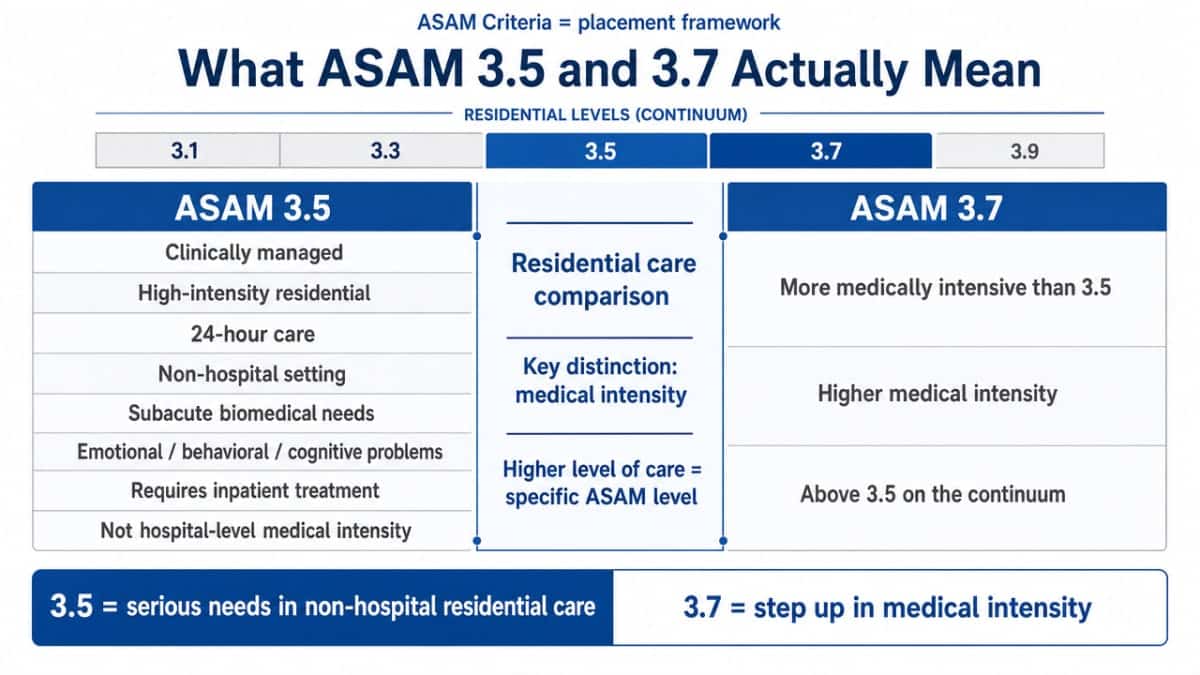
When a clinician says you need a “higher level of care,” they’re usually pointing at a specific number on a specific ladder. The American Society of Addiction Medicine’s placement criteria — the ASAM Criteria — are the national framework for deciding where someone belongs on the continuum, and payers, state Medicaid programs, and most treatment facilities use the same language. Learning what the two most common residential rungs mean helps you walk into any assessment call already knowing what’s being discussed.5
Level 3.5 is clinically managed high-intensity residential care. It provides 24-hour care in a non-hospital setting for people with what the criteria describe as subacute biomedical and emotional, behavioral, or cognitive problems — serious enough to require inpatient treatment, but not so acute that you need a hospital’s full medical resources. In plain terms, 3.5 is where you go when you cannot stabilize at home, when your symptoms and substance use are feeding each other, and when you need the structure of living in a treatment environment to interrupt that cycle. The ASAM Fourth Edition is explicit that 3.5-level programs put a greater share of their time into psychotherapy — individual, group, family — supported by psychiatric services rather than centered on them. Level 3.5 programs can also provide on-site supervised withdrawal management with rapid access to medications when that’s part of the picture.4,6,7,8
Level 3.7 is medically monitored intensive inpatient care. It’s still residential, but it’s staffed differently. Level 3.7 has 24-hour nursing care with physician availability, designed for people whose biomedical or psychiatric problems are significant enough that they need medical monitoring around the clock — not full ICU-level hospitalization, but not something a 3.5 program’s staffing model can safely hold. If you’re in active withdrawal from alcohol or benzodiazepines, if you have complicating medical conditions layered onto your psychiatric picture, or if your symptoms are severe enough that a nurse or physician needs to be reachable at any hour, 3.7 is the level built for that.6,8
The two levels are not a hierarchy of quality. They’re a hierarchy of medical intensity. A well-run 3.5 program with strong psychiatric services can be exactly the right match for someone with treatment-resistant depression, complex PTSD with substance use, or bipolar illness that has not stabilized on standard regimens. A 3.7 program is the right match when your presentation includes medical or psychiatric acuity that requires nursing eyes on you overnight.
ViewPoint operates in this residential range in Prescott, Arizona, with board-certified psychiatry available 24/7 and advanced medication protocols — including clozapine — that many programs do not offer. When you call for an assessment, part of what’s being determined is not just whether residential is right, but which residential intensity matches what you’re actually carrying. That decision is the ASAM Criteria doing its job, and it’s the same job your outpatient prescriber and your insurance company are already familiar with.5
Treatment Resistance vs. Being Told You Aren’t Trying
There’s a specific kind of exhaustion that comes from being a psychiatric patient whose symptoms don’t quit. You’ve done the homework between sessions. You’ve taken the medication on schedule, even when it made you nauseous or flat or unable to sleep. You’ve been honest with your therapist about the hard stuff. And you’re still not better.
Somewhere in that stretch, someone probably implied — or said outright — that the problem is your engagement. That you need to sit with the feelings longer. That if you’d just commit, this would work.
Treatment resistance is a clinical phenomenon, not a compliance one. The literature on co-occurring substance use and psychiatric illness is clear that these presentations often need more intensive interventions than a single-disorder case, and that psychiatric conditions and substance use each make the other harder to treat. Active substance use can also mimic or mask psychiatric symptoms, which means outpatient clinicians working in 45-minute windows are sometimes trying to treat a moving target without the assessment time to see it clearly.11
The distinction matters because it changes what happens next. If your struggle is non-adherence, the answer is coaching, structure, and support. If your struggle is treatment-resistant illness, the answer is a setting with the psychiatric depth to try strategies that outpatient can’t — longer observation windows, medication combinations that require close monitoring, protocols like clozapine that need structured titration, and the daily therapeutic contact to work on what’s underneath. SAMHSA’s foundational guidance explicitly names non-response to less intensive treatment as an indication for stepping up, not as evidence that the patient is the problem.3
If you’ve been carrying the story that you haven’t tried hard enough, put it down. What you need next isn’t more effort at the same level. It’s a different level.
The Dual-Diagnosis Blind Spot
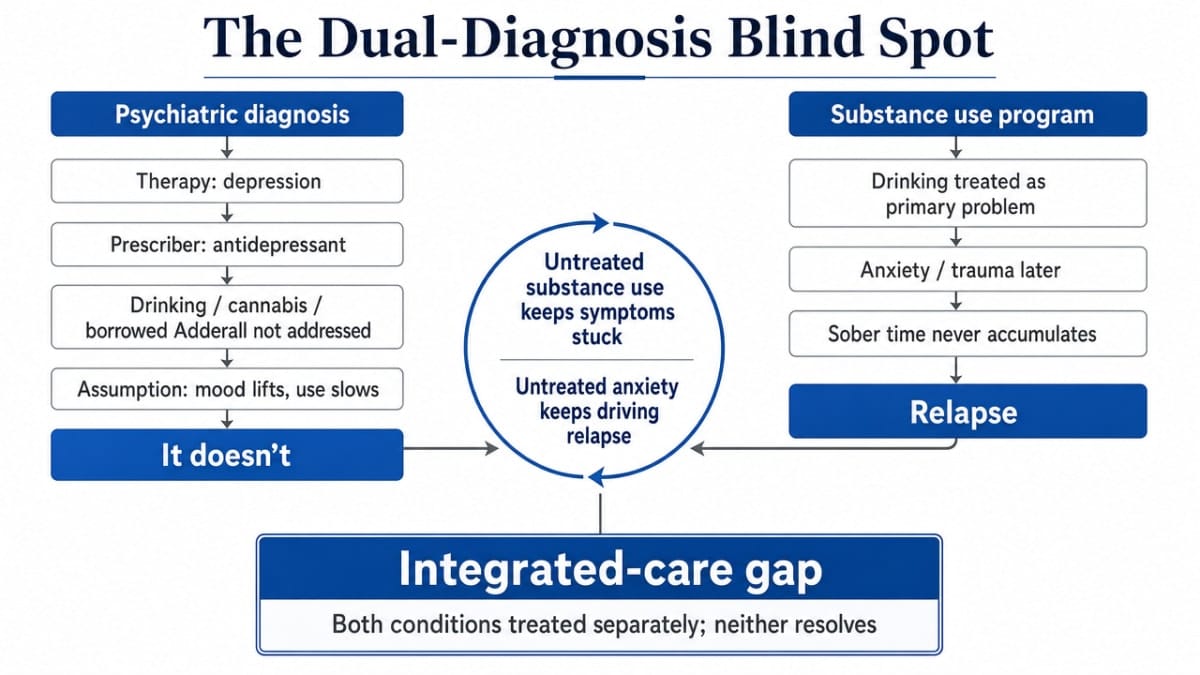
Here is the pattern that keeps people stuck for years. You have a psychiatric diagnosis. You also drink too much, or you’re using cannabis to sleep, or the Adderall your friend gives you is the only thing that gets you out of bed. Your therapist works on the depression. Your prescriber adjusts the antidepressant. Nobody’s really addressing the drinking, because it isn’t the presenting complaint, and the assumption is that if the mood lifts, the drinking will slow down. It doesn’t.
Or the reverse. You’ve been through an outpatient substance use program that treated the drinking as the primary problem, and the anxiety and trauma symptoms underneath got framed as things to work on later, once you had some sober time. The sober time never accumulated, because the untreated anxiety kept driving the relapse.
This is the integrated-care gap, and it is well documented. A 2019 review in Alcohol Research found that among adults with a co-occurring mental health condition and substance use disorder, only 8.3% received treatment for both conditions in the past year. Another 38.2% received mental health services only, 4.4% received substance use treatment only, and 49% received no treatment at all. Roughly half of the people carrying both diagnoses are getting nothing. Of the half who are in care, most are getting care for one side of the problem while the other side keeps running.10
If that sounds like your experience, you are not an unusual case. You are the modal case. SAMHSA’s foundational guidance is clear that co-occurring disorders worsen each other and that treating them in parallel systems — one for mental health, one for substance use — is a large part of why people cycle without progress . The residential dual-diagnosis model exists specifically to close this gap: one team, one treatment plan, both conditions on the table from day one.1,2
What you want to ask any program you consider is whether the psychiatry and the substance use work happen under the same roof, on the same case, with clinicians who actually talk to each other. That is the difference between integrated care and coordinated referrals, and for a treatment-resistant presentation, it’s usually the difference that matters.
What a Real Assessment Looks Like
If you call ViewPoint, the intake conversation is not a sales screen. It’s the first pass at a clinical question: does what you’re carrying match what residential care can actually do, and if so, at what intensity. SAMHSA’s guidance is direct that screening and assessment are the gateway to appropriate care, and that programs should treat every entry point as a legitimate one — the “no wrong door” principle. What that means for you is that the first call is a place to describe what’s happening, not a place to be sold on a bed.12
A serious assessment covers several layers, usually across more than one conversation.
History review. Not just diagnoses on paper, but the actual trajectory. Which medications you’ve tried, at what doses, for how long, and what happened when you stopped. Which therapists you’ve worked with and what the sessions focused on. Prior hospitalizations, prior residential stays, prior detox episodes. This is the part most outpatient intakes compress into a form. A real assessment slows it down, because the pattern in that history is often where the answer lives.
Integrated psychiatry and therapy consult. A board-certified psychiatrist looks at your medication history and current symptoms while a clinician looks at the therapeutic and behavioral picture — on the same case, not in separate silos. For treatment-resistant presentations, this is where questions about clozapine candidacy, complex medication combinations, and longer observation windows get raised. The ASAM Fourth Edition builds integrated co-occurring capable standards into every level of care, and a legitimate dual-diagnosis assessment reflects that from the first conversation.8
Medication reconciliation. A careful review of what you’ve been on, in what order, at what doses, and why each was stopped or changed. This sounds administrative. It isn’t. Many treatment-resistant patients have been through medication trials that were shorter than guidelines recommend, or combinations that were never fully optimized. A real reconciliation surfaces those gaps and shapes what comes next.
Dual-diagnosis screening. Structured questions about substance use — how much, how often, what happens when you stop, whether the use is intertwined with the psychiatric symptoms. SAMHSA is clear that failing to screen creates a domino effect: no screening, no assessment, no diagnosis, no treatment. This step is where the two sides of a co-occurring picture get put on the same page.5,12
Level-of-care recommendation. Using the ASAM Criteria — the same framework payers and outpatient prescribers reference — the team makes a placement recommendation. Sometimes that recommendation is 3.5. Sometimes 3.7. Sometimes it’s a lower level with specific enhancements. Sometimes it’s a referral elsewhere because a different setting is the better match. An honest assessment is willing to say the last one out loud.
What you should expect to walk away from that call with is not a decision, but clarity. Whether residential is indicated for your situation, which level, and what admission would actually involve.
What Residential Days Actually Contain
People imagine residential care as either a hospital ward or a wellness retreat. It’s neither. At the 3.5 level, a day has a shape, and knowing that shape ahead of time takes some of the fear out of the decision.
Mornings usually open with a check-in — vitals, a brief conversation with nursing about sleep and symptoms, medication administration. Then group therapy, which sounds softer than it is. At a program with a real psychotherapy focus, groups are working sessions: skills work, process work, trauma-informed content, relapse prevention when substance use is part of the picture. The ASAM Fourth Edition specifically notes that 3.5-level programs put a greater share of their time into psychotherapy compared with more medically managed settings.8
Afternoons typically include individual therapy at least several times a week, psychiatric appointments as often as your medication picture requires, and family sessions when family is part of the plan. At ViewPoint, that psychiatric contact is with board-certified physicians who can adjust medications quickly, run longer observation windows on new regimens, and — when clinically indicated — initiate protocols like clozapine that outpatient settings rarely attempt. Nursing is on-site continuously.
Evenings are quieter. Structured but not clinical. Meals, some free time, community time with the other residents, sleep hygiene that actually gets protected.
The evidence base for this model is stronger than treatment center marketing usually admits. Residential SUD treatment generally produces significant improvements in substance use, psychiatric symptoms, quality of life, and social functioning, particularly for unstable co-occurring presentations. That’s not a promise. It’s what the data show when the level of care finally matches what the person is carrying.9
Making the Call to ViewPoint
If some part of this article named what you’ve been living with, the useful next step is a conversation, not another months-long stretch of the same weekly cycle. ViewPoint Dual Recovery is a Joint Commission-accredited psychiatric facility in Prescott, Arizona, licensed by Arizona ADHS and LegitScript certified, specializing in treatment-resistant psychiatric conditions and dual diagnosis. Board-certified psychiatrists are on-site 24/7, and the assessment team works from the same ASAM framework your outpatient prescriber and insurance company already reference.5
When you call, you’re not committing to admission. You’re asking a clinical question: given what I’ve tried, what I’m carrying, and what isn’t holding, is a higher level of care indicated — and if so, which one. The answer might be yes, at 3.5. It might be yes, at 3.7. It might be a specific enhancement to your current outpatient plan. SAMHSA’s guidance treats every entry point into care as a legitimate one, and a real intake reflects that.12
You’ve been carrying this longer than you should have had to. Reach out to ViewPoint and find out what the honest recommendation is.
Find Out If Advanced Care Is Needed Next
Get clear guidance on whether residential treatment is the right next step for your situation.
Frequently Asked Questions
How do I know outpatient therapy isn’t working anymore?
Look at the last six months, not the last good week. If you cannot keep yourself safe between appointments, if medication trials keep failing, if relapses are happening within days of stabilization, or if your outpatient team has raised the question of a higher level of care, outpatient has likely been outgrown. SAMHSA guidance names non-response to less intensive treatment as a direct indication to step up.3
What is the difference between ASAM Level 3.5 and Level 3.7 residential care?
Both are 24-hour residential settings. Level 3.5 is clinically managed high-intensity care for subacute problems, with a greater share of time spent on psychotherapy. Level 3.7 is medically monitored intensive inpatient care with 24-hour nursing and physician availability, built for people whose biomedical or psychiatric acuity requires medical eyes on them around the clock. The two are a hierarchy of medical intensity, not of quality.4,6,8
Does needing residential treatment mean I failed at outpatient therapy?
No. It means the level of care did not match the severity of what you were carrying. SAMHSA’s TIP 42 explicitly names non-response to less intensive treatment as a criterion for stepping up, not as evidence the patient is the problem. Treatment-resistant psychiatric illness and co-occurring conditions often require more intensive interventions than outpatient can deliver in 45-minute weekly sessions. The mismatch is structural, not personal.3,11
What happens during a dual-diagnosis assessment?
A serious assessment covers medication and treatment history, an integrated psychiatry-and-therapy consult, careful medication reconciliation, structured substance use screening, and an ASAM-based level-of-care recommendation. Sometimes the recommendation is 3.5, sometimes 3.7, sometimes a specific enhancement to your current outpatient plan, sometimes a referral elsewhere. SAMHSA’s “no wrong door” principle means the first call is a clinical conversation, not a commitment to admission.5,12
Why do so many people with co-occurring disorders go untreated for one of them?
Mental health and substance use services grew up in separate systems, and most programs still treat one side of the picture at a time. The result is well documented: among adults with a co-occurring mental health condition and substance use disorder, 38.2% receive mental health services only, 4.4% receive substance use treatment only, and 49% receive no treatment at all. Integrated residential care exists specifically to close that gap.10
Can I still see my current therapist and psychiatrist after residential treatment?
Yes, and continuity is usually part of a good discharge plan. Residential care is a stabilization episode, not a replacement for your outpatient team. SAMHSA’s guidance emphasizes coordinated transitions across levels of care as needs change, including handoffs back to community prescribers and therapists. Expect the residential team to communicate directly with your outpatient providers so medication changes, therapy focus, and safety planning carry forward cleanly.1,2
References
- Managing Life with Co-Occurring Disorders. https://www.samhsa.gov/mental-health/serious-mental-illness/co-occurring-disorders
- Co-Occurring Disorders and Other Health Conditions. https://www.samhsa.gov/substance-use/treatment/co-occurring-disorders
- Substance Abuse Treatment for Persons With Co-Occurring Disorders (TIP 42, 2010). https://library.samhsa.gov/product/substance-abuse-treatment-persons-co-occurring-disorders/sma10-4531
- ASAM 3.5–3.7 Residential Levels of Care (Pennsylvania DDAP Presentation). https://www.pa.gov/content/dam/copapwp-pagov/en/ddap/documents/professionals/documents/asam-page/asam-update/asam%203.5-3.7%20powerpoint%20from%2010.1.18%20meeting%20with%20healthchoices%20representatives.pptx
- ASAM Criteria for Patients with Addiction and Co-occurring Conditions. https://www.samhsa.gov/resource/ebp/asam-criteria-patients-addiction-co-occurring-conditions
- The ASAM Criteria® – AHCCCS Brochure (Arizona Medicaid). https://www.azahcccs.gov/PlansProviders/Downloads/CurrentProviders/ASAMCriteriaBrochure.pdf
- Pathway to ASAM Fourth Edition Level 3.5 Clinically Managed High-Intensity Residential Treatment. https://hcpf.colorado.gov/sites/hcpf/files/ASAM%20Fourth%20Edition%203.5%20Residential%20Pathway%20Webinar%20Slides.pdf
- ASAM Criteria Fourth Edition Dissemination Summary – Colorado HCPF. https://hcpf.colorado.gov/sites/hcpf/files/ASAM-Fourth-Ed-Disseminate-Summary%20(1)%20(1).pdf
- Chapter 7—Treatment Models and Settings for People With Co-Occurring Disorders. https://www.ncbi.nlm.nih.gov/sites/books/NBK571024/?report=reader
- Integrating Treatment for Co-Occurring Mental Health Conditions. https://pmc.ncbi.nlm.nih.gov/articles/PMC6799972/
- Treatment for Substance Use Disorder With Co-Occurring Mental Illness. https://pmc.ncbi.nlm.nih.gov/articles/PMC6526999/
- Substance Use Disorder Treatment for People with Co-Occurring Disorders (Advisory). https://library.samhsa.gov/sites/default/files/pep20-06-04-006.pdf
- Substance Use Disorder Treatment for People With Co-Occurring Disorders (TIP 42, 2020 Update). https://www.psychiatry.wisc.edu/wp-content/uploads/2023/05/SAMHSA-TIP-42.pdf