
Key Takeaways
- Chronic impulsivity breaks into four measurable facets — motor inhibition, negative urgency, delay discounting, and reflection impulsivity — and each drives relapse through a different failure mode that needs a matched intervention.7
- Relapse in this pattern is the predictable output of under-functioning fronto-striatal circuitry and serotonergic and GABAergic dysfunction, not a motivation problem that more accountability can fix.8,5
- Only about 18% of SUD programs and 9% of mental health organizations are equipped for dual diagnosis, while integrated care improves adherence, relapse rates, and psychiatric stability.9,4
- DBT skills mapped to specific impulsivity failures — urge surfing, distress tolerance, chain analysis, dialectical abstinence — produced significant gains in executive function in methadone-maintained patients.1,10
Why the same relapse keeps happening
You already know the shape of it. The morning after. The phone in your hand, the messages you have to send, the appointment you have to reschedule, the person across the kitchen who is trying very hard not to look disappointed. And underneath all of it, the question you cannot answer for yourself: Why did I do that again, when I knew?
If you have completed a 30-day program, or two, or four, and still find yourself here, you are not lazy and you are not broken. You are running into a clinical pattern that most standard addiction treatment does not directly treat. Chronic impulsivity is not a mood or a mindset. It is a measurable, multidimensional feature of the brain — motor disinhibition, urgency under intense emotion, a pull toward the immediate over the delayed — and it both precedes substance use and outlasts detox. When it is left untreated, relapse is not a moral event. It is the predictable output of machinery that was never repaired.7
This article is written for the reader who has been through the cycle enough times to stop believing platitudes. You want the mechanism, the evidence, and a clear picture of what treatment for both impulse control and substance use actually looks like when they are addressed together, not in sequence.
Impulsivity is not one thing
The four facets that actually drive substance use
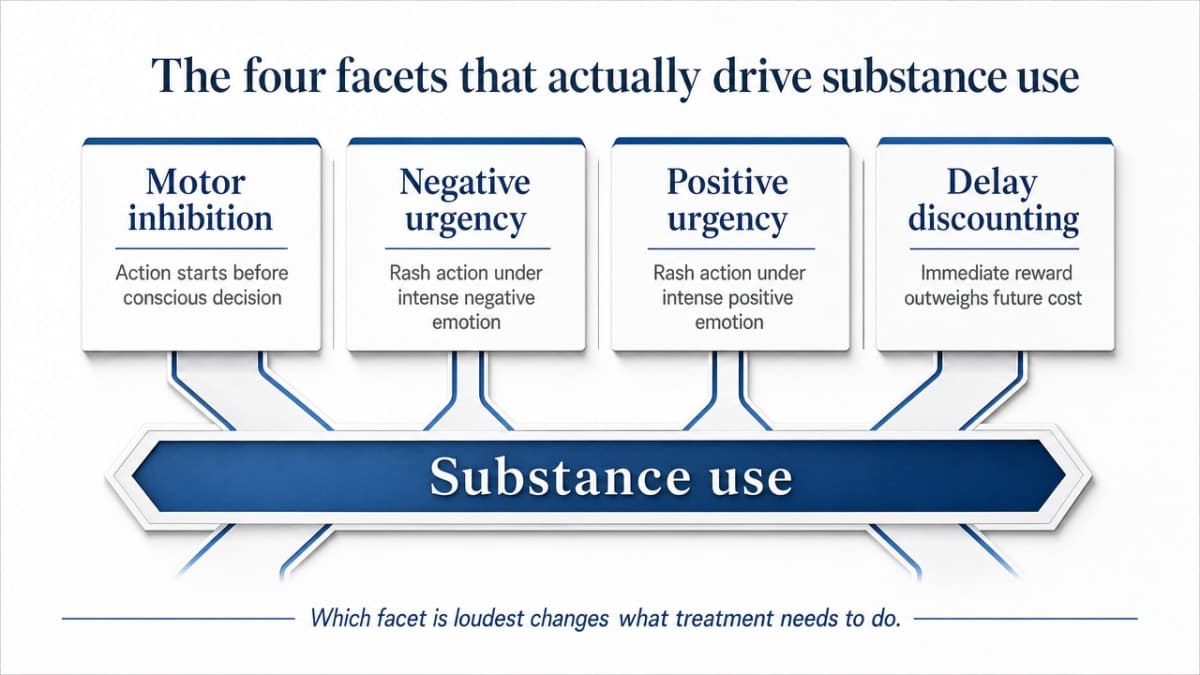
When a clinician says you are “impulsive,” that word is doing too much work. In the research literature, impulsivity breaks apart into at least four distinct facets, each with its own signature in how substance use actually plays out in a life. Understanding which facet is loudest for you changes what treatment needs to do.7
| Term | Description |
|---|---|
| Motor inhibition | Is the raw ability to stop a physical action once it has started. When this is impaired, the hand is already reaching for the drink, the pipe, the phone to text the dealer, before any conscious decision has finished forming. You do not talk yourself into it. You notice you are already doing it. |
| Negative urgency | Is the pull toward rash action under intense negative emotion. This is the facet that shows up after the fight with your partner, after the shame spiral, after the panic attack you did not see coming. The emotion is unbearable for ninety seconds, and using is the fastest way to make it stop. Negative urgency is one of the strongest predictors of both onset and relapse across substance classes. |
| Delay discounting | Is how sharply you devalue a future reward compared with an immediate one. A steeper discount curve means sobriety in six months feels almost weightless against relief in the next ten minutes. This is not a values problem. It is a measurable cognitive pattern that shows up on behavioral tasks in people with alcohol dependence, cocaine dependence, and gambling disorders. |
| Reflection impulsivity | Is the tendency to act before gathering enough information. You accept the invitation, the ride home, the pill someone offers, without the pause that would have let you notice the setup. In the aftermath, you can usually see everything you missed. That is the point — the deficit is in the pause itself, not in your intelligence. |
Naming the facet that runs your relapses is the first piece of work. The interventions that follow — urge surfing, distress tolerance, chain analysis — are not generic self-help. Each one is aimed at a specific failure mode in this list.
What the brain is actually doing
Under those four facets sits neurobiology that has been mapped in reasonable detail. The fronto-striatal circuitry — the connections between the prefrontal cortex, which weighs consequences and holds plans, and the striatum, which registers reward and initiates action — runs the loop that turns a craving into a behavior. In people with alcohol, cocaine, or gambling problems, this circuit shows measurable deficits in response inhibition and delay discounting on standard neurocognitive tasks.8
Two neurotransmitter systems keep coming up in the shared machinery of impulse control disorders and substance use disorders: serotonin, which modulates behavioral restraint, and GABA, the brain’s main inhibitory signal. Dysfunction in either can produce the felt experience of not being able to hold the brake down. This is part of why serotonergic medications sometimes help with both the impulsive behavior and the substance-related pattern at the same time.5
None of this means your brain is permanently broken. It does mean that willpower framing — “just want it more” — is the wrong tool. If the inhibitory circuitry is under-functioning, the fix has to involve building new skills that route around the deficit and, when indicated, medication that supports the underlying chemistry. That combination is what integrated dual diagnosis care is built to deliver.
Why standard rehab misses the mechanism
The dual diagnosis capacity gap
Here is the piece that almost no one says out loud when you are choosing a program: most of the places you can call are not built for what you actually have. According to NIDA’s research on comorbidities, about half of people who experience a mental illness will also develop a substance use disorder in their lifetime, and roughly one in four adults with serious mental illness has a co-occurring substance use disorder at any given time. That is not a rare presentation. That is the median case walking into treatment.9
What this looks like in practice: the rehab that runs excellent groups on triggers and refusal skills but has no psychiatrist on staff who will actually manage your medication. The outpatient therapist who is skilled with anxiety but tells you they “don’t do addiction” once you disclose. The 30-day program that stabilizes you physically and discharges you back into the same emotional dysregulation you arrived with. Integrated care — where the psychiatric and the addiction pieces are held by the same team, in the same treatment plan — is associated with better adherence, fewer relapses, and improved psychiatric stability compared with parallel or sequential treatment. The gap between what the evidence supports and what most programs actually deliver is the space you have been falling through.4
Relapse as predictable output, not moral failure
Consider what a standard relapse looks like when you rewind the tape. A hard emotion lands — grief, shame, rage, a body sensation you cannot name. Within seconds, before any narrative has formed, the pull toward the substance is already active. The rational part of you, the part that completed the workbook and knows the consequences, is late to the meeting. It arrives to find the decision already in motion. If your fronto-striatal circuitry is under-functioning and your negative urgency runs high, this is not a lapse of character. It is what that specific brain does under that specific load.8
Programs that treat relapse as a motivation problem tend to prescribe more motivation — more meetings, more accountability, more consequences. When the mechanism is impulsivity, that prescription treats the wrong variable. You can want sobriety badly and still lose the ninety seconds where the decision is actually made. Impulsivity accelerates the development of clinically significant substance use and complicates the course of recovery precisely because it operates below the level where willpower lives.8
The reframe matters clinically and personally. Clinically, it moves treatment toward interventions that build in the pause — skills that give the prefrontal cortex time to catch up with the striatum, and medication that supports the underlying inhibitory chemistry when indicated. Personally, it lets you stop carrying every relapse as evidence that you are, at some root level, the problem. You have been running the wrong protocol on the right hardware. That is a different situation, and it has a different answer.
Mapping DBT skills to specific impulsivity failures
Urge surfing for craving spikes
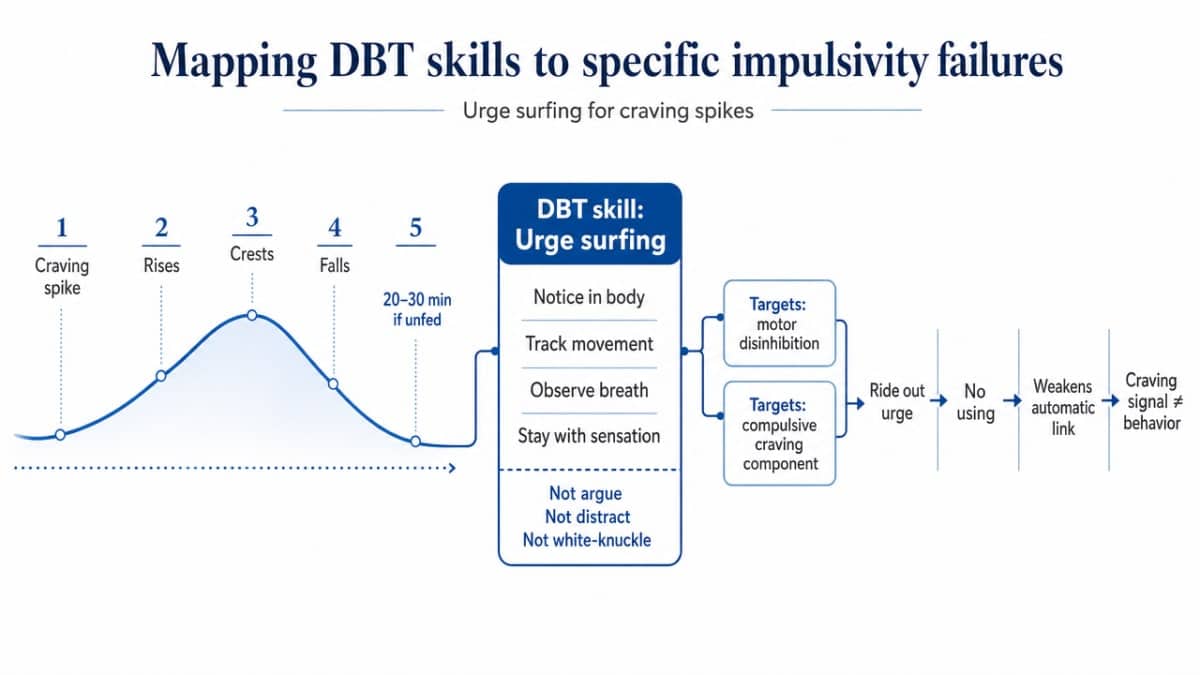
A craving is not a steady state. It is a wave — it rises, crests, and falls, usually within twenty to thirty minutes if nothing feeds it. The problem is that when you are inside one, it does not feel like weather. It feels like a verdict.
Urge surfing is the DBT-informed skill built specifically for that wave, and it is aimed directly at motor disinhibition and the compulsive component of craving. You are not asked to argue with the urge, distract from it, or white-knuckle through it. You are asked to notice it in the body — where it sits, how it moves, what it does to your breath — and stay with the sensation while it moves through its arc. The clinical logic is precise: every time you ride out an urge without using, you weaken the automatic link between the craving signal and the behavior that has followed it a thousand times.10
In the marijuana cessation pilot RCT, participants receiving DBT showed improvements across craving subscales including compulsivity, expectancy, and purposefulness — the very components that make an urge feel like a decision already made. That is what urge surfing is buying you: a few minutes of skilled attention that let the prefrontal cortex catch up.6
Distress tolerance for negative urgency
Negative urgency is the facet that runs most of the relapses you cannot explain. Something unbearable lands — a memory, a phone call, a body sensation that arrives without a name — and the pull to make it stop right now overwhelms every plan you made when you were calm.
Distress tolerance skills are the DBT answer to that specific failure mode. The skills are deliberately simple because they have to work when your thinking is offline: cold water on the face to trigger the mammalian dive reflex, paced breathing that lengthens the exhale, intense exercise for a short burst, or grounding through the five senses. None of these fix the emotion. They lower the physiological intensity enough that the urge stops feeling like an emergency.10
The point is not to feel better. The point is to survive the ninety seconds where the decision to use is actually made, without acting. Over time, this rewrites what your body learns about intolerable feelings — that they are, in fact, tolerable, and that you have a shelf of tools that work faster than a substance does.
Chain analysis for post-relapse learning
If you have relapsed, chain analysis is where the recovery of that relapse actually happens. It is a structured walk backward through the event — vulnerability factors, prompting event, thoughts, emotions, urges, actions, consequences — laid out link by link until the sequence becomes visible.10
What you find is almost never what shame tells you happened. You did not “just decide” to use. You slept four hours the night before. You skipped breakfast. You took a call from someone who has always destabilized you. You noticed a body sensation you interpreted as anxiety. You told yourself you would only drive past the place. Each link is small. Together, they form a chain that was, in retrospect, followable.
The clinical work is not confession. It is pattern recognition. Once a chain is on paper, you can identify the earliest link where a different skill would have changed the outcome, and rehearse that intervention for the next time the chain starts to form. Chain analysis converts a relapse from a source of shame into usable clinical data — which is the only thing that makes it worth what it cost you.
Dialectical abstinence and the Clear Mind/Addict Mind frame
Dialectical abstinence holds two truths at once: you commit fully to not using, and you plan skillfully for what to do if you slip, so a lapse does not become a full return to use. Rigid abstinence tends to collapse into shame at the first stumble. Harm reduction alone can drift. Holding both is what actually works for treatment-resistant patterns.10
The Clear Mind/Addict Mind frame gives you language for the states you have probably already noticed but could not name. Addict Mind is the state where using feels reasonable, plans get rewritten, and the risk gets minimized. Clean Mind, its opposite trap, is the overconfident state where you believe the problem is solved and stop practicing skills. Clear Mind is the middle — abstinent, alert, and honest that the pull is still real.10
Knowing which mind you are in when you make a decision is, itself, a skill. It is what lets you catch a shift before it becomes a chain.
What the outcome data actually shows
You have been promised results before. So it matters what the actual numbers say when DBT is added to substance use treatment, and where the data still has edges.
The most useful recent trial comes from a 2024 study of patients already stabilized on methadone maintenance — a population that looks a lot like the treatment-resistant reader this article was written for. These are people who have not been served by abstinence-only programs and who carry both an opioid use disorder and, very often, the fronto-striatal deficits that come with it. The intervention group received DBT alongside their existing pharmacotherapy. The measured outcomes were not vague mood ratings. They were core executive functions, the machinery underneath impulse control.1
Across five domains, DBT produced statistically significant improvements:1
- risky decision-making (F = 4.1, p = 0.04)
- attention (F = 18.2, p = 0.001)
- cognitive flexibility (F = 18.5, p = 0.001)
- problem-solving (F = 18.5, p = 0.001)
- planning (F = 14.10, p = 0.003)
Read those five together. Risky decision-making is the delay discounting problem. Attention and cognitive flexibility are what let you notice a chain forming and step out of it. Problem-solving and planning are what let you build a life that does not run on ninety-second decisions. The therapy moved every one of them in the same direction, in a population where standard treatment alone had not.
The systematic review of DBT skills training across SUD populations lands in the same territory, more cautiously. Across the studies pooled, DBT-ST was feasible, acceptable, and offered preliminary support for reductions in substance use and improvements in emotion regulation. The authors are honest that samples are still small and adaptations vary between programs. This is not a settled literature. It is a converging one — and the direction of convergence is that skills training aimed at the impulsivity mechanism does something distinct from what abstinence programming does.3
What none of this promises is a cure. What it does say, with more evidence each year, is that the executive functions you have watched fail you are not fixed traits. They respond to the right kind of training. That is a different clinical situation than the one most standard programs have been treating.
Where medication management fits alongside skills work
Skills training does real work on the machinery of impulsivity, but it is not the whole answer for every reader. If your inhibitory chemistry is genuinely under-functioning, no amount of urge surfing will fully compensate for a signal that never gets loud enough in the first place. This is where the pharmacology side of dual diagnosis care earns its keep.
The neurobiological overlap between impulse control problems and substance use disorders is not incidental. Both patterns implicate the serotonergic and GABAergic systems, and serotonergic agents have a documented role in managing impulse control disorders alongside substance use presentations. A psychiatrist working the case can evaluate whether an SSRI, a mood stabilizer, an anticraving agent, or medication-assisted treatment for opioid or alcohol use disorder belongs in your plan — and, just as importantly, whether medications you are already on are helping or quietly making the impulsivity worse.5
What matters is that the two sides are held by the same team. The DBT skills work becomes more accessible when the underlying dysregulation is medically supported, and the medication is more likely to hold when you have skills to manage the moments it does not fully cover. Integrated care that combines both is associated with better adherence, fewer relapses, and improved psychiatric stability compared with programs that hand you off between providers. At ViewPoint, board-certified psychiatry and DBT-informed therapy sit inside one treatment plan, not two.4
What integrated dual diagnosis care looks like day to day
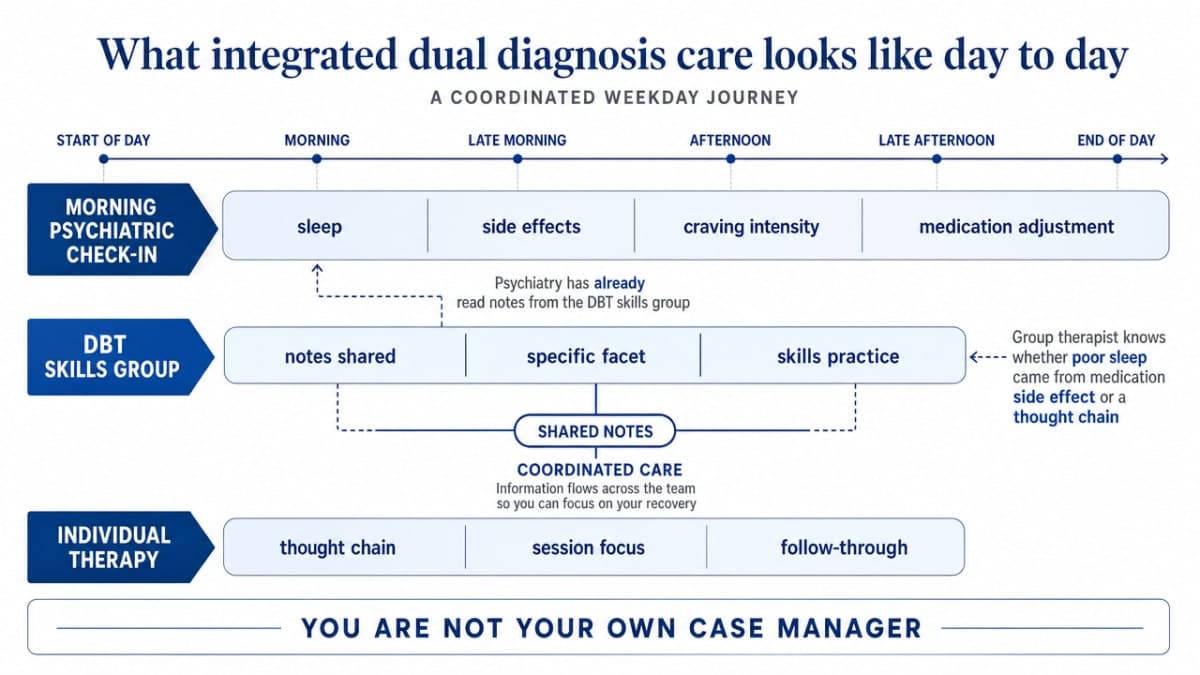
If you have only experienced sequential treatment — detox first, then a mental health referral three months later — integrated care is a different shape entirely. On a given weekday inside a program built for dual diagnosis, the psychiatrist who is managing your medication has already read the notes from your DBT skills group. The therapist running that group knows whether last night’s sleep was fractured by a medication side effect or by a chain of thoughts worth working through in session. Nothing about your care requires you to be your own case manager.
A day tends to move in layers. Morning psychiatric check-ins address the biology — sleep, side effects, craving intensity, whether an anticraving agent or mood stabilizer needs adjustment given what happened yesterday. Skills groups later in the day work the specific facet of impulsivity that is loudest in your presentation: distress tolerance for the reader whose relapses are driven by negative urgency, urge surfing for the reader whose motor disinhibition wins the ninety-second window. Individual therapy is where chain analyses get built after a slip or a near-miss, and where the results of that analysis get fed back into the treatment plan the whole team is working from.10
This is the coordination that produces the outcomes the evidence describes — better adherence, fewer relapses, improved psychiatric stability — when compared with programs that split the two problems between providers who never speak. At ViewPoint’s Prescott facility, board-certified psychiatry is on-site around the clock, treatment length is set by clinical need rather than a 30-day insurance clock, and the DBT-informed skills work is delivered inside the same care team, not referred out. If you have already run the parallel-treatment experiment and watched it fail, integrated dual diagnosis care is the specific alternative the clinical argument in this article has been pointing at.4
Evaluate Complex Impulsivity and Substance Use Patterns
Gain clear clinical guidance for addressing chronic impulsivity alongside co-occurring substance use challenges.
Frequently Asked Questions
Is impulse control disorder the same as addiction?
No, though they overlap in ways that matter. Impulse control disorders and substance use disorders often co-occur and share neurobiological machinery — particularly serotonergic and GABAergic dysfunction that undermines behavioral restraint. You can carry impulsive patterns without meeting criteria for addiction, and vice versa. When both are present, treating one while ignoring the other is what tends to fail.5
Why do I keep relapsing even after completing rehab?
Because most standard rehab treats abstinence and psychoeducation, not the impulsivity mechanism underneath. If your relapses are driven by negative urgency or motor disinhibition, the ninety-second window where the decision actually happens has never been directly trained. Impulsivity accelerates onset and complicates recovery in ways that willpower framing cannot reach. The pattern is clinical, not characterological — and it responds to different tools.8
How is dual diagnosis treatment different from standard addiction treatment?
In integrated dual diagnosis care, the psychiatric and substance use pieces are held by one team inside one treatment plan. The psychiatrist adjusting your medication reads the same notes as the therapist running your skills group. Integrated approaches are associated with better adherence, fewer relapses, and improved psychiatric stability compared with parallel or sequential care. Standard programs typically address one side and refer the other.4
Can DBT actually reduce impulsive substance use, or just help with emotions?
Both, and the executive function data is the more surprising piece. In a 2024 RCT of methadone-maintained patients, DBT produced significant gains in risky decision-making, attention, cognitive flexibility, problem-solving, and planning — the machinery of impulse control itself. A systematic review of DBT skills training across SUD populations also found preliminary support for substance use reduction alongside emotion regulation improvements.1,3
Do I need medication if I’m doing DBT skills work?
Not always, but often it helps. The shared serotonergic and GABAergic dysfunction underlying many impulse control and substance use presentations sometimes responds to serotonergic agents or anticraving medications. A board-certified psychiatrist working the case can evaluate whether medication belongs in your plan and whether current prescriptions are helping or hurting. Skills work becomes more accessible when the underlying chemistry is medically supported.5
How do I know if a program is truly equipped for dual diagnosis?
Ask specific questions. Is board-certified psychiatry on-site, not consulting from a distance? Does the same team hold both the medication and the therapy plan? Are DBT-informed skills — urge surfing, distress tolerance, chain analysis — delivered in-house rather than referred out? Only about 18% of SUD programs are equipped for dual diagnosis. The answers to those questions tell you which category you are calling.9,10
References
- Effects of Dialectical Behavior Therapy on Cognitive and Executive Functions in Patients Under Methadone Maintenance Treatment. https://pubmed.ncbi.nlm.nih.gov/39621497/
- Feasibility, Acceptability, and Potential Efficacy of a Self-Guided Internet-Delivered Dialectical Behavior Therapy Intervention for Substance Use Disorders: Randomized Controlled Trial. https://pmc.ncbi.nlm.nih.gov/articles/PMC10828941/
- Dialectical behaviour therapy skills training for individuals with substance use disorder: A systematic review. https://pubmed.ncbi.nlm.nih.gov/34337811/
- Guidance for Integrated Care of Patients with Substance Use and Mental Disorders. https://www.cdc.gov/drugoverdose/pdf/2024-guidance-integrated-care.pdf
- The relationship between substance use disorders, impulse control disorders, and pathological aggression. https://pubmed.ncbi.nlm.nih.gov/9702290/
- A pilot randomized controlled trial of dialectical behavior therapy for reducing craving and achieving cessation in patients with marijuana use disorder. https://pmc.ncbi.nlm.nih.gov/articles/PMC8835386/
- Impulsivities and addictions: a multidimensional integrative framework informing assessment and interventions for substance use disorders. https://pubmed.ncbi.nlm.nih.gov/30966920/
- Recent Research on Impulsivity in Individuals With Drug Use and Mental Health Disorders: Implications for Alcoholism. https://pmc.ncbi.nlm.nih.gov/articles/PMC4777895/
- Common Comorbidities with Substance Use Disorders Research Report (NIDA). https://www.ncbi.nlm.nih.gov/books/NBK571451/
- Treating Substance Use with DBT (CE training slide deck). https://cme.shamp.uidaho.edu/sites/default/files/media/2025-07/Treating%20Substance%20use%20with%20DBT.pdf