

Key Takeaways
- Only 18.6% of the 20.4 million U.S. adults with co-occurring disorders received both types of treatment in 2023, leaving most without adequate care 2.
- A 2025 umbrella review of 28 systematic reviews found integrated treatment usually outperformed treating one disorder alone or delivering uncoordinated separate services 1.
- Integrated care produces clearer gains in psychiatric symptoms, while substance-use outcomes and retention show mixed results and no consistent advantage over separate treatment 7.
- Coordinating treatment for both conditions reduces hospitalizations, arrests, and crisis episodes, lowering the odds that someone cycles through emergency rooms and holding cells 6.
- Housing stability and daily functioning improve under integrated care, with SAMHSA and NICE both treating housing as a clinical outcome rather than an afterthought 4, 12.
- Treatment satisfaction and engagement rise when one team addresses both conditions equally, which protects against the dropout that often precedes relapse and rehospitalization 9.
- Quality of life and social outcomes, including relationships, work, and participation in daily life, move in the right direction under integrated management 11.
Why the Numbers on Co-Occurring Care Actually Matter to You
If you’ve already watched someone you love bounce between a mental health clinic and a separate addiction program, you know how exhausting fragmented care can be. Two sets of intake forms. Two treatment plans that don’t quite talk to each other. A psychiatrist who manages medications but asks you not to discuss drinking, and a counselor who addresses substance use but shrugs at panic attacks. You’re the one holding the pieces together, and it’s wearing you down.
So when you search for data on integrated care, you’re not looking for a sales pitch. You want to know whether coordinating treatment for both conditions actually produces different results, and how big that difference really is.
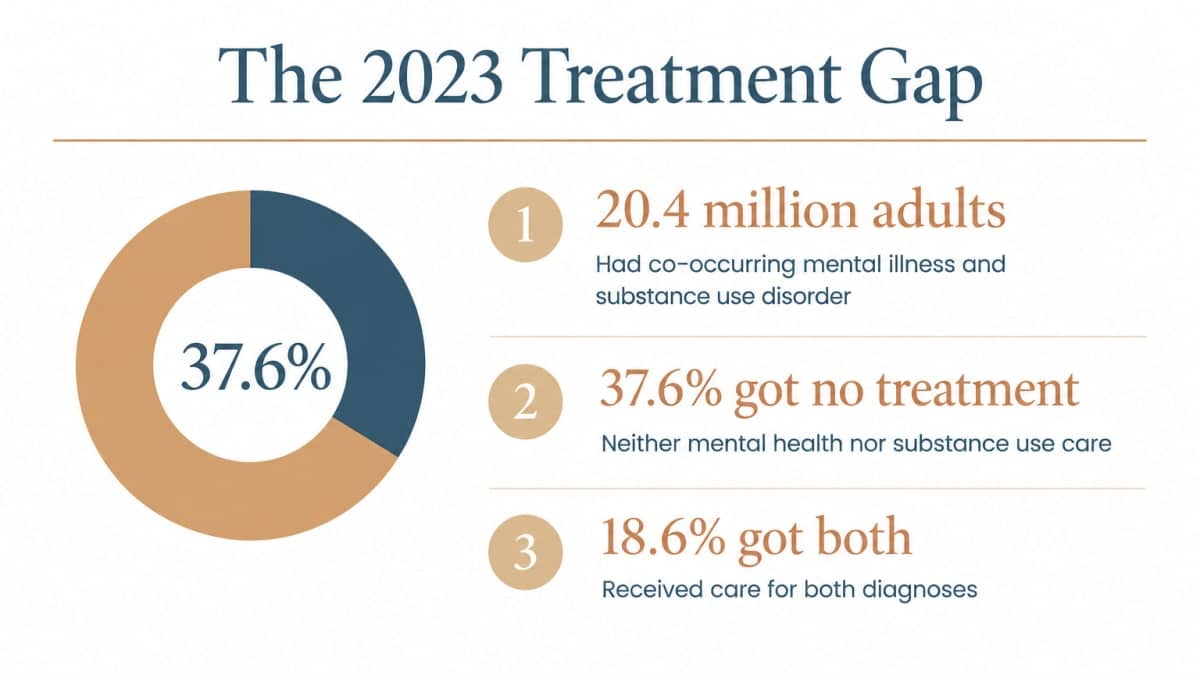
Here’s the backdrop that makes every outcome number more urgent. In 2023, roughly 20.4 million U.S. adults had both a mental illness and a substance use disorder, and only 18.6% of them received both types of treatment they needed 2. The rest got partial care, or none at all. That gap is not a minor detail. It shapes who shows up in emergency rooms, who cycles through housing instability, and who finally finds steady ground.
The seven findings ahead give you an honest read of what the research actually shows, where integrated treatment clearly helps, and where the evidence stays mixed. You deserve both halves of that picture before you make your next call.
What ‘Integrated Care’ Really Means (and What It Doesn’t)
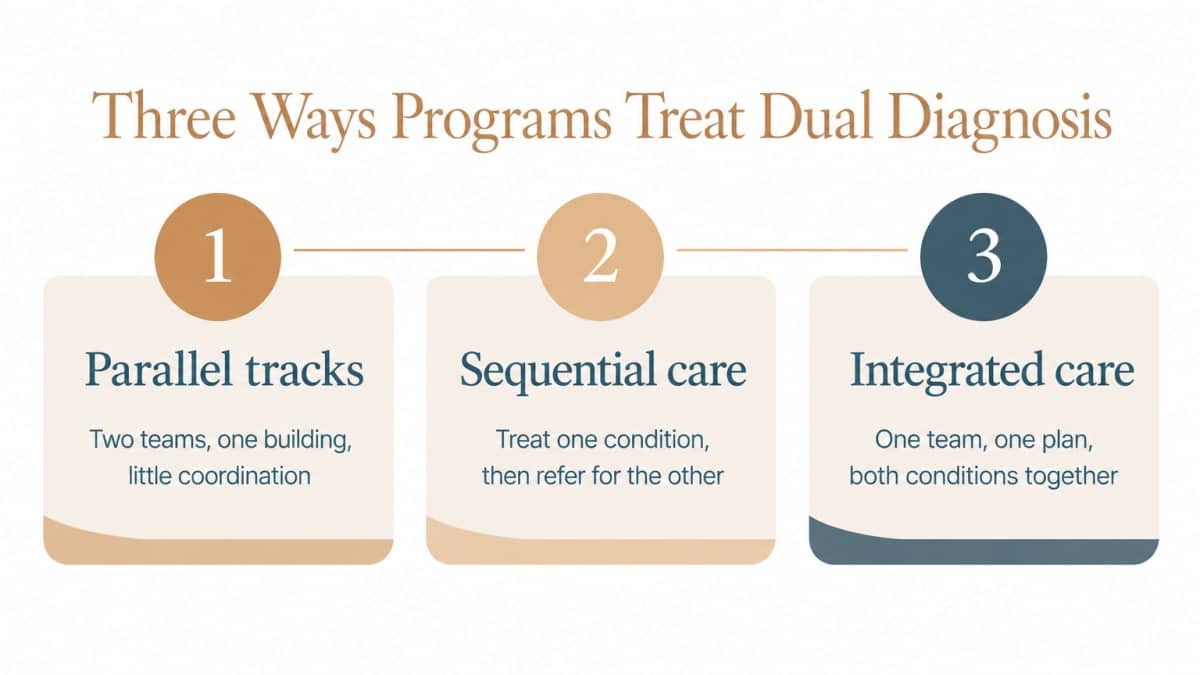
Here’s where a lot of confusion starts. Plenty of programs advertise “dual diagnosis treatment,” but what you actually receive can look very different from one place to the next. Some run two parallel tracks under one roof. Others treat one condition first, then refer out for the second. A few do what the research actually describes as integrated care.
SAMHSA defines integrated treatment as a strategy in which interventions for both the substance use disorder and the mental disorder are combined in a single session or series of sessions, delivered as part of one coordinated plan 5. Read that again. Same session, or a planned sequence of sessions that one team owns. Not two clinicians who happen to work in the same building and swap occasional emails.
That distinction matters because the outcomes research hinges on it. When studies compare “integrated” to “non-integrated” care, they’re comparing a team that treats both conditions together to arrangements where the two problems get handled on separate tracks, in separate appointments, often with separate goals 7. Those are structurally different experiences for you or your loved one.
SAMHSA frames integrated care as a whole-person approach, not a bundle of services tossed together 4. The screening addresses both conditions. The treatment plan addresses both conditions. The medication decisions account for both. The therapist and the psychiatrist actually talk, often in the same case conference, and the plan adjusts in real time.
Keeping this definition in mind changes how you read every statistic that follows. The findings ahead describe outcomes from real integration, not from the looser arrangement that often shares the name.
The 7 Research Findings on Integrated Care Outcomes
Finding 1: Most Adults With Co-Occurring Disorders Still Get No Treatment at All
Before any outcome debate matters, you have to see the shape of the problem. Of the 20.4 million U.S. adults who had both a mental illness and a substance use disorder in 2023, 37.6% received no treatment of any kind, and only 18.6% received both types of care their diagnoses called for 2. In raw numbers, 7.7 million adults got neither mental-health nor substance-use services that year 3.
Sit with that for a moment. The population these findings describe is enormous, and most of it is standing outside the treatment system entirely. That is the starting line for every conversation about whether integrated care works. The debate about which model produces better symptom scores is important, but it reaches only the small fraction of people who actually get through the door.
Among the adults who did receive some care in 2023, most got mental-health treatment only, not substance-use treatment, and not both together 3. That means even inside the treatment system, partial coverage is the norm. A person might see a therapist for anxiety for months while their drinking goes unaddressed, or finish a 30-day program for opioid use while their bipolar disorder stays unmanaged after discharge.
If you’ve been fighting to get a loved one connected to care, this data is not meant to discourage you. It’s meant to validate what you’ve probably already sensed: the system is not built for people with two diagnoses, and finding a program that treats both at once is genuinely harder than it should be. You are not imagining the difficulty, and you are not alone in it. The access gap is the single biggest reason outcomes at the population level stay stuck, no matter how good any one program’s results look.
Finding 2: Integrated Treatment Usually Beats Treating One Disorder Alone
When researchers put all the available evidence on one table, a clear pattern shows up. A 2025 umbrella review synthesized 28 systematic reviews drawn from more than 5,400 records and concluded that integrated treatment was usually better than treating one disorder alone, and sometimes better than separate, uncoordinated services 1. That is the broadest, most current synthesis available, and it points in one direction.
The word “usually” is doing honest work in that sentence. The reviewers did not find a single psychosocial model that outperformed every alternative across every diagnosis. Studies varied in intervention type, follow-up length, dropout rates, and the comparator groups also improved 1. What held up was the directional finding: addressing both conditions together produced better outcomes than ignoring one of them.
If you have watched someone bounce between a mental health clinic and an addiction program with no shared plan, this finding may be the most important one for you. It tells you that the exhaustion of coordinating care yourself, the appointments that contradict each other, the medications no one is tracking together, is not just inconvenient. It is probably producing worse results than a program that handles both conditions on one plan. The research supports what your experience has been telling you.
Finding 3: Psychiatric Symptoms Improve More — but Substance-Use Gains Are Mixed
Here is where the picture gets more nuanced, and where honest sources matter. A 2023 systematic review and meta-analysis compared integrated and non-integrated treatment specifically for dual-diagnosis populations and found a clear advantage for integrated treatment on psychiatric symptom improvement 7. On that general category of psychiatric symptom improvement, integrated programs outperformed programs that treated the disorders separately.
Substance-use outcomes were a different story. The same meta-analysis found no significant benefit for integrated treatment on substance misuse or on treatment retention 7. The authors concluded that evidence was not strong enough to establish broad superior efficacy of either approach across all outcomes. Read that carefully. Integrated care did not do worse on substance use, but it did not clearly do better on that specific endpoint either.
A review focused on alcohol use disorder and co-occurring mental-health conditions echoed the caution. The authors noted that evidence for superior efficacy of integrated treatment remains limited, and one included systematic review found no significant differences in substance use, functioning, or life satisfaction when compared to usual care 8.
What does this mean for you? It means that if the main thing you need addressed is psychiatric symptoms, say, the suicidal depression that fuels the drinking, integrated care has stronger evidence on your side. If your primary question is whether integrated treatment will cut substance use more than a specialized addiction program alone, the honest answer is: maybe, but the data is not conclusive on that specific point.
This is not a reason to lose faith in integration. It is a reason to ask any program a direct question: how do you measure substance-use outcomes, and what does your team do when they do not improve on schedule? Programs that cannot answer that are not managing the harder half of the problem.
Finding 4: Fewer Hospitalizations, Arrests, and Crisis Episodes
Symptom scores tell part of the story. What happens in the rest of a person’s life tells more of it. The SAMHSA evidence-based practices kit reported positive outcomes across hospitalization rates, arrests, and functional status, not just clinical symptom scales 6. These are the outcomes you probably care about most if you have been the one answering 2 a.m. calls from the emergency department or posting bail.
SAMHSA’s current patient-facing guidance lists fewer hospitalizations among the specific benefits of integrating screening and treatment for both conditions 4. The international clinical guidelines review found that evidence linked integrated management with reductions in substance abuse and improvements in psychiatric symptoms, which together drive down the crisis events that put people in hospital beds and holding cells 11.
The flip side is also worth naming. The SAMHSA kit was clear that clients who do not respond to outpatient integrated services remain at elevated risk for hospitalization, incarceration, homelessness, and other adverse outcomes 6. Integration is not a shield. It is a care structure that reduces the odds of crisis for most people, while a subset still needs higher levels of care.
If your loved one has already been hospitalized more than once, this finding is where the practical argument for integrated treatment lives. Each avoided hospitalization is a week of someone’s life returned to them. Each avoided arrest is a record that does not follow them into their next job interview or custody hearing. Those are the wins that compound.
Finding 5: Better Housing Stability and Daily Functioning
Co-occurring disorders and housing instability travel together, and researchers have been tracking that connection for a long time. SAMHSA’s evidence-based practices kit identified housing stability as one of the outcome domains where integrated treatment produced positive results, alongside functional status and quality of life 6. SAMHSA’s current patient guidance names greater housing stability directly as an expected benefit of integrating care for both conditions 4.
The NICE guideline for coexisting severe mental illness and substance misuse goes further on the service-design side. It recommends coordinated services that address wider health and social-care needs, including employment and housing, through partnership working across specialist services, health and social care, and support services 12. The underlying logic is simple. A person who is stably housed and employed has a much better chance of keeping appointments, taking medications on schedule, and avoiding the environments that trigger relapse.
Daily functioning follows the same pattern. The international guidelines review found that integrated management was linked to improved psychiatric symptoms and quality of life, with social outcomes moving alongside clinical ones 11. These are the measures that matter when you ask whether someone is actually getting their life back, not just whether their chart looks better.
If stable housing has been the piece that keeps slipping away during previous treatment attempts, look for programs that treat it as a clinical outcome, not an afterthought. The evidence says it belongs on the treatment plan.
Finding 6: Higher Treatment Satisfaction and Engagement
Satisfaction can sound like a soft outcome until you remember what it predicts. People who feel heard and respected show up for the next appointment. People who feel bounced between unconnected providers stop showing up, and dropout is one of the strongest predictors of relapse and rehospitalization.
A systematic review of strategies to improve integration in alcohol-and-other-drug treatment settings found that, with some exceptions, prior reviews generally reported improved alcohol-and-other-drug or mental-health outcomes and higher treatment satisfaction among clients receiving integrated care 9. Higher satisfaction was not a side effect. It was tracked as a core engagement outcome, and it moved in the right direction when care was coordinated.
There is a reason this matters for you specifically. If you have watched someone discharge themselves against medical advice because their psychiatrist dismissed their drinking, or because their counselor refused to discuss panic attacks, you already know how fragile engagement is in dual diagnosis. The research is validating what you have seen. When one team addresses both conditions with equal weight, people stay in treatment longer.
Finding 7: Quality of Life and Social Outcomes Move in the Right Direction
The last finding is the one that holds the others together. The international clinical guidelines review examined whether dual-diagnosis evidence addressed outcomes beyond symptom scales and found that integrated management was linked to reductions in substance abuse, improved psychiatric symptoms, better quality of life, and better social outcomes 11. Quality of life is not a vague feel-good measure here. It covers the ability to maintain relationships, hold work or school commitments, and participate in daily life without constant crisis.
SAMHSA’s patient-facing guidance lists improved quality of life among the expected benefits of integrating screening and treatment for both conditions, alongside reduced substance use and improved functioning 4. The NICE guideline reinforces the social frame by requiring that coordinated services address employment, housing, and broader social care, not only clinical symptoms 12.
What does this look like in a person’s life? It looks like being able to attend a family dinner without the dread of a scene. It looks like a part-time job that lasts more than a few weeks. It looks like a parent being present for a child’s school event instead of being too anxious or too intoxicated to go.
If someone you love has been surviving but not living for a long time, this is the finding that explains what integrated care is actually trying to restore. Not just lower scores on a depression inventory. A life with room in it again.
Where the Evidence Is Honest About Its Limits
You deserve the caveats, not just the wins. The 2025 umbrella review that supports the broad case for integrated care also found that no single psychosocial model could be recommended as superior across the board, because studies varied widely in dropout rates, follow-up length, and the fact that comparator groups also improved 1. People in usual care often get better too. That is worth remembering before you treat any outcome gap as a clean before-and-after.
The 2023 meta-analysis is even more direct. Its authors concluded that the evidence was not strong enough to establish broad superior efficacy of integrated treatment on every endpoint, especially for substance misuse and retention 7. The alcohol-use-disorder review reached a similar place, noting that one included systematic review found no significant differences in substance use, functioning, or life satisfaction compared with usual care 8.
Older landmark syntheses carry their own limits. The SAMHSA evidence-based practices kit that documented gains across hospitalization, housing, arrests, and quality of life draws on research from the 2000s, and SAMHSA itself notes methodological constraints in the underlying studies 6. The international guidelines review found real variation in the scope and quality of national guidelines, which means the strength of recommendations is not identical from one country or setting to another 11.
None of this unwinds the case for integrated care. It tightens it. The honest reading is that integration consistently helps psychiatric symptoms, engagement, hospitalization, and housing stability, while substance-use outcomes and retention depend heavily on how the program is actually run. Ask any program you are considering how they track those harder measures over six and twelve months, not just at discharge. The answer will tell you whether they are managing to the full picture or only to the parts that look best on paper.
What These Findings Mean for Your Next Decision
Pull the seven findings together and a practical picture emerges. Integrated care is not a magic word. It is a specific way of organizing treatment that, when it is actually delivered, produces stronger psychiatric symptom improvement, better engagement, fewer hospitalizations, more stable housing, and better quality of life than fragmented alternatives 1, 6, 11. Substance-use outcomes and retention are where the picture gets more complicated, and that is worth knowing before you choose a program 7, 8.
So what do you do with that? A few concrete things.
- Ask any program you are considering how its psychiatrist and therapist share decisions on a single case. If the answer is vague, you are probably looking at parallel care. SAMHSA’s definition is specific: interventions for both conditions combined in the same session or a planned sequence, delivered by one team 5. That is the structure the outcomes research describes.
- Ask how substance-use outcomes are measured at six and twelve months, not only at discharge. Programs that track the harder endpoints are the ones managing to the full picture.
- Ask what happens when someone is not responding. The honest answer involves medication changes, higher levels of care, and family involvement, not a quiet discharge.
If you have been carrying the coordination load for someone you love, you have already done more than most systems ask of a family member. A program like ViewPoint Dual Recovery in Prescott, Arizona is built for the complex cases others turn away. The next call does not have to be another cold intake. It can be the one where someone finally picks up both halves of the problem at once.
See If Integrated Care Fits Your Needs
Discuss your mental health and substance use needs to understand which treatment approach may be right for you.
Frequently Asked Questions
What does ‘integrated care’ mean for co-occurring disorders?
Integrated care means interventions for both the substance use disorder and the mental disorder are combined in a single session or a planned series of sessions, delivered by one coordinated team 5. Screening, treatment planning, medication decisions, and therapy all account for both conditions at once. If a program hands you two separate plans with two separate teams who rarely talk, that is parallel care, not integrated care.
Does integrated treatment work better than treating one disorder at a time?
Usually, yes. A 2025 umbrella review of 28 systematic reviews concluded that integrated treatment was generally better than treating one disorder alone, and sometimes better than uncoordinated separate services 1. The gain is clearest for psychiatric symptoms, engagement, and crisis-related outcomes. It is not a guarantee on every endpoint, and comparator groups often improve too, so the honest read is “usually better,” not “always superior.”
Which outcomes improve the most with integrated care?
The strongest gains show up in psychiatric symptoms, hospitalization rates, housing stability, functional status, and quality of life 6, 7, 11. Treatment satisfaction and engagement also tend to climb when one team addresses both conditions together 9. SAMHSA names reduced substance use, fewer hospitalizations, improved functioning, better housing stability, and improved quality of life as expected benefits when screening and treatment cover both conditions 4.
Where is the research still mixed or uncertain?
Substance-use outcomes and treatment retention are where the evidence gets softer. A 2023 meta-analysis found an advantage for integrated care on psychiatric symptoms but no significant benefit for substance misuse or retention 7. A review focused on alcohol use disorder reached a similar caution, noting that evidence for broadly superior efficacy is limited 8. Integrated care does not do worse on these measures, but superiority is not consistently proven.
How can I tell if a program delivers real integrated care or just claims to?
Ask how the psychiatrist and therapist share decisions on a single case. Ask whether both conditions are addressed in the same session or a planned sequence by one team, which is SAMHSA’s actual definition 5. Ask how substance-use outcomes are tracked at six and twelve months, not only at discharge. Vague answers, split charts, or “we refer out for that” usually point to parallel care wearing an integrated label.
Why do so many adults with co-occurring disorders still receive no treatment?
The system was built on separate tracks for mental health and substance use, and programs that handle both well are harder to find. In 2023, 7.7 million U.S. adults with co-occurring disorders received neither type of care 3. Among those who did get help, most received mental-health treatment only, not both 3. Cost, stigma, geography, and the lack of truly integrated programs all keep that gap wide.
References
- Effectiveness of Psychosocial Interventions for Adults With Substance Use Disorder That Have a Co-Occurring Common Mental Health Disorder: An Umbrella Review. https://pmc.ncbi.nlm.nih.gov/articles/PMC12682421/
- Key Substance Use and Mental Health Indicators in the United States. https://www.samhsa.gov/data/sites/default/files/reports/rpt47095/National%20Report/National%20Report/2023-nsduh-annual-national.htm
- Highlights for the 2023 National Survey on Drug Use and Health. https://www.samhsa.gov/data/sites/default/files/NSDUH%202023%20Annual%20Release/2023-nsduh-main-highlights.pdf
- Managing Life with Co-Occurring Disorders. https://www.samhsa.gov/mental-health/serious-mental-illness/co-occurring-disorders
- Substance Use Disorder Treatment for People With Co-Occurring Disorders. https://library.samhsa.gov/sites/default/files/pep20-06-04-006.pdf
- Integrated Treatment for Co-Occurring Disorders: The Evidence. https://library.samhsa.gov/sites/default/files/ebp-kit-the-evidence-10242019.pdf
- Integrated vs non-integrated treatment outcomes in dual diagnosis: A systematic review and meta-analysis. https://pmc.ncbi.nlm.nih.gov/articles/PMC10157410/
- Integrating Treatment for Co-Occurring Mental Health Conditions. https://pmc.ncbi.nlm.nih.gov/articles/PMC6799972/
- Strategies to facilitate integrated care for people with alcohol and other drug problems: a systematic review. https://pmc.ncbi.nlm.nih.gov/articles/PMC5384147/
- Cognitive-Behavioral Interventions Targeting Alcohol or Other Drug Use and Co-Occurring Mental Health Problems: A Meta-Analysis. https://pmc.ncbi.nlm.nih.gov/articles/PMC8406071/
- Scope, quality and inclusivity of international clinical guidelines on mental health and substance abuse in relation to dual diagnosis, social and community outcomes: a systematic review. https://pmc.ncbi.nlm.nih.gov/articles/PMC8066498/
- Coexisting severe mental illness and substance misuse: community health and social care services. https://www.nice.org.uk/guidance/ng58