

Key Takeaways
- Persistent anger after treatment often signals untreated trauma, mood instability, psychosis, or withdrawal rather than a skills deficit, and substances temporarily mask but ultimately amplify it.
- Standard eight-week anger classes assume a stable nervous system and rarely screen for PTSD, bipolar irritability, or psychotic agitation, leaving the underlying drivers active.
- Integrated dual diagnosis care, where psychiatry and therapy share one formulation, treats anger alongside medication decisions, trauma work, and relapse prevention for more durable results.2
- Families and clinicians should plan for clinical-need-based length of stay, since fixed 30-day insurance timelines rarely allow medication trials, trauma processing, and anger reassessment to complete.
Why Anger Persists After Standard Treatment
You have likely experienced the cycle: complete a program, practice coping skills, and achieve a period of calm. Then, an external trigger or internal stressor reignites the anger, often leading back to substance use or a near relapse. Standard anger management and even typical rehab programs often fail to address the underlying causes of this persistent anger.
For individuals with co-occurring psychiatric and substance use conditions, anger is not merely a behavioral issue or a lack of coping skills. Instead, it functions as a symptom, frequently emerging when underlying trauma, mood disorders, psychosis, or withdrawal are active. Substances may temporarily suppress this anger but ultimately amplify it. The anger returns because the core issues driving it were never fully addressed.
This article explores the true drivers of anger in these complex cases, explains why conventional eight-week courses are insufficient, and details how an integrated dual diagnosis program approaches anger as an integral part of a comprehensive clinical picture.
Anger as a Clinical Signal, Not a Character Flaw
The Clinical Measurement of Anger
Many standard anger management programs overlook a crucial fact: anger is clinically measurable. Professionals use validated scales to assess trait anger, state anger, hostility, and aggression. Research consistently shows that individuals who use psychoactive substances exhibit elevated anger scores compared to non-users, and this heightened anger is a significant risk factor for relapse. A 2021 systematic review and meta-analysis confirmed this pattern, highlighting that elevated anger predicts future substance use issues. This is not a moral judgment but a clinical indicator, much like blood pressure readings.6
Understanding anger as a measurable variable transforms its role in a clinical setting. It is not a sign of personal failure but a predictor of future outcomes. If a program assesses anger at intake, treats substance use, but never re-evaluates the anger, clients may leave with the same underlying issues, leading to subsequent crises.
The meta-analysis authors explicitly recommended that substance use treatment programs incorporate intensive, targeted anger modules focusing on daily stressors, family conflicts, and frustrations. These modules should be core clinical work, not mere add-ons. If previous programs offered only a workbook for anger, it indicates that the clinical measurement of anger was not integrated into the treatment plan, leaving a critical gap.6
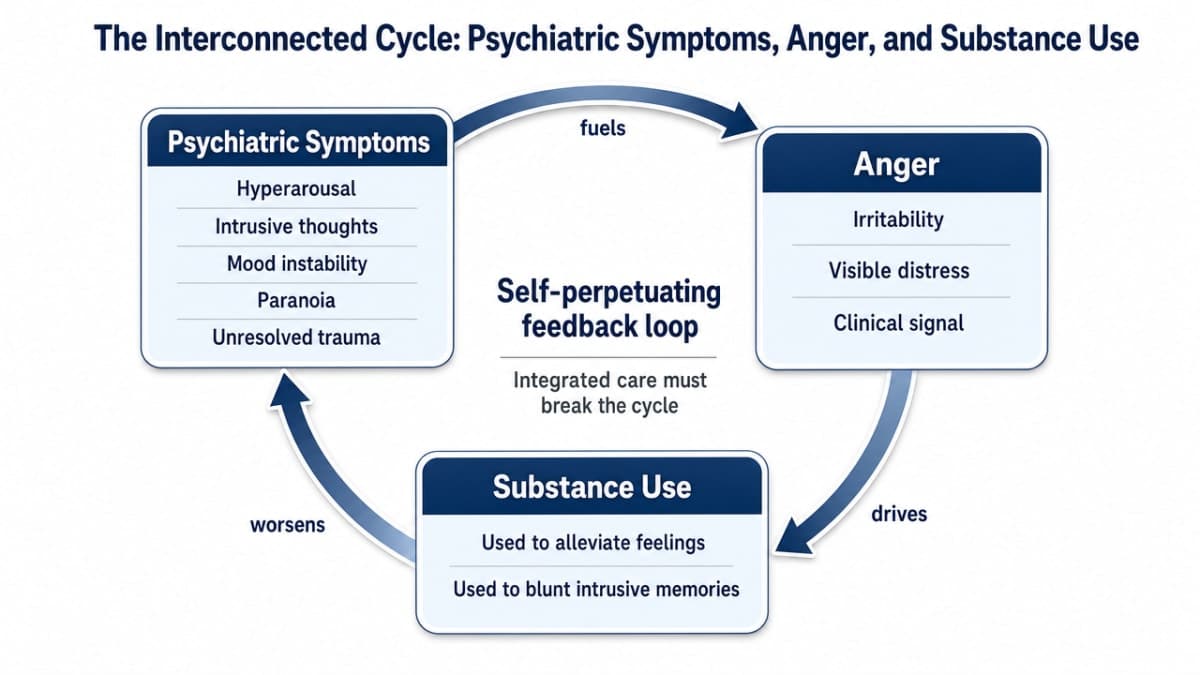
The Interconnected Cycle: Psychiatric Symptoms, Anger, and Substance Use
When anger is recognized as a clinical signal, the next step is to identify what it signifies. In populations with treatment-resistant conditions and dual diagnoses, anger is rarely a singular issue. It is part of a complex feedback loop involving psychiatric symptoms, anger, and substance use, where each component exacerbates the others.
Untreated psychiatric symptoms and unresolved trauma create a foundation of hyperarousal, intrusive thoughts, mood instability, or paranoia. Anger and irritability often manifest as visible expressions of this underlying distress. For instance, individuals with PTSD frequently experience chronic anger and hyperarousal as primary symptoms, and they often use substances to alleviate these intense feelings and intrusive memories. The substance, in this context, serves a specific, albeit maladaptive, purpose.13
Substance use then becomes part of the problem. Alcohol, stimulants, and opioids each impact anger and aggression differently. However, research consistently shows that substances can heighten aggression by reducing inhibitions and altering cognitive processes. Furthermore, withdrawal states introduce additional agitation. Thus, the same substance that provides temporary relief from hyperarousal can later contribute to disinhibited behavior and worsen the underlying psychiatric condition.11
Limitations of Standard Anger Management
What Standard Anger Management Can and Cannot Achieve
Standard anger management programs are not inherently flawed; they are curricula with specific limitations. Most focus on psychoeducation and skill-building: identifying triggers, recognizing physical warning signs, practicing pauses, and using assertive communication. For individuals whose anger stems primarily from everyday stress, this approach can be genuinely helpful. Court-mandated programs also serve a distinct purpose in fulfilling legal requirements.
However, these programs become inadequate when applied to individuals with treatment-resistant psychiatric illnesses, active or recent substance use, or a history of trauma. Such classes often assume a stable nervous system and the ability to access skills under duress. They rarely screen for conditions like PTSD, bipolar irritability, psychotic-spectrum agitation, or the specific effects of substance use on baseline arousal. Furthermore, they do not involve medication adjustments, coordination with psychiatrists, or reassessment of whether irritability is a manifestation of a mood episode.
Research on emotion regulation in substance use populations highlights this mismatch. Individuals with substance use disorders often exhibit significant difficulties in emotion regulation, which predict greater use severity and relapse. While a skills class can identify this problem, it typically cannot address the biological, psychiatric, and pharmacological factors that contribute to it.14
Integrating Anger into Treatment Improves Outcomes
The effectiveness of anger treatment significantly improves when it is integrated directly into addiction treatment rather than offered as a separate component. A randomized controlled trial involving individuals with comorbid problem gambling, anger, and substance use demonstrated this. Participants who received a 14-week integrated therapy reported significantly reduced trait anger and substance use at follow-up, compared to those who received standard treatment-as-usual that addressed gambling and substance use without an explicit anger component. This suggests that when anger becomes a central part of the clinical formulation, outcomes are enhanced.2
While this specific study focused on a particular population, its findings align with broader research on integrated care. Integrated behavioral treatments for co-occurring substance use disorder (SUD) and anxiety show clinically meaningful improvements over SUD care alone. Similarly, integrated approaches in outpatient psychiatric settings boost treatment motivation for patients with SUD alongside anxiety or depression, conditions often associated with irritability and anger. These studies indicate that skills training is valuable, but its effectiveness is maximized when embedded within a comprehensive clinical framework that addresses psychiatry and substance use concurrently.7,8
If you have experienced the temporary benefits of a standalone anger class, only to see them fade, it is likely because the program addressed only one layer of a multi-layered problem. When anger is incorporated into the treatment plan alongside medication management, trauma work, and relapse prevention, the skills learned become more sustainable because the underlying system is also being treated.
Anger Across Different Diagnoses
Trauma-Driven Anger and PTSD
For trauma survivors, anger is distinct from general anger and requires specialized care. In the presence of PTSD, chronic anger and hyperarousal are core symptoms, not merely personality traits. Individuals with PTSD often use substances to cope with hyperarousal, intrusive memories, and negative emotions, which paradoxically worsens their PTSD symptoms. In these cases, anger is a symptom of unresolved trauma, which previous programs may have overlooked.13
Clinically, this means trauma-driven anger responds best to trauma-focused interventions, delivered in coordination with substance use treatment. While there is ongoing discussion about the optimal timing of exposure therapy relative to SUD care, it is clear that treating anger without addressing the underlying trauma leaves the root cause unaddressed. A program that does not thoroughly assess trauma history is missing a critical piece of the puzzle.13
Bipolar Irritability, Psychotic-Spectrum Agitation, and Borderline Dysregulation
Anger manifests differently depending on underlying diagnoses such as bipolar disorder, psychotic-spectrum illnesses, or borderline personality disorder, each requiring a tailored approach.
In bipolar disorder, irritability can signal a mixed or hypomanic state. What appears as a short temper may actually be a mood episode. A skills-based class cannot address this; instead, a mood-stabilizing medication decision by a psychiatrist who understands the client’s substance use history is crucial. Treating irritability as a behavioral issue when it is a mood episode often leads to a cycle of ineffective treatments.
Psychotic-spectrum agitation presents another unique challenge. Paranoia, disorganized thinking, and command hallucinations can lead to anger and aggression that will not respond to cognitive reframing exercises, as the perceived threat originates from a different clinical process. For treatment-resistant cases, advanced medication strategies, including clozapine protocols, become integral to the anger management plan.
Borderline personality disorder (BPD) involves rapid mood shifts, intense anger triggered by perceived abandonment or invalidation, and often co-occurring impulsive substance use. Dialectical Behavior Therapy (DBT) is specifically designed for this profile, focusing on emotion regulation, distress tolerance, and interpersonal effectiveness. Integrated dual diagnosis programs adapt DBT into specialized tracks for substance use and anger, and for substance use and BPD, treating these as interconnected manifestations of underlying dysregulation. Best practices for co-occurring disorders also recommend protocols like Dual Focus Schema Therapy and DBT for substance abusers, which address personality pathology, chronic anger, and SUD concurrently.5,9,12
Withdrawal, Craving, and Physiological Contributions to Anger
The body’s physiological state significantly contributes to anger. Withdrawal and active craving can induce agitation that mimics anger, even in the absence of external triggers. Alcohol withdrawal, for example, can lead to irritability and aggression. Stimulant crashes and opioid withdrawal also manifest with aggression, driven by disinhibition, sleep disruption, and altered cognitive processing.11
This underscores the importance of timing in dual diagnosis care. Attempting to teach coping skills to a nervous system in acute withdrawal is ineffective. Medical stabilization, medication for withdrawal symptoms, and psychiatric management must occur concurrently with emotion regulation work. Once the body is calm enough to learn, previously practiced skills become more effective because they are supported by a stable physiological foundation.
Integrated Dual Diagnosis Care: A Different Approach
Coordinated Psychiatry and Therapy
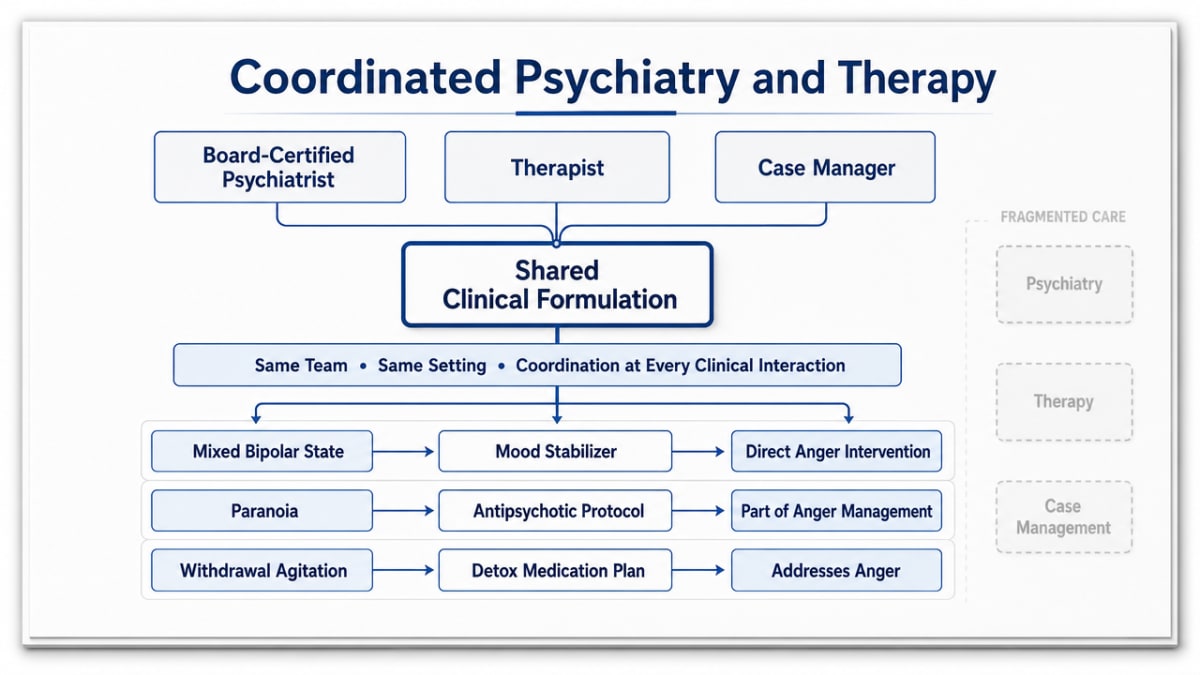
A key distinction between standalone anger classes and integrated dual diagnosis care is the collaborative approach of the treatment team. In integrated care, a board-certified psychiatrist, a therapist, and often a case manager work together from a shared clinical formulation within the same setting. This means mental health and substance use interventions are delivered by the same team, with coordination at every clinical interaction.1,3
For anger, this integrated approach is crucial because medication decisions and therapeutic interventions are inseparable. If irritability stems from a mixed bipolar state, the mood stabilizer is a direct anger intervention. If paranoia drives aggression, an antipsychotic protocol becomes part of the anger management. If withdrawal agitation is the primary factor, the detox medication plan addresses the anger. At ViewPoint, 24/7 board-certified psychiatry is integrated into the same treatment plan as therapy, ensuring these critical decisions are made collaboratively rather than by disconnected providers.
DBT, CBT, and Emotion Regulation Skills
Once psychiatric issues are addressed, skills training becomes more effective. DBT and CBT protocols designed for co-occurring populations offer a level of specificity that general anger classes cannot. DBT, developed for severe dysregulation, focuses on emotion regulation, distress tolerance, and interpersonal effectiveness. Integrated dual diagnosis programs adapt DBT into specialized tracks, including one specifically for substance use and anger. This approach views anger not as an isolated behavior but as an output of a broader emotion regulation system that also contributes to substance use.5,12
CBT-based and schema-focused protocols address chronic anger, personality pathology, and SUD within a single clinical framework. This integrated structure is more effective because deficits in emotion regulation predict greater substance use severity and relapse. If a program teaches craving management but neglects the anger that often precedes cravings, it provides an incomplete skill set. Integrated care develops both sets of skills concurrently, with clinicians who understand their interconnectedness.9,14
Clinical-Need-Based Length of Stay
Another significant difference, often unstated by insurance-driven programs, is the duration of treatment. Anger linked to trauma, mood instability, or psychotic-spectrum illness does not resolve within a fixed 30-day period dictated by insurance. Resolution occurs when the psychiatric condition stabilizes, substance use is controlled, and skills are sufficiently practiced to withstand real-world stressors.
Guidance for Referring Clinicians and Families
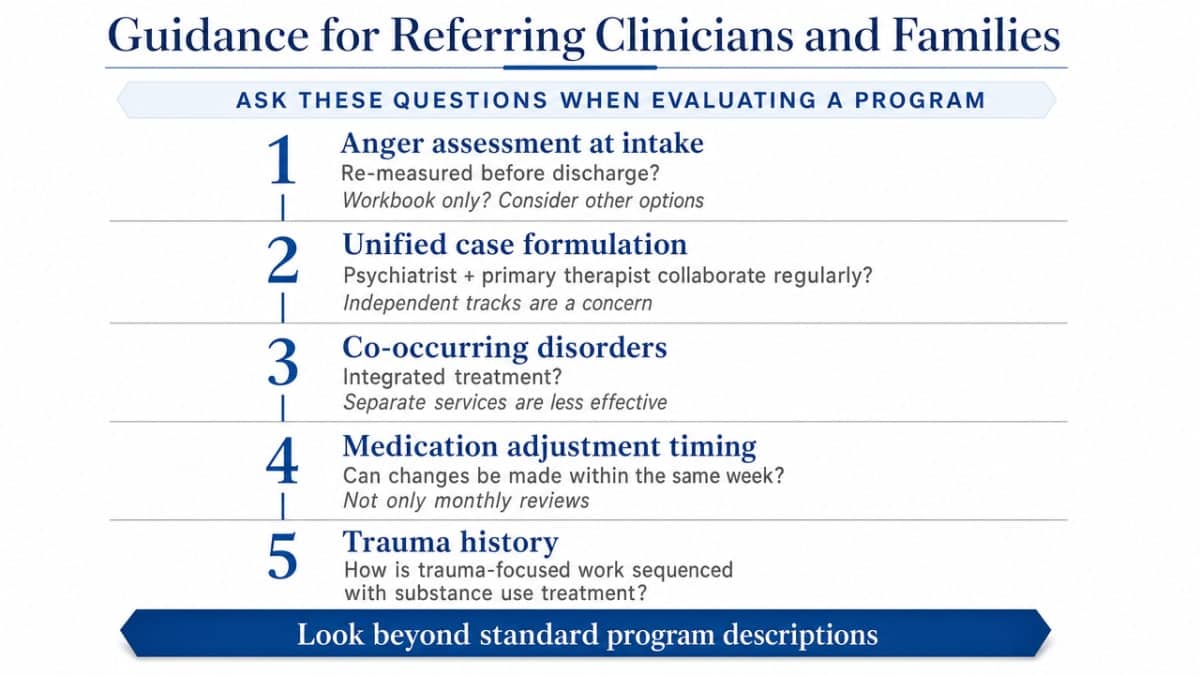
For referring clinicians evaluating programs for complex cases, or family members seeking effective treatment, specific questions are crucial. These go beyond typical program descriptions.
Inquire about how anger is assessed at intake and whether it is re-measured before discharge. If the primary tool is a workbook, consider other options. Ask if the psychiatrist and primary therapist share a unified case formulation and collaborate regularly, or if they operate independently. Separate services for co-occurring disorders are consistently less effective than integrated ones. Also, ask if the program can adjust medication based on therapeutic progress within the same week, rather than waiting for monthly reviews.4
For trauma histories, ask about the sequencing of trauma-focused work relative to substance use treatment. For suspected mood or psychotic-spectrum drivers, inquire about available medication strategies for treatment-resistant presentations, including clozapine protocols. For borderline features, ask if DBT is a formal, dedicated track or merely a single group session. The answers to these questions reveal the program’s capacity to treat the full spectrum of underlying issues.5,13
Addressing Anger in ViewPoint’s Treatment Planning
The critical question to ask is not simply whether ViewPoint offers an anger management group, but how anger is integrated into your comprehensive treatment plan alongside psychiatric care, substance use treatment, and any underlying trauma. This holistic approach is what sets ViewPoint apart.
The intake team in Prescott is prepared to discuss how anger is assessed, how it informs medication decisions made by your psychiatrist, and how your therapy track is tailored to your specific needs. You have invested in treatment before; now, consider a program that addresses the entire clinical picture.
Break the Anger-Substance Cycle With Expert Help
Get expert guidance on addressing anger within your full dual diagnosis treatment plan.
References
- Integrated Treatment of Substance Use and Psychiatric Disorders. https://pmc.ncbi.nlm.nih.gov/articles/PMC3753025/
- Randomized Control Trial of an Integrated Therapy for Comorbid Problem Gambling, Anger, and Substance Use. https://pubmed.ncbi.nlm.nih.gov/18815997/
- Integrated Treatment for Co-Occurring Disorders: The Evidence (SAMHSA Evidence-Based Practices KIT). https://library.samhsa.gov/sites/default/files/ebp-kit-the-evidence-10242019.pdf
- Psychosocial Approaches to Dual Diagnosis. https://pubmed.ncbi.nlm.nih.gov/10755672/
- A Model for Integrating Dialectical Behaviour Therapy for Substance Use and Concurrent Disorders. https://pubmed.ncbi.nlm.nih.gov/18253609/
- Anger and Substance Abuse: A Systematic Review and Meta-Analysis. https://pmc.ncbi.nlm.nih.gov/articles/PMC8827371/
- The Effectiveness of Integrated Treatment in Patients with Substance Use Disorder Co-occurring with Anxiety and/or Depression. https://pmc.ncbi.nlm.nih.gov/articles/PMC3974008/
- Integrated Behavioral Treatments for Comorbid Anxiety and Substance Use Disorders: Systematic Review and Meta-analysis. https://pubmed.ncbi.nlm.nih.gov/37866006/
- Co-Occurring Mental Health and Substance Abuse Disorders: Best Practices in Treatment (Washington State DSHS). https://www.dshs.wa.gov/sites/default/files/BHSIA/dbh/documents/cobestpract.pdf
- Substance Use and Psychiatric Disorders in a Community Epidemiological Study. https://pmc.ncbi.nlm.nih.gov/articles/PMC165062/
- Anger, Aggression, and Violence in Mental Health and Substance Use Disorders. https://pmc.ncbi.nlm.nih.gov/articles/PMC4195639/
- Dialectical Behavior Therapy as Treatment for Borderline Personality Disorder. https://pmc.ncbi.nlm.nih.gov/articles/PMC2928226/
- Integrated Treatment of PTSD and Substance Use Disorders: Rationale and Evidence. https://pmc.ncbi.nlm.nih.gov/articles/PMC3398680/
- Emotion Regulation Difficulties in Substance Use Disorders: A Critical Review. https://pmc.ncbi.nlm.nih.gov/articles/PMC5114031/