Key Takeaways
- Bipolar disorder has no single cause — inherited biology, brain networks, sleep systems, and life events interact, and no choice or event alone explains why it appears 1.
- Genetics matter but aren’t destiny: risk is polygenic, spread across nearly 300 genomic regions, and identical twins don’t always share the diagnosis 2, 1.
- Childhood adversity, substance misuse, circadian disruption, and certain medications like corticosteroids are risk factors or triggers in vulnerable people, not root causes 4, 13, 7, 14.
- Family history is information for your clinical team, and protecting sleep plus discussing medication triggers are practical levers — not cures to manage alone 1, 7, 14.
If You’re Asking “Why Did This Happen?”
If you’ve just been diagnosed with bipolar disorder, or someone you love has, you’re probably asking one question before any other: why?
Maybe you’re scanning your family tree, wondering which relative passed something down. Maybe you’re replaying a hard childhood, a bad breakup, a stretch of sleepless nights, or the week you started a new medication. Maybe you’re a parent quietly carrying guilt that something you did — or didn’t do — set this in motion.
What researchers do know is that bipolar disorder grows out of several things interacting at once — inherited biology, brain development, sleep and stress systems, and life events that press on all of them 1. That’s a more honest answer than a single villain, and it’s also a more hopeful one.
This article walks through what the evidence actually shows, in plain language, so you can trade guilt for a clearer map.
The Short Answer: No Single Cause, Many Interacting Factors
If you want the honest, one-paragraph version: researchers do not know exactly what causes bipolar disorder, and no single gene, event, or exposure explains it on its own 1. What they do see, across decades of family studies, brain imaging, and large genetic analyses, is a pattern — several systems that influence mood sit under pressure at the same time, and in some people, that pressure tips into episodes.
Think of it less like a switch and more like a stack of ingredients.
Inherited biology is one ingredient. Bipolar disorder is highly heritable, but it is polygenic, meaning risk is spread across many genes that each contribute a small amount rather than one dominant gene calling the shots 3. Brain development, cellular energy systems, and circuits that regulate mood add other layers 9. Then life pushes in — sleep and circadian rhythms, childhood adversity, substance exposure, certain medications, and major stressors can all interact with that underlying biology 1, 4.
No one of these, by itself, is the cause. The reason this matters for you: if you’ve been searching for the moment or the mistake that caused this, the science simply does not point there.
Genetics: What You Inherit, and What You Don’t
Family History, Twin Studies, and the Heritability Range
If bipolar disorder shows up in your family tree, you’ve probably already done the math in your head. A parent. A sibling. Maybe a grandparent whose moods people whispered about. That worry is understandable, and the science does say family history matters — but not in the way most people fear.
Researchers measure how much genes contribute to a trait across a population using something called heritability. Heritability is not your personal odds. It’s a population statistic — how much of the variation between people in a group can be traced to genetic differences. For bipolar disorder, twin studies have landed on heritability estimates roughly between 60% and 90%, depending on how the study was designed and how the diagnosis was defined 3.
That’s a wide range, and it’s wide for a reason. Different samples, different diagnostic cutoffs, and different statistical methods give different numbers 3.
Here’s the part worth sitting with: a high heritability number does not mean you will definitely develop bipolar disorder if a relative has it. Family history raises risk, but it does not make the condition inevitable 1. Many people with affected parents or siblings never develop it. Many people who do develop it have no obvious family history at all.
So yes, biology travels through families. And no, your DNA is not writing a verdict.
The 2025 Genetic Map: Hundreds of Small Signals, Not One “Bipolar Gene”
For a long time, the public story about mental illness genetics sounded like a treasure hunt — find the one broken gene, fix it, done. That story was never quite right, and recent research has made that clearer than ever.
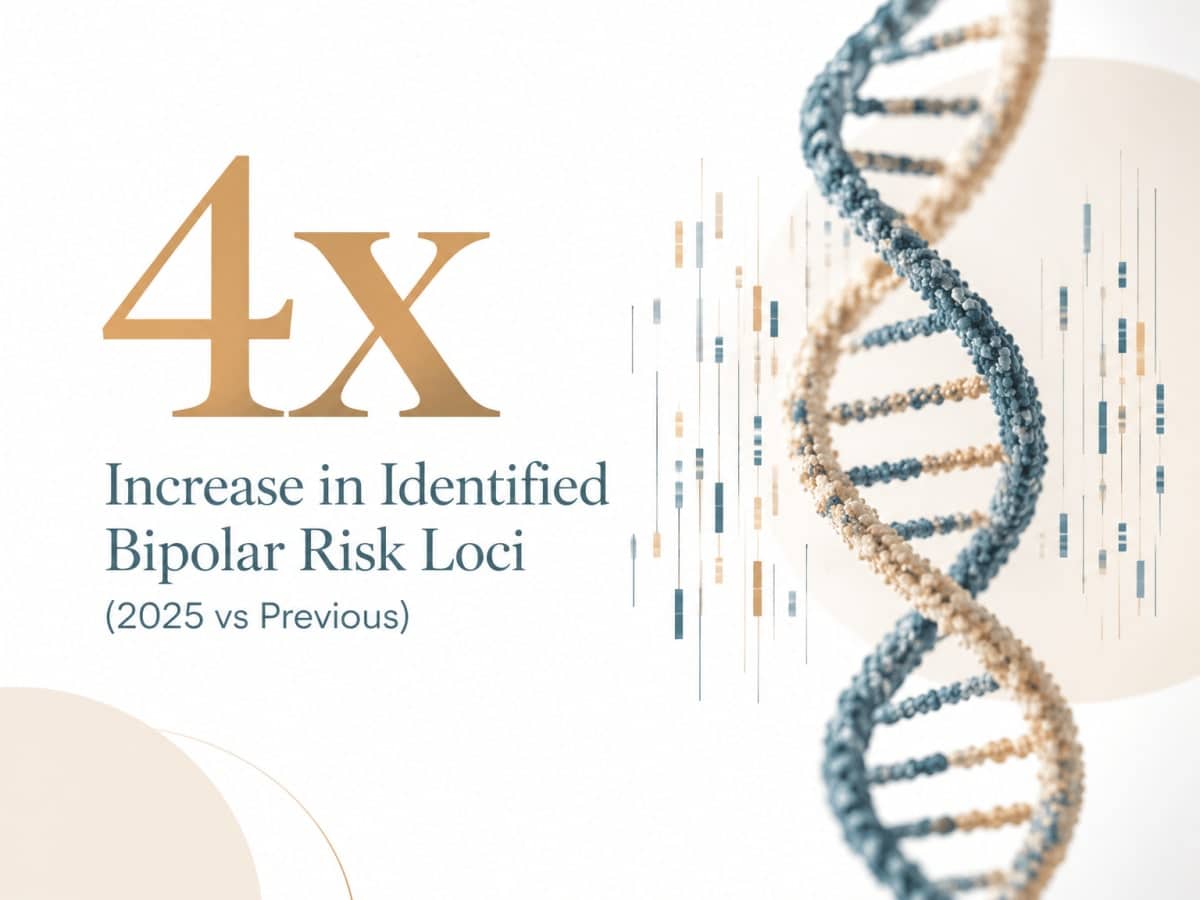
In a 2025 science update, the National Institute of Mental Health highlighted research identifying nearly 300 regions of the genome and 36 likely genes tied to bipolar disorder — a more than four-fold increase over earlier genetic findings 2. Each of those regions nudges risk up or down by a small amount. None of them acts like an on/off switch.
This is what researchers mean when they call bipolar disorder polygenic: many genes, each contributing a little 3. It’s less like inheriting one dominant trait and more like inheriting a long list of small tendencies that add up differently in different people.
Two things follow from that. First, there is no single test that can scan one gene and tell you whether you’ll develop bipolar disorder. Second, if an older relative was once told they carried “the bipolar gene,” that framing is out of date — the science has moved on 2. Questions still remain about whether certain genetic patterns map onto specific bipolar subtypes 2, but the big picture is clear: risk is distributed, not concentrated.
Why Identical Twins Can Have Different Outcomes
Here’s a finding that often brings people real relief: identical twins — two people with the same DNA — do not always share a bipolar diagnosis 1. One twin may develop the condition. The other may not.
Think about what that means. If genes alone were enough to cause bipolar disorder, identical twins would always match. They don’t. Something else is in the mix — development, life events, sleep and stress systems, the countless small differences in how two bodies grow and move through the world.
This is probably the single most reassuring data point for anyone carrying a family-history fear. Your DNA is part of your story. It is not the whole story.
It also reframes the question. Instead of asking, “Will my genes decide this?” a more useful question is, “What else is on the scale, and which parts of it can my clinical team actually work with?” The rest of this article walks through those other parts — the brain, life experiences, sleep, triggers, and the places where genes and environment meet.
What’s Happening in the Brain
Beyond the “Chemical Imbalance” Story
You’ve probably heard someone — maybe a well-meaning doctor years ago, maybe a pharmaceutical ad — describe bipolar disorder as a “chemical imbalance.” It’s a tidy phrase. It also sells the biology short.
Current research describes bipolar disorder as biologically heterogeneous, meaning the underlying biology is not the same from person to person 9. Rather than one neurotransmitter being too high or too low, reviewers point to several interacting systems:
- how brain cells develop and connect
- how calcium moves in and out of cells to carry signals
- how mitochondria (the tiny power plants inside your cells) produce energy
- how the immune system behaves inside the brain
- how the body manages its overall metabolism 9, 10
That’s a lot of moving parts. The honest takeaway is that mood regulation runs on more than a single chemical dial — and that’s part of why finding the right medication can take time and adjustment.
One more thing worth knowing: some of these biological findings may partly reflect the current mood episode, how long someone has been ill, other health conditions, or medication exposure, not just an underlying cause 9. Science is still untangling what comes first.
Distributed Networks and Resting-State Brain Activity
If you’ve ever wondered whether a brain scan could show bipolar disorder, the current answer is: not yet, at least not in a way that can diagnose any one person.
What researchers can see, when they pool many studies together, is a pattern. A 2024 meta-analysis of resting-state functional MRI studies — scans taken while people are awake but not doing a task — found reliable differences in activity across several brain regions between people with bipolar disorder and people without it 11. Not one damaged spot. A distributed set of circuits that help regulate mood, attention, and emotion.
Those differences are real at the group level, but they are not diagnostically specific. Similar patterns can appear in other conditions, and findings can shift with the current mood episode, medication, age, and other health factors 11.
What this means for you: mood regulation is a network job, not a single-switch job.
Life Experiences and Environmental Risk Factors
Childhood Adversity, Family Stress, and Adolescent Risk
If part of what you’re carrying is the fear that something that happened to you — or something that happened in your home growing up — caused your bipolar disorder, read this slowly.
Hard experiences in childhood and adolescence do appear in the research as risk factors. A systematic review focused on teens at familial or clinical high risk for bipolar disorder found that stressful life events — particularly sexual, physical, and emotional abuse — along with adverse family experiences, were associated with more severe psychopathology and increased risk in those vulnerable young people 6. The reviewers concluded that stressful life events and family-related environmental features play a relevant role during adolescence 6.
Notice the careful words: risk factor, associated with, relevant role. Not cause.
That distinction matters. Many people who experience adversity never develop bipolar disorder. Many people who develop it had stable, loving childhoods. What the evidence suggests is that early stress can press on an already vulnerable system — not that any one experience, or any one person in your past, flipped a switch.
Grading the Evidence: Which Risk Factors Have the Strongest Support
Not every “linked to bipolar disorder” headline carries the same weight. Researchers now grade how strong the evidence actually is behind each reported association, which helps you tell a well-supported finding from a shaky one.
An umbrella review — a study of other systematic reviews and meta-analyses — looked across the environmental and medical risk factors that have been tied to bipolar disorder 4. Key findings included:
- The most convincing evidence was for an association with irritable bowel syndrome, with an odds ratio of 2.48 4.
- Childhood adversity reached the “highly suggestive” tier of evidence 4.
- Weaker, less consistent evidence showed up for asthma, obesity, Toxoplasma gondii infection, and head injury 4.
A separate evidence synthesis focused on adolescence reported an odds ratio of 2.87 for substance misuse and 1.33 for childhood adversity in selected analyses 13.
A few things to hold onto. An odds ratio is a comparison of risk between groups, not your personal probability. These associations do not establish that any of these conditions or exposures directly cause bipolar disorder 4. And something like irritable bowel syndrome showing up on the list does not mean your gut gave you bipolar disorder — it likely points to shared biological pathways researchers are still mapping.
What this grading does well is set expectations. Some risk factors are solidly repeated across studies. Others are early signals that may not survive more research.
Prenatal and Developmental Exposures
If you’re a parent reading this and wondering whether something during pregnancy or your child’s early years set the stage, here’s where the science lands.
A systematic review of longitudinal studies — the kind that follow people over time — looked at prenatal and developmental exposures such as maternal influenza during pregnancy, fetal-development indicators, cannabis and other substances, parental loss, adversity, abuse, and brain injury 5. Several of these appeared as possible risk clusters.
But the reviewers were direct about the limits: the evidence linking viral infection, substances, or trauma to later bipolar disorder was preliminary, and predictive sensitivity, specificity, and value could not be calculated 5. Translation: these exposures may matter, but researchers cannot yet tell you how much, for whom, or with any usable certainty.
That’s not a comforting “everything’s fine.” It’s an honest “we don’t know enough to assign blame.”
Sleep and Circadian Rhythms: A Two-Way Street
If you’ve noticed that bad sleep and bad mood seem to feed each other, you’re not imagining it. Sleep and bipolar disorder are tangled up — and the relationship runs both directions.
A recent review describes sleep and biological rhythms as integral to mood regulation in bipolar disorder. Changes in sleep phase (when you fall asleep and wake up), sleep duration, and sleep structure show up across all phases of the illness — depression, mania, and the stretches in between — and they are linked to higher relapse risk, poorer quality of life, impaired thinking, and heightened suicide risk 7. That’s not a small finding. It’s part of why clinicians pay such close attention to sleep patterns during treatment.
The biology sits deep. Researchers studying circadian rhythms in bipolar disorder point to differences in sleep–wake cycles, melatonin and cortisol timing, chronotype (whether you naturally run early or late), and the activity of so-called clock genes that help the body keep time 8.
Here is the part the headlines usually get wrong: this does not mean poor sleep causes bipolar disorder, and it does not mean a perfect sleep schedule can prevent it. The review on clock-gene biology is explicit that the relationship is not a simple one-way street 8. Circadian disruption may contribute to episodes in some people. Episodes clearly disrupt sleep in nearly everyone. And both can be shaped by medication, stress, and daily life 7.
What you can do with this is practical, not magical. If you have a diagnosis, protecting your sleep and keeping steady daily rhythms is one of the levers your clinical team will likely want to work with you on — not as a cure, but as one meaningful piece of staying well.
How Genes and Environment Actually Meet
Here’s where the two halves of the story stop being separate.
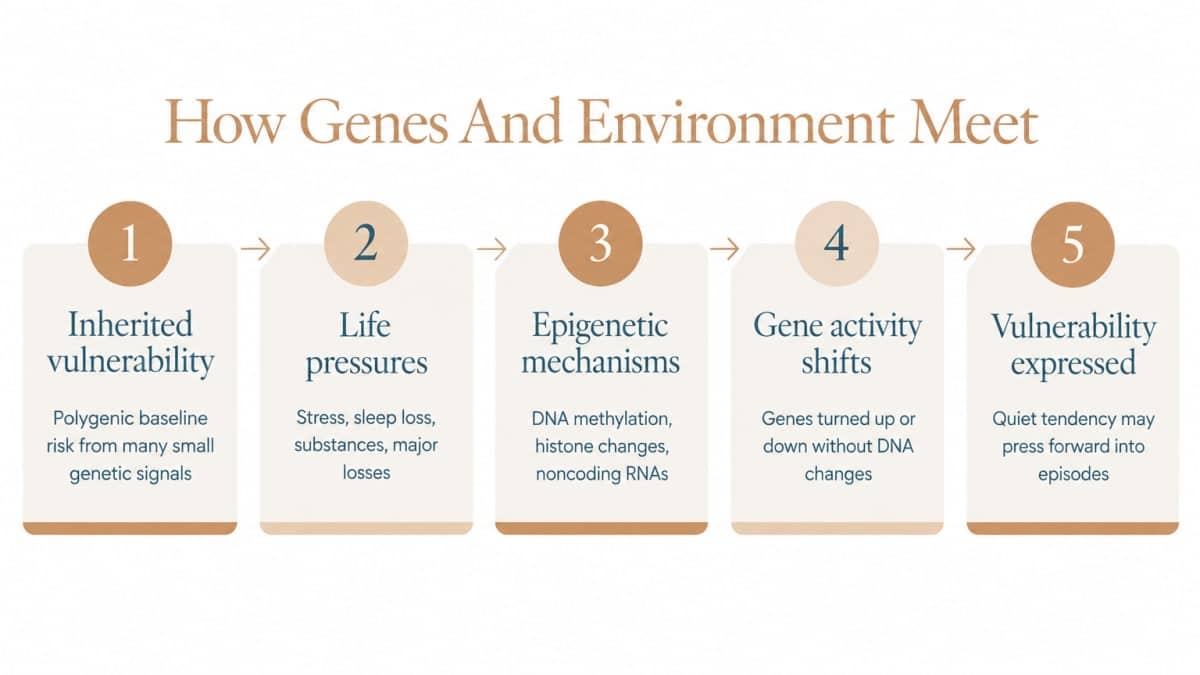
Genes do not act in a vacuum. Life experiences do not land on a blank slate. In bipolar disorder, inherited vulnerability and the environment around you shape each other — and that interaction is where researchers now spend much of their effort 1.
One mechanism that helps explain how this works is called epigenetics. A critical review of the research describes mechanisms like DNA methylation, histone modification, and noncoding RNAs — biological processes that can turn gene activity up or down without changing the DNA sequence itself 12. In plain terms: your experiences, your stress load, your sleep patterns, even the medications you take, can influence which genes get used and how loudly. The review is honest that these findings are still limited and not well standardized, so no one can read your epigenetic signature and predict your future 12.
Still, the model is useful. A genetic tendency may stay quiet for years, then press forward when something — chronic sleep loss, a major loss, substance exposure, a stretch of relentless stress — pushes on the system 1.
Nothing here points to a single person to blame. It points to a biology that listens to a life.
Triggers and Mimics: What Looks Like a Cause but Isn’t
Substance Use as Trigger, Risk Factor, and Confounder
If a first episode arrived during a stretch of heavy drinking, cannabis use, or stimulants, it’s natural to point at the substance and say, “That did it.” The reality is more layered.
Substance misuse shows up consistently in the risk research. One evidence synthesis focused on adolescents and high-risk youth reported an odds ratio of 2.87 for substance misuse — a meaningful signal, but one that describes a risk relationship, not proof that drugs or alcohol directly cause bipolar disorder 13. A longitudinal review similarly flagged cannabis and other substances as possible contributors, while noting the evidence remained preliminary 5.
Here’s the knot researchers are still untangling: substance use can trigger an episode in someone already vulnerable, it can worsen the course of the illness, and in some people, early mood symptoms drive the substance use in the first place. Those three stories can look identical from the outside.
What this means for you is practical. Substances are worth taking seriously as part of staying well — not as the thing to blame for what started.
Medication-Induced Mania and Medical Mimics
Sometimes a manic episode shows up right after a medical event or a new prescription, and the question becomes whether this is bipolar disorder or something else wearing its clothes.
Corticosteroids — drugs like prednisone, often prescribed for asthma flares, autoimmune conditions, or severe allergic reactions — can trigger manic symptoms. A systematic review of 47 articles found that corticosteroid-related mania appears more likely at prednisone-equivalent doses above 40 mg, though individual risk varies 14. Other medical conditions and medications can produce similar symptoms.
Medication-induced mania does not automatically mean primary bipolar disorder. Clinicians look at timing, prior episodes, family history, other medical conditions, and whether symptoms persist after the exposure changes 14. It’s also worth remembering that the diagnostic labels themselves — bipolar I, bipolar II — describe the syndrome, not its cause. Bipolar I requires at least one manic episode; bipolar II requires hypomania plus major depression 15. Those categories tell your clinical team what they’re treating. They do not, on their own, explain why it’s happening.
If a new medication seems to have triggered symptoms, that’s a conversation to bring to your prescriber — not a verdict to deliver to yourself.
What This Means for You or Someone You Love
If you’ve read this far, you already know the headline: bipolar disorder does not have one cause, and nothing you can point to in your past is likely to be the single reason it appeared 1. That’s worth letting land.
Here’s what the research model actually hands you. Inherited biology sets a baseline. Brain networks, sleep systems, and stress responses add layers. Life events press on all of them 1. None of those pieces, by itself, writes the ending — which is also why no one piece carries the blame.
Practically, that reframes what to do next. Family history is information for your clinical team, not a sentence. Steady sleep and lower substance exposure are levers worth working with your prescriber on, not cures to white-knuckle alone 7. If a medication seems to have triggered symptoms, that belongs in a conversation with the doctor who prescribed it 14.
And if standard treatment hasn’t settled your moods — if episodes keep breaking through, or mixed and rapid-cycling patterns don’t fit the usual playbook — that’s a signal to seek care built for complex presentations, like the specialized bipolar programs at ViewPoint Dual Recovery in Prescott, Arizona.
You didn’t cause this. You can work with it.
Explore Care for Complex Bipolar Symptoms
Discuss your symptoms and treatment history to learn what level of support may fit your needs.
Frequently Asked Questions
If bipolar disorder runs in my family, will I definitely develop it?
No. Family history raises your risk, but it does not make bipolar disorder inevitable 1. One of the clearest signs of this is that identical twins — who share the same DNA — do not always share the diagnosis 1. Many people with affected relatives never develop it. If you’re worried, share your family history with a clinician who can help you watch for early signs.
Did something I did or something that happened to me cause my bipolar disorder?
Almost certainly not in the way you fear. The exact cause is unknown, and no credible research points to a single choice or event as the reason bipolar disorder appears 1. Hard experiences can act as risk factors in people who are already biologically vulnerable 6, but that is very different from one moment, one mistake, or one person causing the condition.
Can poor sleep or shift work cause bipolar disorder?
Sleep and circadian disruption are tightly linked to bipolar disorder, but the relationship runs both ways and is not a simple cause 8. Disrupted sleep patterns are associated with relapse, poorer quality of life, and higher suicide risk during the illness 7. Protecting sleep is a meaningful part of staying well if you have a diagnosis, but good sleep habits alone cannot prevent the condition.
Can substance use or medications trigger bipolar disorder?
Substance misuse is a repeated risk factor, with an odds ratio of 2.87 in one adolescent evidence synthesis 13. Certain medications can also set off manic symptoms — corticosteroids like prednisone are a known example, especially at doses above 40 mg equivalent 14. These exposures can trigger episodes in vulnerable people, but a trigger is not the same as the underlying cause. Discuss timing with your prescriber.
Is bipolar disorder caused by a chemical imbalance in the brain?
The “chemical imbalance” phrase oversimplifies the biology. Current research describes bipolar disorder as biologically heterogeneous, involving neurodevelopment, calcium signaling, mitochondrial energy production, immune activity, and distributed brain networks — not a single neurotransmitter being too high or too low 9, 10. That’s part of why finding the right medication combination can take time. Mood regulation is a network job, not a single-switch job 11.
Can childhood trauma cause bipolar disorder later in life?
Childhood adversity is one of the better-supported environmental risk factors, reaching the “highly suggestive” tier in an umbrella review 4, with an odds ratio of 1.33 in adolescent analyses 13. In teens at familial or clinical high risk, abuse and adverse family experiences are linked with more severe symptoms 6. But many trauma survivors never develop bipolar disorder, and many people with it had stable childhoods. Trauma is a risk factor, not a verdict.
References
- Bipolar Disorder. https://www.nimh.nih.gov/health/publications/bipolar-disorder
- Study Illuminates the Genetic Architecture of Bipolar Disorder. https://www.nimh.nih.gov/news/science-updates/2025/study-illuminates-the-genetic-architecture-of-bipolar-disorder
- Genetic contributions to bipolar disorder: current status and clinical implications. https://pmc.ncbi.nlm.nih.gov/articles/PMC8477227/
- Systematic assessment of environmental risk factors for bipolar disorder: an umbrella review of systematic reviews and meta-analyses. https://pubmed.ncbi.nlm.nih.gov/28470927/
- The role of environmental exposures as risk factors for bipolar disorder: A systematic review of longitudinal studies. https://pubmed.ncbi.nlm.nih.gov/26773919/
- Environmental Risk Factors for Bipolar Disorders and High-Risk States in Adolescence: A Systematic Review. https://pubmed.ncbi.nlm.nih.gov/33322430/
- Sleep and circadian disruption in bipolar disorders: From psychopathology to digital phenotyping in clinical practice. https://pmc.ncbi.nlm.nih.gov/articles/PMC11804932/
- Bipolar Disorder, Circadian Rhythm and Clock Genes. https://pmc.ncbi.nlm.nih.gov/articles/PMC11024693/
- Bipolar Disorder. https://pmc.ncbi.nlm.nih.gov/articles/PMC10786345/
- Neurobiology of bipolar disorders: a review of genetic components, signaling pathways, biochemical changes, and neuroimaging findings. https://pmc.ncbi.nlm.nih.gov/articles/PMC7524405/
- Functional magnetic resonance imaging studies in bipolar disorder in resting state: A coordinates-based meta-analysis. https://pubmed.ncbi.nlm.nih.gov/39146823/
- Epigenetics in bipolar disorder: a critical review of the literature. https://pubmed.ncbi.nlm.nih.gov/33290382/
- Environmental Risk Factors in Bipolar Disorder and High-Risk States in Adolescence. https://pubmed.ncbi.nlm.nih.gov/33479726/
- Corticosteroids and mania: A systematic review. https://pubmed.ncbi.nlm.nih.gov/38363330/
- Introduction to Bipolar Disorder. https://www.ncbi.nlm.nih.gov/books/NBK545968/