Key Takeaways
- Clozapine remains underused nationally because real titration demands slow dose escalation, ANC surveillance, cardiac monitoring, REMS documentation, and tight pharmacy-lab-psychiatry coordination that most facilities never build 6, 7.
- Arizona’s rural geography and workforce shortages leave few programs equipped to run a full titration, and rural patients see more monitoring gaps than urban ones 9.
Why This Search Is Harder Than It Should Be
If you’ve landed on this page, you already know the shape of the problem. Two antipsychotic trials didn’t work, or worked partially and then stopped, and someone finally said the word clozapine. Now you’re trying to find an Arizona facility that can actually run it. That search is harder than it should be, and the difficulty isn’t in your head.
Clozapine is the evidence-based standard for treatment-resistant schizophrenia, consistently recommended after failure of two adequate antipsychotic trials 16, 18. It’s also one of the most underused medications in psychiatry. National prescribing data show persistently low utilization across U.S. regions, well below what guideline-eligible patient counts would predict 6. The reasons aren’t clinical mystery. A systematic review of the barriers points to the same short list every time: monitoring requirements, side effect profile, and prescriber unfamiliarity 7.
Translate that into what you’re experiencing. A general psychiatric facility can prescribe an antipsychotic in an afternoon. A real clozapine titration program has to assemble slow dose escalation, absolute neutrophil count surveillance, cardiac monitoring in the early weeks, REMS documentation, and a coordinated loop between psychiatry, pharmacy, and the lab 13. Most facilities don’t have that infrastructure standing up, so they don’t offer the service.
You deserve a clearer map. The sections ahead lay out what a titration program actually includes, why Arizona’s geography and workforce shape access, and how to interrogate any program you’re considering — including how ViewPoint Dual Recovery in Prescott fits that picture.
What Actually Defines a Clozapine Titration Program
The Titration Protocol: 12.5 mg to a Working Dose
The dose curve is the first thing to look at. A real titration program starts low and moves slowly, because rapid escalation is where cardiovascular collapse, seizures, and severe orthostatic hypotension appear. APA guidance is explicit: initiation begins at 12.5 mg once or twice daily, with slow escalation from there 14. The stepwise guideline and checklist paper puts the same starting dose in writing and recommends daily increases of 25 to 50 mg, targeting a therapeutic range of roughly 250 to 450 mg/day in adults 20.
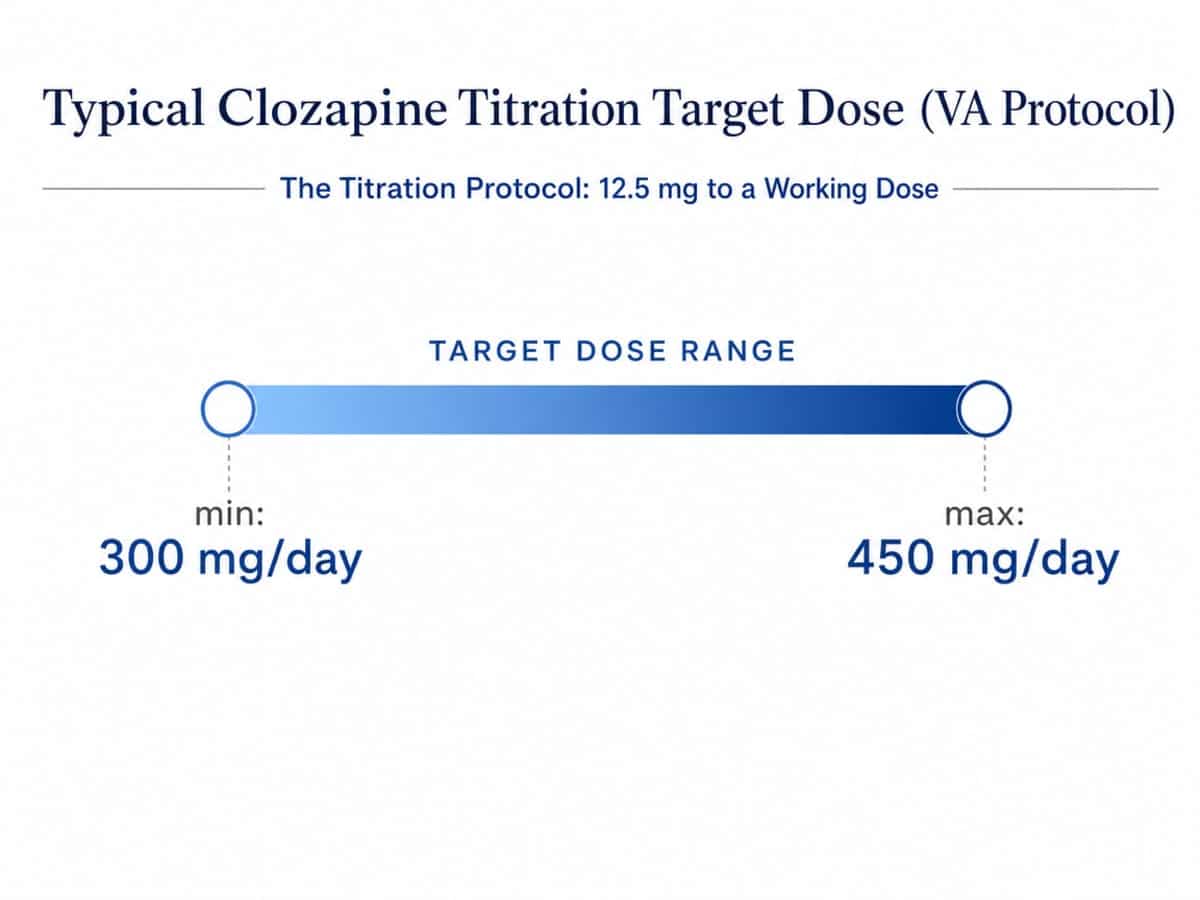
The VA National Protocol offers one high-quality reference point for the arc. Within its inpatient framework, titration proceeds in 25 to 50 mg/day increments toward a target daily dose of 300 to 450 mg by the end of week two, delivered in divided doses 1. That target is not a mandate for every setting — outpatient titration typically moves more slowly to accommodate side-effect tolerance — but it gives you a concrete benchmark for what a resourced program can accomplish and how quickly.
What that pace demands operationally matters more than the numbers themselves. Someone has to see you, or a family member on your behalf, most days during the early phase. Vital signs — sitting and standing blood pressure, pulse, temperature — are checked at each contact because orthostatic hypotension and tachycardia are early tells. Doses are held or reduced when side effects cross a threshold, and the UNC clozapine toolkit specifically recommends a slower titration when side effects are more than mild 5. A program that hands you a rigid ramp regardless of response is not a program; it is a prescription.
Underdosing is the other failure mode. Reaching a working dose is the whole point. APA guidance stresses maintaining an adequate target and serum level for at least 8 weeks before concluding non-response 14. Programs that stall at 100 or 150 mg because side effects were not managed leave patients with all of the monitoring burden and none of the therapeutic benefit.
The Monitoring Infrastructure: ANC, Cardiac, and Serum Levels
The dosing schedule is only half of the picture. The monitoring calendar is the other half, and it is where most facilities quietly step back from clozapine.
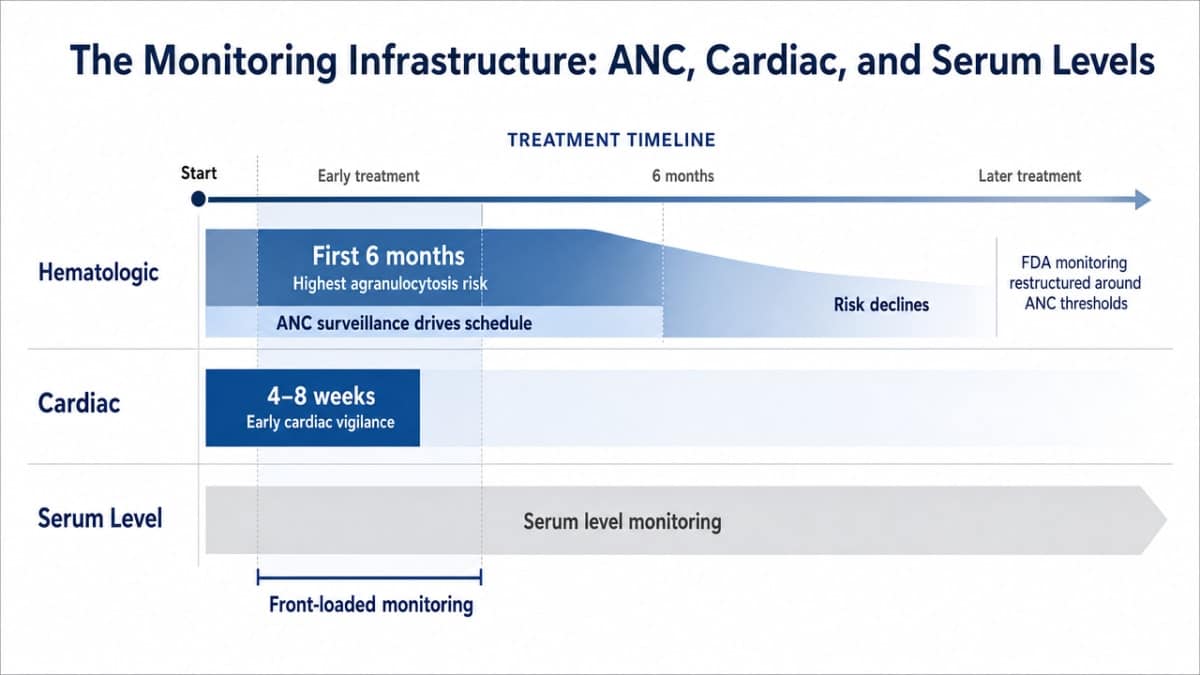
Two risk windows shape everything. Clozapine-associated myocarditis clusters in the first 4 to 8 weeks of treatment, which is why cardiac vigilance during early titration is not optional 11. Hematologic risk follows a longer arc: agranulocytosis risk is highest across the first six months, then declines substantially 12. Those two curves — a sharp early cardiac peak overlapping with a longer neutrophil risk period — explain why the monitoring intensity in a real program is front-loaded and why the calendar looks the way it does.
On the hematologic side, ANC surveillance drives the schedule. FDA restructured monitoring around ANC thresholds, with treatment interruption triggered at ANC below 1,000 cells per microliter 3. In practice, that means weekly ANC draws for the first six months for most patients, biweekly through month twelve, and monthly thereafter if counts stay stable. A functioning program owns the phlebotomy pathway, knows what to do when results drop, and has a rechallenge protocol ready 12.
Cardiac monitoring during weeks 4 to 8 typically pairs symptom screening — new-onset chest pain, unexplained fatigue, fever, tachycardia at rest — with baseline and follow-up troponin, C-reactive protein, and ECG when indicated 11. It is a low-drama process when a program has it built in, and a serious problem when it does not.
Serum level testing is the third pillar and the one most likely to be missing. TRRIP consensus and APA guidance both use a trough clozapine level of at least 350 ng/mL as a benchmark for an adequate trial, alongside at least 80% adherence over 12 or more weeks 14, 18. Without access to a lab that can turn around a clozapine level in a clinically useful window, you cannot tell whether a partial response reflects an insufficient dose, a metabolizer profile pushing drug through too quickly, or genuine non-response. Programs that dose blindly, without serum levels, are guessing at the exact moment guessing is most expensive.
You should hear all three streams — ANC, cardiac, serum level — described concretely when you ask about monitoring. If a facility describes only one, or waves at the others, that is diagnostic.
REMS Documentation and the Pharmacy-Lab-Psychiatry Loop
Every clozapine prescription in the United States flows through the REMS program, and the paperwork is not just a compliance formality — it is the connective tissue that keeps titration safe. Under current expectations, prescribers must document and submit ANC results, monitoring frequency, and an ongoing risk-benefit assessment for each patient through the Patient Status Form, submitted on a monthly cadence 4. A program that treats REMS as a one-time enrollment task rather than a monthly workflow will start missing dispensing cycles, and you will feel it as pharmacy delays and abrupt medication gaps.
The bigger operational picture is a three-way loop. Effective outpatient clozapine care depends on close collaboration between psychiatric providers, laboratories, and community pharmacies, with someone owning the handoffs 13. In a working program, that looks like this: the lab draws ANC on a scheduled day, the result reaches the prescriber the same day, the prescriber submits Patient Status Form data, and the pharmacy dispenses the next supply against a current authorization. Break any link and the chain stops.
This is why dedicated clozapine clinic models — where titration, monitoring, and side-effect management sit under one roof — have been associated with more appropriate prescribing and better treatment continuity than dispersed care 8. The point is not the building; it is that one team is responsible end to end. When you evaluate a program, ask who owns the REMS submission, where labs are drawn, and how pharmacy is coordinated. If those answers land with three different people who do not talk to each other, the loop is not closed.
The Arizona Access Picture
Rural Geography, Workforce, and the Underuse Gap
Arizona’s map does not help you. Outside the Phoenix and Tucson corridors, the drive to a psychiatrist who has managed a titration through week eight can stretch into hours, and the drive to a lab that turns ANC around same-day can be another one. That is not an Arizona quirk — it is a documented pattern. A national analysis of rural-urban clozapine care found that rural patients were significantly less likely to receive clozapine and more likely to experience gaps in recommended monitoring than urban patients 9. Every one of those gaps is a place where a titration can quietly derail.
The workforce math sits on top of that geography. Clozapine underuse in the U.S. is not driven by lack of eligible patients; national prescribing data show persistently low rates across regions despite guideline support 6. The reasons a systematic review keeps surfacing are prescriber unfamiliarity, monitoring requirements, and the side-effect profile 7. When you translate that into a rural Arizona county, it often means the local psychiatrist has never run a titration, the nearest lab does not stock the right tubes on a Saturday, and the community pharmacy is not enrolled to dispense against a fresh REMS authorization.
None of this is your fault, and it is worth naming out loud. If your search feels like it has been narrowing to a handful of places in the state, that is because the supply of real programs is genuinely small — and the evidence backs up what your calendar is telling you.
SB 1720: What Changed in 2025 for Arizona Members
There is one recent piece of state policy worth understanding before you evaluate any Arizona program, because it changes what a facility can offer you outside its walls.
Arizona SB 1720, passed in 2025, requires health insurers to give subscribers prescribed clozapine access to less-invasive hematologic monitoring — specifically finger-stick absolute neutrophil count devices — along with mobile phlebotomy services and genetic testing to help guide monitoring frequency and neutrophil parameters. The law also mandates in-home hematologic monitoring services for members with serious mental illness or serious emotional disturbance 21. For a state where the driving distance to a hospital lab can be the deciding factor in whether someone stays on clozapine, this is a meaningful shift.
Read the fine print, though. The fact sheet spells out what insurers must make available; it does not spell out how uniformly those services will reach every county, which carriers will contract with which mobile phlebotomy vendors, or how quickly finger-stick device adoption will happen at the clinic level 21. Rural implementation questions remain open.
What this means practically: when you ask an Arizona program about monitoring, ask whether they have integrated the SB 1720 options into their workflow, or whether they still default to a weekly hospital lab draw. A program that has actually built finger-stick ANC or mobile phlebotomy into its titration pathway is telling you something real about its infrastructure — and something real about how much friction the first six months will add to your life.
How to Evaluate an Arizona Program
A Practical Checklist for Interrogating Any Titration Program
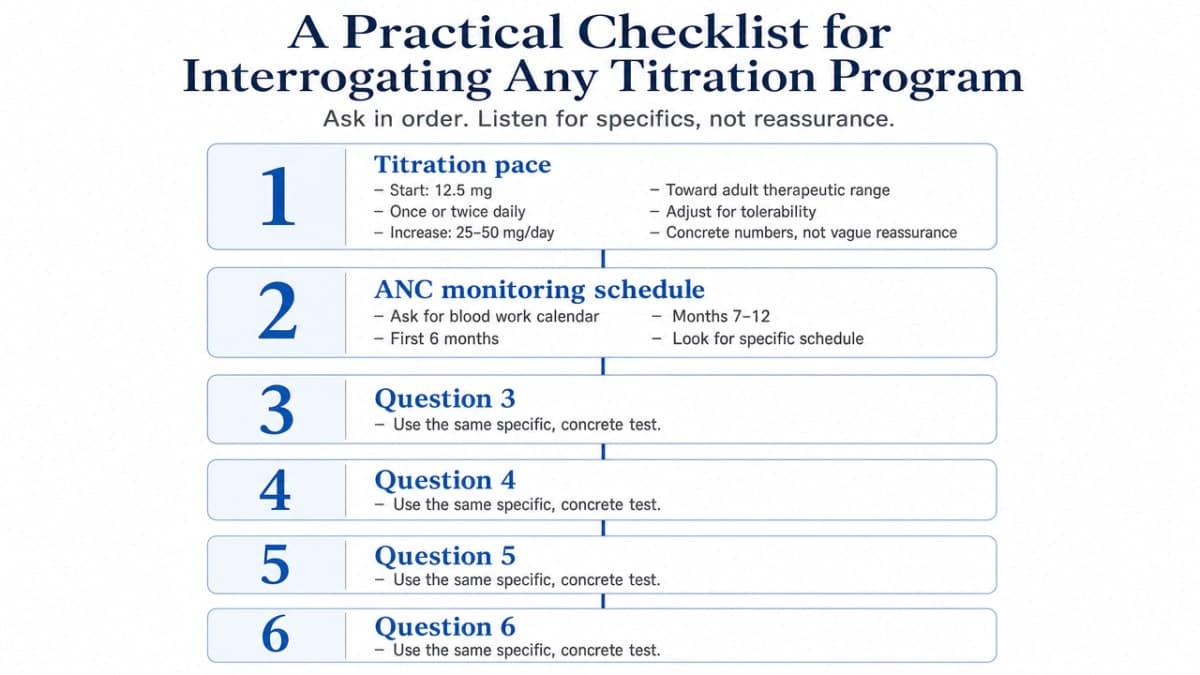
You do not need a clinical degree to tell a serious clozapine program from a well-intentioned prescriber. You need a short list of questions and a willingness to notice what the answers sound like. When you call an Arizona facility, work through these six items in order and listen for specifics, not reassurance.
- 1. Titration pace. Ask how they start and how quickly they escalate. The answer you want to hear is a starting dose of 12.5 mg once or twice daily, followed by daily increases of roughly 25 to 50 mg toward a therapeutic range in adults, adjusted for tolerability 20. If they cannot describe the ramp in that kind of concrete language, they have not run enough titrations to speak in numbers.
- 2. ANC monitoring schedule. Ask what the blood work calendar looks like for the first six months, then months seven through twelve, then after that. A working program will describe weekly draws early, biweekly through month twelve, and monthly thereafter for stable patients, with a specific plan for what happens if ANC drops below 1,000 cells per microliter 3, 12.
- 3. Cardiac surveillance in weeks 4 to 8. Ask what they do to screen for myocarditis in the early weeks. The answer should include symptom checks and baseline plus follow-up labs during that window, because that is where cases cluster 11. A shrug here is the answer.
- 4. REMS Patient Status Form workflow. Ask who submits monthly ANC results and the risk-benefit assessment to REMS, and how they prevent dispensing gaps 4. If ownership is unclear, dispensing will stall.
- 5. Serum trough level access. Ask whether they draw clozapine trough levels and use a benchmark of at least 350 ng/mL when judging response over an adequate trial 14, 18. Programs that dose without levels are guessing.
- 6. Pharmacy, lab, and psychiatry coordination. Ask who owns the handoffs between the three 13. One name is a good sign. Three departments pointing at each other is not.
Take notes. Compare answers across facilities. The pattern will be obvious.
Questions Referring Clinicians Should Ask on Behalf of Patients
If you are a referring psychiatrist, primary care physician, or case manager sending a patient into a titration program, your questions run a layer deeper. You are not just checking whether the program exists — you are checking whether it can absorb a complex case and hand it back to you cleanly.
Ask about their criteria for establishing an adequate prior trial. A program that takes treatment resistance seriously will reference failure of at least two adequate antipsychotic trials, with attention to adherence and duration, before initiating clozapine 18. That conversation tells you whether they will re-litigate the referral or accept the clinical picture you built.
Ask how they handle the first six months of hematologic risk and what triggers dose interruption versus rechallenge 12. Ask what their cardiac workup looks like in weeks 4 to 8, including which labs and what symptom prompts return to clinic 11. Ask whether they routinely draw trough clozapine levels and adjust dosing against them, particularly when response is partial at guideline-range doses 19.
Then ask about the loop back to you. Who sends you ANC results, dose changes, and side-effect events? What does the discharge or step-down plan look like when the patient stabilizes? Outpatient clozapine care depends on close collaboration between psychiatry, laboratories, and community pharmacies 13. If the program cannot describe how you fit into that loop, your patient will fall through it.
Clozapine in Co-Occurring Substance Use
If schizophrenia and a substance use disorder are both on the chart, most treatment paths get narrower, not wider. Clozapine is one of the places that pattern reverses. Peer-reviewed evidence on dual-diagnosis populations suggests clozapine can be used safely in many patients with co-occurring substance use disorders when monitoring protocols are followed, and that its distinctive receptor profile may support adherence and outcomes in ways other antipsychotics do not 10.
The caveats are real, and worth naming. Adherence is harder to hold steady when active use is in the picture, and drug interactions — with nicotine especially, which induces CYP1A2 and can meaningfully lower serum clozapine levels — matter more here than in a single-diagnosis case 10. A program that treats substance use as a separate problem, referred out to a different building on a different day, will lose the signal on both sides.
What you want to hear from an Arizona program is that psychiatric and substance use care sit in the same treatment plan, with the same team watching adherence, side effects, and serum levels together 13. Ask directly: who manages the substance use piece during titration, and how do they communicate with the prescriber running the ANC and cardiac workup? A single integrated answer is the marker of a program built for cases like yours, rather than one willing to try.
ViewPoint Dual Recovery in Prescott: What Integrated Capability Looks Like
Here is where the checklist meets a specific address. ViewPoint Dual Recovery, a Joint Commission-accredited psychiatric facility in Prescott, is one of the Arizona programs built to run clozapine rather than refer it out. That matters because the six items you just learned to ask about — starting dose and escalation pace, ANC calendar, cardiac surveillance in weeks 4 to 8, REMS Patient Status Form ownership, serum trough access, and pharmacy-lab-psychiatry coordination — only work when one team holds all of them at once 8, 13.
The dual-diagnosis piece is where the fit gets sharper. ViewPoint’s core positioning is treatment-resistant psychiatric care and co-occurring substance use in the same treatment plan, with board-certified psychiatrists overseeing every titration. For clozapine, that structure is not a marketing detail. It is the difference between catching a nicotine-driven drop in serum levels or a missed dose during an early relapse, and losing the trial to fragmented care 10. Integrated teams see those signals in the same chart.
None of this makes the decision for you. It gives you a program in Arizona that can answer the checklist questions with specifics rather than shrugs — and that, after everything you have already been through, is the standard worth holding out for.
See if advanced clozapine protocols fit your case
Get expert input on safe clozapine titration for complex, treatment-resistant presentations.
Frequently Asked Questions
How long does clozapine titration typically take before reaching a working dose?
Titration usually spans two to six weeks, depending on setting and tolerability. Inpatient protocols can reach a 300 to 450 mg/day target by the end of week two using 25 to 50 mg/day increments from a 12.5 mg start 1. Outpatient titration typically moves more slowly. Response is then judged over at least eight weeks at an adequate dose and serum level 14.
What lab and cardiac monitoring should I expect during the first months of treatment?
Expect weekly ANC draws for the first six months, with treatment interruption if ANC drops below 1,000 cells per microliter 3, 12. During weeks four through eight, expect cardiac screening for myocarditis symptoms, often paired with troponin, C-reactive protein, and ECG as indicated 11. A serious program also draws periodic trough clozapine levels to guide dose decisions rather than guessing 14.
Can clozapine be started as an outpatient in Arizona, or does it require hospitalization?
Both are possible. Some programs prefer inpatient initiation because rapid dose increases have caused cardiovascular collapse and death, making close monitoring safer early on 14. Outpatient titration works when a facility has integrated psychiatry, lab, and pharmacy coordination with same-day ANC results and daily contact during escalation 13. Your clinical picture, distance from the program, and family support usually decide which path fits.
Does Arizona SB 1720 mean I can do ANC monitoring at home instead of a lab?
Potentially, yes. SB 1720 requires Arizona health insurers to give clozapine patients access to finger-stick ANC devices, mobile phlebotomy, and, for members with serious mental illness, in-home hematologic monitoring 21. Coverage and rural rollout details are not fully specified in the fact sheet, so ask your insurer and your program whether finger-stick or mobile options are actually contracted and integrated into their titration workflow 21.
Is clozapine safe for patients with a co-occurring substance use disorder?
Evidence suggests clozapine can be used safely in many dual-diagnosis patients when monitoring protocols are followed and the care team watches for adherence and drug interactions 10. Nicotine use in particular can lower serum clozapine levels through CYP1A2 induction, so changes in smoking during titration matter. An integrated program that manages psychiatric and substance use care under one team is better positioned to catch these signals early 13.
How do I know if I’ve had an adequate clozapine trial before considering it a failure?
TRRIP consensus criteria set a clear bar: at least 12 weeks at an adequate dose with 80% or greater adherence, and a trough clozapine level of at least 350 ng/mL 18. APA guidance similarly recommends maintaining target dose and serum level for at least eight weeks before judging non-response 14. If your prior trial never reached those markers, especially the serum level, it was not an adequate trial.
References
- Clozapine National Protocol Guidance – Monitoring (March 2025). https://www.va.gov/formularyadvisor/DOC_PDF/CRE_Clozapine_National_Protocol_Guidance_-_Monitoring_Mar_2025.pdf
- Evaluating the Role of Clozapine in Treatment-Resistant Schizophrenia. https://pmc.ncbi.nlm.nih.gov/articles/PMC12607604/
- New Food and Drug Administration Recommendations for Clozapine Prescribing and Monitoring Requirements. https://pmc.ncbi.nlm.nih.gov/articles/PMC5052970/
- November 19, 2024 Joint Meeting of the Drug Safety and Risk Management Advisory Committee and Psychopharmacologic Drugs Advisory Committee (Clozapine REMS). https://www.fda.gov/media/183549/download
- Clozapine Toolkit – UNC Center for Excellence in Community Mental Health. https://www.med.unc.edu/psych/cecmh/education-and-training/north-carolina-clozapine-network-nccn/clozapine-toolkit/
- Patterns of Clozapine Use in the United States. https://pubmed.ncbi.nlm.nih.gov/29737705/
- Barriers to Clozapine Use in Schizophrenia: A Systematic Review. https://pubmed.ncbi.nlm.nih.gov/31591663/
- Clozapine Clinics: A Model for Improving Clozapine Use. https://pubmed.ncbi.nlm.nih.gov/31128039/
- Rural–Urban Differences in Clozapine Use and Monitoring. https://pubmed.ncbi.nlm.nih.gov/34384965/
- Clozapine in Patients With Co‑Occurring Substance Use Disorders. https://pubmed.ncbi.nlm.nih.gov/32069368/
- Clozapine-Related Myocarditis and Cardiomyopathy: Incidence and Monitoring. https://pubmed.ncbi.nlm.nih.gov/33432943/
- Clozapine-Induced Neutropenia and Agranulocytosis: Risk, Monitoring, and Management. https://pubmed.ncbi.nlm.nih.gov/29223107/
- Outpatient Management of Clozapine: Practical Considerations. https://pubmed.ncbi.nlm.nih.gov/28320167/
- The American Psychiatric Association practice guideline for the treatment of patients with schizophrenia (summary slides). https://www.med.unc.edu/psych/epi-nc/wp-content/uploads/sites/720/2024/01/APA-2020-guidelines-1.pdf
- Treatment-Resistant Schizophrenia. https://pmc.ncbi.nlm.nih.gov/articles/PMC7725152/
- Clozapine: a review of clinical practice guidelines and prescribing trends. https://pmc.ncbi.nlm.nih.gov/articles/PMC3999500/
- Guideline for pharmacological treatment of schizophrenia 2022. https://pmc.ncbi.nlm.nih.gov/articles/PMC11666347/
- Treatment Response and Resistance in Psychosis (TRRIP Working Group Consensus Guidelines). https://pmc.ncbi.nlm.nih.gov/articles/PMC6231547/
- Clozapine: pharmacokinetics and dynamics (educational slides). https://www.med.unc.edu/psych/epi-nc/wp-content/uploads/sites/720/2026/02/Clozapine-pharmacokinetics-dynamics-2.pdf
- A Guideline and Checklist for Initiating and Managing Clozapine Treatment in Patients with Treatment-Resistant Schizophrenia. https://pmc.ncbi.nlm.nih.gov/articles/PMC9243911/
- SB1720 – Senate Fact Sheet – Arizona Legislature. https://www.azleg.gov/legtext/57leg/1R/summary/S.1720HHS_REVISED.DOCX.htm