Key Takeaways
- Weekly outpatient EMDR in Prescott often stalls for people with complex trauma, active substance use, or co-occurring diagnoses because the between-session hours are too unsupported to hold what processing opens up.
- EMDR sits among first-line PTSD therapies alongside prolonged exposure and cognitive processing therapy 7, and phased care that stabilizes before processing tends to hold complex presentations more durably 11.
- Prescott’s care gap is not a shortage of EMDR providers but a shortage of settings between weekly therapy and psychiatric hospitalization, which is where residential trauma programs are designed to fit.
- Before choosing a residential program, compare who delivers the full eight-phase protocol, whether psychiatry and substance use care are on-site, and how stabilization, processing, and reintegration are each handled.
When Weekly EMDR Stops Being Enough
You already know what EMDR is. You have probably already tried it. Maybe you found a good therapist in Prescott, sat down for a session, moved through a memory with the eye movements or the taps, and left the office feeling wrung out but hopeful. Then Tuesday night hit. Or Thursday. The nightmares came back louder. The urge to drink, or use, or disappear got sharper. By the time you made it to next week’s appointment, you had spent seven days white-knuckling something you had cracked open in fifty minutes.
If that is your experience, you are not doing therapy wrong. And EMDR is not the wrong tool. What is wrong is the setting.
Weekly outpatient EMDR is built on a quiet assumption: that between sessions, your life is stable enough to hold what gets stirred up. For a lot of people, that assumption holds. For people with complex trauma, active substance use, a co-occurring psychiatric diagnosis, or a history of dissociating during processing, it often does not. The container is too thin.
This page is for you if weekly sessions have stalled, destabilized you, or quietly convinced you that you are the problem. You are not. The question worth asking is not whether EMDR works. Major clinical guidelines already place it among the first-line trauma therapies for PTSD 7. The question is what needs to be built around EMDR so you can actually finish the work. That is what the rest of this piece is about.
Why the Container Around EMDR Decides the Outcome
The Between-Session Problem Nobody Warns You About
Here is what most EMDR intake paperwork will not tell you: the fifty minutes in the chair are the safest part of the week. The 167 hours after are where things get complicated.
When a session opens up a memory, your nervous system does not politely file it away by the time you reach the parking lot. You may drive home hyperaroused. Sleep gets thin. Old coping strategies come back on their own, without asking permission. If you have a history with alcohol, opioids, or self-harm, those strategies know your address. If you have a diagnosis like bipolar disorder, complex PTSD, or a psychotic-spectrum illness, the added activation can tip a fragile equilibrium into something harder to walk back.
Your therapist is not with you at 2 a.m. Your prescriber is not answering the phone on Sunday. The crisis line is a stranger. So you white-knuckle it, or you numb it, or you cancel next week’s session because the last one cost you three nights of sleep. None of that is failure. It is a mismatch between what trauma processing asks of a nervous system and what a once-a-week appointment can hold.
Reviews of the EMDR evidence base note that structured delivery is associated with meaningful symptom reduction and low discontinuation rates in adults with PTSD 9. The catch is that “structured” does a lot of quiet work in that sentence. Structure is not just the eight-phase protocol. It is who picks up the phone when the memory follows you home. That question has an answer, and it changes what EMDR can actually do for you.
Phased Care: Stabilize First, Process Second
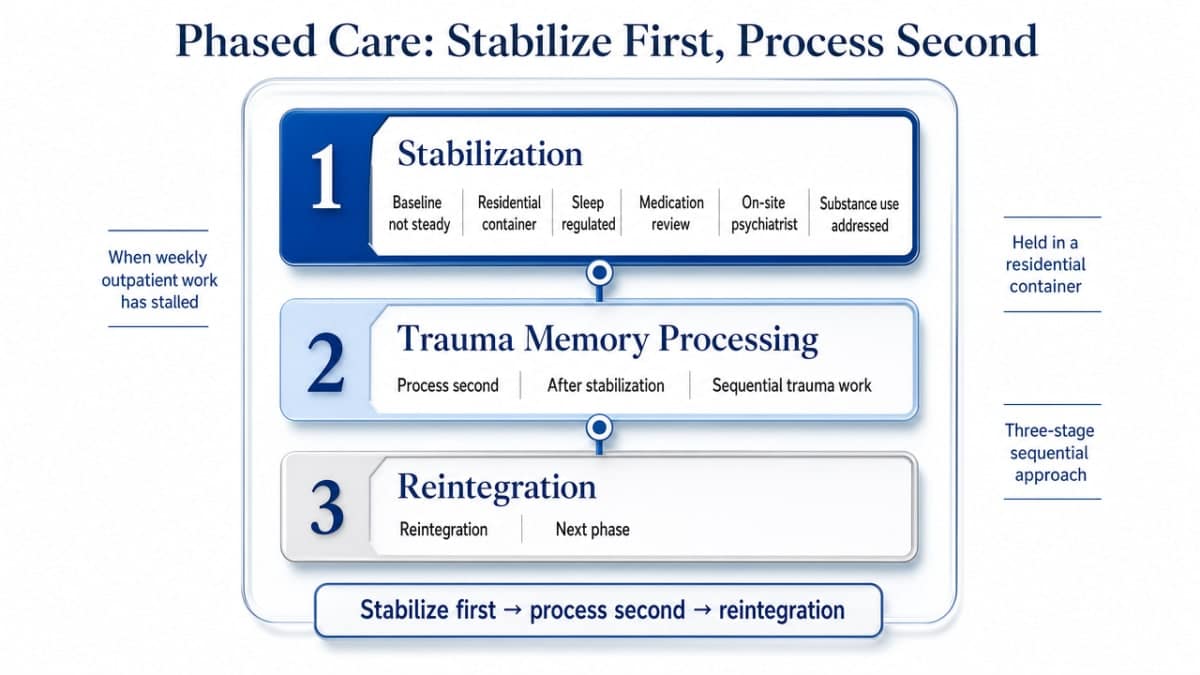
There is a model of trauma care that clinicians who work with complex presentations tend to lean on, especially when standard weekly outpatient work has stalled. It is called phased care, and it moves in three stages: stabilization, trauma memory processing, and reintegration. Guidance summarized in the complex PTSD literature, including NICE-aligned frameworks, describes this sequential approach as one of the more durable ways to hold someone through trauma work when their baseline is not steady enough to skip straight to reprocessing 11.
Stabilization is the phase most outpatient EMDR courses gloss over or condense into a couple of grounding exercises. In a residential container, it is a real chunk of the work. Sleep gets regulated. Medications get reviewed by a psychiatrist who is on-site, not booked out six weeks. Substance use, if it is part of the picture, gets addressed at the same time rather than being treated as a separate problem to solve later. You build a floor before you start pulling up the boards.
Trauma memory processing is where EMDR does what EMDR does. But now it happens with a nervous system that has been fed, rested, and monitored. The processing does not have to compete with the rest of your life because, for a few weeks, it is the point of your life.
Reintegration is the phase that gets short-changed in outpatient care almost every time. It is the work of taking a nervous system that is no longer running on trauma logic and teaching it how to live in your actual home, your actual job, your actual relationships. In a residential setting, this includes discharge planning, family sessions, relapse-prevention work if substances were part of the story, and a real handoff to whoever will hold you next.
The reason this sequence matters is simple. When people describe outpatient EMDR that “did not work,” what usually happened is that stabilization was skipped, processing was attempted anyway, and reintegration never got a chance because they dropped out of treatment. The therapy was not the problem. The order was.
What the Evidence Actually Says About EMDR
First-Line Status, Without the Hype
You do not have to take a therapist’s word for it, and you do not have to take a marketing page’s word for it either. EMDR sits inside the small group of trauma therapies that the VA/DoD 2023 Clinical Practice Guideline names as first-line for PTSD, alongside prolonged exposure and cognitive processing therapy 7. The National Center for PTSD lists the same three as the treatments with the strongest evidence for actually reducing trauma symptoms, not just managing them 8.
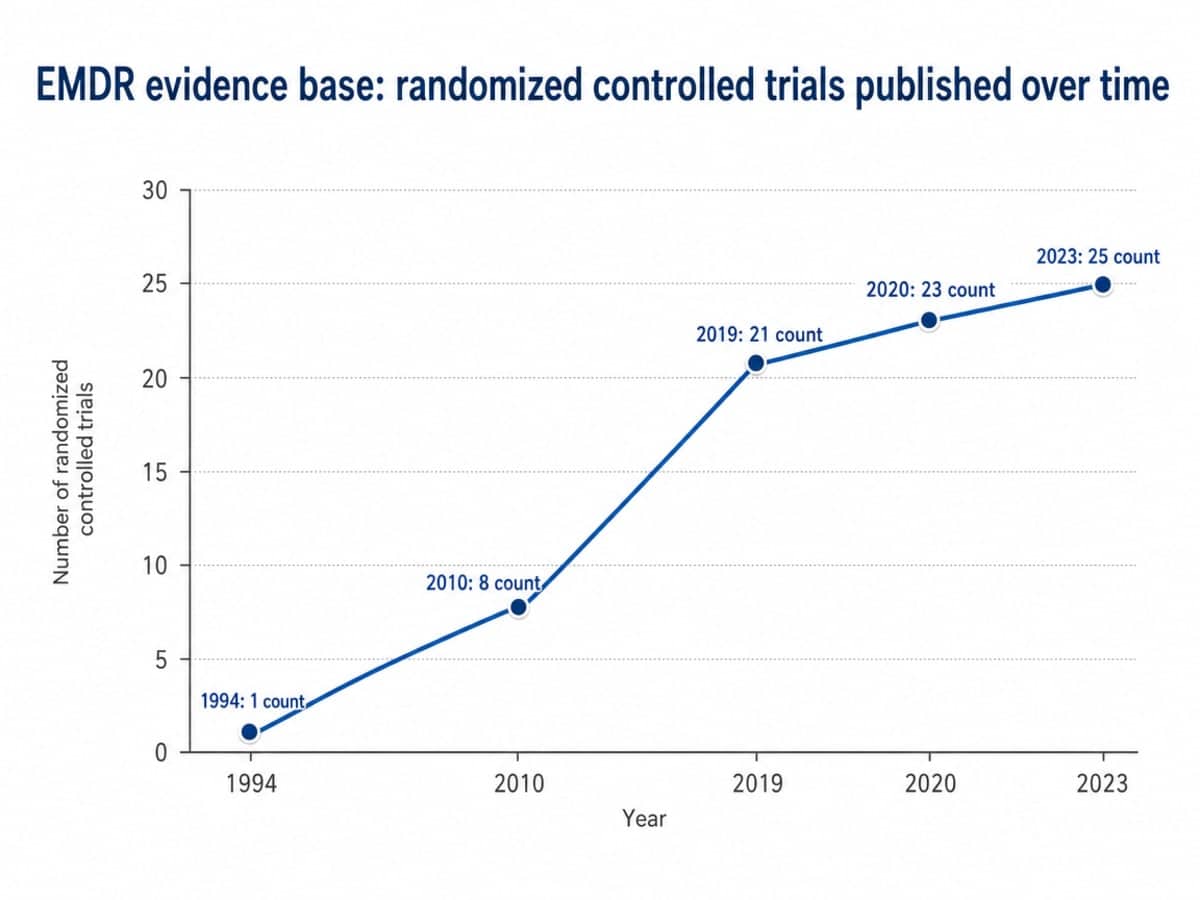
That standing did not appear overnight. It was built one randomized trial at a time, across three decades. A 2024 systematic review tracked how the evidence base has thickened:
- one RCT published in 1994
- eight by 2010
- twenty-one by 2019
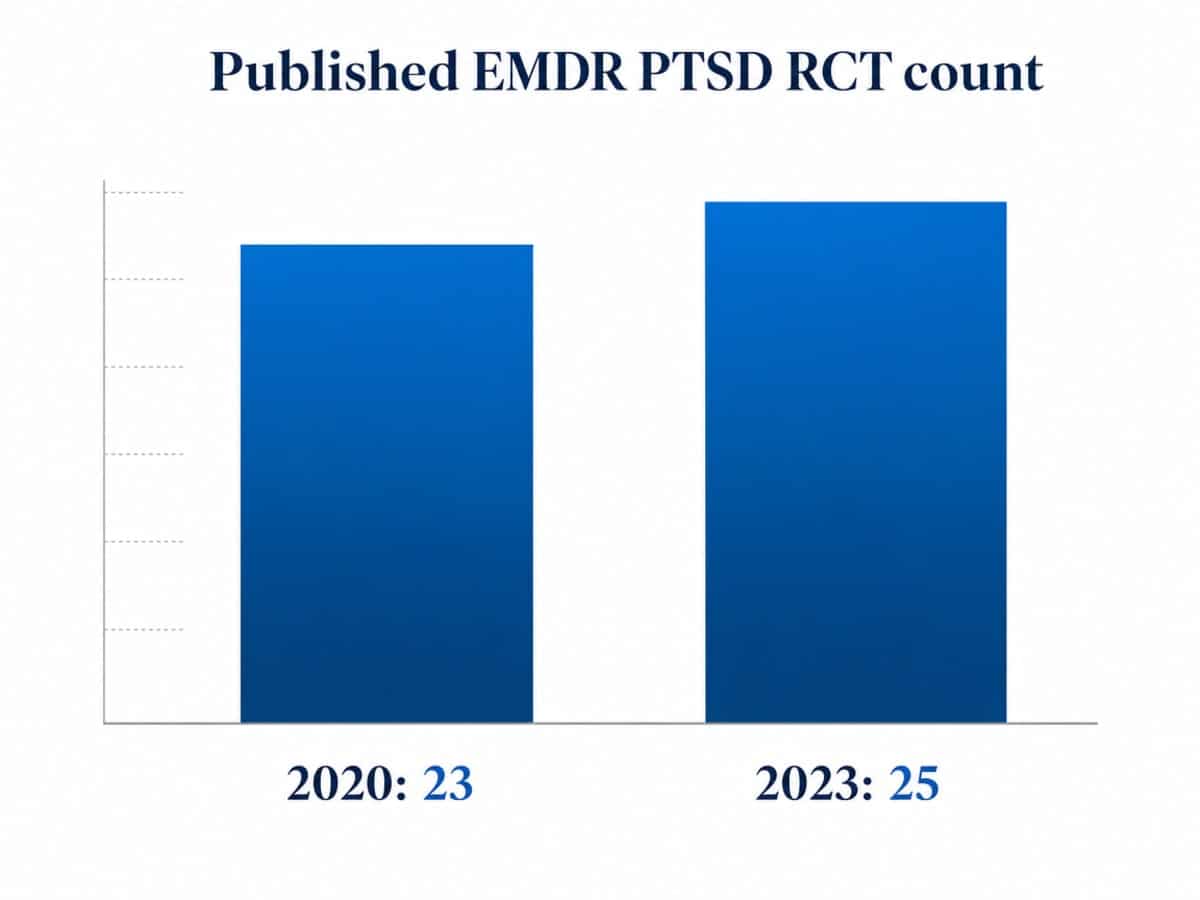
- twenty-three in 2020
- twenty-five by 2023 4
That is a slow, unglamorous curve of clinicians running the same protocol against comparison groups and reporting what happened. It is the kind of curve that guideline committees care about.
The takeaway for you is smaller and more useful than “EMDR is proven.” It is this: if a therapist or a program tells you EMDR is experimental, or fringe, or the newest thing they are trying, they are behind. And if someone tells you EMDR is a guaranteed fix, they are ahead of what the evidence actually says. It is a first-line option with real backing. That is the honest ceiling, and it is high enough to build on.
EMDR vs. CBT and the Honest Read
You may be wondering why anyone would choose EMDR over CBT, or vice versa. It is a fair question, and the research gives a more grown-up answer than most therapy websites do.
A 2022 meta-analysis compared EMDR and CBT head to head across randomized trials for PTSD, anxiety, and depression. Both treatments were effective at reducing PTSD symptoms, and at three-month follow-up there was little evidence that EMDR outperformed CBT for PTSD specifically 1. For the raw trauma symptoms, they are close enough that either can be a defensible choice.
Where the same analysis found a difference was on the co-occurring stuff. EMDR showed greater reductions in depression and anxiety symptoms in some of the comparisons 1. If your trauma has come packaged with a heavy depressive floor, or an anxiety pattern that will not quiet down, that is worth weighing.
Two things follow from this that matter for your decision. First, the modality is not the deciding factor in most cases. A therapist you trust running either protocol well will outperform a mismatched fit with the “right” method. Second, if your presentation is layered, depression plus PTSD plus insomnia plus something you cope with by drinking, the container matters more than the choice between two evidence-based protocols. Which brings the next question forward: what does EMDR look like when it is not delivered one hour at a time?
Intensive and Residential EMDR: What Has Been Tested
Most of what you have read about EMDR assumes a weekly outpatient rhythm. That is not the only way it has been studied.
A 2018 feasibility study looked at an intensive five-day inpatient program that ran two EMDR sessions a day, paired with a daily trauma-informed yoga session, for patients with PTSD 6. The researchers reported large pre- to post-treatment reductions in PTSD symptoms and good tolerability, meaning people stayed in and finished the work 6. They were careful about their own findings: small sample, no control group, results labeled preliminary 6. This is not the moment to overclaim.
What that study does establish is a proof of concept. Compressed EMDR inside a structured inpatient setting, with clinical staff around the clock and adjunctive body-based work, is feasible for people who would likely not tolerate the same processing spread across weekly appointments. That matters because it lines up with what larger reviews say about completion. The 2025 adult systematic review that pulled together 29 RCTs found that EMDR significantly reduced PTSD symptoms with low discontinuation rates when it was delivered inside structured protocols 9. People finish it when the delivery holds them.
You should not read the inpatient study as proof that five days will fix your trauma. Read it as evidence that the format of EMDR is more flexible than the weekly-hour default suggests, and that residential delivery is a real option supported by early data, not an experimental workaround. When your baseline will not carry weekly work, changing the format is a legitimate clinical move, not a compromise.
Signs Outpatient EMDR Is Not the Right Setting for You Right Now
Not every trauma survivor needs a residential program. Plenty of people do good, durable work in a weekly office. The question is honest: which one are you, right now, in this season of your life? A few patterns tend to show up when outpatient EMDR is asking more of your nervous system than the format can support.
You leave sessions and cannot come down. The activation stretches into days, not hours. Sleep gets shredded. You are exhausted by Wednesday and dreading Thursday’s appointment because you know what it will cost you.
You dissociate during processing. You lose time in session, or you go somewhere far away in your head and cannot describe where. Your therapist keeps shortening the sets, and you keep leaving without finishing the memory.
You use something to survive the week. Alcohol, opioids, benzos not prescribed to you, food, self-harm, a person who is not good for you. The coping is not a moral failure. It is a signal that the work is bigger than the container.
You have a psychiatric diagnosis that gets shakier when trauma comes up. Bipolar cycles tighten. Depression deepens. Psychotic symptoms flicker back. Your medication needs adjusting, but your prescriber is booked into next month.
You have canceled the last three sessions. Not because you do not want to heal, but because some part of you knows the setup is not safe enough. Avoidance in this case is data, not weakness.
The Prescott and Yavapai County Care Gap
Prescott is not a treatment desert. If you drive through town, you will see counseling offices, wellness practices, and clinicians who list EMDR on their websites. Yavapai County itself runs the Community Health Center of Yavapai out of a Prescott clinic on Commerce Drive, with phone access for Prescott, Prescott Valley, and Ash Fork residents 12. Access, in the technical sense, exists.
The gap is not access. The gap is what sits between two very different levels of care.
On one end, you have weekly outpatient therapy. Fifty minutes, once a week, with a therapist who cannot be with you the other six days. On the other end, you have psychiatric hospitalization, which is built for acute crisis and lasts a few days at most. In between those two, for someone whose trauma is too complex for weekly sessions but who is not in immediate danger, there is a lot of open space.
That open space is where most people with complex PTSD, dual diagnosis, or a history of destabilizing during outpatient EMDR get stuck. They cycle. Weekly therapy is not enough. The ER is too much. So they stay in the middle, trying the same weekly rhythm harder, hoping this time will be different.
The care gap in Prescott is not a shortage of EMDR providers. It is a shortage of settings equipped to hold trauma work between those two poles. That is the space a structured trauma program is built to fill.
ViewPoint’s Trauma-Focused Program as a Structured Container
What Changes When EMDR Happens Inside a Structured Program
Same protocol. Same eye movements or bilateral taps. Same eight phases. What changes in a structured program is everything around the fifty minutes.
ViewPoint’s Trauma-Focused Program in Prescott is built as an integrated psychiatric and trauma container, not a stand-alone EMDR practice. That distinction matters. In weekly outpatient work, your therapist runs the session and then hands you back to your life. In a structured program, the therapist runs the session and hands you to a team that follows up: board-certified psychiatry and medication management on site, medication management by clinicians who see you daily instead of quarterly, and group and individual therapy woven through the week.
Consider what shifts across a single dimension at a time. Session frequency moves from one hour a week to structured, more frequent processing paced by your clinical team. The 2018 five-day inpatient feasibility study ran two EMDR sessions a day with an adjunctive body-based session, and the researchers reported large pre- to post-treatment symptom reductions with good tolerability, though the sample was small and preliminary 6. That is not a promise of five-day cures. It is proof that compressed EMDR is survivable when the setting supports it.
Between-session support changes too. If a memory follows you into the evening, someone is there. If your medication needs adjusting mid-week because processing activated a depressive dip, a psychiatrist adjusts it that day. If a co-occurring substance use pattern flares, it gets addressed in the same building, by the same team, not punted to a separate referral you may or may not follow up on.
That is the category difference. ViewPoint is not offering EMDR as one service among many. It is offering the clinical scaffolding that lets EMDR do its job for people whose baseline could not carry the work in an outpatient chair.
Duration Set by Clinical Need, Not Insurance Calendars
Here is something worth naming plainly: most residential programs discharge you when your benefits run out, not when your nervous system is ready. That is not a criticism of the clinicians inside them. It is a description of how the system usually works.
ViewPoint sets treatment duration by clinical need. If your stabilization phase takes longer because your medications are still being calibrated, stabilization takes longer. If trauma processing needs more sessions before you can move into reintegration, you get those sessions. If you finish sooner than expected, you don’t stay in the program longer than you need.
This matters for EMDR specifically because trauma work does not run on a calendar. The phased-care model that guides complex PTSD treatment moves in a sequence, not a schedule 11. Rushing stabilization to get to processing is one of the more common ways outpatient EMDR quietly fails. Rushing processing to hit a discharge date is how residential treatment sometimes reproduces the same problem indoors.
The practical version of this for you: you will not be asked to compress trauma into a treatment duration someone chose before they met you. That is a small thing to say and a large thing to actually build a program around.
How to Tell if a Residential Trauma Program Is Actually Equipped for EMDR
Not every residential program that lists EMDR on its website is built to hold it well. Some offer the protocol as one item on a menu. Others have the clinical scaffolding to actually deliver trauma processing to people who could not tolerate it in an outpatient chair. The difference is worth asking about directly.
A few questions cut through the marketing quickly:
- Who runs the EMDR sessions, and are they trained in the full eight-phase protocol?
- What happens if a session opens up more than you can carry at 10 p.m., and who exactly is on the unit at that hour?
- Is a psychiatrist on-site or on-call for medication adjustments during processing weeks, or does that get referred out?
- If you have a co-occurring substance use or psychiatric diagnosis, is it treated in the same building by the same team, or handed off to a separate program after discharge?
Ask how the program handles the stabilization phase. Programs equipped for complex trauma treat it as real clinical work, not a two-day intake before jumping to processing 11. Ask about reintegration and discharge planning. A program that cannot tell you what week three looks like, or what the handoff back to outpatient care includes, is not thinking in the sequence trauma work actually requires.
You are allowed to interview a program the way it will interview you. Good ones expect it.
Start your trauma recovery plan with expert insight
Receive a personalized clinical evaluation to clarify your best next steps for trauma-focused care.
Frequently Asked Questions
How is residential EMDR different from weekly outpatient EMDR?
The protocol is the same. What changes is everything around it. In a residential setting, sessions happen more frequently, a clinical team stays with you between them, and psychiatric support is on-site rather than booked out weeks. Early inpatient EMDR research shows compressed delivery can be feasible and tolerated when the setting holds the nervous system between sessions 6.
I dissociated or destabilized during outpatient EMDR. Does that mean EMDR won’t work for me?
No. It usually means the container was too thin, not that the therapy failed you. Complex trauma often needs a real stabilization phase before processing, which weekly appointments rarely deliver in full 11. When stabilization gets the time it needs, and support is available around the clock, processing that felt impossible outpatient can become survivable and finishable.
Can I do EMDR if I’m also dealing with active substance use or a co-occurring diagnosis?
Yes, but the setting matters. Outpatient EMDR often struggles when substance use or an unstable psychiatric diagnosis is in the picture, because the between-session hours pull hard on old coping. A residential program that treats mental health and substance use in the same building, with the same team, addresses both at once instead of asking you to solve one before starting the other.
Why should I consider a residential program in Prescott instead of continuing weekly therapy?
If weekly work has stalled, destabilized you, or you keep canceling because sessions cost you your week, the format itself may need to change. Reviews of adult EMDR find low discontinuation rates when delivery is structured enough to keep people in treatment 9. A structured program in Prescott gives you that structure without waiting for a hospitalization to force the issue.
How long does trauma-focused treatment usually last?
It depends on where your nervous system starts and what stabilization requires. ViewPoint sets treatment duration by clinical need rather than an insurance calendar, which matters because phased trauma care moves in a sequence, not on a schedule 11. Some people need longer in stabilization before processing begins. Others move through more quickly. You will not be asked to compress trauma work into a preset length.
What should I ask a residential program to know if it’s actually equipped for EMDR?
Ask who runs sessions and whether they are trained in the full eight-phase protocol. Ask who is on the unit at night if a memory follows you into the evening. Ask if psychiatry is on-site for mid-week medication adjustments. Ask how stabilization and reintegration are handled, not just processing. Programs built for complex trauma treat all three phases as real clinical work 11.
References
- Eye Movement Desensitization and Reprocessing versus Cognitive Behavior Therapy for Post-traumatic Stress Disorder, Anxiety, and Depression Symptoms: A Meta-analysis. https://pmc.ncbi.nlm.nih.gov/articles/PMC9778888/
- A Systematic Review and Meta-Analysis of Randomized Controlled Trials of Eye Movement Desensitization and Reprocessing for Posttraumatic Stress Disorder. https://pubmed.ncbi.nlm.nih.gov/42483107/
- Clinical and Cost‐Effectiveness of Eye Movement Desensitisation and Reprocessing for Children and Adolescents with Posttraumatic Stress Disorder. https://pmc.ncbi.nlm.nih.gov/articles/PMC12676259/
- The Efficacy of Eye Movement Desensitization and Reprocessing for Adults with Posttraumatic Stress Disorder: A Systematic Review. https://pmc.ncbi.nlm.nih.gov/articles/PMC11433385/
- The Use of Eye-Movement Desensitization Reprocessing Therapy to Treat PTSD. https://pmc.ncbi.nlm.nih.gov/articles/PMC5997931/
- A five-day inpatient EMDR treatment programme for PTSD. https://pmc.ncbi.nlm.nih.gov/articles/PMC5804727/
- Overview of Psychotherapy for PTSD – PTSD: National Center for PTSD. https://www.ptsd.va.gov/professional/treat/txessentials/overview_therapy.asp
- Management of Posttraumatic Stress Disorder and Acute Stress Disorder. https://www.healthquality.va.gov/guidelines/mh/ptsd/
- Clinical and cost‐effectiveness of eye movement desensitization and reprocessing for treatment and prevention of post‐traumatic stress disorder in adults: A systematic review and meta‐analysis. https://pmc.ncbi.nlm.nih.gov/articles/PMC12514334/
- Revisiting Eye Movement Desensitization and Reprocessing Therapy for Post-traumatic Stress Disorder: A Systematic Review and Discussion of the American Psychological Association’s 2017 Recommendations. https://pmc.ncbi.nlm.nih.gov/articles/PMC11111257/
- PTSD and complex PTSD, current treatments and debates. https://pmc.ncbi.nlm.nih.gov/articles/PMC12466117/
- Community Health Center of Yavapai. https://www.yavapaiaz.gov/Resident-Services/Health-Services/Community-Health-Center-of-Yavapai