

Key Takeaways
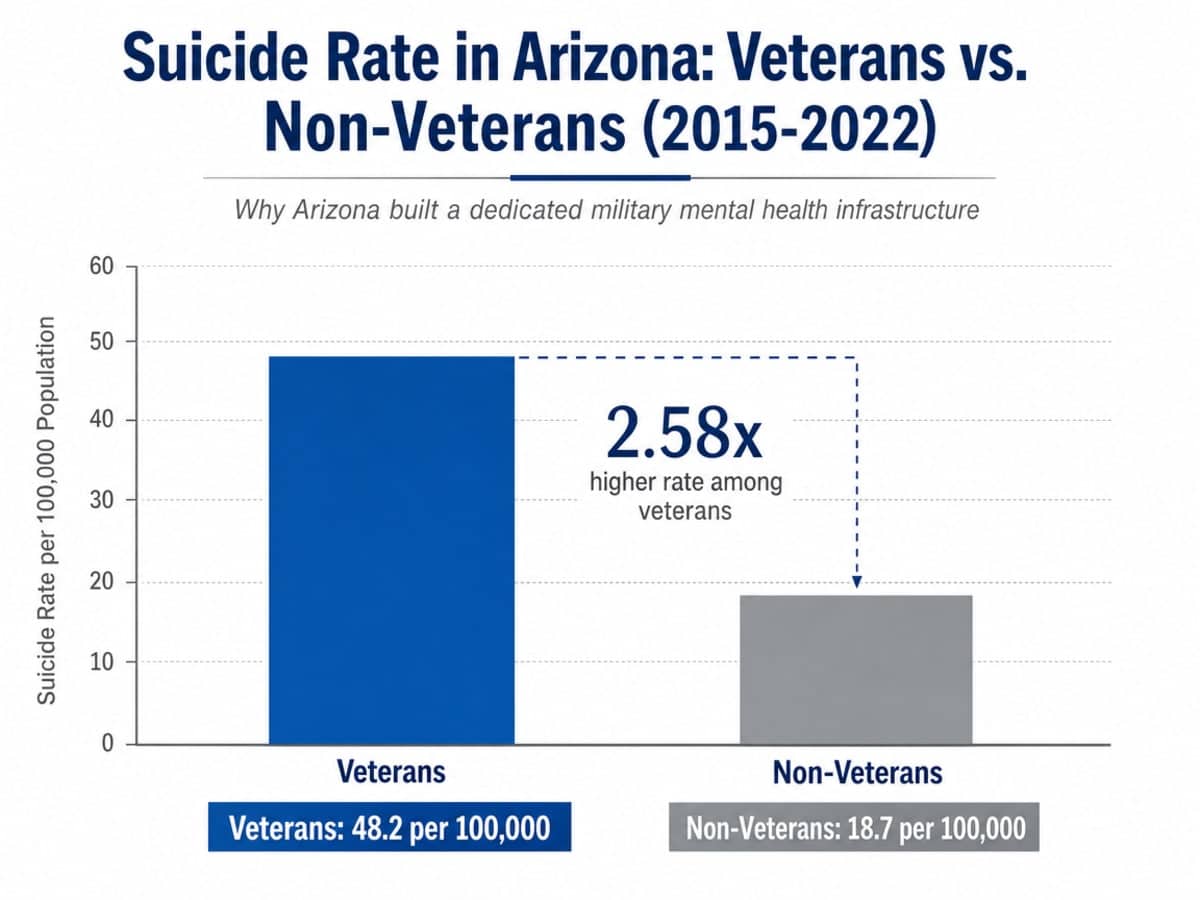
- Arizona built dedicated veteran mental health infrastructure because the veteran suicide rate reached 48.2 per 100,000 between 2015 and 2022, more than double the non-veteran rate 4.
- State law ARS §36-146 requires annual reporting on veteran suicides, which is why Be Connected and a statewide coalition treat prevention as an ongoing public health commitment 3.
- Which door fits depends on the situation: 988 Press 1 for crisis, Vet Centers for family counseling without VA enrollment, Coaching Into Care when a veteran refuses help, and county VSOs for benefits questions 6, 8, 11.
- For Arizona families weighing civilian psychiatric care, verify Joint Commission accreditation, ADHS licensing, psychiatrist involvement, length-of-stay drivers, and insurance coverage directly with any facility before admission.
You’re the one making the calls. Start here.
You’ve probably already tried a few numbers. Maybe you got a phone tree, maybe you got a kind voice that couldn’t quite tell you if your situation qualified, maybe you got a callback that never came. If you’re the spouse, parent, or adult child of an Arizona service member or veteran, you’re carrying something heavy: the job of finding help for someone else while your own sleep, work, and patience take the hit.
That’s real, and it’s not a personal failure. Arizona’s mental health support for military families is genuinely there, but it’s spread across the VA, Vet Centers, TRICARE, Military OneSource, the statewide Be Connected program, county Veterans Service Offices, and private psychiatric providers. No single office hands you a map.
This guide is that map. You’ll get plain language on what each resource actually does, where the eligibility gaps sit for family members, and how to think about civilian psychiatric care when standard programs haven’t worked. Take what fits your situation today. Leave the rest for later.
Why Arizona built a dedicated military mental health infrastructure
You may have wondered why Arizona has so many veteran-specific programs when other states seem to fold everything into general mental health services. The reason is in the numbers, and they’re hard to sit with.
Between 2015 and 2022, the suicide rate among Arizona veterans was 48.2 per 100,000 — more than double the non-veteran rate of 18.7 per 100,000, according to the Arizona Violent Death Reporting System maintained by ASU’s Center for Violence Prevention and Community Safety 4. That gap isn’t a rounding error. It’s the reason your state, your legislature, and a coalition of VA and community partners decided this couldn’t be handled by general services alone.
In response, Arizona passed a state law (ARS §36-146) requiring the Department of Health Services to produce an annual report on veteran suicides — rates, methods, demographics, regional patterns, and comparisons to national numbers 3. That statute is the reason the data you’re reading exists at all, and it’s why prevention planning in Arizona is treated as an ongoing public health commitment rather than a one-time campaign.
On the ground, that commitment shows up as Be Connected, a statewide upstream prevention program built to support Arizona’s 500,000-plus service members, veterans, and their families across housing, employment, behavioral health, and connection to care 5. It launched as a coalition of state, community, and VA partners specifically to bring that suicide rate down 12.
So when you feel like the system is a lot to hold, remember: it’s a lot because your family’s situation was taken seriously enough to build one.
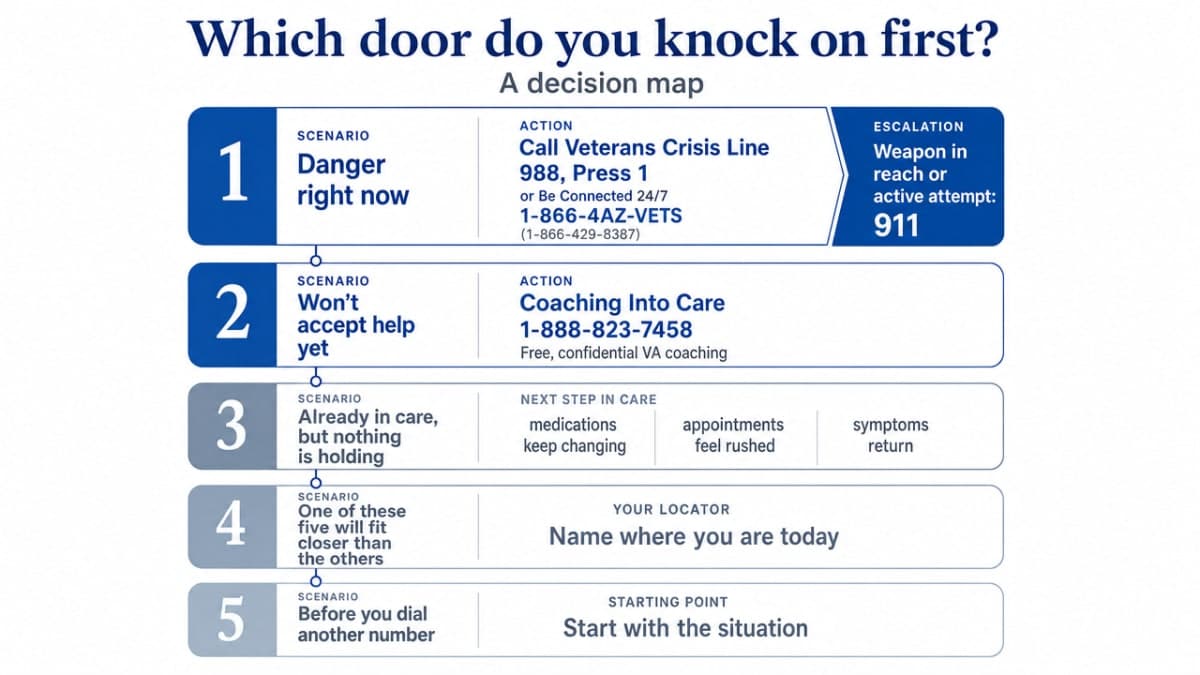
Which door do you knock on first? A decision map
The reason families get stuck isn’t a lack of resources. It’s that every resource assumes you already know which one applies to your situation. So before you dial another number, name where you actually are today. One of these five will fit closer than the others.
- Someone is in danger right now.
- Skip the research. Call the Veterans Crisis Line at 988, Press 1, or Be Connected’s 24/7 line at 1-866-4AZ-VETS (1-866-429-8387) 12. If there’s a weapon in reach or an active attempt, call 911.
- Your veteran won’t accept help yet.
- You’re not powerless here. Coaching Into Care (1-888-823-7458) is a free, confidential VA service that coaches you on how to have the conversation without making it worse 8.
- They’re already in care, but nothing is holding.
- Medications keep getting swapped, appointments feel rushed, symptoms come back. This is where you start asking about specialized psychiatric care — VA specialty programs, or a Joint Commission-accredited civilian facility if standard outpatient hasn’t worked.
- You need care for yourself or your kids.
- The Vet Center system offers confidential counseling to eligible family members without requiring the veteran to be enrolled in VA health care 6. The VA Caregiver Support Line (1-855-260-3274) is also for you, not just the veteran 7.
- You’re lost in the benefits paperwork.
- Call your county Veterans Service Office. They exist to translate VA eligibility into plain English and connect you to the right program 11.
Pick the branch that matches today. The next sections walk each one in detail.
If someone is in crisis right now
Veterans Crisis Line, 988 Press 1, and Be Connected’s 24/7 line
If you’re reading this while something is actively happening, put the guide down and dial. You can come back to the rest later.
Veterans Crisis Line: 988, then Press 1. It’s free, confidential, and staffed 24/7 by responders trained specifically for service members, veterans, and their families. You do not have to be enrolled in VA care to use it. You can also text 838255 or chat online if speaking out loud feels impossible right now. Family members can call this line too — you don’t have to hand the phone to your veteran to get help.
Be Connected: 1-866-4AZ-VETS (1-866-429-8387). This is Arizona’s own 24/7 line, built by a coalition of state, community, and VA partners to reduce veteran suicides across the state 12. Call it when you need someone who knows Arizona programs, Arizona counties, and Arizona wait times — not a national script.
Both lines can stay on with you while you make a plan. That includes helping you decide whether the next step is an ER, a same-day appointment, or a safety plan for the night. You don’t have to know what you need before you call.
When to call 911 or go to the ER instead
When you call 911, you can ask for a CIT (Crisis Intervention Team) officer — Arizona agencies train officers specifically for mental health calls. Say the words “mental health crisis” and “veteran” early in the call. That framing changes how the response is handled.
If you’re not sure which door is right, call 988 Press 1 first and let the responder help you decide. That’s what the line is for.
Ongoing care through the VA and Vet Centers
Phoenix VA, Prescott VA, and community-based outpatient clinics
Once the immediate danger has passed, the next question is where ongoing care lives. For most enrolled veterans in Arizona, that starts with the Phoenix VA Health Care System, which offers individual counseling, group therapy, and specialized programs for PTSD and substance use 11. Northern Arizona is served by the Northern Arizona VA in Prescott, and both systems feed into a wider network of community-based outpatient clinics (CBOCs) scattered across the state so your veteran doesn’t have to drive three hours for a therapy appointment 8.
Here’s what to know before you call. VA mental health care is for the enrolled veteran, not for you as a spouse or parent. Your role at intake is usually to help schedule, remind, and show up — not to be the patient in that chair.
Ask specifically about the suicide prevention coordinator at your veteran’s assigned facility 6. That person can flag your veteran for closer follow-up, help resolve appointment gaps, and connect the case to specialty programs. Most families don’t know to ask for them by name. Now you do.
Vet Centers: what they cover without VA enrollment
Vet Centers are the resource families most often miss, and they may be the one that fits your situation best. They provide confidential counseling, community engagement, and referrals to eligible individuals and their families — and you do not need to be enrolled in VA health care or have a service connection to use them 6.
What that means in plain terms: a combat veteran can walk in and start talking. A spouse struggling with the strain of caregiving can be seen. Bereaved family members of a service member who died in the line of duty can be seen. The paperwork wall that keeps a lot of families out of VA medical centers isn’t the same wall here.
What Vet Centers are not: they’re not psychiatric hospitals, they don’t prescribe medication, and they don’t replace intensive care for a treatment-resistant condition. They’re a low-friction place to start talking, get assessed, and get referred outward when needed. For a lot of Arizona families, that’s exactly the door they’ve been looking for.
County Veterans Service Offices as your benefits translator
If you’ve spent an evening lost in VA eligibility PDFs, this section is for you. Every Arizona county has a Veterans Service Office (VSO), and the whole point of that office is to translate benefits into plain English and connect families to the right mental health referrals 11.
Call your county VSO when you’re stuck on questions like: Is my veteran eligible for VA mental health care based on their discharge status? What does their service connection cover? Can we get travel reimbursement for appointments in Phoenix or Prescott? Is there a program for the surviving spouse of a service member?
VSO staff won’t do the therapy. They’ll do the paperwork with you, which is often the piece that’s been keeping you awake. Bring a notepad, bring the DD-214 if you have it, and let them earn their job.
TRICARE, Military OneSource, and civilian network care
If your service member is still on active duty, in the Guard, or in the Reserves — or if you’re a covered dependent — your first insurance card is probably TRICARE, not the VA. That single fact changes which providers you can see, how much you pay, and how fast you can get in.
TRICARE covers mental health care for enrolled spouses and children, not just the service member. You can usually see a network therapist or psychiatrist without a referral under TRICARE Select, though rules differ by plan and region. Call the number on the back of your card before you book, and ask specifically whether your provider is in-network for behavioral health — the medical network and behavioral health network don’t always match.
Military OneSource (1-800-342-9647) is the other card in your wallet you may not know you have. It offers free, confidential non-medical counseling — up to 12 sessions per issue, per counselor — for service members and their families, including in-person, phone, and video options. It does not replace psychiatric treatment, and it’s not designed for active suicidality or severe conditions. Use it for adjustment stress, relationship strain, grief, and parenting under deployment.
When your loved one’s condition is more complex than either of those doors can hold, civilian psychiatric providers become part of the plan. Arizona has a mix of accredited facilities that accept various commercial insurances and private pay 11. Ask any facility directly whether they take TRICARE, what your out-of-pocket looks like, and whether they’ve worked with military families before.
Comparing your options at a glance
You’ve now read about six different doors. Here’s how they line up side by side, so you can stop holding it all in your head.
| Resource | Who it serves | Cost to family | Best use | What it is NOT |
|---|---|---|---|---|
| Veterans Crisis Line (988, Press 1) | Veterans, service members, and family members | Free | Immediate crisis, any hour | Not ongoing therapy or medication management |
| Vet Center | Eligible veterans and their families; no VA enrollment required 6 | Free | Confidential counseling, readjustment support, referrals 6 | Not a psychiatric hospital; no prescribing |
| VA Mental Health (Phoenix VA, Northern AZ VA, CBOCs) | Enrolled veterans only | Free or low copay for the veteran | Ongoing psychiatric care, PTSD and substance use programs 11 | Not for family members as patients |
| TRICARE network | Service members, spouses, dependents | Copays vary by plan | Civilian outpatient therapy and psychiatry | Not automatic — verify behavioral health network |
| Military OneSource | Active duty, Guard, Reserve, and families | Free | Short-term non-medical counseling, adjustment stress | Not for active suicidality or severe conditions |
| Private psychiatric facility | Anyone accepted for admission | Insurance or private pay | Complex or treatment-resistant cases | Not a VA or TRICARE partner unless confirmed directly |
Notice the pattern. The veteran-only doors are the ones with the deepest clinical services. The family-inclusive doors are lighter-touch. That gap is exactly why you may end up combining two or three of these at once — and why it’s okay to ask each one, out loud, whether your specific situation fits.
When your veteran won’t accept help yet
This is one of the hardest places to stand. You can see the drinking, the isolation, the anger that isn’t really about the dishes. You’ve said something, maybe more than once, and it hasn’t landed. You’re not failing. You’re up against something that a lot of families in Arizona are up against right now.
Two things are true at the same time. You can’t force an adult veteran into care against their will unless they meet the legal threshold for an emergency hold. And you don’t have to sit and wait for that emergency alone.
Call Coaching Into Care at 1-888-823-7458. It’s a free, confidential VA service that pairs you with a licensed psychologist or social worker who coaches you — the family member — on how to actually talk to your veteran about treatment 8. They’ll help you think through what to say, when to say it, and what to do when it doesn’t go well the first time. Sessions happen over the phone, so no one has to know you called.
While you’re doing that work, get yourself grounded. The VA Caregiver Support Line (1-855-260-3274) is there for family members carrying this exact weight 7. You’re allowed to make that call before your veteran makes theirs.
Family caregivers need care too
You’ve been reading a guide about your veteran’s care. This section is about you.
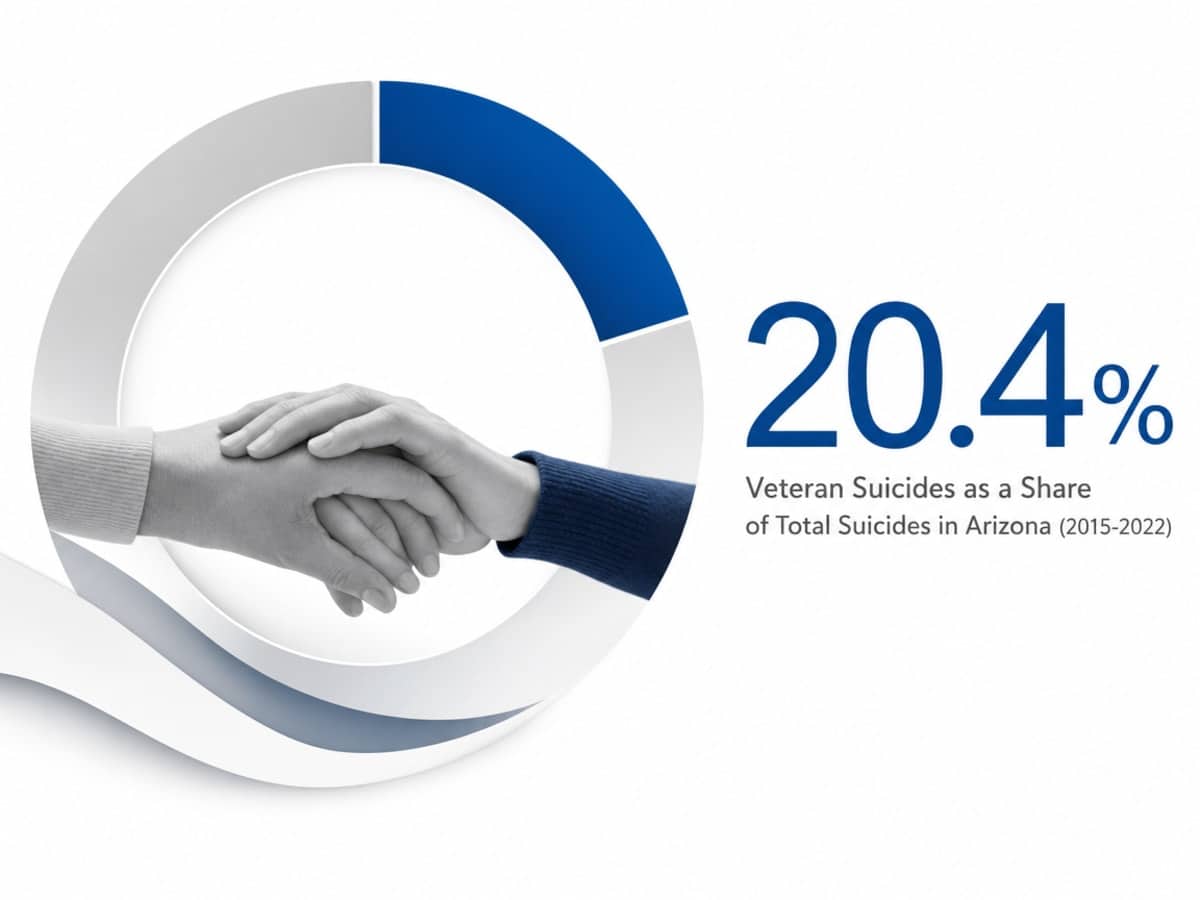
Between 2015 and 2022, veterans made up 20.4% of all suicide deaths in Arizona 4. That number isn’t here to scare you. It’s here to explain why your presence, your calls, your noticing when something is off actually matters to the outcome. And it’s the same reason you can’t afford to run yourself into the ground doing it alone.
Two phone numbers exist specifically for you.
The VA Caregiver Support Line at 1-855-260-3274 is a toll-free resource for caregivers, family members, and friends of veterans. You can call for information, coaching, and connection to available supports — you don’t have to be the one enrolled in VA care 7. Coaching Into Care at 1-888-823-7458 is a free, confidential VA service that helps you think through how to talk with your veteran about treatment when the conversations at home keep stalling 8.
Vet Centers are also open to eligible family members for confidential counseling, without requiring your veteran to be enrolled in VA health care 6. If you need a place to talk that isn’t your kitchen table at midnight, that’s a real door.
Put one of these numbers in your phone tonight. Not for later. For you.
PTSD and trauma-specific supports for the whole family
Trauma doesn’t stay in one person’s head. If your veteran is living with PTSD, you already know how it shows up at your dinner table — the startle at a slammed door, the nightmares, the withdrawal, the anger that arrives without warning. Your kids feel it too, even when no one has explained a thing to them.
The VA’s National Center for PTSD keeps a family-facing page with supports built for exactly this situation 9. A few worth writing down tonight:
Vet Center Combat Call Center: 1-877-WAR-VETS (1-877-927-8387). Staffed by combat veterans and family members of combat veterans. Available around the clock when talking to someone who has lived it matters more than talking to a stranger 9.
Give an Hour. A nonprofit that connects military families affected by post-9/11 service to free mental health sessions with licensed civilian providers 9. Useful when TRICARE waits are long or your veteran won’t step into a VA building.
Sesame Street for Military Families. Free videos and printable tools for kids ages 2 to 8 to understand deployment, homecoming, injury, and grief in language they can hold 9. Small thing. Big relief when your six-year-old asks a question you didn’t know how to answer.
PTSD care works better when the family is in the room, even quietly. You don’t have to become a therapist. You just have to know these numbers exist.
When standard programs haven’t worked: evaluating a civilian psychiatric facility
Signs the current plan isn’t holding
You’ll usually feel it before a chart confirms it. The medication that helped for three months stops working. Appointments shrink to fifteen minutes and a script refill. Symptoms your loved one thought were behind them — the drinking, the paranoia, the crash after a manic stretch — start showing up again, and no one on the current care team seems alarmed enough.
A few honest signals it’s time to look wider:
- Two or more medication trials without lasting improvement
- A substance use pattern that keeps returning even after outpatient treatment
- Symptoms that flip between poles faster than the current provider can adjust
- A psychiatric hospitalization followed by discharge to an outpatient plan that hasn’t changed
Write these down. You’ll need them for the next call.
Questions to ask any private facility before you commit
Before you tour, before you sign, before you hand over insurance information, get direct answers to these. A good facility will not flinch at any of them.
- Accreditation and licensing.
- Are you Joint Commission-accredited? Are you licensed by Arizona ADHS? Ask them to say it out loud, not just point to a website.
- Clinical fit.
- Have you treated cases like ours — treatment-resistant depression, rapid-cycling bipolar, schizophrenia with substance use, trauma tangled with addiction? What does a typical treatment plan look like for that presentation, and who leads it?
- Psychiatry access.
- Is a board-certified psychiatrist involved in medication decisions daily, or only at intake? What’s the after-hours coverage?
- Length of stay.
- Is the length driven by clinical progress or by insurance authorization?
- Payment.
- What insurances do you accept, what’s the private-pay cost, and can you verify our specific plan before admission?
- Family involvement.
- How will I be included, and what will I not be told because of privacy law?
Where ViewPoint fits in the conversation
ViewPoint Dual Recovery is a Joint Commission-accredited psychiatric facility in Prescott, Arizona, licensed by Arizona ADHS. It focuses on cases other programs have called too complex: treatment-resistant psychiatric conditions, dual diagnosis where mental health and substance use are tangled, and advanced medication strategies for bipolar and schizophrenia.
To be clear about what ViewPoint is not: it is not a VA facility and, unless you confirm otherwise directly with admissions, not a designated VA or TRICARE partner. If your loved one’s prior care hasn’t held and you’re weighing civilian options, call and ask whether their situation — the diagnosis, the history, the coverage — is a fit. That’s the honest way to find out.
See if advanced psychiatric care fits your needs
Find out if specialized support matches your family’s mental health challenges.
Frequently Asked Questions
Can family members of a veteran get counseling at an Arizona Vet Center even if the veteran isn’t enrolled in VA health care?
Yes, in many cases. Vet Centers offer confidential counseling and referrals to eligible individuals and their families, and you don’t need to be enrolled in VA health care or have a service connection to be seen 6. Call your nearest Vet Center first to confirm your specific eligibility category before your first visit.
What’s the difference between calling 988 Press 1, Be Connected (1-866-4AZ-VETS), and the VA Caregiver Support Line?
Use 988 Press 1 for an immediate crisis, any hour, for veterans, service members, or family members. Call Be Connected at 1-866-429-8387 when you need someone who knows Arizona programs and can connect you to state and local resources 12. Call the VA Caregiver Support Line at 1-855-260-3274 when the person who needs support is you 7.
My veteran refuses to seek help. Is there anything I can do besides wait for a crisis?
Yes. Call Coaching Into Care at 1-888-823-7458. It’s a free, confidential VA service that pairs you with a licensed psychologist or social worker who coaches you on how to approach the conversation, what to say, and what to do when it stalls 8. You call. Your veteran doesn’t have to know.
Does TRICARE or Military OneSource cover mental health care for spouses and children, or is it only for the service member?
Both cover eligible family members, not just the service member. TRICARE offers mental health benefits for enrolled spouses and dependents, with rules that vary by plan — call the number on your card to verify behavioral health network status. Military OneSource (1-800-342-9647) provides free short-term non-medical counseling for the whole family.
If VA and outpatient care haven’t worked, what should I ask a private psychiatric facility in Arizona before admitting a loved one?
Ask five things directly. Are you Joint Commission-accredited and Arizona ADHS-licensed? Have you treated cases like ours (treatment-resistant, dual diagnosis, rapid-cycling bipolar)? Is a board-certified psychiatrist involved in daily medication decisions? Is length of stay driven by clinical progress or insurance authorization? What insurances do you accept, and can you verify our plan before admission?
Is ViewPoint a VA or TRICARE partner facility?
ViewPoint Dual Recovery is a Joint Commission-accredited psychiatric facility in Prescott, Arizona, licensed by Arizona ADHS. It is not a VA facility, and it should not be assumed to be a designated VA or TRICARE partner unless you confirm that directly with their admissions team. Call and ask whether your situation is a fit.
References
- Arizona Veteran Suicide Data Sheet 2022. https://www.mentalhealth.va.gov/docs/data-sheets/2022/2022_State_Data_Sheets_Arizona_508.pdf
- Veteran Suicide Data and Reporting – VA Mental Health. https://www.mentalhealth.va.gov/suicide_prevention/data.asp
- Arizona Revised Statutes 36-146 – Veteran suicides; annual report; distribution. https://www.azleg.gov/ars/36/00146.htm
- Arizona Violent Death Reporting System: Suicides Involving Veterans, 2015–2023. https://cvpcs.asu.edu/sites/g/files/litvpz1111/files/2023-11/vetsuicide2023_july_v2_003.pdf
- Upstream Prevention by Addressing Social Determinants (ACMF/Be Connected). https://goyff.az.gov/sites/default/files/meeting-documents/materials/acmf_bc_parents_commission_11-8-22.pdf
- Get Help: Find Local Care (VA Mental Health). https://www.mentalhealth.va.gov/get-help/local-care.asp
- Family Member or Friend – VA Mental Health. https://www.mentalhealth.va.gov/families/index.asp
- Mental Health Resources for Veterans and Their Families (VA Reference Sheet). https://www.mentalhealth.va.gov/HEALTHPARTNERSHIPS/docs/VAMH_Resources_Reference_Sheet.pdf
- Help for Family and Friends (PTSD: National Center for PTSD). https://www.ptsd.va.gov/family/support_family_friends.asp
- Arizona Veteran Suicide Data Sheet 2021. https://www.mentalhealth.va.gov/docs/data-sheets/2021/2021-State-Data-Sheet-Arizona-508.pdf
- Mental Health | Attorney General’s Office. https://www.azag.gov/office/outreach/military-families/mental-health
- Be Connected – Arizona forms coalition to help prevent veteran suicides. https://news.va.gov/41472/connected-arizona-forms-coalition-help-prevent-veteran-suicides/