Key Takeaways
- Self-harm and substance use often serve the same emotional regulation function, so removing one behavior without building replacement skills leaves the underlying job unfinished.
- Integrated care under one team and one plan outperforms sequential or parallel models, producing better engagement and lower substance use across co-occurring presentations 14.
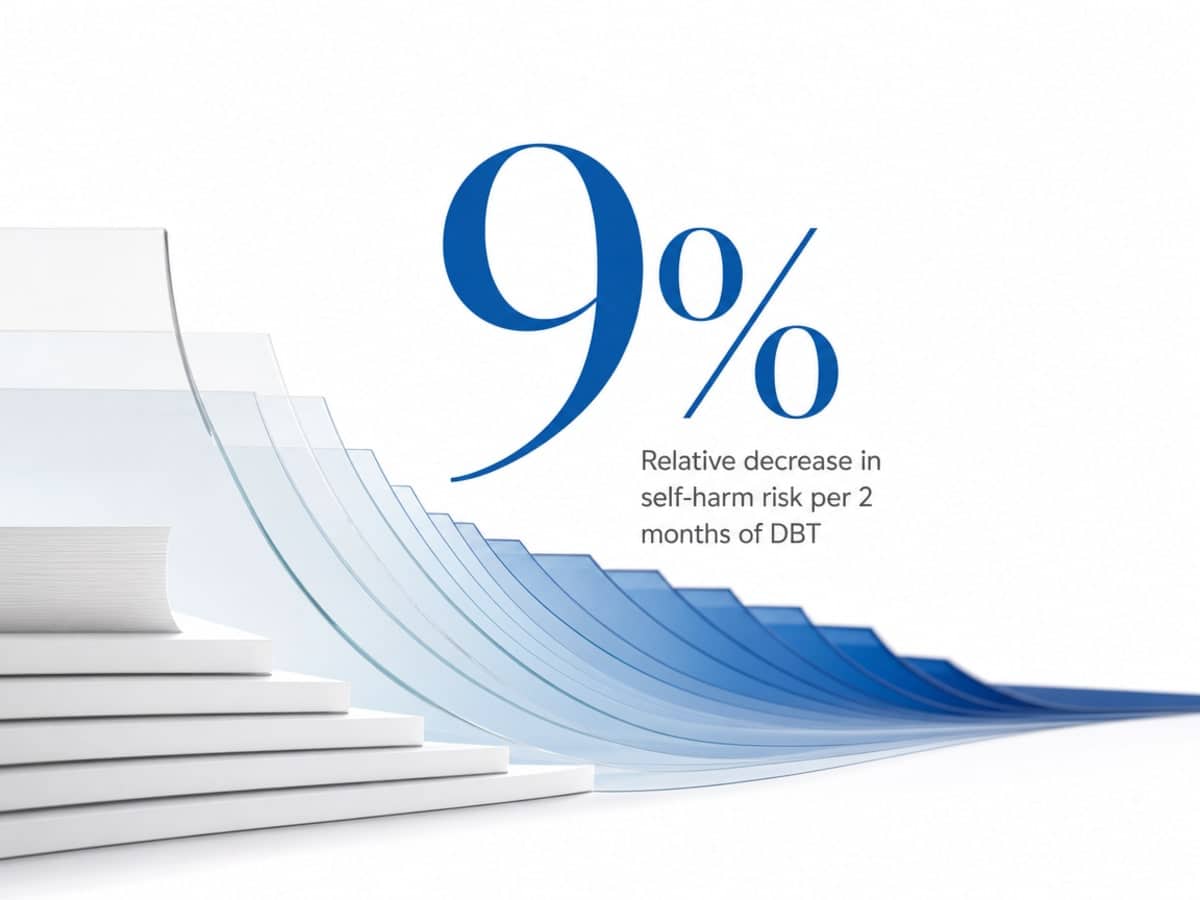
- DBT works as a bridge because the same distress tolerance and emotion regulation skills address both self-harm urges and cravings, with risk dropping roughly 9% for every two months in treatment 5.
- When choosing a program, press for specifics on case ownership, plan updates, mid-stay self-harm response, how length of stay is decided, and who is reachable overnight.
Two Behaviors, One Emotional Job
If you have watched someone you love cut and drink, or if you have lived inside both patterns yourself, you already know something the treatment system is often slow to admit: these are not two separate problems politely taking turns. They are usually the same attempt to make an unbearable feeling stop, using whatever tool is closest.
That reframe matters because it changes what treatment has to do. When self-harm and substance use are treated as unrelated diagnoses, you get a familiar loop: the psychiatric team stabilizes the crisis and refers out for addiction, or the rehab program pauses when cutting resurfaces. Meanwhile the underlying job those behaviors are doing, quieting a nervous system that has run out of other options, never gets addressed. A systematic review across 36 nonclinical studies found that people who use substances are significantly more likely to also self-harm, with negative affect linking the two 11. That pattern shows up outside hospital walls, which tells you it is about function, not just severity.
This piece is written for the reader who has already tried something that did not hold. You are not looking for warning-sign checklists. You want mechanism, evidence, and a clear picture of what safety-focused, integrated care actually does when both behaviors are in the room at once.
Why Self-Harm and Substance Use Travel Together
The Shared-Coping Mechanism
Here is the reframe worth sitting with: self-harm and substance use are often the same behavior wearing different clothes. Both interrupt a feeling that has gotten too loud. A cut releases something. A drink dulls something. A pill flattens something. The specific tool changes, but the job is identical, and the job is regulation of an affect state the person cannot yet tolerate any other way.
That framing is not a metaphor. When researchers pooled 61 systematic reviews on self-harm in adolescents and young adults, the risk factors that kept surfacing were the same ones that drive substance use: trauma histories, mood and anxiety disorders, behavioral disorders, and family relationship disruption, with behavioral and mood/anxiety disorders carrying the strongest evidence 12. Two behaviors, one shared root system.
If you have ever asked a client or a loved one “why cutting and drinking, why both,” the honest answer is usually some version of: whichever one was closest when the feeling hit. That is not manipulation or weakness. It is a nervous system running through its available options.
What the Population Data Actually Shows
Zoom out from the therapy room and the pattern holds. In a NESARC analysis of U.S. adults, deliberate self-harm reached a 2.91% prevalence and clustered tightly with severe psychopathology, wide-ranging substance abuse, and adverse childhood experiences 9. NESARC is cross-sectional, so it cannot tell you whether substance use worsens self-harm risk or whether both are downstream of shared drivers, and the authors are careful to say so. What it does establish is that the overlap is not a clinical curiosity confined to inpatient units. It is a population-level pattern.
The overlap also shows up well outside diagnosed populations. A systematic review of 36 studies in nonclinical samples found that people who use substances are significantly more likely to also self-harm, with depression and anxiety consistently linking the two 11. College students, community samples, young adults who have never seen a therapist, the association still appears. That is what makes the shared-function argument hard to dismiss.
The broader co-occurrence picture is just as stark. CDC data show that people with a mental health condition are more likely to use substances or have a substance use disorder, and in 2024, 37.1% of overdose deaths had evidence of a mental health diagnosis while only 20.2% of those individuals were in current treatment at the time of death 1. Most of the people carrying both problems are not connected to care that addresses either one adequately, let alone both.
The Repeat-Risk Window After a Crisis
The period right after a self-harm episode is not a plateau. It is a slope, and for people who also use substances, the slope is steeper. A hospital-based longitudinal study of patients presenting for deliberate self-harm found that those with identified problem drug use were younger, more socially disadvantaged, more likely to carry personality disorder and comorbid alcohol problems, and more likely to have another self-harm episode within a year than patients without drug problems 10. Problem drug use appeared in 8.7% of assessed patients in that sample, and it marked out a group that standard aftercare was not holding.
You have probably watched this play out. Someone gets stitched up, gets a follow-up card, and is discharged into the same environment with the same feelings and the same tools. The withdrawal window and the urge-to-self-harm window overlap. When either one spikes, the other one is right there.
That is why the case for continuous clinical availability is not a marketing line. It is a response to a documented repeat-risk window, and it shapes what integrated care has to look like when you build it seriously.
Why Sequential and Siloed Care Keeps Failing
You have probably lived some version of this sequence. The psychiatric hospital admits your loved one after a self-harm episode, stabilizes the crisis over a week, and discharges with a referral to an outpatient addiction program that has a three-week waitlist. Or the rehab intake nurse sees fresh cuts on the arm and says the program is not equipped for that, come back when the self-harm is under control. Or the outpatient therapist doing good DBT work has to pause when drinking escalates, because the practice cannot manage medical risk. Each provider is doing the responsible thing inside their own scope. The person in the middle keeps falling through the seams.
Sequential care assumes one behavior can be paused while the other is treated. That assumption breaks against the shared-function evidence. If both behaviors are doing the same regulation job, removing one without building a replacement skill leaves the other to expand and fill the gap. SAMHSA’s evidence review on co-occurring disorders is direct about this: integrated treatment produces better engagement, lower substance use, and better psychiatric outcomes than parallel or sequential models 14. The 2020 update of TIP 42 keeps that conclusion and adds structured self-harm risk assessment as a coordinated function of the same team, not a separate consultation 15.
Siloed care also creates handoff gaps at exactly the moments risk is highest. The person who walks out of a psychiatric unit into a three-week wait is the same person the hospital-based data flagged as more likely to have a repeat self-harm episode within a year when problem drug use is in the picture 10. The wait is not neutral time. It is the repeat-risk window, running unattended.
What Integrated Treatment Looks Like in Practice
One Team, One Plan, One Safety Strategy
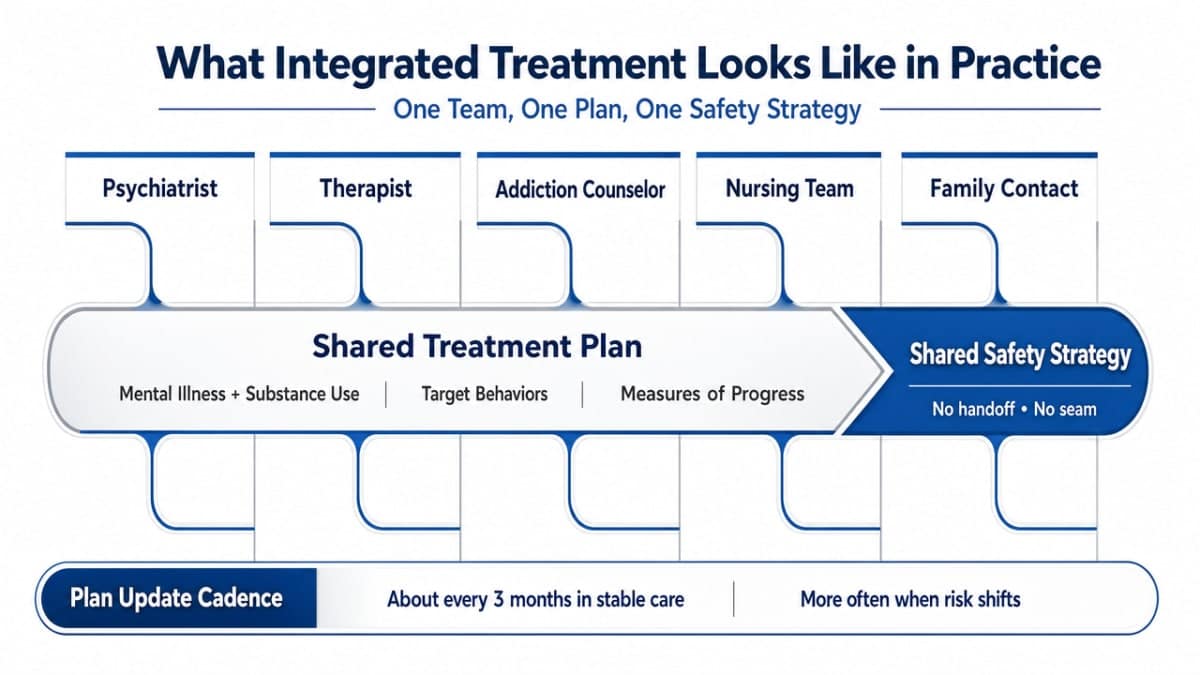
Integrated care is not a scheduling trick. It is a structural choice about who owns the case. In a truly integrated model, the psychiatrist, the therapist, the addiction counselor, the nursing team, and the family contact are all working from the same treatment plan, meeting about the same person, and updating the same safety strategy. There is no handoff, because there is no seam.
SAMHSA’s implementation toolkit is explicit about the mechanics. Integrated treatment plans should cover mental illness and substance use disorders jointly, name specific target behaviors, define measures of progress, and be updated on a defined cadence, roughly every three months in stable care and more often when risk shifts 13. That cadence matters when self-harm and substance use are both in play, because urges do not respect quarterly reviews. A withdrawal spike in week two can change what the safety plan needs to hold by week three.
The safety plan itself has to be built for both behaviors at once. That means naming the cues that precede a self-harm urge and the cues that precede a substance use urge in the same document, listing skills that work for each, and identifying who on the team gets contacted when either one escalates. One plan. One team. One phone number when things get loud at 11 p.m.
The Evidence for Integration Over Parallel Care
The case for integration is not a preference. It is what the outcome data keeps showing. SAMHSA’s evidence review on co-occurring disorders synthesized trials and program evaluations and reached a consistent conclusion: integrated treatment is associated with better engagement, reduced substance use, and better psychiatric outcomes than parallel or sequential models 14. People stay in care longer, drop out less, and move further on both fronts when both fronts are being held by the same team.
The 2020 update of TIP 42 built on that base and added structured risk assessment for self-harm as a coordinated function of the integrated team, not a specialty consult that happens somewhere else 15. That distinction matters for the reader who has watched a psychiatric hospital assess suicide risk while the addiction program assessed relapse risk, with neither one owning the overlap. In an integrated model, the same clinician who knows the substance use history is asking about the self-harm urges, in the same visit, with the same chart open.
The honest limit: the evidence base still varies in program components and outcome measures, so “integrated” is not a single protocol. What the research does establish is direction. When you build it, both problems move.
DBT as the Skills Bridge Between Both Behaviors
How DBT Replaces the Coping Function
If self-harm and substance use are both doing the same regulation job, then any treatment worth building has to answer a specific question: what replaces the job? Willpower does not. Insight alone does not. What the evidence keeps pointing to is a set of teachable skills that give the nervous system something else to reach for when the feeling gets loud.
Dialectical behavior therapy is built around exactly that substitution. The four skill modules, mindfulness, distress tolerance, emotion regulation, and interpersonal effectiveness, are not abstract concepts. They are concrete tools you practice until they load faster than the old ones. TIPP for a spiking body. Urge surfing for a craving that feels like it will not pass. Opposite action for the pull to isolate. Naming the emotion before the behavior chooses for you.
What makes DBT a bridge rather than two separate protocols is that the same skill often works for both urges. The distress tolerance skill you use to sit through the impulse to cut is the same one that carries you through a craving at 9 p.m. That is not a coincidence. It is what happens when treatment targets the function underneath the behavior instead of the behavior on the surface.
Expect the skills to feel awkward at first. That is not failure. That is a new tool being unfamiliar in your hand.
What the Trials and Meta-Analyses Show
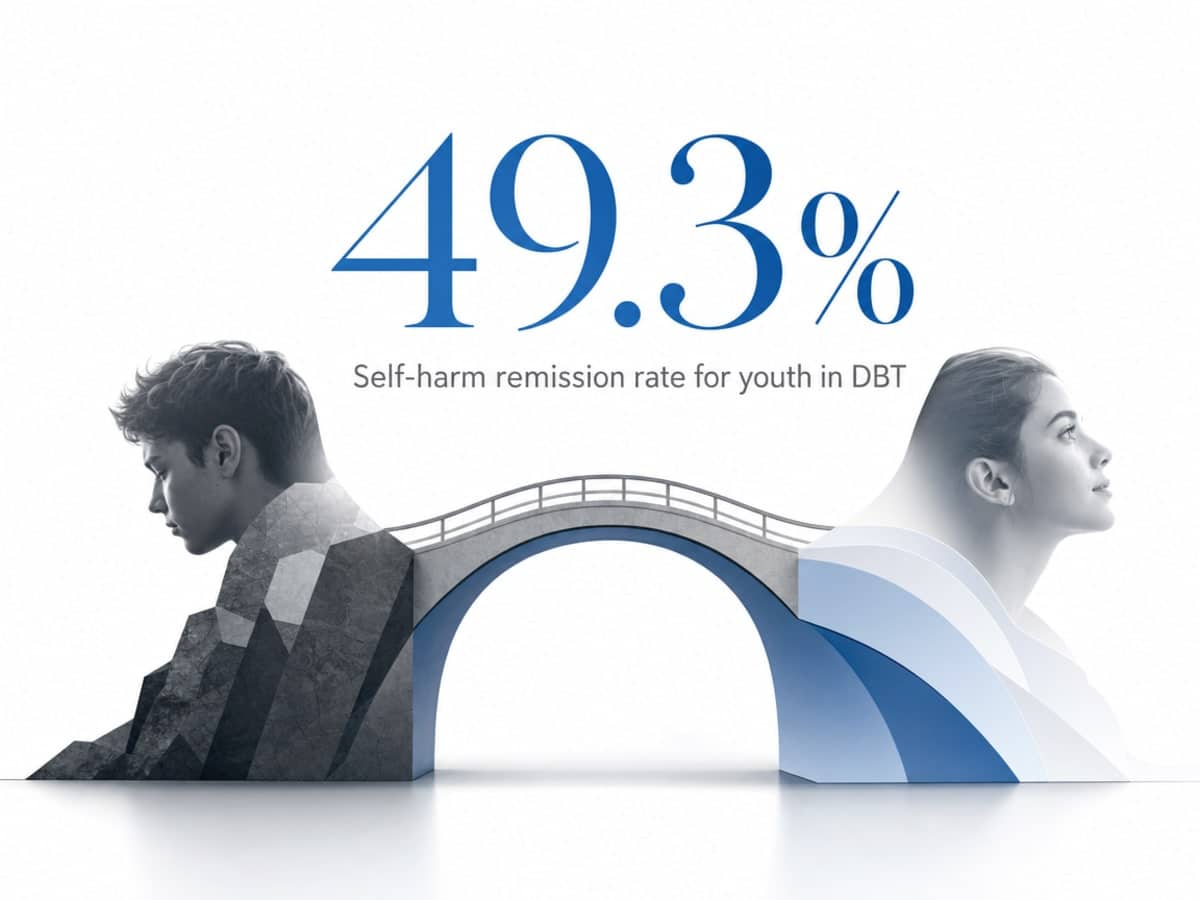
The trial evidence for DBT is unusually consistent for a psychotherapy literature. In a multisite randomized trial of suicidal, self-harming youth, 49.3% of participants receiving DBT achieved self-harm remission during follow-up, and the same group reported lower substance misuse than the comparison condition 2. That second finding is the one worth pausing on. The same skills that moved the self-harm number also moved the substance number, in the same participants, which is what you would expect if both behaviors share a regulation function.
Pooled across studies, the effect is smaller but still real. A meta-analysis of DBT for adolescents found small to moderate effects for reducing self-harm and suicidal ideation compared with control conditions 3. A 2025 review of interventions for self-harm in children and adolescents reached a similar conclusion, with moderate certainty that DBT reduces the number of adolescents engaging in self-harm behaviors 4. Two separate randomized studies of DBT-A for repeated self-harm found it superior to enhanced usual care for self-harm, suicidal ideation, and depressive symptoms, with that advantage still present at 3-year follow-up 6, 7.
A few honest caveats belong in the same paragraph as the numbers. The 49.3% remission figure comes from a youth sample, and pooled effect sizes in controlled comparisons run smaller than pre-post analyses suggest. “DBT works” is not the same as “DBT works equally for every presentation.” What the body of evidence does support is direction and durability: skills-based work moves both self-harm and substance-related outcomes, and the movement holds up over years rather than weeks.
Why Length of Stay Matters More Than Insurance Timelines
Skills do not install in a week. They install by repetition, in real situations, with a clinical team catching what falls. The dose matters, and the dose-response curve is measurable. In a pragmatic randomized trial of DBT for self-harming patients with personality disorder, the risk of self-harm decreased by 9% for every two months a patient spent in DBT compared with treatment as usual 5. Time in treatment did the work.
That finding has an operational consequence most families feel before they can name it. When length of stay is set by insurance authorization rather than clinical need, you get discharged into the same environment carrying half-built skills. The urges did not shrink to fit the benefit period. ViewPoint sets treatment duration based on clinical progress rather than authorization windows precisely because the evidence says the extra weeks are where the risk reduction lives, not where the marginal cost sits.
If you are weighing programs, ask directly how length of stay gets decided, who makes the call, and what happens when clinical need and insurance timeline disagree. The answer tells you which curve the program is optimizing for.
The Role of 24/7 Clinical Availability
Urges do not keep business hours. The pull to cut at 11 p.m., the craving that arrives at 3 a.m. when the room is quiet and the coping tools have not loaded yet, the withdrawal wave that peaks on day four regardless of the schedule, these are the moments treatment either holds or it does not. If skills are still new, the gap between an outpatient session on Tuesday and the next one on Friday is a long time to hold a spike alone.
Continuous clinical coverage is a direct answer to a documented risk pattern. Patients presenting for self-harm who also had problem drug use were more likely to have another self-harm episode within a year than patients without drug problems 10. The overlap between withdrawal cues and self-harm urges lives inside that year, often at hours no outpatient clinic is open. When board-certified psychiatry and nursing are reachable around the clock, the safety plan you built in daylight actually has somewhere to route at midnight, and a shaky skill attempt gets coached through instead of abandoned.
Calling the line instead of using, or instead of cutting, is a real win. Name it as one.
What to Ask When You’re Choosing a Program
You have probably sat through enough intake calls to know that most programs sound similar on the phone. The differences show up in the answers to specific questions, and those answers tell you whether a program is actually built to hold both self-harm and substance use at once.
A short list worth using:
- Who owns the case? If the psychiatrist and the addiction counselor work from separate plans, that is parallel care wearing an integrated label. SAMHSA’s guidance is that both conditions belong in one plan with defined target behaviors and progress measures 13.
- How often does the plan get updated, and who updates it? Quarterly is the baseline; more often when risk shifts.
- What happens if self-harm resurfaces mid-stay? A program that would discharge or transfer is telling you where its scope actually ends.
- How is length of stay decided? Ask directly whether clinical progress or authorization drives the discharge date, given that self-harm risk drops roughly 9% for every two months in DBT 5.
- Who is reachable at 2 a.m.? A nurse line is not the same as board-certified psychiatry. Get the specific answer.
How ViewPoint Holds Both Problems at Once
ViewPoint Dual Recovery is a Joint Commission-accredited psychiatric facility in Prescott, Arizona built for the case other programs consider too complex: treatment-resistant psychiatric presentations, dual diagnosis, and the exact overlap this article has been describing. That means one integrated team, board-certified psychiatry available around the clock, and a single treatment plan that names both the self-harm urges and the substance use urges as clinical targets from day one.
Practically, what that looks like: DBT-informed skills work as the core replacement for the coping function both behaviors have been doing, medication management run by the same psychiatrists who know your self-harm history, safety planning updated on the cadence SAMHSA’s integrated-care guidance recommends 13, and family counseling that brings the people around you into the plan rather than around it. Length of stay gets set by clinical progress, not authorization windows, because the risk-reduction curve depends on time in treatment 5. If self-harm resurfaces mid-stay, no one transfers you out. That is the point.
A Safety-Focused Next Step
If you have read this far, you are probably already doing hard work, either for yourself or for someone you love. That counts. Choosing to look at both behaviors at once, instead of triaging them into separate lanes, is the shift most people arrive at only after a program has let them down.
ViewPoint’s admissions team in Prescott is set up for exactly this conversation. A call covers the specifics: current safety, what an integrated plan would name as targets, medication review under board-certified psychiatry, and how family fits into the plan rather than around it. No sales script, no pressure to decide in one call.
Find Your Path Beyond Self-Harm and Use
Gain expert insight into safe, integrated support for both self-harm and substance use challenges.
Frequently Asked Questions
Why do self-harm and substance use so often show up together?
Because they are often doing the same job. Both interrupt an emotional state the nervous system cannot yet tolerate any other way. Population-level and nonclinical data show substance use and self-harm cluster together in the context of depression, anxiety, and trauma 11, 9. The tool changes; the underlying function is the same.
Can I get treatment for both self-harm and addiction at the same time, or do I have to address one first?
You can and should treat them together. SAMHSA’s evidence review found integrated care produces better engagement, lower substance use, and better psychiatric outcomes than parallel or sequential models 14. Being asked to pause one problem to work on the other is a sign the program is not built for this overlap.
How does DBT actually help with both self-harm urges and substance cravings?
DBT teaches concrete skills, distress tolerance, emotion regulation, mindfulness, that replace the coping function underneath both behaviors. In a randomized trial of self-harming youth, DBT participants also reported lower substance misuse than the comparison group 2. The same skill that carries you through an urge to cut carries you through a craving.
What should I ask a program to make sure it can hold both problems at once?
Ask who owns the case, whether both conditions live in one treatment plan updated on a defined cadence 13, what happens if self-harm resurfaces mid-stay, whether clinical progress or insurance drives discharge, and who is reachable overnight. Vague answers to any of those usually mean parallel care wearing an integrated label.
Why does 24/7 clinical availability matter for this kind of care?
Because urges and withdrawal do not schedule themselves. Patients presenting for self-harm with problem drug use had elevated risk of another self-harm episode within a year 10, and much of that window falls outside clinic hours. Continuous coverage means the safety plan built in daylight has somewhere to route at 2 a.m.
What should I do right now if I’m in crisis or supporting someone who is?
Call or text 988, or go to the nearest emergency department 8. If you are supporting someone, stay with them, remove immediate access to means if you can do so safely, and let the crisis line coach you through the next hour. The longer treatment conversation can start once everyone is safe.
References
- Substance Use & Mental Health. https://www.cdc.gov/mental-health/about-data/substance-use-mental-health.html
- Dialectical Behavior Therapy for Suicidal Self-Harming Youth. https://pubmed.ncbi.nlm.nih.gov/33539915/
- Efficacy of dialectical behavior therapy for adolescent self-harm and suicidal ideation: a meta-analysis. https://pubmed.ncbi.nlm.nih.gov/33875025/
- Effects of interventions for self-harm in children and adolescents. https://pubmed.ncbi.nlm.nih.gov/41014367/
- Effectiveness and cost-effectiveness of dialectical behaviour therapy for self-harming patients with personality disorder: a pragmatic randomised controlled trial. https://pubmed.ncbi.nlm.nih.gov/22964561/
- Dialectical behavior therapy for adolescents with repeated self-harm. https://pubmed.ncbi.nlm.nih.gov/25245352/
- Long term effectiveness of dialectical behavior therapy for adolescents with repeated self-harm. https://pubmed.ncbi.nlm.nih.gov/31127612/
- Finding Help for Co-Occurring Substance Use and Mental Health. https://www.nimh.nih.gov/health/topics/substance-use-and-mental-health
- Deliberate self-harm and the nexus of violence, victimization, and mental health problems in the United States. https://pubmed.ncbi.nlm.nih.gov/25500323/
- Problem drug use, drug misuse and deliberate self-harm. https://pubmed.ncbi.nlm.nih.gov/19936579/
- Deliberate self-harm, substance use, and negative affect in nonclinical samples: A systematic review. https://pubmed.ncbi.nlm.nih.gov/23577914/
- Risk and protective factors for self-harm in adolescents and young adults: An umbrella review of systematic reviews. https://pubmed.ncbi.nlm.nih.gov/37972513/
- Integrated Treatment for Co-Occurring Disorders: Building Your Program. https://library.samhsa.gov/sites/default/files/ebp-kit-building-your-program-10112019.pdf
- Integrated Treatment for Co-Occurring Disorders: The Evidence. https://library.samhsa.gov/sites/default/files/ebp-kit-the-evidence-10242019.pdf
- Substance Use Disorder Treatment for People With Co-Occurring Disorders: Updated 2020. https://pubmed.ncbi.nlm.nih.gov/34106563/