

Key Takeaways
- Siblings of people with severe mental illness show measurable elevations in depression, anxiety, and caregiver burden across dozens of countries, so the weight you feel is documented, not imagined 1.
- The roles siblings inherit, shadow child, backup parent, estranged relative, or future caregiver, accumulate without conversation, and how you interpret behavior as symptom or choice changes how heavy it feels 12.
- Clinical guidelines define carers broadly enough to include siblings, and a signed release of information, even a narrow one, is the practical gate to being looped into treatment planning 15.
- Act on a shorter horizon: secure a release and a support group this month, request a family session this year, and have the succession conversation with parents before a crisis forces it 9.
The family member the treatment team forgets to call
You probably heard about the diagnosis second. Maybe from your mother, over a phone call that started with “I don’t want you to worry, but.” Maybe from a text your brother sent at 3 a.m. that you read at 6. The hospital had already been told who mattered. It wasn’t you.
That’s the strange position siblings occupy when severe mental illness enters a family. You are close enough to feel every tremor, far enough that no one thinks to loop you in. You may be the one who drives four hours when a parent is too exhausted to make the trip. You may be the one who screens the calls, or the one who stopped answering because answering was hollowing you out. Either way, the treatment team probably doesn’t have your number.
This piece is for you. Not for your sibling, not for your parents, not for the clinicians. You. It will name the roles you were handed, the guilt you carry, the grief that doesn’t have a ceremony, and the part siblings are supposed to play in serious psychiatric care but often don’t get invited to. Read at whatever pace you can. Some of this will land hard.
You are not imagining this: what the research actually says about siblings
If you have ever wondered whether you are overreacting, you are not. The weight you feel has been measured, and the measurements are not subtle.
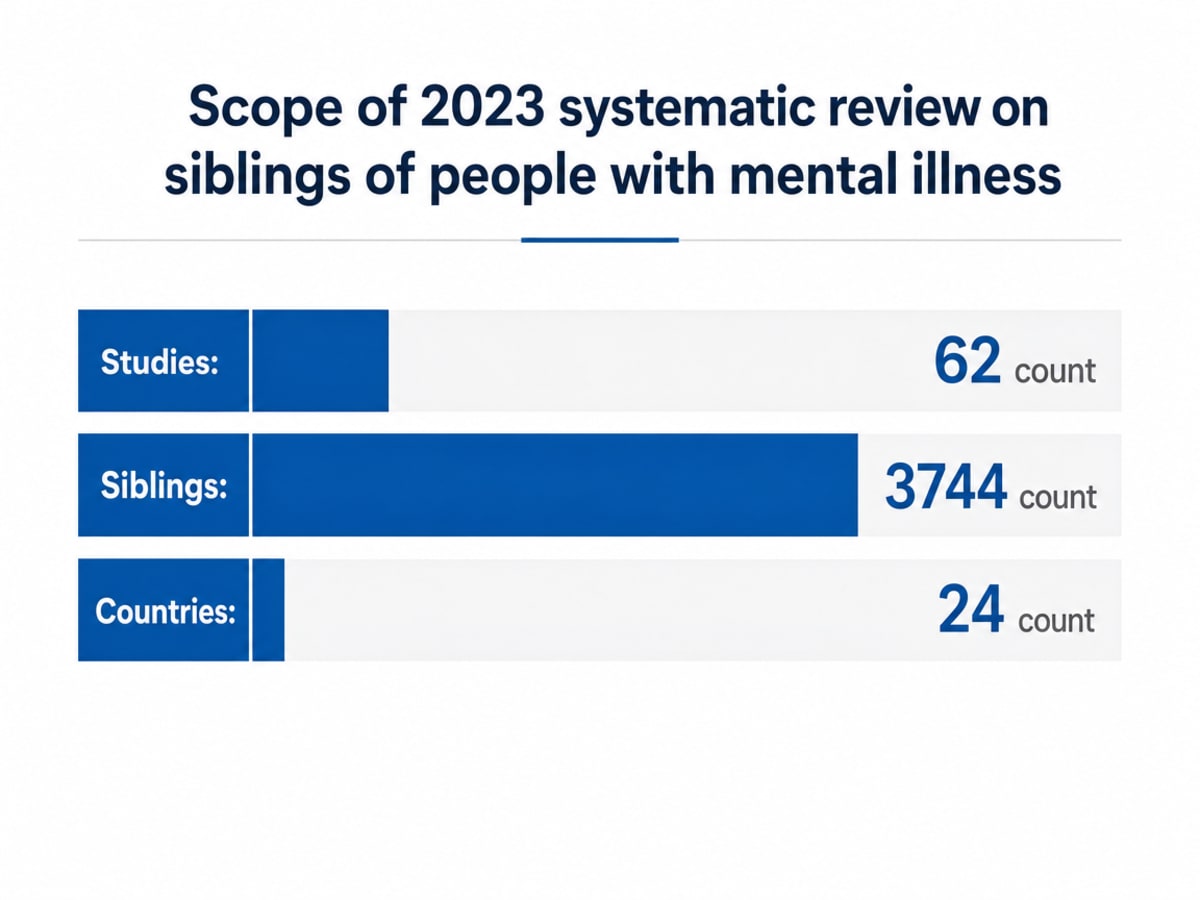
A 2023 mixed-studies systematic review and meta-analysis pooled data from 62 studies covering 3,744 siblings across 24 countries. The pattern was consistent: siblings of people with mental illness show elevated depressive and anxiety symptoms, carry substantial subjective and objective burden, and report reduced wellbeing compared to siblings of people without psychiatric conditions 1. That is not a personal failing. That is a documented pattern across two dozen countries.
The burden takes different shapes. Some of it is practical, like the phone calls at odd hours or the trips to the emergency room. Some of it is quieter, like the vigilance that never really turns off, or the way you scan your own moods for signs of the same illness. A separate review of 56 studies on siblings found that the impact goes well beyond psychiatric symptoms into caregiving strain, changes in the sibling relationship itself, and how much you feel you understand about what is happening 2.
None of this means you are ill. It means you are in a role that is genuinely hard, and researchers have been quietly confirming that for decades. The older literature going back to reviews of well siblings of people with schizophrenia said much the same thing, though services have been slow to respond 8.
So when your therapist, your partner, or the well-meaning friend at work suggests you might be making too much of it, you can trust yourself. What you are carrying has a name and a body of evidence behind it. The question is what to do with that, which is where the rest of this piece goes.
The roles you were handed without a conversation
The shadow child who learned to need less
You were the one who did homework quietly in the next room while your parents were on the phone with the psychiatrist, or the ER, or the school. You learned early that your report card wasn’t the emergency. Your birthday could be rescheduled. Your fear of the dark was, in the family calculus, small.
That kind of childhood teaches you to compress yourself. You get good at reading the temperature of a room before you walk in. You become the one who doesn’t ask for much because there isn’t much to give. Adults praise you for being mature. What they are describing is a child who has stopped expecting to be centered.
Sibling research has been quietly noting this for decades: the impact on well siblings shows up in behavior, in the sibling relationship itself, and in how much emotional room they feel entitled to take up in the family 2. If you are now an adult who struggles to name what you want or to let anyone take care of you, that is not a character flaw. It is a skill you learned because you had to.
The backup parent, the one who gets the 2 a.m. call
Your phone rings at odd hours. Sometimes it is your sibling. Sometimes it is your mother saying she doesn’t know what else to do. You have a folder in your email called “pharmacy,” or a running note on your phone with the case manager’s direct line and the last three medication changes. You know which hospital has the shorter wait and which one your sibling refuses to go back to.
You did not sign up for this role. It accumulated. One crisis at a time, one favor at a time, until the family started to assume you would pick up.
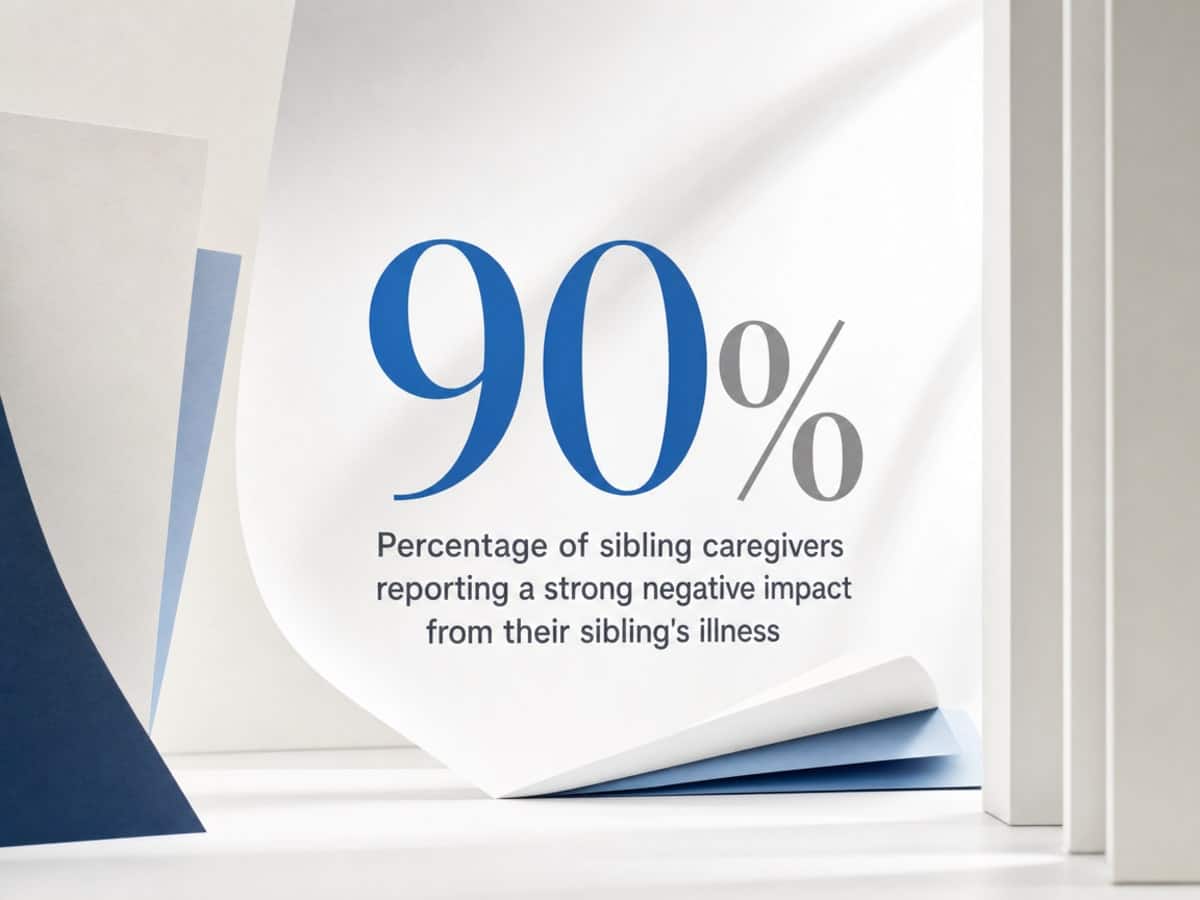
The strain is real, and it has been measured. In one study of sibling caregivers of people with severe mental illness, 90 percent described the illness as having a strong, negative impact on themselves and their families, though the sample was small and cannot speak for every family 10. Read that number as validation, not verdict. A family booklet from an early psychosis program puts the same idea in gentler language, warning parents against turning siblings into “mini-parents” and reminding everyone that a sibling still needs their own life protected 14.
You are allowed to want that life back.
The estranged sibling deciding whether to re-engage
Maybe you stepped back years ago. Maybe there was a fight, or a lie, or a night that ended somewhere you never wanted to be again. Maybe your therapist used the word “boundary” and you finally let yourself believe it. Now something has shifted, a parent is aging, a diagnosis has been updated, a message has arrived, and you are staring at the possibility of walking back in.
Estrangement in these families rarely looks like a clean break. It looks like blocked numbers you occasionally unblock. It looks like knowing exactly what happened in the last hospitalization even though you swore you were done. Grief and distance can coexist. So can love and self-protection.
You are not required to re-enter the relationship to be a good person, and you are not required to stay away to be a healthy one. Siblings in this literature are described as both vulnerable and potentially supportive, sometimes in the same year, sometimes in the same week 1. Whatever you decide, decide it slowly, and decide it with people who know your history and your limits.
The future caregiver waiting for the handoff from aging parents
Somewhere in the back of your mind, there is a clock. Your parents are getting older. They still take the lead on the appointments, the medications, the housing conversations. But you have started to notice how tired your mother sounds, how your father repeats himself, how neither of them has said out loud what happens next.
You have. Probably in the shower, or during a long drive, or at 3 a.m. when you couldn’t sleep. What happens when they can’t? Do you move closer? Do you take over the finances? Do your own children, your own marriage, your own work absorb this?
This anticipatory role has a weight of its own. A systematic review of 56 sibling studies found that caregiving experience and expected future caregiving are recurring themes, not side notes 2. The dread you feel about a handoff nobody has scheduled is a rational response to a real transition.
The most useful thing you can do right now is refuse to inherit this in silence. Bring it up with your parents while they are still the primary planners. Ask what documents exist, what the treatment team knows about you, and whether your name is anywhere on the paperwork. Better to have the awkward conversation at a kitchen table than in a hospital corridor.
Guilt, blame, and the story you tell yourself about their choices
There is a sentence that runs on a loop in a lot of sibling heads: if they would just try harder. Sometimes it comes out as anger. Sometimes as a quiet, guilty relief that you were not the one this happened to. Sometimes both in the same hour.
You have probably rehearsed the counter-argument too. You know, intellectually, that schizophrenia and rapid-cycling bipolar disorder and severe dual diagnosis are not choices. You have read the pamphlets. And still, when your sibling stops taking medication for the fourth time, or spends the rent money, or lashes out at your mother, some part of you thinks: you could have not done that.
This is worth naming because it has been studied. A 1997 study of 164 siblings of people with serious mental illness found that siblings who viewed the ill person’s behavior as within their control carried significantly heavier subjective burden than siblings who viewed the same behavior as outside their control 12. The sample is decades old and modest in size, but the finding has held up in how clinicians think about family psychoeducation. How you interpret a behavior changes how heavy it feels.
That is not the same as saying your sibling has no agency, or that nothing they do is their responsibility. Both things can be true. A person can be genuinely ill and still make choices that hurt you. What psychoeducation offers, and what a good family session can help you sort through, is the difference between a symptom and a decision, so you stop carrying the weight of both as if they were one thing.
The guilt piece is quieter and harder to shake. Guilt that you moved away. Guilt that you have a partner, a career, a bedroom that is yours. Guilt that on the mornings you do not think about your sibling, you feel almost light. None of that means you did something wrong. It means you loved someone and got a different life than they did, and there is no clean way to hold that.
Grief that has no funeral: ambiguous loss between siblings
Your sibling is still alive. That is the part that makes this so hard to explain to anyone who has not lived it.
There is no casserole brought to the door. No card in the mail. No coworker offering to cover your shift. And yet something has ended. The brother who used to call you with terrible jokes at midnight. The sister who was going to be the maid of honor. The person you thought you would grow old alongside, comparing notes about your parents, your kids, your knees. That version of them may not be coming back, and there is no ritual for that kind of loss.
Clinicians sometimes call this ambiguous loss. You are grieving someone who is physically present but psychologically altered, or present some weeks and unreachable others. The 2023 review of sibling wellbeing describes exactly this texture, cataloging altered family roles, changed sibling relationships, and the reduced wellbeing that follows 1. You are not being dramatic. You are mourning in a format the culture has not built words for.
Let yourself name it as grief. Not stress, not frustration, not a rough patch. Grief. Naming it will not bring your sibling back to who they were, but it will stop you from arguing with your own feelings.
Why siblings belong in treatment planning, not just the waiting room
For a long time, family involvement in serious psychiatric care meant parents. Sometimes spouses. Almost never siblings. That default is out of step with what the guidelines actually say.
The NICE guideline for psychosis and schizophrenia in adults defines carers broadly, as any family member in regular and substantial contact with the patient, and recommends offering them written and verbal information about diagnosis, management, recovery, and crisis help, plus an assessment of their own needs 15. Siblings in close contact fit that definition. The NIMH resource on first-episode psychosis goes further, saying that supportive people should be included in all phases of treatment planning and decision-making to the greatest extent possible 4. Neither document treats siblings as optional.
There is a clinical reason for that, not just a compassionate one. A 2022 review of family therapy for schizophrenia notes that structured family work with psychoeducation, communication skills, and crisis planning is under-used despite meta-analytic evidence linking it to lower relapse risk 5. When a sibling is the person who takes the middle-of-the-night calls or notices the earliest signs of decompensation, that sibling is already part of the crisis system. Bringing you into the plan on purpose is more useful than leaving you to improvise.
At facilities like ViewPoint, family counseling is built into treatment for complex psychiatric and dual diagnosis cases, and “family” is not code for “parents only.” If your brother or sister consents, you can be part of the psychoeducation sessions, the discharge planning, and the conversations about what happens after they leave. That is the version of family involvement the evidence actually points to.
How to enter the conversation with the care team without overstepping
The hardest part is often the first sentence. You are not the patient. You may not be the emergency contact. And yet you have information the team needs, and questions you deserve to ask. Here is what tends to work.
Start by asking your sibling directly, in a calm moment, whether they will sign a release of information naming you. That single form changes what a clinician is legally allowed to tell you. If your sibling agrees to only partial disclosure, that is still useful. A release limited to “medication changes and hospitalizations” is more than a release that never gets signed.
When you do reach the team, lead with what you are seeing, not what you want done. “He has stopped sleeping and stopped answering my mother’s calls” gives a clinician something to work with. “You need to admit him” puts them in a corner. Ask what the plan is if things worsen, what the earliest warning signs have been in past episodes, and who you should call at 2 a.m. if you are the one who picks up.
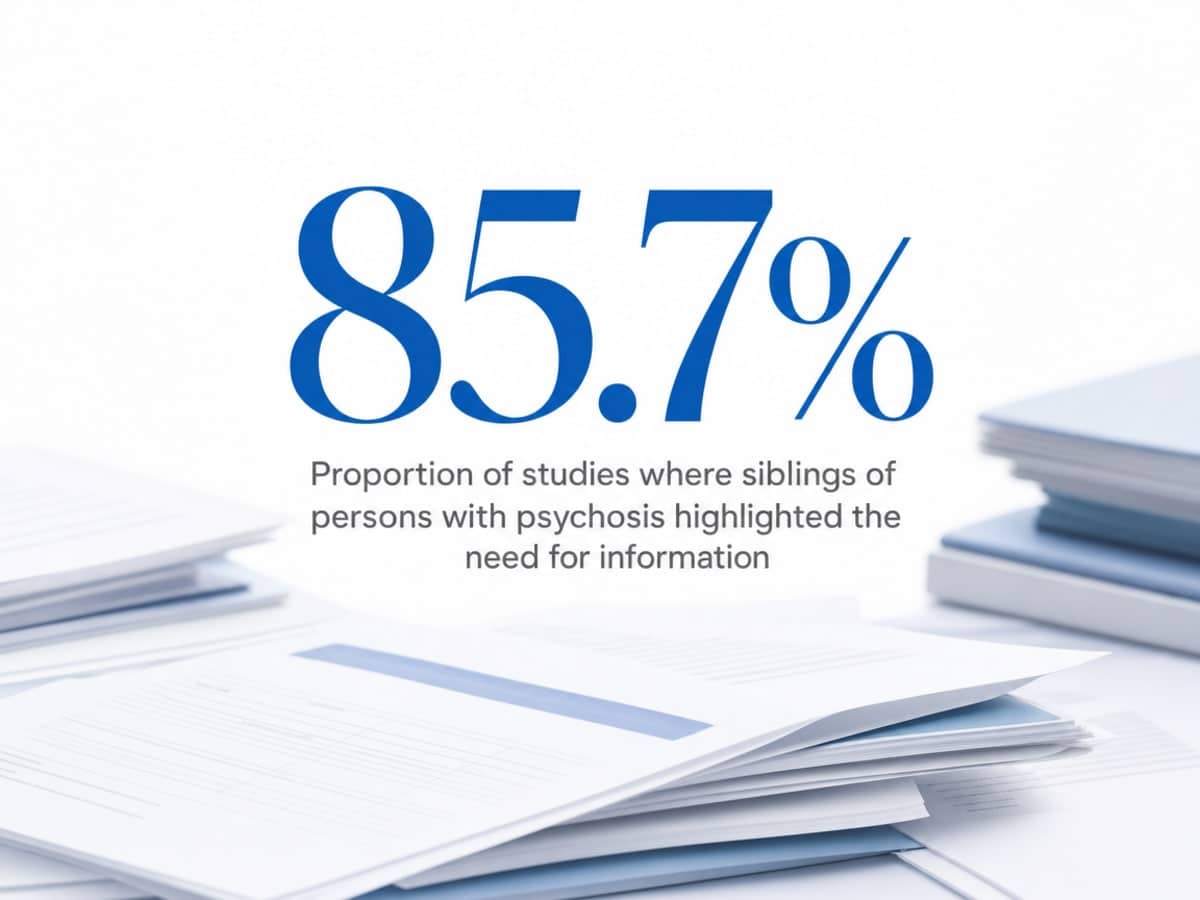
You are also allowed to ask for things for yourself. A systematic review of what siblings of people with psychosis actually say they need found that in 6 of 7 included studies, siblings named two things above the rest: information about the illness and access to caregiver support groups 9. Both are reasonable requests to bring to a family session. Neither requires you to take over anyone’s care.
When the family system is more complicated than one diagnosis
The sibling articles you find online tend to assume a tidy picture: one ill person, one stable family around them, everyone else basically okay. That is not the family a lot of you grew up in.
In families where one member has dual diagnosis, meaning a psychiatric condition alongside substance use, more than one person is often struggling. A study of family history among people with dual diagnosis found high rates of psychiatric and substance problems across the whole family system. Among high-risk cases, sibling-level problems ranged from 43 percent for psychiatric issues to 64 percent for drug issues, with over 60 percent reporting lifetime problems with siblings and higher rates of abuse in those families 13. That is one study, and it describes a specific high-risk subset, not every dual-diagnosis family. But if you have been quietly counting the diagnoses in your own household, aunts, uncles, a parent who never got help, another sibling with their own substance issues, the research says you are not an outlier.
This changes what family involvement can realistically look like. You may not have a stable parent to hand things off to, or a sober sibling to share the calls with. Family sessions may need to hold more than one person’s pain at a time. Be honest with a care team about what your family actually looks like, not the version you wish you could bring.
Why sibling-specific care is individualized rather than protocolized
You might reasonably ask why there isn’t a standardized program for siblings, the way there are structured protocols for the patient. The honest answer is that the evidence base is still thin, and any clinician who tells you otherwise is overselling.
A 2025 systematic review looked at interventions specifically designed for siblings of children and young people with mental health conditions. The researchers screened 2,469 records and found only 4 eligible studies 11. That is not a small gap. That is a field still in its early chapters. The same review noted that sibling support groups had high acceptability, which is useful, but four studies cannot tell a clinician exactly how many sessions you need, in what format, or on what timeline.
An earlier review of psychoeducation for siblings of people with severe mental illness reached a similar verdict: coping outcomes tended to improve, but the evidence base was small and low quality, and the authors declined to claim that sibling psychoeducation reliably improves wellbeing or patient outcomes 3.
What that means in practice is that a facility working with your family cannot hand you a manual. What a good team can do is tailor the involvement to your role, your history, and what your sibling consents to. If you are the 2 a.m. call taker, you need different information than the estranged sibling considering re-entry. Individualized is not a marketing word here. It is the only intellectually honest response to a research literature that is still catching up.
What to ask for this month, this year, and when parents can no longer carry it
You do not have to fix everything by Sunday. But you can pick a shorter horizon and act inside it.
This month. Ask your sibling, in a quiet moment, to sign a release of information that names you, even a narrow one covering medication changes and hospitalizations. Write down the current diagnosis, medications, prescribing psychiatrist, and case manager in one place you can actually find at 2 a.m. Find one caregiver support group, online or local, and go once. Siblings in the research consistently name information and support-group access as their top two needs, so treating both as basic infrastructure is not overreach 9.
This year. Ask to sit in on at least one family session with your sibling’s treatment team. If your sibling is being treated at a program like ViewPoint that builds family counseling into complex psychiatric and dual diagnosis care, request that siblings be included, not just parents. Bring the questions you have been carrying alone: what are the early warning signs, what does the crisis plan say, what is your role in it.
When your parents can no longer carry it. Have the kitchen-table conversation now. Ask what documents exist, who the emergency contacts are, and what your parents imagine happening next. You are allowed to say yes to some of it and no to other parts. What you are not required to do is inherit this in silence.
Find clarity for your sibling’s next steps
Start a no-pressure conversation to explore tailored support for your family and your sibling’s unique needs.
Frequently Asked Questions
Is it normal to feel guilty that I’m the ‘well one’ in the family?
Yes, and it is one of the most common feelings siblings describe. Guilt about your own stability, your job, your relationships, or the mornings you don’t think about your sibling does not mean you did something wrong. It means you loved someone and got a different life. Naming it as guilt, rather than proof of failure, is the first honest step.
Can I be included in my sibling’s treatment planning if I’m not their legal guardian or spouse?
Often, yes. NICE guidance defines carers broadly to include any family member in regular and substantial contact, which can cover siblings 15. The practical gate is a release of information signed by your sibling. Even a narrow release covering medication changes and hospitalizations lets a clinician talk with you. Ask for that release in a calm moment, not during a crisis.
What should I do when my sibling refuses treatment but keeps calling me in crisis?
You are allowed to answer some calls and not others, and to decide what you can offer before the phone rings. Keep the case manager’s number, current medications, and the local crisis line saved where you can find them fast. When you answer, describe what you see rather than what you demand. Refusal of treatment does not obligate you to become the treatment.
Am I at higher risk of developing the same mental illness as my sibling?
For schizophrenia specifically, unaffected siblings show somewhat higher rates of depression history and subtle cognitive differences in family studies 7. That is a population signal, not a personal forecast. Most siblings do not develop the same illness. If you notice sleep changes, persistent low mood, or unusual thinking, bring it to your own clinician. Vigilance about yourself is reasonable; catastrophizing is not required.
How do I start planning for the day my parents can no longer be the primary caregiver?
Start at a kitchen table while your parents are still the planners. Ask what documents exist, who the emergency contacts are, what the treatment team knows about you, and what your parents imagine happening next. Get your name added to releases where your sibling agrees. You are allowed to accept some responsibilities and decline others. A written plan beats a hallway conversation during a hospitalization.
Is it okay to step back from my sibling if the relationship is hurting my own mental health?
Yes. Siblings in the research are described as both vulnerable and potentially supportive, sometimes in the same season 1. Distance is not abandonment, and staying close is not obligation. What matters is that you decide with people who know your history, not out of a single hard night. You can step back and still love them. You can re-engage later on different terms.
References
- Distress, burden, and wellbeing in siblings of people with mental illness: a mixed-studies systematic review and meta-analysis. https://pmc.ncbi.nlm.nih.gov/articles/PMC10951414/
- Non-psychopathology Related Outcomes Among Siblings of Individuals with Mental Illness: A Systematic Review. https://pubmed.ncbi.nlm.nih.gov/33052503/
- Psychoeducation for siblings of people with severe mental illness. https://pmc.ncbi.nlm.nih.gov/articles/PMC8078555/
- Evidence-Based Treatments for First Episode Psychosis. https://www.nimh.nih.gov/sites/default/files/documents/health/topics/schizophrenia/raise/evidence-based-treatments-for-first-episode-psychosis.pdf
- Family therapy for persons with schizophrenia: neglected yet important. https://pmc.ncbi.nlm.nih.gov/articles/PMC10238333/
- Effective family interventions for people with schizophrenia. https://pubmed.ncbi.nlm.nih.gov/35093199/
- A Closer Look at Siblings of Patients with Schizophrenia. https://pmc.ncbi.nlm.nih.gov/articles/PMC3030992/
- Siblings of schizophrenic patients–a review. https://pubmed.ncbi.nlm.nih.gov/10857265/
- Needs of Siblings of Persons with Psychosis: A Systematic Review. https://pmc.ncbi.nlm.nih.gov/articles/PMC4153857/
- Psychological factors of sibling caregivers of patients with severe mental illness. https://pmc.ncbi.nlm.nih.gov/articles/PMC7451338/
- Interventions for siblings of children and young people with mental health conditions: A systematic review. https://pmc.ncbi.nlm.nih.gov/articles/PMC12159328/
- Factors associated with subjective burden in siblings of persons with serious mental illness. https://pubmed.ncbi.nlm.nih.gov/9142356/
- Impact of Family History in Persons With Dual Diagnosis. https://pmc.ncbi.nlm.nih.gov/articles/PMC3607460/
- Supporting the Siblings of Individuals with Psychosis. https://www.medschool.umaryland.edu/media/som/departments/psychiatry/documents/eip/EASA-Sibling-Support-Family-Booklet.pdf
- Psychosis and schizophrenia in adults: prevention and management (NICE guideline CG178). https://www.ncbi.nlm.nih.gov/books/NBK555203/