

Key Takeaways
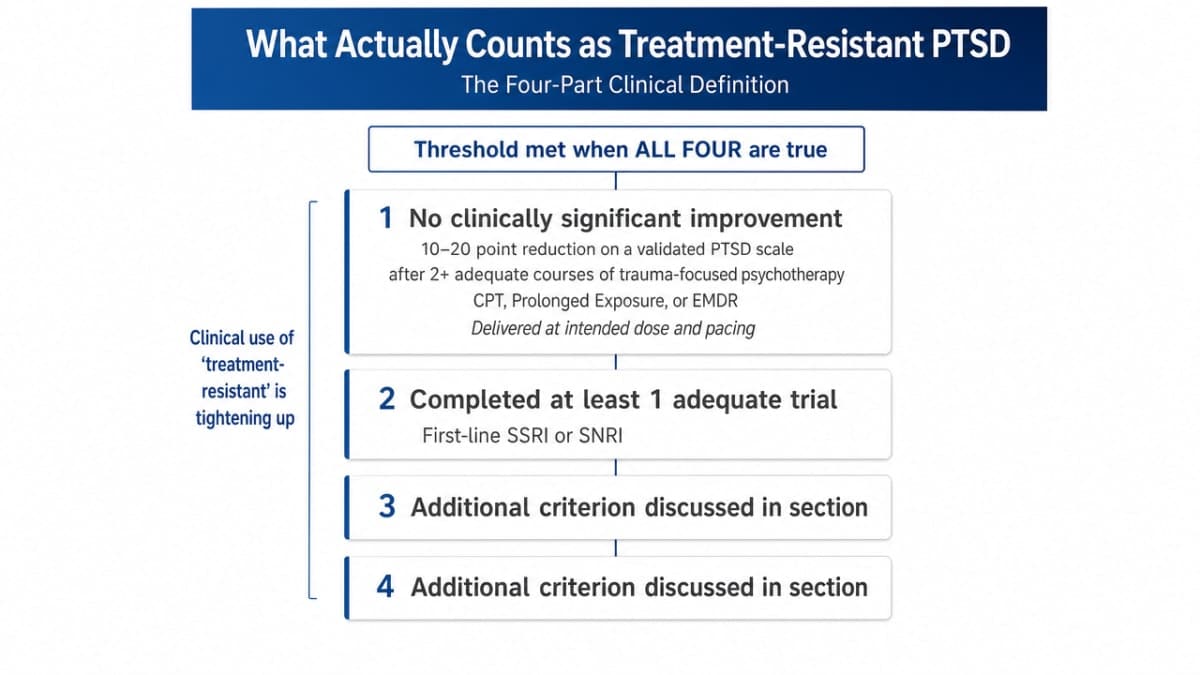
- Treatment-resistant PTSD is a defined clinical picture: non-response to two adequate trauma-focused therapy courses, one adequate SSRI or SNRI trial, symptoms past twelve months, and ongoing functional impairment 5.
- Non-response usually reflects severity, comorbidity, or care that was never guideline-concordant in the first place — not patient failure or lack of effort 4, 6.
- Residential programs that keep manualized CPT, PE, or EMDR central, run integrated psychiatry, and treat comorbidities in the same container match what the evidence actually supports 11.
- Length of stay and aftercare drive durability, so a fixed 30-day calendar or deferred comorbidity treatment can waste the runway severe cases need 7.
You’ve Done the Work. The Symptoms Are Still Here.
You showed up to the sessions. You did the worksheets, the exposure hierarchies, the memory work that left you shaking on your therapist’s couch. You took the sertraline, or the paroxetine, or the venlafaxine, and you waited the twelve weeks your prescriber asked you to wait. And you’re still not sleeping through the night.
That matters. It means something clinically, and it deserves to be named clearly instead of dressed up as a motivation problem or a coping-skills gap.
The evidence-based first line for PTSD is trauma-focused psychotherapy — Cognitive Processing Therapy, Prolonged Exposure, or EMDR — sometimes paired with an SSRI or SNRI 1. For a lot of people, that combination is enough. For a smaller group, it isn’t. Non-response to adequate trauma-focused care is a recognized clinical picture, not a character flaw or a sign you didn’t try hard enough 4.
This piece is written for that smaller group, and for the family members and clinicians standing next to them. It draws a line between a trauma response that’s still resolving and severe, chronic PTSD that has already outlasted the treatments designed to address it. Then it walks through what an extended residential trauma-focused program actually does differently — and what the evidence says you can reasonably expect from it.
What Actually Counts as Treatment-Resistant PTSD
The Four-Part Clinical Definition
“Treatment-resistant” gets used loosely. In the clinical literature, it’s tightening up.
A 2026 systematic review that combed through how researchers actually apply the label proposed four provisional consensus criteria for treatment-resistant PTSD 5. You meet the threshold when all four are true.
- You haven’t seen a clinically significant improvement — defined as a 10- to 20-point reduction on a validated PTSD scale like the PCL-5 — after two or more adequate courses of evidence-based trauma-focused psychotherapy. That means Cognitive Processing Therapy, Prolonged Exposure, or EMDR, delivered at the intended dose and pacing, not two weeks of stabilization work that got interrupted.
- You’ve completed at least one adequate trial of a first-line SSRI or SNRI. More on what “adequate” means in a moment.
- Your symptoms have persisted for twelve months or longer. This is the chronicity marker that separates a still-evolving trauma response from something more entrenched.
- You’re carrying ongoing functional impairment — work, relationships, sleep, parenting, the ability to leave the house on a bad week. Symptoms on a checklist without functional cost is a different clinical picture than symptoms that are actively narrowing your life.
If you’re reading this and mentally checking three of the four boxes, that’s clinically meaningful information. It doesn’t mean you’re broken. It means the standard outpatient pathway hasn’t matched what your nervous system is doing, and it’s reasonable to ask what a different level of care would look like.
Trauma Response vs. Severe, Chronic PTSD
Not every hard reaction to something terrible is PTSD, and not every case of PTSD is severe or chronic. That distinction protects you from being funneled into the wrong level of care.
A trauma response in the weeks or months after an event — intrusive memories, hypervigilance, sleep disruption, avoidance of reminders — is common and often self-resolving, especially with early support and time. Even when it consolidates into diagnosable PTSD, the majority of people who complete a full course of trauma-focused psychotherapy respond well 2. Comorbidity like depression or substance use doesn’t disqualify you from that first-line care; the VA/DoD guideline is explicit that complexity alone is not a reason to skip CPT, PE, or EMDR 2.
Severe, chronic PTSD looks different from the outside. The timeline is measured in years, not months. Symptoms haven’t just persisted — they’ve reorganized your life around them. You’ve built routines to avoid triggers, lost jobs or relationships, cycled through providers. And critically, you’ve already had at least one real attempt at guideline-concordant treatment that didn’t move the needle.
That last piece is what shifts the clinical conversation from “which outpatient therapy next” to “what level of care matches this severity.”
What an ‘Adequate Trial’ of Medication Actually Means
Before you count yourself as having “failed medication,” it’s worth being precise about what the word “adequate” carries.
The VA National Center for PTSD identifies sertraline and paroxetine as the SSRIs with the most robust empirical support for PTSD, with venlafaxine (an SNRI) also considered first-line 3. An adequate trial generally means reaching a therapeutic dose and staying there long enough — typically eight to twelve weeks at target dose — to see whether symptoms actually shift.
Two weeks of sertraline at 25 mg that made you nauseous isn’t a failed trial. Neither is switching medications every month because sleep didn’t improve on week three. Those are common, understandable patterns, but they leave the question of medication response genuinely unanswered.
If your history includes one or two SSRIs pushed to a real dose for a real duration with a real outcome measurement, that counts. If it doesn’t, a residential admission is often the first setting where an adequate trial actually happens — with daily observation, side-effect management, and a psychiatrist who can adjust in real time rather than at the next month’s appointment.
Why Non-Response Happens (and Why It’s Not a Personal Failure)
When trauma-focused therapy doesn’t produce the expected shift, the first instinct is often to blame the patient — didn’t do enough homework, didn’t stay with exposures long enough, wasn’t ready. That framing is usually wrong, and it delays the actual clinical question, which is: what’s driving the non-response?
The predictors are reasonably well characterized. High baseline symptom severity, significant comorbidity (depression, substance use, dissociation), emotion dysregulation, and cumulative or developmental trauma histories all raise the probability that a standard course of CPT, PE, or EMDR won’t fully land 4. None of these are things you chose. They’re features of the clinical picture you walked in with.
That distinction is not academic. If your outpatient course involved scattered sessions, provider changes, unaddressed drinking, or a medication trial that never reached target dose, you may not be treatment-resistant in the strict sense — you may be undertreated. Both pictures can point toward residential care, but for different reasons: one to try augmentation and intensification, the other to finally get the integrated, uninterrupted delivery the guidelines actually describe.
When Residential Care Matches the Evidence
The Signals That Point Upward in Level of Care
Severe PTSD residential treatment isn’t a reward for suffering harder. It’s a match to a specific clinical picture — and there are recognizable signals that you’re in it.
The clearest one is the pattern already described: two or more adequate courses of trauma-focused psychotherapy behind you, at least one real medication trial, symptoms past the twelve-month mark, and functional impairment that hasn’t yielded 5. When that stack is present, more of the same outpatient work is unlikely to be what shifts things.
Other signals tend to cluster around it:
- Repeated crisis contacts — ER visits, brief hospitalizations, safety plans that keep getting rewritten.
- Sleep that has collapsed to three or four broken hours.
- Dissociation severe enough that exposure work in a 50-minute weekly session gets aborted before it can consolidate.
- Substance use that’s escalating alongside the trauma symptoms rather than being addressed separately.
- A caregiver or partner who is running out of capacity to hold the container at home.
Any one of these on its own doesn’t automatically point to residential. Together, they describe a nervous system that needs a different environment to do the work — one where the day isn’t interrupted every ninety minutes by the demands of a life the symptoms have already destabilized.
What a Trauma-Focused Residential Program Contains
The word “residential” covers a wide range of programs, and that range matters. VA staff who work inside these settings have been candid that some residential programs deliver consistent manualized trauma-focused therapy, and others drift toward supportive milieu work, coping-skills groups, and psychoeducation that never touches the trauma memories directly 11. The programs credited with actually reducing PTSD symptoms are the ones that keep evidence-based therapies at the center of the schedule.
A trauma-focused residential program built on that evidence has a few consistent features.
- Manualized trauma-focused psychotherapy is the spine of the week — Cognitive Processing Therapy, Prolonged Exposure, or EMDR, delivered individually multiple times per week at the intended pacing, not diluted into occasional sessions between other activities 1. Group work supports that individual therapy rather than replacing it.
- Integrated psychiatry runs in parallel, not as a separate silo. A board-certified psychiatrist adjusts medications based on daily observation — sleep, dissociation, side effects, panic frequency — instead of waiting for a monthly check-in. This is where medication trials that were never adequate outpatient finally get to reach a therapeutic dose under real supervision.
- Comorbidity gets addressed alongside the trauma work, not sequenced after it. Depression, substance use, and traumatic brain injury sequelae are treated as part of the same clinical picture, since they’re the same predictors that made outpatient care harder to complete in the first place 4.
That integration is what separates a trauma-focused residential program from a general behavioral-health stay that happens to include some trauma content.
Length of Stay Is a Clinical Variable, Not a Calendar Decision
Insurance calendars run on 30-day increments. Nervous systems don’t.
One of the more useful findings in the residential PTSD literature is boringly practical: how long you stay matters, and the relationship is dose-dependent. A VA study looking at length of stay in residential PTSD programs found that longer stays were associated with lower PTSD Checklist scores at discharge, and veterans who left with lower PCL scores went on to use fewer outpatient mental health visits in the year that followed 7. In plain terms, the work done inside the residential container reduced the work that had to be done outside it afterward.
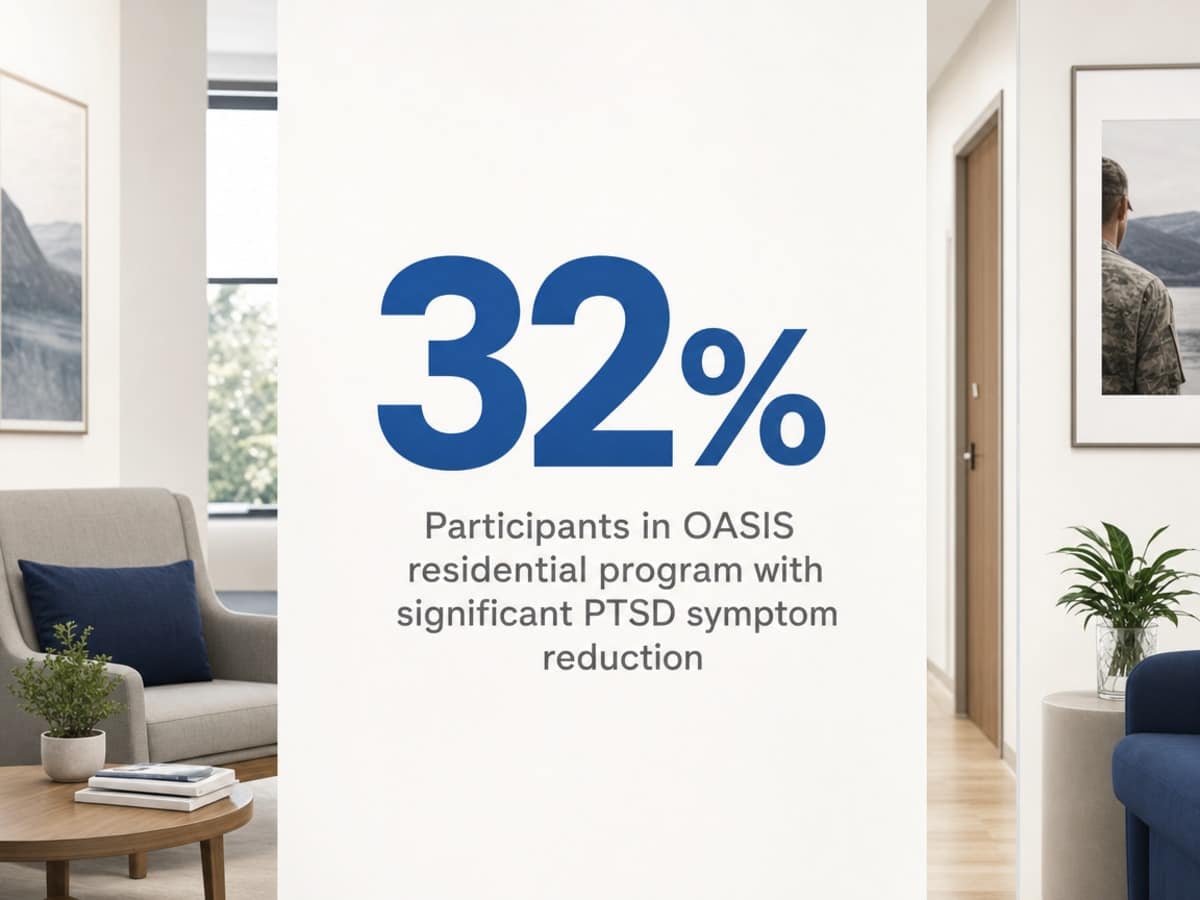
The OASIS residential program for active duty service members put a number on the per-week effect. Participants experienced roughly a 0.76-point reduction on the PTSD Checklist for each additional week of treatment, and 32% of participants achieved a clinically significant reduction in PTSD symptoms overall — a rate the authors noted was consistent with meta-analytic norms for this population 8. Those figures are drawn from a military sample, so the exact numbers don’t transfer cleanly to every civilian case, but the underlying pattern is what matters: symptom change accrues week over week, not on a fixed date.
Ask any program you’re evaluating how they set length of stay — whether it’s a fixed 30 or 45 days for everyone, or whether it’s tied to a measurable trajectory the treatment team reviews. The answer tells you whether the program is built around your clinical picture or around a billing cycle.
Honest Expectations: What Residential Care Can and Can’t Do
Who Benefits Most—and Who Benefits Least
Residential trauma-focused care is not a guarantee, and any program that talks about it that way is selling something. The evidence is more useful — and more honest — than the marketing.
The OASIS residential program for active duty service members offers a grounded reference point. Across the participant cohort, 32% achieved a clinically significant reduction in PTSD symptoms — a rate the authors noted was consistent with meta-analytic norms for trauma-focused care in military populations 8. That means roughly one in three left with a symptom change large enough to register on a validated scale. It also means two out of three did not, at least not by that threshold. Both facts belong in the conversation.
The predictors of who responds are becoming clearer. A study of combat veterans in residential PTSD care found that patients with intermediate symptom severity and intermediate risk-factor loading tended to benefit most, while average symptom reductions across programs were modest overall (effect size d = .19) 9. Patients arriving with the highest baseline severity, heavy comorbidity, or active substance use often need longer stays and integrated treatment of those comorbidities before the trauma work can fully take hold — which is exactly why the delivery model matters as much as the diagnosis.
If you’re weighing this decision, the honest read is: residential care meaningfully helps a substantial minority, moves the needle for many others, and works best when comorbidities are treated in the same container rather than deferred.
Durability of Gains for Chronic PTSD
The other question that matters: if symptoms do drop during a residential stay, do the gains hold?
For chronic PTSD, the longer-arc data is cautiously encouraging. A study of 64 patients in an intensive residential program for chronic PTSD documented significant reductions in depression, anxiety, and PTSD symptoms that were maintained at two-year follow-up 12. Two years is a meaningful window for a condition that had already outlasted standard outpatient care.
Residential programs that address functional recovery alongside symptom reduction show a similar pattern. An eight-week residential program for veterans with co-occurring PTSD and traumatic brain injury produced significant improvements in PTSD and depression symptoms and in occupational performance — the daily-life capacities that chronic PTSD tends to erode 10.
Durability isn’t automatic. It tracks with the intensity and consistency of the trauma-focused work done inside the stay, and with what happens in the weeks after discharge. Aftercare is part of the treatment, not an afterthought.
Augmentation Strategies for the Hardest Cases
For a subset of patients, even a well-run trauma-focused residential program isn’t enough on its own. The symptoms move, but not far enough. This is where augmentation strategies enter the conversation — additions to standard trauma-focused care, not replacements for it.
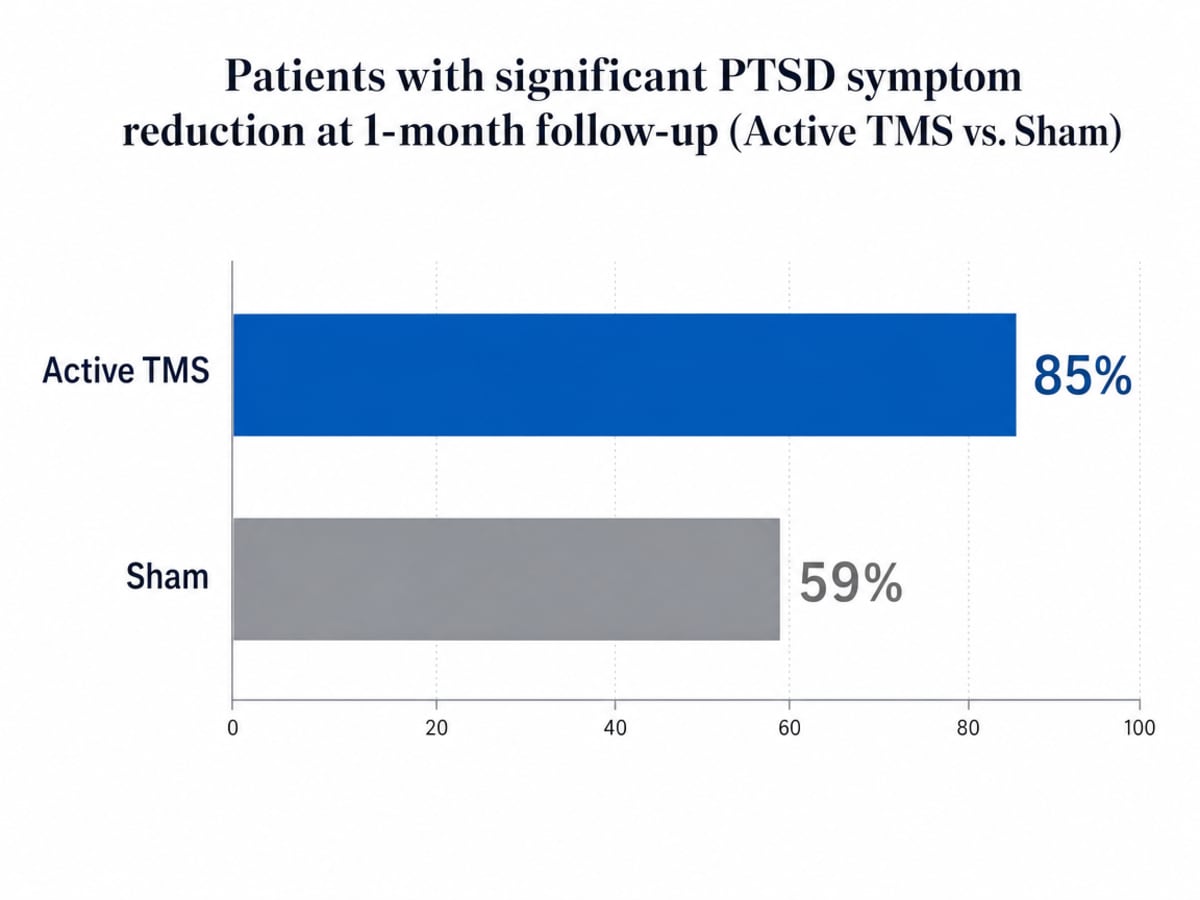
Neuromodulation is the augmentation that has moved furthest in the residential setting. A randomized clinical trial evaluated navigated transcranial magnetic stimulation (TMS) added to residential standard-of-care trauma-focused treatment — Prolonged Exposure and cognitive behavioral therapies — in military personnel and veterans with PTSD. At one-month follow-up, 85% of participants who received active TMS achieved clinically significant PTSD symptom reductions, compared with 59% in the sham group 13. Improvements persisted through three-month follow-up for most participants.
That 26-point gap is meaningful, and the population studied matters — active duty and veteran patients already inside a residential trauma-focused program, not outpatients receiving TMS in isolation. What the trial demonstrates is that the residential container itself makes advanced augmentation feasible: the equipment, the daily monitoring, and the coordination between neuromodulation sessions and trauma-focused therapy all sit under one roof.
TMS isn’t the right addition for every patient, and selection criteria are still being refined. But for someone who has already completed two adequate courses of CPT, PE, or EMDR without sufficient response, an intensive setting that can layer neuromodulation onto continued trauma work opens a door that outpatient care structurally cannot.
How to Evaluate a Residential Program Before You Commit
Not all residential programs are built the same, and the difference isn’t always visible on the website. A handful of direct questions, asked before admission, will tell you more than a brochure ever will.
- Start with the therapy schedule. Ask how many individual sessions of Cognitive Processing Therapy, Prolonged Exposure, or EMDR you will receive per week, and who delivers them. Programs that lean on group process and psychoeducation without protecting individual manualized trauma-focused time tend to produce weaker results than those that keep evidence-based therapies at the center 11.
- Ask how length of stay is determined. A program that quotes you 30 days regardless of severity is running a calendar. A program that describes reviewing symptom trajectory — PCL scores, sleep, dissociation, exposure tolerance — and adjusting duration accordingly is running a clinical decision, which is the model the length-of-stay evidence supports 7.
- Ask who manages medications and how often. Daily psychiatric availability matters when adequate SSRI or SNRI trials are part of what you came for 3. Weekly check-ins from a rotating prescriber rarely produce the responsive dose adjustments severe cases need.
- Ask how comorbidities are handled — depression, substance use, TBI, dissociation. If the answer is “we address those after the trauma work,” that’s the sequenced model that leaves the same predictors of non-response unaddressed 4. Integrated care handles them in the same container.
- Ask about accreditation, aftercare planning, and what the first four weeks after discharge look like. Durability of gains tracks with what happens next, not just what happens inside.
A Concrete Example of the Model the Evidence Supports
What the evidence describes and what a program actually delivers aren’t always the same thing. It helps to see the model made concrete.
ViewPoint Dual Recovery, a Joint Commission-accredited psychiatric facility in Prescott, Arizona, is built around the clinical picture this article has been describing: severe, chronic PTSD that hasn’t yielded to standard outpatient care, often layered with depression, substance use, or other psychiatric complexity. The Trauma-Focused Program keeps manualized CPT, PE, and EMDR at the center of the weekly schedule rather than replacing them with general milieu work 11. Board-certified psychiatrists adjust medication as treatment progresses, so adequate SSRI/SNRI trials are possible during treatment 3. Comorbidities are treated inside the same container as the trauma work, not sequenced behind it — the integrated model that addresses the same predictors of outpatient non-response head-on 4.
Treatment duration is set by clinical trajectory rather than a fixed benefit calendar as consequential 7. That’s the shape the evidence points to. Whether ViewPoint or another program, the criteria to hold any residential option against are the same.
Start a tailored plan for severe, chronic PTSD
Clarify your next clinical steps with expert guidance for treatment-resistant PTSD.
Frequently Asked Questions
How do I know if my PTSD is severe enough for residential treatment?
The clearest marker is a pattern, not a single symptom. If you’ve completed two or more adequate courses of trauma-focused psychotherapy (CPT, PE, or EMDR) and at least one first-line SSRI or SNRI trial, symptoms have persisted past twelve months, and daily functioning remains impaired, you meet the provisional criteria for treatment-resistant PTSD that residential care is designed to address 5.
How long does residential PTSD treatment usually last?
There isn’t a fixed number. VA data show longer stays are linked to lower PTSD Checklist scores at discharge and fewer outpatient visits afterward, which is why length of stay should track symptom trajectory rather than a benefit calendar 7. For severe, chronic cases, meaningful stays often run several weeks to a few months, adjusted as the treatment team reviews progress.
What’s the difference between a general trauma response and treatment-resistant PTSD?
A trauma response often resolves with time and early support, and most people who complete a full course of trauma-focused psychotherapy respond well 2. Treatment-resistant PTSD is defined by non-response to two or more adequate trauma-focused therapy courses plus a first-line medication trial, symptoms lasting twelve months or more, and functional impairment that hasn’t lifted 5. Duration, treatment history, and daily impact separate them.
What actually happens inside a trauma-focused residential program?
The spine of the week is individual, manualized trauma-focused therapy — CPT, PE, or EMDR — delivered multiple times weekly at intended pacing rather than diluted into occasional sessions 1. Board-certified psychiatry runs in parallel for real-time medication adjustment, and comorbidities like depression or substance use are treated in the same container. Programs that keep evidence-based therapies central produce the strongest outcomes 11.
Can residential care help if I also have depression, substance use, or a TBI?
Yes, and comorbidity is often the reason outpatient care stalled. Comorbidity is not a barrier to trauma-focused treatment when it’s addressed alongside the trauma work 2. An eight-week residential program for veterans with co-occurring PTSD and traumatic brain injury produced significant improvements in symptoms and daily occupational performance 10. Integrated care handles these pieces together instead of sequencing them.
What if I’ve already tried residential treatment and it didn’t work?
Ask what the prior program actually delivered. Many stays labeled residential lean on supportive milieu and psychoeducation rather than consistent manualized trauma-focused therapy, which is the content credited with symptom reduction 11. A different program with individual CPT, PE, or EMDR at the center, integrated psychiatry, and augmentation options like navigated TMS for the hardest cases can produce different results 13.
References
- Management of Posttraumatic Stress Disorder and Acute Stress Disorder (VA/DoD Clinical Practice Guideline). https://www.healthquality.va.gov/guidelines/mh/ptsd/
- VA/DoD 2023 Clinical Practice Guideline for the Management of PTSD and Acute Stress Disorder. https://www.ptsd.va.gov/professional/treat/txessentials/cpg_ptsd_management.asp
- Clinician’s Guide to Medications for PTSD. https://www.ptsd.va.gov/professional/treat/txessentials/clinician_guide_meds.asp
- Predicting and Managing Treatment Non-Response in Posttraumatic Stress Disorder. https://pmc.ncbi.nlm.nih.gov/articles/PMC7748158/
- Toward a Definition of Treatment-Resistant Posttraumatic Stress Disorder. https://pmc.ncbi.nlm.nih.gov/articles/PMC13391186/
- Assessing Treatment-Resistant Posttraumatic Stress Disorder. https://pmc.ncbi.nlm.nih.gov/articles/PMC4287702/
- Associations Between Residential Treatment Length, PTSD Symptoms, and Outpatient Mental Health Service Use in Veterans. https://pmc.ncbi.nlm.nih.gov/articles/PMC6542559/
- Overcoming Adversity and Stress Injury Support (OASIS): Evaluation of Residential Treatment Outcomes for U.S. Service Members with Posttraumatic Stress Disorder. https://pmc.ncbi.nlm.nih.gov/articles/PMC8247997/
- Residential Treatment for Combat-Related Posttraumatic Stress Disorder: Identifying Trajectories of Change and Predictors of Treatment Response. https://pmc.ncbi.nlm.nih.gov/articles/PMC4109915/
- Effects on Symptom Severity and Occupational Performance of a Residential Rehabilitation Program for Veterans with PTSD and TBI. https://pmc.ncbi.nlm.nih.gov/articles/PMC4086411/
- Residential Treatment for Posttraumatic Stress Disorder in the Department of Veterans Affairs. https://pmc.ncbi.nlm.nih.gov/articles/PMC4233343/
- An Intensive Treatment Program for Chronic Posttraumatic Stress Disorder: 2-Year Outcome Data. https://pubmed.ncbi.nlm.nih.gov/10619211/
- Residential Therapy with Navigated Transcranial Magnetic Stimulation for Posttraumatic Stress Disorder (Randomized Clinical Trial). https://www.ptsd.va.gov/professional/articles/article-pdf/id1663362.pdf