

Key Takeaways
- Arizona licenses residential psychosis care under A.A.C. Title 9, Chapter 10, Article 7, with a separate secure facility class under A.R.S. § 36-425.06 for chronically treatment-resistant cases.2,3
- A program built for complex psychosis integrates coordinated specialty care components in-house: medication management, CBT for psychosis, family psychoeducation, supported employment, and case management.7
- After two adequate antipsychotic trials without response, clozapine is the next indicated step per APA guidelines, requiring on-site nursing, blood monitoring, and REMS enrollment.11
- Verify current ADHS licensure, confirm Article 7 staffing coverage, and ask intake teams about AHCCCS acceptance and help documenting an SMI determination before choosing a facility.4,5,8
When Standard Treatment Stops Working
You have probably been at this longer than you expected. Maybe a first hospitalization led to a discharge plan, a prescription, and a follow-up appointment that felt too short. Then came a second medication. Then a third. The voices got quieter for a while, or the paranoia loosened, and then something slipped. That exhaustion you are feeling is real, and it is not a sign that your family member, your patient, or you have failed.
When two adequate trials of antipsychotic medication have not produced lasting relief, clinicians consider the case treatment-resistant, and the treatment plan needs to change, not the person on it. Sustained, well-monitored antipsychotic treatment is still the strongest evidence-based lever for reducing relapse and protecting long-term function, but the strategy behind it has to match the complexity of the illness.6,11
This guide walks through what specialized psychosis care in Arizona actually looks like: how the state licenses the facilities that provide it, what medication management should include when standard drugs have not worked, which therapies belong alongside medication, and how to tell a program built for complex cases apart from a general behavioral health center. You are making a clinical decision, and you deserve specifics.
What Separates a Psychosis Program From General Behavioral Health Care
Most behavioral health centers in Arizona can prescribe an antipsychotic, offer group therapy, and check in on symptoms. That is not the same thing as a program built for psychosis. The clearest way to tell them apart is to look for the components of coordinated specialty care, the model SAMHSA and NIMH built around research showing that integrated treatment beats standard outpatient care on symptoms, functioning, and engagement.7,12
A specialized psychosis program brings five things together under one clinical roof, not scattered across three referrals you have to chase:7
- Medication management by a psychiatrist who understands antipsychotic sequencing, side-effect monitoring, and when a case has crossed into treatment resistance, not a monthly 15-minute refill visit.
- Cognitive behavioral therapy for psychosis (CBTp), a structured talk therapy that helps you or your family member work with distressing voices, unusual beliefs, and the fear that comes with them, rather than just waiting for medication to silence everything.
- Family psychoeducation that teaches the people around the patient what psychosis is, what relapse warning signs look like, and how to respond without escalating a crisis.
- Supported employment or education, so returning to a job, a class, or a training program is part of the treatment plan, not a hope for after discharge.
- Case management that holds the whole plan together across appointments, medication changes, benefits paperwork, and step-down housing.
A general behavioral health facility might offer one or two of these. A specialized psychosis program treats them as inseparable. When you are screening a facility in Arizona, ask which of the five they provide in-house and which they refer out. The answer tells you what kind of care you are actually being offered.
How Arizona Licenses the Facilities That Treat Psychosis
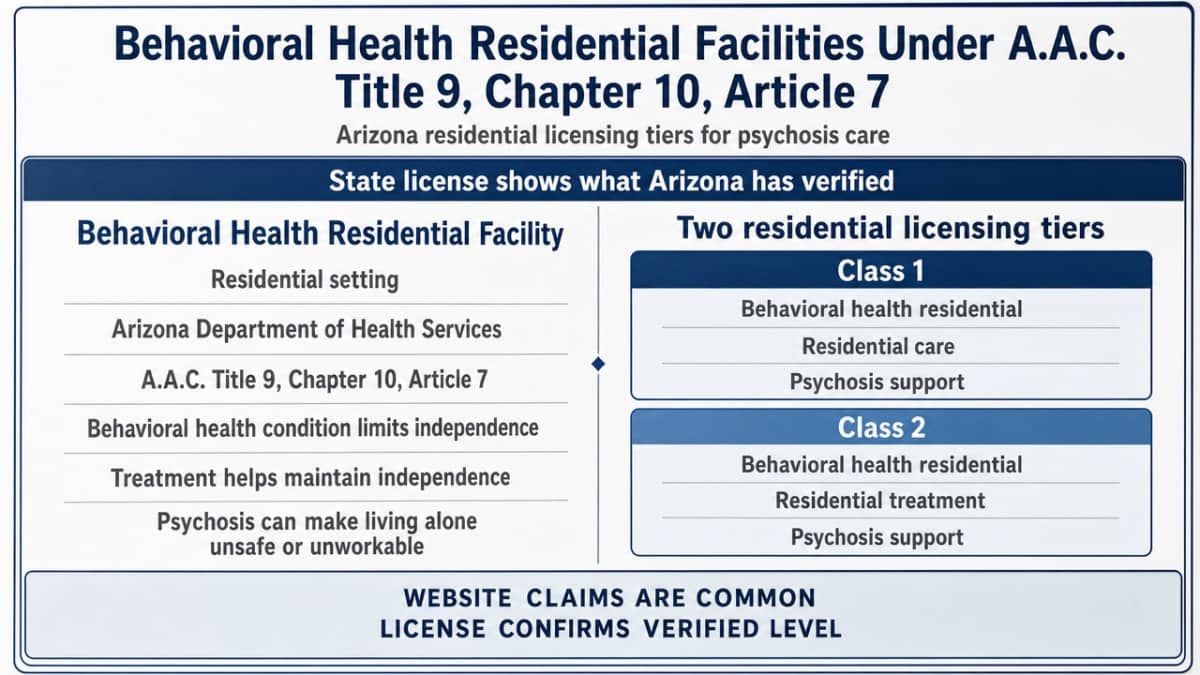
Behavioral Health Residential Facilities Under A.A.C. Title 9, Chapter 10, Article 7
When you look at a facility’s website, everyone says they treat psychosis. The license is what tells you what the state has actually verified. In Arizona, the most common residential setting for someone with schizophrenia, schizoaffective disorder, or another psychotic illness is a behavioral health residential facility, licensed by the Arizona Department of Health Services under A.A.C. Title 9, Chapter 10, Article 7.2
The state defines this class of facility as one that treats people whose behavioral health condition limits their ability to be independent or requires treatment to maintain that independence. That covers the population you are likely thinking about: someone whose psychosis has made living alone unsafe or unworkable, at least for now.1
Secure Behavioral Health Residential Facilities and A.R.S. § 36-425.06
There is a second tier that many families do not know exists until a clinician mentions it. A secure behavioral health residential facility is a separate license class under A.R.S. § 36-425.06, created specifically for people who have been determined seriously mentally ill and are, in the statute’s own words,
“chronically resistant to treatment for a mental disorder.”3
These facilities provide twenty-four-hour on-site supportive treatment and supervision by staff with behavioral health training, and admission generally involves court-ordered placement. That legal framing matters. It means the state has built a category expressly for the kind of case your family may be dealing with: someone who cycles through hospitalizations, walks away from voluntary programs, or whose symptoms make an unlocked residential setting unsafe.3
A secure BHRF is not the right level of care for every treatment-resistant patient, and the loss of autonomy is real. The statute also requires AHCCCS to report annually on funding and bed availability, which is why access can be tight. If a clinician is talking with you about a secure placement, they are not giving up on the person; they are recognizing that a locked, court-supervised setting with intensive medication management may be what breaks the cycle after less restrictive options have not held.3
ADHS Licensure and Accreditation as Quality Signals
Two quick checks will tell you whether a program is legitimate before you ever tour it. First, ADHS licensure is required for any mental health or substance use disorder treatment facility operating in Arizona. If a program cannot show you its current ADHS license, stop there.4
Second, accreditation is not required by the state, but proof of accreditation from a recognized body will stay the onsite compliance inspection prerequisite during licensing. Practically, that means an accredited facility has already passed an outside clinical review on top of the state’s rules. When you are choosing between two programs and one is accredited by a body like the Joint Commission, that is a meaningful signal about their clinical operations, not just their marketing.4
Ask for the license number and the accreditation certificate. Reputable programs hand them over without hesitation.
The Medication Question: Sustained Antipsychotic Strategy
Why Consistency Matters More Than Any Single Drug
Families often ask which antipsychotic is the best one. It is a reasonable question, and it is not quite the right one. The strongest evidence-based lever in schizophrenia care is not a specific molecule; it is sustained treatment with an antipsychotic that the patient can actually tolerate and keep taking. Gaps in treatment are where relapse lives.6
Inconsistent medication use is one of the clearest paths into treatment resistance and cognitive decline over time. That is not a scolding directed at the person taking the medication. Side effects are real, insight can waver during acute episodes, and pharmacy runs and prior authorizations can drop the ball in ways no one anticipated. A specialized program plans for all of that.6
What sustained strategy looks like in practice: a psychiatrist who checks in on effectiveness and side effects on a real schedule, not once a quarter; nursing staff who can catch early signs of a metabolic shift, a movement disorder, or sedation before it becomes a reason to quit; and a clear plan for what happens if a dose is missed or an insurance change interrupts the supply. If the program you are looking at cannot describe how it prevents medication gaps, that is the question to keep asking.
Clozapine and Long-Acting Injectables for Treatment-Resistant Cases
Here is where the treatment plan changes. The APA practice guideline for schizophrenia recommends clozapine for patients who have not responded to two adequate trials of other antipsychotics, and also for patients with persistent suicidal ideation or behavior. Two prior agents is a defined threshold, not a matter of opinion. If you have already been through that sequence, clozapine is not a last resort someone forgot to mention; it is the next indicated step.11
Clozapine carries a monitoring burden. Regular blood draws are required because of the risk of a serious drop in white blood cells, and side effects like sedation, drooling, and metabolic changes need close management. That is exactly why it belongs in a program with on-site nursing and psychiatry, not a once-a-month outpatient visit. A center that runs clozapine protocols routinely has the lab logistics, the REMS enrollment, and the clinical experience to make the trial feasible rather than frightening.11
Long-acting injectable antipsychotics are the other tool that changes the picture. Instead of a daily pill, the medication is given as a shot every two, four, or even twelve weeks. The APA guideline supports LAIs for patients who prefer them and for those where adherence has been a problem. For someone who has cycled through hospitalizations because pills got missed during symptom flares, an LAI can be the difference between another relapse and a stretch of stability long enough to do the rest of the work.11

Therapy That Actually Works Alongside Medication
Medication quiets the loudest symptoms. It does not, on its own, teach someone how to live with a voice that still whispers on a bad day, or how to trust their own thoughts again after a period where they could not. That is the work of therapy, and the research on early and ongoing psychosis is clear: combining antipsychotic medication with structured psychotherapy and family intervention produces better symptom and functional outcomes than medication alone.10
CBT for psychosis is the one most families have not heard of. It is not talk therapy in the general sense. A trained therapist works with the patient on the specific content of their experiences, the voices, the fixed beliefs, the anxious anticipation of the next episode, and helps them build responses that reduce distress and reclaim daily function. It does not try to argue anyone out of what they perceive. It changes the relationship to the perception.
Family psychoeducation shifts the temperature at home. When the people living with the patient understand the illness, the medication schedule, and the early warning signs of relapse, the household stops running on guesswork. That protects everyone.7
Ask any program you are considering whether CBTp is delivered by a therapist trained specifically in that model, and how often family sessions actually happen. “We do therapy” is not the same answer.
Treating Psychosis and Substance Use in the Same Setting
Alcohol, cannabis, methamphetamine, and opioids show up in a large share of psychosis cases, and pretending they are a separate problem for a separate program almost always backfires. Someone in acute psychosis who is also withdrawing from alcohol or using stimulants cannot stabilize on medication that keeps getting undercut. And a substance use program that hands off psychiatric care to an outside referral cannot adjust an antipsychotic in real time when symptoms shift.
Arizona’s Article 7 rules recognize this overlap directly. Behavioral health residential facilities are licensed to treat individuals with mental disorders and substance use disorders in the same setting, with a behavioral health professional and a registered nurse available on-site or on-call at all times. That staffing pattern is what makes integrated treatment possible rather than theoretical.2,5
What integrated care should look like in practice: one psychiatrist managing the antipsychotic and, when needed, medications for alcohol or opioid use disorder; one therapist working on both the voices and the drinking in the same session rather than treating them as unrelated; and a nursing team that can safely oversee withdrawal while an antipsychotic dose is being adjusted. If a program tells you they will treat the psychosis first and “address the substance use later,” you are looking at sequential care, not integrated care. Ask specifically whether the psychiatrist on staff prescribes for both diagnoses and whether therapy addresses them together.
Phases of Progress: What Recovery Looks Like Week by Week
Recovery from a psychotic episode does not arrive as a single moment. It arrives as a sequence of small, uneven changes, and knowing what to watch for helps you tell whether treatment is working or whether the plan needs adjusting.10,11
- The first phase is acute stabilization. In the first days to two weeks, the goal is safety and sleep. A specialized program starts or resumes an antipsychotic, manages any withdrawal from alcohol or other substances, and gets a sleep cycle back. Early wins look ordinary and matter enormously: sleeping through the night, eating a meal without prompting, sitting through a group without leaving.
- The second phase is medication optimization, usually weeks two through eight. This is where the psychiatrist adjusts doses, changes agents if response is partial, and, when two adequate trials have not worked, moves to a clozapine trial with the required blood monitoring. For someone whose adherence has been the barrier, a long-acting injectable may be introduced here. Progress markers are quieter voices, less paranoid interpretation of ordinary events, and a return of some emotional range.
- The third phase is psychosocial engagement. Once medication is stable enough that the person can think alongside a therapist, CBT for psychosis and family sessions do their real work. Combined with sustained medication, this integrated approach outperforms medication alone on symptoms and functioning. Signs of progress here are conversational: naming a warning sign before it becomes a crisis, disagreeing with a voice instead of obeying it, tolerating a family meal.
- The final phase is step-down planning. Housing, outpatient psychiatry, therapy continuation, and a return to school or work get scheduled before discharge, not after. That handoff is where a lot of recoveries stall, and it is worth asking any Arizona program exactly who owns it.
Paying for Care: AHCCCS, SMI Determination, and Private Coverage
The clinical picture is one problem. Paying for months of intensive care is another, and it deserves a straight answer. In Arizona, most people receiving specialized psychosis care are funded through one of three routes: AHCCCS (the state Medicaid program), commercial insurance, or private pay, sometimes in combination.
If your family member has a psychotic disorder, the mechanism that opens the widest door is an SMI determination through AHCCCS. Schizophrenia and schizoaffective disorder are core diagnoses under Arizona’s serious mental illness criteria, alongside functional impairment thresholds that many people with treatment-resistant psychosis clearly meet. An SMI designation is what unlocks access to enhanced services: case management, higher levels of residential care, and, when clinically indicated, placement in a secure behavioral health residential facility.3,8
The determination itself is a process, not a form. A qualified evaluator reviews diagnosis, history, and functional impact. If you have been hovering around the threshold, ask the referring clinician or a program’s intake team to help document the functional evidence, hospitalizations, inability to sustain work or school, safety concerns, that the reviewer needs to see.8
Commercial insurance typically covers residential and outpatient psychosis care, though benefit design, prior authorization, and length-of-stay decisions vary by plan. Private pay fills the gap for families choosing a program outside their network. Ask any Arizona facility three specific questions: whether they accept AHCCCS, which commercial plans they contract with, and how they handle authorization for extended stays when the clinical picture warrants it.
Questions to Ask Before You Choose a Program
By the time you are touring facilities or making intake calls, decision fatigue is real. A short, specific question list keeps the conversation on clinical substance instead of amenities.
- Show me your current ADHS license and any accreditation certificate. Both should be produced without hesitation.4
- Which of the five coordinated specialty care components do you deliver in-house? Medication management, CBT for psychosis, family psychoeducation, supported employment or education, and case management.7
- Do you run clozapine protocols on-site, including the required blood monitoring and REMS enrollment? If two adequate antipsychotic trials have already failed, this is the next indicated step and needs to happen without a referral chain.11
- Is a behavioral health professional and a registered nurse available on-site or on-call at all times? This is the Article 7 staffing floor, not an upgrade.2,5
- Is CBT for psychosis delivered by a therapist trained in that specific model, and how often do family sessions occur?
- Does one psychiatrist manage both the antipsychotic and any medications for co-occurring alcohol or opioid use disorder? Sequential handoffs are not integrated care.
- Who owns the step-down plan, and when does it start? Housing, outpatient psychiatry, and therapy continuation should be scheduled before discharge.
- Do you accept AHCCCS, and can your intake team help document evidence for an SMI determination if one is not already in place?8
Write the answers down. Compare them side by side. The program built for treatment-resistant psychosis will sound different from the one that is not.
Where ViewPoint Fits in Prescott
Most of this guide has kept ViewPoint at arm’s length on purpose. You deserved to see the clinical picture first, not a pitch. Here is where the brand mention is earned: ViewPoint Dual Recovery is a Joint Commission-accredited psychiatric facility in Prescott built for the cases other Arizona programs decline as too complex, treatment-resistant schizophrenia, rapid-cycling bipolar disorder, and psychosis layered with substance use.
What that looks like in practice matches the checklist you have been reading. Board-certified psychiatry is on-site around the clock, clozapine protocols run in-house with the required blood monitoring, and one integrated team manages the antipsychotic strategy and any co-occurring substance use in the same treatment plan. Length of stay is set by clinical response, not a preset benchmark.11
If two or three medications have not held, that is not the end of the road. It is the signal that a different level of care is indicated.
Request a tailored assessment for complex psychosis
Get expert insight on next-step treatment options for persistent or treatment-resistant psychotic symptoms.
Frequently Asked Questions
How do I know if a psychosis treatment center in Arizona is equipped for treatment-resistant cases?
Ask three things. Does the program run clozapine protocols on-site with the required blood monitoring? Is a behavioral health professional and a registered nurse available on-site or on-call around the clock, as Article 7 requires? And does one psychiatrist manage both the antipsychotic strategy and any co-occurring substance use in the same plan? A yes to all three points to a program built for complex cases.2,5
What is the difference between a behavioral health residential facility and a secure behavioral health residential facility in Arizona?
A behavioral health residential facility is licensed under A.A.C. Title 9, Chapter 10, Article 7 and treats people whose condition limits independent living. A secure behavioral health residential facility is a separate license class under A.R.S. § 36-425.06, created for individuals determined seriously mentally ill and chronically resistant to treatment, with twenty-four-hour on-site supervision and generally court-ordered placement. The secure setting is a locked environment; the standard BHRF is not.1,2,3
When should clozapine be considered for someone with schizophrenia?
The APA practice guideline recommends clozapine after two adequate trials of other antipsychotics have not produced a sufficient response, and also for patients with persistent suicidal ideation or behavior. If your family member has already been through that sequence, clozapine is the next indicated step, not a last resort. It carries a real monitoring burden, which is why it belongs in a program with on-site nursing and psychiatry.11
Does AHCCCS cover psychosis treatment, and how does SMI determination affect access?
Yes. AHCCCS funds psychosis care, and a serious mental illness determination is the mechanism that opens access to enhanced services. Schizophrenia and schizoaffective disorder are core SMI diagnoses under Arizona’s criteria, paired with functional impairment thresholds. An SMI designation unlocks case management, higher levels of residential care, and, when clinically indicated, placement in a secure behavioral health residential facility. Ask a program’s intake team to help document the functional evidence.3,8
Can a psychosis treatment center treat co-occurring substance use at the same time?
The right ones can. Arizona’s Article 7 rules license behavioral health residential facilities to treat mental disorders and substance use disorders in the same setting, with the staffing to make that safe. Integrated care means one psychiatrist prescribing for both diagnoses and therapy addressing them together, not a handoff between programs. If a facility says it will treat the psychosis first and the substance use later, that is sequential care.2
What therapies should a specialized psychosis program offer alongside medication?
Look for CBT for psychosis delivered by a therapist trained in that specific model, family psychoeducation, and supported employment or education alongside case management. Combining antipsychotic medication with CBT for psychosis and family interventions produces better symptom and functional outcomes than medication alone. If a program describes therapy only as “groups” without naming CBTp or scheduled family sessions, you are being offered general behavioral health care, not specialized psychosis treatment.7,10
References
- Residential Health Care Institution Licensing Process. https://www.azdhs.gov/documents/licensing/residential-facilities/training/residential-licensure-process.pdf
- Arizona Administrative Code Title 9, Chapter 10, Article 7: Behavioral Health Residential Facilities. https://www.azdhs.gov/documents/licensing/residential-facilities/article-7.pdf
- Arizona Revised Statutes § 36-425.06 – Secure behavioral health residential facilities. https://www.azleg.gov/ars/36/00425-06.htm
- Arizona Summary – State Residential Treatment for Behavioral Health Conditions. https://aspe.hhs.gov/sites/default/files/2021-08/StateBHCond-Arizona.pdf
- Behavioral Health Residential Facilities Rules Update and Training Presentation. https://www.azdhs.gov/documents/licensing/residential-facilities/training/behavioral-health-residential-facilities-rules.pdf
- Medications for psychosis in people with schizophrenia. https://pmc.ncbi.nlm.nih.gov/articles/PMC13064772/
- Coordinated Specialty Care for First Episode Psychosis: Information and Resources. https://library.samhsa.gov/sites/default/files/pep23-01-00-003.pdf
- Arizona Health Care Cost Containment System (AHCCCS) – Serious Mental Illness Determination Guidelines. https://azahcccs.gov/AHCCCS/Downloads/SMI/SMI_Determination_Guidelines.pdf
- Serious Mental Illness (SMI) – Tools & Resources. https://www.cdc.gov/mentalhealth/tools-resources/serious-mental-illness.htm
- Psychosocial Interventions in Early Psychosis: A Systematic Review. https://pubmed.ncbi.nlm.nih.gov/36448247/
- The American Psychiatric Association Practice Guideline for the Treatment of Patients With Schizophrenia. https://pmc.ncbi.nlm.nih.gov/articles/PMC7725162/
- NIMH White Paper – Coordinated Specialty Care for First Episode Psychosis (RAISE Initiative). https://www.nimh.nih.gov/health/topics/schizophrenia/raise/nimh-white-paper-csc-for-fep_147096.pdf