Key Takeaways
- Washington psychiatric declines are usually a staffing story, not a bed shortage — state hospitals run above 85% occupancy and behavioral health vacancies still rely on contract staff 8, 15.
- A program that can genuinely hold high-acuity cases needs 24/7 in-house RN coverage, capacity for 1:1 observation, onsite board-certified psychiatry, withdrawal management, and an active daily treatment program 1, 2, 16.
- Cases get labeled ‘too complex’ when behavioral acuity, medical complexity, active substance use, and prior treatment failure stack together beyond what local Washington staffing rosters can safely absorb.
- If local calls produce only waitlists, gather records immediately, work the five-question intake script in batches, and include out-of-state programs by day three rather than as a last resort 6.
When the intake coordinator says the case is outside their scope
You already know the sentence. Some version of it has been said to you on the phone, or written into a discharge summary, or delivered in a hallway conversation you weren’t ready for: the case is outside our scope of service. Sometimes it’s softer — we’re not the right level of care. Sometimes it’s blunter — we can’t accept him. The meaning is the same. The door you were counting on has closed.
If you’re reading this, your loved one has probably been through more than one of those doors. A local hospital held them for 72 hours and discharged. A residential program said no after reviewing records. An ER has been boarding your daughter for days while someone, somewhere, tries to find a bed. You’ve been told about waitlists. You’ve been told to try again next week.
Here is what almost no one says out loud on those calls: the decline is rarely about a missing bed. It’s about staffing, psychiatric coverage, and the kind of acuity infrastructure that most Washington programs cannot sustain right now 8, 15. That distinction matters, because it changes what you should be asking for and where you should be looking.
This guide is written for you — the parent, the spouse, the adult child on the phone at 11 p.m. It will name what “too complex” usually means, walk through what a program that genuinely accepts high-acuity cases must have, and be honest about when a Washington placement stops being realistic. You are not overreacting. You are reading the system correctly.
Why Washington programs are declining acute cases right now
The bed you were promised is a staffing story
When an intake coordinator tells you there is “no bed,” they are usually not walking you past an empty room. They are telling you the truth in a shorthand that hides the actual constraint: they do not have the staff to safely open that room for a patient at your loved one’s acuity level.
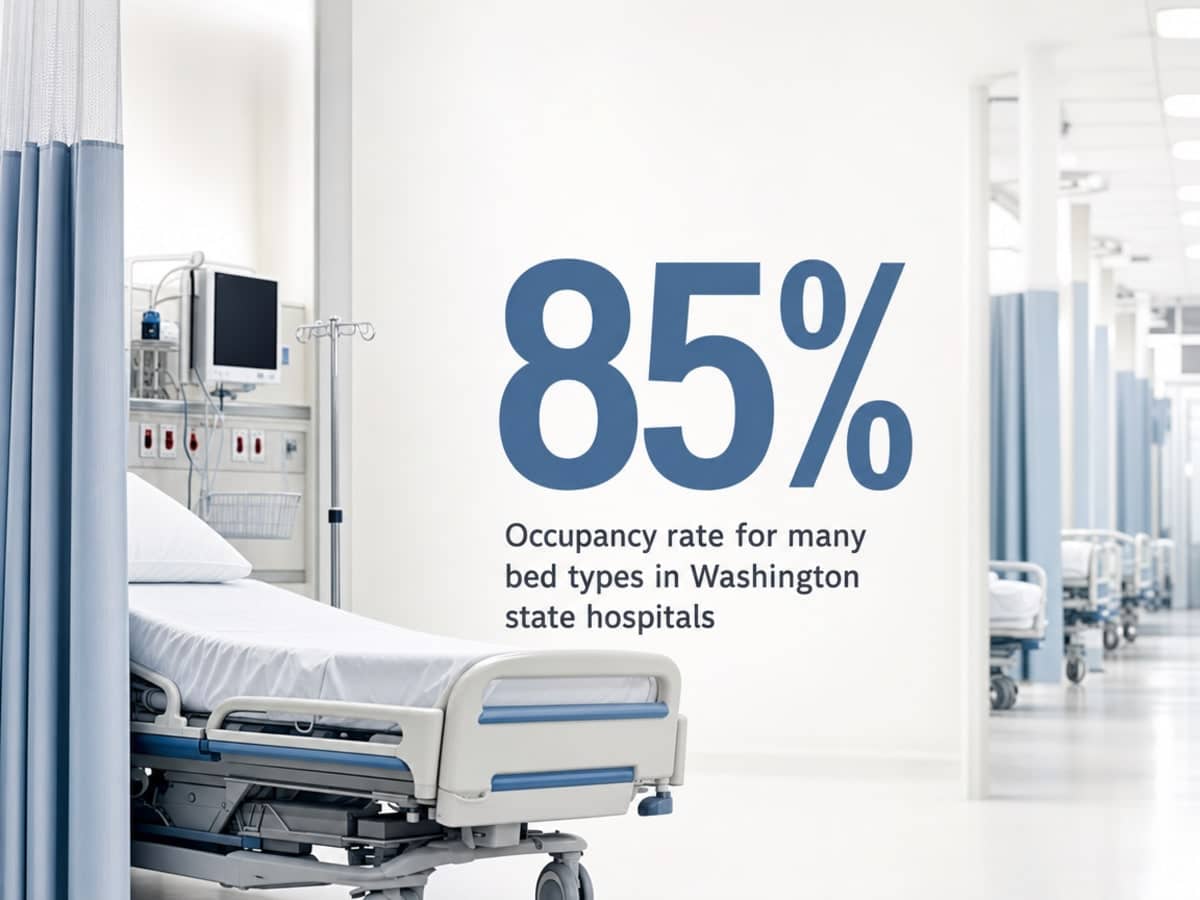
Washington’s own numbers show why. The Office of Financial Management’s mental health system assessment found that state hospitals were operating above 85% occupancy for many bed types, with staffing described as lean compared with other states 8. Above 85% is the point where facilities lose the flexibility to absorb a high-acuity admission without pulling nurses off other patients or triggering unsafe ratios on the receiving unit. So when your son’s records land on an intake desk and the reviewer sees active psychosis, self-harm risk, or a history of aggression, the math on that unit stops working. The decline follows.
This is why adding beds hasn’t solved the access problem you’re hitting. Between 2011 and 2016, Washington increased its psychiatric treatment bed count by more than 52% 10. Families still get declined, still board in emergency rooms, still hear “we can’t accept him.” A licensed bed is a room with a bed frame in it. A staffed bed is a room with the nurses, psychiatric coverage, and observation capacity to actually admit a patient who needs 1:1 eyes or emergency medication changes. Washington has more of the first than the second right now.
You are not being lied to on those calls. You are being handed a system-level shortage in the shape of a personal denial.
Psychiatrist shortages and contract nursing behind the decline letter
Behind almost every decline letter is a staffing roster that couldn’t hold the case.
Washington has been documenting a major shortage of psychiatrists for years, along with too few psychiatric advanced practice providers to fill the gap. The state’s own workforce assessment named the shortage directly and recommended expanding residencies and psychiatric ARNP training to catch up 14. That was the diagnosis. The follow-up hasn’t closed the gap. The 2023 Health Workforce Council report notes that behavioral health vacancies still have not recovered, and that facilities are relying on more expensive temporary contract staff just to meet the regulatory staffing minimums they are already required to hit 15.
Here is what that means on the phone with you. A residential program may have the license, the physical space, and the contract with your loved one’s insurance. What it does not have this week is a psychiatrist willing to accept a treatment-resistant schizophrenia case that needs weekly medication decisions, or the nursing depth to safely run a 1:1 observation while the rest of the unit keeps operating. So the intake coordinator reviews the packet and says the case is outside their scope of service — not because your family member is unmanageable, but because the roster on shift can’t hold that level of care without breaking somewhere else.
When you hear “we’re not the right fit,” translate it: the program cannot staff the acuity your loved one is presenting. That is a real answer, and it points you toward the right next question — which programs actually can.
What families actually wait through: ER boarding to three-week holds
While the staffing math plays out in offices you’ll never see, you are the one sitting in a plastic chair.
Washington’s 2024 rural access study reported inpatient psychiatric wait times ranging from 12–18 hours on the short end, to one day, to three weeks on the long end 7. Read that range again. The same state, in the same year, has families whose loved one gets a bed within a shift and families whose loved one is still in a locked emergency room three weeks later. Which end of that range you land on depends on where you live, what insurance you carry, and how acute the presentation is. The most acute cases — the ones a local unit has already declined — tend to wait the longest, because every program they get referred to is doing the same staffing calculation the last one did.
That is what “boarding” actually looks like from your side. Your daughter is medically cleared. She has been in an ER hallway or a small side room for days. Fluorescent lights, no therapy, minimal privacy, security nearby, and a rotating cast of nurses who are kind but not trained for what she needs. You are sleeping in the chair or driving home to shower and coming back. Someone tells you they are “still working on placement.” Then a shift changes and someone else tells you the same thing.
This is not a failure of effort on your part or theirs. It is the visible edge of the capacity story in section 2.1. And it is one of the honest reasons families start asking whether the search needs to widen past Washington entirely.
What ‘too complex’ usually means on a decline call
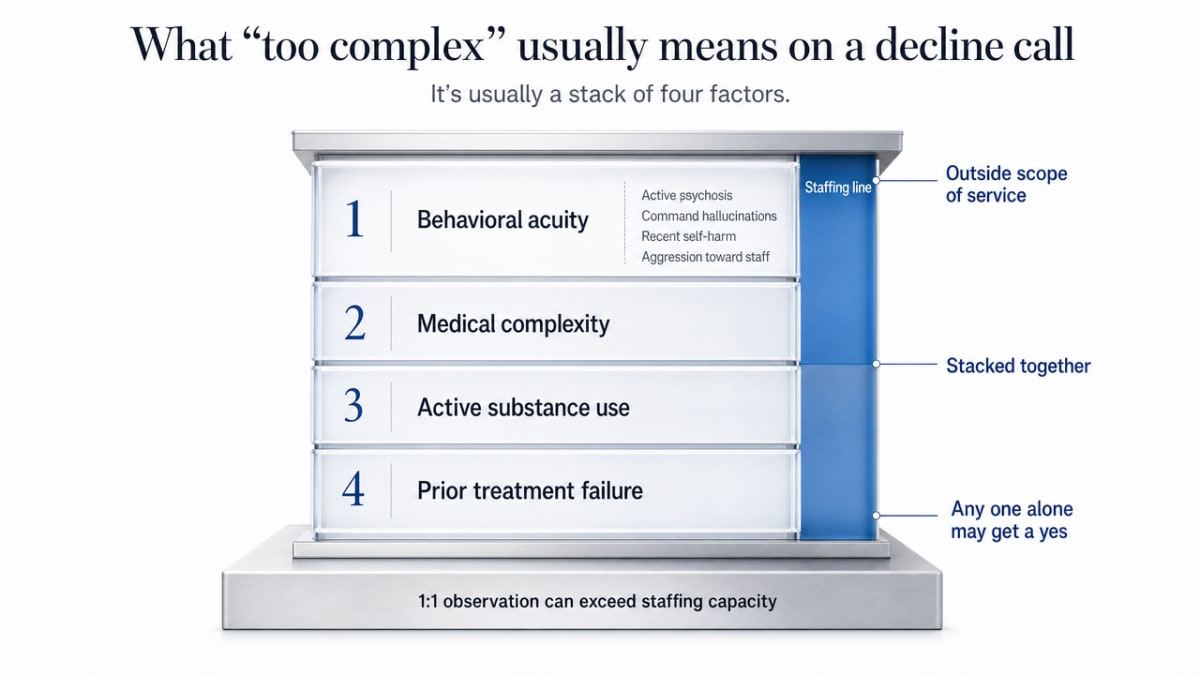
“Too complex” is almost never one thing. It’s a stack.
When an intake reviewer reads your loved one’s records and writes back that the case is outside their scope of service, they are usually looking at four things at once:
- behavioral acuity
- medical complexity
- active substance use
- a history of prior treatment failure
Any one of these on its own might get a yes. Stacked together, they cross the line where the program’s staffing and psychiatric coverage can no longer safely hold the case 2, 16.
Behavioral acuity is the part you can feel in the room. Active psychosis. Command hallucinations. Recent self-harm. Aggression toward staff on the last unit. A program that has one nurse for eight patients on the evening shift cannot absorb someone who may need 1:1 observation — one staff member whose only job for that shift is to keep eyes on your loved one — without pulling that nurse away from everyone else 16.
Medical complexity narrows the door further. Diabetes with insulin, a seizure history, pregnancy, a recent hospitalization for something physical — each of these requires nursing skill many residential programs do not staff for. Add active alcohol or opioid use, and now the program needs withdrawal management on top of psychiatric care. Most Washington programs are set up to do one or the other well, not both at the same time.
Prior treatment failure is the fourth layer. If your son has already cycled through two programs this year, the reviewer reads that as evidence the case needs more medication expertise and longer stabilization than their model provides — often including access to clozapine, an antipsychotic reserved for treatment-resistant schizophrenia that requires close blood monitoring and prescriber comfort many programs do not have.
None of this means your family member is beyond help. It means you are looking for a specific kind of program, and the criteria in the next section are how you find one.
What a program that genuinely accepts high-acuity cases must have
The federal floor: 24-hour RN coverage and an active treatment program
Before you evaluate any specific program, know the federal baseline. It’s the floor no psychiatric hospital in the country is allowed to drop below, and it tells you a lot about what your loved one actually needs on shift.
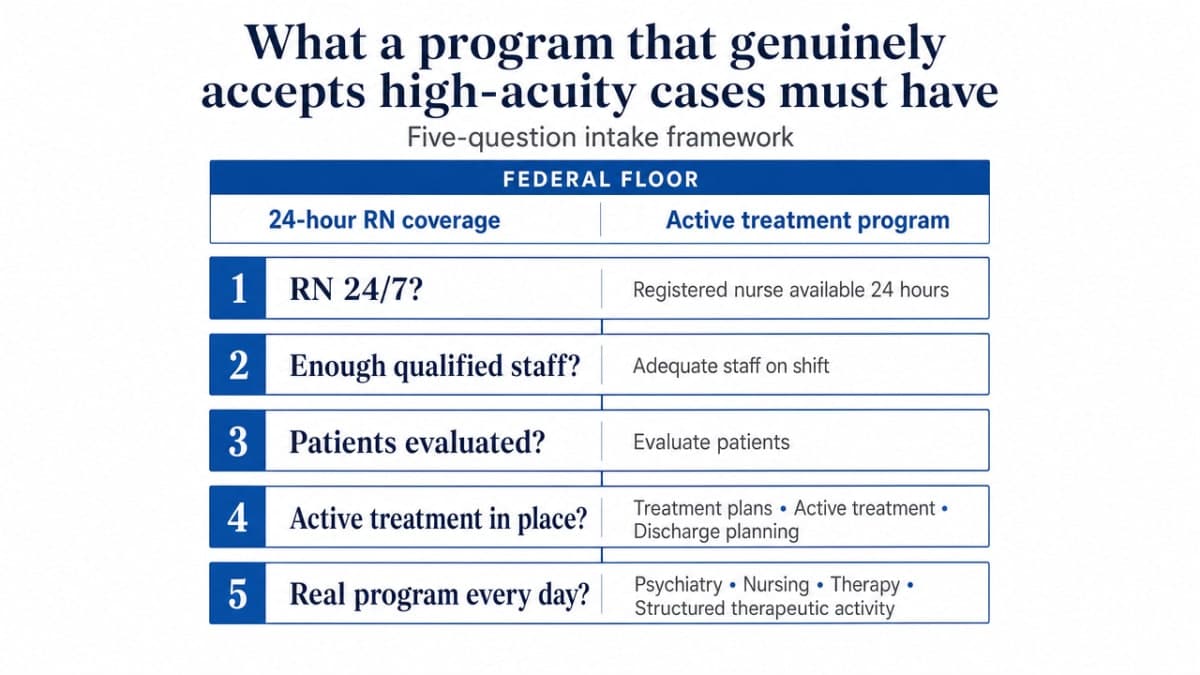
CMS requires that a psychiatric hospital have a registered nurse available 24 hours a day, and that the facility maintain adequate numbers of qualified staff to evaluate patients, formulate treatment plans, provide active treatment, and plan for discharge 2. The word that does the work there is active. A psychiatric hospital can’t just hold your son safely for three days and hand him back. Under CMS rules, it must run a real program — psychiatry, nursing, therapy, and structured therapeutic activity — every day he is there 1.
When you’re on an intake call, this is the first floor to check. Ask directly: is there a registered nurse in the building 24 hours a day, seven days a week? Is there an active daily treatment program, or is this a supervised setting where patients spend most of their time waiting? A program that hesitates on either question is not equipped for the kind of acuity your family is dealing with. A program that answers cleanly is at least standing where it’s supposed to stand.
Washington’s IBHTF minimums and what they signal about acuity
Washington built a category specifically for higher-acuity residential care: the Intensive Behavioral Health Treatment Facility, governed by WAC 246-341-1137. Reading the minimums tells you what “intensive” actually means in this state — and what it doesn’t.
An IBHTF must provide 24-hour observation by at least two staff who are awake and on duty, with an onsite psychiatric nurse at all times 17. The Health Care Authority’s own toolkit goes further, treating at least one mental health professional, one nurse, and one certified peer per shift as the bare minimum, and recommending at least five staff on day and swing shifts and three on nights 5. That is what Washington considers the floor for intensive residential behavioral health care.
Read it carefully, and something becomes clear. Two awake staff and a psychiatric nurse can hold a group of stabilizing residents. They cannot safely run continuous 1:1 observation on a patient in active psychosis while also caring for everyone else on the unit. IBHTFs are a real level of care and a real step forward for Washington, but the minimums are designed for a specific population — and if your loved one’s acuity keeps triggering declines, that population is probably not the one described here 5.
2:1 and 1:1 nursing ratios: the real definition of high-acuity capacity
Here is where the language of “high-acuity” stops being marketing and starts being math.
Washington’s own state hospital clinical staffing model uses an acuity tool that scales nursing directly to patient risk. For high-acuity patients, the tool specifies a 2:1 nursing-to-patient ratio — two nursing staff assigned to one patient. For a patient requiring constant observation, the ratio moves to 1:1: one staff member whose only job for that shift is to keep eyes on your loved one 16. Some forensic units run at a staffing complement of 2.0 staff per patient overall 19. That is what it actually takes to hold the acuity level your local program has been declining.
Put the pieces together and you have a family-usable checklist for every intake call:
- Is there a registered nurse in the building 24 hours a day? 2
- Are there at least two awake staff and an onsite psychiatric nurse at all times? 5, 17
- Can the program run 1:1 constant observation without pulling nursing off the rest of the unit? 16
- Is there a board-certified psychiatrist available — not on call from another state — to make same-day medication decisions?
- Is there an active daily treatment program, not a holding pattern? 1
Using these criteria on the phone: a working script
You will probably make eight to fifteen of these calls before you find a real yes. Save your energy. The script below front-loads the questions that separate a genuine high-acuity program from a step-down setting with a good website.
Open plainly. “My family member has been declined by a local program because the case is considered high-acuity. Before I send records, I need to confirm what your program can staff. Can I ask you five questions?” Most intake coordinators will say yes, because you have just made their job easier.
Then work the list, in order, and write down the exact answers:
- Is a registered nurse in the building 24 hours a day, seven days a week? Not on call. In the building 2.
- Can you run continuous 1:1 observation on a patient without pulling nursing off the rest of the unit? If the answer includes “we would need to bring in a sitter” or “it depends on census,” that is a soft no 16.
- Is there a board-certified psychiatrist available to make same-day medication decisions, including complex antipsychotic changes? Ask specifically about clozapine comfort if that is on the table.
- Do you accept active substance use alongside psychiatric acuity, and can you manage withdrawal on the same unit?
- What is the active daily treatment program — psychiatry, nursing, therapy, structured groups — not just supervision? 1
A program that answers all five cleanly is worth sending records to. One that qualifies three of them isn’t. That isn’t harshness on your part. That is what your loved one is presenting.
When out-of-state stops being a leap and starts being the plan
Washington already sends patients out of region for inpatient care
Crossing a state line for psychiatric care can feel like a failure. It isn’t. Washington families are already doing a version of this every week, just inside the state’s borders.
The 2023 rural access study is direct about it: some Washington localities have to transport patients outside their region for inpatient care because the local system cannot hold the case 6. A family in Okanogan County ends up with a loved one placed in Spokane. A family on the Olympic Peninsula ends up in Tacoma. The drive is long, the visits are hard, and no one calls this a leap. It’s called “the closest bed that will take him.”
When your loved one’s acuity has already exceeded what regional programs can staff, the geography question changes shape. It stops being “in-state or out-of-state” and starts being “which program can actually run 1:1 observation with board-certified psychiatry on shift.” If that program is in Yakima, you go to Yakima. If it’s in Prescott, Arizona, you go to Prescott. The clinical match is the filter. The map is second.
You are not abandoning Washington by widening the search. You are doing what Washington’s own system already does when the local answer is no.
ViewPoint in Prescott, Arizona as a clinical answer, not a marketing pitch
Use the checklist from section 4.3 on ViewPoint the same way you’d use it on any other program. That’s the honest way to evaluate this.
ViewPoint Dual Recovery is a Joint Commission-accredited psychiatric treatment facility in Prescott, Arizona, and it is built for the cases other programs decline. The clinical signals line up with what high-acuity actually requires: 24/7 board-certified psychiatry available onsite, not on call from another time zone; advanced medication management including clozapine protocols for treatment-resistant schizophrenia; and an integrated care team where psychiatrists and therapists work the same case together rather than passing notes back and forth 1, 2.
The facility’s focus is narrow on purpose. Treatment-resistant psychiatric conditions. Rapid-cycling bipolar disorder. Co-occurring mental health and substance use disorders on the same unit, so a patient in active psychosis who is also withdrawing from alcohol is not two problems being handed between two programs. That’s the stack that gets declined in Washington. It’s the stack ViewPoint was designed for.
The other piece that matters when you’ve been through insurance-driven discharges is treatment duration. ViewPoint sets treatment duration by clinical need rather than the calendar an insurer prefers. For a family whose loved one has cycled through 5-day holds and 14-day step-downs that ended before stabilization was real, that difference is not a slogan. It’s the reason the next admission might actually hold.
Prescott is a long way from Seattle, Spokane, or Vancouver. It is also a program that can say yes to the five questions on your list without qualifying the answer. When Washington capacity has run out and your loved one is still boarding, that is the question that matters.
What to do this week if your loved one has been declined
You are not going to solve this in one afternoon. But there are a few concrete things you can do in the next seven days that meaningfully change what happens next.
Get the records in your hands. Ask the last facility for the discharge summary, the most recent psychiatric evaluation, the medication list, and any incident notes. Programs cannot review your loved one without them, and every day you wait on a fax is a day of boarding.
Work the script from section 5 in batches. Make five calls in the morning, five in the afternoon. Write down each answer. A program that qualifies its response on 24/7 RN coverage or 1:1 observation is a soft no 2, 16. Move on. You are not being rude; you are matching acuity to staffing.
Widen the map early. Washington already routes patients out of region when local units cannot hold the case 6. If day three of calls has produced only waitlists, start including out-of-state programs like ViewPoint in the same round rather than treating it as a last resort.
Take care of the person making the calls. That is you. Eat something. Sleep in a real bed for six hours. Your loved one needs you functional next week, not just this one.
Find Out If Advanced Care Is Right For You
Receive expert guidance on next steps for severe, treatment-resistant mental health needs when local options are exhausted.
Frequently Asked Questions
Why did the Washington facility say my loved one’s case was ‘outside their scope of service’?
That phrase almost always means the program’s current staffing roster cannot safely hold the acuity your loved one is presenting. Behavioral health vacancies in Washington have not fully recovered, and facilities lean on temporary contract staff just to hit regulatory minimums 15. When your family member’s records show active psychosis, self-harm risk, or complex medication needs, the intake reviewer is doing staffing math, not judging your family.
What questions should I ask an intake coordinator to know if a program can truly handle high-acuity psychiatric care?
Ask five direct questions. Is a registered nurse in the building 24 hours a day, seven days a week 2? Can the program run continuous 1:1 observation without pulling nursing off the rest of the unit 16? Is a board-certified psychiatrist available for same-day medication decisions, including clozapine? Can withdrawal be managed alongside psychiatric acuity? Is there a real active daily treatment program, not just supervision 1?
Is it safe or reasonable to send my family member out of state for psychiatric treatment?
Yes, when local staffing cannot hold the case. Washington’s own 2023 rural access study notes that some localities already transport patients outside their region for inpatient care because the local system cannot absorb them 6. Once you’ve crossed a county line for the closest bed that will accept the case, crossing a state line for a program that can genuinely staff high-acuity care is the same clinical logic.
What makes a case ‘too complex’ for a Washington psychiatric program to accept?
It’s usually four factors stacked. Behavioral acuity — active psychosis, self-harm, aggression — that may require 1:1 observation 16. Medical complexity like diabetes, seizures, or pregnancy. Active alcohol or opioid use that requires withdrawal management on the same unit. And prior treatment failure suggesting the case needs longer stabilization and deeper medication expertise than the program’s model provides. Any one might get a yes. Stacked, they cross the staffing line.
What is clozapine, and why does it matter which program can prescribe it?
Clozapine is an antipsychotic reserved for treatment-resistant schizophrenia — cases where two other antipsychotics have failed. It often works when nothing else has, but it requires ongoing blood monitoring and a prescriber comfortable managing it. Many Washington programs simply don’t run clozapine protocols, so a case that needs one gets declined. Ask directly whether the program has active clozapine capacity.
What should I do this week while my loved one is boarding in an ER or waiting for a bed?
Get the discharge summary, recent psychiatric evaluation, medication list, and incident notes into your hands so nothing waits on a fax. Work the five-question script in batches — five calls morning, five afternoon — and write down each answer. Start including out-of-state programs by day three rather than treating them as a last resort 6. And sleep six real hours. Your loved one needs you functional next week too.
References
- Psychiatric Hospitals – CMS. https://www.cms.gov/medicare/health-safety-standards/certification-compliance/psychiatric-hospitals
- State Operations Manual – Appendix AA. https://www.cms.gov/regulations-and-guidance/guidance/manuals/downloads/som107ap_aa_psyc_hospitals.pdf
- Chapter 71.12 RCW. https://app.leg.wa.gov/rcw/default.aspx?cite=71.12
- Chapter 246-322 WAC. https://app.leg.wa.gov/wac/default.aspx?cite=246-322&full=true
- Intensive Behavioral Health Treatment Facilities Toolkit. https://www.hca.wa.gov/assets/billers-and-providers/intensive-behavioral-health-treatment-facilities-toolkit.pdf
- Rural Access Study – Washington State Health Care Authority. https://www.hca.wa.gov/assets/program/rural-access-study-legislative-report-2023.pdf
- Rural Access Study – Washington State Health Care Authority. https://www.hca.wa.gov/assets/program/rural-access-study-leg-report-2024.pdf
- Initial Findings Report – Office of Financial Management. https://ofm.wa.gov/wp-content/uploads/sites/default/files/public/legacy/reports/MentalHealthSystemAssessmentInitialFindings.pdf
- Inpatient Psychiatric Capacity and Utilization in Washington State. https://www.wsipp.wa.gov/ReportFile/1585/Wsipp_Inpatient-Psychiatric-Capacity-and-Utilization-in-Washington-State_Report.pdf
- Crisis Mental Health Services and Inpatient Psychiatric Care Capacity, Utilization, and Outcomes for Washington Adults. https://www.wsipp.wa.gov/ReportFile/1648/Wsipp_Crisis-Mental-Health-Services-and-Inpatient-Psychiatric-Care-Capacity-Utilization-and-Outcomes-for-Washington-Adults_Report.pdf
- REPORT TO THE LEGISLATURE. https://www.dshs.wa.gov/sites/default/files/rda/reports/research-4-105.pdf
- Washington State Hospital Master Plan Report. https://www.dshs.wa.gov/sites/default/files/BHSIA/WSH/WSH-MP-Masterplan-Report-2021-0507-clean.pdf
- Ward Size/Discharge Planning/Community Placements. https://www.dshs.wa.gov/sites/default/files/legislative/documents/StateHospitalSizes.pdf
- Washington’s Behavioral Health Workforce Assessment. https://wtb.wa.gov/wp-content/uploads/2023/01/Behavioral-Health-Workforce-Analysis-Phase-I-2016.pdf
- Health Workforce Council – 2023 Annual Report. https://wtb.wa.gov/wp-content/uploads/2024/01/Health-Workforce-Council-Annual-Report-2023.pdf
- State Hospital Clinical Staffing Model and Acuity Tool. https://app.leg.wa.gov/ReportsToTheLegislature/Home/GetPDF?fileName=Staffing%20Model-Acuity%20Tool_090118_FINAL_01f35cdf-bb51-4b13-9e58-e181a245d6f2.pdf
- WAC 246-341-1137 – Intensive Behavioral Health Treatment Services. https://app.leg.wa.gov/WAC/default.aspx?cite=246-341-1137
- Children and Youth Behavioral Health Workgroup – June 2023 Meeting Notes. https://www.hca.wa.gov/assets/program/cybhwg-workgroup-meeting-notes-20230620.pdf
- Mental Health System Assessment – Initial Findings Report. https://ofm.wa.gov/sites/default/files/public/legacy/reports/MentalHealthSystemAssessmentInitialFindings.pdf