Key Takeaways
- Family involvement is not a courtesy from the treatment team — it’s a clinical function that sits on a spectrum from information sharing to psychoeducation to formal family therapy 6.
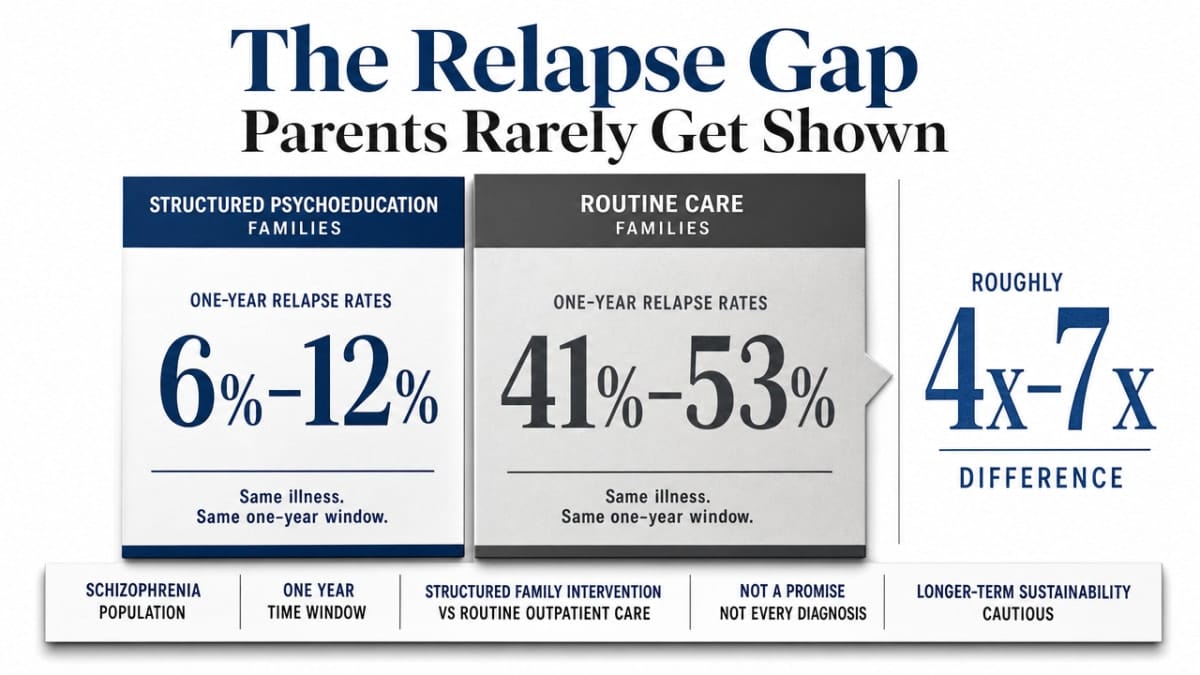
- Structured psychoeducation cut one-year relapse rates to 6-12%, compared with 41-53% under routine care, in a long-running schizophrenia intervention program 1.
- Caregiver exhaustion is documented, not personal failure — nearly one in three family caregivers meets criteria for significant burden, and resilience is teachable through the same family programs that lower relapse 3, 4.
- On the admissions call, ask which of the three engagement tiers a program actually delivers, who runs sessions, and what involvement looks like for your child’s specific diagnoses and history.
You Are Not Locked Out — Even When It Feels That Way
You’ve been told, more than once, that your child is an adult now. Maybe a nurse said it kindly. Maybe a discharge planner said it flatly, on a Tuesday afternoon, while handing you a folder you didn’t help build. Either way, the message landed the same: step back. Wait in the hallway. Sign here.
And so you have been waiting. Sometimes for a phone call that doesn’t come. Sometimes for a relapse you can already feel arriving. You are exhausted in a way that people who haven’t lived this don’t quite believe.
Here is what you may not have been told plainly: your involvement is not a courtesy the treatment team extends to you. When it’s done right, it is part of the treatment. Major reviews of care for serious mental illness describe family engagement as a spectrum — from basic information sharing, to structured psychoeducation, to formal family therapy — and treat it as a core function of good clinical care, not a nicety 6. The SAMHSA advisory on family therapy in substance use disorder treatment says something similar: family involvement improves outcomes for many patients, and providers should let the patient define who counts as family 9.
That doesn’t erase HIPAA. It doesn’t override your adult child’s right to consent, or refuse. But it does mean the wall you keep bumping into is often lower than it looks — and that a program built for treatment-resistant and dual-diagnosis cases should have a door in that wall, with a process behind it.
You are not locked out. You may have simply been standing at the wrong door, on the wrong floor, in a building that never told you where the family entrance was. The rest of this piece is a map to that entrance — and a way to think about what you’re actually walking into once you’re through it.
The False Choice Between Detaching and Doing Everything
If you have searched for help at 2 a.m., you already know the two loudest pieces of advice on the internet. One says detach. Set the boundary. Let your child hit bottom. The other says the opposite — show up harder, drive faster, call more, pay more, do more. Both are offered with total confidence. Neither is what the evidence actually recommends.
You have probably tried both. Most parents in your position have. You went cold for a week and it felt like abandoning someone in a burning building. You went all-in for a month and lost eight pounds, missed work, and still ended up in the same ER waiting room. Neither approach worked because neither was designed as treatment. They were designed as coping strategies for you.
There is a third option, and it is not a compromise. It has a name in the clinical literature: structured family engagement. It sits on a spectrum — from basic information sharing, to psychoeducation, to formal family therapy — and it is treated as a core function of good care for serious mental illness, not an extra 6. In substance use disorder treatment, including the dual-diagnosis cases where your child likely lives, the SAMHSA advisory frames family involvement the same way: as something that improves outcomes for many patients when it is done deliberately, with the patient defining who counts as family 9.
The difference matters. Detaching asks you to leave. Doing everything asks you to disappear into the role. Structured involvement asks you to stay a parent — informed, coached, and useful in specific ways at specific moments — without becoming the case manager, the pharmacist, and the crisis line all at once.
That third path is not something you build alone at your kitchen table. It is something a treatment program builds with you, and the quality of that build varies wildly from one facility to the next. The question is not whether you should help. The question is what kind of help the program you are calling is actually equipped to teach you.
What Actually Moves the Needle: Structured Family Involvement
The Relapse Gap Parents Rarely Get Shown
Here is a number nobody hands you in the discharge folder. In a ten-year psychoeducational family intervention program for schizophrenia, one-year relapse rates ran between 6% and 12% for families who received structured psychoeducation — compared with 41% to 53% for families getting routine care 1. Same illness. Same one-year window. Roughly a fourfold to sevenfold difference.
Read that again if you need to. Most parents never see it stated that plainly.
A few honest caveats before you carry this number anywhere. It comes from a schizophrenia population, measured at one year, comparing a structured family intervention against usual outpatient care. It is not a promise about your child. It does not cover every diagnosis, and the authors themselves are careful about longer-term sustainability. But the direction is not subtle, and it is not an outlier. A broader systematic review of family and patient psychoeducation in severe mental disorders reaches the same conclusion — reduced relapse, reduced rehospitalization, and lower burden and distress in relatives 7. A more recent randomized trial of a brief multi-family psychoeducation program found the same pattern: significantly reduced relapse risk at 12 months, plus lower caregiver burden and depression 10.
What this means for you as a parent is not that you have been failing. It means that the version of “help” you have been offered — sit in the waiting room, get a discharge summary, hope it holds — is measurably weaker than the version that includes you as a trained participant. When treatment teams talk about family involvement as clinical, this is what they mean. Not sentiment. Not moral support. A different curve on the relapse graph.
The next question is the one that actually determines what you get: what kind of family involvement is a program equipped to deliver? That varies enormously, and the language on a facility’s website will not tell you.
Three Levels of Involvement — And Which One a Program Actually Offers
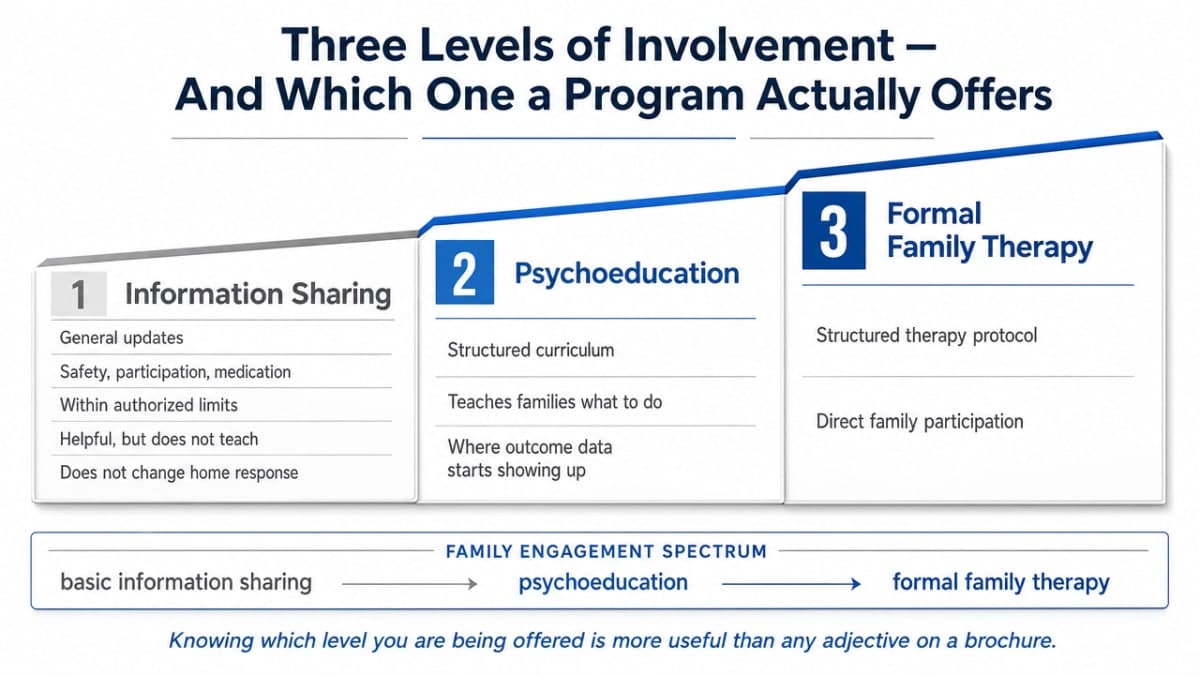
When a program says it is “family-friendly,” that phrase can mean almost anything — from a weekly voicemail update to a fully structured family therapy protocol. The clinical literature is more precise. Family engagement in mental health care sits on a spectrum: from basic information sharing, to psychoeducation, to formal family therapy 6. Knowing which level you are being offered is more useful than any adjective on a brochure.
- Information sharing
- The floor. A clinician gives you general updates — that your child is safe, participating, taking medication — usually within the limits your adult child has authorized. Helpful, but it does not teach you anything. It does not change what happens when your child comes home.
- Psychoeducation
- Where the outcome data starts showing up. This is a structured curriculum for you: what the illness is, how the medications work and why they sometimes stop working, what early warning signs of relapse look like in your specific child, how to communicate during a symptomatic episode without escalating it, how to set expectations that are neither too high nor too low. It is teaching, not therapy. Even short, structured programs — six sessions in one trial — have moved relapse and caregiver burden in the right direction 10. A recent meta-analysis of face-to-face psychoeducation for parents specifically found large short-term improvements in psychosocial wellbeing and parental anxiety 11.
- Family therapy
- The most intensive tier. Here a clinician works with you and your adult child together on the specific patterns between you — the arguments that keep looping, the boundary that keeps eroding, the trauma nobody has said out loud. This is what SAMHSA describes when it recommends family therapy in substance use disorder treatment, including dual-diagnosis cases 9.
When you call an admissions line, do not ask if the program “involves families.” Ask which of these three the program actually provides, how often, and who runs it. If the answer is only the first tier, you now know what you are getting — and what you are not.
The Exhaustion Is Data, Not Weakness
You have probably stopped telling people how tired you are. It stopped being useful somewhere around the third hospitalization. Friends nod, then change the subject. Your spouse, if you still have one, is tired in a different way. You have learned to say “we’re doing okay” and mean something like “I slept four hours and I’ve already refilled a prescription this morning.”
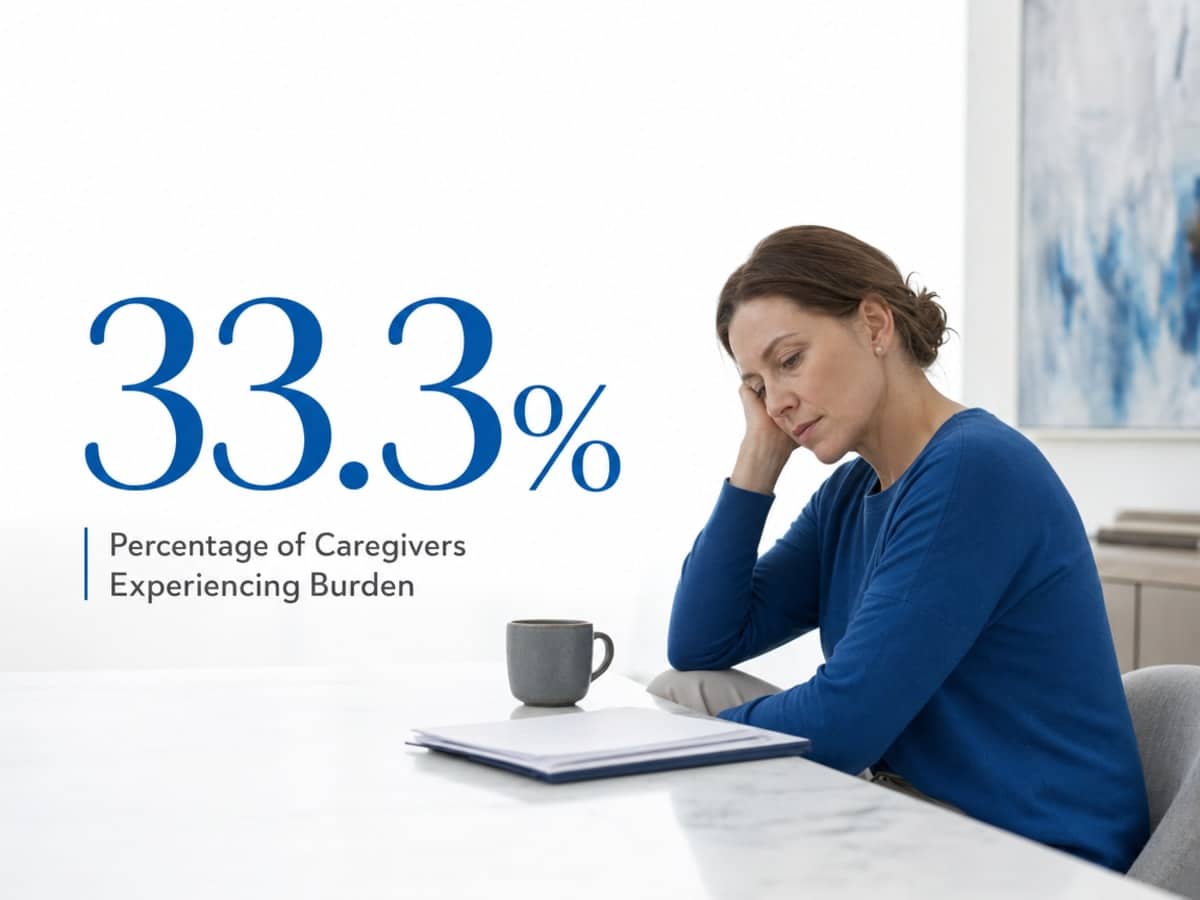
What you are carrying has a clinical name. A 2022 study of family caregivers of people with mental illness found that nearly one in three meets criteria for significant caregiver burden 3. Roughly 33%. Not the small fraction you might assume when you look around and think everyone else is handling it better than you are.
That number matters because it tells you something about yourself that you probably will not accept from a friend: you are not weak. You are inside a documented pattern. Researchers describe the load in two dimensions — objective burden, meaning the disruption to your job, your sleep, your money, your other relationships, and subjective burden, meaning the grief, the guilt, the shame, the anger you keep swallowing 2. Both are real. Both accumulate. Neither responds well to the advice to just take care of yourself more.
What does respond, according to a 2024 study of caregivers of people with severe mental illness, is resilience — and resilience is teachable, not a personality trait you were either born with or missed 4. Caregivers who scored higher on resilience carried lower burden, and the authors specifically recommended psychoeducational programs directed at families as a way to build it. This is the same category of program that lowers your child’s relapse risk. The design of it happens to also lower yours.
If nobody has told you that yet, someone should have. You are allowed to need support of your own, and asking for it is not stepping away from your child. It is one of the ways you stay useful to them.
What to Ask For — And What to Bring — On the Admissions Call
The admissions call is the first place the program’s actual family model shows itself. Not the website, not the brochure, not the intake packet. The call. Ten minutes in, you will know whether this is a facility that has thought about you, or one that will tolerate you.
Before you dial, put five things in front of you:
- the medication list you keep in your phone,
- the rough timeline of hospitalizations and diagnoses over the last two years,
- the names of the outpatient providers your child has already seen,
- a note about substance use if it’s part of the picture,
- and a short list of what has actually helped in past treatment episodes and what has not.
This is the information a good clinician will ask for anyway. Having it ready shortens the call and tells the admissions team you are a working partner, not a panicked bystander.
Now the questions. Ask which of the three tiers of family engagement the program offers — information sharing, structured psychoeducation, or formal family therapy — and how often each happens 6. Ask who runs the family sessions and what their clinical training is. Ask what a family weekend actually includes, hour by hour, and whether it is once during the stay or recurring. Ask what the release-of-information process looks like so you can be part of treatment planning if your adult child consents. Ask how the team communicates with you between visits, and who your point of contact will be.
Then ask the questions the recent qualitative research says caregivers want answered but rarely get:
- Will I be given accessible information about the illness itself?
- Will I be actively and respectfully included in treatment planning?
- Will I learn practical caregiving skills for the specific things I face at home?
- Are there support groups for parents connected to the program 5?
Finally, ask the question most parents forget. Ask what involvement looks like for your specific situation — a treatment-resistant case, a dual diagnosis, a third or fourth admission, a child who has refused family contact before and may again. This is the exact question ViewPoint Dual Recovery’s admissions team is set up to answer, because the family education and family weekend programming there are built around complex psychiatric and co-occurring cases rather than a one-size template. You are not asking for a favor. You are asking a program to describe its clinical model to the person who will be living with the outcome.
When Family Involvement Is Not the Right Move
Everything above assumes involvement is safe. Sometimes it isn’t, and any honest article for parents has to say so.
The SAMHSA advisory on family therapy in substance use disorder treatment is careful about this. It recommends family involvement broadly, and then names the situations where a clinician should slow down or step around it: active violence, ongoing abuse, trauma dynamics that a family session would replay rather than repair, and complex legal circumstances that change what can be said in the room 9. The same advisory adds a quieter but important point — the patient gets to define who counts as family. Sometimes that answer will not include you, at least not right now.
If your adult child has told a treatment team they do not want you involved, that is not the end of the story, but it is the start of a different one. A good program will not force contact. It will, over time, revisit the question as your child stabilizes, and it will offer you your own support in the meantime — psychoeducation you can attend without your child present, a parent group, guidance on how to be reachable without being intrusive.
There is also the harder case. If being in a room with your child is not safe for you, or if your presence is not safe for them, involvement means something different — coordinated from a distance, with a clinician deciding what is shared and when. That is still involvement. It is not failure. It is the version of care your specific situation actually calls for.
What a Family Weekend and Family Education Actually Look Like
By this point, the phrase “family programming” should mean something more specific to you than it did an hour ago. Here is what it looks like on the ground, at a program built for treatment-resistant and dual-diagnosis cases like ViewPoint Dual Recovery in Prescott, Arizona.
Family education is the curriculum piece. It is not a pamphlet and it is not a hallway update. It is structured teaching, delivered by clinicians who work with your child’s actual case — the psychiatrist managing a complicated medication regimen, the therapist running individual sessions, the team that sees the behavior you only hear about by phone. The content covers what the diagnosis actually is and is not, how the medications work (including advanced strategies like clozapine protocols when they apply), what early warning signs of relapse look like in your specific child, and how to communicate during a symptomatic episode without pouring gasoline on it. Even brief, structured versions of this kind of teaching have moved relapse risk and caregiver burden in randomized trials 10.
Family weekend is the in-person piece — usually a two-day block where you are at our Prescott location, in rooms with clinicians, and in rooms with your adult child. A typical weekend blends three things:
- psychoeducation sessions where you learn alongside other parents in the same situation,
- joint sessions where a therapist works with you and your child together on the patterns you both keep hitting,
- and time for the harder conversations that never fit into a fifteen-minute phone call.
For dual-diagnosis cases, some of that time addresses the substance use side directly — how enabling patterns form without anyone meaning to, what a realistic home environment looks like after discharge, and what to do the first time something goes sideways. SAMHSA’s guidance on family therapy in substance use treatment describes this kind of structured involvement as a core part of care, not a supplement 9.
What you should notice about that description is what is missing. There is no lecture hall. There is no generic slideshow about “mental illness.” The work is built around your child’s case, which means your questions get answered in the room where the clinicians actually know the answer.
If you want to know what a family weekend and family education look like for your specific situation — the diagnoses, the prior admissions, the substance use picture, whether your child is currently willing to have you in the room — that is the conversation ViewPoint’s admissions team is set up to have. Ask them to walk you through it call by call, session by session, before you decide anything.
A First Concrete Step This Week
You do not need a plan for the next year. You need one phone call this week.
Before you make it, spend twenty minutes putting the five things from earlier into one place: the current medication list, the two-year timeline of hospitalizations and diagnoses, the names of prior outpatient providers, a short note on substance use if it applies, and one sentence on what has helped before and what has not. Put it in a document you can email to yourself. That single file is the difference between an admissions call that circles and one that moves.
Then pick up the phone. When you call ViewPoint Dual Recovery’s admissions team in Prescott, ask the question you now have language for: what does family involvement look like for your specific situation — the diagnoses, the prior admissions, whether substance use is in the picture, whether your adult child is currently willing to have you in the room. Ask them to walk you through the family education curriculum and the family weekend, session by session.
You are not committing to anything on that call. You are gathering the information a parent is entitled to have before deciding what comes next. That is the step this week.
Find out which next steps are available now
Get expert guidance tailored to your adult child’s unique mental health challenges.
Frequently Asked Questions
My adult child is over 18. Does HIPAA mean I can’t be involved in their treatment at all?
No. HIPAA limits what a treatment team can share with you without your adult child’s consent, but it does not stop your child from signing a release of information that names you. Most programs have that form on hand. Even without a signed release, clinicians can generally listen to information you provide and involve you in psychoeducation that does not disclose your child’s specific chart. The wall is real, but there is almost always a door.
What’s the difference between family therapy, family psychoeducation, and just getting updates from staff?
They sit on a spectrum 6. Staff updates are information sharing — you learn your child is safe and participating. Psychoeducation is a structured curriculum that teaches you the illness, the medications, relapse warning signs, and communication skills. Family therapy is a clinician working with you and your child together on the specific patterns between you. Each level requires different training and time. Ask which one a program actually delivers before assuming “family-friendly” means the top tier.
Does family involvement actually change outcomes, or is it more for the parents’ peace of mind?
It changes outcomes. A systematic review of family and patient psychoeducation in severe mental disorders found significant reductions in relapse and rehospitalization, plus lower caregiver burden and distress 7. A more recent randomized trial of a brief multi-family psychoeducation program found the same pattern — reduced 12-month relapse risk and lower caregiver burden and depression 10. This is not sentiment. It is a different curve on the relapse graph, measurable in clinical trials.
What should I ask when I call a treatment program’s admissions line?
Ask which tier of family engagement they offer — information sharing, structured psychoeducation, or formal family therapy — and how often each happens 6. Ask who runs family sessions and what their clinical training is. Ask what a family weekend actually includes, hour by hour. Ask how the team will communicate with you between visits and who your point of contact will be. Ask what involvement looks like for your child’s specific case.
Is there ever a time when family involvement is not the right move?
Yes. The SAMHSA advisory on family therapy in substance use disorder treatment names the situations clearly: active violence, ongoing abuse, trauma dynamics a family session would replay rather than repair, and complex legal circumstances 9. It also notes the patient defines who counts as family. If your adult child has asked not to have you involved right now, a good program will not force it — but should still offer you your own psychoeducation and support.
My child has a dual diagnosis — mental illness and substance use. Does family involvement still apply?
Yes, and arguably more. SAMHSA’s advisory on family therapy in substance use disorder treatment describes family involvement as a core part of care in these cases, including when co-occurring mental illness is present 9. Dual-diagnosis work touches things families live with directly — enabling patterns, home environment after discharge, what to do the first time something goes sideways. A program built for treatment-resistant and dual-diagnosis cases should have specific family programming that addresses both sides.
References
- Psychoeducational family intervention for schizophrenia: a ten‑year experience. https://pmc.ncbi.nlm.nih.gov/articles/PMC1414722/
- Caring for the family caregivers of persons with mental illness. https://pmc.ncbi.nlm.nih.gov/articles/PMC4181176/
- Caregiver Burden among Caregivers of Patients with Mental Illness. https://pmc.ncbi.nlm.nih.gov/articles/PMC9777672/
- Resilience and burden in family caregivers of patients with severe mental illness. https://pmc.ncbi.nlm.nih.gov/articles/PMC11861625/
- Experiences, needs and priorities of family caregivers of people with psychosis: A qualitative evidence synthesis. https://pmc.ncbi.nlm.nih.gov/articles/PMC13244235/
- Family engagement as part of managing patients with mental illness in primary care. https://pmc.ncbi.nlm.nih.gov/articles/PMC8801858/
- Family and Patient Psychoeducation for Severe Mental Disorder in Adults. https://pmc.ncbi.nlm.nih.gov/articles/PMC6505048/
- Living with severe mental illness—what families and friends must know: evaluation of a one‑day psychoeducation workshop. https://pubmed.ncbi.nlm.nih.gov/16512508/
- The Importance of Family Therapy in Substance Use Disorder Treatment (Advisory 39). https://library.samhsa.gov/sites/default/files/pep20-02-02-016.pdf
- Family psychoeducation to improve outcome in caregivers and patients with schizophrenia. https://pmc.ncbi.nlm.nih.gov/articles/PMC10326382/
- Face‑to‑face psychoeducation for the parents of people with severe mental illness. https://pubmed.ncbi.nlm.nih.gov/41636687/
- Family Therapy Can Help People Recover From Mental Illness or Addiction. https://library.samhsa.gov/product/family-therapy-can-help-people-recovery-mental-illness-or-addiction/sma15-4784