Key Takeaways
- Federal parity law and Illinois oversight require most commercial, employer-sponsored, and marketplace plans to cover residential dual diagnosis treatment as an inpatient benefit, including out-of-state 1, 10.
- Coverage reality depends on your plan type: employer-sponsored plans offer the strongest out-of-state footing, marketplace plans hinge on whether out-of-network benefits exist, and Illinois Medicaid managed care rarely pays for out-of-state residential care 20.
- Non-quantitative treatment limits like prior authorization, medical necessity criteria, and reimbursement methodology quietly shape access, and the 2024 Final Rule now requires plans to document that behavioral health standards are not more restrictive 5.
- Before committing to any admission, run a real verification call that asks about the inpatient out-of-network classification, deductible, coinsurance, prior authorization, and out-of-network out-of-pocket maximum 15.
What Illinois families actually get wrong about out-of-state dual diagnosis coverage
You have probably been told some version of this: your plan covers in-state care, and anything else is a luxury you pay for yourself. If a local program has already tried and stalled, that answer feels like a door closing. It is not the whole story.
Federal parity law requires most Illinois commercial, employer-sponsored, and marketplace plans to cover mental health and substance use disorder care on terms comparable to medical or surgical care, including how they handle geographic limits, facility-type rules, and network standards 1. That protection extends to residential dual diagnosis programs, which federal regulators treat as an inpatient benefit when a plan classifies rehab hospitals or skilled nursing facilities as inpatient 8. Out-of-state does not automatically mean out-of-pocket.
What trips families up is the gap between what a plan covers on paper and what it actually approves in practice. Illinois regulators have flagged this gap directly, pointing to non-quantitative treatment limits and network design as recurring compliance concerns 16. That is why a plan summary alone will not tell you what you need to know.
The way through is not hope, and it is not a phone call to member services that ends in “it depends.” It is a real benefits verification, done by someone who knows which questions actually surface how your plan behaves.
The parity law your plan does not want you to quote back to them
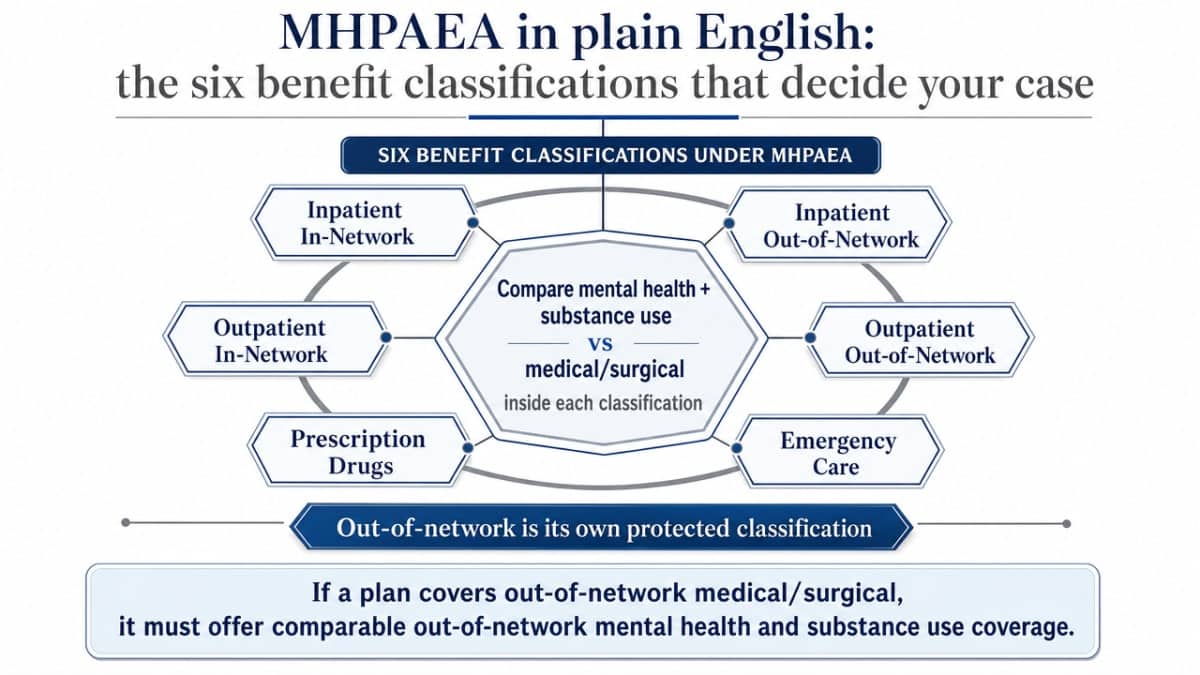
MHPAEA in plain English: the six benefit classifications that decide your case
Here is the piece of the parity law that changes conversations with insurers. Federal regulators sort every health benefit into six buckets, and your plan has to compare mental health and substance use coverage to medical/surgical coverage inside each one separately. The six classifications are:
- inpatient in-network
- inpatient out-of-network
- outpatient in-network
- outpatient out-of-network
- prescription drugs
- emergency care 2
Why does that matter for a family looking at Arizona from Illinois? Because “out-of-network” is its own protected classification. If your plan offers any out-of-network medical/surgical benefits, it has to offer out-of-network mental health and substance use benefits on comparable terms. A plan cannot quietly zero out behavioral health at the network edge while paying for medical care there.
Residential dual diagnosis care lands squarely inside the inpatient classification, which we will unpack in the next section. For now, the practical move is simple. When you or a verification specialist calls your insurer, do not ask a vague question like “is this covered?” Ask what your plan pays under the inpatient out-of-network classification for mental health and substance use disorder services, and what the corresponding medical/surgical numbers look like.
That framing forces the conversation into the same six-bucket structure regulators use. It also flags any answer that treats behavioral health as a separate, lesser category, which is exactly the kind of drift the classification rule was written to prevent 2.
Why residential dual diagnosis care counts as an inpatient benefit
The reasoning is grounded in how plans already handle medical care. The Department of Labor has been direct: if your plan classifies care in skilled nursing facilities or rehabilitation hospitals as inpatient, it must likewise treat covered residential mental health and substance use care as inpatient 8. Facility-type exclusions themselves are non-quantitative treatment limits and have to satisfy parity 8.
What this does for you, as the person on the phone trying to make sense of a plan document: it takes the argument off the table. If a representative tells you residential dual diagnosis treatment is “not a covered level of care” while the same plan pays for medical rehabilitation stays, that answer does not match federal guidance. The claim belongs in the inpatient bucket you already have benefits for.
You may still owe a deductible. You may still face prior authorization. But the framing that residential is somehow outside your plan’s coverage architecture is the framing to push back on, with the DOL guidance in hand.
The NQTL problem: where coverage narrows quietly
Financial rules are the easy part of parity. If your plan requires a 20% coinsurance for inpatient medical care, it cannot demand 40% for inpatient mental health care. Those numbers are visible, comparable, and hard to hide.
The harder part is everything that shapes access without a dollar sign attached. Regulators call these non-quantitative treatment limitations, or NQTLs. They include:
- prior authorization criteria
- medical necessity review
- how a plan admits providers into its network
- the reimbursement methodology it uses to pay them 11
NQTLs also cover facility-type rules, geographic limits, and the standards a plan applies when deciding whether to approve a level of care 2.
Here is why this matters for your case. A plan can technically “cover” out-of-network residential dual diagnosis treatment and still make it functionally unreachable by requiring more aggressive concurrent review, applying tighter medical necessity standards than it uses for comparable medical care, or reimbursing at rates so low that no residential provider will accept the plan. Peer-reviewed evaluation of parity has documented exactly this pattern, where nominal coverage exists but NQTLs like preauthorization and medical necessity review continue to shape who actually gets treated 13.
The 2024 MHPAEA Final Rule tightened this. Plans now have to conduct comparative analyses of their NQTLs and document that behavioral health standards are not more restrictive in operation than medical/surgical standards 5. That does not mean every plan complies. It means when a denial arrives, the reasoning behind the NQTL is fair game to question, and Illinois regulators have been paying attention to exactly these patterns 16.
Three Illinois coverage worlds, three different answers
Commercial and employer-sponsored plans: the strongest path out of state
If your coverage comes through an employer or you bought a commercial plan directly, you are standing on the widest legal footing for an out-of-state admission. Federal parity applies. Illinois parity applies on top of it. And the classification math from the last section works in your favor: your plan almost certainly offers some out-of-network medical/surgical benefits, which means it has to offer comparable out-of-network mental health and substance use benefits 1.
The practical question is not whether coverage exists. It is what your specific plan pays after deductible, what percentage of allowed charges it reimburses out-of-network, and how it defines medical necessity for residential care. Two employees at the same Illinois company can have very different exposure depending on which plan option they picked at open enrollment.
Self-funded employer plans, which cover a large share of Illinois workers, are regulated federally rather than by the Illinois Department of Insurance. They still must follow MHPAEA, and the 2024 Final Rule now requires them to document comparative NQTL analyses showing behavioral health standards are not more restrictive in operation than medical/surgical standards 5. Fully insured commercial plans answer to both federal parity and Illinois state oversight, and IDOI has been actively citing insurers on parity issues 19.
The short version: this is the group most likely to get meaningful out-of-state coverage, and also the group most likely to be told “we don’t cover that” by a first-line representative who has not read the plan carefully.
ACA marketplace plans: parity applies, networks are tighter
If you bought your plan through Get Covered Illinois or healthcare.gov, mental health and substance use disorder services are essential health benefits, and parity requirements apply to how those services are structured 1. The 2024 Final Rule reaches these plans too, tightening how NQTLs like prior authorization and medical necessity review are documented 5.
The honest catch: marketplace plans are usually built around narrower networks and higher out-of-network exposure than employer coverage. Some silver and bronze plans offer no out-of-network benefits at all outside of emergencies. That is a plan design choice, not a parity violation, as long as the same rule applies to medical/surgical care.
What that means for you: read the plan brochure for the out-of-network column before you read the mental health column. If there is no out-of-network coverage for either, out-of-state residential care will not be paid by the plan. If there is out-of-network coverage on the medical side, the mental health side has to be comparable, and that is where verification earns its keep.
Illinois Medicaid managed care: the honest limits of out-of-state care
This is the section that most Illinois families do not want to read, and we owe you a straight answer. If your coverage is Illinois Medicaid, delivered through a managed care organization contracted with HFS, out-of-state residential care is rarely paid for except in narrow, pre-approved circumstances.
That is not a parity violation. Federal parity rules for Medicaid and CHIP do not distinguish between in-network and out-of-network classifications the way commercial rules do, and plans that do not offer out-of-network benefits at all are not required to file out-of-network NQTL templates 20. Illinois Medicaid managed care contracts require MH/SUD benefits to be provided in the same classifications as medical/surgical benefits, without more restrictive financial requirements or treatment limitations 22. The parity obligation is real. The network is still in Illinois.
HFS reviews of out-of-network claim handling for MH/SUD versus medical/surgical services confirm that the operative question inside Medicaid is how in-state and contracted-provider claims are processed, not how a Prescott admission would be reimbursed 18.
If Medicaid is your only coverage, the productive next step is not a flight. It is a verification call that maps what your specific managed care organization does cover for intensive dual diagnosis treatment, and whether any pathway exists for a clinically justified out-of-state placement.
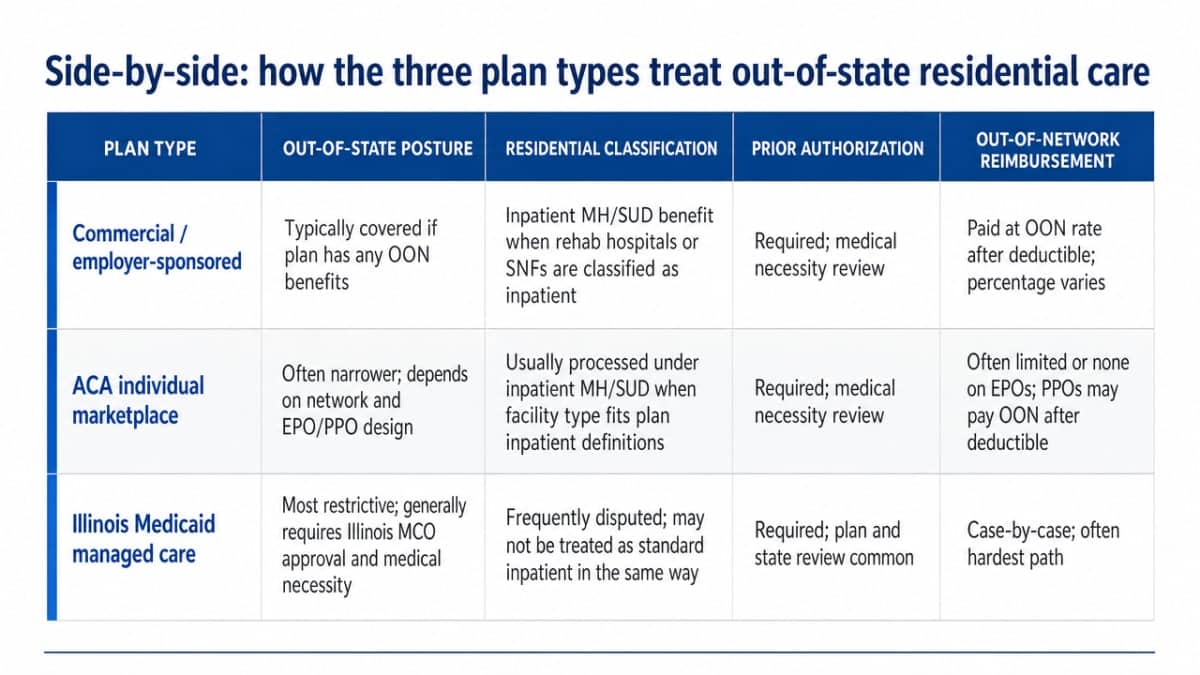
Side-by-side: how the three plan types treat out-of-state residential care
Before you make any call, it helps to see the three coverage worlds next to each other. The comparison below draws on Illinois DOI enforcement reporting and HFS parity analysis of how each plan type actually behaves on residential MH/SUD claims, not just what the plan document says on page one 18.
| Plan type | Out-of-state posture | Residential classification | Prior authorization | Out-of-network reimbursement ||—|—|—|—|—|| Commercial / employer-sponsored | Typically covered if plan has any OON benefits; strongest legal footing under MHPAEA and IL parity 19| Inpatient MH/SUD benefit when plan classifies rehab hospitals or SNFs as inpatient 8| Required; medical necessity review scrutinized under 2024 Final Rule NQTL analyses 5| Paid at OON rate after deductible; percentage varies by plan || ACA marketplace | Depends entirely on whether the specific metal-tier plan offers OON benefits; many do not | Same inpatient classification rule applies where OON benefits exist 8| Required; parity applies to medical necessity criteria 1| Often limited or absent; check plan brochure first || Illinois Medicaid managed care | Rarely paid; parity does not require OON classifications for plans without OON benefits 20| Provided in same classifications as medical/surgical within the contracted network 22| Required within network; out-of-state typically needs prior state approval | Generally not applicable to out-of-state residential |
Use this table to find your row, then take that row into the verification conversation. That is the only way the abstract rules turn into a real number for your family.
What Illinois enforcement records reveal about how plans really behave
Reading Illinois Department of Insurance and HFS reports in order tells a quieter story than any single denial letter can. It is the story of regulators catching up to how plans actually operate, year by year, and finding the same patterns keep surfacing.
Go back to 2020, and the joint IDOI and HFS report was already flagging that Medicaid managed care contracts had to prohibit aggregate lifetime and annual dollar limits on MH/SUD services and could not apply financial requirements or treatment limitations more restrictively than for medical/surgical care in the same classification 22. The rules were on paper. The compliance work was just getting started.
The 2023–2024 HFS parity analysis went deeper into how out-of-network MH/SUD claims are actually processed relative to medical/surgical claims, and it found the operational questions live inside prior authorization, utilization review, and reimbursement mechanics 18. Then September 9, 2024 brought new federal parity rules, and the Illinois working group report tracked how the state would fold those into its oversight 17. The 2025 IDOI compliance report documented specific enforcement actions against commercial insurers, and the 2026 report continued to identify network adequacy and more restrictive treatment limits as recurring problem areas for behavioral health 21.
What that arc means for you: plans are not always following the rules on the first pass. That is exactly why a real verification, not a plan summary, is what protects your family.
What a real insurance verification call sounds like
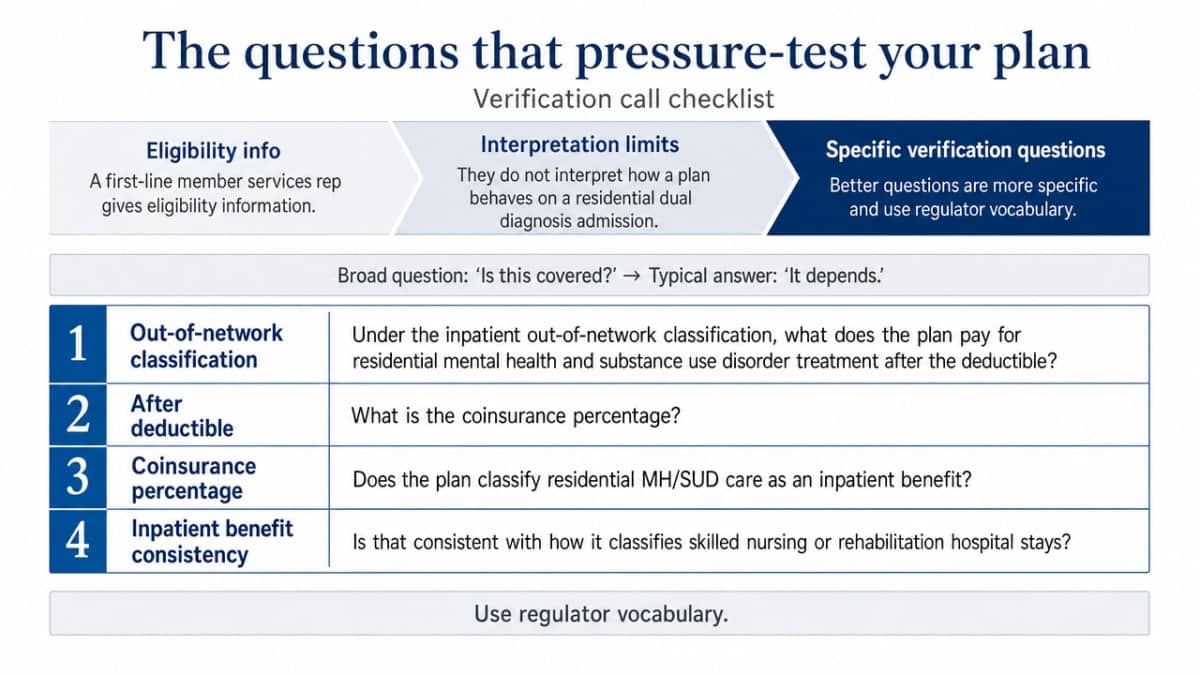
The questions that pressure-test your plan
A first-line member services rep is trained to give you eligibility information, not to interpret how your plan behaves on a residential dual diagnosis admission. That is why “is this covered?” almost always comes back as “it depends.” The questions that actually surface what your plan will pay are more specific, and they borrow the vocabulary regulators use.
Here is what a serious verification call sounds like, whether you make it yourself or hand it to a verification specialist:
- Under the inpatient out-of-network classification, what does the plan pay for residential mental health and substance use disorder treatment after the deductible, and what is the coinsurance percentage?
- Does the plan classify residential MH/SUD care as an inpatient benefit, consistent with how it classifies skilled nursing or rehabilitation hospital stays 8?
- What are the specific medical necessity criteria for residential dual diagnosis care, and what utilization review or concurrent review schedule applies?
- What is the prior authorization process, what clinical documentation is required, and what is the average turnaround time?
- How does the plan calculate out-of-network reimbursement — usual and customary, Medicare-based, or another methodology — and what is the allowed amount for the relevant residential codes 9?
- What is the out-of-network out-of-pocket maximum for this plan year?
Write down the representative’s name, the reference number for the call, and the date. If an answer conflicts with federal guidance treating residential MH/SUD as an inpatient benefit, ask them to escalate to a behavioral health reviewer and document that request.
How ViewPoint’s verification team works a benefits check
You do not have to make those calls alone. ViewPoint’s verification team runs this process before you commit to anything — before a deposit, before travel plans, before anyone commits.
Here is what the workflow looks like on your end. You share the front and back of the insurance card, the policyholder’s date of birth, and a short description of what has been tried so far. ViewPoint’s team takes it from there. They contact the insurer directly, ask the classification and NQTL questions in the language plans respond to, and pull benefits under the inpatient out-of-network category where residential MH/SUD care belongs 10.
What you receive back is a written benefit summary in plain language. It spells out the deductible status, the coinsurance percentage, the out-of-network out-of-pocket maximum, the prior authorization requirements, and any medical necessity criteria the plan has flagged. If the plan’s initial response conflicts with parity guidance — for example, treating residential care as excluded when the plan pays for medical rehabilitation stays — the team documents that and can raise it directly with the insurer, referencing the 2024 Final Rule expectations for NQTL analyses 5.
Nothing is committed on your side until you have that summary, read it, and decide the numbers make sense for your family. That is the point of the verification: the guesswork ends before the decision begins.
The financial exposure categories you should understand before you commit
Even when parity works in your favor and your plan agrees to pay for residential dual diagnosis care out of state, you still owe something. Federal guidance names the categories plainly: deductibles, copayments, coinsurance, and out-of-pocket maximums are the financial requirements every plan has to disclose, and parity applies to how each one is set for mental health and substance use care compared to medical care 15.
Here is how those categories usually show up on an out-of-network, out-of-state admission. Your deductible is what you pay before the plan starts sharing costs. If you have already met part of it this year through other care, that credit carries over. Coinsurance is the percentage you owe after the deductible; on out-of-network claims it is typically higher than in-network, and it is calculated against the plan’s allowed amount, not the provider’s billed charge. That distinction matters, because the gap between billed and allowed can land on you unless the provider works out a single-case agreement or you have a plan that pays a percentage of billed charges.
The out-of-network out-of-pocket maximum is the number that protects you. Once you hit it, the plan pays 100% of allowed charges for the rest of the plan year. Ask for that figure specifically. It is the ceiling that turns an open-ended worry into a defined decision.
If a denial comes back: appeals, parity complaints, and the Illinois Department of Insurance
A denial is not the end of the conversation. It is the start of a different one, and you have more standing than the letter suggests.
Start with the plan’s internal appeal. Request the specific medical necessity criteria used to deny the claim in writing, along with the reviewer’s credentials. If the denial rests on treating residential dual diagnosis care as excluded or as a lesser level of care, cite the federal position that residential MH/SUD is an inpatient benefit under the six-classification structure 10. Ask for the plan’s comparative NQTL analysis for the standard that produced the denial — plans are now required to have one on file 5.
If the internal appeal fails, Illinois gives you a second door. For fully insured commercial and marketplace plans, file a parity complaint with the Illinois Department of Insurance. IDOI has been actively citing insurers for more restrictive treatment limits and inadequate behavioral health networks 21. Self-funded employer plans go to the U.S. Department of Labor instead.
Keep every call log, denial letter, and clinical record together in one folder. That paper trail is what turns a frustrating letter into a case a regulator can actually work.
Clarify Your Dual Diagnosis Coverage Path Today
Receive clear answers on insurance coverage and personalized next steps for your complex treatment needs.
Frequently Asked Questions
Will my Illinois insurance pay for out-of-state residential dual diagnosis treatment?
Often yes, if you have commercial, employer-sponsored, or marketplace coverage with out-of-network benefits. Federal parity law requires those plans to treat mental health and substance use disorder services comparably to medical care across geographic and network classifications 1. What you actually pay depends on your specific plan’s deductible, coinsurance, and reimbursement methodology, which a real verification call can pin down.
Is residential dual diagnosis treatment considered inpatient care under my plan?
Yes. Federal regulators have stated that residential mental health and substance use disorder treatment is a category of inpatient benefit under the six-classification structure 10. If your plan classifies skilled nursing or rehabilitation hospital stays as inpatient, it must treat covered residential care the same way 8. If a representative tells you otherwise, request escalation to a behavioral health reviewer.
Does Illinois Medicaid managed care cover out-of-state dual diagnosis programs?
Rarely, and only in narrow pre-approved circumstances. Illinois Medicaid managed care must provide MH/SUD benefits in the same classifications as medical/surgical care within its contracted network 22, but plans without out-of-network benefits are not required to file out-of-network parity templates 20. If Medicaid is your only coverage, a verification call can map what your specific managed care organization does allow.
What questions should I ask my insurer to verify dual diagnosis benefits?
Ask what the plan pays under the inpatient out-of-network classification for residential MH/SUD care after deductible, whether residential is classified as inpatient consistent with rehabilitation hospital stays 8, the specific medical necessity criteria, prior authorization steps, the out-of-network reimbursement methodology 9, and the out-of-network out-of-pocket maximum. Write down the representative’s name, reference number, and date of every call.
What can I do if my Illinois plan denies coverage for dual diagnosis treatment?
Start with the internal appeal and request the medical necessity criteria and reviewer credentials in writing. Cite the federal position that residential MH/SUD is an inpatient benefit 10and ask for the plan’s comparative NQTL analysis 5. If the appeal fails, fully insured plans go to the Illinois Department of Insurance, which has actively cited insurers on parity issues 21.
How does ViewPoint’s insurance verification process work for Illinois families?
You share your insurance card, the policyholder’s date of birth, and a short care history. ViewPoint’s team contacts your insurer, pulls benefits under the inpatient out-of-network classification where residential care belongs 10, and returns a written summary covering deductible, coinsurance, out-of-pocket maximum, prior authorization, and medical necessity criteria. Nothing is committed on your side until you have read those numbers.
References
- The Mental Health Parity and Addiction Equity Act (MHPAEA) – CMS. https://www.cms.gov/marketplace/private-health-insurance/mental-health-parity-addiction-equity
- Plan or Policy Non-Quantitative Treatment Limitations (NQTLs) that May Be Warning Signs for Non-Compliance with MHPAEA. https://www.cms.gov/cciio/resources/regulations-and-guidance/downloads/mhapeachecklistwarningsigns.pdf
- Affordable Care Act Implementation FAQs – Set 17. https://www.cms.gov/cciio/resources/fact-sheets-and-faqs/aca_implementation_faqs17
- The Mental Health Parity and Addiction Equity Act of 2008 (MHPAEA). https://www.cms.gov/newsroom/fact-sheets/mental-health-parity-and-addiction-equity-act-2008-mhpaea
- Requirements Related to the Mental Health Parity and Addiction Equity Act (Final Rule). https://www.cms.gov/files/document/mhpaea-final-rule-omnibus-clean-9424-final-posting508.pdf
- Statement Regarding Enforcement of Final Rule Requirements Related to the Mental Health Parity and Addiction Equity Act. https://www.cms.gov/files/document/statement-regarding-enforcement-final-rule-requirements-related-mhpaea.pdf
- Departments of Labor, Health and Human Services, Treasury Issue Final Rules Strengthening Access to Mental Health and Substance Use Disorder Benefits. https://www.cms.gov/newsroom/press-releases/departments-labor-health-and-human-services-treasury-issue-final-rules-strengthening-access-mental
- FAQs about Mental Health and Substance Use Disorder Parity Implementation and the Consolidated Appropriations Act, 2021 (Part 39). https://www.dol.gov/agencies/ebsa/about-ebsa/our-activities/resource-center/faqs/aca-part-39-final
- FAQs about Mental Health and Substance Use Disorder Parity Implementation and the Consolidated Appropriations Act, 2021 (Part 39) (PDF). https://www.dol.gov/sites/dolgov/files/ebsa/about-ebsa/our-activities/resource-center/faqs/aca-part-39-final.pdf
- Public Comment on MHPAEA FAQs (Residential Treatment and Eating Disorders). https://www.dol.gov/sites/dolgov/files/EBSA/laws-and-regulations/rules-and-regulations/public-comments/faq-39/00013.pdf
- Parity Compliance Toolkit: Applying Mental Health and Substance Use Disorder Parity Requirements in Medicaid and CHIP. https://www.medicaid.gov/medicaid/benefits/downloads/bhs/parity-toolkit.pdf
- Mental Health Parity and Addiction Equity Act FAQs (Pennsylvania Insurance Department). https://www.pa.gov/agencies/insurance/laws-regulations-notices/mental-health-parity/mental-health-parity-faqs
- The Mental Health Parity and Addiction Equity Act Evaluation Study. https://pmc.ncbi.nlm.nih.gov/articles/PMC6232447/
- FY 2022 MHPAEA Enforcement Fact Sheet. https://www.cms.gov/files/document/mhpaea-enforcement-2022.pdf
- Illinois IL-18-0002 – Medicaid and CHIP Parity Compliance. https://www.medicaid.gov/CHIP/Downloads/IL-18-0002.pdf
- Annual Report: Compliance Mental Health and Substance Use Disorder Coverage and Parity Laws (2024). https://idoi.illinois.gov/content/dam/soi/en/web/insurance/reports/reports/ANNUAL-REPORT-IDOI-IHFS-2024.pdf
- Working Group Regarding Treatment and Coverage of Substance Use Disorders and Mental Illness – Annual Report (2024). https://idoi.illinois.gov/content/dam/soi/en/web/insurance/reports/reports/mhsud-working-group-2024-annual-report.pdf
- 2023–2024 Mental Health Parity Analysis Summary Report (Illinois HFS). https://hfs.illinois.gov/content/dam/soi/en/web/hfs/sitecollectiondocuments/il20232024mentalhealthparitysummaryreport.pdf
- Compliance Actions Under State and Federal Mental Health and Substance Use Disorder Coverage and Parity Laws (2025). https://idoi.illinois.gov/content/dam/soi/en/web/insurance/reports/reports/compliance-actions-under-state-and-federal-mental-health-and-substance-use-disorder-coverage-and-parity-laws-2025.pdf
- Phase I NQTL Report Template Instructions – Illinois Department of Insurance. https://idoi.illinois.gov/content/dam/soi/en/web/insurance/sites/insurance/companies/documents/phase-i-nqtl-rpt-template-instructions.pdf
- Illinois Department of Insurance – Compliance Actions Under State and Federal Mental Health and Substance Use Disorder Coverage and Parity Laws (2026). https://idoi.illinois.gov/content/dam/soi/en/web/insurance/reports/reports/compliance-actions-under-state-and-federal-mhsud-coverage-and-parity-laws-2026.pdf
- Illinois Department of Insurance & HFS – Annual Report: Compliance Mental Health and Substance Coverage and Parity Laws (2020). https://idoi.illinois.gov/content/dam/soi/en/web/insurance/sites/insurance/reports/reports/idoi-hfs-annual-report-compliance-mental-health-and-substance-coverage-and-parity-laws-08-2020.pdf