Key Takeaways
- Apple Health coverage for planned out-of-state psychiatric placement hinges on WAC 182-501-0182, which lists five circumstances that function as a documentation checklist rather than a persuasion hurdle 1.
- Washington’s Involuntary Treatment Act authority does not cross state lines, and Apple Health will not cover services delivered outside Washington under the ITA, so the admission must convert to voluntary with a clean capacity and consent record 2, 6.
- In-state unavailability is established through a dated, member-specific referral log that names the capability gap — clozapine titration, co-occurring SUD scope, cardiac monitoring — not through workforce-shortage data or general bed shortages 13.
- Before authorizing, verify the receiving facility holds current licensure for the specific level of care in the treating state, and flag expedited review at submission when the member’s life or health is at risk 9, 11.
What a defensible out-of-state authorization file actually looks like
You already know the hard part of these cases isn’t the clinical judgment. It’s translating a treatment-resistant presentation into a file that maps, line by line, to Washington’s out-of-state coverage rules and the plan’s own utilization criteria. When a member’s needs point toward a specialty psychiatric program outside Washington, the packet you assemble has to do three things at once: prove medical necessity, satisfy one of the specific circumstances that permits out-of-state coverage under WAC 182-501-0182, and confirm the receiving facility is the right level of care in the state where treatment will occur 1, 11.
For Apple Health members, planned nonemergency out-of-state care generally requires prior authorization through the appropriate payer representative, and Washington does not cover services delivered under the Involuntary Treatment Act outside the state 2, 3. That single sentence shapes almost every other choice in the file — legal status, transportation, admission pathway, and the clinical narrative that ties it all together.
Think of the rest of this article as a packet-assembly reference. You’ll see the five statutory triggers translated into concrete artifacts, a documentation blueprint for treatment resistance and failed lower levels of care, the parity lens on your own internal review, and a receiving-side workflow that can move the administrative pieces in parallel with your clinical work.
The five WAC 182-501-0182 triggers, mapped to clinical artifacts
Reading the rule as a documentation checklist, not a hurdle
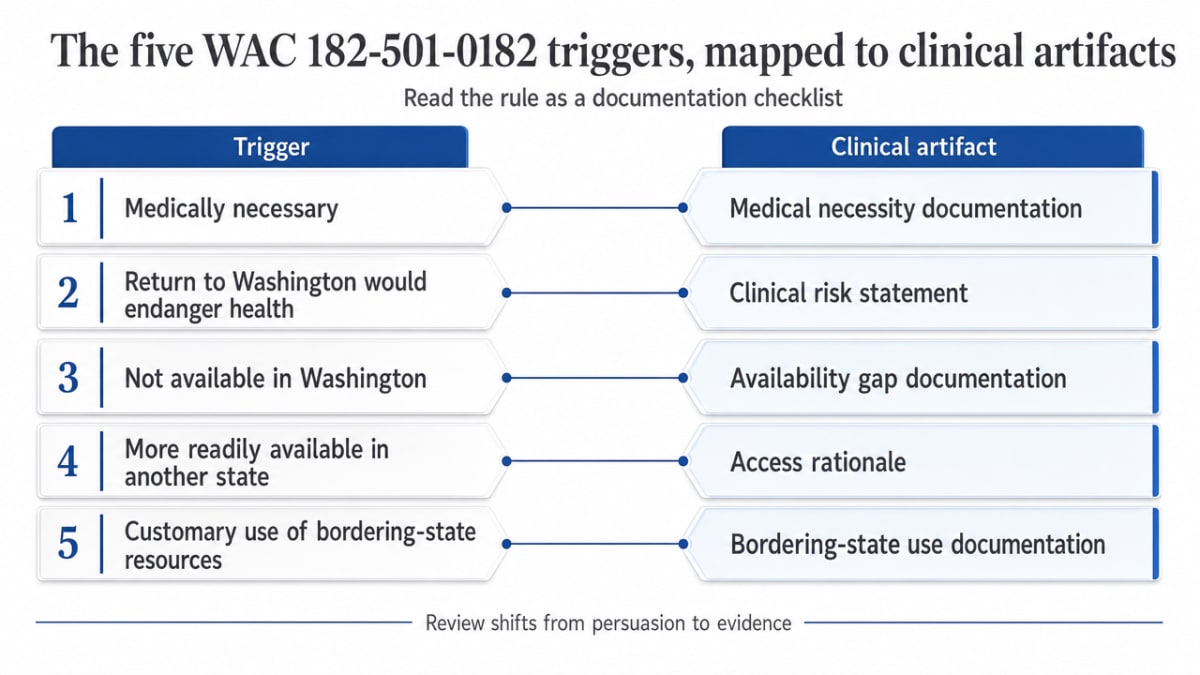
WAC 182-501-0182 is written as a list of circumstances, but you can read it as a documentation prompt. The rule identifies five situations that can support Apple Health coverage for planned, nonemergency care delivered outside Washington:
- the service is medically necessary;
- requiring the member to return to Washington would endanger their health;
- the service is not available in Washington;
- the service is more readily available in another state; or
- the care falls within customary use of bordering-state resources 1.
Each phrase in that list corresponds to a specific artifact you either already have in the chart or need to generate before submission.
That reframing matters because it changes the review from a persuasion exercise into an evidentiary one. You are not arguing that an out-of-state placement is a good idea. You are showing, with dated records and clinician attestation, which of the five circumstances applies and how the member’s presentation fits it. When more than one circumstance applies — and for treatment-resistant psychiatric cases, two or three usually do — the file gets stronger, not more cluttered, because the reviewer can find the same clinical fact supporting multiple statutory pathways.
Build the packet in the order the rule lists them, and let the clinical record populate each slot.
Trigger-to-artifact crosswalk
Use the crosswalk below to match each WAC 182-501-0182 circumstance to the artifact that carries the weight for it 1. Nothing here is exotic — these are documents your treating clinicians and prior UM colleagues have almost certainly generated. The work is in pulling them into one file and labeling them against the statute.
| WAC 182-501-0182 circumstance | Clinical artifact that satisfies it ||—|—|| Service is medically necessary | Treating psychiatrist’s narrative tying DSM-5 diagnosis, current acuity, safety risk, and functional impairment to the requested level of care; consideration of less restrictive alternatives documented in the chart 5 || Returning to Washington would endanger health | Attending clinician attestation describing acute risk during transport or interruption, including recent suicidality, aggression, medical instability, or destabilization from prior transfers || Service is not available in Washington | Dated referral log listing Washington facilities contacted, dates of contact, waitlist responses, and specific capability gaps (for example, no in-state clozapine titration program accepting the member, no bed with co-occurring SUD capacity) || Service is more readily available elsewhere | Comparative capability summary: receiving facility’s specialty scope, average time to admission, and named clinical protocols the member requires but cannot access on an appropriate timeline in Washington || Customary use of bordering-state resources | Not typically applicable for an Arizona placement; note it as not-applied rather than leaving it blank |
A few notes on assembly. The medical-necessity artifact should mirror the documentation model used in Washington’s own residential and inpatient service standards — diagnosis basis, physical-health assessment, examination after admission, and less-restrictive alternatives considered — so the reviewer sees a familiar structure even for an out-of-state request 5. The referral log is the single artifact reviewers push back on most often, so date every entry and name the specific capability gap rather than a general “no beds available.” And when you draft the danger-in-return attestation, keep it to observed clinical facts; a reviewer can accept a clinician’s judgment when the underlying observations are specific.
Building the clinical narrative: diagnosis, acuity, and failed lower levels of care
Diagnosis basis and acuity summary that survives peer review
The diagnosis section of your packet is where reviewers form their first impression of the file, so it has to carry weight without padding. Lead with the current DSM-5 diagnosis and the observations that support it: mental status findings, symptom duration, functional impairment, and the specifiers that matter for the requested level of care. If the working diagnosis has changed over the last twelve months, say so and explain what shifted the formulation. Reviewers trust files that show clinical thinking, not files that state conclusions.
Mirror the structure Washington uses for its own residential and inpatient services: basis for the admission diagnosis, physical-health assessment, examination timing, and the clinical facts supporting the level of care 5. Even though the receiving facility sits outside Washington, presenting the narrative in a familiar frame makes the reviewer’s job faster.
The acuity summary should be quantitative wherever possible. Recent suicide attempts with dates, C-SSRS scores if available, aggression incidents with settings and outcomes, weight loss, sleep disruption, psychotic symptom frequency. A reviewer can accept a strong clinical judgment when the underlying observations are specific and dated. Vague acuity descriptions are the single most common reason a well-founded request gets kicked back for more information.
Documenting adequate prior trials for treatment-resistant presentations
Treatment resistance is a claim that only holds up when the trials behind it are documented in detail. For schizophrenia cases, the APA guideline recommends clozapine after minimal or no response to two adequate antipsychotic trials, and also for persistent suicide risk despite other treatment 12. “Adequate” is doing a lot of work in that sentence, and reviewers know it. Your file should show, for each prior antipsychotic:
- the medication,
- dose range,
- total duration at therapeutic dose,
- adherence data,
- serum levels where relevant,
- target symptoms,
- measured response, and
- reason for discontinuation.
The same discipline applies to bipolar and depressive presentations. Lithium levels, valproate levels, adequate SSRI or SNRI trials at therapeutic dose for a documented duration, augmentation strategies attempted, ECT considered or completed. If a trial was cut short by side effects, name the side effect and the objective finding. If adherence was partial, say what the pill counts, pharmacy fills, or long-acting injectable records show.
Co-occurring substance use belongs in this section, not siloed elsewhere. A case manager reviewing a request for integrated dual-diagnosis care needs to see how prior substance-use treatment interacted with psychiatric stabilization: relapses tied to medication gaps, detox admissions that did not include psychiatric follow-through, or outpatient dual-diagnosis programs that could not hold the acuity. That linkage is what turns two separate problem lists into one coherent case for specialized placement.
The less-restrictive-alternatives record
Every reviewer, whether they use MCG, InterQual, or a plan-specific criteria set, will look for evidence that lower levels of care were tried or ruled out with clinical justification. Washington’s own service standards require documented consideration of less restrictive alternatives at admission 5, and building your file to that standard makes the medical-necessity argument almost self-executing.
List the levels of care attempted in the last twelve to twenty-four months with dates: outpatient psychiatry, intensive outpatient, partial hospitalization, community-based crisis stabilization, prior residential stays, inpatient admissions. For each, note the discharge disposition, the interval before decompensation, and the specific reason a lower level cannot hold the member now. If a step was skipped rather than tried, explain why the clinical picture ruled it out — for example, an active psychotic exacerbation that would not be safely managed at IOP.
This record is what closes the loop on the medical-necessity trigger under WAC 182-501-0182 1. A reviewer reading it should be able to say, in one paragraph, why nothing short of the requested placement fits the presentation.
Establishing in-state unavailability without overclaiming
The unavailability trigger under WAC 182-501-0182 is where well-built files most often stumble, because case managers reach for population-level data when what the reviewer wants is a member-specific paper trail 1. You cannot document in-state unavailability by citing that Washington has a behavioral-health workforce shortage. You document it by showing which specific programs you contacted for this member, on what dates, what they said, and why their response does not meet the clinical need.
System-level context can frame the record, but be careful with scope. The 2025 HCA Behavioral Health Provider Survey drew 272 responses from publicly funded behavioral-health treatment agencies and clinical staff, with 241 complete responses and an overall response rate of 40.8% for a survey fielded February through June 2025 13. That is useful background on Washington’s publicly funded behavioral-health system, but it is not a real-time bed inventory, does not cover commercial-only providers, and cannot substitute for a member-specific referral log. Cite it, if at all, as context — not as proof that no bed exists.
The load-bearing artifact is your own dated referral log. For each Washington facility contacted, capture the date, the person you spoke with, the specific capability you asked about (clozapine titration with cardiac monitoring, co-occurring stimulant-use disorder programming, trauma-informed care for a member with prior aggression, adolescent step-down after inpatient stabilization), and the response — full waitlist, no capacity for the acuity, exclusionary criteria, or a program scope that does not match the presentation. If a facility declined based on the member’s insurance, note that too; it goes to availability in a practical sense even when a bed technically exists.
The ITA boundary and the voluntary-conversion record
Here is where a lot of otherwise strong files stall. Washington’s Involuntary Treatment Act, codified in Chapter 71.05 RCW, gives Washington courts and designated crisis responders authority over civil commitment, less-restrictive alternatives, and treatment without consent inside the state 6. That authority does not follow the member across the Arizona state line. And Apple Health does not cover services delivered outside Washington under the ITA at all 2. If your member is currently on a detention, a 14-day, or a 90/180-day order, the out-of-state placement cannot be an extension of that legal status — it has to be a voluntary admission.
That means your file needs a voluntary-conversion record, and it needs to be clean. Document the date the ITA order was lifted or expired, the clinical status at that point, and the capacity evaluation supporting the member’s ability to consent to voluntary treatment. Include the signed voluntary admission agreement, the discussion of risks and alternatives, and — where a guardian or surrogate is involved — the legal authority for their consent.
One practical note on transport. Once the legal basis shifts to voluntary, transport planning shifts too. No secure conveyance under an ITA order, no involuntary medication en route. Build the clinical stabilization plan for the travel window itself, and name who is accompanying the member.
Verifying the receiving facility’s licensure and scope
Before you sign off, confirm the receiving facility is licensed for the exact level of care the member needs in the state where treatment will actually happen. Washington’s benchmark plan is explicit on this point: residential care must be delivered by a facility licensed for that particular level of care in the state where care is provided 11. A general behavioral-health license is not the same as licensure for psychiatric residential treatment, and a reviewer who catches that gap after admission has an easy denial.
For an Arizona placement, that means verifying current ADHS licensure for the specific service category, accreditation status (Joint Commission or equivalent), and DEA registration if controlled-substance protocols like clozapine titration or MAT are part of the treatment plan. Ask for license numbers and expiration dates in writing, not screenshots.
Scope matters as much as licensure. If the member needs integrated dual-diagnosis care, confirm the facility is credentialed to treat co-occurring substance-use disorders concurrently, not sequentially. If clozapine monitoring, cardiac telemetry, or medical detox capacity is clinically indicated, the facility’s scope has to include it — or you are authorizing a placement that will need a second transfer within a week.
Parity as a review lens and an escalation lever
Aligning utilization criteria with generally accepted standards
Parity is not just a member-protection concept for you to hand off to compliance. It is a review lens you can apply to your own utilization decision before the file leaves your desk. Washington’s mental health parity rulemaking implementing E2SHB 1432 requires that utilization and clinical review criteria be consistent with generally accepted standards of mental-health and substance-use care 7. The Office of the Insurance Commissioner reinforces that plans cannot refuse to cover medically necessary mental-health services or limit benefits based on age, condition, treatment interruption, or failure to complete a prior course of treatment 8.
Practically, that means when you weigh a specialty placement request against your plan’s criteria, ask whether the same acuity presentation on the medical side — say, a complex cardiac case requiring a specialized out-of-state program — would face the same documentation threshold. If the psychiatric criteria demand exhausted lower levels of care that would not be required for a comparable medical placement, that is a parity signal worth flagging internally. Reference generally accepted standards, such as the APA schizophrenia guideline for clozapine candidacy, in the criteria you apply rather than plan-specific thresholds that drift from clinical consensus 12.
Expedited review, internal appeal, and IRO pathways
If a denial comes back and the clinical facts have not changed, the escalation ladder is well defined. Internal appeal comes first, and this is the moment to have the treating psychiatrist link each specific clinical finding to the exact language of the plan’s stated medical-necessity criteria and to generally accepted standards. If the internal appeal upholds the denial, an independent review organization can review it, and members or their representatives can also request the plan’s parity disclosure documents to see how the criteria were developed and applied 9. One caution on plan type: self-funded employer plans generally fall under federal rather than Washington state regulation, so confirm the member’s coverage category before quoting Washington appeal deadlines to the family or the treating team.
Packet assembly and submission sequence
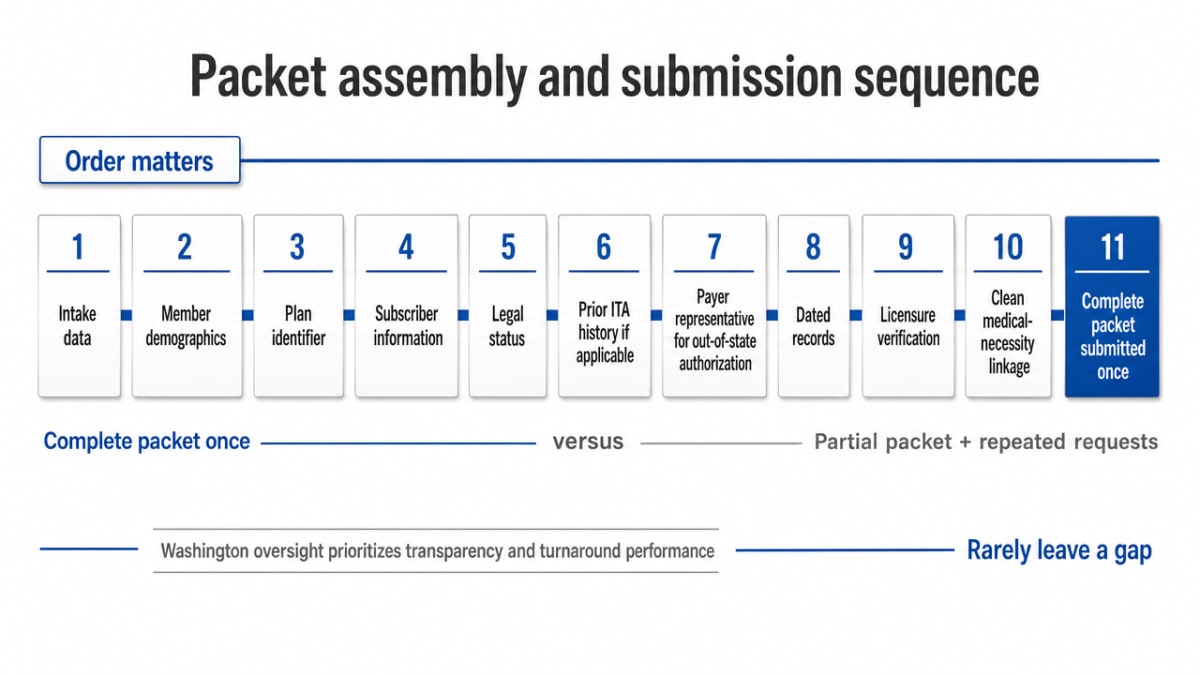
Order matters. A complete packet submitted once beats a partial packet chased through three rounds of requests for information, and Washington’s own oversight reflects that priority — the OIC’s 2024 prior authorization annual report to the Legislature is part of a continuing state effort to improve utilization-review transparency and turnaround performance across health plans 10. First submissions that are missing dated records, licensure verification, or a clean medical-necessity linkage burn the clock you may not have.
Assemble in this sequence and you will rarely leave a gap.
- Start with the intake data: member demographics, plan identifier, subscriber information, current legal status (voluntary, prior ITA history if applicable), and confirmation of the payer representative responsible for out-of-state authorization for Apple Health members 3.
- Next, the treating clinician’s narrative — diagnosis basis, acuity summary, safety findings, functional impairment — structured to mirror Washington’s own admission documentation model so a reviewer reads a familiar frame 5.
- Then the prior-trials and failed-lower-level-of-care record, with medications, doses, durations, adherence data, and dated dispositions from each prior level of care.
- After the clinical spine, drop in the receiving facility’s licensure verification: state license number for the specific service category, accreditation status, and DEA registration if controlled-substance protocols apply.
- Follow with the parity-aligned medical-necessity linkage — a paragraph that ties each clinical fact to the plan’s stated criteria and to generally accepted mental-health standards.
- Close with the referral log establishing in-state unavailability and the voluntary-consent record if the member is post-ITA.
Flag expedited review in the cover letter when the clinical picture warrants it, and cross-reference each artifact to the WAC 182-501-0182 circumstance it supports 1. One submission, one file, one clock.
If you’re coordinating with a receiving facility in Arizona
Once your clinical file is assembled, the administrative work on the receiving side runs in parallel: benefits verification, confirmation of the payer representative responsible for out-of-state authorization for Apple Health members, and pre-admission review of what the plan will require in writing 3. That verification work does not replace your utilization decision — you still hold the authorization authority — but it can keep the clock moving while you finalize the medical-necessity linkage.
ViewPoint Dual Recovery’s insurance verification team, based in Prescott, Arizona, handles that receiving-side coordination for Washington case managers referring members with treatment-resistant psychiatric and dual-diagnosis presentations. The team confirms plan benefits and out-of-network provisions, identifies the specific authorization pathway and documentation the plan expects, and provides current ADHS licensure and Joint Commission accreditation details for the service category being requested so your file has verified receiving-facility information rather than screenshots 11. When your clinical picture warrants expedited handling, they can coordinate intake timing against the review window.
Start with the Verify Insurance process on ViewPoint’s site to open the file. Your clinical judgment leads. The administrative friction on the Arizona side does not have to.
Clarify Complex Psychiatric Placement Needs Today
Receive expert guidance on next steps for your member’s unique psychiatric challenges.
Frequently Asked Questions
Which WAC controls whether Apple Health will cover a planned out-of-state psychiatric placement?
WAC 182-501-0182 identifies the circumstances that can support coverage for planned nonemergency out-of-state care, and WAC 182-501-0180 sets the general requirements that the service be within the member’s program, permitted outside Washington, and medically necessary 1, 2. Read them together, and build the packet against both.
Can a Washington ITA order follow the member to an Arizona facility?
No. Chapter 71.05 RCW governs civil commitment inside Washington, and Apple Health does not cover services delivered outside the state under the Involuntary Treatment Act 6, 2. The placement must convert to a voluntary admission, and your file should include the capacity evaluation, the date the order was lifted or expired, and the signed voluntary agreement.
What documentation best establishes that an appropriate placement is unavailable in Washington?
A dated, member-specific referral log. For each Washington facility contacted, capture the date, the person spoken with, the specific capability requested, and the response — full waitlist, exclusionary criteria, or a scope that does not match the presentation. Name the capability gap, not the diagnosis, so the record satisfies the unavailability circumstance under WAC 182-501-0182 1.
How do parity requirements affect my internal utilization review of a psychiatric placement request?
Washington’s parity rulemaking implementing E2SHB 1432 requires utilization and clinical review criteria to be consistent with generally accepted standards of mental-health and substance-use care 7. If your criteria demand more of a psychiatric placement than a comparable medical placement would face, or drift from clinical consensus like the APA schizophrenia guideline, flag that internally before the file leaves your desk 8, 12.
When should I flag a psychiatric placement request for expedited review, and what happens if the denial is upheld?
Flag it at submission whenever the member’s life or health is at risk; the insurer must then issue an expedited decision within 72 hours 9. If internal appeal upholds the denial, an independent review organization can review it, and the member or representative can request the plan’s parity-disclosure documents. Confirm the plan type first — self-funded plans follow federal rules.
What should I verify about the receiving facility’s licensure before authorizing?
Confirm the facility holds a current license in the state of treatment for the specific level of care requested, since Washington’s benchmark plan requires residential care to be delivered by a facility licensed for that level in the state where care occurs 11. For Arizona, that means ADHS licensure for the service category, accreditation status, and DEA registration if controlled-substance protocols apply.
References
- WAC 182-501-0182 – Health care provided in another state or U.S. territory—Nonemergency. https://app.leg.wa.gov/wac/default.aspx?cite=182-501-0182
- WAC 182-501-0180 – Health care services provided outside the state of Washington—General provisions. https://app.leg.wa.gov/wac/default.aspx?cite=182-501-0180
- Mental Health Services Billing Guide. https://www.hca.wa.gov/assets/billers-and-providers/mental-health-svcs-bg-20251001.pdf
- WAC 246-341-1105 – Behavioral health residential and inpatient intervention, assessment and treatment services—Certification standards. https://app.leg.wa.gov/wac/default.aspx?cite=246-341-1105
- WAC 246-341-1118 – Residential and inpatient mental health services—Service standards. https://app.leg.wa.gov/wac/default.aspx?cite=246-341-1118&pdf=true
- Chapter 71.05 RCW – Behavioral health disorders. https://app.leg.wa.gov/rcw/default.aspx?cite=71.05&full=true
- Mental Health Parity Rulemaking (R 2025-13). https://www.insurance.wa.gov/laws-rules/legislation-and-rulemaking/rulemaking/mental-health-parity-rulemaking-r-2025-13
- Mental health parity. https://www.insurance.wa.gov/insurance-resources/health-insurance/mental-health-and-substance-use-disorders/mental-health-parity
- Appealing a behavioral health treatment or service denial. https://www.insurance.wa.gov/insurance-resources/health-insurance/mental-health-and-substance-use-disorders/appealing-behavioral-health-treatment-or-service-denial
- Health plan prior authorization data 2024 annual report to the Legislature. https://www.insurance.wa.gov/sites/default/files/2025-02/2025-prior-authorization-report-final.pdf
- Benefits Health Benefits benchmark plan. https://www.insurance.wa.gov/sites/default/files/2024-11/washington-ehb-bmp-app-b-final.pdf
- The American Psychiatric Association practice guideline for the treatment of patients with schizophrenia. https://www.med.unc.edu/psych/epi-nc/wp-content/uploads/sites/720/2024/01/APA-2020-guidelines-1.pdf
- 2025 Behavioral Health Provider Survey Interpretive Report. https://www.hca.wa.gov/assets/program/Behavioral-health-provider-survey-interpretive-report-2025.pdf