Key Takeaways
- Bipolar disorder in women often tilts toward bipolar II, depression, mixed features, and rapid cycling, which is why single-visit snapshots get mislabeled as unipolar depression, PMDD, or anxiety.
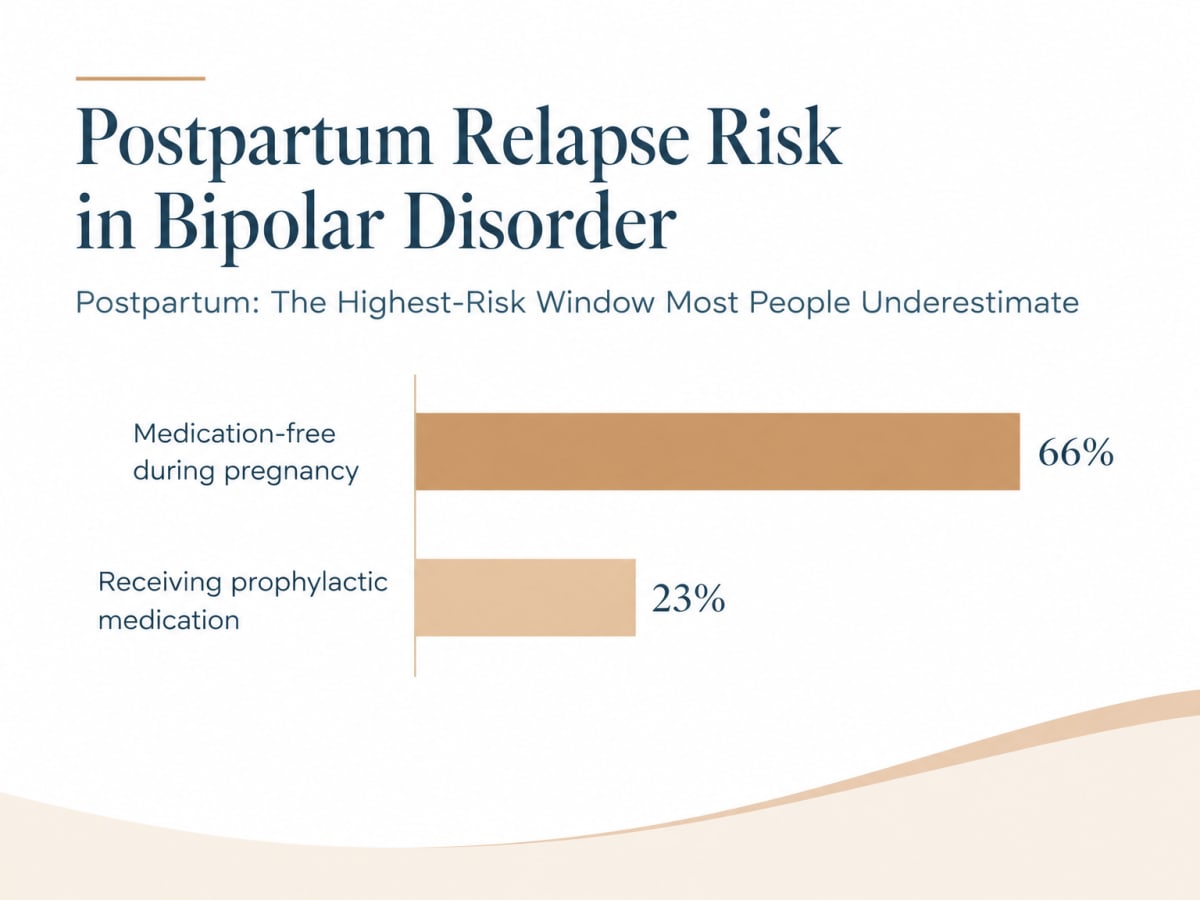
- Hormonal windows reshape the illness: premenstrual weeks can amplify symptoms, pregnancy carries variable recurrence risk, and among women with bipolar disorder specifically, the postpartum period shows a 66% relapse rate off medication versus 23% on prophylaxis 8.
- A sound evaluation builds a lifetime timeline, screens for thyroid disease, trauma, and substance use, reviews prior medication responses, and includes direct safety assessment rather than a brief symptom check.
- Focus next on prospective mood and menstrual tracking across at least two cycles, document past episodes and medication reactions, and seek specialty care if rapid cycling or mixed states persist.
Why Women Often Get the Wrong Diagnosis First
If you’re reading this, there’s a good chance someone has already handed you an answer that didn’t quite fit. Maybe it was depression. Maybe PMDD, postpartum depression, generalized anxiety, or “it’s probably perimenopause.” You tried the medication. You tried the therapy. Something still isn’t right.
Here’s what often gets missed: bipolar disorder in women tends to lean toward the depressive side of the illness. Many women more commonly develop bipolar II, bipolar depression, mixed mania, and rapid cycling than the stereotypical high-energy mania that most people picture when they hear the word “bipolar” 19. The ups are quieter. The downs are louder. And the whole pattern often shifts around your menstrual cycle, a pregnancy, the months after a baby, or the years leading into menopause.
That tilt matters, because a single-visit snapshot can look identical to unipolar depression. Diagnosis actually depends on the shape of your symptoms across your lifetime — their severity, length, frequency, and your family history — not just how you feel in the chair that day 1. When antidepressants are prescribed without a mood stabilizer to someone who actually has bipolar disorder, they can trigger mania or push the illness into faster, more unstable cycling 1.
You’re not imagining the mismatch. You’ve been reading your symptoms through the wrong frame. The rest of this guide helps you see the pattern you’ve been living.
The Pattern Underneath the Labels: How Bipolar Disorder Actually Shows Up in Women
Depression That Keeps Coming Back — and Doesn’t Respond to Antidepressants Alone
The first thing to notice is how much of your life has been spent in the low gear. Not the dramatic, bedridden kind of depression every time — sometimes the functional kind. You go to work. You answer the texts. You get the kids where they need to be. And underneath all of it, there’s a weight you cannot explain and a flatness that doesn’t lift when it should.
Women with bipolar disorder more often spend time in depressive and mixed states than in classic highs, which is one reason bipolar II and bipolar depression get missed for years at a time 19. The depressive episodes themselves can look like what you’ve been told they are: low mood, loss of pleasure, sleep and appetite changes, trouble concentrating, hopelessness, thoughts of not wanting to be here 1.
What’s different is what happens when you treat only that half of the illness. If your depression keeps coming back, or antidepressants have made you feel wired, irritable, or worse — that is information worth bringing to an evaluation.
Hypomania You Didn’t Call Hypomania
Hypomania rarely announces itself. It feels like finally getting your life together.
You sleep four hours and feel fine. You answer every email in the inbox. You start three projects at once and genuinely believe you’ll finish them. Your thoughts move faster than your mouth, which can look like being “on” at work or finally being fun again at dinner. People around you notice the energy before they notice anything is wrong. You might, too — but you code it as a good week, a productive stretch, or finally snapping out of it.
Clinically, hypomania involves a sustained change from your usual self: elevated or irritable mood, less need for sleep, faster speech, racing thoughts, more goal-directed activity, and sometimes risk-taking that doesn’t fit your values 1. The window typically lasts at least four days and is noticeable to people who know you.
Here’s the part women miss most often: the crash. The productive stretch ends, and the next two months are gone to a depression that feels like it came out of nowhere. If your “good weeks” keep landing you back in bed, that cycle is the pattern — not two separate problems.
Mixed Features: Wired, Exhausted, and Hopeless at the Same Time
Mixed features are the states that confuse everyone — including you.
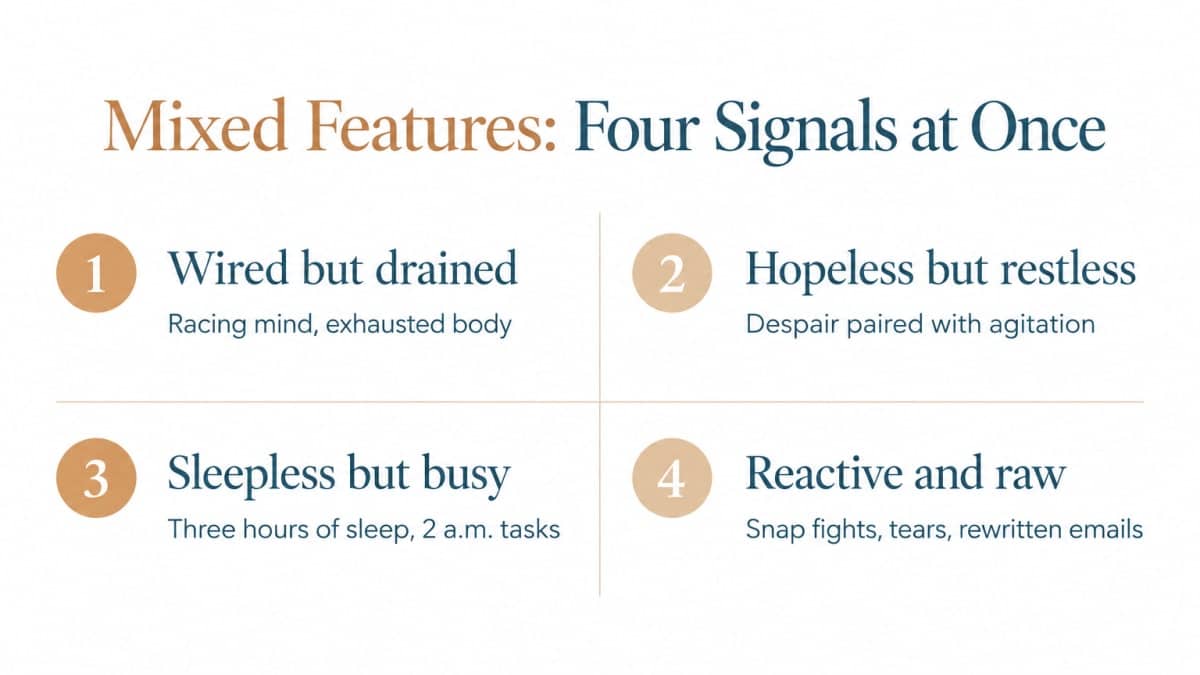
You are depressed, but you cannot sit still. You feel hopeless, but your brain is racing. You sleep three hours and reorganize the pantry at 2 a.m., then cry in the car at 7. You rewrite the same email eleven times. You pick a fight you did not mean to pick. The energy is there, but none of it feels good.
This is the presentation that gets labeled anxiety, agitated depression, PMDD, or “just stress” — and it’s the one women with bipolar disorder experience more often than the classic alternating pattern suggests 5. In clinical terms, mixed features mean symptoms of depression and symptoms of mania or hypomania showing up together or close enough to overlap, and they require the same longitudinal view as any other episode type: severity, length, frequency, lifetime history, and family history 1.
If something inside you feels pressurized and empty at the same time, that is not a character flaw and it is not a weak stress response. It is a describable mood state. Writing down what it actually looks like for you — hour by hour — is the first thing a good evaluator will want to see.
Rapid Cycling and Why It Hits Women Harder
Rapid cycling means four or more mood episodes — depression, hypomania, mania, or mixed — within a twelve-month period 1. For some women, that looks like a depression in January, a hypomania in March, another depression in June, a mixed state in September. The ground never stops moving.
Rapid cycling is more common than most people realize. A meta-review of 22 reviews covering 30 studies and 13,698 people with bipolar disorder found a pooled one-year prevalence of 22.3% and a lifetime prevalence of 35.5%, with women showing higher lifetime prevalence than men in meta-regression 3. In a separate clinical sample of 1,225 patients with bipolar I or II, female sex was a significant predictor of rapid cycling and cycle acceleration even after adjusting for age, bipolar subtype, BMI, comorbidity, and antidepressant use 2.
If your episodes are getting shorter and closer together instead of further apart, that is a signal, not a personality shift. Rapid cycling also tends to respond less well to the first mood stabilizer tried, which is one reason a thorough review of what has and hasn’t worked belongs in your next appointment 3.

The Same Illness at Different Hormonal Windows
Adolescence and the Reproductive Years
Bipolar disorder often shows up for the first time in late adolescence or your twenties, but the early signal is rarely a textbook manic episode. It’s more often a depression that doesn’t quite behave — the one that lifts for a few weeks of unusual confidence and then crashes harder than before.
During the reproductive years, women more commonly develop bipolar II, bipolar depression, mixed mania, and rapid cycling than the high-energy mania most people picture 19. The illness also tends to travel with company. Thyroid disease, migraine, panic disorder, social phobia, eating disorders, and alcohol-use problems show up at higher rates in women with bipolar disorder, which means the “depression plus” picture — depression plus the thyroid issue, depression plus the drinking that got heavier last year, depression plus the eating problem that came back — is worth taking seriously as a single pattern, not three separate problems 19.
If you can look back and see a decade of depressions that never fully stayed fixed, short stretches of unusual drive, and a handful of other diagnoses that keep accumulating, that is the kind of lifetime story a good evaluator wants to hear 1.
The Week Before Your Period: PMDD, Premenstrual Worsening, or Both?
You know the week. The one where your sleep gets strange, your temper gets shorter, and something small — a slow driver, a dirty counter — pulls the floor out from under you. Then your period starts and the fog lifts, and you tell yourself it was just PMS.
Between 45% and 68% of women with bipolar disorder report premenstrual mood symptoms of varying severity, according to a review of the overlap between PMDD and bipolar disorder 7. That is a wide range because studies defined and measured things differently, but the direction is clear: for a lot of women with bipolar disorder, the luteal week makes the illness louder.
Here’s where differential thinking matters. PMDD is a distinct condition that resolves after menstruation starts. Premenstrual worsening of bipolar disorder is the same bipolar illness getting amplified in a predictable window. Both can be true at once. The only reliable way to tell them apart is prospective tracking — the same review recommends charting your menstrual cycle alongside your mood symptoms for at least two full cycles before trying to decide which pattern you’re actually seeing 7.
Two cycles of writing it down is already more than most evaluations get.
Pregnancy: What the Recurrence Numbers Actually Say
Pregnancy gets talked about as a protective window. For some women with bipolar disorder, it is. For others, it isn’t — and the honest answer depends on your illness history and your medication decisions, not on pregnancy itself.
A systematic review of 11 studies found a median mood-episode recurrence rate of 24% during pregnancy among women with bipolar disorder, with a range from 4% to 73% depending on the sample 11. Depressive and mixed episodes were more commonly reported than hypomanic or manic ones in the available evidence 11. The wide range reflects a real clinical truth: some stable women stay well through pregnancy, while others — particularly those with more severe or unstable illness — face higher recurrence risk, especially if mood stabilizers are stopped abruptly 10.
The decision to stay on, adjust, or taper medication during pregnancy is individual. It needs a conversation that weighs your specific episode history, how stable the last year has looked, prior response to medication, and the risks on both sides. “Stop everything because you’re pregnant” and “stay on everything no matter what” are both too blunt for a decision this important 10.
Postpartum: The Highest-Risk Window Most People Underestimate
The weeks after a baby are the single highest-risk window for mood episodes in women with bipolar disorder, and almost no one tells you that before you deliver.
What postpartum relapse looks like is not always what the pediatric intake form screens for. It can look like depression. It can also look like a manic or mixed episode: not sleeping even when the baby sleeps, racing thoughts, agitation, intrusive and unfamiliar thinking, a sense that your brain is somewhere you cannot reach it. These are not “baby blues,” and they are not failures of mothering.
A recent narrative review of postpartum bipolar care recommends vigilant monitoring that extends past the first few weeks and continues through weaning, the return of your menstrual cycle, and going back to work — not just the standard six-week check 12. If you have a bipolar diagnosis or a strong family history, a written relapse-prevention plan made before delivery is one of the most protective things you can do.
Perimenopause and Menopause: ‘Is It Hormones or Bipolar?’
Somewhere in your forties, the question starts arriving: is this perimenopause, or is something else happening again?
Sleep gets fragmented. The irritability has an edge you don’t recognize. Depression returns, or an old pattern of racing nights and crashing days starts up again after years of stability. A qualitative study of women with bipolar disorder living through the menopausal transition found that this exact confusion — attributing symptoms to menopause, to bipolar disorder, to medication, or to some overlap of all three — is one of the hardest parts of that stage of the illness 20. Prior literature cited in that study suggests that roughly one in five women with bipolar disorder may experience worsening mood symptoms, mostly depressive, around menopause 20.
The biological story is still being written. A review of the possible estrogen–mitochondria link in bipolar disorder describes hormonal fluctuation as a plausible contributor to rapid cycling, mixed episodes, and depressive symptoms in women — but presents this as an emerging hypothesis, not an established diagnostic tool 21. In practice, that means your symptoms deserve both a careful psychiatric look and a medical workup, not an automatic hormone explanation.
What Looks Like Bipolar Disorder but Might Not Be
Pattern recognition cuts both ways. The same lens that helps you see bipolar disorder underneath a long list of labels can also lead you to read everything as bipolar — and that’s not accurate either.
A few things can mimic or layer on top of bipolar disorder, and a good evaluation checks for all of them before settling on a diagnosis. Thyroid disease is near the top of the list for women, because it can produce depression, irritability, sleep changes, and energy swings that look mood-driven but are driven by your thyroid instead 19. Trauma responses can produce hypervigilance, sleep disruption, emotional swings, and dissociative stretches that get mistaken for cycling. Alcohol and other substances change sleep, mood, and judgment in ways that mimic hypomania coming down and depression ramping up — and alcohol-use problems show up more often in women with bipolar disorder, which means both things can be true at once 19.
PMDD is its own condition, not a bipolar variant, and it resolves after your period starts 7. Postpartum depression without hypomanic or mixed features is postpartum depression. Perimenopausal mood changes are real on their own terms 20.
The point of this section is not to talk you out of what you’re seeing. It’s to make sure the evaluation you ask for includes a thyroid panel, a trauma history, a substance-use review, and prospective tracking — so whatever the answer turns out to be, it’s the right one 1.
Suicidal Thinking and Substance Use: Why These Can’t Wait
Suicidal thinking is not a background symptom in bipolar disorder. It is one of the most important things an evaluation needs to ask about directly, and it climbs during depressive and mixed episodes — the two states women with bipolar disorder spend the most time in 5. A cohort study of 12,850 people with bipolar disorder identified a consistent cluster of risk factors: prior suicide attempts, a co-occurring psychiatric condition, substance-use disorder, anxiety, a recent mood episode, recent inpatient care, and living alone 18.
Alcohol and other substances change the equation fast. A review of suicide assessment in bipolar disorder found that alcohol- and substance-use disorders are significantly associated with attempt risk, with the strongest signal for alcohol 17. If drinking has crept up, or something you started to sleep is now something you need to function, that belongs in the same conversation as your mood — not in a separate one you plan to handle later.
Tell someone today. A good evaluator will not be surprised.
What a Thorough Evaluation Should Actually Include
A good evaluation does not try to diagnose you in forty-five minutes. It builds a timeline.
The VA/DoD clinical practice guideline for bipolar disorder opens its care algorithm with exactly that sequence: diagnosis and triage, safety screening, then collaborative maintenance planning 16. In practice, that means an evaluator who is doing the job well will ask about more than how you feel this week. They will walk back through your lifetime course — the depressions, the “good stretches” that didn’t look like mania to you but might count as hypomania, the mixed states, and how long each one lasted 1.
Bring data if you have it. Two cycles of mood and menstrual tracking is a strong start — the same prospective charting recommended for sorting PMDD from premenstrual worsening of bipolar disorder is useful here too 7. Write down what medications you’ve tried, at what dose, for how long, and what happened — including whether an antidepressant made you wired, irritable, or sent you into a faster cycle 1.
Expect a medical workup, not just a mental-health interview. Thyroid testing belongs on the list because thyroid disease is a common comorbidity in women with bipolar disorder and can mimic mood symptoms 19. A substance-use review and a direct safety assessment belong in the first visit, not the fifth 16. Family psychiatric history matters because it shapes how your symptoms are read 1.
If you are pregnant, postpartum, or planning a pregnancy, that context changes the plan — a written relapse-prevention and medication strategy should come out of the appointment, not a vague “we’ll see” 12.
When Standard Outpatient Care Isn’t Enough
Most women with bipolar disorder can be well cared for by a steady outpatient psychiatrist and a therapist who understand the illness. Some presentations need more than that, and recognizing which is which matters.
A few patterns point toward specialty-level mood stabilization. Rapid cycling that keeps accelerating despite treatment is one — the same meta-review that reported higher lifetime rapid-cycling prevalence in women also found that rapid cycling responds less well to standard mood stabilizers 3. Persistent mixed features, a perinatal relapse, or a severe episode during pregnancy or postpartum is another, especially when a prevention plan needs to balance medication choice, breastfeeding, and extended monitoring 12.
Treatment resistance has a specific meaning, not a vague one. The International Society for Bipolar Disorders consensus defines treatment-resistant bipolar depression as failure to achieve significant, sustained response after at least two adequately dosed, long-enough medication trials with adherence accounted for 15. For mania, no agreed definition exists yet, so persistent manic or mixed symptoms call for a careful recheck of diagnosis, dose, duration, adherence, substance use, and medical contributors before the label is used 14. Acute treatment-resistant episodes may benefit from options like ECT in bipolar depression or clozapine in mania, but the evidence base is still small 13.
If you have been through two real trials and you are still cycling, that is a reason to ask for a specialty evaluation — not a reason to assume this is just how your life has to feel.
Get Clarity on Complex Bipolar Symptoms
Discuss your symptoms with a clinical team and learn whether specialized treatment may fit your needs.
Frequently Asked Questions
How is bipolar disorder different in women than in men?
The illness itself is the same, but the pattern tends to tilt. Women more commonly develop bipolar II, bipolar depression, mixed features, and rapid cycling, rather than the high-energy mania people picture when they hear the word 19. Not every study replicates every finding, so treat the tilt as a reason for careful evaluation rather than a different diagnosis 4.
Can PMDD and bipolar disorder look the same, and how do I tell them apart?
Yes, and they can co-exist. PMDD symptoms resolve once your period starts. Premenstrual worsening of bipolar disorder is the same illness getting amplified in the luteal week. The only reliable way to sort them is prospective tracking — chart your mood and menstrual cycle for at least two full cycles before anyone tries to decide which pattern you’re actually living 7.
Why do antidepressants sometimes make things worse if I actually have bipolar disorder?
When bipolar disorder is treated as unipolar depression and an antidepressant is prescribed without a mood stabilizer, it can trigger a manic or hypomanic episode or push the illness into faster, more unstable cycling 1. If a prior antidepressant made you feel wired, irritable, agitated, or sent you into a shorter and more volatile cycle, write that down and bring it to your next evaluation.
I was diagnosed with postpartum depression — could it actually be bipolar disorder?
It’s worth asking. A systematic review found that 54.9% of women with a prior bipolar diagnosis experienced at least one bipolar-spectrum mood episode during pregnancy or postpartum 9. Postpartum relapse can look like depression, or like a mixed or manic episode: not sleeping even when the baby sleeps, racing thoughts, agitation, intrusive thinking. A careful lifetime history can help clarify what you’re actually seeing 1.
Can perimenopause trigger bipolar symptoms, or is it just hormones?
Both can be true. Women describe real difficulty telling menopause, bipolar disorder, and medication effects apart during this stage 20. A possible estrogen-related mechanism is being studied, but it remains an emerging hypothesis, not a diagnostic tool 21. If sleep, mood, and energy are changing in your forties, ask for both a psychiatric review and a medical workup — not an automatic hormone explanation.
What should I bring to an evaluation if I think I might have bipolar disorder?
Bring a timeline: past depressions, any stretches that might have been hypomania, mixed states, how long each lasted, and your family psychiatric history 1. Add two cycles of mood and menstrual tracking if you can 7. List every medication tried, the dose, the duration, and what happened — including any antidepressant that made things worse. Expect thyroid testing and a substance-use review 16.
References
- Bipolar Disorder. https://www.nimh.nih.gov/health/publications/bipolar-disorder?concern=/
- Sex differences in the risk of rapid cycling and other indicators of adverse illness course in patients with bipolar I and II disorder. https://pubmed.ncbi.nlm.nih.gov/26529373/
- Prevalence and outcomes of rapid cycling bipolar disorder: Mixed method systematic meta-review. https://pubmed.ncbi.nlm.nih.gov/37429185/
- Is sex important? Gender differences in bipolar disorder. https://pubmed.ncbi.nlm.nih.gov/21047158/
- Sex Differences in Bipolar Disorders: Impact on Clinical Presentation, Course, and Treatment. https://pmc.ncbi.nlm.nih.gov/articles/PMC9226371/
- Bipolar disorder in women. https://pmc.ncbi.nlm.nih.gov/articles/PMC4539870/
- Comorbid Premenstrual Dysphoric Disorder and Bipolar Disorder: A Review. https://pmc.ncbi.nlm.nih.gov/articles/PMC8423998/
- Risk of Postpartum Relapse in Bipolar Disorder and Postpartum Psychosis: A Systematic Review and Meta-Analysis. https://pubmed.ncbi.nlm.nih.gov/26514657/
- Prevalence of Bipolar Disorder in Perinatal Women: A Systematic Review and Meta-Analysis. https://pubmed.ncbi.nlm.nih.gov/35830616/
- Pregnancy and bipolar disorder: the risk of recurrence when discontinuing treatment with mood stabilisers: a systematic review. https://pubmed.ncbi.nlm.nih.gov/27852343/
- Recurrence of bipolar disorder during pregnancy: a systematic review. https://pubmed.ncbi.nlm.nih.gov/29549439/
- The postpartum period and bipolar disorder: early identification, prevention, and management. https://pubmed.ncbi.nlm.nih.gov/41919352/
- The concept and management of acute episodes of treatment-resistant bipolar disorder: a systematic review and exploratory meta-analysis of randomized controlled trials. https://pubmed.ncbi.nlm.nih.gov/32750614/
- Challenges in defining treatment-resistant mania in adults: A systematic review. https://pubmed.ncbi.nlm.nih.gov/37963496/
- Defining Treatment-Resistant Bipolar Depression. https://pubmed.ncbi.nlm.nih.gov/40808269/
- Management of Bipolar Disorder Provider Summary. https://healthquality.va.gov/HEALTHQUALITY/guidelines/MH/bd/VA-DOD-CPG-BD-Provider-SummaryFinal508.pdf
- Suicide Assessment and Prevention in Bipolar Disorder. https://pmc.ncbi.nlm.nih.gov/articles/PMC11058945/
- Risk factors for suicide in bipolar disorder: a cohort study of 12 850 patients. https://pmc.ncbi.nlm.nih.gov/articles/PMC6220973/
- Women and Bipolar Disorder Across the Life Span. https://pmc.ncbi.nlm.nih.gov/articles/PMC3107596/
- “Is it menopause or bipolar?”: a qualitative study of the experience of women with bipolar disorder during the menopausal transition. https://pmc.ncbi.nlm.nih.gov/articles/PMC5689207/
- The Estrogen–Mitochondria Axis in Bipolar Disorder. https://pmc.ncbi.nlm.nih.gov/articles/PMC13127198/