Key Takeaways
- The 72 hours after inpatient discharge carry the highest relapse and suicide risk, so a receiving facility must give a clinical decision in hours, not days 1.
- Vet intake speed by asking who makes the acceptance call, how fast a psychiatrist evaluates on arrival, and how the facility maintains contact if a bed is delayed.
- Require a direct psychiatrist-to-psychiatrist handoff before transport to protect medication reconciliation, tapers, and lab-driven adjustments from being reconstructed from scratch 1.
- Confirm the facility runs clozapine, lithium, and LAI protocols in-house with board-certified coverage on nights and weekends, or complex cases will stall on arrival.
- Insist on one integrated dual-diagnosis team working from a single plan, since bidirectional coordination between psychiatric and addiction services is what reduces relapse 6, 5.
- Verify a named family contact and a written safety plan the receiving psychiatrist will review, update, and share back, since family engagement lowers 90-day rehospitalization 8, 7.
- ViewPoint’s admissions workflow pairs same-day psychiatrist decisions with parallel admission scheduling and a receiving psychiatrist who inherits the plan rather than restarting it 4.
- Structured first-two-week continuity — uninterrupted medications, scheduled family contact, and safety plan updates returned to the referring unit — is what lowers held-bed hours and 30-day readmissions 3, 4.
The 72-Hour Window Where Handoffs Break
You already know the shape of the problem. A patient stabilizes on the unit, the utilization committee is asking about the bed, and you’re staring at a discharge packet for someone who is better but not close to ready for a standard outpatient handoff. Treatment-resistant schizophrenia mid-clozapine titration. Rapid-cycling bipolar with a fresh lithium level. Co-occurring opioid use with a suboxone bridge that needs to survive the ride to the next facility. The clinical work has been done. What happens in the next 72 hours will decide whether it holds.
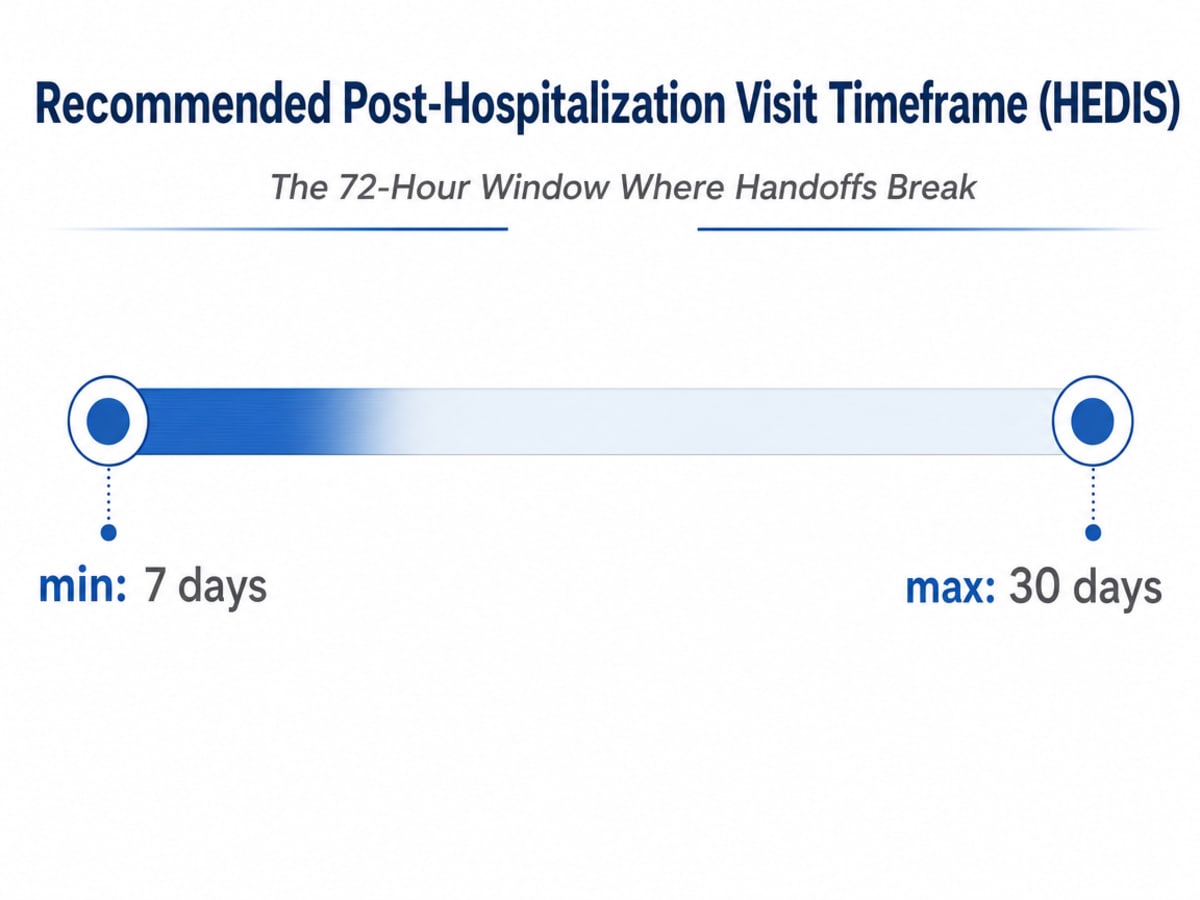
The days immediately after inpatient discharge carry the highest risk of suicide and psychiatric relapse in the entire care trajectory, which is why HEDIS quality standards anchor post-hospitalization follow-up to a 7-to-30-day visit and why continuity guidelines push teams to schedule that first appointment before the patient leaves the unit 1. Seven days is the ceiling for a good handoff, not the target. For a complex case, the target is hours.
That reframes what you’re actually vetting when you call a step-down facility. You’re not shopping for a program. You’re extending the safety envelope your team built on the unit into a receiving environment that can hold it without a gap. A facility that takes 48 hours to review a packet, another 24 to schedule an intake, and another 72 to get the patient in front of a psychiatrist has already burned the window that the research says matters most. The rest of this piece is about how to tell, in one phone call, whether the partner on the other end of the line is built for that window or not.
How to Vet a Step-Down Facility in One Phone Call
Intake Speed: What Counts as Rapid, and Why It Matters Clinically
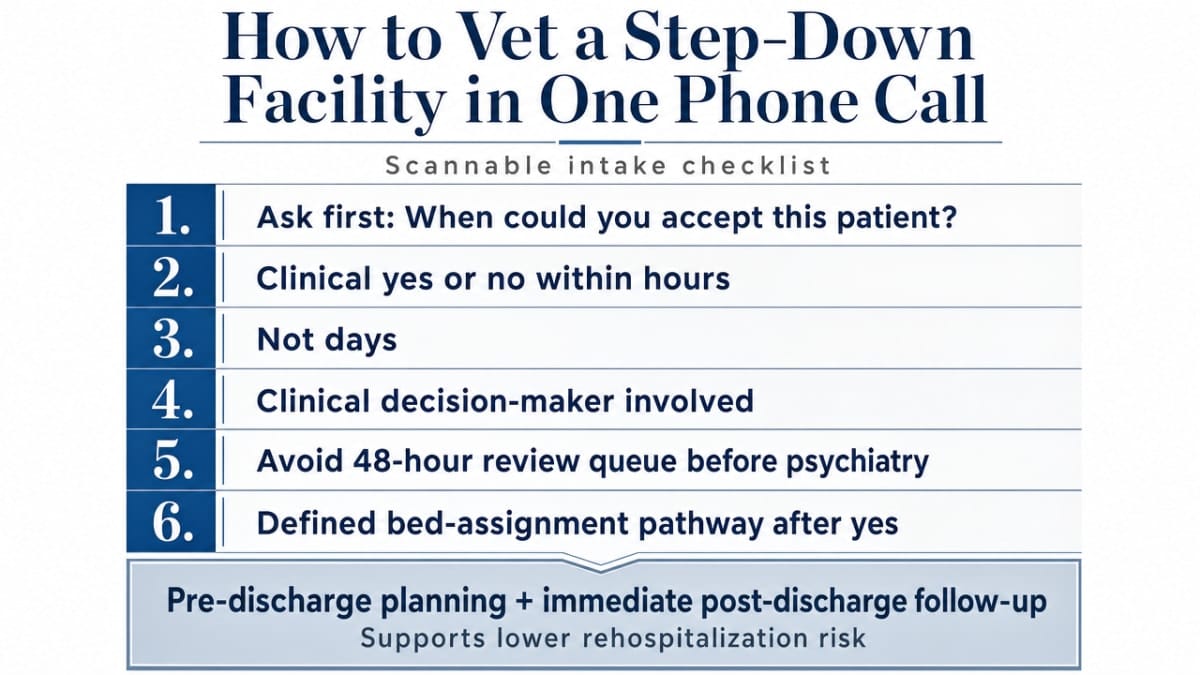
Ask this on the first call: When could you accept this patient? Then listen for whether the answer includes a clinical decision-maker or a review queue. A facility that routes complex referrals through a 48-hour utilization review committee before a psychiatrist ever sees the packet is telling you, without meaning to, that they are not built for the window you are working in.
Rapid intake does not mean same-day beds always exist. It means the receiving facility can give you a clinical yes or no within hours, not days, and can articulate a defined bed-assignment pathway once that yes is given. Comprehensive interventions that pair pre-discharge planning with immediate post-discharge follow-up produce the largest reduction in rehospitalization for severe mental illness 4. That effect is neutralized if the receiving facility cannot begin the intake sequence quickly enough to preserve continuity.
For your triage on the phone, three questions do most of the work:
- Who makes the acceptance decision and when can they get on this call?
- Once accepted, what is the interval from arrival to first psychiatric evaluation?
- If a bed is not immediately available, what interim contact does the facility maintain with your team and the patient so the handoff does not go dark?
A step-down partner that answers those three cleanly is telling you their admissions workflow was designed by someone who has held a bed on a Friday afternoon. One that hedges is telling you the opposite.
Psychiatric Continuity: Medication Reconciliation and Clinician-to-Clinician Handoff
Medication reconciliation is where good handoffs quietly fail. The discharge summary lists the current regimen, the receiving facility’s intake nurse types it into a different EHR, and somewhere between those two moments a PRN dose gets dropped, a taper schedule loses its step, or a recently discontinued agent gets restarted because it appeared in the historical med list. For a rapid-cycling bipolar patient stabilized on a specific lithium level, or a schizophrenia patient three weeks into a clozapine titration, these are not clerical errors. They are relapse triggers.
The standard you should require is a direct clinician-to-clinician conversation before the patient leaves your unit, not after. The continuity literature is explicit that both inpatient and outpatient psychiatric teams need to be involved in the discharge planning process, with open communication and coordination between hospital staff and the receiving clinicians 1. A voicemail from your attending to their admissions coordinator does not meet that bar. A scheduled phone call between the discharging psychiatrist and the receiving psychiatrist does.
When you vet a facility, ask whether their intake psychiatrist will be on a call with your attending before transport, and ask whether they will accept a verbal medication order confirmation to bridge the first 24 hours if there is any ambiguity in the written orders. Ask how they handle a taper that is mid-step. Ask what happens if a lab result from your unit arrives after the patient does.
You are not being difficult by asking. You are protecting the work your unit already did. A facility that treats these questions as friction is one where continuity will be reconstructed from scratch on arrival, which is another way of saying it will not be reconstructed at all. A facility that treats them as routine is one where the receiving psychiatrist expects to inherit a plan, not invent one.
Complex Medications: Clozapine, Lithium, LAIs, and Mid-Titration Cases
This is where most step-down facilities quietly disqualify themselves. A patient on clozapine needs ANC monitoring on a defined schedule, a REMS-registered prescriber, and a facility that will not pause the medication because their weekend coverage is uncomfortable with it. A patient on lithium needs level monitoring, hydration awareness, and a psychiatrist who will not reflexively cut the dose after one borderline reading. A patient who received a long-acting injectable on the unit needs the next dose scheduled and administered on time, in a facility that stocks the medication or can source it without a two-week delay.
These are not exotic requests. They are the standard of care for the population you are actually trying to place. But when you call a general step-down program and describe a clozapine patient mid-titration, the pause on the other end of the line tells you what you need to know.
Vet for this directly. Ask whether the facility has board-certified psychiatry available on nights and weekends, not just on-call coverage. Ask whether they run clozapine protocols in-house or refer out for monitoring. Ask how they handle a mid-titration case where the plan needs to continue exactly as written for the next three weeks. Ask what happens if the patient refuses a dose on day two.
ViewPoint accepts these cases as core clinical work, including active clozapine protocols and complex medication strategies for treatment-resistant schizophrenia and rapid-cycling bipolar. If a facility cannot say the same in plain language, you already have your answer.
Dual-Diagnosis Integration: One Team, Not a Warm Referral
The tell on dual-diagnosis capability is whether the facility treats mental health and substance use as one clinical picture or two parallel referrals. A patient with co-occurring opioid use disorder on a suboxone bridge, or a trauma-related alcohol use disorder overlaying a mood disorder, does not benefit from a facility that treats the psychiatric piece and hands you a phone number for addiction services down the road. Effective coordination for co-occurring disorders requires bidirectional communication and shared planning between mental health and addiction services, beginning at admission and extending through the post-discharge period 6. That is a description of an integrated team, not a referral relationship.
| Fragmented handoff | Coordinated handoff 6 |
|---|---|
| Psychiatric plan written, addiction plan referred out | Single integrated plan authored by both disciplines |
| Suboxone or naltrexone bridge “to be arranged” | Bridging medication continued without gap |
| Separate intake calls for MH and SUD teams | One admissions conversation covering both |
| Relapse triggers a new referral loop | Relapse triggers a same-team clinical response |
| Communication one-directional at discharge | Bidirectional communication across the transition |
Integrated discharge planning that addresses psychiatric and substance use needs together is the intervention that meaningfully reduces relapse and readmission in dual-diagnosis populations 5. When you vet a facility, ask whether the psychiatrist and the addiction clinician sit on the same treatment team, whether they attend the same case conference, and whether a single treatment plan governs both conditions. Ask how they handle a bridging medication that needs to continue without interruption.
ViewPoint is built around this integration by design, with psychiatrists and therapists collaborating on each case rather than running parallel tracks. For a stabilized-but-not-ready patient with both diagnoses, that structural choice is the difference between a handoff that holds and one that unwinds in the first week.
Family Loop and Written Safety Plan
Two artifacts should exist before the patient leaves your unit: a written safety plan the receiving facility has read, and a family communication plan the receiving facility has agreed to honor. Both are underweighted in most handoffs, and both change outcomes. Patients whose families are actively engaged in discharge planning show higher adherence to post-discharge treatment and lower rates of 90-day rehospitalization 8. Structured safety planning and clear communication of risk factors at discharge are essential components of safer psychiatric transitions 7.
Vet the family loop directly. Ask who at the receiving facility will be the family’s named point of contact, how often that person will initiate updates, and what the release-of-information workflow looks like on day one. A facility that says “the therapist will call when they can” is one where the family will hear nothing for two weeks and start calling your unit instead.
Vet the safety plan the same way. Ask whether the receiving psychiatrist will review your safety plan on arrival, whether they will add to it based on their own risk assessment, and whether the updated plan will be shared back with your team and the family. Ask what triggers a re-evaluation.
Six questions to ask any step-down facility before you send the packet:
- When can your clinical decision-maker give me an accept or decline?
- What is the interval from arrival to first psychiatric evaluation?
- Will your intake psychiatrist speak directly with our attending before transport?
- Do you run clozapine, lithium, and LAI protocols in-house, including nights and weekends?
- Do your psychiatric and addiction clinicians work as one team on a single plan?
- Who is the family’s named contact, and will you share the updated written safety plan back with us?
The Questions to Ask Before You Send the Packet
Before the packet leaves your desk, run one more pass. Not the payer verification, not the transport arrangement — the clinical vetting call that decides whether the receiving facility can actually hold what your team built. Most step-down programs will not fail on paper. They will fail on the specifics you did not ask about because the referral coordinator sounded competent and the beds were open.
Structured, individualized care plans with active coordination between services are what the evidence associates with reduced rehospitalization for severe mental illness 3. That coordination does not happen by accident on the receiving end. It happens because someone on your side asked pointed questions and did not accept vague answers.
Use these before you send the packet:
- Clinical decision timeline. When can a psychiatrist — not an intake coordinator — give me an accept or decline on this case?
- Arrival to evaluation interval. Once the patient walks in, how many hours until they are in front of the treating psychiatrist?
- Direct handoff. Will your receiving psychiatrist take a call from our attending before transport, and will they accept verbal medication order confirmation for the first 24 hours?
- Complex medication capability. Do you run clozapine, lithium level monitoring, and LAI administration in-house, with board-certified coverage on nights and weekends?
- Integrated dual-diagnosis team. Do psychiatry and addiction clinicians work from one plan in one case conference, or two?
- Family contact and written safety plan. Who is the family’s named point of contact, and will you share the updated written safety plan back to our unit?
What ViewPoint Does When the Referral Call Comes In
The Admissions Workflow: Referral to Admission to First Psychiatric Evaluation
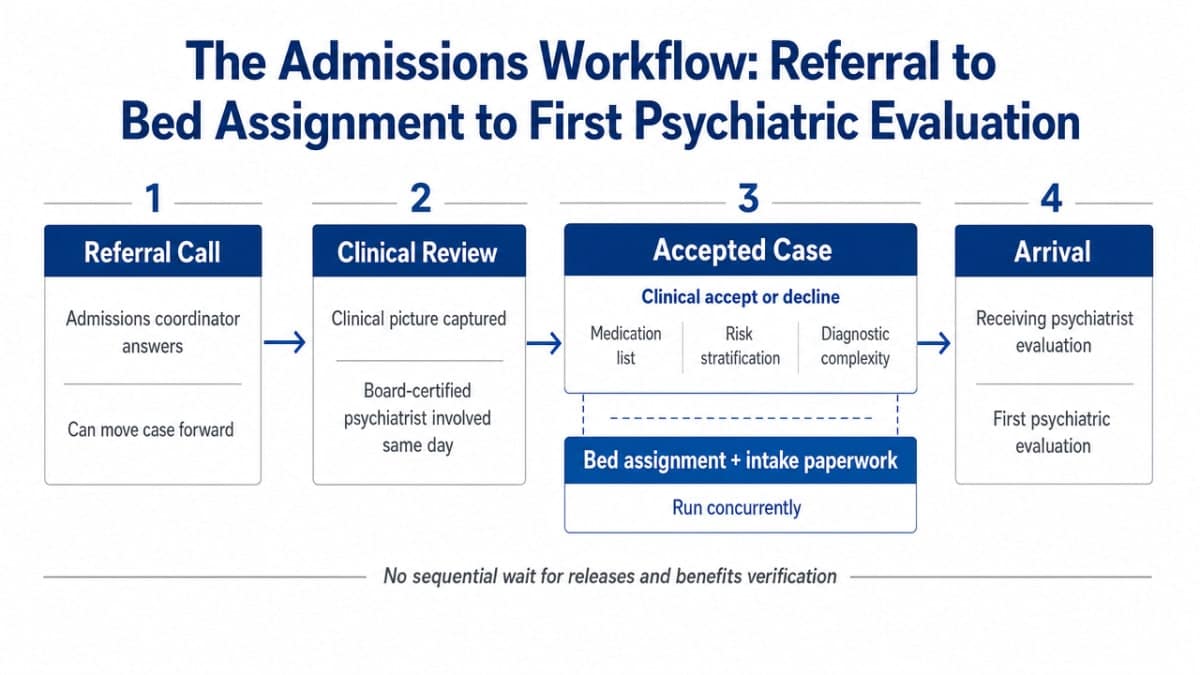
When your call reaches ViewPoint’s admissions team, the first person you talk to has authority to move the case forward, not just take a message. The admissions coordinator captures the clinical picture on the initial call and pulls a board-certified psychiatrist into the acceptance decision the same day. You get a clinical accept or decline from someone who can actually evaluate the medication list, the risk stratification, and the diagnostic complexity — not a queue slot behind a Monday morning utilization meeting.
Once the case is accepted, bed assignment moves in parallel with intake paperwork rather than after it. Your team is not asked to sit on a stabilized patient while a receiving facility processes releases and verifies benefits sequentially. The admissions coordinator runs those tracks concurrently and keeps you looped in on any obstacle the moment it surfaces.
On arrival, the receiving psychiatrist is the point of continuity, not an intake nurse working from a photocopied summary. That first evaluation focuses on the plan your team wrote — confirming the current regimen, reviewing the safety plan you sent, and clarifying anything the discharging psychiatrist flagged on the handoff call. Comprehensive transitional interventions that pair pre-discharge planning with immediate post-discharge follow-up produce the largest reductions in rehospitalization for severe mental illness 4, and that pairing is what this workflow is designed to protect. You are not handing your work to a program that will start over. You are handing it to a team that expects to inherit a plan already in motion.
Who ViewPoint Accepts That Other Step-Down Programs Return
You know the pattern. You describe the case honestly on the call — active clozapine titration, a lithium level that came back on the low end this morning, opioid use disorder with a suboxone bridge, or persistent SI with a plan that has since been contracted around — and the facility on the other end starts asking whether the patient might be a better fit somewhere else. Somewhere else usually means back to you in ten days.
ViewPoint accepts these as core clinical work rather than exceptions:
- Treatment-resistant schizophrenia mid-clozapine protocol, with ANC monitoring continued on schedule.
- Rapid-cycling bipolar patients whose medication strategy needs to hold exactly as written through the next several weeks.
- Co-occurring opioid, alcohol, or stimulant use disorders that require a bridging medication to survive the transport and the first night.
- Trauma-related presentations where the addiction and the psychiatric illness are one clinical problem, not two.
The reason these cases can land here is structural. Board-certified psychiatry is available 24/7, so a weekend admission does not mean waiting until Monday for someone who can write an order on clozapine or adjust a lithium dose. Psychiatrists and therapists work the same case on the same team, so a dual-diagnosis handoff does not fracture into parallel referrals 5. Treatment duration is set by clinical need rather than a fixed insurance cycle, so a patient who needs three more weeks to stabilize gets three more weeks.
How the First Two Weeks Are Structured to Protect Your Discharge
The first two weeks after arrival are where a handoff either holds or quietly comes apart, and the structure at ViewPoint is built around that fact. Individualized care plans with active coordination between services are what the evidence associates with reduced rehospitalization for serious mental illness 3, and that plan is written in the first 24 to 48 hours by the same psychiatrist and therapist who will carry the case, not by an intake team that hands it off later.
Medication continuity is treated as non-negotiable. The regimen you sent is continued without a reset, labs are drawn on the schedule your unit established, and any change to the plan gets a phone call back to your attending rather than an after-the-fact note in a discharge summary you will read weeks later. For dual-diagnosis cases, the bridging medication continues without a gap and the addiction clinician is in the same case conference as the psychiatrist from day one 6.
The family is contacted within the first days by a named point of contact, not left to call the main line. Adherence and 90-day rehospitalization outcomes both improve when families are actively engaged in the transition 8, and that engagement is scheduled rather than left to chance. If the safety plan needs updating based on what the receiving psychiatrist sees, the updated plan comes back to your unit so your records reflect the current risk picture 7. You are not left guessing at what happened after the transport pulled away.
Reducing Held-Bed Hours and Readmission Exposure
You are measured on two numbers that pull in opposite directions: length of stay on the unit and 30-day readmissions after discharge. A step-down partner either helps you on both or costs you on both. There is no middle version.
Held-bed hours accrue in the gaps you cannot see from the packet — the utilization committee that meets Tuesday and Thursday, the intake coordinator who cannot say yes without a psychiatrist, the benefits verification that runs after clinical review instead of alongside it. Each of those gaps is a shift your patient stays on an acute bed they no longer clinically need. A receiving facility that gives you a clinical decision the same day and runs bed assignment in parallel with paperwork does not just feel faster. It shortens the window your utilization team is asking you about.
Readmission exposure works on the other end of the same handoff. Comprehensive transitional interventions that pair pre-discharge planning with immediate post-discharge follow-up produce the largest reductions in rehospitalization for severe mental illness 4, and structured, individualized care plans with active coordination between services show the same effect across the broader evidence base 3. The partner that protects the first two weeks — medication continuity, family contact, safety plan updated and shared back — is the partner that keeps the patient off your census in day 28.
How to Reach ViewPoint’s Admissions Team
When you have a stabilized-but-not-ready patient and need a clinical decision today, call ViewPoint’s admissions line directly. A live coordinator answers, pulls a board-certified psychiatrist onto the case, and works the acceptance and bed assignment in parallel. Have the current medication list, safety plan, most recent labs, and any active protocols (clozapine, LAI schedule, bridging medications) ready to share on the first call. If you prefer a warm handoff between attendings before transport, ask for it — the receiving psychiatrist expects that call. Send the packet after the clinical yes, not before.
Streamline your step-down transition with expert input
Receive a clear clinical recommendation for your patient’s next level of psychiatric care.
Frequently Asked Questions
What should I ask a step-down facility on the first referral call?
Six questions do the real work: when can a psychiatrist give you an accept or decline, what’s the interval from arrival to first psychiatric evaluation, will their receiving psychiatrist take a call from your attending before transport, do they run clozapine and LAI protocols in-house with weekend coverage, do psychiatry and addiction clinicians work one plan, and who is the family’s named contact. Hesitation on any of these is your answer.
Does ViewPoint accept patients on clozapine or other complex psychiatric medications?
Yes. Active clozapine titration with ANC monitoring continued on schedule, lithium level management, long-acting injectables, and mid-titration regimens are core clinical work here, not exceptions. Board-certified psychiatry is available 24/7, so a Friday admission does not mean waiting until Monday for someone who can write on clozapine or adjust a lithium dose. Send the current regimen and any active protocols on the first call and they continue without a reset.
How does ViewPoint handle patients with co-occurring substance use disorders?
Psychiatric and addiction clinicians work the same case on the same team, from one integrated plan in one case conference. Bridging medications like buprenorphine or naltrexone continue without a gap through transport and the first night. Effective coordination for co-occurring disorders requires bidirectional communication and shared planning between mental health and addiction services across the transition 6, and that structure is built in rather than arranged after arrival.
How is the family kept in the loop after the handoff?
A named point of contact reaches the family within the first days rather than waiting for them to call the main line. Updates are scheduled, not incidental, and the release-of-information workflow is handled on day one. Adherence and 90-day rehospitalization outcomes both improve when families are actively engaged in the transition 8, so this contact is treated as a clinical intervention. Your unit gets looped in on any material change.
What happens in the first 24 to 72 hours after a patient arrives?
The receiving psychiatrist evaluates on arrival and confirms the regimen your team wrote rather than starting over. The safety plan you sent is reviewed, updated based on the psychiatrist’s own risk assessment, and shared back to your unit 7. Labs continue on the schedule your unit set, bridging medications continue without interruption, and the family’s named contact makes first outreach. Any material change generates a call back to your attending.
How do I reach ViewPoint’s admissions team to start a referral?
Call the admissions line directly. A live coordinator answers and pulls a board-certified psychiatrist onto the case the same day for a clinical accept or decline. Have the current medication list, most recent labs, safety plan, and any active protocols (clozapine, LAI schedule, bridging medications) ready to share on the first call. If you want a warm handoff between attendings before transport, ask for it — the receiving psychiatrist expects that call.
References
- Ensuring Continuity of Care: Effective Strategies for the Post-Hospitalization Transition of Individuals With Schizophrenia. https://pmc.ncbi.nlm.nih.gov/articles/PMC10863747/
- Transitions in care from psychiatric hospital to community. https://www.ncbi.nlm.nih.gov/pmc/articles/PMC5147624/
- Discharge planning and continuity of care in mental health: A systematic review. https://www.ncbi.nlm.nih.gov/pmc/articles/PMC4209158/
- Transitions of care from hospital to community for patients with severe mental illness: A meta-review of interventions. https://pubmed.ncbi.nlm.nih.gov/31884663/
- Discharge planning in psychiatric care for people with substance use disorders. https://pubmed.ncbi.nlm.nih.gov/32238612/
- Hospital discharge coordination for patients with co-occurring mental health and substance use disorders. https://www.ncbi.nlm.nih.gov/pmc/articles/PMC8967880/
- Improving transitions of care in psychiatry: A framework for safer discharge. https://www.ncbi.nlm.nih.gov/pmc/articles/PMC8056263/
- Family involvement in psychiatric discharge planning: Impacts on outcomes. https://pubmed.ncbi.nlm.nih.gov/34342557/
- Discharge planning and Mental Healthcare Act 2017. https://pmc.ncbi.nlm.nih.gov/articles/PMC6482710/
- Discharge and Conditional Release Section # PC-400. https://omh.ny.gov/omhweb/policymanual/pc_400.pdf
- Discharge Planning and Continuity of Care: Inpatient Behavioral Health Guideline. https://www.utoledo.edu/policies/utmc/nursing/guidelines/inpatient-behavioral-health/pdfs/discharge-planning-guideline.pdf