Key Takeaways
- Nearly one in four Arizona adults lives with mental illness and about 21% of adult public mental health clients carry co-occurring substance use disorders, making dual diagnosis care a common need 11.
- Structured family psychoeducation delivered with fidelity is linked to 20 to 50 percent fewer relapses and rehospitalizations in schizophrenia-spectrum care, though the signal is smaller for depression 6, 4.
- Arizona’s Title 36 names spouses, parents, adult children, adult siblings, and blood relatives as family, giving you recognized standing to be involved in treatment conversations 15.
- When calling a Prescott program, ask how many family sessions and weekends are included, how the model preserves fidelity, and how both diagnoses are handled together 6, 14.
When the last program didn’t hold: what changes when your family is part of the plan
You have already done more than most people will ever understand. You have driven to the ER at 2 a.m. You have sat through intake calls with a clipboard on your knee. You have watched a discharge summary promise stability, then watched that stability come apart in a matter of weeks. If you are reading this, another program did not hold, and you are trying to figure out what to do differently this time.
Here is what the research keeps showing, quietly and consistently: when families are treated as part of the clinical plan, not as visitors, relapse and rehospitalization rates drop, treatment adherence improves, and caregiver stress goes down 3. That is not a soft add-on. For serious mental illness and dual diagnosis, it is one of the most evidence-backed levers a treatment team has 2.
This guide is written to you, the person making the call. Not to your loved one. You will see what family involvement actually looks like at a Prescott program built for treatment-resistant psychiatric care and dual diagnosis, from education sessions to structured family weekends. You will also see what Arizona law says about your role, and what the honest limits of the evidence are. No toxic positivity. No promises no clinician can keep. Just a clearer path than the one you have been walking.
The Arizona picture behind your exhaustion
How many families are living what you are living
You are not the only person in your zip code who has stopped sleeping through the night. The scale of what Arizona families are carrying is easy to underestimate, especially when your own crisis has kept you too tired to look up.
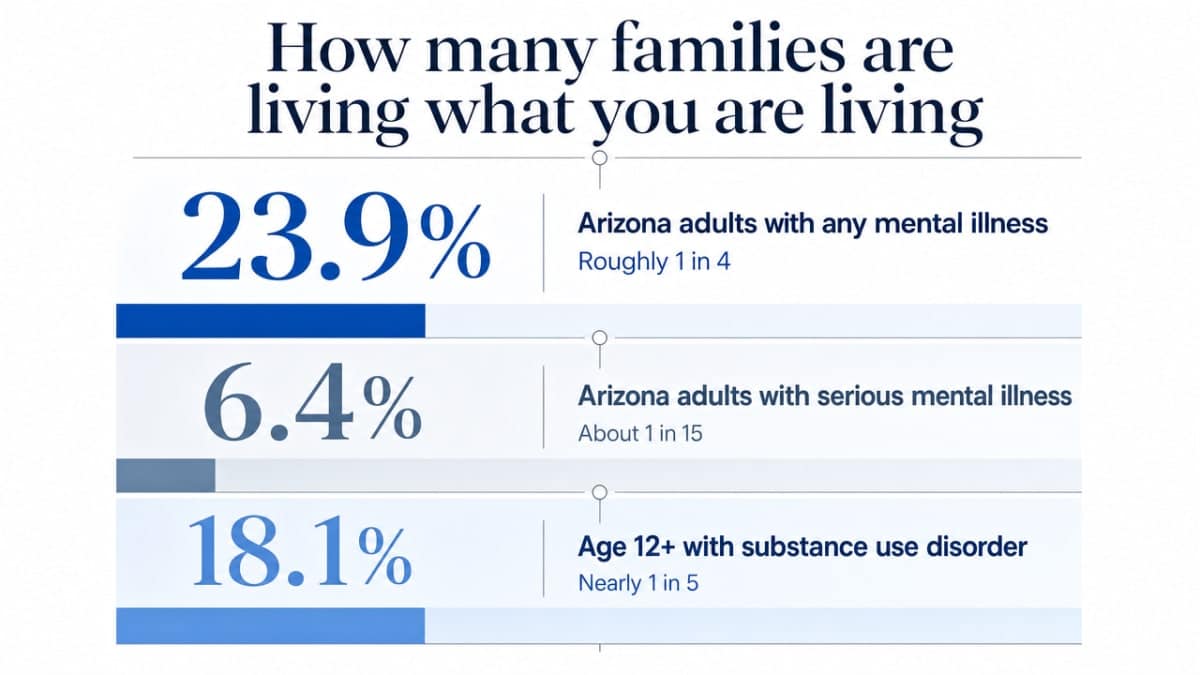
Recent SAMHSA data for 2021–2023 puts it plainly:
- 23.9% of Arizona adults had any mental illness
- 6.4% had serious mental illness
- 18.1% of people age 12 and older had a substance use disorder in the past year 8
Roughly one in four adults. One in fifteen with something serious enough to interfere with daily life. And nearly one in five, from middle-schoolers up, meeting criteria for a substance use disorder.
Read those three numbers together and the room your family lives in gets more crowded. The neighbor who no longer comes to the door. The coworker who quietly took FMLA. The parent you met once at a school event who is also driving to Prescott, or Phoenix, or Tucson for a psychiatric intake.
None of that makes what you are going through easier. But it does mean the guilt you might be carrying — the sense that your family is somehow uniquely broken — is not the whole story. Serious psychiatric illness is common here. So is the exhaustion that comes from loving someone through it. The programs that take families seriously are responding to a real, statewide load, not a rare edge case.
Why dual diagnosis changes what family involvement has to do
If your loved one has been cycling between a psychiatric diagnosis and a substance use problem — and being handed off between programs that treat one or the other — you already know that split care rarely holds. The Arizona numbers show how many families are stuck in that gap.
State-level NSDUH tables count about 559,000 Arizonans with a co-occurring substance use disorder and any mental illness, and roughly 177,000 with a co-occurring substance use disorder and serious mental illness 9. Inside Arizona’s public mental health system, the 2022 Uniform Reporting System found that 21% of adult clients had co-occurring mental health and substance use disorders 11. Whichever door your family walked through — private, public, ER — a fifth to a quarter of the people in the waiting room are carrying both.
That changes what your role has to look like. A family session that only covers a mood disorder, and quietly avoids the drinking or the fentanyl, leaves the biggest relapse trigger untouched. A substance use program that treats the psychiatric symptoms as “just cravings” sends your loved one home to the same crisis you brought them in for.
What family involvement has to do in a dual diagnosis case is different. You need to understand both diagnoses, in language you can actually use. You need a plan that names the interaction between them — how a manic episode raises use, how withdrawal mimics psychosis, how a missed clozapine dose can pull the whole system down. And you need a clinical team that expects you at the table for both conversations, not one.
That is why programs built specifically for treatment-resistant psychiatric care and dual diagnosis, like the model used in Prescott, treat family education as part of the medical plan — not as a Sunday-afternoon extra.
What the evidence actually says about including families
The relapse and rehospitalization numbers, with the fine print
Here is the headline number, and then the fine print, because you deserve both.
When families participate in structured family psychoeducation — the kind delivered with fidelity to the model, over months, not a single afternoon — consumers and their families see 20 to 50 percent fewer relapses and rehospitalizations compared with standard services, along with better knowledge about the illness and lower family stress 6. A separate evidence review put it even more directly: family psychoeducational interventions are more effective at preventing relapse than either medication or individual treatment on its own, with that same 20% to 50% range for reduced relapse and readmission 2.
That is a big claim. It deserves the caveats attached to it.
Most of that evidence base was built in schizophrenia and schizophrenia-spectrum disorders. It is the population where family psychoeducation has been studied the longest and where the effect sizes are strongest 2. A 2023 trial of a brief multifamily psychoeducation program for caregivers of adults with schizophrenia and related disorders confirmed the same pattern in current practice: significantly reduced risk of relapse at 12 months, plus lower caregiver burden and depression 1. Good news, and narrow news.
The other piece of fine print is fidelity. The 20–50% range assumes the program is actually delivered as designed — sustained, structured, with real clinician involvement — not squeezed into a single family night 6. Diluted versions do not produce the same numbers.
What family engagement reduces for you, not just for your loved one
Most of the outcomes conversation is framed around the patient. Fewer relapses. Shorter admissions. Better adherence. Those matter. But you are also in this equation, and the research knows it.
A broader synthesis of family engagement in mental health care found that when families are actively included — through education, planning meetings, and crisis support — outcomes stretch across the whole system:
- fewer relapses
- longer stretches between them
- reduced hospital admissions
- shorter inpatient stays
- improved treatment adherence, with benefits that can hold over time when the engagement is maintained 3
Adherence is the quiet one on that list. It is often what breaks first at home, and it is often what a family can help protect once they understand what they are looking at.
Your own load matters too. The 2023 multifamily psychoeducation trial measured caregivers directly and found reduced caregiver burden and reduced depression, alongside better knowledge about the illness 1. That is not a side effect. That is the point. If you have been running on adrenaline and guilt for a year, a program that treats your exhaustion as clinically relevant — rather than as background noise — changes the math.
One honest note. The same synthesis flags that stigma, communication barriers, and caregiver burnout can complicate engagement 3. In other words, the benefits are real, and the work is real too.
Where the evidence is thinner and how to read it honestly
Not every diagnosis has the same evidence behind family work, and pretending otherwise would not help you.
For major depressive disorder, a 2022 systematic review and meta-analysis found that family psychoeducation produced a small but statistically significant improvement in depressive symptoms at 16 weeks and at final follow-up — with GRADE ratings indicating very low certainty, and no significant effect on family functioning itself 4. Read that carefully. It is not nothing. It is also not the 20–50% relapse reduction seen in schizophrenia research 2. Different diagnosis, different signal strength.
What this means in practice: if your loved one carries a treatment-resistant depression diagnosis, or a mood disorder tangled up with substance use, family involvement is still worth doing. Just expect the gains to look more like steadier communication, better crisis planning, and a household that can spot early warning signs — rather than a dramatic curve on a chart. That is still progress. And in a treatment-resistant case, small stable gains are often what recovery is actually made of.
How Arizona defines your role in the treatment room
Who legally counts as family under Title 36
You may have been told, at some point, that you were not “on the list.” A nurse could not talk to you. A discharge planner would not return your call. It felt personal. It usually is not.
Arizona spells out who counts. Under A.R.S. § 36-501, a “family member” for the state’s mental health treatment and evaluation code means a spouse, parent, adult child, adult sibling, or other blood relative of the person undergoing treatment or evaluation 15. If you are the wife, the dad, the grown daughter, the older brother — you are named in the statute. That does not override your loved one’s right to consent to what gets shared, but it does mean your standing to be involved is not something you invented.
One honest gap: the statute is written around blood and marriage. Chosen family, long-term partners without a marriage certificate, and close friends who have been doing the work of family are not explicitly named 15. If that is your situation, you can still be included, but the program will usually need your loved one’s clear, written go-ahead.
Marriage and family therapy as a recognized profession in Arizona
The people who will sit in the room with your family are not improvising. Arizona formally recognizes marriage and family therapy as a licensed behavioral health profession, defined as the professional application of family systems theories, principles, and techniques to treat interpersonal relationship issues and nervous, mental, and emotional disorders that are cognitive, affective, or behavioral 16. That is the legal language. In plain terms: a licensed marriage and family therapist is trained to work with the whole system around your loved one, not just the individual.
Why this matters for you: when a Prescott program schedules a family session, the clinician facilitating it is practicing a recognized specialty with its own coursework, supervision, and licensing standards. You are not being handed off to a well-meaning volunteer. Your questions belong in that room, and someone in that room is trained to hold them.
What family involvement looks like week to week at a Prescott program
Education sessions: learning the illness, not blaming yourself
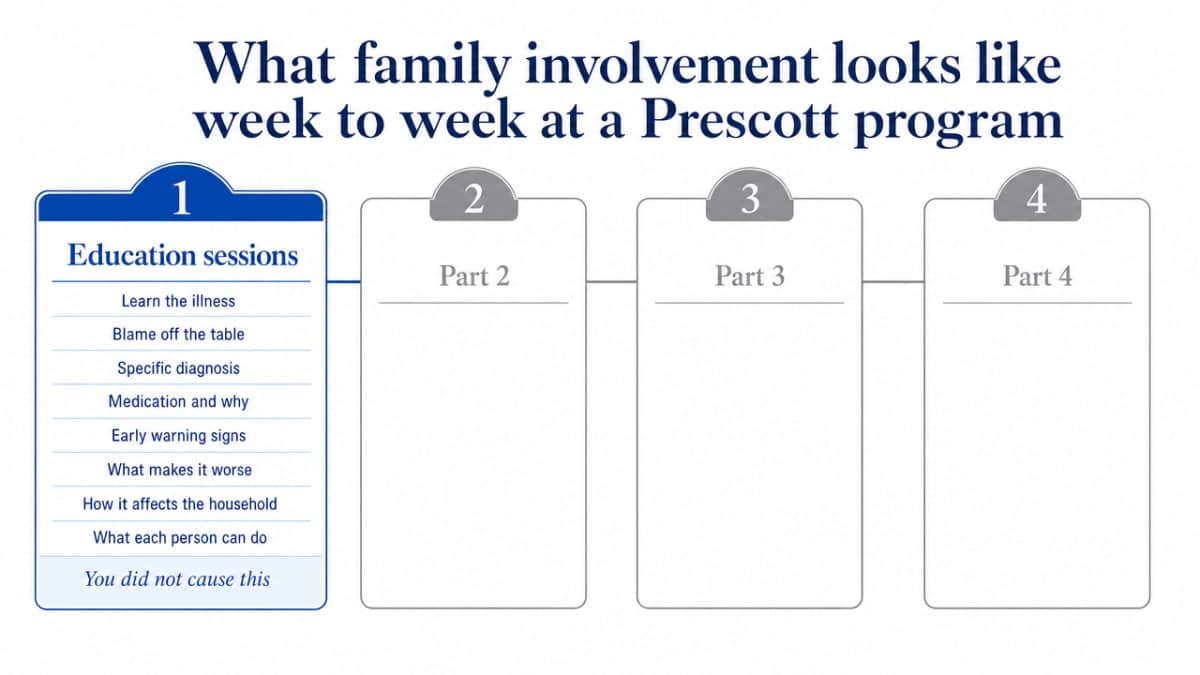
The first thing an education session usually does is take the blame off the table. You did not cause this. You cannot love it away. What you can do is learn to read it, and that is what these sessions are for.
In a structured psychoeducation block, a clinician walks your family through the actual diagnosis your loved one carries. Not the Wikipedia version. The specific symptom pattern, the medication being used and why, the early warning signs of relapse for this person, and the things that reliably make it worse. SAMHSA’s family therapy guidance frames this kind of session as a working conversation about how the illness moves through a household and what each person can do about it 5.
You will hear terms you have been Googling at midnight for months. Prodrome. Adherence. Trigger. Once those words stop being scary and start being tools, the whole household calms down a notch. That drop in guesswork is one of the measurable outcomes: families who complete structured psychoeducation report better knowledge about the illness and lower stress at home 6.
Structured family sessions inside a treatment-resistant plan
A structured family session is not a group vent. It has an agenda, a clinician facilitating it, and a purpose tied to the week’s clinical work. Arizona recognizes marriage and family therapy as a licensed specialty, defined as the professional application of family systems theories and techniques to treat interpersonal relationship issues and mental and emotional disorders 16. That is the training in the room with you.
In a treatment-resistant plan, sessions tend to follow the arc of care. Early on, you might spend a session mapping the last relapse together: what the household saw, what got missed, what a repeat would look like. A few weeks in, a session may focus on communication patterns that quietly raise the temperature at home, and how to interrupt them. Later, sessions shift toward discharge planning, medication routines, and how to respond if symptoms start to creep back.
The broader engagement literature backs this up. When families are actively included through education, planning meetings, and crisis support, relapses drop, hospital admissions fall, inpatient stays shorten, and adherence improves, with benefits that hold when engagement is maintained 3. That last word matters. A single session is a start. A structured series is what moves the numbers.
Family weekends: what actually happens in the room
A family weekend sounds softer than it is. In a program built for treatment-resistant psychiatric care, it is a working weekend, and it earns its place on the schedule.
A typical block runs across two days and stacks four kinds of work:
- An education segment covering the specific diagnosis and current medication plan, in language a non-clinician can actually use.
- A joint session where you and your loved one talk with a therapist present, so hard conversations happen with a facilitator instead of at a kitchen table at 11 p.m.
- Communication skills practice — real drills, not lectures — for how to name a symptom without starting a fight.
- A safety and relapse plan that names early warning signs, who calls whom, and what the first three steps are if things start to slip.
SAMHSA’s family therapy guidance describes this same combination of education, joint work, and planning as the core of effective family sessions in recovery 5.
You will probably cry at some point. You will probably laugh at some point too. Both are fine. The 2023 multifamily psychoeducation trial in schizophrenia and related disorders found that this kind of structured work reduced caregiver burden and caregiver depression alongside patient relapse risk 1. Translation: the weekend is designed to give something back to you, not just extract more from you.
How family work sits alongside clozapine protocols and dual diagnosis care
In a treatment-resistant case, family work is not running on a parallel track from the medical plan. It is woven into it.
If your loved one is on a clozapine protocol, for example, the medication requires regular blood monitoring and consistent dosing to work. A family that understands why a missed dose is a bigger deal than it looks becomes part of the adherence system. If dual diagnosis is in the picture — and inside Arizona’s public mental health system, 21% of adult clients carry co-occurring mental health and substance use disorders 11 — family sessions have to cover both. That means talking openly about how substance use interacts with psychiatric symptoms, and building a home plan that does not pretend one of the two conditions is not there.
Arizona has already treated this integrated, family-centered approach as a policy expectation in other contexts. The Arizona Families F.I.R.S.T. program manual, for instance, requires that co-occurring trauma, domestic violence, and mental illness be incorporated into treatment for clients who need it 14. In a Prescott program built around treatment-resistant and dual diagnosis care, that same principle drives how your family shows up in the plan.
Taking the next step as the person making the call
You have already carried this longer than most people know. The next step is smaller than it feels. It is a phone call, on a Tuesday, from your car, with a list of questions in your lap.
When you call a Prescott program built for treatment-resistant psychiatric care and dual diagnosis, ask three things:
- What does family involvement actually include — how many sessions, how long, and is a family weekend part of the plan?
- How is the model delivered with fidelity, since diluted versions do not produce the same outcomes 6?
- How are both diagnoses handled in the same room when substance use and a psychiatric condition are both on the table 14?
You do not need to have the right words. You do not need your loved one’s permission to gather information. Under Arizona’s Title 36 definition, if you are a spouse, parent, adult child, adult sibling, or other blood relative, your standing to ask is already named 15. Make the call. Bring your exhaustion with you. This time, a team is expecting you at the table.
Find out if our family therapy fits
Get expert guidance on next steps for your family’s mental health recovery journey.

Frequently Asked Questions
Who counts as a family member for treatment involvement in Arizona?
Under A.R.S. § 36-501, a family member is a spouse, parent, adult child, adult sibling, or other blood relative of the person in treatment or evaluation 15. If you fit one of those categories, your standing to be involved is already named in state law. Chosen family and unmarried partners are not spelled out in the statute, so a program will usually ask your loved one to sign a written release naming you.
Does family therapy actually reduce relapse and rehospitalization?
For schizophrenia and related disorders, yes. Structured family psychoeducation delivered with fidelity is linked to 20 to 50 percent fewer relapses and rehospitalizations than standard services, along with better family knowledge and lower stress at home 6. The effect is strongest in schizophrenia-spectrum care 2. For depression, the signal is smaller and lower certainty 4. Expect real gains, and ask how the model is delivered.
What happens during a family weekend at a Prescott program?
A family weekend usually stacks four kinds of work across two days: an education block on the specific diagnosis and medication plan, a joint session with a therapist facilitating hard conversations, communication skills practice, and a written safety and relapse plan. SAMHSA describes this same combination — education, joint work, and planning — as the core of effective family therapy in recovery 5. Expect real work.
How does family involvement work when my loved one has both a psychiatric diagnosis and a substance use disorder?
Both conditions come into the same room. Inside Arizona’s public mental health system, 21% of adult clients carry co-occurring mental health and substance use disorders 11, and Arizona policy already treats integrated, family-centered care as an expectation for co-occurring cases 14. Your sessions will cover how use interacts with psychiatric symptoms, how withdrawal can mimic relapse, and how the home plan protects both tracks at once.
What if previous treatment programs didn’t include us or didn’t hold?
You are not starting over from zero — you are choosing a different model. Broad evidence shows that when families are actively included through education, planning, and crisis support, relapses drop, admissions fall, inpatient stays shorten, and adherence improves, especially when engagement is sustained 3. A program built for treatment-resistant psychiatric care and dual diagnosis expects you at the table, not in the waiting room.
How do I take the next step if I’m the one making the call?
Pick up the phone. You do not need your loved one’s permission to gather information, and under Title 36 your standing as a spouse, parent, adult child, adult sibling, or blood relative is already recognized 15. Ask what family involvement includes, how many sessions and weekends are built in, and how the team handles both a psychiatric diagnosis and substance use in the same plan 14.
References
- Family psychoeducation to improve outcome in caregivers of patients with schizophrenia and related disorders. https://pmc.ncbi.nlm.nih.gov/articles/PMC10326382/
- Evidence-Based Family Psychoeducational Interventions for Patients With Schizophrenia and Their Families. https://pmc.ncbi.nlm.nih.gov/articles/PMC2247440/
- Family engagement as part of managing patients with mental illness. https://pmc.ncbi.nlm.nih.gov/articles/PMC8801858/
- Effectiveness of family psychoeducation for major depressive disorder: a systematic review and meta-analysis. https://pmc.ncbi.nlm.nih.gov/articles/PMC9380172/
- Family Therapy Can Help: For People in Recovery From Mental Illness or Addiction. https://library.samhsa.gov/product/family-therapy-can-help-people-recovery-mental-illness-or-addiction/sma15-4784
- Family Psychoeducation Best and Promising Practices Fact Sheet. https://sites.rutgers.edu/nec-mhttc/wp-content/uploads/sites/1286/2025/01/FamilyPsychoeducation-BPP-Fact-Sheet.pdf
- Behavioral Health Barometer: Arizona, Volume 4. https://www.samhsa.gov/data/sites/default/files/Arizona_BHBarometer_Volume_4.pdf
- Behavioral Health Barometer: Arizona, Volume 8 (2021–2023 Indicators). https://www.samhsa.gov/data/sites/default/files/reports/rpt56781/2023-nsduh-barometer-arizona.pdf
- ARIZONA – National Survey on Drug Use and Health State Tables. https://www.samhsa.gov/data/sites/default/files/reports/rpt56188/2023-nsduh-sae-state-tables_0/2023-nsduh-sae-state-tabs-arizona.pdf
- Behavioral Health Barometer: Arizona, Volume 6. https://www.samhsa.gov/data/sites/default/files/reports/rpt32819/Arizona-BH-Barometer_Volume6.pdf
- Arizona 2022 Uniform Reporting System Mental Health Data Results. https://www.samhsa.gov/data/sites/default/files/reports/rpt42739/Arizona.pdf
- Arizona 2024 Uniform Reporting System Mental Health Data Results. https://www.samhsa.gov/data/sites/default/files/reports/rpt56435/Arizona.pdf
- Behavioral Health Barometer: Arizona, Volume 5. https://www.samhsa.gov/data/sites/default/files/cbhsq-reports/Arizona-BH-BarometerVolume5.pdf
- THE ARIZONA FAMILIES F.I.R.S.T. PROGRAM MANUAL. https://extranet.azdcs.gov/DCSPolicy/Content/Program%20Policy/03%20Case%20Planning%20and%20Services/Links/Arizona%20Families%20FIRST%20Program%20Manual%202020_12_22.pdf
- A.R.S. § 36-501 – Definitions (Family member). https://www.azleg.gov/ars/36/00501.htm
- Chapter 0241 – Behavioral Health Professions (Marriage and family therapy definition). https://www.azleg.gov/legtext/53leg/2r/laws/0241.htm