Key Takeaways
- Psychiatric medication care unfolds in three phases—acute, continuation, and maintenance—so a single prescription cannot substitute for months or years of monitored adjustment 10.
- For complex diagnoses like schizophrenia and bipolar disorder, maintenance treatment often runs from 18 months to lifelong, requiring a prescriber who plans for that timeline 9, 3.
- Fragmented prescribing across multiple providers is the norm, and for dual-diagnosis cases it can improve antipsychotic adherence while worsening cardiometabolic follow-through 6, 5.
- When comparing Prescott options, look for integrated psychiatry, therapy, and medical monitoring under one team, plus aftercare that preserves the same clinical relationship 7.
When the Prescription Keeps Changing but Nothing Gets Better
You know the pattern. A new prescriber, a new medication, a promise that this one might be different. Six weeks later, you’re back to describing the same symptoms to someone who doesn’t quite remember the last three medications you tried, or why you stopped them. The prescription changes. The stability doesn’t.
If that’s where you are, it isn’t a personal failing. It’s what happens when psychiatric care gets treated as a series of prescriptions instead of a continuous relationship. Research on Medicaid patients with multiple chronic conditions found that having a single provider manage medications is the exception, not the rule — most people cycle through several prescribers, each seeing only a slice of the picture 6. For someone with treatment-resistant depression, rapid-cycling bipolar disorder, or schizophrenia complicated by substance use, that fragmentation is often the actual problem hiding under a diagnosis of “treatment resistance.”
Here’s the harder truth: for complex psychiatric diagnoses, a single prescription was never going to be enough. The guidelines don’t describe medication as a one-visit event. They describe it as a phased, monitored process that unfolds over months and years — adjusting doses, watching for side effects, coordinating with other clinicians, and revisiting the plan as your life changes 2.
This piece walks through what “ongoing psychiatric medication management” actually involves, why continuity matters more for complex diagnoses than for routine ones, and what a Prescott-based option built around that continuity looks like. You’ve likely done the hard work of trying already. What’s missing may not be another new medication. It may be someone staying with you long enough to see what’s really happening.
What ‘Ongoing’ Actually Means in Psychiatric Care
The Three Phases: Acute, Continuation, Maintenance
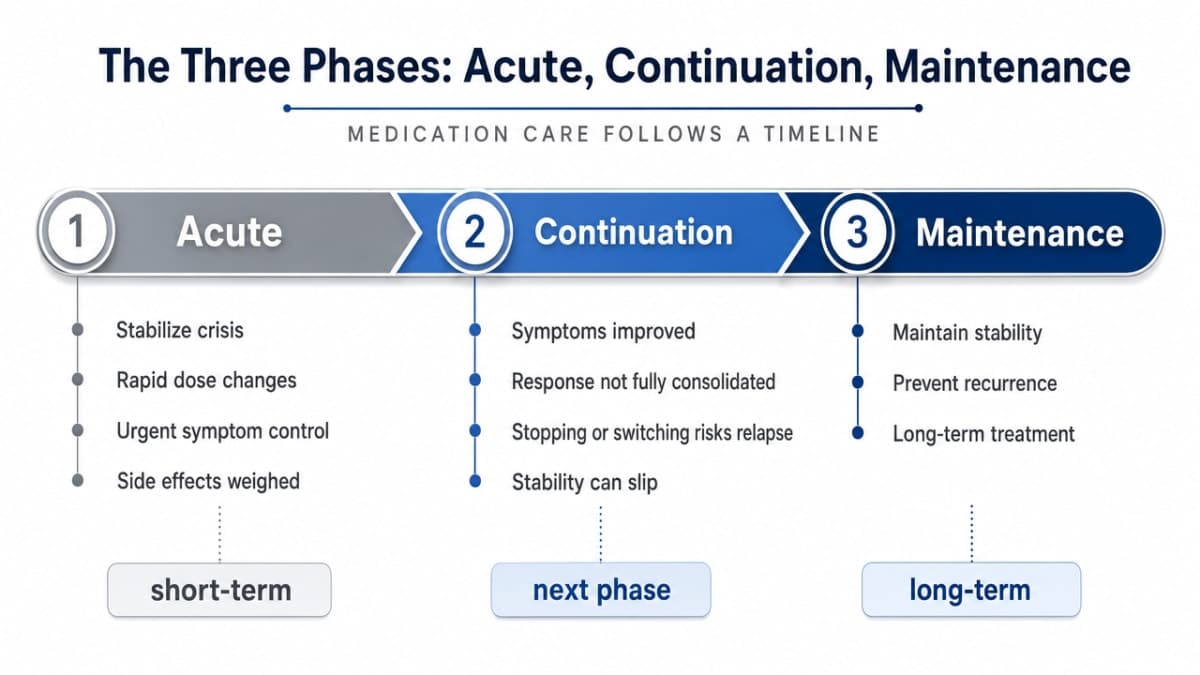
Psychiatric treatment isn’t shaped like a prescription pad. It’s shaped like a timeline. Major practice guidelines describe medication care in three distinct phases, and each one has a different job to do 10.
- Acute phase
- The acute phase is what most people picture when they think about psychiatric medication: stabilize the crisis. Bring down the mania, quiet the psychosis, pull someone back from a suicidal depression. This is where dose changes happen quickly and side effects are weighed against the urgent need to get symptoms under control.
- Continuation phase
- The continuation phase is where a lot of care quietly falls apart. Symptoms have improved, so it feels like the emergency is over — but the brain hasn’t fully consolidated the response yet. Stopping or switching medication here is one of the most common ways stability slips. Guidelines are explicit that the agents that worked in the acute phase should generally be continued into continuation and maintenance 4.
- Maintenance phase
- The maintenance phase is the long stretch. For bipolar disorder, review guidelines describe a maintenance phase lasting anywhere from 1 to 2 years to a lifetime, depending on the pattern of episodes and the person’s risk profile 10. The clinical goal shifts from stabilization to relapse prevention and long-term monitoring — watching for the metabolic changes, kidney or thyroid effects, and cognitive shifts that come with years on the same regimen. The APA guideline for schizophrenia frames the same logic: once a patient improves on an antipsychotic, the recommendation is to continue it and keep monitoring both effectiveness and side effects 2.
Each phase asks something different from the person prescribing. That’s why one visit, no matter how thorough, can’t do the work of three phases spread across years.
Why a Single Prescription Is Not a Treatment Plan
Here’s what a prescription actually is: a snapshot. It captures what one clinician thought would help on one afternoon, based on what you were able to describe in twenty or thirty minutes. That’s useful. It’s not a plan.
A plan is what happens between prescriptions. Are the voices quieter or just further away? Is the sleep real sleep, or medication sleep that leaves you exhausted? Did the lithium level come back where it should be, and has your thyroid started to drift? Did the new antipsychotic add fifteen pounds in two months and push your fasting glucose in the wrong direction? None of that shows up on a prescription. All of it shows up in the follow-up.
The bipolar literature makes this concrete. Maintenance dosing isn’t a fixed setting — it involves active titration, deliberate simplification when possible, and matching the agent to the pattern of illness (lamotrigine when depression dominates, lithium or a second-generation antipsychotic when mania does) 11. That kind of tailoring only works if someone is watching over time.
If you’ve been treated as a series of refills, you already know how this fails. A prescriber you barely know inherits a regimen they didn’t design. Something isn’t quite right, but there’s no one who remembers what “right” looked like for you six months ago. So the dose gets bumped, or a new agent gets added, and the picture gets muddier.
The plan is the relationship. The prescription is just one artifact of it.
How Long Maintenance Actually Lasts for Complex Diagnoses
Schizophrenia: 18 Months, Often 2 to 5 Years or Longer
If you’ve been told you’ll need to stay on an antipsychotic “for a while,” here’s what the guidelines actually say a while means.
After the positive symptoms of an acute schizophrenia episode resolve, published pharmacotherapy guidelines recommend continuing maintenance antipsychotic treatment for a minimum of 18 months — and often 2 to 5 years or longer, depending on how many episodes you’ve had and how disruptive they’ve been 9. For someone with recurrent episodes or a first episode that took a heavy toll, indefinite maintenance is frequently the recommendation.
The reason isn’t stubbornness on the part of the field. It’s what happens when maintenance stops too early. A large body of systematic-review evidence shows that maintenance antipsychotic treatment prevents relapse far more effectively than placebo across roughly two years of follow-up 1. Relapse isn’t just a return of symptoms — each episode can extend recovery time, disrupt work and relationships, and make the next episode harder to treat.
Bipolar Disorder: 12 to 18 Months After Mania, Often Lifelong
Bipolar disorder has its own duration logic, and it’s shaped by how the illness recurs. You may have felt this yourself — a stretch of stability that convinced you the medication was doing nothing, followed by a return of symptoms weeks or months after stopping.
Current bipolar guidelines recommend maintenance treatment for at least 12 to 18 months after stabilization of a manic episode, with further continuation depending on your history, your risk profile, and an ongoing conversation between you and your prescriber 3. Comparative reviews of psychiatric practice guidelines put the maintenance window somewhere between 1 to 2 years and lifetime, and many people with recurrent bipolar illness fall on the longer end of that range 10.
The agent matters, too. If a specific medication brought you out of the acute episode, guidelines generally recommend continuing it into maintenance rather than swapping to something new once you feel better 4. First-line maintenance options include lithium, quetiapine, divalproex, and lamotrigine, and the choice often depends on the pattern of your illness — lamotrigine tends to be favored when depression dominates, while lithium or a second-generation antipsychotic may be favored when mania does 11.
That tailoring is exactly why maintenance isn’t a set-and-forget prescription. It’s an ongoing decision. Your pattern can shift over years. Side effects that were tolerable at 30 may not be at 50. A regimen that made sense during a manic-dominant phase may need to change as depressive episodes become more prominent.
If you’ve been on the same combination for years without anyone reassessing whether it’s still the right combination, that’s not stability. That’s inertia. Maintenance is meant to be reviewed, not just refilled.
The Coordination Problem Nobody Warns You About
Fragmented Prescribing Is the Default, Not the Exception
If you’ve been prescribed psychiatric medication by more than one clinician in the last few years, you’re not an outlier. You’re the norm.
An observational study of Medicaid beneficiaries with multiple chronic conditions, including subgroups with schizophrenia and depression, found that having a single provider manage medications is the exception rather than the rule — most patients receive prescriptions from multiple providers, which fractures longitudinal, informational, and management continuity 6. The default state of the system is that no one person holds the whole picture of your care.
That’s worth sitting with for a minute, because it reframes what’s been happening to you. When medications get changed without a clear reason, when a side effect gets missed until it becomes a bigger problem, when the same conversation about the same symptom happens for the third time with someone new — that isn’t necessarily anyone’s individual failure. It’s a structural feature of how prescribing usually works.
For routine conditions, fragmentation is inconvenient. For treatment-resistant schizophrenia, rapid-cycling bipolar disorder, and dual-diagnosis cases, it’s actively dangerous. The subtle signals that a maintenance regimen needs adjusting — a slight change in affect, a creeping metabolic shift, a pattern of missed doses — only register when someone knows what your baseline looks like. A new prescriber every six months doesn’t have that baseline. They have a chart and twenty minutes.
Continuity, in other words, has to be engineered. It doesn’t happen by accident inside a fragmented system.
The Dual-Diagnosis Trade-Off in Multi-Prescriber Care
Here’s where it gets more complicated, and where a lot of well-meaning advice about “seeing a specialist” runs into evidence that doesn’t quite cooperate.
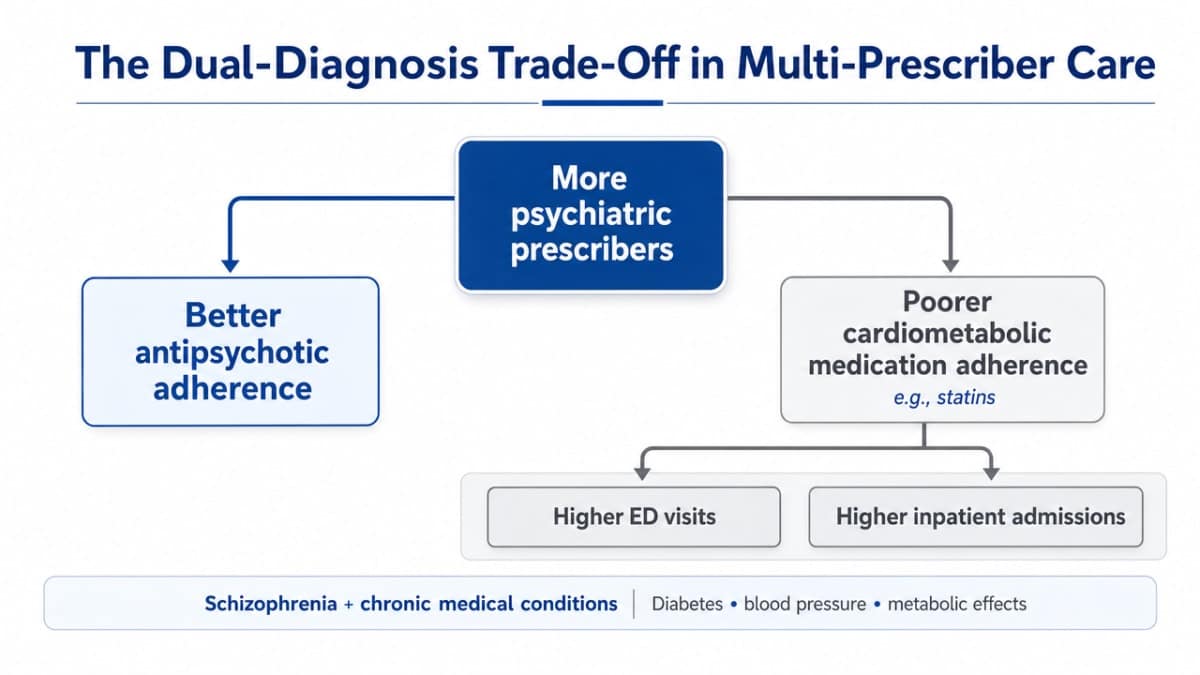
A study of adults with schizophrenia and comorbid chronic medical conditions looked at what happens when multiple psychiatric specialist prescribers are involved in a patient’s care. The finding cuts in two directions at once:
- having more psychiatric specialists was associated with better antipsychotic adherence
- but also with poorer adherence to cardiometabolic medications like statins
- and with higher rates of emergency department visits and inpatient admissions 5
If you’re managing schizophrenia alongside diabetes, high blood pressure, or the metabolic effects that many antipsychotics themselves produce, that trade-off matters. Second-generation antipsychotics can raise your fasting glucose, shift your lipid panel, and add weight that puts your cardiovascular system under real strain. The medications that keep the psychosis quiet can quietly worsen the medical conditions that kill people with schizophrenia decades earlier than the general population. You need someone tracking both sides at once.
This is the specific reason integrated teams matter more for dual diagnosis than for single-diagnosis care. When your psychiatry, your therapy, and your medical monitoring live inside the same team — sharing notes, sharing lab results, sharing a plan — the coordination stops depending on you to be the messenger between providers who’ve never spoken. When they don’t, the burden of holding it together falls on you and your family, usually during the periods when you have the least capacity to carry it.
What you’re looking for isn’t just a prescriber. It’s a prescribing arrangement designed to close the gaps the research says are usually open.
What Good Medication Management Looks Like Month to Month
Titration, Side-Effect Tracking, and Rational Simplification
Month to month, good medication management isn’t dramatic. It’s small, deliberate, and unglamorous — which is part of why it gets skipped.
Titration is the first piece. Doses aren’t set at the first visit and left alone. A prescriber who’s actually managing your care is watching how you responded to the last change, what shifted in your sleep or your energy or your intrusive thoughts, and whether the current dose is doing what it was supposed to do. If a symptom is still breaking through, the answer isn’t automatically a new medication — sometimes it’s more time at the current dose, sometimes a small upward adjustment, sometimes a change in timing. That decision requires knowing what “before” looked like.
Side-effect tracking runs in parallel. For second-generation antipsychotics, that means periodic weight, fasting glucose, and lipid panels — the metabolic parameters that quietly drift and eventually become their own diagnoses. For lithium, it means lithium levels, kidney function, and thyroid checks on a schedule. For clozapine, it means the absolute neutrophil count monitoring the protocol requires. The APA schizophrenia guideline is explicit that once a patient improves on an antipsychotic, the standard is to continue it while monitoring both effectiveness and side effects — not one or the other 2.
Then there’s rational simplification. If you’ve been on the same three or four medications for years, some of them may have been added during a crisis that’s long since passed. Bipolar maintenance guidance points toward monotherapy when it’s achievable, and toward matching the agent to your current pattern of illness rather than the pattern you had at diagnosis 11. That kind of periodic pruning — asking whether every medication on the list is still earning its place — only happens when someone has the time and the relationship to do it carefully. Rushed handoffs default to leaving everything as-is, because changing something you don’t fully understand is riskier than continuing it.
Relational Continuity and Why It Changes Outcomes
There’s a version of continuity that lives on paper — a shared chart, an accurate medication list, a note about what was tried and why it was stopped. That version matters. But it’s not the whole thing.
The other version is relational: the same clinician, or the same tight team, knowing you well enough to notice when something is off before you’ve fully put it into words. A systematic review of continuity in severe mental illness found that higher continuity of care may prevent premature deaths and suicide, lower emergency department visits, and improve quality of life 7. Those aren’t soft outcomes. They’re the outcomes that separate a life that holds together from one that keeps unraveling in the same places.
What that looks like in practice is small. A prescriber who remembers that flat affect is your baseline, not a warning sign — and that when your affect brightens artificially, that’s the warning sign. Someone who notices that you’re describing your sleep differently than you did six weeks ago. A team that catches a subtle akathisia before it becomes the reason you stop taking the medication altogether.
If you’ve had good relational continuity before, you already know how much lighter the whole system feels when someone else is helping hold it. If you haven’t, it can be hard to imagine that as a real option. It is one. And for complex psychiatric diagnoses, it’s arguably the single most protective factor a treatment plan can have.
A Prescott Option Built Around Continuity
If you’ve read this far, you’re probably not looking for another prescriber to try. You’re looking for a place where the prescribing is actually connected to everything else — the therapy, the medical monitoring, the plan for what happens after the intensive part of treatment ends.
ViewPoint Dual Recovery is a Joint Commission-accredited psychiatric treatment facility in Prescott, Arizona, built specifically for cases other programs consider too complex: treatment-resistant schizophrenia, rapid-cycling bipolar disorder, and dual-diagnosis presentations where a mental health condition and a substance use disorder are tangled together. On-site, board-certified psychiatry is part of every treatment plan, which means the person adjusting your medication is part of the same team running your therapy and tracking your labs — not a name on a referral you’ll follow up on later.
That matters for the coordination problem you already know too well. When psychiatry, therapy, and medical monitoring share notes inside one team, the trade-off between better antipsychotic adherence and worse cardiometabolic follow-through starts to close 5. When a clozapine protocol or a lithium regimen needs the kind of tight monitoring the guidelines actually call for, it happens in the same building where the rest of your care lives 2.
The other piece is what happens after. Discharge is where continuity most often breaks — a stable regimen gets handed to a new prescriber who inherits a chart instead of a relationship, and stability starts to erode within weeks. ViewPoint’s post-treatment medication management is designed to bridge that gap, keeping the same clinical team involved in your aftercare so titration, side-effect tracking, and rational simplification continue on the timeline your diagnosis actually needs. That kind of relational continuity is what the evidence links to fewer emergency visits, lower suicide risk, and better quality of life for people with severe mental illness 7.
If you’ve been carrying the coordination yourself for years, you don’t have to keep doing that alone. Talking to ViewPoint’s psychiatric care team is a place to start.
Start a real conversation about ongoing medication needs
Gain expert guidance on sustainable psychiatric medication management tailored to complex, treatment-resistant cases.
Frequently Asked Questions
How is ongoing psychiatric medication management different from just getting a refill?
A refill continues the last prescription. Ongoing management asks whether that prescription is still the right one. It includes dose titration, side-effect and lab monitoring, and periodic reassessment of whether the regimen still fits your current pattern of illness. The APA guideline frames this as continuing effective medication while actively monitoring both effectiveness and side effects, not one or the other 2.
How often should I expect to see a prescriber during maintenance treatment?
Frequency depends on your diagnosis, how recently you stabilized, and what your medications require in terms of lab monitoring. Early in maintenance, visits are often monthly. Once stable, they may stretch to every 6 to 12 weeks. Lithium, clozapine, and second-generation antipsychotics all carry monitoring schedules that shape the calendar. If you’re only seen for refills, you’re not actually in a maintenance protocol.
What happens if I’ve already tried several medications without stable results?
That’s more common than the word “treatment-resistant” suggests, and it isn’t always about the medication itself. Fragmented prescribing across multiple providers is the norm rather than the exception, which means past trials may not have had the follow-through to succeed 6. A specialized team can review what was actually tried, at what dose, for how long, and whether the reason it “failed” was pharmacologic or structural.
Can medication management coordinate with my primary care doctor for other conditions?
It should. Research on adults with schizophrenia and comorbid chronic conditions found that more psychiatric prescribers can improve antipsychotic adherence while worsening adherence to cardiometabolic medications like statins 5. That’s exactly why coordination with your primary care doctor matters. An integrated team shares labs, notes, and a plan so metabolic monitoring for antipsychotics doesn’t fall into the gap between your psychiatrist and your PCP.
What does aftercare medication management look like after a treatment program ends?
The strongest version is continuity of the same clinical team into outpatient life — same prescriber, same chart, same understanding of your baseline. That relational continuity is linked in the evidence to fewer emergency visits, lower suicide risk, and better quality of life for people with severe mental illness 7. Practically, aftercare should include scheduled follow-ups, lab monitoring on the timeline your medications require, and a clear plan for how to reach the team between visits.
Is on-site psychiatry available in Prescott for treatment-resistant and dual-diagnosis cases?
Yes. ViewPoint Dual Recovery is a Joint Commission-accredited psychiatric treatment facility in Prescott with board-certified psychiatry available on site, built specifically for treatment-resistant schizophrenia, rapid-cycling bipolar disorder, and dual-diagnosis presentations. That means medication decisions, therapy, and medical monitoring happen inside one team, and post-treatment medication management is designed to continue with that team rather than handing you off to a stranger.
References
- Maintenance treatment with antipsychotic drugs for schizophrenia. https://pmc.ncbi.nlm.nih.gov/articles/PMC9702459/
- The American Psychiatric Association practice guideline for the treatment of patients with schizophrenia. https://www.med.unc.edu/psych/epi-nc/wp-content/uploads/sites/720/2024/01/APA-2020-guidelines-1.pdf
- Clinical practice guidelines for the management of bipolar disorder. https://pmc.ncbi.nlm.nih.gov/articles/PMC12900052/
- The CANMAT and ISBD Guidelines for the Treatment of Bipolar Disorder: Summary and a 2023 Update of Evidence. https://pmc.ncbi.nlm.nih.gov/articles/PMC11058959/
- Continuity of Medication Management among Adults with Schizophrenia and Comorbid Chronic Conditions. https://pmc.ncbi.nlm.nih.gov/articles/PMC5849398/
- Continuity of Medication Management in Medicaid Patients With Multiple Chronic Conditions. https://pmc.ncbi.nlm.nih.gov/articles/PMC5843714/
- Relational continuity may give better clinical outcomes in patients with severe mental illness. https://pmc.ncbi.nlm.nih.gov/articles/PMC10729558/
- The American Psychiatric Association Practice Guideline for the Treatment of Patients With Schizophrenia. https://pmc.ncbi.nlm.nih.gov/articles/PMC7725162/
- Guidelines for the Pharmacotherapy of Schizophrenia in Adults. https://pmc.ncbi.nlm.nih.gov/articles/PMC5593252/
- Clinical Practice Guidelines in Psychiatry. https://pmc.ncbi.nlm.nih.gov/articles/PMC4003831/
- Mindful Medication Management in Bipolar Disorder (Lecture Slides). https://pharmacy.hsc.wvu.edu/media/4095/pipestem-mindful-med-oct-24-1-slides-per-page.pdf