Key Takeaways
- Rapid cycling is a DSM-5 course specifier describing at least four distinct manic, hypomanic, major depressive, or mixed episodes within 12 months, not a separate bipolar diagnosis 6.
- The pattern often shifts over time: in STEP-BD, 32% met the threshold at entry but only 5% still did a year later 3.
- Clinically, the specifier flags higher recurrence risk, heavier depressive load, and elevated suicidality, which shapes how treatment plans and co-occurring conditions get addressed 1, 9.
- Treatment implications include no clear winner between lithium and divalproex, a complementary role for lamotrigine on depression, and real caution around continued antidepressant use 4, 7, 5.
Four Episodes in a Year: The Pattern Behind the Term
If you’ve been told you have rapid cycling bipolar disorder, or you’re watching someone you love move through mood shift after mood shift, the first thing worth saying is this: four episodes in twelve months is a lot to live through. Exhaustion is a reasonable response. So is fear.
The term itself is specific. Rapid cycling describes a pattern where someone with bipolar I or bipolar II disorder experiences at least four distinct mood episodes — manic, hypomanic, major depressive, or mixed — within a 12-month window 6. It’s not a separate kind of bipolar disorder, and it’s not a personality trait. It’s a way of describing how often episodes have been showing up recently.
That distinction matters more than it might sound. The pattern can shift. In one large prospective study, most people with a prior rapid-cycling history did not keep meeting the four-episode threshold the following year 3. The label describes a window of time, not a verdict about the rest of your life.
What the term does flag is that the illness is being more active than usual, and that treatment deserves a closer look. The sections ahead walk through the definition, how common it is, what the research actually says about treatment, and when a higher level of psychiatric care starts to make sense.
The DSM-5 Definition in Plain Language
A Specifier, Not a Separate Type of Bipolar
Here’s a distinction that often gets lost: rapid cycling is a specifier, not a diagnosis of its own. You don’t have “rapid cycling disorder” the way you might have bipolar I or bipolar II. You have bipolar I or bipolar II, and the rapid cycling label describes how your episodes have been grouped recently 6.
Think of it like a note attached to a diagnosis rather than a replacement for it. The underlying illness is still bipolar disorder. The specifier just tells your clinician — and you — that in the past year, episodes have been coming more often than usual.
Why does the wording matter? Because “subtype” sounds permanent. “Specifier” is honest about what the term actually captures: a snapshot of a 12-month window. If your pattern changes next year, the specifier can change with it. The diagnosis stays. The description of your course updates 2.
That framing can take some pressure off. You are not a different kind of patient. You are someone whose bipolar disorder is being more active right now, and that is information your treatment plan can use.
The Four-Episode, 12-Month Rule and the Remission Clause
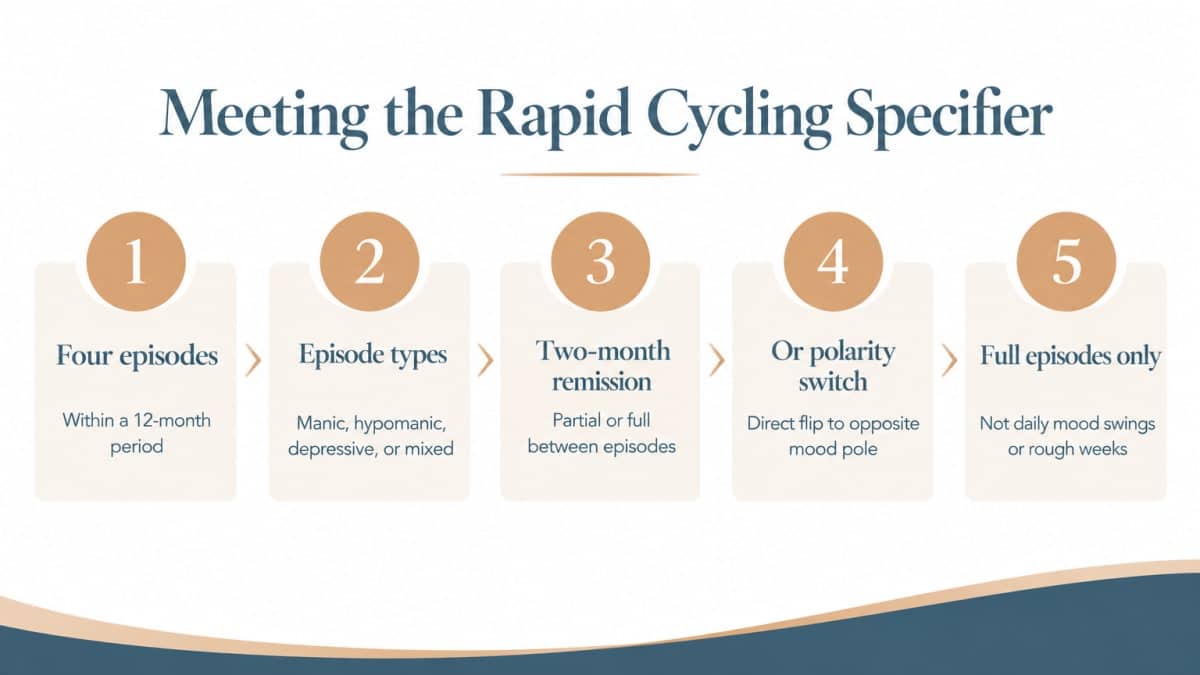
The counting rule is where the DSM-5 definition gets specific. To meet the rapid cycling specifier, you need at least four distinct mood episodes — manic, hypomanic, major depressive, or mixed — within a 12-month period 6.
Four episodes. Twelve months. That part is straightforward.
What trips people up is the rule about what separates one episode from the next. Episodes have to be marked off from each other in one of two ways:
- By at least two months of partial or full remission between them, or
- By a switch directly into an episode of the opposite polarity — for example, a depressive episode flipping into a manic or hypomanic one 6.
So if you had a depressive episode in January, started feeling steadier through March, then slid into another depression in April, those are two separate episodes under the rule. If you went straight from a manic episode in June into a depressive episode in July with no steady stretch between them, that polarity switch also counts them as two.
What doesn’t count: mood swings that happen within a single episode. A rough week inside an ongoing depression isn’t a new episode. Day-to-day irritability or quick mood shifts over hours don’t meet the threshold either. The DSM-5 is counting full clinical episodes, not emotional weather 2.
This is also why diagnosis takes time and careful history-taking. Nobody can meet the specifier based on a single rough month. The clinician is looking back across a year, mapping when episodes started, when they lifted, and whether what you lived through fits the formal definition of each episode type 6.
What Counts as a Mood Episode
Since the whole specifier depends on counting episodes, it helps to be clear about what an episode actually is.
Bipolar disorder involves four kinds of episodes that can be counted toward the rapid cycling threshold 10:
- Manic episode: A period of unusually elevated, expansive, or irritable mood with increased energy, severe enough to disrupt daily life or require hospitalization.
- Hypomanic episode: A shorter, less severe version of mania — noticeably elevated or irritable mood and energy, without the full impairment or psychosis that marks a manic episode.
- Major depressive episode: A period of persistent low mood or loss of interest, along with changes in sleep, energy, appetite, concentration, or thoughts of death.
- Mixed features: Symptoms of both poles showing up at the same time — depression carrying agitation and racing thoughts, or mania threaded with hopelessness.
Each one, when it meets the full criteria, is one episode. Four of them in a year is what the specifier is measuring 6.
How Common Is This Pattern?
Prevalence Numbers Vary Widely for a Reason
If you’ve gone looking for a straight answer about how common rapid cycling is, you’ve probably noticed the numbers don’t agree. One source says 5%. Another says a third of people with bipolar disorder. That’s a huge spread, and it can leave you wondering what to actually believe.
The spread is real, and there’s a reason for it. A 2023 systematic meta-review pooling 30 studies with 13,698 people found a one-year prevalence of 22.3% and a lifetime prevalence of 35.5% 2. A separate systematic review reported one-year estimates ranging anywhere from 5% to 33.3% across the research base 6. A 2023 cohort study of 1,261 bipolar patients landed lower, at 9.36% with a history of rapid cycling 1.
What’s driving the gap? Mostly, how researchers set up the question. Some studies ask whether someone has ever met the four-episode threshold. Others only count the past year. Some draw from specialty clinics where more complex cases cluster. Others pull from community samples. The definitions themselves have shifted over the years too 2.
The honest takeaway: rapid cycling is not rare, but it isn’t the default experience of bipolar disorder either. Somewhere in the range of roughly one in ten to one in three people with bipolar disorder will meet the specifier at some point.
Who Tends to Develop It
Rapid cycling doesn’t land evenly across everyone with bipolar disorder. A few patterns show up often enough across studies to be worth knowing.
Bipolar II appears to carry higher risk than bipolar I. In the 2023 cohort of 1,261 patients, 15.2% of bipolar II participants had a rapid-cycling history, compared with 3.74% of bipolar I participants 1. Women also showed somewhat higher rates in that same cohort 1.
Beyond type and gender, systematic reviews have linked rapid cycling with earlier age of onset, a longer illness course, and higher rates of co-occurring substance use problems 6. None of these are causes exactly — they’re clinical correlates, factors that tend to travel with the pattern.
If you see yourself in some of these descriptions, try not to read them as a sentence. They’re context for your clinician, not a prediction about your future. Plenty of people with every one of these risk factors go on to have long stretches of stability. The point of knowing them is simple: they give the team around you more information to work with when they’re building a treatment plan that actually fits your situation.
The Good News Most Articles Skip: It Often Fluctuates
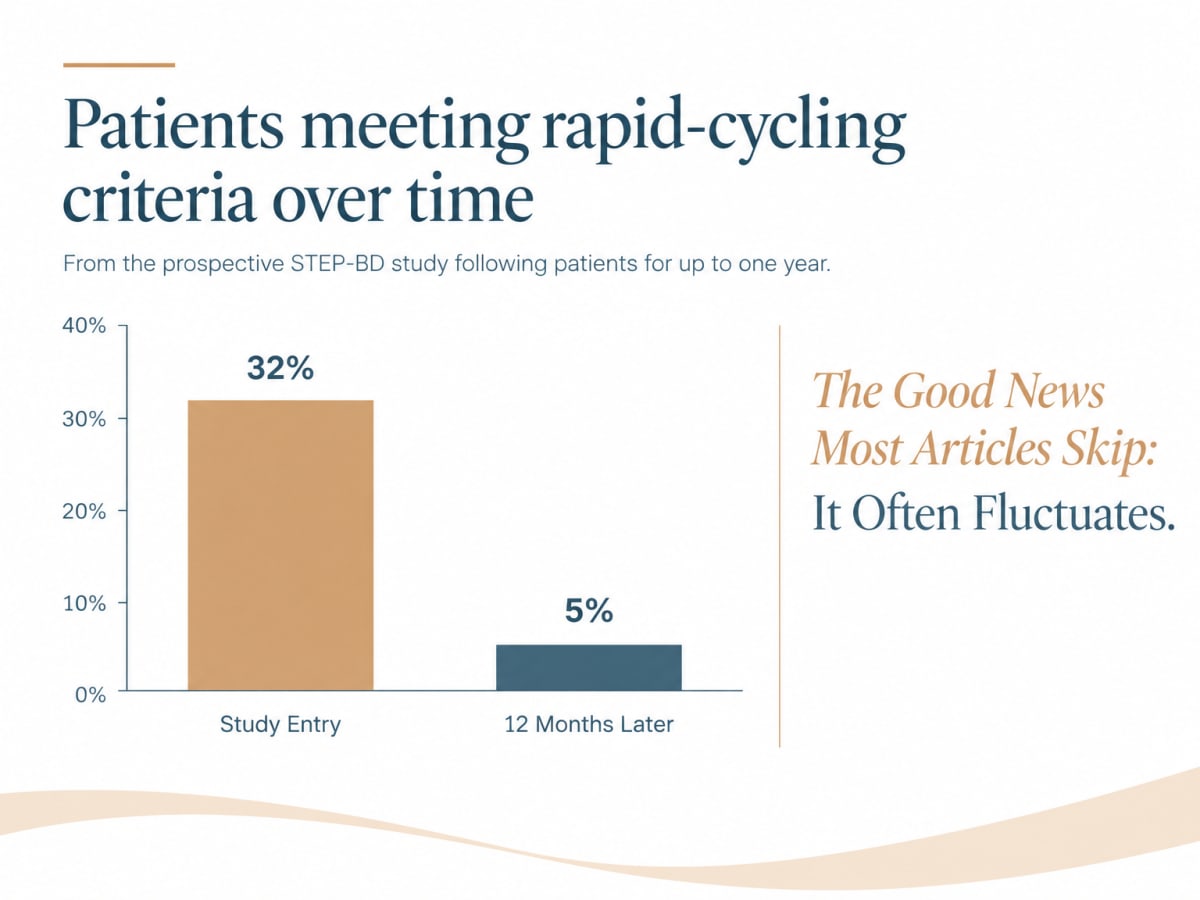
The clearest evidence for this comes from the STEP-BD study, one of the largest prospective looks at the course of bipolar disorder. At study entry, 32% of participants met the rapid-cycling threshold for the preceding year. Twelve months later, after a year of follow-up, only 5% still met it 3. The pattern that had been there going in didn’t hold for the vast majority of people going forward.
That’s a striking shift, and it’s worth sitting with for a moment. If you’ve been told you have rapid cycling, the research base is actually telling you something hopeful about the odds of still meeting that specifier a year from now.
Other data points land in the same place. In the 2023 cohort of 1,261 bipolar patients, 79.5% of those with a prior rapid-cycling history averaged fewer than four episodes per year during follow-up 1. A separate two-year multicenter survey found rapid cycling in 10.6% of participants, but only 3.6% stayed in a rapid-cycling pattern across both years 8.
None of this means the past year wasn’t hard, or that treatment stops mattering. It means the label is describing a season, not a permanent setting. That’s a real difference, and it’s worth holding onto when the exhaustion makes the future feel fixed.
Rapid Cycling Bipolar vs. Borderline Personality Disorder
If you searched “rapid cycling BPD” and landed here, you’re not the only one. The two terms get confused all the time, partly because “BPD” is used as shorthand for both bipolar disorder and borderline personality disorder in different corners of the internet. They are not the same condition.
Rapid cycling bipolar disorder is a mood disorder with a course specifier. The shifts you’re counting are full mood episodes — manic, hypomanic, major depressive, or mixed — each lasting days to weeks and separated by remission or a polarity switch 6. The underlying illness involves neurobiological mood regulation, and medication is a central part of treatment 10.
Borderline personality disorder is a personality disorder. The mood shifts there are usually faster — hours, not weeks — and tend to be triggered by relationship stress or fear of abandonment rather than arriving on their own. Treatment leans heavily on specific psychotherapies rather than mood stabilizers.
The two can co-occur, which makes careful assessment matter. If your clinician is taking time with your history, that’s a good sign — they’re trying to see which pattern is actually driving what you’re living through, so the treatment plan fits.
Why This Pattern Matters Clinically
Higher Recurrence and Depressive Load
If rapid cycling often fluctuates year to year, you might wonder why clinicians treat the specifier so seriously when it does apply. The answer sits in what the past year has actually looked like for people meeting the threshold — and in what the research shows about the months that follow.
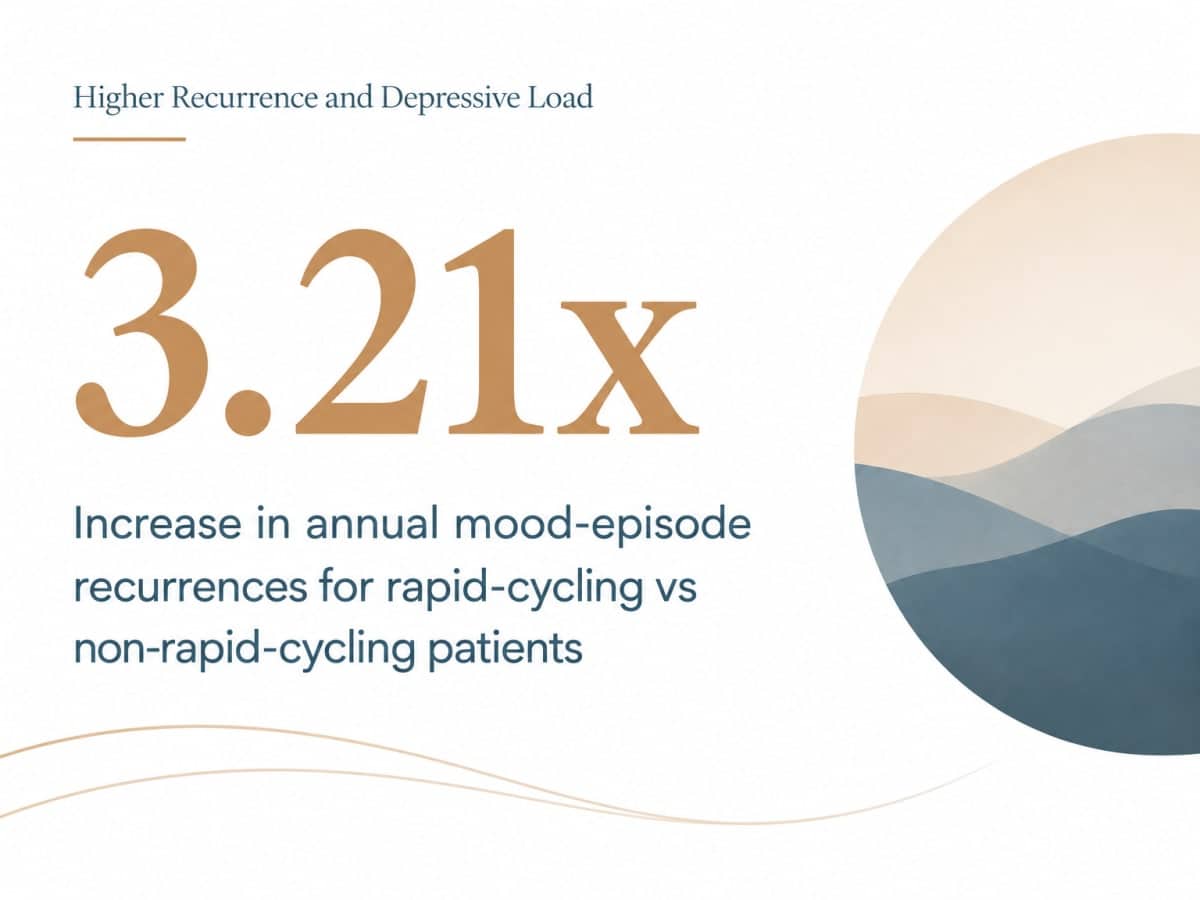
In the 2023 cohort study of 1,261 people with bipolar disorder, participants with rapid cycling had 3.21 times the average prospective annual recurrence rate of non-rapid-cycling participants during follow-up 1. That’s not a small gap. Even accounting for how often the pattern eases up over time, people who have met the specifier are, on average, moving through more episodes in the year ahead than peers who haven’t.
Depression tends to carry the heavier share of that load. The same cohort found that the increased recurrence risk was especially pronounced for depressive episodes 1. Earlier reviews describe something similar: rapid cycling is often characterized by frequent depressive and manic symptoms, with depression driving much of the day-to-day burden 9.
That matters for how your treatment plan gets built. A regimen that stabilizes mania but leaves depression recurring won’t feel like stability from where you’re sitting.
Suicidality, Comorbidity, and Substance Use
Beyond episode count, rapid cycling tends to travel with other clinical concerns that deserve honest naming.
Suicidal risk is one of them. The 2023 cohort found higher suicidal risk among participants with a rapid-cycling history 1. Systematic reviews have reported similar associations across portions of the research base, linking the pattern with increased suicidality 6. If you’ve had thoughts of suicide alongside the mood shifts, you are not an outlier — and that part of your history belongs in the conversation with your clinician.
Co-occurring psychiatric conditions are also common. Reviews describe rapid cycling as frequently accompanied by other mental health conditions and substantial clinical burden 9. Substance use problems come up repeatedly too, often alongside earlier age of onset and a longer illness course 6.
None of this is said to frighten you. It’s said because treatment plans that only address the mood episodes — without looking at substance use, trauma history, or co-occurring conditions — tend to leave the biggest drivers untouched. The pattern asks for a wider assessment, and a care team willing to treat what’s actually there.
What Treatment Actually Looks Like
Lithium and Divalproex: Closer Than You’d Think
For years, there was a working assumption in parts of the field that divalproex (valproate) was the better choice for rapid cycling, while lithium struggled to hold the pattern. The direct evidence doesn’t really back that up.
The clearest head-to-head comes from a 20-month double-blind maintenance trial that randomized people with rapid-cycling bipolar disorder to lithium or divalproex after they had been stabilized. Relapse into any mood episode happened in 56% of the lithium group and 50% of the divalproex group — a gap that didn’t reach statistical significance 4. The authors found no support for the idea that divalproex outperformed lithium.
What that means practically: neither medication is a magic answer, and neither is clearly second-string. Both relapse rates are high enough to say out loud. Monotherapy with either agent left roughly half of participants having another episode over the follow-up period, which is part of why many clinicians treating rapid cycling move toward combination strategies rather than counting on a single drug to do all the work 12.
Lamotrigine’s Role for the Depressive Side
Because depression carries so much of the weight in rapid cycling, the medication question isn’t only about preventing mania. It’s also about keeping the depressive side from pulling you back down every few months.
Lamotrigine shows up often in this part of the conversation. In an 18-month placebo-controlled maintenance trial in bipolar I disorder, both lamotrigine and lithium delayed the time to any mood episode compared with placebo — but with different strengths. Lamotrigine was particularly useful for delaying depressive episodes, while lithium had the edge on manic, hypomanic, and mixed episodes 7.
That’s why you’llسometimes see lamotrigine added to a lithium or divalproex regimen rather than used alone. A review of randomized evidence in rapid-cycling bipolar disorder specifically describes lamotrigine as playing a complementary role for depressive symptoms 12. The goal isn’t to pick a winner. It’s to cover both poles.
The Antidepressant Question
This is where treatment gets genuinely complicated, and where you deserve the nuance rather than a slogan.
Standard antidepressants — the kind prescribed for unipolar depression — don’t behave the same way in bipolar illness. In rapid cycling specifically, there’s been long-standing concern that continued antidepressant use may actually worsen the pattern of recurrence. A STEP-BD randomized clinical trial examined what happened when people with rapid-cycling and non-rapid-cycling bipolar depression either continued or discontinued adjunctive antidepressants after remission. Rapid-cycling participants who continued antidepressants experienced roughly three times as many depressive episodes over the following year as those who discontinued them 5.
That finding is important, but it’s not a blanket instruction. It doesn’t mean antidepressants are categorically wrong for every person with bipolar depression. It means that in a rapid-cycling pattern specifically, ongoing antidepressant exposure appears to carry real risk of fueling the recurrence cycle rather than quieting it 5.
What this looks like in practice: careful review of what you’re actually taking, honest discussion of what each medication is doing, and changes made deliberately with a prescriber — never on your own. The goal is a regimen that stabilizes without quietly working against itself.
When Standard Outpatient Care Isn’t Enough
A monthly med check and a weekly therapy hour can hold a lot. For some patterns, it isn’t enough — and that’s not a failure on your part. It’s a mismatch between what the illness is doing and what the setting can see.
A few signals suggest the current level of care may be undersized for what you’re living through:
- You’ve tried two or more mood stabilizers at adequate doses and the episodes keep coming.
- Your medication list has grown without the pattern easing.
- Antidepressants have been added, removed, and added again without a clear plan around the rapid-cycling risk the research has flagged 5.
- Substance use, trauma history, or another psychiatric condition is in the picture and hasn’t been treated alongside the mood episodes 9.
- Suicidal thoughts have surfaced during the shifts 1.
- Your prescriber and therapist aren’t talking to each other, so nobody is holding the whole picture.
What a higher level of psychiatric care offers isn’t more appointments. It’s integration — a team working from the same chart, mood tracked longitudinally rather than described from memory, medication strategy adjusted with the full history in view, and co-occurring conditions treated at the same time rather than in sequence. For complex bipolar presentations in Prescott, Arizona, ViewPoint Dual Recovery is one option built around that kind of integrated model.
Explore Care For Rapid Cycling
Discuss your mood changes and learn whether specialized treatment may fit your needs.
Frequently Asked Questions
Is rapid cycling bipolar a permanent diagnosis?
No. Rapid cycling is a course specifier describing a 12-month window, not a lifelong label. In the STEP-BD study, 32% of participants met the threshold at entry, but only 5% still did a year later 3. In a 2023 cohort, 79.5% of people with a prior rapid-cycling history averaged fewer than four episodes during follow-up 1. The pattern can ease.
What’s the difference between rapid cycling bipolar and borderline personality disorder (BPD)?
They’re different conditions that share the letters “BPD.” Rapid cycling bipolar involves full mood episodes lasting days to weeks, counted under a DSM-5 specifier when four or more occur in a year 6. Borderline personality disorder involves faster mood shifts, often triggered by relationship stress, and treatment leans on specific psychotherapies rather than mood stabilizers. Careful assessment sorts out which pattern fits your experience.
Can antidepressants trigger rapid cycling?
They may worsen it. A STEP-BD randomized trial found that rapid-cycling participants who continued adjunctive antidepressants after remission had roughly three times as many depressive episodes over the following year as those who discontinued them 5. That doesn’t mean antidepressants are wrong for every person with bipolar depression. It means the decision deserves careful review with your prescriber, never a solo change on your end.
Which mood stabilizer works best for rapid cycling?
There isn’t a clear winner. A 20-month maintenance trial comparing lithium and divalproex found relapse in 56% versus 50% of participants, with no statistically significant difference 4. Lamotrigine often gets added for the depressive side, where it has shown particular benefit delaying depressive episodes 7, 12. For many people with rapid cycling, combinations rather than single agents end up carrying more of the stabilization work.
How is rapid cycling actually diagnosed?
Through longitudinal history. Your clinician maps the past 12 months to see whether you had at least four distinct manic, hypomanic, major depressive, or mixed episodes, each separated by at least two months of partial or full remission or by a direct switch to opposite polarity 6. Day-to-day mood shifts don’t count. A single rough month doesn’t either. It’s full episodes, carefully mapped 2.
When should I consider a higher level of care than my current outpatient treatment?
When the current setting can’t hold what the illness is doing. Signals include two or more mood stabilizers tried without the pattern easing, antidepressants cycled in and out without a clear plan 5, co-occurring substance use or trauma that hasn’t been treated alongside the episodes 9, suicidal thoughts during shifts 1, or a prescriber and therapist who aren’t coordinating. Integrated psychiatric care addresses those gaps.
References
- Characteristics of rapid cycling in 1261 bipolar disorder patients. https://pmc.ncbi.nlm.nih.gov/articles/PMC10239745/
- Prevalence and outcomes of rapid cycling bipolar disorder: Mixed method systematic meta-review. https://pubmed.ncbi.nlm.nih.gov/37429185/
- The prospective course of rapid-cycling bipolar disorder: findings from the STEP-BD. https://pubmed.ncbi.nlm.nih.gov/18198271/
- A 20-month, double-blind, maintenance trial of lithium versus divalproex in rapid-cycling bipolar disorder. https://pubmed.ncbi.nlm.nih.gov/16263857/
- Antidepressants worsen rapid-cycling course in bipolar depression: A STEP-BD randomized clinical trial. https://pubmed.ncbi.nlm.nih.gov/26142612/
- Rapid cycling in bipolar disorder: a systematic review. https://pubmed.ncbi.nlm.nih.gov/25004199/
- A placebo-controlled 18-month trial of lamotrigine and lithium maintenance treatment in recently manic or hypomanic patients with bipolar I disorder. https://pubmed.ncbi.nlm.nih.gov/12695317/
- Clinical characteristics and prescriptions associated with a 2-year course of rapid cycling and euthymia in bipolar disorder: a multicenter treatment survey for bipolar disorder in psychiatric clinics. https://pmc.ncbi.nlm.nih.gov/articles/PMC10229865/
- Psychiatric and clinical correlates of rapid cycling bipolar disorder. https://pmc.ncbi.nlm.nih.gov/articles/PMC7111346/
- Bipolar Disorder. https://www.nimh.nih.gov/health/publications/bipolar-disorder
- Rapid and non-rapid cycling bipolar disorder: a meta-analysis of clinical studies. https://pubmed.ncbi.nlm.nih.gov/14728111/
- New data on the use of lithium, divalproate, and lamotrigine in rapid cycling bipolar disorder. https://pubmed.ncbi.nlm.nih.gov/15797691/