Key Takeaways
- Severe anxiety warrants a higher level of care when three factors converge: measurable functional collapse, inadequate response to properly delivered outpatient treatment, and a co-occurring condition outpatient settings cannot safely contain 3.
- Clinical severity is measured by what anxiety takes from a life, not symptom intensity — roughly three of four adults with GAD experience moderate or serious impairment 6.
- Integrated specialized care addresses anxiety, substance use, and mood or trauma concurrently through one team, rather than sequencing referrals across separate outpatient programs 2, 8.
- Cases often stall because outpatient systems repeat the same level of care with different ingredients; escalation requires bringing shared clinical language — safety, function, treatment response, comorbidity — to the care team 3.
When Outpatient Anxiety Care Stops Being Enough
You already know what standard care looks like. You’ve tried the weekly therapist, the SSRI trials, maybe an intensive outpatient program that met three evenings a week. And you’re still here, reading this, because something isn’t holding.
That’s not a failure of effort. It’s a level-of-care question. Severe anxiety earns 24-hour residential treatment when three things line up at the same time: measurable functional collapse, inadequate response to properly delivered outpatient treatment, and a co-occurring condition that outpatient settings can’t safely contain 3. Any one of those alone might be workable. Together, they’re the clinical signature of a case that needs more structure than an office visit can provide 10.
This piece walks through how to recognize that threshold using the same frameworks your care team uses — NICE Step 4, the ASAM residential levels, and SAMHSA’s co-occurring criteria. If you’re the one making this decision, or helping someone else make it, you deserve a clearer map than “try harder next time.”
What ‘Severe’ Actually Means in Clinical Terms
Symptom Intensity vs. Functional Collapse
Here’s where a lot of care decisions go sideways. You or your loved one describes the symptoms — the racing heart, the 3 a.m. wake-ups, the panic that shows up in the grocery store aisle — and the clinical response tries to match the intensity of those symptoms. More medication. A stronger therapy modality. Another referral.
But clinical severity in anxiety isn’t really measured by how bad the symptoms feel. It’s measured by what those symptoms have taken from you. Guidelines assess severity of functional impairment directly and note that some patients become so incapacitated they give up jobs and social roles entirely 4. That’s the actual clinical marker — not the subjective volume of the anxiety, but whether it has collapsed the structure of a life.
Ask different questions. Are you still working, or did you go on leave? Are you leaving the house for anything besides appointments? Have you stopped answering your kids, your parents, your closest friends? When those answers start turning, you’re no longer looking at a symptom management problem. You’re looking at a level-of-care problem, and that’s a different conversation.
How Often Anxiety Reaches Serious Impairment
If you’ve been told, or quietly told yourself, that your case is unusual — that most people with anxiety don’t get this bad — the population data says otherwise.
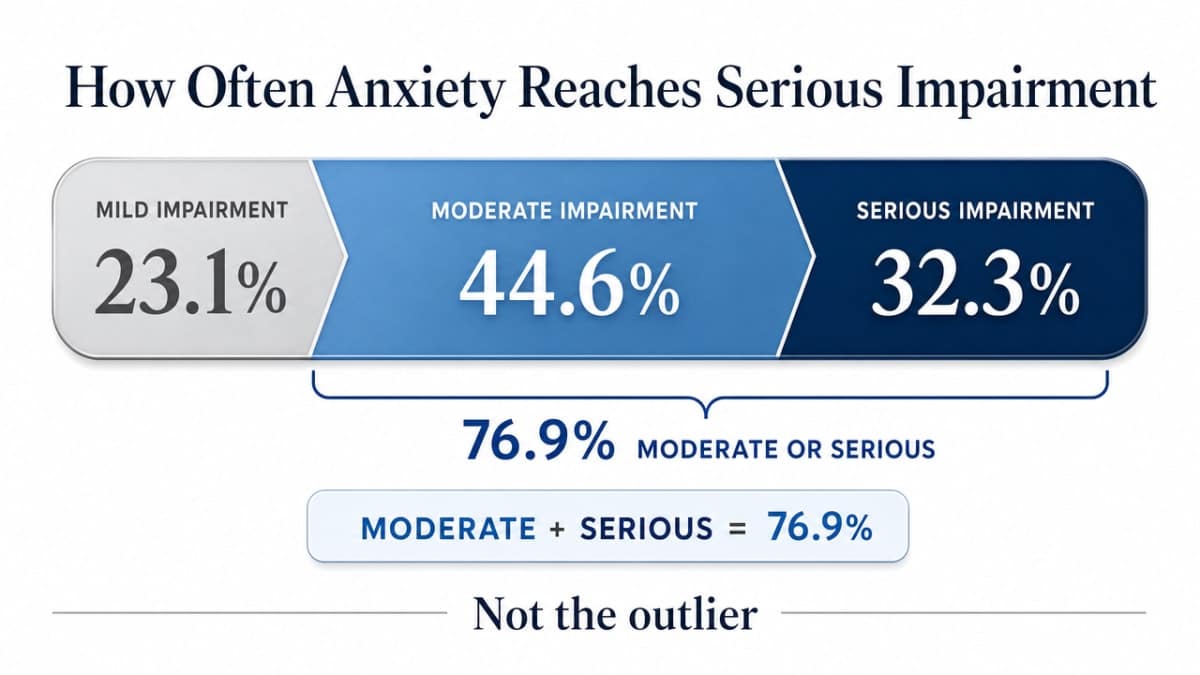
NIMH’s breakdown of generalized anxiety disorder in U.S. adults finds that 32.3% experience serious impairment, 44.6% experience moderate impairment, and only 23.1% experience mild impairment 6. Read that again. Roughly three out of four adults with GAD are functioning at moderate or serious impairment levels. Serious impairment is the majority-adjacent experience, not the outlier.
That matters for two reasons. First, if you’re the patient, you are not the strange, extreme case your inner critic keeps insisting you are. The clinical population you belong to is heavily weighted toward significant functional loss. Second, if you’re a referring clinician or a family member, the base rate should recalibrate what “normal course of illness” looks like. A patient who has been white-knuckling through IOP for months while still unable to hold a work schedule is not failing at recovery — they are demonstrating the impairment profile the diagnosis actually produces at scale.
The zoomed-out picture across all anxiety disorders is similar in shape, though slightly less severe on average 5. GAD in particular skews hard toward the impaired end. What that skew tells you: severity dense enough to warrant residential-level care is not a rare edge case. It’s a predictable subset of the diagnosis, and it deserves a care plan built for it rather than an outpatient plan repeated with slightly more intensity.
The NICE Step 4 Threshold
The NICE stepped-care model gives you a working definition of when anxiety has moved past what outpatient care can hold. Step 4 is the specialist tier, and the criteria for reaching it are specific: refractory anxiety that hasn’t responded to lower-intensity treatment, very severe functional impairment such as self-neglect, persistent suicidal thoughts, or multiple psychiatric comorbidities 3.
Notice what’s on that list and what isn’t. It isn’t about how anxious you feel on a 0–10 scale. It’s about whether the illness has become refractory, whether basic self-care has broken down, whether safety is now part of the picture, and whether you’re carrying more than one psychiatric diagnosis at once. Any single item on that list is a serious signal. Two or more, converging, is the clinical picture Step 4 was written for.
This is the threshold you can bring to your outpatient therapist or prescriber without having to argue about it. “Here’s where I am against Step 4 criteria” is a shared-language conversation, not a plea. And if you meet more than one criterion, the guideline isn’t ambiguous — specialist referral, which in practice often means a residential or highly structured setting, is the indicated response, not an optional one 3.
Four Signs the Threshold Has Been Crossed
Safety Concerns You Can No Longer Manage at Home
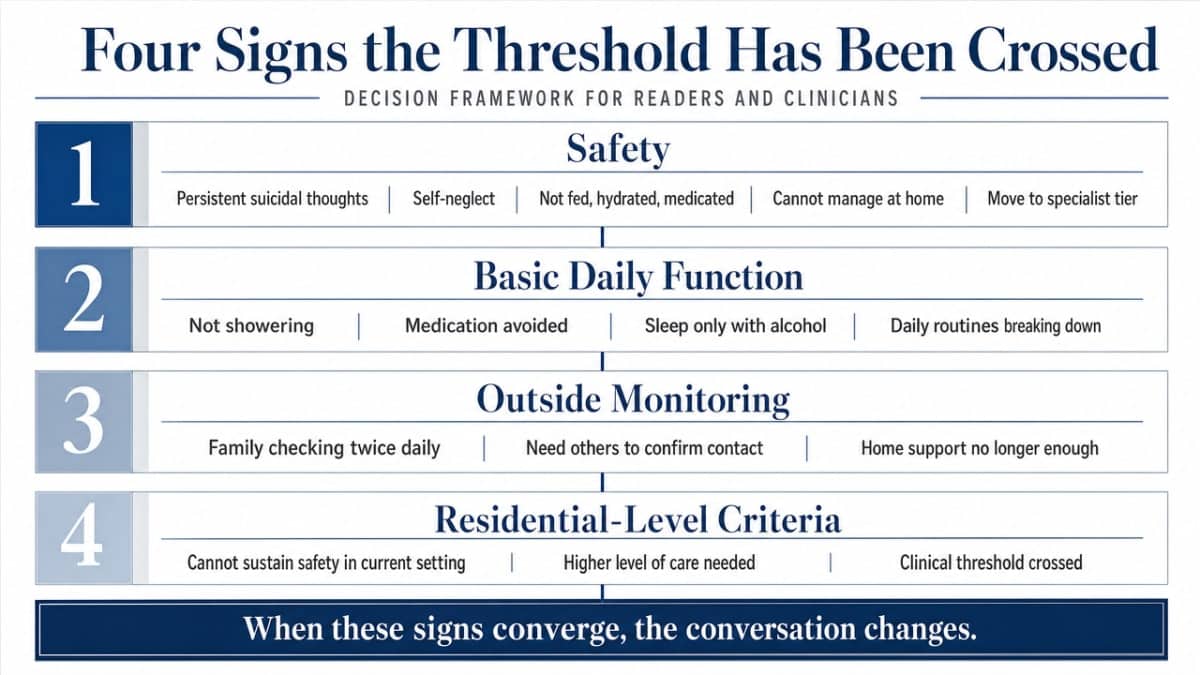
Safety is the first threshold, and it’s the one that changes the conversation fastest. When anxiety starts producing persistent suicidal thoughts, self-neglect, or an inability to keep yourself basically fed, hydrated, and medicated, you’re inside the criteria that clinical guidelines use to move care to a specialist tier 3.
This isn’t always dramatic. It often looks quiet. You haven’t showered in four days. You’ve stopped taking your prescribed medication because the anxiety around swallowing pills has become worse than the symptoms they treat. You’re drinking a bottle of wine at night because that’s the only way sleep happens. A family member has started calling twice a day just to make sure you answered the phone.
Function Has Collapsed Across Work, Self-Care, or Relationships
The second threshold is the one you can almost measure. Function.
Work is often the first casualty, and it’s visible: FMLA paperwork, a leave of absence, a resignation you didn’t plan. Then self-care goes — the meals get skipped, the hygiene routine dissolves, the doctor’s appointments get missed because leaving the house has become its own crisis. Then relationships. You stop returning texts. Your partner starts sleeping in the other room because your panic wakes them at 2 a.m. every night. Your kids learn to tiptoe.
Clinical guidance is direct about this pattern: some patients with anxiety disorders become so severely incapacitated that they give up work and social roles entirely 4. That isn’t a personal failing. It’s what the illness produces at its severe end.
Here’s the practical test. Count the domains where function has collapsed — occupational, self-care, relational, safety. One domain is a warning. Two is a signal. Three or more, sustained over weeks, is the functional profile that residential-level care was designed to hold 10.
Adequately Delivered Outpatient Treatment Has Failed
The third threshold has a specific name in the guidelines: refractory. Anxiety that hasn’t responded to lower-intensity treatment, properly delivered, is one of the explicit factors moving a case toward Step 4 specialist care 3.
The word properly is doing work in that sentence. Refractory doesn’t mean you tried one SSRI for six weeks and stopped. It means adequate trials — therapeutic doses, sufficient duration, evidence-based modalities like CBT delivered at the right frequency — and the symptoms and impairment have persisted anyway. If you’ve cycled through two or more antidepressant trials, completed a course of exposure or cognitive therapy, and possibly stepped up to an IOP without the functional picture improving, you’ve generated the clinical history that supports escalation.
This is where a lot of patients get stuck. The outpatient system tends to keep repeating itself — another therapist, another medication, another intensive outpatient round — because each individual clinician is doing the appropriate next step at their level. But at some point, repeating the same level of care with slightly different ingredients stops being escalation. It becomes a holding pattern. When your history shows adequate trials without adequate response, the guideline-based move isn’t a fourth outpatient attempt. It’s a higher level of care 3.
A Co-Occurring Condition Is Driving the Instability
The fourth threshold is the one outpatient systems handle worst: another diagnosis in the room. Anxiety layered with a substance use disorder. Anxiety inside a rapid-cycling bipolar picture. Anxiety braided into unprocessed trauma. NICE guidance names multiple psychiatric comorbidities as a Step 4 factor for a reason — the presence of a second serious condition changes what a treatment setting has to be able to do 3.
SAMHSA’s quadrant model is the clearest way to see this. It sorts co-occurring cases by severity along two axes: the mental health disorder on one, the substance use disorder on the other. Low/low cases fit standard outpatient. High-severity mental health with high-severity substance use — the quadrant where severe anxiety with active SUD lives — is the placement pattern that maps to integrated 24-hour care, because the functional impairment and safety risk in that quadrant can’t be split across two outpatient programs and reassembled later 1.
If you’re using alcohol or benzodiazepines nightly to manage anxiety, if a mood episode is destabilizing your anxiety treatment, if trauma responses are undoing the coping skills you just learned in therapy — you’re in the quadrant the guideline was written for. ASAM Level 3.3 exists specifically for adults with co-occurring disorders who need clinically managed 24-hour care 2. That match isn’t accidental. It’s what the framework points to when a single condition isn’t the whole clinical picture.
Matching Anxiety Severity to the Right Level of Care
What ASAM Levels 2.1, 3.3, and 3.5 Actually Deliver
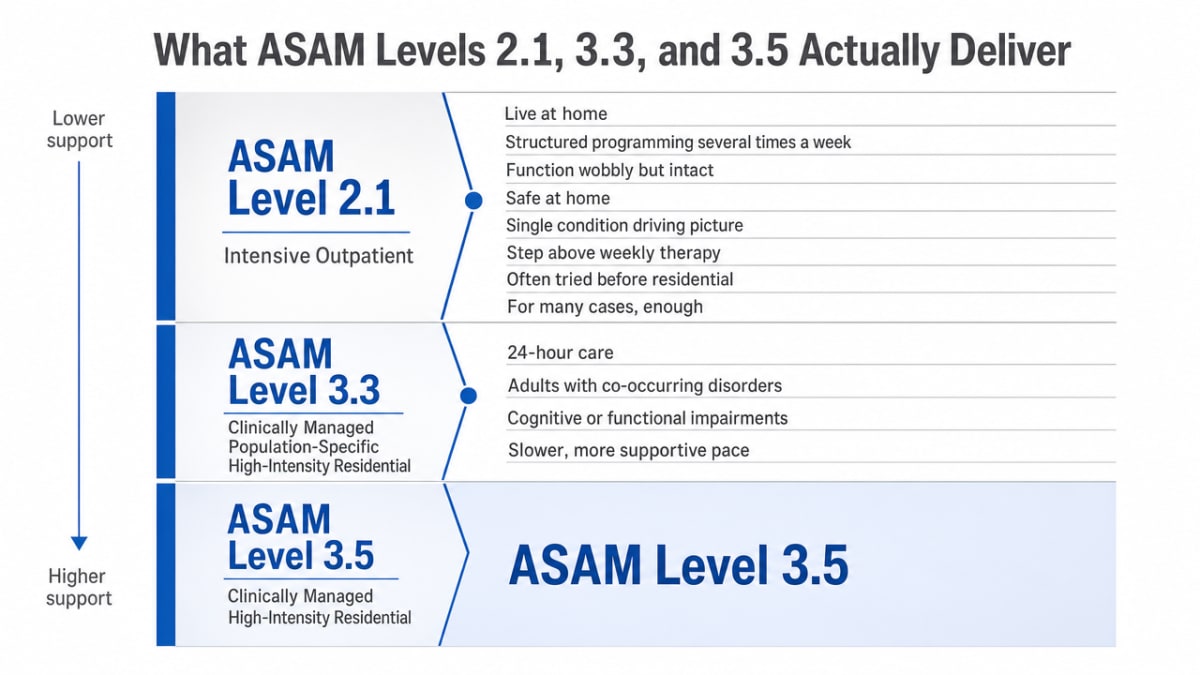
Once you’ve decided the outpatient tier isn’t holding, the next question is specific: which higher level of care actually matches what’s happening? The ASAM criteria give you three distinct answers, and the differences between them matter.
- ASAM Level 2.1 — Intensive Outpatient.
This is the step just above weekly therapy. You live at home and attend structured programming several times a week. It’s the right match when function is wobbly but intact, when you’re safe at home, and when a single condition is driving the picture. It’s what most patients try before residential, and for many cases, it’s enough.
- ASAM Level 3.3 — Clinically Managed Population-Specific High-Intensity Residential.
This is 24-hour care built specifically for adults with co-occurring disorders and cognitive or functional impairments that need a slower, more supportive pace 2. If severe anxiety is layered with an active substance use disorder, or with the kind of functional impairment that makes standard programming hard to absorb, 3.3 is the level designed for that combination 2.
- ASAM Level 3.5 — Clinically Managed High-Intensity Residential.
Also 24-hour care, appropriate for people whose functional limitations mean they cannot be safely treated outside a stable 24-hour environment 10. This is where the safety threshold and the function threshold from earlier in this article converge with a level of care that can actually contain them.
The practical difference: Level 2.1 gives you hours of clinical contact per week. Levels 3.3 and 3.5 give you a full clinical environment — nursing, psychiatry, structured therapy, and a living situation where the next crisis doesn’t have to be handled alone. When function has collapsed across multiple domains, that structural difference is the point.
When 24-Hour Structure Is the Clinically Correct Answer
There’s a specific moment in a lot of severe anxiety cases when the right question shifts. It stops being “what treatment should we add?” and becomes “where does treatment need to happen?”
That shift is what 24-hour structure answers. The clinical language for it is direct: residential care is appropriate when a person cannot safely be treated outside a 24-hour stable living environment that supports recovery skill development 10. Read that as a description of a room, not a philosophy. Meals happen. Medications are on time. Sleep is protected. A clinician is on the unit at 3 a.m. when the panic wakes you. The environment itself is doing therapeutic work that no amount of outpatient scheduling can reproduce.
For severe anxiety with self-neglect, refractory symptoms, or a co-occurring diagnosis pulling the system apart, that container is the intervention. It’s what makes the medication adjustments actually get taken, the exposure work actually get practiced, and the co-occurring substance use actually get treated in the same week rather than in sequence 9. If you’re weighing whether to escalate, the honest test is whether the environment your loved one lives in can hold the treatment plan. When it can’t, 24-hour structure isn’t a step down in independence. It’s the step that makes the rest of recovery possible.
Why Integrated Residential Care Works Where Sequential Care Fails
The Cycle Most Severe Anxiety Patients Get Stuck In
You’ve probably seen this pattern from the inside. The anxiety program treats the anxiety. The substance use program, when you finally get there, treats the drinking. The mood specialist handles the bipolar piece on alternating Thursdays. Each clinician does careful work at their own level. And still, nothing quite holds.
That’s sequential care, and it’s the default in most outpatient systems. One condition gets addressed while the others wait in line. The problem is that severe anxiety with a co-occurring disorder doesn’t take turns. The nightly drinking that started as sleep management undoes the SSRI trial. The unprocessed trauma reignites the panic the exposure work just settled. The mood swing derails the coping plan before it’s practiced twice.
SAMHSA’s guidance on co-occurring disorders is direct on this point: integrated, not sequential, treatment is what these presentations require, and clients need a model of care built around the combination rather than split across separate programs 1, 9. When you’ve been cycling through outpatient episodes without traction, it usually isn’t that the treatments failed. It’s that the structure kept them from working on the same person at the same time.
What Integrated Dual Diagnosis Treatment Looks Like Day to Day
Integrated care isn’t a philosophy statement on a program brochure. It’s a schedule, a team roster, and a treatment plan that names every diagnosis in the same document.
On a given program day, the psychiatrist adjusting your anxiety medication is talking to the therapist running your trauma work and the clinician monitoring the substance use piece — because they are on the same team, meeting about the same case, that same week. The VA’s residential rehab standard puts this bluntly: co-occurring mental health and substance use disorders must be addressed as part of one recovery plan, delivered through an integrated care model that allows concurrent treatment 8. Not referred out. Not sequenced. Concurrent.
Practically, that looks like a morning group on distress tolerance, an afternoon session working the specific fear driving both the panic and the drinking, medication review with a psychiatrist who has read the therapist’s notes from yesterday, and an evening structure where sleep, meals, and medication actually happen without you having to enforce them yourself. Integrated screening, dual recovery supports, and a co-occurring-specific model of care are the working ingredients 9.
For severe anxiety with an active second diagnosis, this is the setting the guidelines point to. ViewPoint’s Anxiety Treatment program is built inside that dual diagnosis structure — psychiatry, therapy, and substance use care operating as one team rather than three referrals — which is what integrated co-occurring care is supposed to deliver 2, 8.
Bringing the Decision to Your Care Team
A Self-Assessment Scaffold for Patients, Families, and Referrers
You don’t need a perfect answer before you talk to your care team. You need a shared language. Here’s a four-part scaffold that maps directly onto the criteria clinicians already use, so you can walk into the next appointment with something specific to work from.
Safety. In the last two weeks, have there been persistent suicidal thoughts, self-neglect, or an inability to keep basic medication, meals, or hygiene going without someone else enforcing them? Any yes here is a Step 4 signal on its own 3.
Function. Count the domains that have collapsed — work or school, self-care, relationships, ability to leave the house. One is a warning. Two or more sustained over weeks is the profile residential-level care was built to hold 4.
Treatment response. Have there been adequate trials of medication and evidence-based therapy — real doses, real duration — without the functional picture improving? Refractory response is an explicit escalation criterion 3.
Comorbidity. Is a second condition — substance use, bipolar, trauma — actively destabilizing the anxiety work? If yes, the placement question is integrated 24-hour care, not another outpatient referral 1.
Bring the answers. Ask directly what level of care your case calls for 2. That’s a clinical conversation, not a request for permission.
How ViewPoint’s Anxiety Treatment Program Can Help
If the scaffold above pointed toward higher-intensity care, the setting has to match what your case actually needs — not a generic program that treats anxiety in isolation.
ViewPoint’s Anxiety Treatment program sits inside a dual diagnosis structure in Prescott, Arizona, built for the presentations most outpatient systems can’t hold: severe anxiety layered with substance use, with a mood disorder, or with unprocessed trauma. Board-certified psychiatrists lead every treatment plan, and the psychiatrist adjusting your medication is on the same team as the therapist doing the trauma work and the clinician monitoring the substance use piece — the concurrent, integrated model the guidelines call for rather than sequential referrals 8, 9.
That structure matters most when a case has already cycled through outpatient episodes without traction. Treatment duration is set by clinical need, not an insurance calendar. If you’ve reached the point where the level-of-care question is real, ViewPoint’s Anxiety Treatment page is the right next step to bring to your care team.
Find out if specialized care fits your needs
Get expert guidance on next steps for severe anxiety and co-occurring conditions.
Frequently Asked Questions
How do I know if my anxiety is severe enough for residential care instead of another round of outpatient therapy?
The clearest markers are converging, not single. Look for adequate outpatient trials without meaningful response, function collapsing across two or more domains (work, self-care, relationships), safety concerns like self-neglect or persistent suicidal thoughts, and a co-occurring diagnosis destabilizing the picture. When two or more line up, NICE Step 4 criteria point toward specialist-level care rather than another outpatient round 3.
What makes residential care different from an intensive outpatient program (IOP) for anxiety?
An IOP (ASAM Level 2.1) gives you structured hours while you live at home. Residential care (ASAM 3.3 or 3.5) is a 24-hour clinical environment where meals, medication, sleep, and crisis response are held by staff, not by you 2. It’s the correct match when functional limitations mean recovery can’t safely happen outside a stable 24-hour setting 10.
Can residential care treat anxiety and a co-occurring substance use disorder at the same time?
Yes, and that concurrent model is what the guidelines actually require. Co-occurring mental health and substance use disorders should be addressed as part of one integrated recovery plan, delivered by a single team, rather than sequenced across separate programs 8. ASAM Level 3.3 is specifically defined as residential treatment for adults with co-occurring disorders, built for exactly this combination 2.
What should a family member do if a loved one refuses to consider a higher level of care?
Bring the conversation back to shared clinical language, not persuasion. Walk through the four thresholds together — safety, function, treatment response, comorbidity — and ask the outpatient team directly what level of care the case calls for 2. When self-neglect or persistent suicidal thoughts are present, that’s a Step 4 signal the care team is obligated to address 3.
How can a referring outpatient therapist or primary care provider tell it’s time to escalate?
The referral picture is specific: refractory symptoms after adequate trials, marked functional impairment, self-neglect or persistent suicidal ideation, or multiple psychiatric comorbidities — each is a named Step 4 factor 3. For co-occurring cases, SAMHSA’s quadrant model places high-severity mental health with high-severity substance use in the integrated 24-hour care band, not another outpatient referral 1.
Does going to residential treatment mean outpatient care failed?
No. It means the clinical picture outgrew what an outpatient container can hold. Some anxiety presentations become severely incapacitating, taking work and social roles with them — that’s a described trajectory of the illness, not a failure of the person or the therapist 4. Escalating to a 24-hour setting is the guideline-based response to that trajectory, and it’s how the next stage of treatment becomes possible.
References
- Substance Use Disorder Treatment for People with Co-Occurring Disorders. https://library.samhsa.gov/sites/default/files/pep20-06-04-006.pdf
- Okla. Admin. Code § 450:18-1-2 – Definitions. https://www.law.cornell.edu/regulations/oklahoma/OAC-450-18-1-2
- Generalised anxiety disorder and panic disorder in adults – NCBI Bookshelf. https://www.ncbi.nlm.nih.gov/books/NBK552847/
- Clinical Practice Guidelines for the Management of … – PMC. https://pmc.ncbi.nlm.nih.gov/articles/PMC5310105/
- Any Anxiety Disorder – National Institute of Mental Health. https://www.nimh.nih.gov/health/statistics/any-anxiety-disorder
- Generalized Anxiety Disorder. https://www.nimh.nih.gov/health/statistics/generalized-anxiety-disorder
- Guide to VA Mental Health Services for Veterans & Families. https://www.mentalhealth.va.gov/docs/guide_to_va_mental_health_srvcs_final12-20-10.pdf
- VHA Directive 1162.02, Mental Health Residential Rehabilitation Treatment Programs. https://www.va.gov/vhapublications/ViewPublication.asp?pub_ID=8400
- Chapter 7—Treatment Models and Settings for People With Co-Occurring Disorders. https://www.ncbi.nlm.nih.gov/sites/books/NBK571024/?report=reader
- Overview of Substance Use Disorder Care Clinical Guidelines. https://www.medicaid.gov/state-resource-center/innovation-accelerator-program/iap-downloads/reducing-substance-use-disorders/asam-resource-guide.pdf