

Key Takeaways
- Spouses of people with bipolar disorder carry measurable strain, with higher caregiver burden, lower marital adjustment, and reduced quality of life documented in the research 9, 6.
- Real family work follows a named model like Family-Focused Therapy, delivered in conjoint sessions across three modules: psychoeducation, communication training, and problem-solving 11.
- Insurance-timed 28-day stays rarely fit rapid-cycling or treatment-resistant cases, since clinicians may only observe one mood phase and cannot complete the family curriculum 11.
- Before committing to a program, ask how duration is decided, which family therapy model is used, whether you receive direct psychoeducation, and if you sit in planning meetings.
The Whiplash Nobody Warned You About
You know the feeling. Tuesday night was quiet. You ate dinner together, laughed at something on the TV, and for a few hours it felt like the marriage you remember. By Saturday, you’re standing in a pharmacy parking lot at 11 p.m. holding a prescription bag and wondering how you got here again.
That is the whiplash. Not the diagnosis itself, but the ride the diagnosis puts your marriage on. Stable stretches that let you exhale, then a shift in sleep, or spending, or mood, and suddenly you’re back in triage mode. Canceling plans. Screening calls from his boss. Deciding, alone, whether tonight is an ER night.
If you’re the spouse of someone with bipolar disorder, the exhaustion you feel is not weakness and it is not in your head. Research on partners of people with bipolar disorder consistently finds higher caregiver burden, poorer marital adjustment, and reduced quality of life compared with the general population, especially during active mood episodes 9, 6. The strain is real, it is measurable, and it belongs to you as much as to your partner.
This article is written for you, not about you. You’ll get a clear picture of what real family therapy looks like inside bipolar treatment, why short programs keep letting rapid-cycling and treatment-resistant couples down, and what it looks like when a program treats you as part of the treatment plan instead of a visitor in the waiting room.
Let’s start with what you already suspect: you are not imagining any of this.
You Are Not Imagining the Strain
When you tell a friend you’re tired, you probably downplay it. You say things like “it’s been a rough month” or “we’re managing.” What you don’t say is that you haven’t slept a full night in weeks, that you flinch when the phone rings after 9 p.m., or that you’ve quietly started keeping a separate bank account in case the next manic spending spree cleans out the joint one.
Here is what the research actually shows about lives like yours. In the United States, divorce and separation are two to three times more likely among couples where one partner has bipolar disorder than in the general population 9. That figure comes from a narrative review synthesizing US and international studies on couple functioning, so it reflects broad patterns rather than any single clinic’s outcomes. Read it not as a prediction about your marriage, but as proof that the pressure you’re under is a known, documented pressure. Millions of spouses are carrying some version of it.
The daily wear shows up in more than divorce statistics. Spouses of people with bipolar disorder score lower on marital adjustment and report reduced quality of life, especially in emotional well-being, compared with community norms 6. Higher caregiver burden tracks closely with more severe patient symptoms and with less perceived social support from friends, family, and community 4. Translation: when your partner is sicker and your world has shrunk, you feel it in your body and your mood, not just your calendar.
Notice what those findings do not say. They do not say you are weak, that you chose the wrong person, or that a stronger spouse would be handling this better. They say the opposite. Living inside cycles of mood episodes changes the person doing the living. You are an affected person, not a bystander with a bad attitude.
So if you’ve been quietly wondering whether you’re overreacting, whether other spouses have it this hard, whether it’s normal to feel grief on a Tuesday when nothing is technically wrong — the answer is that your experience matches what clinicians see and what studies measure. That is not a diagnosis. It’s a starting point. Once you accept that the strain is real, the next questions get more useful: what actually helps, and what should a treatment program be doing with you, not just to your partner?
The Crisis-Stability Cycle Inside a Marriage
The cruel part isn’t the crisis. It’s the gap between crises.
You get a few good weeks. Maybe a whole month. Sleep evens out. The two of you cook dinner on a Wednesday. You start to believe, cautiously, that this is the new baseline. And then something shifts — a missed dose, a work stressor, a season change, sometimes nothing you can name — and the temperature in the house changes overnight.
What makes this cycle so corrosive to a marriage is that stability doesn’t feel like safety anymore. It feels like waiting. You are eating dinner while listening for the shift. You are enjoying a weekend while scanning for the tell: the 2 a.m. Amazon orders, the new business idea at midnight, the withdrawn silence that means depression is moving back in. Rest becomes surveillance with better lighting.
Clinical research puts numbers on what you already feel. In a study of partners of people with bipolar disorder, marital disharmony was greater when the patient was ill than when well, and worse during manic phases than depressive ones. Partners also reported less sexual satisfaction during illness episodes than during periods of wellness 1. That is a small sample of couples, not a life sentence, but it maps onto what spouses describe: mania erodes the marriage differently than depression does, and both leave a mark you carry into the stable weeks.
Mania often hurts the partnership most because the behavior is directed outward — the spending, the risk-taking, the confidence that dismisses your worry as controlling. Depression pulls your partner away from you, and that hurts too, but in a quieter way. You end up grieving two different absences from the same person.
Here is something worth naming: the stable stretches are not lies. They are real. Your partner on a good Tuesday is not performing wellness. But the cycle teaches your nervous system that good Tuesdays end, and after enough rounds, your body stops fully landing in the calm. That’s not paranoia. That’s pattern recognition doing its job.
The way out of this loop is not learning to trust the calm harder. It’s getting a treatment structure around both of you that shortens the crises, lengthens the stable stretches, and gives you a role during both. Spouses who are trained in problem-solving and adaptive coping report lower burden than those relying mainly on emotion-focused coping 3. Skills, not stoicism, is what starts to change the ride.
The Spouse as an Affected Patient, Not a Helper
Somewhere along the way, you got assigned a role you never auditioned for: the reliable one. The one who remembers the appointments, refills the prescriptions, reads the pdoc’s after-visit summary in the car. You are, in most people’s eyes, the healthy half of the marriage.
That framing is doing you damage.
Spouses of people with bipolar disorder are not a support system attached to a patient. They are a group with their own measurable health impact. Studies consistently find lower marital adjustment and reduced quality of life among these spouses, especially in emotional well-being, compared with community norms 6. Caregiver burden tracks with patient symptom severity and moves in the opposite direction of perceived social support: the sicker your partner and the smaller your circle, the heavier the load sitting on your chest 4. That load has a name in the literature. It is not called “being a good spouse.”
There is another finding worth sitting with. Spouses who rely mostly on emotion-focused coping — venting, avoiding, hoping it passes — report higher burden than spouses trained in problem-solving and adaptive strategies 3. That is not a scolding. It’s an argument for services. Nobody hands you a manual when you marry someone who later gets diagnosed. The skills that lower your burden are teachable, and they are supposed to be taught to you, by clinicians, as part of treatment.
Which means a program that only talks to your partner and hands you a pamphlet on the way out is missing half the case. You need psychoeducation of your own, delivered directly, not filtered through a spouse who may or may not remember what the doctor said 7. You need someone to ask how you are sleeping, whether your primary care is up to date, whether your anxiety has crossed a line that needs its own care.
What Family Therapy Actually Looks Like
The Three Modules of Family-Focused Therapy
When a program says it “involves the family,” ask what that actually means. Sometimes it means a Saturday visiting hour and a photocopied handout on mood charting. That is not family therapy. That is hospitality.
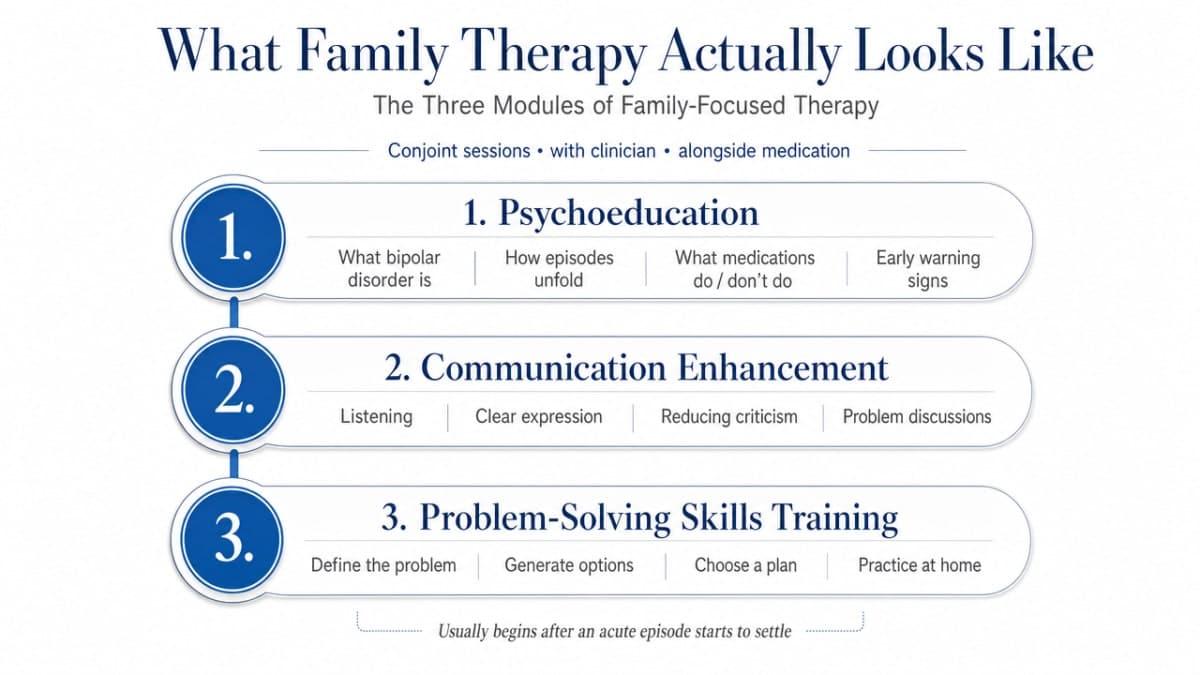
Real family work in bipolar care has a name and a shape. The best-studied version is Family-Focused Therapy, developed by David Miklowitz and refined over more than two decades. FFT is delivered in conjoint sessions — you and your partner in the room together with the clinician — usually after an acute episode has begun to settle, and always alongside medication. It runs on three modules, in this order 11.
Psychoeducation comes first. Both of you learn what bipolar disorder actually is, how episodes unfold, what medications do and don’t do, what early warning signs look like in your partner specifically. You stop guessing. You start recognizing. When you can name the shift you’re seeing at 10 p.m. on a Sunday, you make different decisions than when you’re just scared.
Communication enhancement training is second. This is skills practice: how to express concern without triggering defensiveness, how to listen without absorbing every mood as your own, how to make a request that doesn’t sound like an accusation. You role-play. You get feedback. It feels awkward for about three sessions and then it starts to change how a Wednesday night argument goes.
Problem-solving is third. Together, you tackle the concrete things: the spending, the sleep schedule, the in-laws, the medication side effects, the kids’ questions. Structured, step by step, with the clinician holding the frame.
Across eight randomized controlled trials, FFT plus mood-stabilizing medications hastened recovery from mood episodes, reduced recurrences, and lowered symptom severity compared with briefer psychoeducation over one to two years 11. A separate systematic review of couple and family interventions in adult mental health reached the same direction: FFT improved bipolar symptoms over less intensive treatments 10. That is what you’re looking for. Not a visit day. A structured curriculum, delivered to both of you, that has actually been tested.
How Expressed Emotion Gets Addressed Without Blame
There is a term you may run into in a family session, and it can land hard the first time you hear it: expressed emotion. In the research, it refers to patterns of criticism, hostility, or emotional overinvolvement that clinicians can measure in how family members talk about the patient. High expressed emotion in the household predicts higher relapse rates in bipolar disorder 5.
Read that sentence twice, because it is easy to misread. It does not say that critical spouses cause mania. It does not say that if you had been calmer, gentler, less involved, none of this would have happened. What it says is that the emotional temperature of the home is a modifiable factor in the illness course — one of many, alongside medication adherence, sleep, and substance use.
Here is the part that matters for you. If you have been snapping lately, or hovering, or lecturing at the kitchen counter about missed doses, you are behaving like a person who has been under sustained strain for years. That is a response to the illness, not a character flaw. A skilled family therapist treats high expressed emotion the same way they treat any other clinical target: they name it without shame, teach the communication skills that lower it, and rehearse them until they feel usable 11.
Why 28-Day Programs Keep Failing Rapid-Cycling and Treatment-Resistant Couples
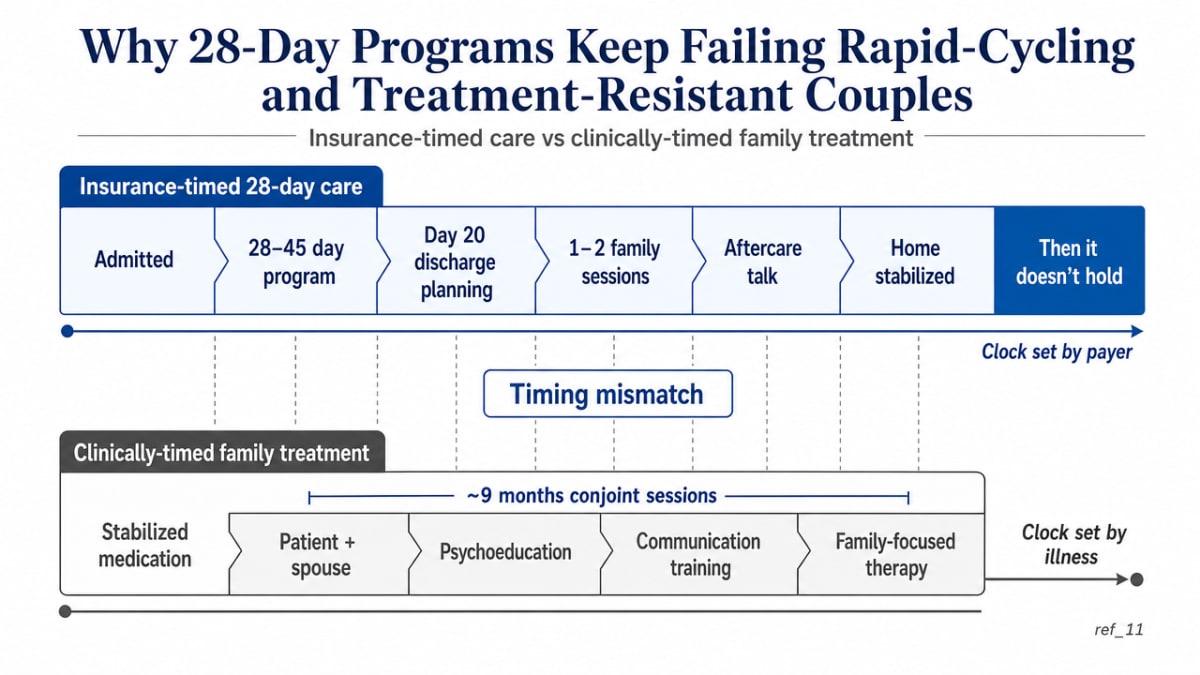
If you’ve been through this cycle more than once, you already know the pattern. Your partner gets admitted. The program is 28 days, sometimes 30, occasionally a generous 45. Around day 20, the discharge planning starts. You get a phone call inviting you to a family session or two. Everyone talks about aftercare. Your partner comes home stabilized, and for a while, it holds.
Then it doesn’t.
Here is the problem with insurance-timed care for rapid-cycling and treatment-resistant bipolar disorder: the clock is set by the payer, not by the illness. Family-Focused Therapy, the most-studied family intervention in bipolar care, was designed to be delivered over roughly nine months in conjoint sessions with the patient and spouse, layered on top of stabilized medication 11. Psychoeducation, communication training, and problem-solving each need real reps. You cannot compress that into three visiting-hour conversations and expect it to change how a Wednesday night argument goes six months from now.
Rapid-cycling makes the mismatch worse. If your partner shifts states every few weeks, a 28-day window may only capture one phase of the illness. The clinical team sees the depressive crash or the manic peak, not both, and certainly not the transitions where your marriage actually gets tested. You leave with a plan built for the version of your partner they met, not the version who will be sitting across from you in three weeks.
Treatment-resistant cases carry their own timing problem. Medication adjustments for these presentations — clozapine protocols, complex mood-stabilizer combinations, careful cross-titrations — take weeks to evaluate, not days. Discharging on a regimen that hasn’t been observed through a full mood cycle sends the couple home to run the experiment alone.
What changes for you when treatment duration is set clinically instead of by benefit design? You get enough sessions to actually finish the family curriculum. You see your partner across more than one mood state before treatment ends. And you stop being the one who has to hold the whole plan together in the parking lot on day 29.
A Seat at the Treatment Planning Table
There is a moment in most treatment programs when the plan gets made. A team meets. Notes are reviewed. Decisions get written down about medications, therapy targets, discharge timing, aftercare. In too many programs, that meeting happens without you.
You get a summary afterward. Sometimes.
That exclusion is not just a courtesy problem. You are the person who will notice the 3 a.m. wake-ups before anyone else does. You know which side effect he mentioned in passing and shrugged off. You remember what happened the last time this exact medication combination was tried and how the fourth week went. Leaving you out of the planning meeting removes the person with the longest continuous data set on your partner from the room where decisions are being made.
The clinical case for including you is straightforward. Family-Focused Therapy is designed as conjoint work with the patient and spouse, not as parallel tracks that occasionally intersect 11. Partner-specific psychoeducation, delivered directly to you rather than filtered through your partner, improves your knowledge and reduces your distress 7. When you understand the treatment plan — the why behind each medication, the early warning signs the team is watching, the specific behaviors that should trigger a call — you stop guessing at home and start executing a shared plan.
A seat at the table is not a favor. It is how the plan actually holds.
Partnership, Not Just Caregiving
Somewhere in the years of appointments and adjustments, the word “marriage” can quietly get replaced by “care.” You stop being a wife or husband and start being a manager. The bedroom becomes a place where you monitor sleep. Dinner becomes a place where you check appetite. Sex, if it’s still happening, has to survive around medication side effects and mood shifts you’re both trying to read.
You are allowed to want the marriage back, not just the stability.
A systematic review of couple-based interventions in serious mental illness, including bipolar disorder, found that programs targeting intimacy and mutual support — not only caregiving tasks — generally improved relationship satisfaction, and in some studies reduced psychiatric symptoms as well 8. That matters because it means the intimate part of your partnership is a legitimate clinical target, not a luxury you’ll get to after your partner is “better.” Waiting for a fully stable version of the illness to rebuild closeness usually means waiting forever.
Ask a program what it does for the couple, not just the patient. A good answer includes conversation about intimacy, shared decision-making, and the friendship underneath the caregiving. That’s the marriage you’re trying to protect.
How ViewPoint’s Prescott Program Includes Spouses
ViewPoint Dual Recovery, a Joint Commission-accredited psychiatric facility in Prescott, Arizona, treats spouses as part of the case, not the visiting list. That shows up in a few concrete ways.
Treatment duration is set clinically, not by a benefit clock. For rapid-cycling and treatment-resistant presentations, that means the family curriculum has room to actually finish, and you see your partner across more than one mood state before treatment ends.
Family work is delivered as conjoint sessions with an integrated team — psychiatrist and therapist on the same case — using the modules the research supports: psychoeducation, communication training, and problem-solving 11. You are in the room, not summarized to afterward.
Psychoeducation is offered directly to you as the spouse, not filtered through your partner. Structured partner-focused education has been shown to improve knowledge and lower distress in spouses of people with bipolar disorder 7. For dual diagnosis cases, that education extends to how substance use interacts with mood cycles, because behavioral couple work has its own evidence in co-occurring disorders 10.
You are invited to ask exactly how this looks for your marriage before you commit. That question is the point.
Questions to Ask Any Program Before You Say Yes
Before you sign paperwork, before you drive your partner to intake, ask the program these questions out loud. The answers will tell you whether spouses are actually part of the plan or an afterthought with a lanyard.
- How is treatment duration decided — by the insurance clock or by clinical response? For rapid-cycling or treatment-resistant cases, this is the first filter.
- What specific family therapy model do you use, and how many sessions will I attend? Listen for named approaches like Family-Focused Therapy and its three modules of psychoeducation, communication training, and problem-solving 11.
- Will I receive psychoeducation directly, or only through my partner? Partner-specific education has been shown to improve spouse knowledge and lower distress 7.
- Am I included in treatment planning meetings, or informed afterward?
- How do you handle intimacy and the marriage itself, not just symptom management? 8
- If substance use is part of the picture, how does couple work address that alongside mood? 10
Ask ViewPoint these exact questions. A program that welcomes them is a program that has answers.
Find out how expert support fits your marriage
Get clear, expert guidance for navigating bipolar disorder together as partners.
Frequently Asked Questions
Is it normal to feel exhausted and grieving even when my spouse is stable?
Yes. The stable stretches often surface the grief you couldn’t feel during the crisis. Your body finally has room to notice what the last episode cost you. Research finds that spouses of people with bipolar disorder show reduced emotional quality of life compared with community norms, even outside active episodes 6. What you’re feeling has a name, and it is not ingratitude.
What is the difference between a family visit day and real family therapy?
A visit day is hospitality. Real family therapy is a structured curriculum. Family-Focused Therapy, the most-studied model, is delivered in conjoint sessions with you and your partner across three modules: psychoeducation, communication training, and problem-solving 11. You attend multiple sessions with a clinician who teaches skills and helps you rehearse them. If a program can’t describe its model by name, it doesn’t have one.
Why do short 28-day programs keep failing us when my partner is rapid-cycling or treatment-resistant?
The clock is set by the insurance benefit, not by the illness. FFT was designed to be delivered over months, not weeks, on top of stabilized medication 11. Rapid-cycling means the team may only see one mood phase before treatment ends. Treatment-resistant medication adjustments need weeks of observation. You leave holding a plan built for a version of your partner the clinicians never fully saw.
I have been told I show high expressed emotion. Does that mean the relapses are my fault?
No. High expressed emotion predicts higher relapse rates, but it does not cause the illness 5. Criticism and overinvolvement are what sustained strain looks like from the outside. A competent family therapist treats them as modifiable communication patterns and works on them with both of you, not as a verdict against you. If a clinician frames it as your problem to fix alone, find another clinician.
Can I be included in treatment planning if my spouse is the identified patient?
You can, and you should ask directly. Partner-specific psychoeducation delivered to you improves your knowledge and lowers your distress 7, and family-focused work is designed as conjoint care with the spouse in the room 11. Bring the specific things you notice at home to the table: sleep changes, side effects, medication timing. You hold the longest continuous record of your partner. That data belongs in planning.
What questions should I ask a program to know if spouses are truly included?
Ask four things. What named family therapy model do you use, and how many sessions will I attend? Will I receive psychoeducation directly, or only through my partner? Am I in treatment planning meetings, or informed afterward? How is treatment duration decided — by the benefit clock or by clinical response? Ask ViewPoint these questions too. Programs that welcome them are programs that have real answers.
References
- Burden and marital and sexual satisfaction in the partners of bipolar patients. https://pubmed.ncbi.nlm.nih.gov/16176436/
- Couple therapy in the 2020s: Current status and emerging directions. https://pmc.ncbi.nlm.nih.gov/articles/PMC10087549/
- [Spousal burden in partners of patients with major depressive disorder and bipolar disorder]. https://pubmed.ncbi.nlm.nih.gov/25314803/
- Caregiver burden and social support in spouses of people with bipolar disorder. https://pubmed.ncbi.nlm.nih.gov/28961515/
- Expressed emotion in families of patients with bipolar disorder: Relationship to outcome. https://pubmed.ncbi.nlm.nih.gov/27152919/
- Marital adjustment and quality of life in spouses of patients with bipolar disorder. https://pubmed.ncbi.nlm.nih.gov/31295546/
- Psychoeducation for partners and family members of people with bipolar disorder: A feasibility study. https://pubmed.ncbi.nlm.nih.gov/33555663/
- Promoting intimate relationships in serious mental illness: A systematic review of couple-based interventions. https://pubmed.ncbi.nlm.nih.gov/38015269/
- The Impact of Bipolar Disorder on Couple Functioning. https://pmc.ncbi.nlm.nih.gov/articles/PMC8400362/
- Couple and family involvement in adult mental health treatment: a systematic review. https://pubmed.ncbi.nlm.nih.gov/23321286/
- Family-Focused Therapy for Bipolar Disorder. https://pmc.ncbi.nlm.nih.gov/articles/PMC5922774/
- Bipolar affective disorder and its impact on various aspects of life. https://pmc.ncbi.nlm.nih.gov/articles/PMC6058431/