

Key Takeaways
- Filter therapists by training and protocol before proximity, since a distant clinician doing evidence-based trauma work will serve you better than a nearby vague offering.
- Ask by name for Cognitive Processing Therapy, EMDR, or Prolonged Exposure — the 2023 VA/DoD guideline strongly recommends these over medication as first-line PTSD care 2.
- Distinguish trauma-informed from trauma-labeled by looking for validated screening tools, retraumatization safeguards, and organizational training that SAMHSA outlines 6, 5.
- Use scripted intake questions about protocol, session length, screening tools, dissociation plans, and co-occurring conditions so you can compare providers on substance rather than tone.
- If substance use is part of your story, seek programs using integrated manualized treatments like Seeking Safety or COPE — current guidance says sobriety is not a prerequisite for trauma work 3.
- When early searches don’t land, narrow by protocol name and widen your radius or consider telehealth before lowering your standards for trained, licensed trauma clinicians 10.
What actually makes a local trauma therapist trustworthy
Proximity is the easiest thing to sort for and the least useful thing to sort by. A clinic four blocks away that runs vague “trauma healing sessions” will cost you more time and more heartache than a clinician thirty minutes out who does actual trauma-focused work. So before you filter by zip code, filter by what the person in that chair is trained to do.
A trustworthy local trauma therapist meets three tests. First, they use an evidence-based protocol for trauma. The 2023 VA/DoD Clinical Practice Guideline for PTSD includes 34 recommendations and strongly recommends Cognitive Processing Therapy, EMDR, or Prolonged Exposure over medication as the first-line approach 2. If you ask a prospective therapist what trauma protocol they use and the answer is a shrug or a brand name you can’t find in any guideline, that’s information.
Second, they can name a licensed credential and describe real trauma experience. NIMH is direct that psychotherapy and medication are the main treatments for PTSD and that you should be working with a licensed mental health professional who has worked with trauma before 10. “Trauma-informed” on a homepage is not the same as hundreds of hours of supervised trauma cases.
Third, they can explain how they handle what else is happening for you. Co-occurring depression, panic, sleep collapse, a psychiatric diagnosis, or substance use should be part of the intake conversation, not something you have to hide to qualify for care. The VA/DoD guideline is explicit that co-occurring substance use disorder should not preclude trauma-focused therapy 3.
You’re allowed to interview them. You’re allowed to ask about training, protocol, and how they’d approach your specific situation. The rest of this guide gives you the language to do that without feeling like you’re auditioning for permission to heal.
The three evidence-based therapies to ask for by name
Cognitive Processing Therapy, EMDR, and Prolonged Exposure
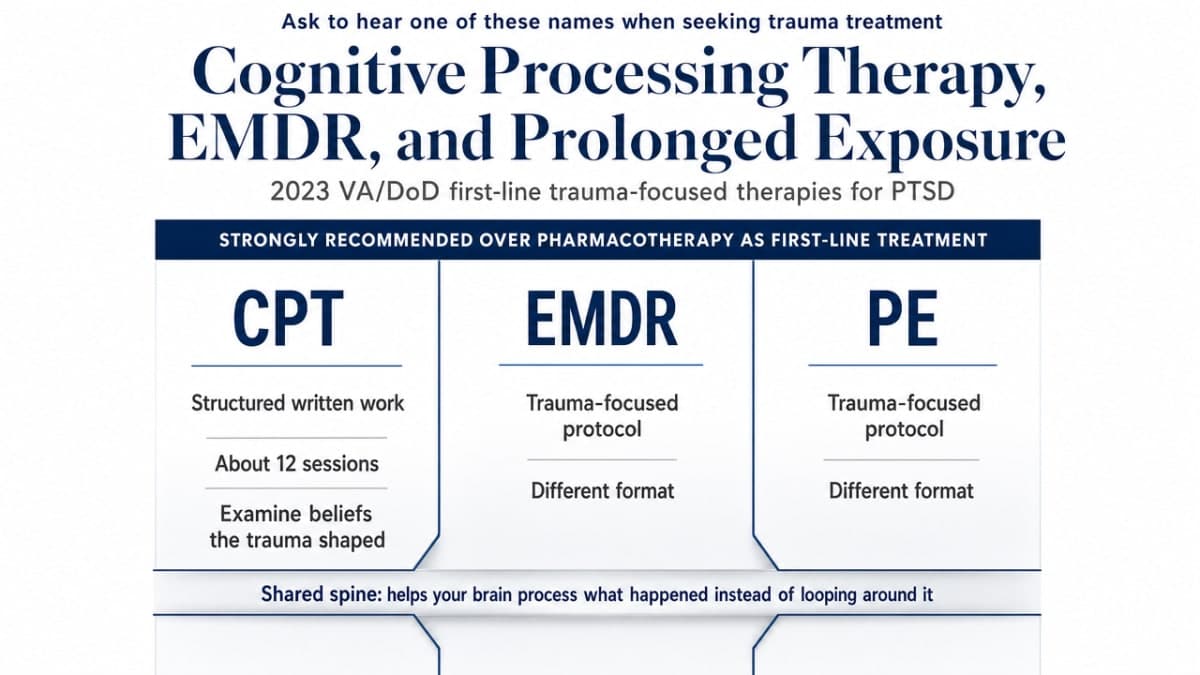
When you call a therapist and ask, “What do you actually do for trauma?” you want to hear one of three names: Cognitive Processing Therapy (CPT), Eye Movement Desensitization and Reprocessing (EMDR), or Prolonged Exposure (PE). The 2023 VA/DoD synopsis includes 34 recommendations and strongly recommends CPT, EMDR, or PE over pharmacotherapy as first-line treatment for PTSD 2. That’s not a soft preference. It’s the recommendation you should be able to hear back, in plain language, from someone asking to treat your trauma.
The three protocols share a spine — they help your brain process what happened instead of looping around it — but the format each one asks of you is different, and that difference matters.
CPT is structured written work. Across roughly twelve sessions, you and the therapist examine the beliefs the trauma installed — beliefs about safety, trust, control, worth — and you write about them. You’ll usually complete a detailed account of the event or work through targeted worksheets between sessions. If you tend to process by writing and thinking, CPT tends to feel workable.
EMDR pairs brief recall of the traumatic memory with bilateral stimulation — usually the therapist’s fingers moving side to side, tones through headphones, or gentle taps. You don’t have to describe the memory in detail out loud. For people who dread narrating what happened, that’s often the deciding factor.
PE is the most exposure-heavy of the three. You’ll do imaginal exposure — recounting the memory in session, sometimes recorded to listen to at home — and in vivo exposure, gradually approaching situations you’ve been avoiding. It asks the most of you upfront and moves fast when it lands.
Any competent trauma therapist should be able to tell you which of these they’re trained in, how many sessions the protocol typically runs, and what the between-session work looks like. If the answer drifts into “I use an eclectic blend of modalities,” ask again, more specifically. Eclectic can be excellent, but it can also be a hedge. You deserve to know what actual protocol will be sitting in the room with you.
What the guideline recommends against, and why that matters when you’re vetting
Knowing what’s endorsed is half the vetting picture. Knowing what the guideline pushes back on is the other half, because it tells you when a well-marketed offering is actually thin on evidence.
The 2023 VA/DoD synopsis recommends against benzodiazepines for PTSD and against cannabis or cannabis-derived products for PTSD 2. If a prescriber’s first move is a standing benzo, or if a program leans on cannabis as part of its “trauma protocol,” that isn’t cutting-edge — it’s out of step with current guidance. This matters especially if substance use is already part of your story, where benzo dependence can quietly stack onto what you came in to address.
The synopsis also flags several newer or adjunctive approaches — including MDMA-assisted psychotherapy and some somatic-only interventions — as having limited evidence at this point 2. That doesn’t mean they can never help anyone. It means a provider who positions them as your primary trauma treatment, in place of CPT, EMDR, or PE, is offering you something the strongest current evidence doesn’t yet back.
Trauma-informed versus trauma-labeled: how to tell the difference
The SAMHSA markers of a genuinely trauma-informed setting
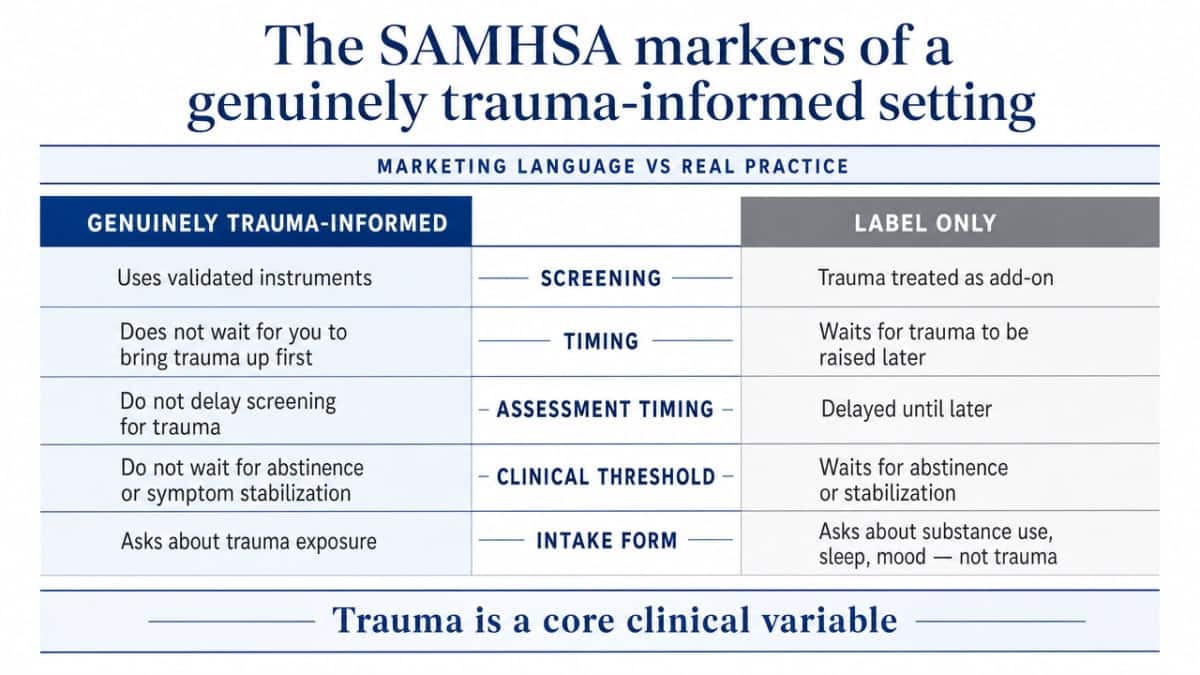
“Trauma-informed” has become the word every behavioral health website uses and very few programs actually earn. The good news is that SAMHSA has published concrete standards, and once you know what to look for, the gap between marketing language and real practice becomes easier to see from the outside.
Start with screening. A genuinely trauma-informed setting uses validated instruments and doesn’t wait for you to bring trauma up first. SAMHSA’s extended manual is direct: use only validated instruments for screening and assessment, and do not delay screening for trauma — do not wait for a period of abstinence or symptom stabilization 6. If a program’s intake form asks about substance use, sleep, and mood but never asks about trauma exposure, that’s a program treating trauma as an add-on rather than a core clinical variable.
Next, look at how they talk about retraumatization. The SAMHSA trauma-informed care manual tells clinicians to minimize the risk of retraumatization by reexamining treatment strategies, procedures, and policies that could mirror characteristics of traumatic experiences 4. In practice, that means things like giving you a choice about who’s in the room, warning you before touch or physical exams, and being willing to pause an exercise if you’re flooded. Ask how they handle a client who dissociates in session. A trauma-informed answer includes specifics — grounding techniques, pacing, a plan for the last ten minutes of a session so you don’t leave activated.
Then there’s organizational commitment. TIP 57 lays out steps for creating a trauma-informed agency: committing to trauma-informed care at the leadership level, building the infrastructure to support it, involving consumers with histories of trauma in program design, and assessing current policies for alignment 5. You can hear this in an intake call. A program that has done this work will describe staff training, supervision structures, and how feedback from former clients has changed the way they do things. A program that hasn’t will describe a warm environment and leave it there.
One setting names practices. The other names feelings. That’s the difference.
Red flags in the intake process itself
The intake call is data. Pay attention to what happens in it.
If the person on the phone rushes past your history to get you booked, that pace will not slow down once you’re a paying client. If they promise a specific outcome — “we’ll get you past this in six weeks” — walk. Trauma work has protocols with typical session ranges, not guarantees. If they ask you to describe the traumatic event in detail during a screening call with a non-clinician, that alone is a retraumatization risk the SAMHSA guidance is designed to prevent 4.
Watch for the paperwork gap. A program that never sends consent forms, never explains its confidentiality limits, and can’t tell you who your clinician will be until day one is a program running loose on the fundamentals. Watch also for the opposite red flag — an intake that demands full trauma disclosure in writing before you’ve met anyone, with no explanation of who will read it or why.
Listen for how they handle your co-occurring picture. If you mention current drinking, medication, or a prior diagnosis and the response is a pause followed by “we’d need you to be stable first,” that’s the older model the current guidance has moved away from 3. A trauma-informed intake asks more questions; it doesn’t close doors.
And trust what the room tells you. If you leave the first appointment feeling smaller than when you walked in, that’s worth naming — either to the therapist in session two, or in your decision about whether there is one.
Scripted questions to ask a prospective trauma therapist
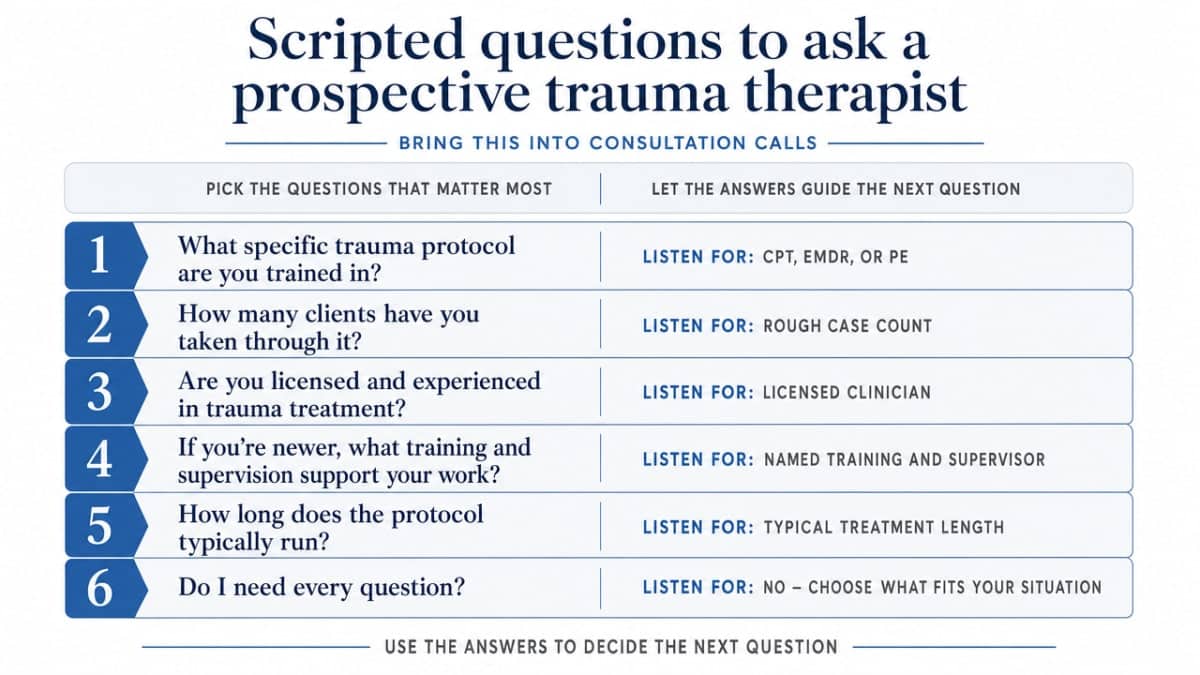
Here’s the thing about calling a therapist: you’re often already tired, sometimes already activated, and the person on the other end has more information than you do. Having a short list in front of you levels that ground. You don’t have to ask every question. Pick the ones that matter for your situation and let the answers guide the next question.
“What specific trauma protocol are you trained in, and how many clients have you taken through it?” You want a named protocol back — CPT, EMDR, or PE — along with a rough count of cases. NIMH is clear that trauma treatment should happen with a licensed clinician experienced in trauma, not just any therapist willing to hear about it 10. A newer clinician can still be a good fit if they name their protocol, their training, and their supervisor.
“How long does the protocol typically run, and what will between-session work look like?” Evidence-based trauma therapies have session ranges, homework patterns, and a shape. If the answer is open-ended and vague, ask again. You’re not being difficult — you’re checking that a real protocol will be in the room.
“What screening tools do you use at intake?” SAMHSA’s guidance calls for validated instruments and says not to delay trauma screening for abstinence or symptom stabilization 6. A clinician who names a tool — the PCL-5, the Life Events Checklist, a standardized depression measure — is telling you they take assessment seriously.
“How do you handle it if I dissociate or get flooded in session?” Listen for specifics: grounding techniques, pacing adjustments, a plan for the last stretch of the session so you leave regulated. This is the retraumatization safeguard question, and a trauma-informed clinician will have a real answer 4.
“If I’m also using substances or on medication, how does that change your approach?” The current guideline says co-occurring substance use should not preclude trauma-focused therapy 3. If the response is “we’d need you sober first,” you’ve learned where that provider sits on current evidence.
“What does a typical first session look like?” You’re allowed to know the shape of the room before you walk in.
Write the answers down. Not to grade — to compare. After two or three of these calls, patterns emerge, and the right next step tends to get clearer than it felt when you started dialing.
If substance use is part of your story
Why ‘get sober first’ is out of step with current guidance
If you’ve been told, by a therapist or an intake coordinator or a well-meaning family member, that you need to be sober for six months before anyone will touch the trauma underneath — that message is older than the current evidence.
SAMHSA’s extended manual is direct on this point. Two of its “Ten General Guidelines” for behavioral health care are to use only validated instruments for screening and to not delay screening for trauma while waiting for abstinence or symptom stabilization 6. That’s the opposite of the “clean up first, we’ll talk about your history later” model many people have been handed. The VA/DoD Quick Reference Guide reinforces it from the treatment side: co-occurring substance use disorder should not preclude first-line trauma-focused therapies like CPT, EMDR, or PE 3.
There’s a clinical reason the guidance has moved. If drinking or using is how you’ve been surviving what happened to you, taking that away without addressing the underlying trauma leaves you standing in the middle of the reason you started in the first place. That’s not a stable place to build sobriety from. Concerns that exposure-based trauma work is too destabilizing for people with active substance use have also softened as data has accumulated — implementation research finds these interventions safe and effective in this population when delivered in a program equipped for it 9.
None of this means every provider has caught up. If you’ve been turned away or told to wait, that wasn’t a judgment on your readiness. It was a program telling you the ceiling of what it’s set up to do. You can look for one that’s built differently.
Integrated programs and the manualized treatments to ask about
An integrated program treats trauma and substance use in the same treatment plan, with clinicians who talk to each other, rather than sending you to two disconnected providers who each assume the other is handling the other half. When you’re calling around, there are specific names to ask about — because “we do dual diagnosis” is a category, but a manualized protocol is a commitment.
Ask whether the program uses Seeking Safety, COPE (Concurrent Treatment of PTSD and Substance Use Disorders Using Prolonged Exposure), TARGET (Trauma Affect Regulation: Guide for Education and Therapy), or ATRIUM (Addictions and Trauma Recovery Integration Model). These are the integrated, manualized treatments that community substance use programs have adopted for comorbid PTSD and SUD, and COPE in particular — the exposure-based one — has evidence supporting both its safety and its effectiveness for symptom reduction in this population 9. If none of those names land, ask what integrated protocol they do use, and how it’s structured week to week.
On what integrated care actually delivers: a systematic review and meta-analysis of integrated treatment programs found statistically significant within-group improvements from baseline to longest follow-up, with an effect size of 0.60 for substance use symptoms and 0.88 for PTSD symptoms — meaningful gains, especially on the trauma side 7. Here’s the honest part: the same review found insufficient evidence that integrated care is clearly superior to well-coordinated non-integrated care at longest follow-up 7. So integrated programs help. Whether they help more than two excellent providers working in tight coordination is not yet settled.
What that means for your search is practical. If a local integrated program uses a named manualized protocol, screens for trauma at intake without requiring abstinence first, and can describe how the substance use side and the trauma side actually interact in your treatment plan — that’s a strong option. If the only integrated program near you is thin on protocol but you can find a trauma clinician who runs CPT, EMDR, or PE and is willing to coordinate with a solid SUD provider you already trust, that’s also a defensible path. Real-world data supports both directions: one study of trauma-informed integrated services for women in urban substance abuse treatment found significantly better outcomes in 30-day drug abstinence rates and in mental health and PTSD symptoms compared with usual care 8.
The goal isn’t to find the theoretically perfect model. It’s to find care where nobody is asking you to hide half of what you’re carrying.
What to do when the first few searches don’t feel right
Two consults in and nothing has landed. Maybe the first person didn’t know what CPT stood for. Maybe the second one was warm but couldn’t tell you how long their protocol runs. Maybe you left both calls more tired than when you started. That’s not you being too picky. That’s the search working — it’s telling you which programs aren’t equipped for what you actually need.
Before you widen the search, narrow the filter. Instead of typing “trauma therapy” into a map, search for the specific protocol: “CPT therapist,” “EMDR-certified clinician,” “prolonged exposure trained.” The provider directories maintained by the developers of each protocol list clinicians who have completed the actual training, not just anyone who has read about it. NIMH is direct that trauma treatment should happen with a licensed clinician experienced in trauma 10, and those directories are the fastest way to sort for that.
Widen your radius before you widen your standards. A CPT-trained clinician forty minutes away, or a solid EMDR provider offering telehealth across your state, is a better use of the next six months than a nearby therapist who might get to your trauma eventually. Telehealth is a real option for all three first-line protocols.
If you’ve been turned away because of substance use, that door closing was a program limitation, not a verdict on your readiness — current guidance is clear that co-occurring SUD should not preclude trauma-focused therapy 3. Try again with a program that names an integrated protocol.
You’re still looking. That counts.
Start Your Path to Trustworthy Trauma Care Today
Find out if integrated trauma-focused treatment is the right fit for your unique needs.
Frequently Asked Questions
What type of therapy is most effective for trauma?
The strongest current evidence points to three trauma-focused psychotherapies: Cognitive Processing Therapy (CPT), Eye Movement Desensitization and Reprocessing (EMDR), and Prolonged Exposure (PE). The 2023 VA/DoD guideline strongly recommends these over medication as first-line treatment for PTSD 2. Each has a different format, but all three help your brain process the trauma rather than loop around it. Ask a prospective therapist which one they’re trained in by name.
How can I tell if a therapist is genuinely trauma-informed or just uses the label?
Look for concrete practices, not warm language. A genuinely trauma-informed setting uses validated screening tools at intake, has specific safeguards against retraumatization, and can describe staff training and supervision structures 5. Ask how they handle a client who dissociates in session. A real answer includes grounding techniques, pacing, and a plan for ending sessions regulated. A vague answer about feeling safe tells you the label is doing the work the practice isn’t.
Do I need to be sober before I can start trauma therapy?
No — and current guidance is direct on this. The VA/DoD Quick Reference Guide states that co-occurring substance use disorder should not preclude trauma-focused therapies like CPT, EMDR, or PE 3. SAMHSA also says not to delay trauma screening while waiting for abstinence or symptom stabilization 6. If a program tells you to “get sober first,” that reflects an older model. Look for a provider or program equipped to address both at once.
What questions should I ask a trauma therapist before booking?
Ask what specific trauma protocol they’re trained in and how many clients they’ve taken through it. Ask how long the protocol typically runs and what between-session work looks like. Ask what screening tools they use at intake. Ask how they handle dissociation or flooding in session. If substance use or medication is part of your picture, ask how that changes their approach 3. Write the answers down so you can compare across calls.
Are there trauma treatments that current guidelines recommend against?
Yes. The 2023 VA/DoD synopsis recommends against benzodiazepines for PTSD and against cannabis or cannabis-derived products for PTSD 2. It also flags several newer or adjunctive approaches — including MDMA-assisted psychotherapy and some somatic-only interventions — as having limited evidence at this point 2. That doesn’t mean adjunctive work can’t help alongside a first-line protocol. It does mean a provider offering these as your primary trauma treatment isn’t aligned with the strongest current guidance.
What should I do if the first therapist I try doesn’t feel right?
Try again. A poor first fit isn’t a verdict on you or on therapy — it’s information about that particular provider. Narrow your search by protocol name: “CPT therapist,” “EMDR-certified,” “prolonged exposure trained.” Widen your radius before you widen your standards, and consider telehealth, which works for all three first-line protocols 10. If you were turned away over substance use, that door closing was a program limitation, not your readiness 3. Keep looking.
References
- VA/DoD 2023 Clinical Practice Guideline for the Management of PTSD. https://www.ptsd.va.gov/professional/treat/txessentials/cpg_ptsd_management.asp
- The Management of Posttraumatic Stress Disorder and Acute Stress Disorder: Synopsis of the 2023 U.S. Department of Veterans Affairs and U.S. Department of Defense Clinical Practice Guideline. https://www.healthquality.va.gov/guidelines/MH/ptsd/PTSD-in-Annals-2024.pdf
- VA/DoD Clinical Practice Guideline for the Management of PTSD – Quick Reference Guide. https://www.healthquality.va.gov/guidelines/MH/ptsd/VA-DoD-CPG-PTSD-Quick-Reference-Guide.pdf
- Trauma-Informed Care in Behavioral Health Services (SMA15-4420). https://library.samhsa.gov/sites/default/files/sma15-4420.pdf
- TIP 57: Trauma-Informed Care in Behavioral Health Services. https://library.samhsa.gov/product/tip-57-trauma-informed-care-behavioral-health-services/sma14-4816
- Trauma-Informed Care in Behavioral Health Services (extended manual). https://library.samhsa.gov/sites/default/files/sma15-4912.pdf
- Integrated treatment programs for individuals with concurrent substance use disorders and trauma experiences: a systematic review and meta-analysis. https://www.ncbi.nlm.nih.gov/books/NBK84755/?report=printable
- Effects of Integrated Trauma Treatment on Outcomes in Women’s Substance Abuse Treatment. https://pmc.ncbi.nlm.nih.gov/articles/PMC2219564/
- Implementation of integrated therapies for comorbid posttraumatic stress disorder and substance use disorders in community settings. https://pmc.ncbi.nlm.nih.gov/articles/PMC4737595/
- Post-Traumatic Stress Disorder (PTSD). https://www.nimh.nih.gov/health/topics/post-traumatic-stress-disorder-ptsd