

Key Takeaways
- Four real care settings exist for young adults with psychosis: outpatient, coordinated specialty care, day hospital, and residential — each fits a different level of stability and support at home.
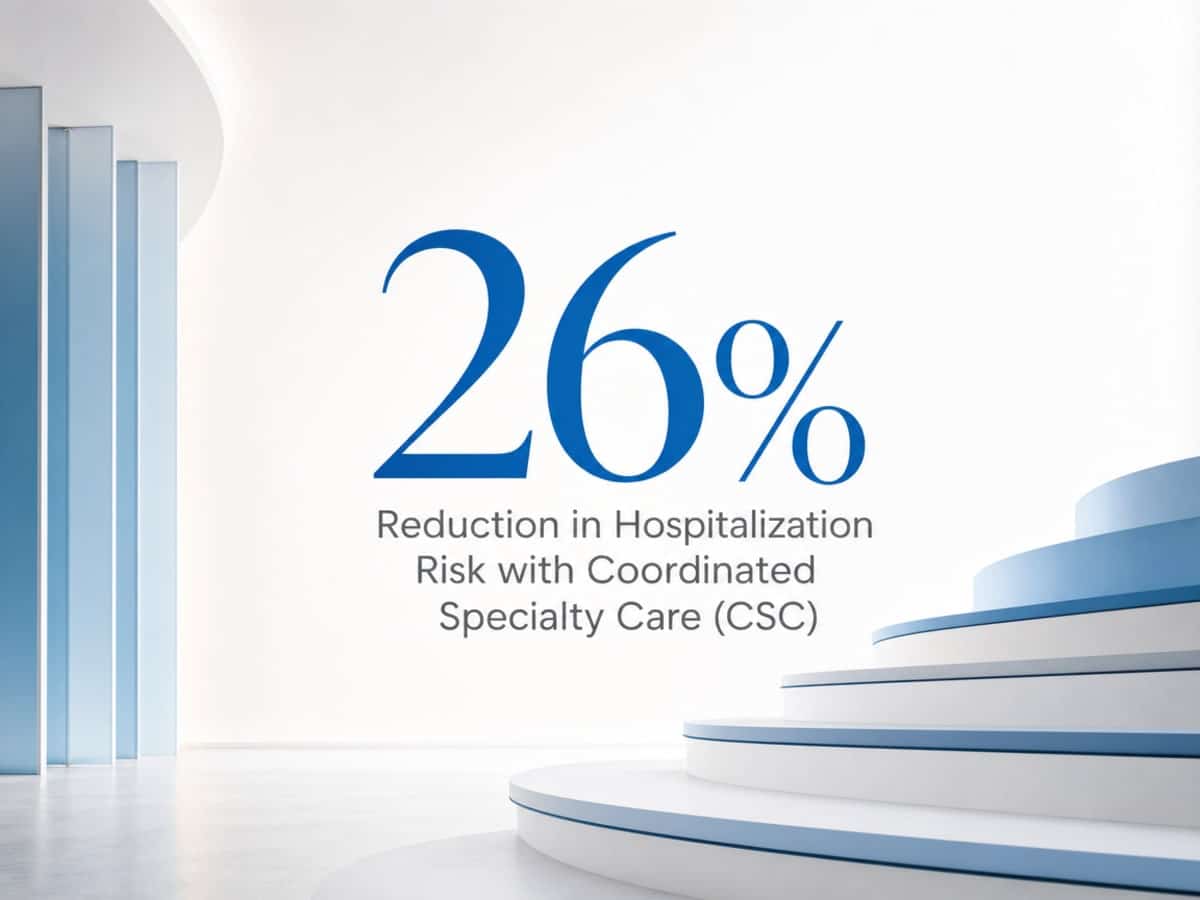
- Coordinated specialty care has the strongest evidence for people around age 27, cutting hospitalization risk by about 26% and treatment dropout by about 30% versus standard care 1.
- Residential treatment is voluntary and recovery-oriented, not a locked ward — you keep your phone, clothes, and the right to leave, and job and housing protections typically apply.
- If earlier treatment didn’t hold or substance use is part of the picture, integrated dual-diagnosis care and clozapine protocols under one team address gaps that standard programs often miss 2, 3, 9.
Reading This Is Already Hard. Start Here.
If you are reading this, something in the last few weeks or months has made you stop and look. Maybe the voices got louder. Maybe a thought that felt true at 3 a.m. felt wrong by morning, and then true again. Maybe someone you trust said, gently, that you didn’t sound like yourself. Sitting with that long enough to type it into a search bar takes more than most people know.
You don’t need to have this figured out to keep reading. You don’t need a diagnosis, a plan, or a person waiting at the other end of a phone call.
What you need, right now, is an honest picture of what treatment for psychosis actually looks like for someone in their late twenties or thirties. Not the version from movies. Not the version a worried family member described. The real one, with medication choices, therapy blocks, real days, and real trade-offs.
That is what the rest of this article gives you. Read at your own pace. You can stop anywhere.
What You’re Actually Choosing Between
The Four Real Settings, Side by Side
Most articles about psychosis treatment jump straight to symptoms or medications. That skips the question you actually have: where does this happen, and what does it cost you in time and freedom?
There are four real settings worth knowing about. Each one exists because people arrive at treatment from different places.
Outpatient care means you keep living your life. You see a psychiatrist for medication, usually once a month, and often a therapist weekly. This works when symptoms are stable and you have people around you. It fits least when you are in the middle of an active episode or your medication hasn’t been figured out yet.
Coordinated specialty care (CSC) is the model built specifically for people in their late twenties and thirties who are in a first or early episode. A team — psychiatrist, therapist, family worker, employment specialist, case manager — shares your case and meets about you. You still live at home. In a meta-analysis of 10 trials with 2,176 participants, mean age around 27, CSC beat standard care on hospitalization risk, treatment retention, symptom severity, and quality of life 1. It is the strongest-evidence option for young adults, and the components (medication, psychotherapy, family education, supported employment and education) are what a good program actually delivers day to day 12.
Day hospital means you show up every morning for structured care — groups, therapy, medication check — and go home at night. A randomized trial found that brief hospitalization followed by day hospital care was as effective as or more effective than longer inpatient stays, with better role functioning and less strain on family 7. Useful when you need intensity but not overnight supervision.
Residential care means you live at the treatment site for a stretch of weeks or months. It is used when outpatient support isn’t enough, when medication needs close adjustment, when substance use is layered in, or when home isn’t a safe place to recover. Structured, recovery-oriented residential programs improve functioning and reduce later hospital use 8.
Read across those four and locate yourself honestly. That’s the starting point, not a permanent label.

Why ‘Residential’ Doesn’t Mean What You Think
When you hear the word residential, your mind probably jumps to a hospital hallway, a locked door, a paper gown. That is inpatient psychiatric hospitalization, and it is a different thing.
Residential care for psychosis is closer to living in a house with a clinical team attached. You have your own bed. You wear your own clothes. You keep your phone, in most programs, on a schedule that makes sense for your recovery. You go outside. You cook or share meals. You meet with your psychiatrist, sit in therapy, spend time in groups with a handful of other people who know exactly what you are working through.
The evidence base treats residential programs as recovery-oriented environments — places designed to rebuild functioning and reduce future hospital stays, not to hold you 8. Reviewers do flag one honest risk: residential settings that lean too institutional can slow the return to normal life. That is a real design question, and it is why the better programs plan for your life outside from day one.
Why Acting Earlier Changes What Treatment Looks Like
There’s a version of this where you wait. You tell yourself the voices will quiet down on their own, or that you can white-knuckle it through the next paranoid stretch. Sometimes that works for a week. Rarely does it work for a year.
Here is the honest version of what earlier care does for someone in their late twenties or thirties. In a meta-analysis of 10 trials covering 2,176 people with early psychosis, mean age around 27, coordinated specialty care cut the risk of hospitalization by about 26% and reduced the risk of dropping out of treatment altogether by about 30%, compared to standard care 1. Those trials also showed small-to-medium improvements in symptom severity, day-to-day functioning, and quality of life 1. That is what the evidence base looks like for people close to your age, not for a generic patient in a textbook.
The number that matters most inside those figures is the drop in treatment discontinuation. Psychosis treatment doesn’t fail people because the medication doesn’t exist. It often fails because someone starts, feels worse before better, and disappears from care. A coordinated team — sharing your case, following up when you miss an appointment, adjusting the plan when a side effect makes life harder — is designed to keep that from happening 12.
Acting earlier doesn’t mean you have to commit to residential care today. It means the version of treatment available to you is wider, lighter, and shorter when you start before an episode forces the decision. Early intervention services are consistently linked to better clinical outcomes and fewer relapses than delayed standard care 6. Waiting narrows the menu. It rarely widens it.
What a Day in Residential Care Actually Looks Like
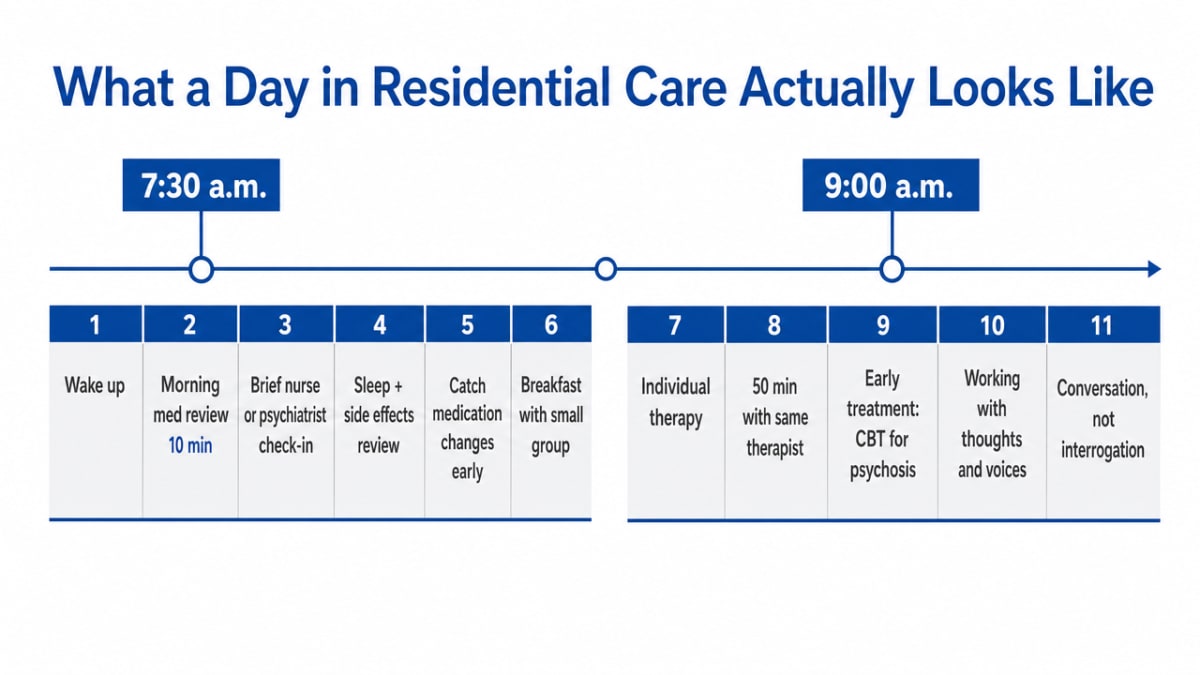
The abstract version of residential treatment tells you nothing useful. Here is a real day, hour by hour, in a program built around the components the evidence actually supports 8, 12.
7:30 a.m. — Wake up, then a morning med review. A nurse or psychiatrist checks in briefly. How did you sleep? Any side effects from last night’s dose? If a medication was recently changed, this is where the team catches problems early instead of a week later. It takes about ten minutes. Then breakfast, usually with the small group of people you live with.
9:00 a.m. — Individual therapy. Fifty minutes with your therapist, usually the same person for your whole stay. Early in treatment, this often looks like cognitive behavioral therapy for psychosis — working with the thoughts and voices, not against them. It is a conversation, not an interrogation. You are allowed to say a session is too much and stop.
10:30 a.m. — Group. A circle of five or six people, one or two clinicians. Topics vary: managing early warning signs, sleep, family conversations, what to say to a boss. Groups feel awkward on day one and different by week two. Nobody expects you to talk the first time.
12:30 p.m. — Lunch and free time. An hour or two that belongs to you. Read. Call someone. Sit outside. This is not a euphemism for supervised activity. It is time off.
2:00 p.m. — A working block. This is where the day flexes. It might be a family session by video, a meeting with a case manager about your job or your lease, a psychiatrist appointment to talk through a medication decision, or supported employment and education planning 12. On a lighter day, it is a skills group or an outdoor activity.
4:30 p.m. — Movement or open time. A walk, yoga, the gym, or nothing at all.
6:00 p.m. — Dinner.
7:30 p.m. — Evening group or reflection. Something quieter — a check-in, a mindfulness practice, sometimes a documentary. The goal is to close the day, not to add more clinical hours.
9:00 p.m. onward — Wind down. An evening med pass if you have nighttime medication. Lights out when you’re ready.
That rhythm is the point. Structured residential programs improve functioning and lower the odds of future hospital use partly because the day itself does work — sleep gets regular, meals happen, medication timing becomes consistent, and a team notices small changes before they become big ones 8. It is closer to living in a house with a schedule than being inside a hospital. Most days will feel long. Some will feel useful. That is what recovery looks like in practice.
The Fears You Haven’t Said Out Loud
Will I Be Committed or Locked In?
This is the fear that keeps most people from typing the search you just typed. So let’s be direct.
Involuntary commitment is a specific legal process that requires evidence you are an immediate danger to yourself or someone else, and it involves a court, not a treatment brochure. Choosing to enter a residential program is a different door entirely. You sign in. You can sign out.
Residential care for psychosis is designed as a recovery-oriented setting, not a holding facility 8. The doors are not locked from the inside. Your phone, your clothes, and your ability to say no to a treatment decision stay with you. If you want to leave, there is a conversation, sometimes a hard one, but not a lock.
Will I Lose My Job, My Housing, My Relationships?
This one deserves a straight answer, because vague reassurance won’t help you decide.
Under federal law, psychiatric treatment is protected medical care. That means the same job protections that cover a surgery or a serious illness usually cover a stay in residential treatment. FMLA, short-term disability, and workplace accommodation processes exist for exactly this. Your employer is not entitled to your diagnosis.
Housing is more practical than legal. A four-to-eight-week stay does not typically cost you a lease, especially if rent keeps getting paid. Good programs help you sort this out during intake, not after.
Relationships are the honest hard part. Some will bend. A few won’t. Family therapy is a standard part of coordinated care for a reason 12— the people around you often need help understanding what happened, and structured conversations tend to work better than a text from the parking lot.
Will I Be Over-Medicated or Labeled for Life?
The over-medication fear is not paranoid. It comes from real stories — someone you know, or someone you were, walked out of a hospital flat, foggy, and unable to think.
Modern guidelines push in the opposite direction. NICE and comparable frameworks emphasize the lowest effective dose, shared decision-making, and combining medication with psychological therapy rather than stacking prescriptions 10, 11. If you feel sedated or blunted, that is clinical information, not a personal failure. A team that hears it and adjusts is doing the job. A team that dismisses it is not.
The label question is quieter but heavier. A diagnosis on a chart is not a sentence about who you are. It is a working hypothesis used to guide treatment, and it can change. What tends to shrink your life is untreated psychosis, not the word for it. Early, coordinated care is consistently tied to better functioning and fewer relapses 6— meaning more of the life you’re afraid of losing, not less.
Medication, Honestly
Medication is the part of treatment most people either fear or over-hope for. Neither version is accurate.
Antipsychotic medication is the backbone of care for psychosis, and current adult guidelines are clear that it works best when paired with psychological therapy, not stacked on top of more pills 10. The goal is the lowest dose that quiets symptoms enough for the rest of your life to move again. Finding that dose takes time, sometimes weeks, sometimes a couple of tries. A first medication that doesn’t fit is information, not failure.
Side effects are real and worth naming. Weight gain, sleepiness, restlessness, a flat feeling — these show up in the early weeks and are the reason a lot of people stop taking medication before it has a chance to work. A team that expects this and adjusts, rather than telling you to push through, is doing the job the guidelines describe 10, 11.
If two well-dosed antipsychotics haven’t held, that’s a specific clinical picture, not a dead end. Clozapine is the medication with the strongest evidence for treatment-resistant schizophrenia, including reduced hospitalizations and lower suicide risk 9. It requires regular blood monitoring, which is why it is often started in a setting where labs and dose adjustments happen without you having to chase them. That is a practical reason to consider residential or closely supervised care, not a punishment.
When the First Round Didn’t Hold: Treatment Resistance and Substance Use
Why Standard Programs Sometimes Miss
If you have already tried treatment and it didn’t hold, you are not the exception. You are one of the reasons more specialized programs exist.
Standard coordinated specialty care is designed around a single presenting problem: a first episode of psychosis in an otherwise unaddicted, medication-responsive young adult. That is not everyone. The RAISE-ETP trial, which tested the NAVIGATE coordinated care program against usual care in 404 people with first-episode psychosis, found real gains on several clinical and functional outcomes — but no significant difference in days of self-reported substance use over two years 2. The program helped with the psychosis. It did not, on its own, move the substance use.
If you were drinking to quiet the paranoia, or using cannabis to sleep, or leaning on something harder to feel like a person, a program that treats the psychosis while politely referring the substance use elsewhere has a real gap. That gap is often where the second episode starts.
What Integrated Dual-Diagnosis Care Adds
Integrated care means one team treats both things at the same time, in the same building, with the same treatment plan. Not two separate providers who occasionally trade notes.
The research on trans-sector integrated programs — starting in a specialized open ward, then continuing in outpatient care — shows higher abstinence motivation and reduced substance use compared with usual care, along with psychoeducational and behavioral group work built specifically for people carrying both diagnoses 3. The effects on substance use in that study were modest and, at points, transient, which is a fair reason to expect real work rather than a fast fix.
What integrated care adds in practice: your psychiatrist knows what you’re using and adjusts medication choices around that. Your therapist doesn’t wait for you to be sober to work on the psychosis. Groups are made up of other people carrying both, not one or the other. The plan treats both as part of the same story, because for you they are.
Where ViewPoint Fits
Most programs are built around the person walking in with one problem, on their first try, with a clean chart. If that isn’t you, the fit gets thinner fast.
ViewPoint Dual Recovery, in Prescott, Arizona, was built for the other case. It’s a Joint Commission-accredited psychiatric facility that specializes in treatment-resistant conditions and dual diagnosis — meaning psychosis alongside substance use, or a first round of care that didn’t hold, or a medication picture complicated enough that a standard 28-day track can’t finish the work.
A few things make the day-to-day different from what you might picture. Board-certified psychiatry is available 24/7, not on a weekly rotation, which matters when a medication change needs a real conversation at 9 p.m. instead of next Tuesday. Clozapine protocols are handled in-house, including the blood monitoring 9. Your psychiatrist and your therapist meet about your case together, so the medication plan and the therapy plan are actually the same plan 12. Substance use, if it’s part of your story, is treated in the same building, on the same schedule, by the same team 3.
The other difference is time. Length of stay is set by what your clinical picture needs, not by what a billing cycle allows. For a first stay that didn’t hold the last time, that distinction is usually the point.
How to Decide What to Do This Week
You don’t have to pick a program this week. You have to pick one honest thing to do.
If you can still sleep most nights, hold most of a workday, and the voices or thoughts feel like background noise you can name, calling an outpatient psychiatrist or an early intervention service is a reasonable first move 6. If the last two weeks have been mostly not sleeping, not eating on a normal schedule, or hiding what’s happening from the people you live with, a higher level of care is worth a conversation, not because you’ve failed at outpatient life but because the setting stops being enough.
If you have already tried medication and therapy and it didn’t hold, or if you are using something to cope with symptoms, that is specifically the picture integrated specialized care was built for.
When you are ready, you can call ViewPoint directly. No referral, no crisis required. A conversation is not a commitment. It is one phone call you can end whenever you want.
Find out which care path fits your needs
Talk with a clinical expert about your unique experience and next-step options—no pressure, just real support.
Frequently Asked Questions
Can I choose to enter residential treatment voluntarily, or does someone have to commit me?
You can walk in on your own. Voluntary admission is how most people enter residential care for psychosis. You call, you talk to intake, you decide. Involuntary commitment is a separate legal process that requires evidence of immediate danger and a court, not a treatment decision. Residential programs are recovery-oriented settings, not holding facilities, and the door is not locked from the inside 8.
How long does residential psychosis treatment usually last?
Standard programs run four to eight weeks, often shaped by an insurance clock. The clinical picture is usually more honest than that. If medication is still being adjusted, or substance use is layered in, real stabilization can take longer. Programs that set length of stay by what your case needs, rather than by a billing cycle, tend to fit treatment-resistant and dual-diagnosis situations better 8.
What happens if I’ve already tried medication and it didn’t work?
Two well-dosed antipsychotics that didn’t hold is a specific clinical picture called treatment resistance, not a dead end. Clozapine has the strongest evidence for this situation, including lower hospitalization and suicide risk, and requires regular blood monitoring 9. That monitoring is easier to start in a setting where labs and dose changes happen without you chasing them, which is one practical reason people choose residential care.
Can I get treatment for psychosis and substance use at the same time?
Yes, and for many people it works better that way. Standard coordinated care improves psychosis outcomes but often doesn’t move substance use on its own 2. Integrated programs treat both in the same building, on the same plan, with one team — an approach linked to higher abstinence motivation and reduced use compared with usual care 3. You don’t have to be sober before starting.
Will going to residential treatment mean losing my job or my housing?
Usually no. Psychiatric treatment is protected medical care under federal law, and FMLA, short-term disability, and workplace accommodations exist for exactly this. Your employer isn’t entitled to your diagnosis. A four-to-eight-week stay rarely costs you a lease if rent keeps getting paid. Intake teams help you sort the practical pieces — work notice, housing, bills — before admission, not after you’ve already arrived.
What’s the difference between a day hospital and residential care?
Day hospital means you show up every morning for structured groups, therapy, and medication check, then go home to sleep. Residential means you live at the treatment site. A randomized trial found day hospital care can match or beat longer inpatient stays on outcomes and role functioning 7. Residential fits better when home isn’t safe to recover in, or when medication needs closer overnight adjustment.
References
- Effectiveness of coordinated specialty care compared to standard care for early psychosis: meta-analysis. https://pmc.ncbi.nlm.nih.gov/articles/PMC5888116/
- Impact of comprehensive treatment for first episode psychosis on substance use. https://pubmed.ncbi.nlm.nih.gov/30086471/
- Trans‑sector integrated treatment in psychosis and addiction. https://pmc.ncbi.nlm.nih.gov/articles/PMC4643160/
- Schizophrenia. https://www.nimh.nih.gov/health/topics/schizophrenia
- Recovery After an Initial Schizophrenia Episode (RAISE). https://www.nimh.nih.gov/health/topics/schizophrenia/raise
- Early intervention services for psychosis: a systematic review. https://pubmed.ncbi.nlm.nih.gov/22370816/
- Day hospital versus inpatient care for acute psychosis: randomized trial. https://pubmed.ncbi.nlm.nih.gov/18021907/
- Residential treatment for severe mental illness: systematized review. https://pubmed.ncbi.nlm.nih.gov/27838636/
- Clozapine in treatment‑resistant schizophrenia: a review. https://pubmed.ncbi.nlm.nih.gov/21993184/
- Psychosis and schizophrenia in adults: prevention and management. https://www.ncbi.nlm.nih.gov/books/NBK555203/
- Psychosis and schizophrenia in children and young people (NICE CG155 evidence review). https://www.ncbi.nlm.nih.gov/books/NBK552055/
- Coordinated Specialty Care for First Episode Psychosis: An Overview. https://www.ncbi.nlm.nih.gov/pmc/articles/PMC6610671/