

Key Takeaways
- NYSHIP doesn’t use the term ‘dual diagnosis,’ but the Empire Plan’s Mental Health and Substance Use (MHSU) Program covers both conditions together under one unified benefit 1.
- Calling the MHSU Program before admission unlocks the highest benefit level — in-network inpatient care is covered at no cost when that pre-admission call is made 8.
- Substance use treatment at a designated Center of Excellence is paid in full for detox, residential, partial hospitalization with boarding, and intensive outpatient when prior authorization is secured 5.
- Timothy’s Law and federal parity rules require that cost-sharing and utilization review for mental health and substance use claims stay comparable to medical/surgical care, giving families grounds to appeal restrictive denials 6.
Why NYSHIP Doesn’t Say ‘Dual Diagnosis’ — And What It Actually Covers Instead
If you’ve been searching NYSHIP documents for the words “dual diagnosis” and coming up empty, you’re not doing it wrong. The plan simply doesn’t use that phrase. That doesn’t mean the coverage isn’t there — it means you have to know what NYSHIP calls it instead, and that small translation is where a lot of families get stuck.
Here’s what to look for. The Empire Plan runs a single benefit called the Mental Health and Substance Use (MHSU) Program, and it’s built to cover both sides of a co-occurring case under one roof. The official certificate spells it out: the MHSU Program “provides comprehensive coverage for Mental Health Care and Substance Use Care, including alcoholism,” spanning inpatient psychiatric care, residential rehabilitation, structured outpatient rehab, aftercare, medication management, and crisis services 1. A second Empire Plan certificate for a different bargaining unit uses the same unified language, which tells you this isn’t a one-off benefit — it’s the operational baseline across NYSHIP groups 2.
Why does the terminology matter? Because when a hospital, therapist, or admissions coordinator asks whether your plan covers “dual diagnosis treatment,” the honest answer is: NYSHIP covers the components that make up dual diagnosis care — psychiatric treatment and substance use treatment, delivered together, when both are medically necessary. That framing is what unlocks the right authorization pathway.
Clinically, this matters more than it might sound. Peer-reviewed research on co-occurring mental and substance use disorders has long pointed out that these conditions produce worse outcomes when treated in sequence rather than together, and that insurance design either supports or blocks integrated care 11. NYSHIP’s plan design leans toward supporting it — you just have to speak the plan’s language to get there. The rest of this guide walks you through exactly how.
How the MHSU Program Treats Co-Occurring Conditions as One Episode of Care
The Unified Program That Covers Both Diagnoses Under One Roof
Here’s the piece that trips up almost every family the first time: with many insurance plans, a mental health diagnosis and a substance use diagnosis get handled by two different departments, sometimes two different vendors. You end up on hold twice, submitting paperwork twice, and getting two answers that don’t line up. If that’s been your experience so far, take a breath — NYSHIP is structured differently, and once you see how, the phone calls get shorter.
The Empire Plan runs mental health care and substance use care through one benefit administrator: the MHSU Program. The 2024 certificate is explicit that this single program “provides comprehensive coverage for Mental Health Care and Substance Use Care, including alcoholism,” and that it spans inpatient psychiatric care, residential rehabilitation, structured outpatient rehab, aftercare, medication management, and crisis services under the same benefit umbrella 1.
What that means for you, practically: when your loved one has both a psychiatric diagnosis and a substance use diagnosis in the same admission, you’re not stitching two benefits together. You’re using one program that already expects both to show up. The reviewer on the other end of the line is looking at inpatient psychiatric care, detox, and residential rehab as coverable services under the same policy — not as competing claims.
That single-program design is the quiet win of the Empire Plan for co-occurring cases. It doesn’t remove the medical necessity review, and it doesn’t guarantee approval for every level of care you request. But it does mean you’re advocating in one conversation instead of two, and that alone saves days.
Why Integrated Authorization Matters When You Have Both Conditions
Having one program on paper isn’t the same as getting one integrated approval in practice. The distinction is worth understanding before you make your first call, because it shapes how you’ll want the treating facility to write things up.
When someone is admitted with only depression, the reviewer authorizes psychiatric care against psychiatric criteria. When someone is admitted only for alcohol detox, the reviewer authorizes SUD care against SUD criteria. When someone has both — say, bipolar disorder plus opioid use, or PTSD plus alcohol use — the case file needs to document both diagnoses as medically necessary, and the level of care requested has to make sense for the combined clinical picture. Miss either half, and the authorization can come back covering only one condition, which is where families run into surprise bills.
This isn’t a NYSHIP-specific hurdle so much as a clinical documentation habit. But the Empire Plan gives you the ground to stand on: medically necessary inpatient and outpatient services for both mental health and substance use conditions are covered through the same program, in-network and, when medically necessary, out-of-network as well 7. That single benefit structure is the reason an integrated request can be reviewed as one episode of care rather than two competing ones.
The Call That Changes What You Pay: MHSU Program and the Clinical Referral Line
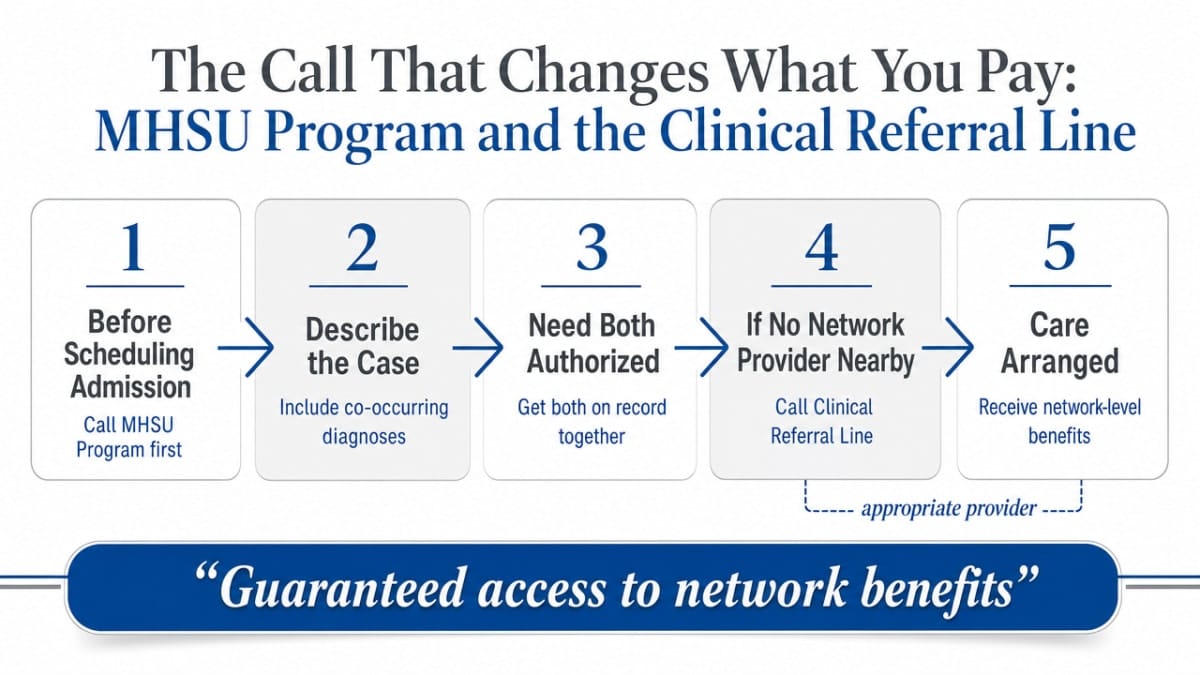
If you do one thing before scheduling an admission, make it this: pick up the phone and call the MHSU Program first. That single call is the difference between paying network rates and staring at a bill you weren’t expecting — and for co-occurring cases, it’s also how you get on the record that both diagnoses need to be authorized together.
Here’s the practical piece. NYSHIP publishes a specific instruction that many members miss: “Under the MHSU Program, you have guaranteed access to network benefits. If there are no network providers in your area, you will receive network level benefits if you call the Clinical Referral Line to arrange your care with an appropriate provider” 4. Read that again, because it’s genuinely unusual. In most plans, “no in-network provider nearby” means you either travel or pay out-of-network rates. Under the Empire Plan, if you call first and the MHSU Program can’t match you with a network provider who can treat the combined clinical picture, they arrange care with an appropriate provider and you still get network-level benefits.
The sequence to run, in order:
- Call the MHSU Program before any admission or first appointment. Have the member’s ID card in hand.
- Ask for the Clinical Referral Line if the local provider list doesn’t include a facility that can treat both the mental health and substance use diagnoses in the same episode 4.
- State both diagnoses on the call. Not one, then the other later. Both, in the same conversation, so the case is opened as co-occurring from minute one.
- Get the prior authorization confirmed in writing — reference number, dates covered, level of care approved. Save it.
- Ask whether a Center of Excellence for Substance Use Disorder applies to the level of care being requested. If it does, that changes what you pay (more on that in the next section) 5.
One more thing worth saying out loud: making this call is a win. If you’ve made it, you’re already ahead of most families in the same situation. Write down the reference number, breathe, and take the next step.
What You’ll Actually Pay in 2026: Copays, OOP Max, and Cost-Sharing Parity
Let’s talk numbers, because this is the part that keeps most families up at night. You’ve called the MHSU Program, you’ve got a reference number, and now you’re trying to figure out what the bill is actually going to look like. The short version: for co-occurring care in-network, the Empire Plan’s cost-sharing is more predictable than you’d guess — and it’s built on the same parity principle for both sides of a dual diagnosis.
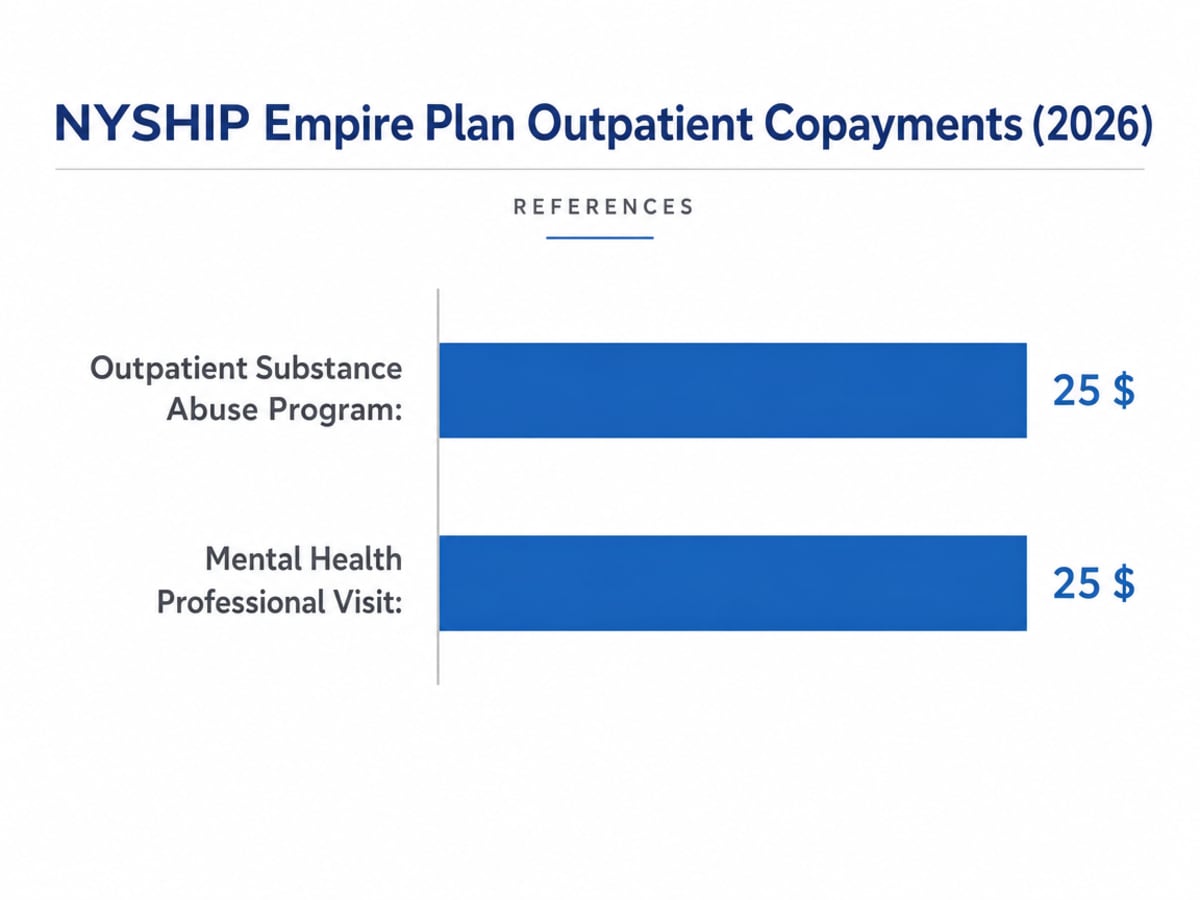
Start with outpatient. Under the 2026 Empire Plan copayment schedule, a visit to an outpatient substance use treatment program costs a $25 copay, and a visit to a mental health professional also costs a $25 copay 9. That’s the same dollar amount for both. It matters more than it might look on the page, because when someone in co-occurring treatment is seeing a psychiatrist on Tuesday and going to an outpatient SUD group on Thursday, you’re not paying one rate for the “mental health” day and a different rate for the “substance use” day. The plan treats them as equivalent care.
Step up a level. If the treatment plan includes an Intensive Outpatient Program (IOP) with an approved provider — a common landing spot for people stepping down from inpatient or trying to avoid it — the 2026 Choices booklet lists the copay at $25 per day 8. That’s per day, not per visit within the day, which is how IOP is usually structured (three-hour blocks, three to five days a week).
Now the inpatient piece, because this is where the sticker shock usually lives. The 2026 Choices booklet is direct: for network benefits, inpatient services are “covered at no cost to you” when members call the MHSU Program before receiving services 8. Zero copay, zero coinsurance — provided the call happens first. This is the single biggest financial reason to make that pre-admission call, and it applies whether the admission is for psychiatric stabilization, detox, or both at once.
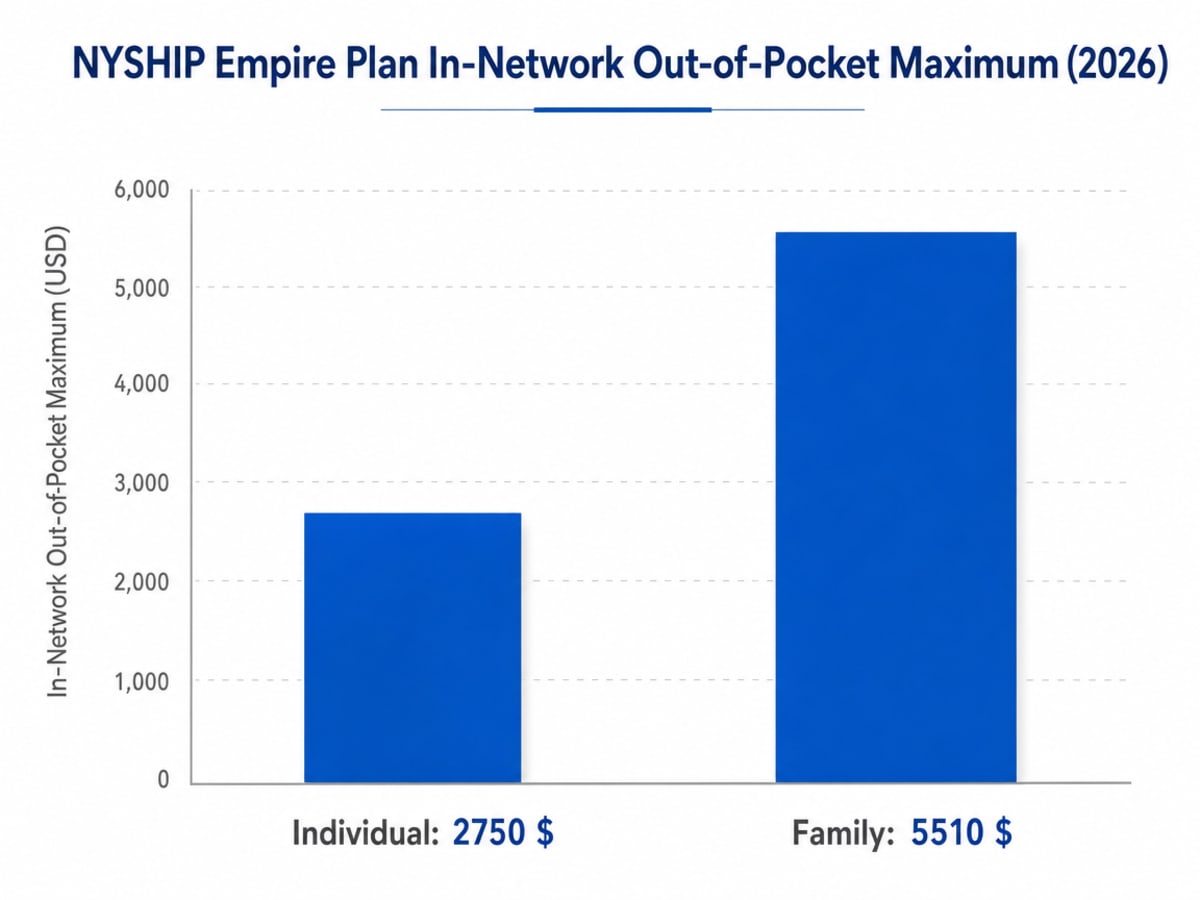
The safety net underneath all of this is the shared in-network out-of-pocket maximum. For a sample 2026 Empire Plan group, that maximum is $2,750 for individual coverage and $5,510 for family coverage, and it’s shared across the Hospital, Medical/Surgical, and Mental Health/Substance Use programs 3. Read that shared piece carefully. It means the money you’re spending on a knee surgery, a specialist visit, and a psychiatric admission all pool into the same cap. Once you hit it, in-network covered services are paid at 100% for the rest of the plan year.
A quick note on what these figures are and aren’t. They’re drawn from a specific 2026 Empire Plan group and represent the design most NYSHIP members will recognize, but your specific bargaining unit or retiree group can vary. Your ID card and your benefits summary are the final word. If the numbers on your card don’t match what you’re reading here, that’s not an error — that’s your plan variant, and it’s worth a five-minute call to confirm.
What’s genuinely encouraging in all this: the parity is real. The plan isn’t quietly charging you more for the substance use side of a dual diagnosis than the mental health side, and it isn’t running two separate deductibles you have to burn through independently. One out-of-pocket cap, matched copays, and inpatient at no cost when you call ahead. If you were bracing for a coverage design that punished you for having both diagnoses, you can put that fear down.
Centers of Excellence: When Substance Use Treatment Can Be Paid in Full
This is the part of the benefit that most families don’t hear about until after they’ve paid for something they didn’t have to. It’s worth learning before you need it.
NYSHIP designates certain facilities as Centers of Excellence for Substance Use Disorder, and when someone receives care at one of them with prior authorization in place and the Empire Plan acting as primary coverage, the benefit shifts from “covered with copays” to “paid in full.” The 2025 NYSHIP summary is explicit that paid-in-full benefits are available for substance use disorder treatment at a Center of Excellence across four specific levels of care: detox, residential treatment, partial hospitalization with boarding, and intensive outpatient, when prior authorization is obtained 5. That’s the full continuum most people step through when a substance use disorder is severe enough to need more than weekly therapy.
Here’s what makes this especially relevant for a co-occurring case. When someone has both a psychiatric diagnosis and a substance use diagnosis, the SUD side of the treatment plan is often where the biggest inpatient and residential costs live. Detox alone can run into five figures at a private facility. Residential SUD care over several weeks can climb higher. Getting that side of the episode into a Center of Excellence — while the mental health side continues to be covered through the same MHSU Program — is the single largest financial lever available under this plan.
A few things to hold in mind so you don’t accidentally lose the benefit:
- Prior authorization isn’t optional here. The paid-in-full designation is conditional on getting authorization before care starts, not after 5. This is the same MHSU Program call described earlier — you’re just also asking whether the recommended facility is a Center of Excellence for the level of care being requested.
- Empire Plan must be primary. If your household has another insurer sitting in front of NYSHIP for this member, the paid-in-full rule applies when Empire Plan is primary 5. Coordination-of-benefits questions are worth resolving on the same verification call.
- The Center of Excellence designation is facility-specific. A facility is either designated for SUD care under this program or it isn’t. Ask the question directly during verification rather than assuming.
One honest caveat. The Center of Excellence rule applies to substance use disorder care. The mental health side of a co-occurring episode is covered through the broader MHSU Program benefits already discussed — inpatient at no cost when you call ahead, and the outpatient copays outlined in the previous section 8. So in a well-authorized dual diagnosis episode, you can end up with the SUD services paid in full at a Center of Excellence and the psychiatric services covered at network rates through the same unified program. That combination is what a good verification call is trying to line up.
If you’re staring at a facility recommendation and don’t know whether it carries the designation, that’s a fair question to hand off. Ask the admissions team, or ask an insurance verification team to confirm it against your specific NYSHIP plan variant before you commit.
Your Rights Under Parity: What Timothy’s Law Guarantees
Before you make another call or sign another authorization form, it helps to know what the law already puts on your side of the table. If an insurer ever leaves you feeling like mental health and substance use care are being treated as second-tier benefits, that instinct is worth trusting — and there’s a specific legal reason it’s wrong.
New York’s Timothy’s Law, together with the federal Mental Health Parity and Addiction Equity Act, requires health plans to cover mental health and substance use disorder treatment on terms comparable to medical/surgical care. According to the New York Attorney General’s parity report, Timothy’s Law mandates at minimum 30 days of inpatient care, 20 outpatient visits, and up to 60 visits of partial hospitalization for mental, nervous, or emotional disorders — and it requires that deductibles, copayments, and coinsurance for mental health treatment stay consistent with those imposed on other benefits 6. That’s the floor. Your NYSHIP plan sits above it.
Parity also covers something less visible than dollar amounts: utilization review. The same report flags that plans can’t apply more restrictive review standards to mental health and substance use claims than they do to comparable medical/surgical claims 6. In plain terms, if an insurer would authorize a two-week hospital stay for a medical condition without requiring you to justify each additional day, they can’t turn around and demand that level of scrutiny for a psychiatric or SUD admission. For co-occurring cases, where the case file is already more complex, this matters.
What to do with this. If you receive a denial or a shorter authorization than the treating clinicians requested, you have grounds to appeal — and citing parity in the appeal is legitimate. You’re not being difficult. You’re using a right the state built for exactly this moment. Small win worth naming: knowing the floor exists changes how you read the next letter that arrives.
When Standard Programs Have Failed: Treatment-Resistant and Out-of-State Cases
If you’re reading this section, there’s a good chance you’ve already been through the standard playbook. Maybe your loved one completed a 28-day program and relapsed within weeks. Maybe the psychiatric medications that were supposed to work didn’t, and the substance use side never got real attention. Maybe you’re looking at Arizona or another state because the right level of care isn’t available close to home. None of that means the plan is out of options — but it does mean the authorization conversation has to be built differently.
Here’s what the Empire Plan actually gives you to work with. Coverage for medically necessary inpatient and outpatient mental health and substance use treatment extends through the participating provider network, and medically necessary care out of network is also covered under the MHSU Program 7. That out-of-network language matters when your case needs a facility that specializes in treatment-resistant psychiatric conditions layered on top of a substance use disorder — programs that don’t exist on every corner. The plan doesn’t require you to accept the closest option; it requires the care to be medically necessary.
Pair that with the guaranteed network access rule you already know about. If no in-network provider in your area can treat the combined clinical picture, calling the Clinical Referral Line to arrange care with an appropriate provider preserves network-level benefits 4. For a treatment-resistant, out-of-state admission, that call is not a formality — it’s the mechanism that keeps your cost-sharing where it should be.
Two things to document from the treating clinicians before the authorization request goes in:
- First, what has already been tried and why it didn’t hold — prior admissions, medication trials, previous levels of care, relapse history.
- Second, why the recommended episode of care is medically necessary for both the psychiatric and substance use diagnoses together, not sequentially.
The research on co-occurring disorders is clear that integrated treatment produces better outcomes than sequential treatment 11, and that clinical case is the one the reviewer needs to see.
If a shorter authorization comes back than the treating team requested, that’s not the end of the road — it’s the start of the appeal, and the parity protections outlined earlier are the ground you stand on. Getting to this point took work. You’re not starting over; you’re just moving the same case into the right lane.
A Same-Day Action Plan for Families Verifying NYSHIP Coverage
You’ve read a lot at this point. If your hands are full and you just need a plan for the next hour, here it is.
Before you make the call (10 minutes)
- Pull the NYSHIP Empire Plan ID card. You’ll need the member ID and group number.
- Write down both diagnoses in plain language — the psychiatric one and the substance use one — so you say them the same way every time 1.
- Note what’s already been tried: prior admissions, medications, outpatient programs. If this is a treatment-resistant case, that history is the authorization request.
The call itself (20–30 minutes)
- Call the MHSU Program and ask for the Clinical Referral Line if the local network can’t treat both conditions in one episode 4.
- State both diagnoses on the same call. Ask for prior authorization for the level of care the treating clinicians are recommending.
- Ask directly: “Is the recommended facility a Center of Excellence for Substance Use Disorder, and does the paid-in-full benefit apply to this level of care?” 5
- Get the reference number, the dates authorized, and the level of care approved. Write them down.
If you’d rather hand this off
Verification calls for co-occurring cases take longer than single-diagnosis ones, and out-of-network or out-of-state situations add another layer. ViewPoint’s insurance verification team handles this call on your behalf — confirming your specific NYSHIP plan variant, checking Center of Excellence status against the recommended level of care, and clarifying what medical necessity documentation the reviewer will want to see for both diagnoses together. If you want that support, the Verify Insurance page is the fastest way to start.
One last thing. Whatever you do next — make the call yourself, hand it off, take an hour to breathe first — you’re not behind. You’re doing the work. That counts.
Clarify your NYSHIP dual diagnosis coverage options
Get a personalized review of your NYSHIP eligibility for integrated mental health and substance use treatment.
Frequently Asked Questions
Does NYSHIP cover dual diagnosis treatment if both conditions are diagnosed at the same time?
Yes, though NYSHIP doesn’t use the phrase “dual diagnosis.” The Empire Plan’s Mental Health and Substance Use (MHSU) Program covers medically necessary inpatient and outpatient care for both mental health and substance use conditions under one unified benefit 1. When both diagnoses are documented in the same episode, the case is reviewed against the combined clinical picture. The key is making sure both diagnoses appear on the authorization request from the start.
Do I need prior authorization before starting co-occurring treatment under the Empire Plan?
For inpatient care, yes — and calling before admission is what unlocks the highest benefit level. The 2026 Choices booklet states that in-network inpatient services are covered at no cost when members call the MHSU Program before receiving services 8. For outpatient care, call first to confirm the provider and level of care. Waiting until after treatment starts can drop you to a lower benefit tier, even if the care itself is covered.
What happens if there are no in-network providers who treat both conditions in my area?
You’re still protected. NYSHIP guarantees network-level benefits when local network providers aren’t available, as long as you call the Clinical Referral Line first and let them arrange care with an appropriate provider 4. This matters for co-occurring cases, where a facility that treats both a psychiatric diagnosis and a substance use diagnosis together may not exist nearby. The call is what preserves your cost-sharing — don’t skip it and book directly.
What is a Center of Excellence, and how does it change what I pay for substance use treatment?
A Center of Excellence is a NYSHIP-designated facility where substance use disorder care is paid in full when prior authorization is obtained and the Empire Plan is primary. The paid-in-full benefit covers four levels: detox, residential treatment, partial hospitalization with boarding, and intensive outpatient 5. For a co-occurring case where the SUD side carries the biggest inpatient costs, routing that portion to a Center of Excellence is the largest financial lever the plan offers.
Can NYSHIP deny longer treatment if standard programs have already failed?
A shorter authorization than requested can happen, but it’s not the final word. Timothy’s Law and federal parity rules require that utilization review for mental health and substance use claims can’t be more restrictive than for comparable medical claims 6. Prior treatment history — failed programs, relapses, medication trials — strengthens the medical necessity case for a longer or more intensive episode. If denied, you have the right to appeal, and citing parity is legitimate.
Does the Empire Plan cover out-of-state treatment for co-occurring conditions?
Yes, when medically necessary. Empire Plan coverage extends to medically necessary out-of-network care under the MHSU Program, which includes out-of-state facilities 7. If no in-network provider in your area can treat the combined clinical picture, calling the Clinical Referral Line before admission preserves network-level benefits even when care is arranged elsewhere 4. For treatment-resistant cases needing specialized programs, document why closer options can’t meet the clinical need and submit that with the authorization request.
References
- EMPIRE PLAN CERTIFICATE (PEF) 2024 – NYS Department of Civil Service. https://www.cs.ny.gov/employee-benefits/hba/shared/publications/certificate/2024/PEF_Certificate_2024.pdf
- EMPIRE PLAN CERTIFICATE (UUP) 2024 – NYS Civil Service. https://www.cs.ny.gov/employee-benefits/nyship/shared/publications/certificate/2024/UUP_Certificate_2024.pdf
- 2026 NYSHIP Plan Comparison – Empire Plan. https://www.cs.ny.gov/employee-benefits/nyship/shared/apps/plan-comparison/compare.cfm?plancode=001&group=6
- Reporting On Mental Health and Substance Use Program 2024 – The Empire Plan. https://www.cs.ny.gov/employee-benefits/hba/shared/publications/reporting-on/2024/reporting-on-mhsu-2024.pdf
- NYSHIP 2025 At a Glance – Dutchess County. https://www.dutchessny.gov/Departments/Human-Resources/Docs/NYSHIP-2025-At-a-Glance.pdf
- Mental Health Parity Report – New York State Attorney General. https://ag.ny.gov/sites/default/files/hcb_mental_health_parity_report.pdf
- Empire Plan Programs and Services – Mental Health and Substance Use Program. https://www.cs.ny.gov/employee-benefits/pa-market/shared/providers/pa_market.cfm
- Active Choices 2026 – NYSHIP Empire Plan. https://www.cs.ny.gov/employee-benefits/nyship/shared/publications/choices/2026/active-choices-2026.pdf
- Empire Plan Copayments – Mental Health and Substance Use Program. https://www.cs.ny.gov/employee-benefits/pa-market/shared/copayments/copayments_pa_empire_plan.cfm
- Mental Health and Substance Use Disorder Coverage Requirements – NYS Department of Financial Services. https://www.dfs.ny.gov/apps_and_licensing/health_insurers/mental_health_and_substance_use_disorder
- Co-Occurring Mental and Substance Use Disorders: The Changing Landscape – Psychiatric Services. https://www.ncbi.nlm.nih.gov/pmc/articles/PMC3753025/