Key Takeaways
- New York’s inpatient psychiatric capacity fell 10.5% between 2014 and 2023, and 20 counties still have zero psychiatric beds, so a hospital denial usually reflects system-wide scarcity rather than your loved one’s case 5, 6.
- High-acuity care in New York runs across distinct tiers — Part 580 units, Part 582 freestanding hospitals, state-operated psychiatric centers, and only two OMH-licensed dual diagnosis inpatient units statewide 1, 2, 3, 10.
- When a unit says ‘not appropriate,’ ask which specific reason applies, request a §9.39 determination in writing, and have the treating clinician formally initiate a state psychiatric center consult 4, 3.
- After two or more in-state denials for acuity, dual diagnosis, or medication complexity, run an out-of-state option in parallel rather than waiting for New York capacity to catch up 9.
When New York Keeps Saying No
You’ve made the calls. The community hospital said the unit was full. The private psychiatric hospital said your loved one was “not appropriate.” The CPEP evaluated, stabilized for a few hours, and sent everyone home with a follow-up number. And here you are, still holding the phone, still watching someone you love spiral.
This guide is a map. It walks you through the tiers of high-acuity psychiatric care that actually operate in New York — Part 580 units inside general hospitals, Part 582 freestanding psychiatric hospitals, state-operated psychiatric centers, the two dual diagnosis inpatient units in the entire state, CPEPs, and crisis residences 1, 2, 3, 10, 13. It explains why so many families keep hitting a wall, what to push for in the next 72 hours, and when it makes sense to look outside New York entirely, including at a program like ViewPoint Dual Recovery in Prescott, Arizona that accepts the treatment-resistant and dual-diagnosis cases many New York programs decline.
You are not out of options. You are in the middle of a hard one.
Why the ‘No Bed’ Answer Is So Common Right Now
A Decade of Shrinking Capacity
When five hospitals in a week tell you there’s no bed, it can start to feel personal, like your loved one is somehow the reason. The numbers tell a different story.
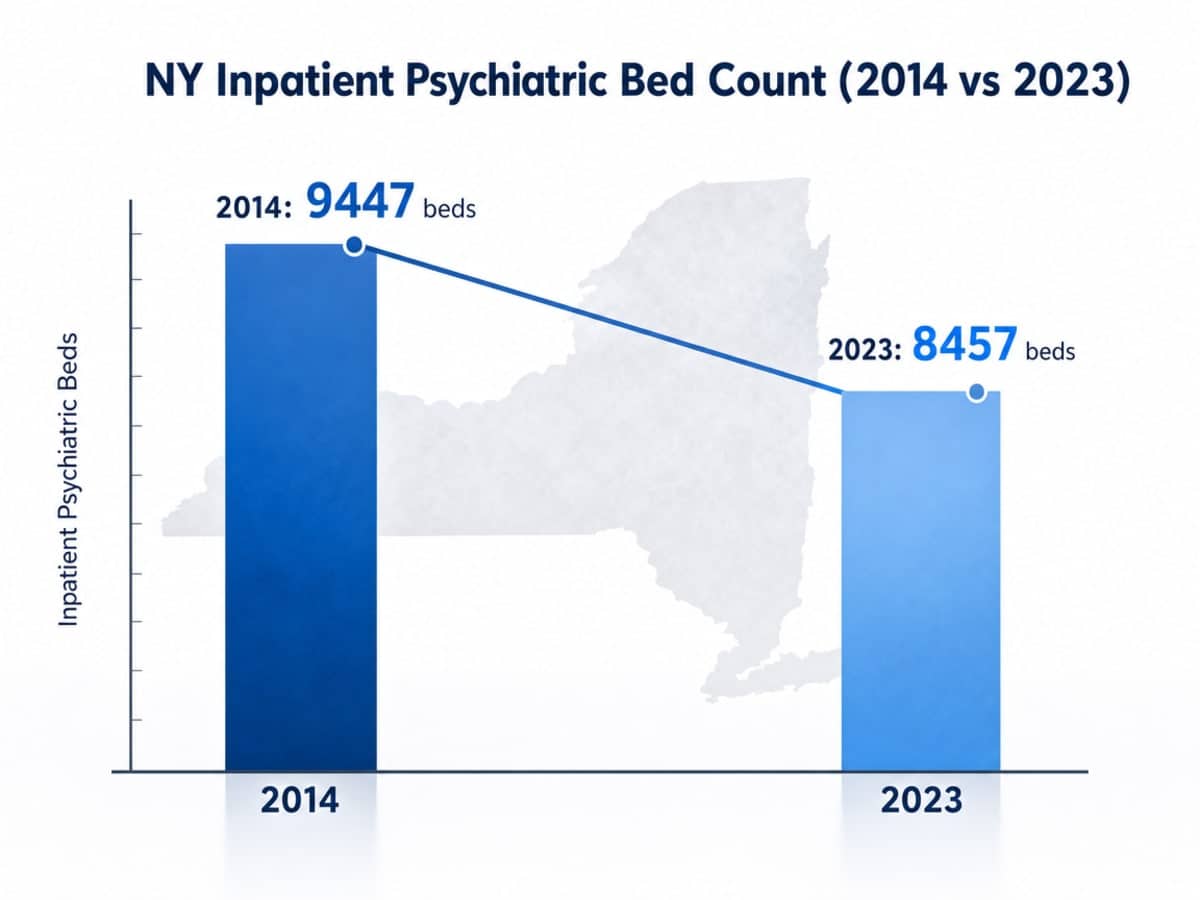
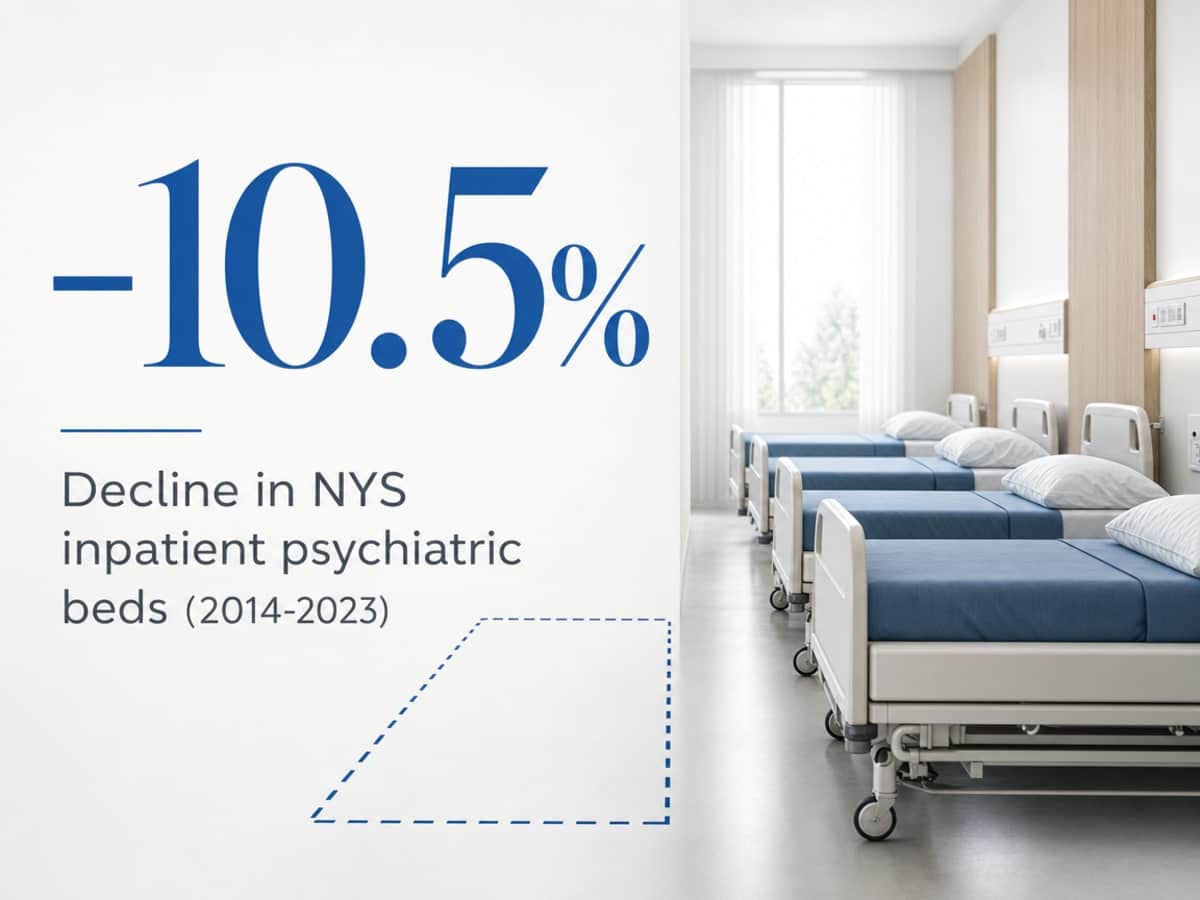
Between April 2014 and December 2023, New York State’s inpatient psychiatric capacity dropped by 10.5%, from 9,447 beds to 8,457 — a net loss of 990 beds statewide over roughly a decade 5. That’s not a rounding error. That is nearly a thousand fewer places for someone in crisis to be admitted, in a state where the share of adults with mental illness went up, not down, during the same period 6.
The beds didn’t disappear all at once. They closed unit by unit — a hospital converting a psychiatric wing to medical use, a private facility narrowing its admission criteria, a state center reducing operating capacity even when its budgeted capacity looked healthier on paper 16. On any given month, some units also run above their budgeted capacity, which is another way of saying the ones still open are frequently full 17.
So when the intake coordinator says, “We don’t have anything,” that answer is usually true. It’s also usually not about your loved one at all.
Where the Beds Actually Are
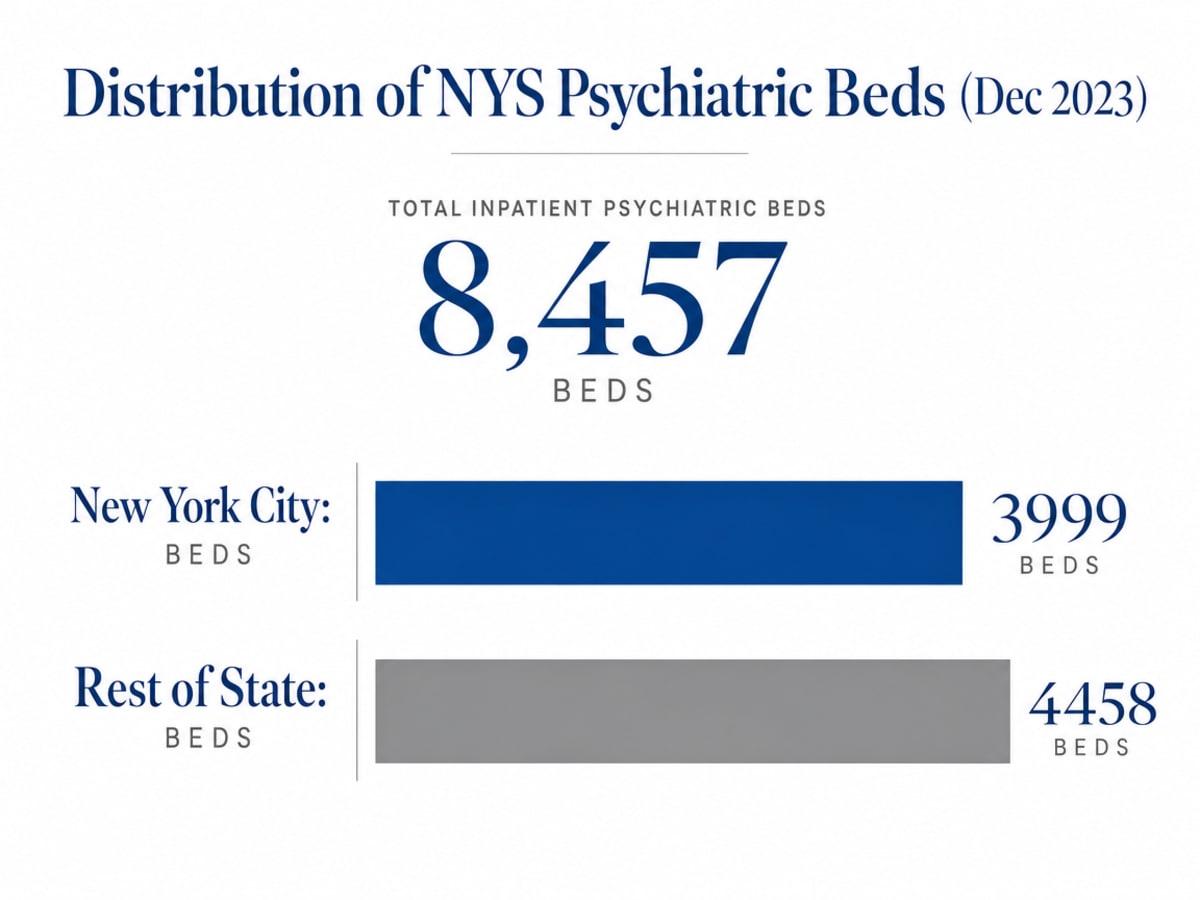
Geography matters more than families are usually told. As of December 2023, New York City held 3,999 of the state’s psychiatric inpatient beds, and the rest of the state held 4,458 6. That looks balanced until you factor in population.
The bed-to-population ratio comes out to roughly 1 bed per 2,084 people in New York City and 1 bed per 2,544 people across the rest of the state 6. And 20 New York counties have zero inpatient psychiatric beds — none 6. If you live in one of those counties, “local” high-acuity care may already mean a two-hour drive on your best day.
This is why families in the North Country, the Southern Tier, or the western Adirondacks often describe the same loop: the nearest emergency department stabilizes, then transfers a patient hours away to a unit that then discharges back home, where no outpatient team is set up to catch what comes next. It is not your organizing that failed. The beds simply are not there.
New Beds Are Coming Back, Slowly
There is real movement in the other direction, and you deserve to know about it. Under the current state administration, New York has brought 1,000 psychiatric beds online — 642 at Article 28 general hospitals and 358 at state-operated psychiatric centers — with a further $43 million committed to expand inpatient and emergency psychiatric services 9. That includes plans to double the Transition to Home program at Creedmoor Psychiatric Center for chronically homeless adults with serious mental illness 9.
This matters. It also does not solve your Tuesday.
New beds open unit by unit, staff by staff. A bed that exists on a press release may still be six months from taking admissions, and even then it may prioritize a specific population — pediatric, forensic, long-stay, or Transition to Home. If you are calling around this week, the honest read is: capacity is being rebuilt, and it is not yet where it needs to be for treatment-resistant or dual-diagnosis cases. Plan for the system you have right now, not the one being announced.
The Tiers of High-Acuity Care in New York
Part 580 Units Inside General Hospitals
When someone in your family lands in a local ER and gets admitted upstairs to a psychiatric floor, that floor is almost always a Part 580 unit. Part 580 is the OMH regulation that governs psychiatric inpatient units operating inside general hospitals. No unit can run without both an OMH operating certificate and a valid Department of Health license 1.
These are the units families are most likely to reach first. They tend to be short-stay, focused on acute stabilization, and staffed for the median case, not the outlier. That is why a treatment-resistant schizophrenia presentation or a severe co-occurring pattern often gets a polite “we’re not the right fit” call within 24 hours of admission 19. It’s not that the unit doesn’t care. It’s that the unit is designed for a narrower range of acuity than what your loved one is bringing.
Part 582 Freestanding Psychiatric Hospitals
Part 582 covers freestanding psychiatric hospitals — facilities that are not tucked inside a general medical hospital but exist as their own dedicated psychiatric institutions 2. Think of the private and nonprofit psychiatric hospitals whose entire building is behavioral health.
On paper, this is where you’d expect deeper capability for complex cases. In practice, many Part 582 hospitals still run tightly defined admission criteria: age bands, diagnosis exclusions, insurance restrictions, and sometimes a hard line against active substance use. The regulation itself excludes certain forensic and Article 10 facilities, and it draws a clear boundary between freestanding inpatient services and CPEP emergency services 2. If a Part 582 hospital declined your loved one, it usually reflects that program’s specific scope — not the outer limit of freestanding psychiatric care as a category.
State-Operated Psychiatric Centers
State psychiatric centers are a different animal. Run directly by OMH, they exist in part to serve the people that community hospitals and private facilities cannot or will not — individuals with severe, persistent mental illness who need longer stays, more structured supervision, and clinical depth that a 5-to-7-day acute stay can’t offer 3.
These are the places where treatment-resistant schizophrenia, chronic suicidality, and complex behavioral presentations are often the norm rather than the exception. The catch is access. State center admissions typically route through a referring hospital or CPEP, not through a family calling directly, and length of stay reflects clinical need rather than a discharge timer. If your loved one has been declined by multiple community hospitals, ask the referring team explicitly whether a state psychiatric center transfer is being considered. That conversation does not usually start on its own.
Dual Diagnosis Inpatient Units: Only Two in the State
If your loved one has a co-occurring intellectual or developmental disability alongside a psychiatric illness — an autism spectrum diagnosis with escalating self-injury, say, or an intellectual disability paired with a psychotic disorder — the specialized inpatient tier you need is extraordinarily narrow.
OMH’s 2025 dual diagnosis guidance describes DD inpatient units as providing specialized inpatient psychiatric care to stabilize adults and children with co-morbid mental illness and intellectual developmental disability diagnoses
who show destructive behaviors or acute safety risks 10. Enhanced staffing, specialized protocols, dedicated Medicaid rate codes for child and adult DD care — the framework exists.
What doesn’t exist is enough of it. Only two hospitals in New York carry OMH-licensed DD inpatient services 10. If your loved one fits this profile and you’ve been told “we’re not equipped for that,” the honest read is that most units genuinely aren’t. Ask specifically about DD inpatient placement rather than a general psychiatric bed.
CPEPs and Crisis Residences Are Stabilization, Not Treatment
Comprehensive Psychiatric Emergency Programs and Crisis Residences show up constantly in the referral instructions families receive, and it’s worth being clear about what they are. CPEPs provide a full range of 24/7 psychiatric emergency services. Crisis Residences are voluntary, short-term programs with 3 to 16 beds offering stabilization, with stays up to 21 days for children and 28 days for adults 13.
Both are valuable. Neither is treatment for a treatment-resistant condition.
A CPEP can hold, evaluate, and route. A crisis residence can decompress a situation that hasn’t tipped into imminent danger. But if your loved one’s core problem is a psychiatric illness that hasn’t responded to two or three medication trials, or a genuinely dual diagnosis that keeps unraveling, a crisis stay buys time — it does not resolve the clinical question. Use these programs as bridges, not destinations.
A Side-by-Side Look at the Tiers
Here is the same information collapsed into one view, so you can hand it to a referring clinician or use it while you’re on hold.
| Tier | Regulatory Category | Typical Length of Stay | Acuity Range | Dual Diagnosis Capability |
|---|---|---|---|---|
| General hospital psych unit | Part 580 1 | Short (days) | Acute, stabilization-focused | Variable, often limited |
| Freestanding psychiatric hospital | Part 582 2 | Short to intermediate | Acute; program-specific | Program-dependent |
| State-operated psychiatric center | OMH-operated 3 | Intermediate to long | Severe, persistent illness | Present in some centers |
| Dual Diagnosis (DD) inpatient unit | OMH-licensed, 2 statewide 10 | Specialized inpatient | Co-occurring IDD + mental illness | Core specialty |
| CPEP | OMH emergency program 13 | Hours to short observation | Emergency stabilization | Screening only |
| Crisis residence | OMH voluntary program 13 | Up to 21 (child) / 28 (adult) days | Sub-acute stabilization | Not designed for treatment-resistant care |
One “no” from one tier is not a “no” from the system. It’s a signal to ask which tier fits — and to keep pushing until someone answers that question directly.
Why Complex Cases Keep Getting Declined
The Dual-Diagnosis Punt
If your loved one uses substances and also has a serious psychiatric illness, you have probably heard some version of this: the psychiatric unit says the substance use makes them inappropriate, and the substance use program says the psychiatric symptoms make them inappropriate. Everyone points at the other door.
Here’s what makes that maddening: New York regulation explicitly forbids it in integrated dual-disorder programs. 14 NYCRR § 512.7 states that admission criteria shall not exclude individuals because of past histories of incarceration or substance abuse,
and providers shall not deny access to services by an otherwise appropriate individual solely on the basis of multiple diagnoses
12. The rule is clear. The practice is not.
Programs still turn people away informally — through waitlists, through “we can’t safely manage that behavior right now,” through a suggestion to “get the substance use under control first.” If you’re hearing that, ask the intake coordinator to put the specific reason for denial in writing. That single request often changes the conversation.
Emergency Departments, §9.39, and Boarding
When there is no inpatient bed available, the emergency department becomes the waiting room. That waiting can stretch from hours into days, and it has a name in health policy circles: psychiatric boarding.
Almost every hospital with an OMH-licensed psychiatric unit is a “9.39 hospital,” meaning it is authorized under Mental Hygiene Law §9.39 to determine whether a person meets the emergency standard for involuntary admission — up to 15 days — based on mental illness plus a likelihood of serious harm to self or others 4. That authority exists. Using it depends on a bed being available downstream, and on the ED physician making the determination in the first place.
If your loved one is boarding, ask directly: has a §9.39 determination been made, and what is the current transfer plan? Boarding is not treatment. It is a holding pattern that a specific question can sometimes shorten.
What ‘Not Appropriate for Our Unit’ Usually Means
“Not appropriate for our unit” almost never means “your loved one doesn’t need help.” It usually means one of a few specific things, and knowing which one matters.
- It can mean the unit isn’t staffed for the level of behavioral acuity your loved one is showing.
- It can mean the medication strategy on the table — clozapine titration, complex mood stabilizer combinations, ECT workup — exceeds what a short-stay Part 580 unit typically manages 1.
- It can mean a co-occurring medical, developmental, or substance use issue falls outside the program’s scope.
- Or it can simply mean the unit is full.
When you get this phrase, ask which one it is. The answer tells you which door to try next — a state psychiatric center, a DD inpatient unit, or an out-of-state program built for the exact complexity being declined.
What to Do in the Next 72 Hours
Ask for a CPEP Re-Evaluation, Not a Repeat ED Visit
If your loved one was seen at a regular emergency department and sent home, going back to that same ED usually produces the same result. A Comprehensive Psychiatric Emergency Program is different. CPEPs deliver a full range of 24/7 psychiatric emergency services and are structured specifically to assess and route people in acute crisis 13.
Call ahead and ask whether your regional CPEP has extended observation capacity available right now, and whether they can accept a direct arrival or need a warm handoff from your current provider. Bring a written timeline: symptoms in the last 72 hours, medications tried, prior admissions, prior denials. That single page changes how quickly a psychiatrist can make a placement call — and whether “we already saw them” becomes the answer again.
Push for a §9.39 Determination in Writing
Nearly every hospital with an OMH-licensed psychiatric unit is a “9.39 hospital,” meaning it holds authority under Mental Hygiene Law §9.39 to admit involuntarily for up to 15 days when a person has a mental illness plus a likelihood of serious harm to self or others 4.
If your loved one meets that standard and is boarding in an ED, ask the attending psychiatrist directly: has a §9.39 determination been made, and if not, what is missing from the assessment? Then ask for the answer in the chart. A documented determination — either way — forces the transfer conversation forward. It also gives you something to hand to the next facility if this one cannot place. Boarding without a decision is the pattern that stretches into days. A decision, even a hard one, moves the case.
Call the State Psychiatric Center in Your Region
State-operated psychiatric centers exist in part for the exact population community hospitals decline: severe, persistent mental illness that needs longer stays and deeper clinical structure 3. What families rarely hear is that transfers to a state center almost always route through a referring hospital or CPEP, not through your direct call.
That means the request has to come from a clinician. Ask the current treating psychiatrist — in the ED, on the inpatient unit, or at the CPEP — to formally initiate a state psychiatric center consult. Name it that way. If the answer is that the case doesn’t qualify, ask for the specific criterion that isn’t met. Vague no’s are how referrals stall.
Consider Out-of-State Placement Sooner Than You Think
Most families wait too long to look outside New York, usually because it feels like giving up on the local system. It isn’t. If your loved one has been declined by two or more programs for acuity, dual diagnosis, or medication complexity — and the state is still rebuilding capacity unit by unit 9— parallel-tracking an out-of-state option is a reasonable next step, not a last resort.
Start those calls this week, not next month. A specialized program like ViewPoint Dual Recovery in Prescott, Arizona is Joint Commission accredited and accepts treatment-resistant psychiatric and dual-diagnosis cases, including clozapine protocols, that many New York units decline. Even if a New York bed opens first, having a real second option means the next “no” doesn’t leave you starting from zero.
When New York Has Said No: ViewPoint Dual Recovery
If you’ve been through the tiers above and the answer is still no — no bed, not appropriate, not equipped for that behavior, not our scope — it is reasonable to look outside New York. Not because the state has failed your loved one, but because the specific combination they present with may not have a matching door open in this state right now.
ViewPoint Dual Recovery is in Prescott, Arizona. It is Joint Commission accredited. It was built for the cases that get labeled “too complex” — treatment-resistant schizophrenia, rapid-cycling bipolar disorder, co-occurring substance use with severe psychiatric illness, and trauma presentations that keep unraveling under standard programs. Board-certified psychiatrists lead treatment, and the medication work includes advanced strategies like clozapine protocols that a short-stay Part 580 unit in New York often isn’t positioned to start 1.
Being clear about what this is: ViewPoint is not a New York facility, and it is not the only option. It is an honest second track to run in parallel while you keep working the New York system. If the next call in New York goes the way the last five did, you’ll already have somewhere that says yes.
A Note for Social Workers and Discharge Planners
Audience shift: this one is for the NY-based social workers, discharge planners, and referring psychiatrists reading over a family member’s shoulder.
You already know the bottleneck. Budgeted capacity and operating capacity are not the same number, and units routinely run above budgeted capacity in your region 17. When you send a referral for a treatment-resistant or dual-diagnosis case, be specific about what has been ruled out — the medication trials attempted, the §9.39 determination status 4, whether a state psychiatric center consult has been initiated 3, and whether a DD inpatient placement has been ruled in or out 10. Vague referrals get vague nos. For families you cannot place in-state within a reasonable window, an out-of-state option like ViewPoint Dual Recovery is a legitimate second track to open early, not a last call.
Find Out If High Acuity Care Fits Now
Connect directly with a clinical team trained to assess complex New York cases others have turned away.
Frequently Asked Questions
What counts as high-acuity psychiatric care in New York?
In New York, high-acuity care means inpatient psychiatric services delivered under OMH certification — Part 580 units inside general hospitals, Part 582 freestanding psychiatric hospitals, state-operated psychiatric centers, and the two OMH-licensed dual diagnosis inpatient units 1, 2, 3, 10. Crisis programs stabilize; these settings treat.
Why do New York hospitals keep saying my loved one is ‘not appropriate’ for their unit?
Usually it means one of three things: the unit is full, the staffing does not match the behavioral acuity being shown, or the medication and diagnostic complexity exceeds what a short-stay Part 580 unit typically manages 1. Ask the intake coordinator which specific reason applies, and request it in writing.
If a facility denies admission based on a substance use history, is that legal in New York?
In integrated dual-disorder programs, no. Under 14 NYCRR § 512.7, admission criteria cannot exclude someone for past substance use, and programs cannot deny an otherwise appropriate individual solely because of multiple diagnoses 12. If you hear that reasoning, ask for the denial rationale documented in writing — it often reopens the conversation.
What is a §9.39 admission and when should we push for one?
Section 9.39 of the Mental Hygiene Law lets designated hospitals admit someone involuntarily for up to 15 days when mental illness creates a likelihood of serious harm to self or others 4. Push for a documented determination when your loved one is boarding in an ED without a clear transfer plan.
Are CPEPs or crisis residences enough for treatment-resistant cases?
No. CPEPs provide 24/7 psychiatric emergency services, and crisis residences offer voluntary stabilization for up to 21 days (children) or 28 days (adults) 13. Both are bridges. If the core issue is a treatment-resistant illness or a genuinely dual presentation, these programs buy time — they do not resolve the clinical question.
When does it make sense to look at out-of-state placement like ViewPoint Dual Recovery?
When two or more New York programs have declined for acuity, dual diagnosis, or medication complexity, start parallel out-of-state calls. ViewPoint Dual Recovery in Prescott, Arizona is Joint Commission accredited and accepts treatment-resistant psychiatric and dual-diagnosis cases, including clozapine protocols, that many New York units are not positioned to handle 1.
References
- Part 580: Operation of Psychiatric Inpatient Units of General Hospitals. https://omh.ny.gov/omhweb/policy_and_regulations/adoption/part-580.pdf
- Part 582: Inpatient Services of Freestanding Psychiatric Facilities. https://omh.ny.gov/omhweb/bh_services_council/part_582.pdf
- Inpatient Programs – State Operated Psychiatric Hospitals. https://omh.ny.gov/omhweb/policymanual/pc-520.pdf
- DAL 16-03: OMH & DOH Addressing Emergency Mental Health Needs of NYS Individuals. https://www.health.ny.gov/professionals/hospital_administrator/letters/2016/2016-11-15_dal_16-03_quidance_to_phl.htm
- Mental Health: Inpatient Service Capacity. https://www.osc.ny.gov/files/reports/pdf/mental-health-inpatient-service-capacity.pdf
- DiNapoli: Percentage of New Yorkers With Mental Illness Rose as Available Psychiatric Beds Declined. https://www.osc.ny.gov/press/releases/2024/03/dinapoli-percentage-new-yorkers-mental-illness-rose-available-psychiatric-beds-declined
- Safer for All: A Comprehensive Plan to Address Mental Health and Public Safety in New York City. https://comptroller.nyc.gov/reports/safer-for-all/
- Governor Hochul Announces 125 New Psychiatric Beds Opened at State-Operated Facilities Since December. https://www.governor.ny.gov/news/governor-hochul-announces-125-new-psychiatric-beds-opened-state-operated-facilities-december
- Governor Hochul Announces $43 Million to Expand Inpatient and Emergency Psychiatric Services in New York State. https://www.governor.ny.gov/news/governor-hochul-announces-43-million-expand-inpatient-and-emergency-psychiatric-services-new
- Notification of Service and Billing Updates: Dual Diagnosis (DD) Inpatient Services. https://omh.ny.gov/omhweb/bho/notification-of-service-and-billing-updates-dd-inpatient-services.pdf
- Billing Behavioral Health Services Under Managed Care. https://omh.ny.gov/omhweb/bho/billing-services.html
- 14 N.Y.C.R.R. § 512.7 – Program Operations for Integrated Treatment of Dual Disorders. https://www.law.cornell.edu/regulations/new-york/14-NYCRR-512.7
- Comprehensive Crisis Response System. https://omh.ny.gov/omhweb/bho/crisis-intervention.html
- Children’s Crisis Residence Program Guidance January 2021. https://omh.ny.gov/omhweb/bho/docs/childrens-crisis-residence-program-guidance.pdf
- OMH Monthly Report: August 2023. https://omh.ny.gov/omhweb/transformation/docs/2023/omh-report-aug-2023.pdf
- OMH Monthly Report: August 2025. https://omh.ny.gov/omhweb/transformation/docs/omh-monthly-report-aug-2025.pdf
- OMH Monthly Report: February 2024. https://omh.ny.gov/omhweb/transformation/docs/2024/omh-monthly-report-feb-2024.pdf
- 2025 Annual Report – New York State Office of Mental Health. https://omh.ny.gov/omhweb/statistics/2025-annual-report.pdf
- Operation of Psychiatric Inpatient Units of General Hospitals (Adoption Notice). https://omh.ny.gov/omhweb/policy_and_regulations/adoption/part_580_582_587_20120305.html