

Key Takeaways
- Hawaiʻi faces a 35% adult psychiatrist shortage and a 64% child and adolescent psychiatry gap, leaving complex cases without local specialty options 4, 9.
- Neighbor-island families often exhaust Oʻahu referrals before mainland care enters the conversation, since specialized programs for treatment-resistant or dual diagnosis cases do not exist on any island.
- Med-QUEST is obligated to arrange off-island or out-of-state psychiatric care when local services and telehealth cannot meet the need, and Chapter 16 can cover travel, lodging, and one attendant 1, 2.
- Before committing, get insurance answers in writing, ask the mainland program about family communication cadence, and require a Hawaiʻi step-down plan started the week your loved one arrives.
When the Next Level of Care Requires a Plane Ride
You have already done the hard things. You called the outpatient psychiatrist. You waited weeks for an appointment. Maybe there was an inpatient stay at Kahi Mōhala, Castle, or a neighbor-island hospital, and now the discharge planner is quietly saying what you have started to suspect: the next level of care your loved one needs is not here.
That is a heavy sentence to sit with. Sending someone you love off-island for psychiatric treatment does not feel like a plan. It feels like a loss.
Here is what we want you to hear first: this is not a failure. Not yours, not the local team’s. Hawaiʻi’s behavioral health workforce is stretched thin across islands and specialties, and complex cases — treatment-resistant depression, rapid-cycling bipolar disorder, schizophrenia that has not responded to two or three medications, dual diagnosis — often require a level of specialty care that simply is not stationed on your island 9.
This guide walks you through why mainland care becomes the realistic path, what Hawaiʻi Medicaid and commercial insurance may actually cover, how the admissions process works step by step, and how families stay connected across five time zones. Take it one section at a time.
Why Hawaiʻi’s Workforce Math Points Off-Island
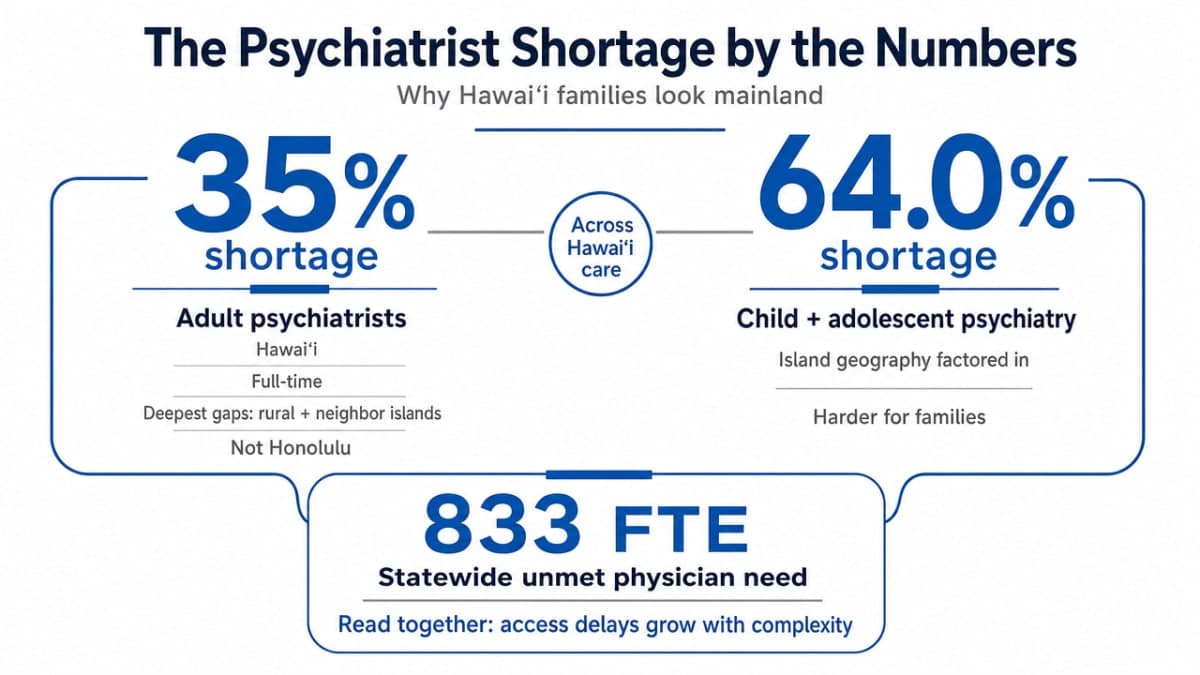
The Psychiatrist Shortage by the Numbers
You are not imagining the wait times. The state’s own data shows exactly why appointments for a psychiatric evaluation stretch out over months, and why a complex case can end up on a waitlist that outlasts the crisis.
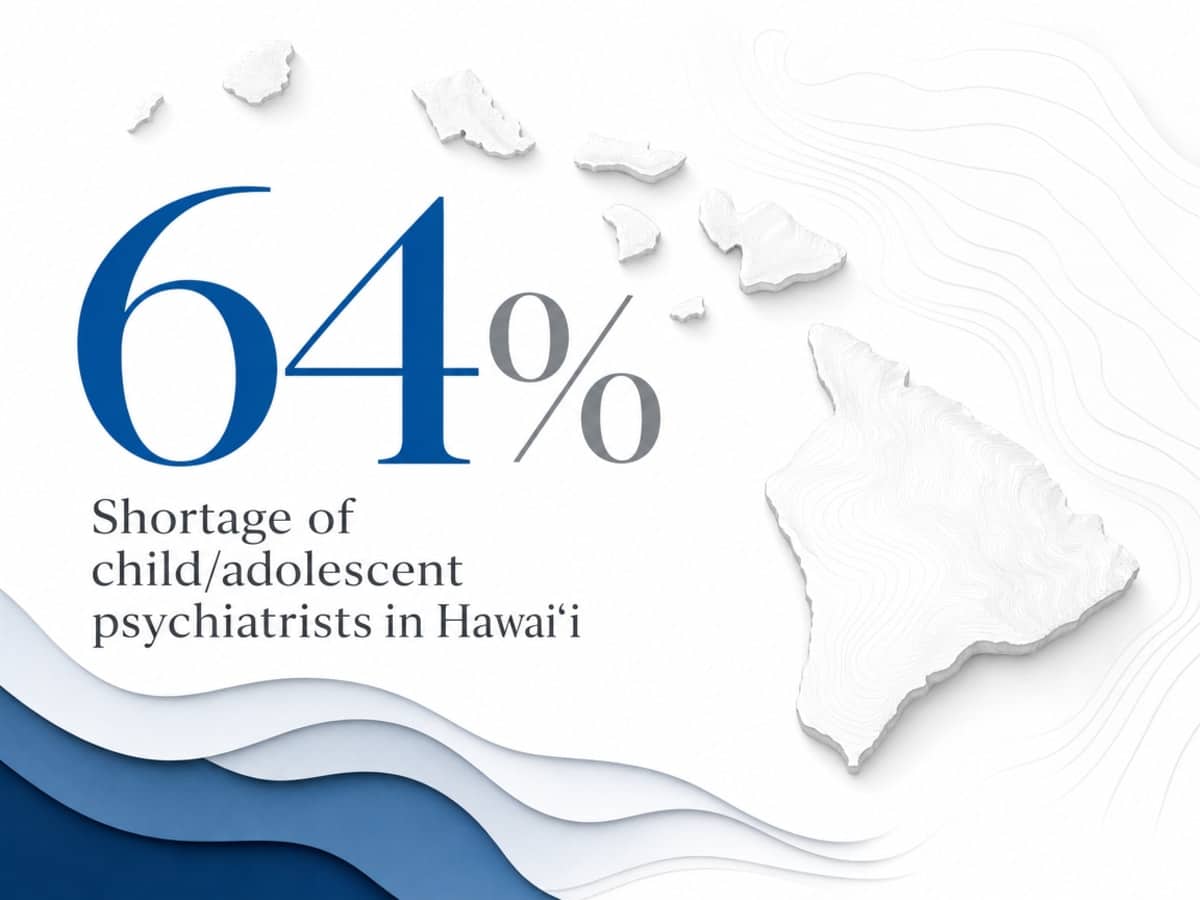
The 2025 State of Well-Being Landscape Assessment estimates that Hawaiʻi has a 35% shortage of full-time adult psychiatrists, with the deepest gaps on rural and neighbor islands rather than in Honolulu 9. For families whose loved one is a teenager or child, the picture is harder. The 2026 Physician Workforce annual report calculates a 64.0% shortage in child and adolescent psychiatry once island geography is factored in, alongside a statewide unmet physician need of 833 full-time equivalents 4.
Read those numbers together and the pattern is clear. When you call around Oʻahu and hear “our next intake is in four months,” or when Hilo has one specialist for a whole side of the island, that is not bad luck. That is the shortage showing up in your week. And for a treatment-resistant case that has already cycled through two or three medication trials, the specialists who could actually help may not have an open chair anywhere in the state.
What This Looks Like on Kauaʻi, Maui, and Hawaiʻi Island
If you live on a neighbor island, you already know the drill. The Hawaiʻi Department of Health has formally identified mental health shortage areas across Hawaiʻi County, Maui County, Kauaʻi County, and parts of the City and County of Honolulu 6. Every county on that list, not just the rural ones.
In practice, that means a family on Kauaʻi may be told the nearest inpatient psychiatric bed is on Oʻahu. A family in Kona may fly to Honolulu for a single medication consult, then fly home the same day. A parent on Maui looking for a child psychiatrist who takes their insurance may hear the same three names from every referral source — and each of those names is booked into next quarter.
Inter-island travel becomes a routine part of care long before mainland travel enters the conversation. So when the discharge planner or the outpatient psychiatrist says the next step is on the continent, it is often because the Oʻahu options have already been tried, or because the specific level of care — a specialized dual diagnosis program, a treatment-resistant schizophrenia unit — does not exist on any island. You did not skip a step. The step is not there.
The In-State System Is Trying — and That Still May Not Be Enough for Your Case
None of this is because Hawaiʻi is standing still. The Adult Mental Health Division and the Child and Adolescent Mental Health Division are actively working to close vacancy rates, and the State Council on Mental Health has flagged workforce capacity as the foremost cross-cutting constraint affecting nearly every part of the behavioral health continuum 7, 8.
There is real expansion underway too. Hawaiʻi was selected for the SAMHSA Certified Community Behavioral Health Clinic Medicaid demonstration program in 2026, building on a planning grant that started in December 2024, with two Adult Mental Health Division clinics on Maui expected to certify by January 2027 11, 13. Over time, that will widen the front door for a lot of people.
Over time is the phrase that matters, though. If your loved one needs a specialized treatment-resistant or dual diagnosis program right now, the in-state expansion timeline and your family’s timeline are not the same timeline. Looking mainland is not giving up on Hawaiʻi. It is meeting the calendar you actually have.
What Mainland Care Actually Means for a Hawaiʻi Family
The Cases Where a Flight Becomes the Right Call
Not every psychiatric situation calls for mainland care. A lot of what Hawaiʻi families need — an SSRI adjustment, weekly therapy, a short inpatient stabilization — can be handled locally, and should be.
The flight becomes the right call when the case has already outgrown what any island program is set up to handle. That usually looks like one of a few patterns: a young adult with schizophrenia who has cycled through two or three antipsychotics without real improvement, and now needs a clozapine trial with the labs and monitoring that go with it. Or a parent with rapid-cycling bipolar disorder whose last three admissions ended the same way — stabilized, discharged, decompensated within weeks. Or a teenager with severe treatment-resistant depression and self-harm behaviors who has been on a child psychiatrist waitlist since spring. Or someone with a serious mental illness and a substance use disorder that keep feeding each other, where treating one without the other has stopped working.
Hawaiʻi Medicaid recognizes this population. Adult QUEST Integration members age 21 or older with serious and persistent mental illness can access additional behavioral health services through the Community Care Services program, which is designed for exactly this level of complexity 3. When even that program cannot match a specific specialty need on-island, the plan is obligated to look further, including off-island or out-of-state when telehealth is not a real substitute 1.
Naming the Hard Part: Ohana, Distance, and Five Time Zones
Let’s say the quiet part out loud. Sending your person to the mainland means someone in your ohana is going to be five time zones from the people who love them, on a continent they may not know, at a moment when they are already fragile. That is not a small thing. In Hawaiʻi, family is not a scheduling category — it is the treatment plan you have been running for years.
You are allowed to grieve the trip before you take it. You are allowed to be angry that a state you love does not have the specialist your kid needs. Both of those feelings are accurate, and neither of them means you are making the wrong choice.
Insurance, Medicaid, and the Coverage Most Families Don’t Know to Ask About
Hawaiʻi Medicaid’s Off-Island and Out-of-State Rules
Here is the sentence most Hawaiʻi families never hear until they go looking for it: if the psychiatric care your loved one needs is not available on the island where they live, and telehealth is not a real substitute, the Med-QUEST behavioral health plan is obligated to arrange that care off-island or out-of-state — and to cover the travel that goes with it 1. That is not a favor. That is written into the state’s own procurement language.
Chapter 16 of the Med-QUEST provider manual spells out what “the travel that goes with it” can actually include. For a recipient traveling inter-island or out-of-state for a covered service, Medicaid may cover transportation, meals, and lodging — and, subject to written justification, the same categories for one attendant or escort so the member is not flying alone 2. For a parent thinking about putting a fragile teenager on a five-hour flight to the mainland, that attendant provision is often the difference between a plan you can live with and a plan you cannot.
Two things matter as you read this. First, the coverage is not automatic — the plan has to determine the service is not available locally and telehealth is not feasible, and the attendant piece requires written justification. Second, you cannot use what you do not know exists. Ask by name.
Commercial Insurance, Parity, and Your Right to Out-of-State Care
If your family is on employer-sponsored insurance or a marketplace plan instead of Medicaid, the rules look different but the underlying principle is similar: your plan cannot make mental health care harder to actually reach than comparable medical care.
Federal parity law, the Mental Health Parity and Addiction Equity Act, requires health plans to apply the same standards to mental health and substance use benefits that they apply to medical and surgical benefits. CMS has been explicit that geographic limits, facility-type limits, and network adequacy can themselves count as treatment limitations subject to parity review 15. Translated into plain English: if your plan’s in-state psychiatric network cannot actually deliver the specialty care your loved one needs in a reasonable time, the plan’s response cannot simply be “tough, that is what our network offers.”
For families with children on Medicaid managed care, CMS guidance is even more direct. Under SHO # 24-005, states and managed care plans are expected to have clear procedures for accessing out-of-network and out-of-state providers when a child’s mental health needs cannot be met in network 16. Medicaid’s own parity resources reinforce that these obligations are enforceable, not aspirational 14.
You do not have to argue the law with your plan. You do have to know it exists so you can ask the right questions and, if needed, request a formal review of a denial.
Questions to Ask Your Plan Before the First Deposit
Before you wire any money or sign an admissions agreement, get answers to a short list of questions in writing. A phone rep’s verbal “yes” will not hold up when the first claim is processed.
Ask your plan:
- Is the mainland facility in-network, and if not, will you cover it as a single-case agreement or out-of-network exception because the specialty care is not available in Hawaiʻi?
- What is my out-of-pocket maximum for this benefit year, and does it reset if treatment crosses into January?
- How many days of residential or inpatient psychiatric treatment are authorized before the next review, and who conducts that review?
- What is the process to appeal a denial, and how fast?
If you are on QUEST Integration, add these:
- Does this request qualify under the off-island/out-of-state provisions 1?
- Will the plan coordinate transportation, lodging, and meals per Chapter 16, and can one attendant travel with the member 2?
Get the case manager’s name and a direct line. Write down the reference number for the call. You are going to need both.
The Mainland Admissions Sequence, Step by Step
From First Call to Boarding Pass: An Operational Timeline
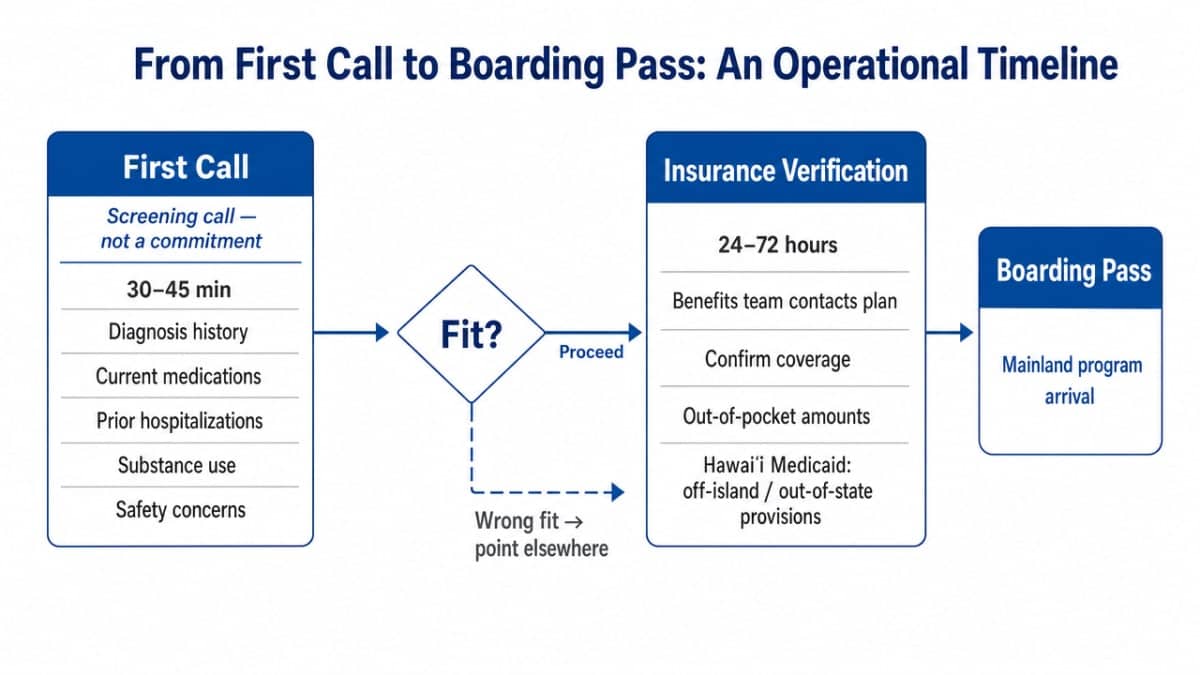
The most common thing families tell us after the fact is that they wish someone had drawn the whole thing on one page before they started. So here it is, in order, from the first phone call to the moment your loved one actually walks through the door of a mainland program.
- Screening call. The first call is a screening call, not a commitment. A good admissions team asks about diagnosis history, current medications, prior hospitalizations, substance use, and safety concerns — usually 30 to 45 minutes. If the fit is wrong, they should say so and point you elsewhere.
- Insurance verification, typically 24 to 72 hours, where the program’s benefits team contacts your plan directly to confirm coverage, out-of-pocket amounts, and — for Hawaiʻi Medicaid members — whether the request qualifies under the off-island/out-of-state provisions the plan is obligated to consider when local specialty care is not available 1.
- Clinical intake. A licensed clinician reviews records from your current providers, talks with your loved one directly when possible, and confirms medical clearance.
- Travel coordination. If your family is on Medicaid managed care with a child or youth, the plan’s out-of-network and out-of-state procedures are supposed to already exist for exactly this scenario 16.
- Arrival, the first 72 hours of stabilization, a family communication cadence set in writing, and — starting the same week — step-down planning for the return to Hawaiʻi.
Two to seven days from first call to boarding pass is realistic when the case is straightforward. Longer when insurance pushes back or records are slow to arrive. Ask for the timeline in writing.
Travel Day and the First 72 Hours
Travel day is the part families dread most, and it is usually not as bad as the anticipation. If your loved one qualifies for a Medicaid-covered attendant, one family member or approved escort can travel with them on the flight, with transportation, meals, and lodging coordinated through the plan subject to written justification 2. For commercial insurance, some programs will send a clinical escort or coordinate with a specialized medical travel service — ask.
Pack lightly. Photo ID, insurance cards, a list of current medications with doses, a small comfort item, and any recent labs or discharge summaries in a folder you can hand to intake. Programs will supply most of the rest.
The first 72 hours on the mainland are quieter than you expect. Your loved one meets the psychiatrist, has a physical, gives blood, sleeps, eats. Big treatment decisions — a clozapine trial, a new mood stabilizer — usually wait a few days while the team observes a baseline. If it feels slow, that is on purpose.
Staying Connected Across Five Time Zones
Hawaiʻi to Arizona is a three-hour difference in summer and two in winter — enough to matter, not enough to break the routine. The trick is agreeing on the cadence before your person leaves.
Ask the program for three things in writing:
- A weekly clinical update from the treatment team,
- A set window for patient phone or video calls that works for Hawaiʻi evenings, and
- A named point of contact for questions in between.
Weekly family therapy sessions by video are standard at most residential programs and should be scheduled at a time that respects your workday, not just theirs.
Send letters. Send photos of the dog, the yard, the grandkids. Small, ordinary updates from home do more clinical work than most families realize — they remind your loved one what they are getting better for.
One Mainland Option Built for Cases Other Programs Decline
By this point in your search, you have probably talked to a few mainland programs that either could not take a complex case or would not commit to how they would handle it. That is worth naming. Not every facility with a nice website is built for treatment-resistant schizophrenia, rapid-cycling bipolar disorder, or a dual diagnosis where the mental health and substance use pieces have to be treated at the same time.
ViewPoint Dual Recovery in Prescott, Arizona is one mainland option built specifically for the cases other programs consider too complex. It is Joint Commission-accredited, with 24/7 board-certified psychiatry, advanced medication management including clozapine protocols, and an integrated care team where psychiatrists and therapists work the same case together rather than in parallel. Treatment length is set by clinical need, not an insurance calendar.
For a Hawaiʻi family, the practical piece is the admissions process itself: one call to start, insurance verification handled directly with your plan — including Med-QUEST off-island and out-of-state provisions when they apply 1 — and a family update cadence agreed on before your loved one boards the flight.
Planning the Return to Hawaiʻi Before You Ever Leave
The best mainland admissions conversations spend real time on discharge before your loved one has even boarded the flight. That sounds backwards until you think about it: the whole point of leaving is to come home.
Ask the mainland program three questions during intake:
- Who on the treatment team owns the step-down plan, and when do they start working on it?
- What Hawaiʻi-based outpatient psychiatrist, therapist, or intensive outpatient program will pick up prescribing and therapy after discharge?
- If the medication plan includes clozapine or another regimen that needs regular labs, who on-island will run those labs and adjust doses?
Your Med-QUEST case manager belongs in this conversation too. The same off-island coordination that got your person to the mainland is supposed to help bring them back, and continuity of care after a specialty stay is part of what the plan is set up to arrange 1. If a Community Care Services enrollment fits your adult loved one’s diagnosis, get that referral started while they are still in treatment, not the week they land at Honolulu 3.
Coming home well is a plan, not a hope.
A Note for Discharge Planners and Hospital Case Managers
If you are reading this on behalf of a patient rather than a family member, the scope shifts a little. You already know the referral pathways on your island. What tends to get lost in a busy discharge is the Med-QUEST language that can move a case forward when the family stalls out.
Start Your Path to Advanced Mainland Care
Connect with experts to clarify your next steps for mainland psychiatric treatment.
Frequently Asked Questions
Will Hawaiʻi Medicaid cover travel to a mainland psychiatric program?
It can, when the specialty care is not available on your home island and telehealth is not a real substitute. The Med-QUEST behavioral health plan is obligated to arrange off-island or out-of-state services in that situation, and Chapter 16 authorizes transportation, meals, and lodging for the member 1, 2. Ask your case manager to document the determination in writing.
Can a family member fly with my loved one as an attendant?
Yes, in many cases. Chapter 16 of the Med-QUEST provider manual allows Medicaid to cover transportation, meals, and lodging for one attendant or escort traveling inter-island or out of state, subject to written justification 2. Ask your case manager how to submit that justification, and request it before you book anything so the coverage is confirmed.
Does commercial insurance have to cover out-of-state psychiatric care?
Federal parity law requires plans to apply the same standards to mental health benefits that they apply to medical benefits, and CMS has said geographic limits and network adequacy can themselves be treatment limitations under review 15, 14. If your in-state network cannot deliver the specialty care in a reasonable time, ask for a single-case agreement or out-of-network exception.
How do we stay in contact with a five-time-zone difference?
Hawaiʻi to the mainland is two to three hours depending on season, which is workable with a written plan. Ask the program for scheduled patient calls in Hawaiʻi-evening windows, a weekly clinical update from the treatment team, weekly video family therapy, and a named point of contact between sessions. Photos and letters from home matter more than families expect.
What happens when it’s time to come back to Hawaiʻi?
Discharge planning should start the week your loved one arrives, not the week they leave. The mainland team lines up a Hawaiʻi outpatient psychiatrist, therapist, and any needed labs before travel home. Your Med-QUEST case manager can help coordinate the return, and adults with serious mental illness may qualify for Community Care Services to pick up ongoing support 3.
Is leaving the islands a sign the local system failed us?
No. It is a sign the specialty care your loved one needs is not currently stationed on your island. State reports name workforce capacity as the foremost cross-cutting constraint across Hawaiʻi’s behavioral health continuum 8. The people inside the system see the gap you see. Going mainland is meeting the calendar your family actually has, not a verdict on anyone.
References
- RFP–MQD–2026-001 Med-QUEST Division … – Hawaii.gov. https://medquest.hawaii.gov/content/dam/formsanddocuments/resources/solicitations-and-contract/2026/CCS_RFP_2026-001%20includes%20Amendment%201.pdf
- Chapter 16 Medicaid Provider Manual – Med-QUEST. https://medquest.hawaii.gov/content/dam/formsanddocuments/resources/Provider-Resources/provider-manuals/PMChp16.pdf
- QUEST Integration Benefits – Hawaii Medicaid. https://medquest.hawaii.gov/content/medquest/en/members-applicants/quest-integration-coverage/medical-benefits.html
- Act 18, SSLH 2009, 2026 Physician Workforce annual report. https://www.hawaii.edu/govrel/docs/reports/2026/act18-sslh2009_2026_physician-workforce_annual-report_508.pdf
- Act 18, SSLH 2009, 2025 Physician Workforce annual report. https://www.hawaii.edu/govrel/docs/reports/2025/act18-sslh2009_2025_physician-workforce_annual-report_508.pdf
- Hawaii Health Professional Shortage Areas. https://www.health.hawaii.gov/opcrh/files/2020/08/Hawaii-Health-Professional-Shortage-Areas.pdf
- Final-SCMH-2025-Report-to-the-Governor-and-Legislature-.pdf. https://health.hawaii.gov/opppd/files/2025/09/Final-SCMH-2025-Report-to-the-Governor-and-Legislature-.pdf
- December 31, 2025 The Honorable Ronald D. Kouchi, President …. https://health.hawaii.gov/opppd/files/2025/12/AMHD_SCMH-AR-to-2026Leg_sub-20251231.pdf
- 2025 State of Well-Being Landscape Assessment Report. https://owr.hawaii.gov/wp-content/uploads/2026/01/SOWB_LandscapeAssessment_2026_01.pdf
- New behavioral health dashboard to help improve care, …. https://www.hawaii.edu/news/2021/05/10/behavioral-health-dashboard/
- HAWAIʻI SELECTED FOR BEHAVIORAL HEALTH CLINIC …. https://health.hawaii.gov/news/newsroom/hawai%CA%BBi-selected-for-behavioral-health-clinic-medicaid-demonstration-program/
- Cooperative Agreements for Certified Community …. https://www.samhsa.gov/grants/grant-announcements/sm-26-016
- ccbhc-demonstration-application-2026.pdf. https://www.samhsa.gov/sites/default/files/ccbhc-demonstration-application-2026.pdf
- Parity. https://www.medicaid.gov/medicaid/benefits/behavioral-health-services/parity
- The Mental Health Parity and Addiction Equity Act (MHPAEA). https://www.cms.gov/marketplace/private-health-insurance/mental-health-parity-addiction-equity
- SHO # 24-005: Best Practices for Adhering to Early and Periodic …. https://www.medicaid.gov/federal-policy-guidance/downloads/sho24005.pdf